Introduction
Filarial worms are considered an economic problem and a significant health threat for both humans and animals (Laaksonen et al., Reference Laaksonen, Kuusela, Nikander, Nylund and Oksanen2007; Taylor et al., Reference Taylor, Hoerauf and Bockarie2010). Setaria nematodes belong to the Filarioidea superfamily and are parasites of different ungulates. At least four species of this superfamily are present in Europe, including Poland: Setaria cervi, Setaria tundra (Demiaszkiewicz et al., Reference Demiaszkiewicz, Kuligowska, Pyziel and Lachowicz2015), Setaria labiatopapillosa (Demiaszkiewicz et al., Reference Demiaszkiewicz, Lachowicz and Kabrowiak2007) and Setaria equina (Gawor, Reference Gawor1995).
Different species of mosquitoes, mostly from Aedes genus, act as a vector of these parasites (Anderson, Reference Anderson2000), the gradations of which might be linked with climate warming (Genchi et al., Reference Genchi, Rinaldi, Mortarino, Genchi and Cringoli2009; Laaksonen et al., Reference Laaksonen, Pusenius, Kumpula, Venäläinen, Kortet, Oksanen and Hoberg2010). Geographical expansion of Setaria worms may be indirectly related to wet and warm summers due to the abundance of intermediate hosts but also to the high density of possible definitive hosts as well as wild and domesticated ungulates. The focus of attention has been recently on S. tundra as it is widening its range far to the South. However, little is known about the presence of S. cervi, another parasite of deer species, in the wild. Although S. cervi became a model species for anti-filarial drugs and treatment methods decades ago (Singhal et al., Reference Singhal, Chandra, Chawla, Gupta and Saxena1969), not much is known about its presence in the wild. Known definitive hosts of S. cervi are: the moose (Alces alces), the red deer (Cervus elaphus), the sika deer (Cervus nippon), the Asian wapiti (Cervus elaphus sibirica), the muntjac (Cervus muntjac), the chital (Axis axis), the fallow deer (Dama dama) (Yeh, Reference Yeh1959; Wang et al., Reference Wang, Tung and Lee1990; Anderson, Reference Anderson2000) but also cattle; Bos taurus (Baqui and Ansari, Reference Baqui and Ansari1976; Sundar and D'Souza, Reference Sundar and D'Souza2015) and Bubalus bubalus (Almeida et al., Reference Almeida, Deobhankar, Bhopale, Zaman and Renapurkar1991). Infection with S. cervi can lead to pathological changes in the central nervous system in definitive hosts (Blažek and Dykova, Reference Blažek, Dyková and Páv1968; Wang et al., Reference Wang, Tung and Lee1990). Literature regarding this species in Europe is scant and mostly older than 50 years (Blažek and Dykova, Reference Blažek, Dyková and Páv1968) that is dated before the systematics of Setaria worms was established. Moreover, as methods of describing Setaria worms based on light microscopy carry a significant risk of misinterpretation (Yeh, Reference Yeh1959), it seems that molecular analysis is essential (Alasaad et al., Reference Alasaad, Pascucci, Jowers, Soriguer, Zhu and Rossi2012).
Setaria tundra, another filarial nematode, has recently expanded its geographical range by hundreds of kilometres and is known to be a major cause of the mass falling of wild and semi-domesticated reindeer in Fennoscandia (Laaksonen et al., Reference Laaksonen, Kuusela, Nikander, Nylund and Oksanen2007, Reference Laaksonen, Solismaa, Kortet, Kuusela and Oksanen2009a). Since 2010, S. tundra has also been reported in Poland (Bednarski et al., Reference Bednarski, Piasecki, Bednarska and Sołtysiak2010). Its main host is the roe deer (Kowal et al., Reference Kowal, Kornaś, Nosal, Basiaga and Lesiak2013; Demiaszkiewicz et al., Reference Demiaszkiewicz, Kuligowska, Pyziel and Lachowicz2015; Tomczuk et al., Reference Tomczuk, Szczepaniak, Grzybek, Studzińska, Demkowska-Kutrzepa, Roczeń-Karczmarz, Łopuszyński, Junkuszew, Gruszecki, Dudko and Bojar2017) yet the moose can serve as an asymptomatic carrier (Demiaszkiewicz et al., Reference Demiaszkiewicz, Kuligowska, Pyziel and Lachowicz2015). Moreover, microfilariae of S. tundra has been detected in Aedes vexans, Ochlerotatus caspius, Culex pipiens and Culex torretium mosquitoes in SW and Central Poland (Rydzanicz et al., Reference Rydzanicz, Lonc, Masny and Golab2016; Masny et al., Reference Masny, Rożej-Bielicka and Gołąb2013) as well as in Hungary (Kemenesi et al., Reference Kemenesi, Kurucz, Kepner, Dallos, Oldal, Herczeg, Vajdovics, Bányai and Jakab2015; Zittra et al., Reference Zittra, Kocziha, Pinnyei, Harl, Kieser, Laciny, Eigner, Silbermayr, Duscher, Fok and Fuehrer2015) and Germany (Czajka et al., Reference Czajka, Becker, Poppert, Jöst, Schmidt-Chanasit and Krüger2012; Kronefeld et al., Reference Kronefeld, Kampen, Sassnau and Werner2014). According to the literature, the red deer (C. elaphus) is considered as a definitive host for only one member of Setaria genus – the S. cervi (Yeh, Reference Yeh1959; Anderson, Reference Anderson2000).
The main aim of our study was to report for the first time S. tundra in the red deer (C. elaphus) in Poland. We also examine the phylogenetic position of the newly-found Setaria nematodes (S. tundra and S. cervi) based on sequences of the mitochondrial cytochrome c oxidase subunit 1 (COX-1) gene.
Methods
Sample collection
Nematodes were collected from 11 red deer harvested during the seasonal cull close to Opole city and Szczedrzyk village, near Turawskie Lake (SW Poland, 50°41′39.5″N 18°05′38.8″E), between September and December in 2017. The study area comprised of managed forests and fields. Managed forests consist of pine trees (Pinus sylvestris) with the addition of deciduous tree species (birch, alder, elm and oak) and are inhabited by a range of wild mammal species indigenous to the region (roe deer, wild boar, fallow deer, hare, red fox, badger, European beaver and many smaller species). Collected Setaria nematodes from the red deer were washed with water, sterilized and kept in 70% ethanol until DNA extraction.
Preparation of material for SEM microscopy
The biological material was fixed with 2.5% glutaraldehyde cacodylic buffer and incubated overnight, then washed in 0.1 M cacodylic buffer (pH 7.2). Afterwards, the material was postfixed in 1% OsO4 in ddH2O for 3 h and washed three times in ddH2O. After postfixation samples were dehydrated through a graded series of EtOH (50% – 10 min, 70% – 24 h, 90% – 10 min, 96% – 10 min) and dried on the Critical Point Drying System (POLARON, the UK). Next, dry samples were mounted on aluminium stubs in different positions and coated with gold with the use of a sputter coater (POLARON SC7620, the UK) and were examined in LEO 1430VP scanning electron microscope produced by Zeiss.
DNA extraction, PCR and sequencing of the mitochondrial COX-1 gene
Genomic DNA was extracted from each of the Setaria worms using DNeasy Blood & Tissue Kit (Quigen, Hilden, Germany) and stored at −20 °C. Primers and cycling conditions used in this study were described previously (Casiraghi et al., Reference Casiraghi, Anderson, Bandi, Bazzocchi and Genchi2001). Detection and genotyping of nematodes were performed by amplification and sequencing of COX-1 gene fragment (690 bp). Dirofilaria repens DNA extracted from the cat was used as a positive control (Bajer et al., Reference Bajer, Rodo, Mierzejewska, Tołkacz and Welc-Faleciak2016). Amplicons were visualized with Midori Green stain (Nippon Genetics Europe GmbH) following electrophoresis in 1.5% agarose gels. Amplicons were purified and sequenced by a private company (Genomed S.A., Poland) in both directions.
Phylogenetic analysis
Obtained nucleotide sequences were analysed using BLAST NCBI and MEGA v. 7.0 software (Kumar et al., Reference Kumar, Stecher and Tamura2016) for sequence alignment, species typing and phylogenetic relationships. After testing the data for the best substitution model, phylogenetic trees were obtained using Maximum Likelihood as the tree construction method and Tamura 92 + G parameter algorithm as a distance method. By comparison, sequences of Setaria spp. obtained from GenBank (https://www.ncbi.nlm.nih.gov) were implemented in the sequence alignment. The stability of inferred phylogenies was assessed by bootstrap analysis of 1000 randomly generated sample trees.
New nucleotide sequences
New nucleotide sequences have been deposited in GenBank NCBI with the accession numbers: MK360913, MK360914 and MK360915.
Results
Red deer examination
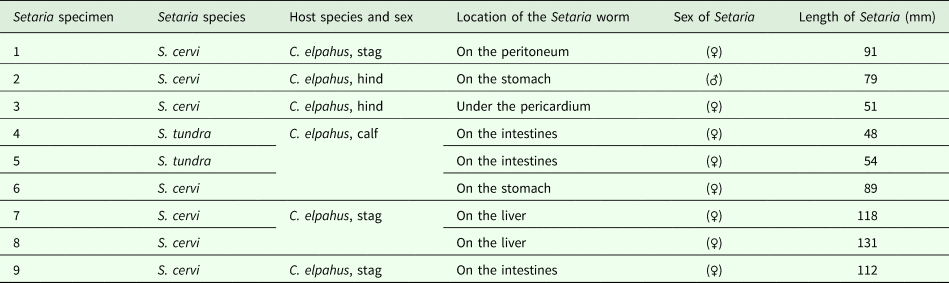
Out of 11 examined specimens of the red deer, eight were infested with Setaria worms (73%). Intensity of infestation of Setaria nematodes ranged from one to three per deer (Table 1). Nine out of 14 of adult Setaria worms were located under the peritoneum: on stomach, intestines and liver; one specimen was located directly on a heart muscle under pericardium. Five nematodes were calcified and/or encysted on the surface of the liver or stomach. Only alive worms (n = 9) were collected for further molecular and microscopic analysis.
Precise information on collected Setaria worms

SEM microscopy analysis
Although most studies regarding Setaria are supported with light microscopy pictures analysis, it is the images obtained from the electron microscopy which allow for precise morphological analysis. Our first step was to observe crucial morphological features with SEM microscopy.
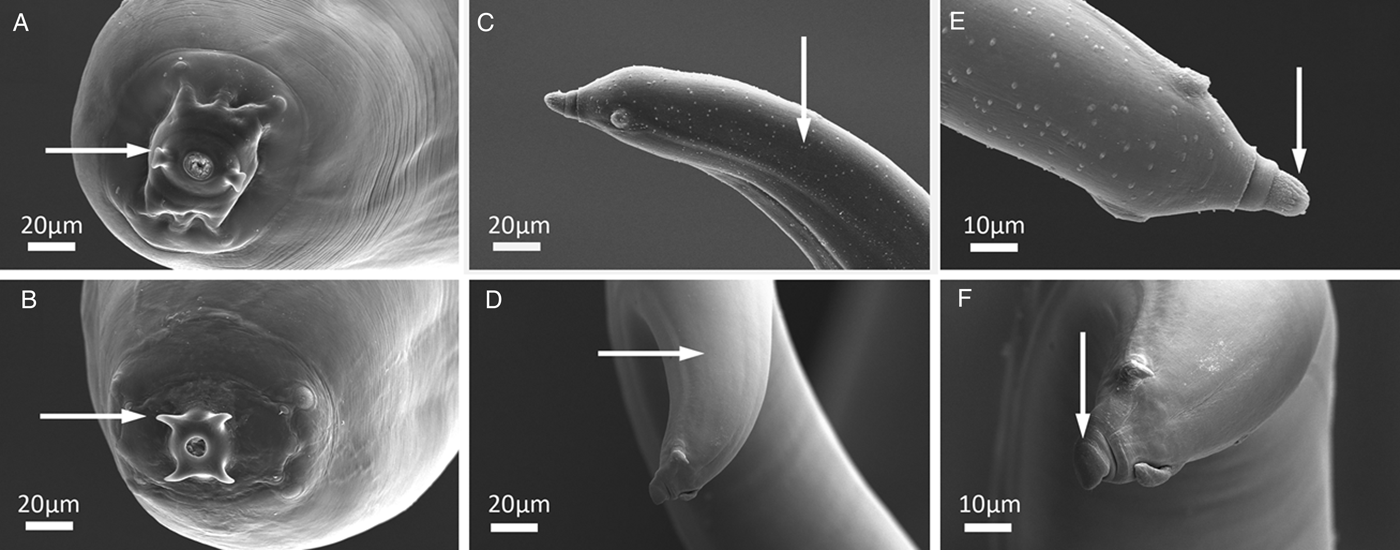
Pictures taken with SEM microscopy allowed to distinguish males from females as well as pointed out species-specific features of analysed nematodes which are shown in Fig. 1.
Key morphological structures of posterior and anterior ends of (♀) of collected Setaria tundra (upper row) and Setaria cervi (lower row) worms.

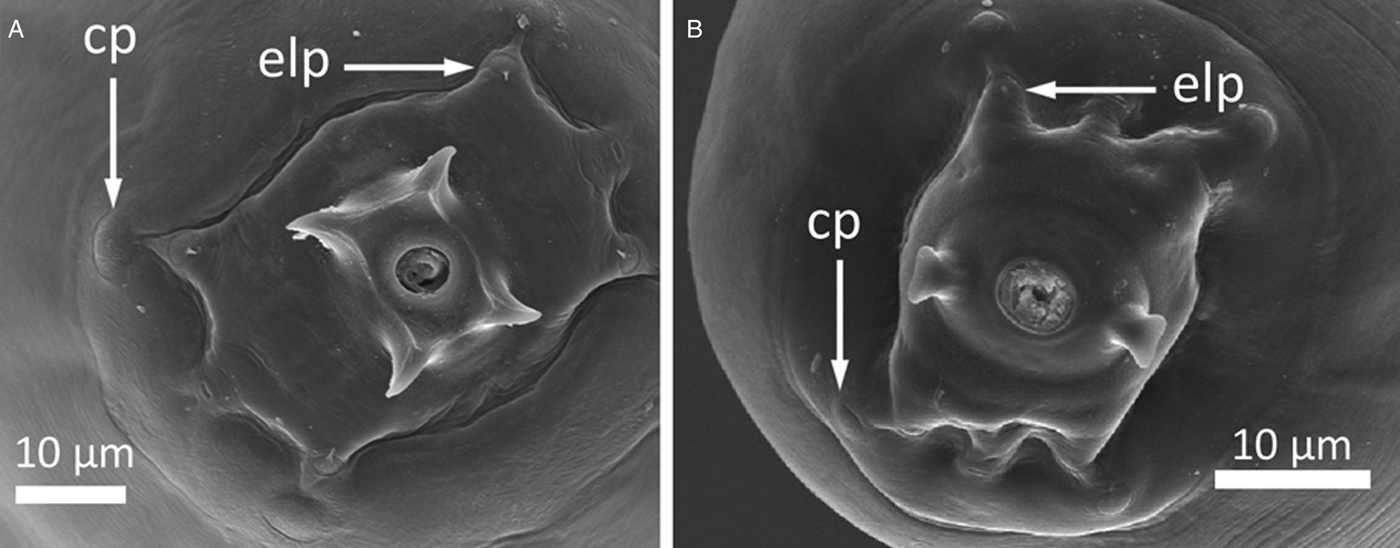
The biggest difference between collected species is the shape of bifid projections around the oral opening on the cephalic region. In S. tundra there are two, rather small, opposite, clearly separated bifid projections protruding from the oval peribuccal crown (Fig. 1A), while in S. cervi the whole peribuccal crown is elevated and possesses four sharp-ended bifid projections which take a shape of a four-pointed star (Fig. 1B). The next two significant differences are clearly visible on the posterior end. Firstly, the surface of S. cervi is smooth (Fig. 1D), while in S. tundra there are numerous small papillae from each side (Fig. 1C). Secondly, the bud-like knob at the end of the tail in male S. tundra (Fig. 1E) is clearly separated from the rest of the tail by annular narrowing and much different than the one in S. cervi which is much shorter, smoother and blunt-ended with caudolateral appendages located closer to the end of the tail (Fig. 1F). Other features, such as four bigger cephalic papillae and four smaller extrenolabial papillae in the cephalic region, are visible in only one of two S. tundra specimen, while in S. cervi they are visible in all collected specimens. However, they look almost identical in both species (Fig. 2).
Posterior ends of (♀) of collected Setaria cervi (A) and Setaria tundra (B) with similar cephalic papillae (cp) and externolabial papillae (elp).

Phylogenetic analysis
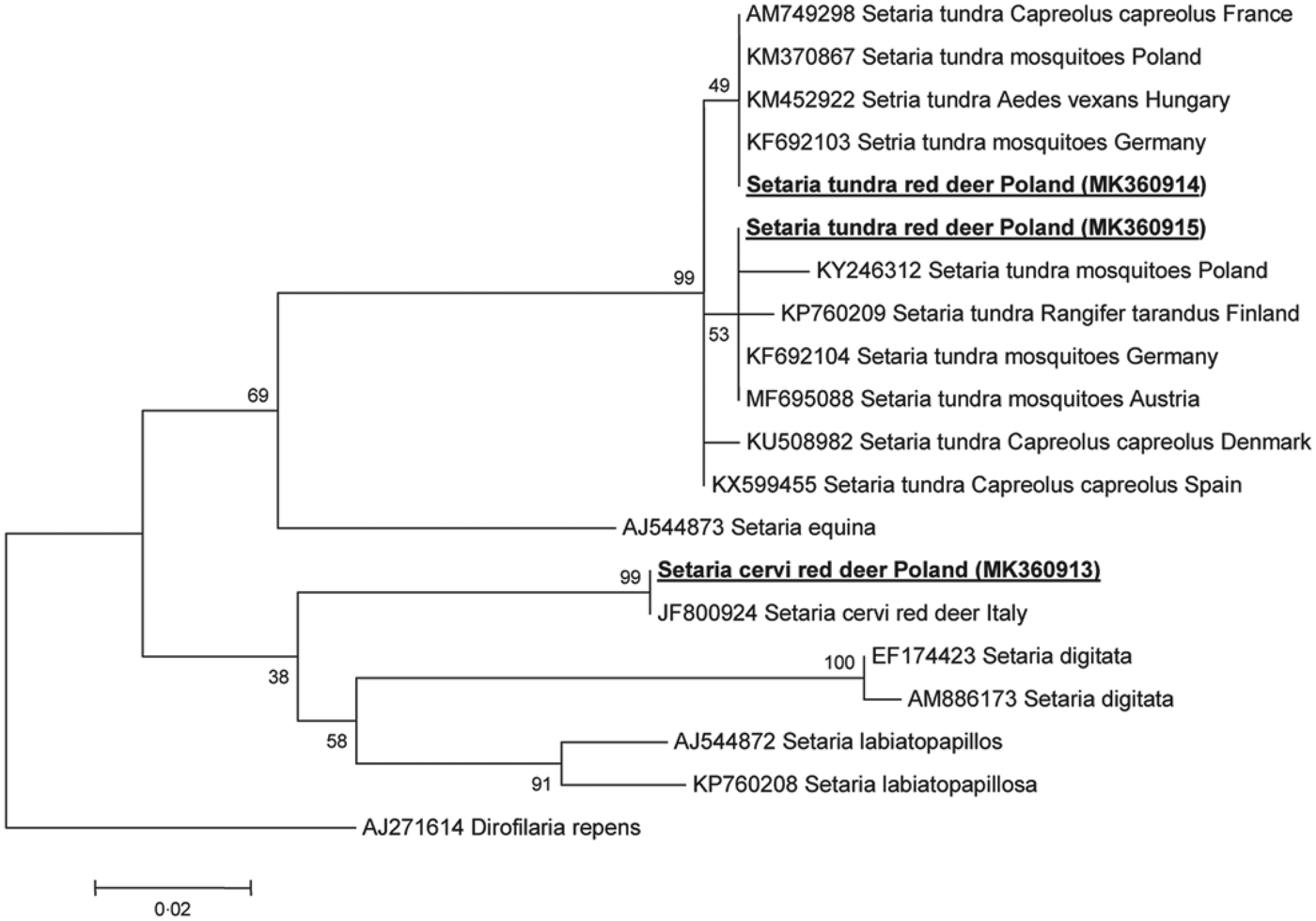
The 689 bp fragment of the COX-1 gene was analysed in nine isolates. Seven of nine sequences (78%) were identical and have shown 100% sequences homology with S. cervi originally isolated from the red and roe deer in Italy (JF800924) (Fig. 3). The nucleotide identity/similarity of the sequenced COX-1 fragments of further two isolates (22%) was very high (99.6%) and differed three nucleotides at position 705 (A→T), 708 (T→C) and 921 (G→A) [number corresponds to the nucleotide positions relative to the sequence of the COX-1 (1647 bp) of S. digitata mitochondrion, complete genome (GU138699)]. The nucleotide sequences of these isolates were identical to S. tundra found on mosquitoes in Germany (KF692103 and KF692104, respectively) and closely related to other S. tundra isolated initially from the roe deer in France (AM749298), Denmark (KU508982) and Spain (KX599455), from the reindeer in Finland (KP760209), as well as from mosquitoes in Hungary (KM45922) and Poland (KM370867) (Fig. 3).
Phylogenetic tree [maximum likelihood (ML)] of the Setaria isolates identified in the red deer from southwest Poland and selected isolates from GenBank, based on a fragment of the COX-1 gene. The numbers at the nodes of the tree indicate bootstrap values (1000 replicates). The accession number of the newly reported sequence in this study is in bold and underlined.

Species of Setaria detected in the study
Species typing was performed on the basis of the sequencing of COX-1 gene fragment (~690 bp) and SEM microscopy analysis. Alignment and phylogenetic analyses, as well as microscopic analysis, revealed the presence of two Setaria species: S. cervi and S. tundra. Setaria tundra was noted in only one individual, a calf of the red deer particularly, while S. cervi was observed in three stages, two hinds and one calf of the red deer. The coinfection of two Setaria species was detected only in the case of the red deer calf (Tab. 1).
Discussion
This is the first time when the results of our study have revealed the S. tundra infection in the red deer. The nematodes were identified by the microscopic and molecular analysis. The phylogenetic studies have shown that our isolates were closely related to S. tundra and S. cervi, respectively, originally isolated from the roe deer or reindeer as well as from mosquitoes in Europe.
According to recent findings (Favia et al., Reference Favia, Cancrini, Ferroglio, Casiraghi, Ricci and Rossi2003; Angelone-Alasaad et al., Reference Angelone-Alasaad, Jowers, Panadero, Pérez-Creo, Pajares, Díez-Baños, Soriguer and Morrondo2016) it is possible that the outbreak route of S. tundra was from South to the North of Europe; however, it stands in contraction with the chronology of the detection of this parasite in various parts of Europe. Its main, definitive host is the reindeer (Rangifer tarandus) in the North (Laaksonen et al., Reference Laaksonen, Solismaa, Kortet, Kuusela and Oksanen2009a, Reference Laaksonen, Solismaa, Orro, Kuusela, Saari, Kortet, Nikander, Oksanen and Sukura2009b), while the roe deer (Capreolus capreolus) further South (Enemark et al., Reference Enemark, le Fèvre Harslund, Oksanen, Chriél and Al-Sabi2011). The moose (A. alces) can serve as an asymptomatic carrier (Demiaszkiewicz et al., Reference Demiaszkiewicz, Kuligowska, Pyziel and Lachowicz2015). These were three cervid species known to harbour S. tundra. We proved that it has now expanded its host range with the red deer. In Poland, the red deer is found throughout the entire country and, with approximately 286 000 individuals (data for 2017, Agricultural Property Agency, Directorate General of the State Forests and the Polish Hunting Association), represents one of the most numerous game mammals. By the same token, it prevails in most European countries (Burbaitė and Csányi, Reference Burbaitė and Csányi2010); thus we can expect further expansion of S. tundra in Central Europe.
Although there are more than one hundred publications on anti-filarial drugs, treatment methods and/or filarial antibodies with S. cervi as a model species, the literature about its biology and presence in wild hosts as well as any reports supported with molecular data are scarce. Out of 15 accessions available in GenBank, only one has been from Europe so far, and other, except one, come from Asia where two other, similar species occurred: S. digitata and S. labiatopapillosa. As of today, the literature regarding the presence of S. cervi in the wild provides very little information. There are only two sources from Europe regarding S. cervi written after Desset's publication (Desset Reference Desset1966) in which systematics of this species has been established. According to them, we can only conclude that S. cervi is present in the Czech Republic and Italy and its only confirmed host is the red deer (Blažek et al., Reference Blažek, Dyková and Páv1968; Alasaad et al., Reference Alasaad, Pascucci, Jowers, Soriguer, Zhu and Rossi2012). To the best of our knowledge, it is the first case of S. cervi in the red deer in Poland confirmed in molecular studies.
In our study, the intensity of infection with S. tundra was similar to other studies and reached maximally two adult worms per one deer. In other studies from Poland, the intensity of S. tundra infection reached 1–3 adult worms per one roe deer, with prevalence of 5.6% (n = 53) (Tomczuk et al., Reference Tomczuk, Szczepaniak, Grzybek, Studzińska, Demkowska-Kutrzepa, Roczeń-Karczmarz, Łopuszyński, Junkuszew, Gruszecki, Dudko and Bojar2017), while in another study the intensity of infection reached 1–11 adult worms per one roe deer with the prevalence of 9.43% (n = 53) (Kowal et al., Reference Kowal, Kornaś, Nosal, Basiaga and Lesiak2013). There are no comprehensive studies on S. cervi in wild hosts to be compared. In our study, a calf of the red deer was infected with both species of Setaria, including two adult (V stage) females of S. tundra, which proves that the red deer can be a definitive host as well. Nevertheless, the studies in question need to be continued since we were able to examine only 11 red deer specimen so far.
Conclusions
This is the first report of S. tundra in the red deer. This finding is consistent with other reports regarding the geographic range of S. tundra. Furthermore, we are the first to confirm S. cervi infection in the red deer in Poland. However, due to a low number of abducted red deer specimen, studies concerning the presence of Setaria nematodes and their species' diversity among game species in Poland should be continued.
Author ORCIDs
Grzegorz Oloś, 0000-0002-2096-980X.
Acknowledgements
We would like to express our gratitude and thanks to ‘Szarak’ Hunting Club no. 10 from Opole, and especially to D. Kowalewski for help in acquiring nematodes.
Financial support
This research received no specific grant from any funding agency, commercial or not-for-profit sectors.
Conflict of interest
None.
Ethical standards
Not applicable.