


I. Irano-Talmudic Research and the Internal-Hermeneutical School
The past few years have witnessed an expansion of the range of sources that Talmudists regularly employ in their research on the Bavli.Footnote 2 Scholars now turn to Iranian epic and folk literature;Footnote 3 to Zoroastrian, Manichaean, and Eastern Christian ritual and theological writings;Footnote 4 to Sasanian civil law;Footnote 5 and to other nonrabbinic sources in an effort to broaden and deepen their understanding of the Bavli and its place in the “splendid confusion” that was Sasanian Mesopotamian society.Footnote 6 As Yaakov Elman has pointed out, this research trend serves as a corrective for more than half a century of scholarly neglect, which was only encouraged by a dearth of critical editions of Middle Persian literature and more general studies of Sasanian culture and religions.Footnote 7 Now, following a steady output of some long-anticipated editions,Footnote 8 and, more significantly, as a result of recent collaboration between Talmudists and Iranists,Footnote 9 the coming years hold great promise for a radically new understanding of the Bavli and its world.
Interestingly, a important parallel trend has pulled the field in a different, if not diametrically opposed, direction. Renewed interest in rabbinic hermeneutics and the modes of amoraic and stammaitic interpretation of the Bible and earlier rabbinic texts has some scholars emphasizing the need to carefully analyze rabbinic data internally before running to the “foreign gods” of Sasanian Mesopotamia. Perhaps the most eloquent expression of this position can be found in Christine Hayes's Between the Babylonian and Palestinian Talmuds, published in 1997.Footnote 10 Responding to Talmudists and historians who, in her view, attribute the evolution of far too many a rabbinic institution and legal innovation to historical circumstances (generally, those of Roman Palestine), Hayes argues for a renewed sensitivity to the “internal” development of rabbinic discourse, and she cautions scholars against irresponsible historical-reductionism of talmudic sugyot. Although writing a few years prior to the resurrection of “Irano-Talmudic” research, Hayes takes aim at what is perhaps this school's most valuable research tool: accounting for the differences between the Babylonian and Palestinian Talmuds. Indeed, in the quest to explain why the Bavli so often diverges from the Yerushalmi in matters of law, theology, and style, Talmudists now consult Iranian sources in order to elucidate the differences between everyday life in Sasanian Mesopotamia and Roman Palestine. Although Hayes does not entirely discount geographic explanations of the Bavli–Yerushalmi divide—the book includes four chapters that do just that—she and the methodological school that Between the Talmuds represents clearly prioritize research of rabbinic hermeneutics over the cultural background of rabbinic texts.
On reflection, these two views are not necessarily antagonistic. The fact that the pendulum of scholarly temperaments has swung in opposite directions at the very same time provides Talmudists with the opportunity to engage text and context simultaneously—and to do so with vigor. Instead of privileging one axis over the other, the measured use of advances in the study of rabbinic hermeneutics, together with an ever-increasing appreciation of the Bavli's Sasanian milieu, can be profitably mined to produce exciting and methodologically sound scholarship.
To that end, I have selected two talmudic narratives that, when carefully probed, exemplify both the challenge and the promise of the marriage of these two research trends. I will argue that careful attention to the hermeneutical engagement of two talmudic storytellers with their sources reveals a similar history of development that can be most profitably explained by recourse to the Bavli's Iranian context. In both cases, older material articulates concern over the legitimacy of two rabbinic practices internally—that is, without mention of any “outsiders” or external forces that challenge, in one way or another, rabbinic authority. However, in a later form that is expressed in the final redaction of the two stories, the preexisting concerns are “externalized” and now refer to encounters between rabbis and Zoroastrians, or, perhaps, “Zoroastrianized” Jews. I argue that the externalization of previously anonymous rabbinic voices and literary characters signifies an intensification of the effect that Jewish–Zoroastrian interaction had on the rabbis and their world.
II. Rava and Ifra Hormiz (B. Niddah 20b)
The first story appears toward the end of an extensive sugya concerning rabbinic “blood science”Footnote 11—the diagnostic process of ruling on women's bloodstains in order to determine whether there is evidence of menstruation and, as a result, the need to abstain from sexual relations. Elsewhere, I have demonstrated how this sugya weaves an increasingly complicated web of stringencies and intricacies that render the practical application of rabbinic “blood science” nearly impossible.Footnote 12 Instead, the Bavli relegates the practice to certain extraordinary rabbis, such as R. Hanina of Sepphoris, who, through diagnostic talent and even antinomianism, represents a new type of rabbinic hero. While the parallel Yerushalmi sugya acknowledges the difficulty of ruling on bloodstains while valorizing the extraordinary aptitude of some rabbis who do so, the Bavli sets out to marginalize the application of “blood science” through, among other rhetorical strategies, praise of the rabbinic “heroes” of earlier generations coupled with a loss of confidence in the skills of contemporary rabbis.
The narrative concerning Rava and the Sasanian queen mother, Ifra Hormiz,Footnote 13 in B. Niddah 20b presents us with an interesting case that in some ways depicts Rava as one such rabbinic hero, yet in others betrays deep anxiety about the practice of “blood science.”

Ifra Hormiz, the mother of King Shapur, sent [a sample of] blood before Rava. Rav Ovadiah was sitting in his presence. [Rava] smelled it. He said to her “this is blood of desire!” She said to her son, “Come [and] see how wise the Jews are!” He said to her, “It is quite possible that [he chanced upon it] like a blind man on a window.”Footnote 16 Thereupon she sent [Rava] sixty kinds of blood, and he identified them all—[but] the last one was lice blood, and he did not recognize it. [Nevertheless,] the matter was successfulFootnote 17 and he sent her a comb that exterminates lice. She exclaimed, “O Jews, you dwell in the chambers of the heart!”
The tale can be logically divided into two parts. In the first half, Ifra Hormiz sends the fourth-century Amora, Rava, a sample of her vaginal blood to examine its purity status.Footnote 18 Rava correctly rules on this sample of Ifra Hormiz's blood and earns the queen mother's praise of the Jews. A transitional passage has King Shapur doubting Rava's expertise. This leads to the second half of the story, in which Ifra Hormiz tests Rava by sending him sixty samples of blood. Here, Rava nearly fails the examination when he is confounded by the last bloodstain. Luckily, he unknowingly sends a delousingFootnote 19 comb as a gift to the queen mother, which she understands as a subtle hint at the origin of the last blood sample.Footnote 20
III. R. Elazar B. Pedat and the Blood of Desire (B. Niddah 20b)
The preceding narrative at B. Niddah 20b is nearly identical to the first half of the Rava tale. It depicts the third-generation Amora, R. Elazar (B. Pedat), using his sense of smell to determine that a bloodstain is indeed “the blood of desire.”

Because a certain woman brought [a sample of] blood before R. Elazar. R. Ammi was sitting in his presence. [R. Elazar] smelled it. He said to her, “this is blood of desire.” After she left, R. Ammi joined her. She said to him, “My husband was [away] on a journey, and I desired him.” [R. Ammi] applied to [R. Elazar] the verse, “the secret of the Lord is with them that fear him (Psalms 25:14).”
IV. R. Elazar b. R. Shimon and the Sixty Bloodstains (B. Bava’ Meẓi‘a’4B)
The second half of the Rava tale shares some structural features with a story told about the fourth-generation Tanna, R. Elazar b. R. Shimon (B. Yoḥai): Footnote 22

One day [R. Elazar b. R. Shimon] went out to the study hall. They brought before him sixty kinds of blood. He declared them all pure. The rabbis were criticizing him. They said, “Is it possible that there was not among them one [case of] doubt?” He retorted, “If it be as I [ruled], let them all be males; and if not, [let there be even] one female among them.” They were all males. They took [the name] “Elazar” after his name.
V. The Literary Development of Niddah II
When placing the R. Elazar and Rava stories in synoptic columns, we discover that the R. Elazar traditions constitute the primary building blocks of the Rava tale.Footnote 23

Let us first examine the relationship between the Rava story (Niddah II) and the one that appears directly before it (Niddah I). Structurally, the two are nearly identical: (A) A woman sends or brings a blood sample to a rabbi. (B) We are told that the rabbi's student is sitting before him. (C) The rabbi examines the blood and declares that it is not menstrual, but rather is the “blood of desire.” (F) Rabbinic or Jewish insight is praised.
The similarity between the two narratives is in some aspects related to “the good story worth retelling”—a talmudic literary technique recently examined by Shamma Friedman.Footnote 24 As in B. Yevamot 121a, in which an identical shipwreck legend is told about two different generations of rabbis, the hero of Niddah I is R. Elazar b. Pedat, a second-generation Palestinian Amora who appears with his student R. Ammi,Footnote 25 while the hero of Niddah II is the fourth-generation Babylonian sage Rava, who appears with his student Rav Ovadiah. Actually, the mirroring of the tales is so thorough that some talmudic commentators have drawn attention to the fact that Rav Ovadiah is listed at the beginning of Niddah II even though he plays no function at all in the narrative.Footnote 26 From a source-critical perspective, Rav Ovadiah's appearance constitutes a type of “literary leftover.” Specifically, Rav Ovadiah's appearance in Niddah II simply imitates the role of R. Ammi in Niddah I, who was needed to examine and confirm the aptitude of his master R. Elazar—a task that is missing and presumably unnecessary in the second tale. This should alert us to the possibility that, initially, a tradition told about R. Elazar was reworked to form the first half of the Rava tale.
An examination of the structural relationship between B. Bava' Meẓi‘a’ 84b and the second half of Niddah II yields similar results. Although there are more significant differences between them, these are outlined later. Both contain (A'), the sending of sixty blood samples before a rabbi; (C'), his ruling (with unstated results) or his citation of the purification of all, or nearly all, of these samples; (D'), a moment of doubt concerning his abilities; (E'), a miraculous or lucky confirmation of the ruling; and finally (F'), praise of the rabbi's aptitude through either the exclamation of a laudatory folk saying or the naming of children conceived from that night's sexual union after him.Footnote 27
Daniel Boyarin and Shamma Friedman have examined the complex of R. Elazar b. R. Shimon stories collected at the beginning of the seventh chapter of B. Bava' Meẓi‘a', in which this story appears.Footnote 28 Boyarin argues for the strong literary relationship between two anecdotes there: namely, the sixty mats filled with R. Elazar b. R. Shimon's diseased blood and pus, and the story of the sixty bloodstains.Footnote 29 Apparently, the bloodstain story appears to have been worked on to fit the motifs and greater program of the R. Elazar b. R. Shimon literary cycle. This is especially clear when we take into consideration Friedman's research on the relationship between the R. Elazar cycle in B. Bava' Meẓi‘a’ and its Palestinian counterpart in Pesikta de-Rav Kahana. Friedman describes how B. Bava' Meẓi‘a’ inherits and ingeniously enlarges and reworks an older Palestinian collection that lacks mention of the bloodstains. In Boyarin's conception, the Babylonian collection invents grotesque elements, such as sixty bloody mattresses and bloodstains, that are barely hinted at in the Pesikta de-Rav Kahana cycle.
A comparison of the B. Bava' Meẓi‘a’ story with Niddah I demonstrates that they, too, are similar. Both narratives contain (A, A'), the presentation of blood samples to a rabbi; (C, C'), his declaration of purity; (D, D'), doubt concerning the ruling expressed explicitly by a group of disgruntled rabbis or implicitly by a student who checks the accuracy of his teacher's ruling; (E, E'), confirmation of the ruling; and finally (F, F'), praise of the rabbi. The shared names (R. Elazar)Footnote 30 and nearly identical structures of the two stories suggest that the B. Bava' Meẓi‘a’ anecdote concerning R. Elazar b. R. Shimon's ruling on the sixty samples of blood was drawn from an older tradition similar or identical to that of Niddah I, and then reworked to fit the larger program of the R. Elazar b. R. Shimon story cycle.Footnote 31
Earlier, I proposed that the unnecessary appearance of Rav Ovadiah in Niddah II reveals that the direction of literary development was Niddah I > Niddah II. Now, I suggest that B. Bava' Meẓi‘a’ is strongly related to the R. Elazar tradition found in Niddah I, and that it was reworked to fit its larger literary program. In other words, it is likely that the stam composed the entire Rava story at a relatively late date,Footnote 32 drawing its material from these two earlier narratives.Footnote 33 What we witness in our synopsis—two smaller literary units juxtaposed with a doubly larger unit—is actually true chronologically. Speaking mathematically, Niddah I + B. Bava' Meẓi‘a’ = Niddah II.
VI. The Meaning of the Evolution of Niddah II
We are now in a position to assess what the storyteller of the Rava narrative may have wished to convey to his audience, as well as to suggest what the tale can tell us about its own context. To do so, we will examine the differences between our story's two sources and its final form. One significant variation is the personification of Ifra Hormiz as the anonymous character(s) who in the two earlier narratives brought bloodstains for examination. The storyteller's decision to give a name to previously anonymous characters is an indication of the literary importance of that newly named individual. By supplying the rabbi with bloodstains, the women in the earlier stories merely facilitate a drama in which the rabbinic hero performs as an expert. Now, Ifra Hormiz's entrance into the Rava narrative draws the reader's attention to the interesting dynamic between the rabbi and the source of the blood samples. The problem that traditional and modern scholars have with Ifra Hormiz's “non-Jewishness”Footnote 34 may be attributable to their assumption that the story is essentially about Rava, and as an “extra,” Ifra Hormiz should blend seamlessly into the “set.” However, if Ifra Hormiz's role is an important one, her religion suggests to the audience that the story is about a rabbi and a Zoroastrian precisely because it relates to the stimulating dynamic of that encounter.
The structural differences between Niddah II and its antecedents are also significant. While both earlier stories end with unambiguously positive confirmations of the rabbi, the Rava tale contains more serious, open-ended moments of anxiety. Regarding the story's first half, Niddah I concludes after R. Elazar's ruling is confirmed (E) and praised (F). However, immediately following Ifra Hormiz's praise in Niddah II, Rava's skill is questioned by no less than the Sasanian King of Kings himself (G). This line has no parallel in either earlier version, in which both anecdotes close after the initial confirmation and praise of the rabbi. It is this crucial moment of doubt that acts as a transition into the second half of the tale, which, I suggest, is drawn from the B. Bava' Meẓi‘a’ narrative. There, too, the primary difference between the earlier and later versions manifests itself at the end of the story. While in the R. Elazar b. R. Shimon story the rabbis merely question whether every ruling was correct (D'), in Niddah II the narrator frankly states that Rava was baffled by the lice blood (D).Footnote 35 Although R. Elazar's decision is confirmed by the miraculous birth of sixty baby boys in B. Bava' Meẓi‘a’ (E'), Rava never comprehends the correct ruling, and he only unknowingly sends a suggestive gift to Ifra Hormiz. Most significant, King Shapur's accusation that Rava lacks expertise and only accidentally issued a correct ruling is confirmed! Although the overriding purpose of the story is probably to show Rava's incredible ability to rule correctly on the first and subsequent fifty-nine bloodstains, Rava's lack of success at determining the final bloodstain on his own alerts the reader to some anxiety still present in the narrative.
Another related narrative concerning Rava, Ifra Hormiz, and King Shapur in B. Ta‘anit 24b might confirm the observation that although the narrator wishes to demonstrate Rava's abilities when they are tested by King Shapur, there is some residual concern that perhaps the king is indeed correct in his doubt of Rava's aptitude:
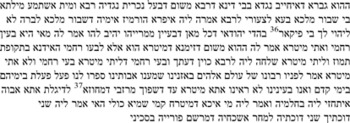
There was a certain man who was sentenced to lashing in Rava's court because he had intercourse with a non-Jewess. Rava beat him and he died. The matter was heard in the court of King Shapur. He wanted to torment Rava. Ifra Hormiz, the mother of King Shapur, said to her son, “Do not have any dispute with these Jews, for everything that they ask of their Master, He gives to them.” He said to her, “What is that?” [She responded,] “They ask for mercy and rain comes.” He said to her, “That is because it is the season of rain! Rather, they should request rain now in the summer season and let rain come!” She sent [the following message] to Rava, “Direct your intentions, request mercy, and let rain come.” He requested mercy and rain did not come. He said before [God], “Master of the world! ‘We, with our ears, have heard, O' God, our fathers have told us the deeds You performed in their time, in days of old (Psalms 44:2)’—but we, with our eyes, have not seen [them]!”Footnote 38 Rain came until it poured from the rain pipes of Mahoza to the Tigris. [Rava's] father came to him in a dream and said to him, “Is there anyone who bothers heaven so much [that you forced us to help bring the rain]! [Rava's father] said to him, “Change your place!” [Rava] changed his place. The next morning he woke up and found his bed incised with knives.
As in Niddah II, King Shapur doubts Rava's ability, although in this case the issue concerns Rava's ability to bring rain. When the king tests Rava during the summer months, Rava is initially ineffective, and he succeeds only by invoking the miracles that the fathers merited on their own accord and through heavenly intervention. In addition, Rava's “success” is deemed a breach of earthly boundaries, and he nearly pays with his life. Although space does not permit a more extensive comparison of Niddah II and this related narrative, at the very least, it seems that a tradition circulated in Babylonia that doubted Rava's abilities in general and specifically regarding encounters with the king.Footnote 39 While these narratives attempt to assure the reader of Rava's ultimate ability against the king's misgivings, both retain some unsettling sentiments as well.
A further similarity between Niddah II and the Ta‘anit tales is also worth noting. Both stories appear within the matrix of larger sugyot that express doubts about rabbinic abilities. In the case of the B. Ta‘anit tale, the subject is rabbinic success—or lack thereof—in praying for rain.Footnote 40 Regarding Niddah II, anxiety concerning the ability of rabbis to determine the source of bloodstains is already present in the halakhic discussions of the larger B. Niddah sugya. Footnote 41 The Gemara describes a rabbi who teaches his students about different blood colors, and ends with Rav Ashi's statement that “[someone] like me, who does not know the difference between this [shade of red] and that—I do not examine blood [colors].”Footnote 42 Later, the Gemara describes the different methods of earlier rabbis—including R. Elazar b. Pedat—to determine the source of bloodstains, but a number of later Amoraim claim that only earlier sages were competent to employ those methods of examination.Footnote 43 Similarly, R. Zera expresses trepidation about trusting his sight for examining blood when he does not have the ability to understand Babylonian coinage. Finally, we read that even though he presumably had the skill, ‘Ulla would refuse to examine blood in Pumbedita because it had its own resident sage, R. Yehuda. This leads into our sequence of stories (Niddah I and II), after which the Gemara concludes with yet another reason for rabbis to decline the examination of blood.
Thus, Rava's lucky ruling and Ifra Hormiz's praise represent the narrator's attempt to close off anxiety about rabbinic “blood science,” just as the story about Rava praying for rain has similar goals. However, there is no denying the unsettling “loose end” that remains untied at the conclusion of Niddah II. I would argue that this represents evidence of a disruption in the fabric of the storyteller's world, which in this case is stammaitic culture. What might lie behind this disruption of rabbinic power and confidence? To return to a previous point, why must this story be transformed into a Jewish–Zoroastrian encounter? An approach to these questions may be sought by fusing the two innovations of the Rava–Ifra Hormiz tale together. More specifically, it is possible to see the tale's moments of doubt as a result of the rabbinic encounter with Zoroastrian purity laws.
VII. Zoroastrian Laws of Menstrual Purity
The maintenance of purity and the avoidance of sources of impurity, including corpses, “noxious creatures,” and menstruating women, constituted a central feature of Zoroastrianism from Young Avestan times (the first half of the first millennium BCE), through the Middle Ages, and into the modern period.Footnote 44 The Zoroastrian menstrual laws were based on Indo-Iranian purity beliefs,Footnote 45 which received a distinctly Zoroastrian recasting in the Young Avestan book the Widēwdād, and underwent further elaboration and intense development in the different layers of the Pahlavi Widēwdād (PV)—its Sasanian Middle Persian ZandFootnote 46—in thematically based legal compilations such as Šāyest nē šāyest (Permitted and Not Permitted) and in later medieval texts.Footnote 47 Still, for the most part, Sasanian Zoroastrianism has bequeathed a few sources to modern scholars with few sources that they can use to reconstruct its legal and ritual system—even the one conceived of by a minority, elite, priestly class. The world inhabited by Sasanian Zoroastrianism was “pervasively oral,” and it seems likely that much of Zoroastrian tradition was lost because it was not written down.Footnote 48 This fate was probably accelerated by Islamic persecution and conversion in the centuries following the Arab conquest, the ascendance of “book culture” in Islamic lands, and the resultant decline of oral transmission. Most of the ritual texts have come down to us in the form of manuscripts no older than the thirteenth and fourteenth centuries, and they frequently contain technical terms whose meaning has been long forgotten.
The most basic treatment of the menstrual purity laws in Sasanian Zoroastrianism can be found in the sixteenth chapter of the Pahlavi Widēvdād. Like all Zands, it consists of at least three separate layers: a Pahlavi translation of the Avesta; glosses that clarify obscure, often slavishly rendered words in that translation; and extended discussions between named and anonymous Zoroastrian authorities. While scholars have compared the first two layers to the biblical targumim, the extended discussions display the highest degree of similarity with rabbinic compilations such as the Mishnah and Tosefta in both style and content.Footnote 49
VIII. The Three Discharges: čihrag, daxšag, and xōn
The opening verse of the sixteenth chapter of the Pahlavi Widēwdād explains what Zoroastrians must do when a woman begins to menstruate. The Avesta employs three adjectives—ciϑrauuaiti, daxštauuaiti, and vohunauuaiti—there and elsewhere when describing menstruating women.Footnote 50 Despite the ambiguity of the meaning of ciϑrauuaiti and daxštauuaiti, it is clear that each word in the triad refers to indications of menstruation. Thus, daxštauuaiti roughly means “with signs (of menstruation),” and vohunauuaiti quite certainly denotes “with blood.” The Zand slavishly translates and then glosses each word as follows:
… čihragōmand [kū zard]Footnote 51daxšagōmand [tahīgōmand] xōnōmand [daštān] …
… of čihrag [that is: yellow]Footnote 52 of daxšag [(that is) tahīg] of blood [(that is) menstruation] …
The glosses here are unanticipated in that they appear to render each Avestan-synonymous adjective differently. According to the Zand, the glosses daštān and zard apparently represent two different menstrual discharges—one regular (and presumably red), and one yellow. Although the term tahīg is itself ambiguous, its appearance elsewhere in the chapter to denote some sort of menstrual dischargeFootnote 53 suggests that the Zand's three glosses may be read as a short list of various menstrual discharges consisting of yellow, blood-red, and the undefined tahīg. Footnote 54 Again, these occur despite the fact that the Avesta clearly is not doing anything other than using three adjectives to describe a menstruant. Apparently, the rabbis were not the only religious group in late antiquity who sought to attribute various menstrual colors to their scripture through the exegesis of redundant terms.
Significantly, in both cases, this form of exegesis may be considered omnisignificant; that is, rabbinic and Zoroastrian exegetes offer new and distinct meanings of scriptural terms in order to avoid perceived redundancies.Footnote 55 As Yaakov Elman and Yuhan Vevaina have demonstrated, omnisignificance is not only a Jewish phenomenon, as first pointed out by James Kugel,Footnote 56 but here and elsewhere can be found in the work of Avestan commentators as well.Footnote 57 In the sense that omnisignificance implies a distinctly reverential posture of exegetes toward the text they are interpreting, its appearance in both Zoroastrian and rabbinic works of late antiquity is yet another important area of study for joint collaboration of Iranists and Talmudists. In the specific context of the menstrual laws, it contains a further layer of significance. From a legal-exegetical perspective, the rabbis did not “need” to derive a complex taxonomy of menstrual colors from the biblical text. Like the Samaritans, they could have read the passages in Leviticus that describe menstruants and applied a more basic approach in which women themselves determine whether their discharges are menstrual, nonmenstrual, or undetermined.Footnote 58 Instead, already beginning in tannaitic literature and developing in the Talmudim, the rabbis chose to develop an area of expertise entirely unanticipated in the Bible. This, in turn, required the rabbis to engage in a high level of exegetical acrobatics in order to ground the bloodstain taxonomy in the biblical text.Footnote 59 Similarly, the Zand chose to link these various discharges directly to the Avestan verse instead of relegating them to common-sense knowledge. While the Zoroastrian system did not undergo anywhere near the level of development and intensity of discourse that the rabbinic system did, the derivation of various discharges through omnisignificant exegesis represents a similar need to attach scriptural authority to this aspect of the menstrual laws.
The Zand's interpretation of čihrag as yellow, and daxšag as tahīg, appears later in the chapter as well. In PV 16.14–15, the Avesta discusses the punishment for having sex with a menstruant. In contrast to 16.13, which describes a woman who hides evidence of menstruation, 16.14–15 deals with a case in which the woman's status as a menstruant is eminently clear:
O Orderly creator …. He who at a prepaid price(?) mingles his body in action (with that) of a woman with signs, with menses, with blood, when her sign is noticeable, when her menses are clear, what is the penalty for it? Then Ahura Mazdā said: The first he approaches, the first he sits down with, one should apply thirty strokes with the horse whip, thirty with the bastinado….Footnote 60
The Avesta contains an interesting play on words. In order to express the certainty of the woman's impure status, the Avesta employs the same adjectives it used previously to describe a menstruant: yat hē ciϑra daxštəm bauuaiti yat hē daxšta ciϑrəm bauuaiti (when her sign is noticeable, when her menses are clear).
The Pahlavi Zand takes this verse out of its plain meaning and translates as follows:Footnote 61
dādār ka nāirīg *čihragōmand daxšagōmand xōnōmand was bār pad kāmag-kunišnīh tan gumēzēd kū-š was bār abāg hamkarzag bēd
tā ka ān ī ōy čīhrag daxšag bawēd [kū az zardīh abāz ō tahīg wardēd]
ayāb ān ī ō daxšag čihrag bawēd [kū az tahīg abāz ō zardīh wardēd].
kadār *ōy ast tōzišn
u-š guft Ohrmazd kū sīh pad abar zanišnīh abar zanišnīh asp-aštar sih srōšō-čaranām.
Creator: When a woman of čihrag, daxšag, of blood, mingles her body in willful action many times [that is she comes into (sexual) contact many times with him].
Until when the čihrag becomes daxšag [that is, it changes from yellow back to tahīg] or that of daxšag becomes čihrag [that is, it changes from tahīg back to yellow].
What is the atonement (for) that?
And Ohrmazd said: thirty strokes *should be struck upon him for the crime (with) the horsewhip, (and) thirty (with the) bastinado.Footnote 62
The Zand's initial translation of the Avesta is quite direct. The word bawēd, the present-singular form of the Pahlavi verb for being (budan), predictably renders Avestan as bauuaiti. Yet the Zand's gloss for bawēd, namely wardēd, connotes “turning” or “changing,” and it emphasizes another aspect of the Pahlavi verb budan—that of “becoming.” Therefore, instead of understanding the phrase to mean “when her sign [ciϑra/čihrag] is noticeable, when her menses [daxshta/daxšag] are clear,” the Zand perceives čihrag as physically changing into daxšag and vice versa. Like the opening verse of the chapter, this section also implies that čihrag and daxšag are two different substances and not simply repetitive adjectives that describe a menstruant. Accordingly, once again čihrag is glossed as zard (yellow) and daxšag as tahīg.
I suggest that in an effort to give a sense of divine authority to the decisions that Zoroastrians had to make regarding vaginal discharges, the Zand links the substances to scripture. However, as I stated previously, unlike the rabbis, the Zoroastrian priests did not devise a complex system of pure and impure discharges that led to a new kind of ecclesiastical expertise. We only have hints in the Pahlavi Widēwdād, and one explicit statement in Šāyest nē šāyest,Footnote 63 that express an actual position on examinations of bloodstains. Again, the Zand in the opening verse of PV 16 implicitly considers regular (red), yellow, and tahīg discharges impure because they require a woman who experiences them to get herself to the daštānistān (menstrual “hut”). The Zand in PV 16.11 also treats tahīg as an impure substance.Footnote 64
Šāyest nē šāyest 3.14–18 closely follows the laws of tahīg outlined in PV 16.11. A synoptic study of Šāyest nē šāyest 3 and PV 16 reveals that Šāyest nē šāyest 3.19 is based on PV 16.11.2. Šāyest nē šāyest 3.19 states,
čihrag ka gōn bē wašt ān ī pēš ān-iz ī pas az daštān bē āyēd rēmanīh
ēdōn bawēd čiyōn daštān
(Regarding) čihrag: When the color has changed, that which comes before and also that which comes after menstruation is impure. It is as (regular) menstruation.
The Šāyest nē šāyest passage appears to be interpreting a phrase from PV 16.11.2, ud harw čiš ēdōn bawēd čiyōn daštān, or “and everything is like menstruation.”Footnote 65 This clause is apparently understood to mean that all “things” (čiš)—or discharges (čihrag)—are to be considered impure. Šāyest nē šāyest either reflects a different version of the Pahlavi Widēwdād or, alternatively, reinterprets it to mean that the undefined “thing” in the phrase harw čiš (everything) refers specifically to discharges.
Despite the fact that in an extensive passage, PV 16.2 is concerned with the legal parameters of the onset of menstruation, it is striking that there is no indisputable mention in the Zand or in subsequent medieval responsa of women or priests checking the appearance of vaginal discharges. Even though Zoroastrian law was careful about determining the exact moment of menstrual impurity, and, accordingly, there are two explicit references to examinations in that passage (PV 16.2.3 and 16.2.5), these two cases seem to relate to verifying simply whether there is an emission at all and not to the particulars of a discharge's appearance.Footnote 66
IX. The Result of Rabbinic and Zoroastrian Differences on Ruling on Bloodstains
In sum, Zoroastrian law considers, but rejects, legal differentiation between the colors of vaginal discharges. Thus, we might say that rabbinic concern over ruling on bloodstains, which is already present in other parts of the sugya at B. Niddah 19a–21b, is a looming concern for the narrator of the Rava and Ifra Hormiz tale precisely because the connotations of that encounter were a great source of anxiety. The narrator's attempt to allay this concern betrays the rabbinic lack of confidence to rule on bloodstains. While this lack of confidence might previously have demonstrated a form of basic religious piety (stringency in the face of doubt) or an awareness of the “decline of the generations,” it becomes acute in daily contact between Jews, who were lenient in this matter, and Zoroastrians, who were more stringent.
Although the tale is clearly a literary construction that does not record an actual historical event, it does preserve important information regarding its narrator and his world. First, at the risk of stating the obvious, the story confirms our knowledge that Babylonian rabbis recognized the significance of menstrual impurity in Zoroastrian life.Footnote 67 It also goes far beyond this by expressing a two-pronged rabbinic fantasy: first, that the rabbinic menstrual impurity laws are essentially superior to the competing Zoroastrian system; and second, that rabbis are consulted by Sasanian royalty regarding purity matters. At the same time, in the form of two moments of doubt, the tale retains traces of anxiety concerning these very claims: Do the Jews really curry royal admiration, and are rabbis truly unassailable in their diagnosis of bloodstains?
X. Rav Kahana and the Min (B. Sanhedrin 37a)
The same dual focus on internal hermeneutics and external circumstances might be applied to another talmudic story to reveal a remarkably similar development. Once again, we find older, “anonymous” rabbinic concerns “externalized” and placed in the mouth of a character who apparently represents Zoroastrianism:

A certain min said to Rav Kahana, “You say that a menstruant is permitted to seclude herself with [her] husband. Is it possible for fire to be near flax without singeing it?” [R. Kahana] responded, “The Torah testifies of us, “Hedged with lilies (Songs 7:3).” That even like hedges of lilies they will not make breaches among us.
I. H. Weiss and, more recently, Eli Ahdut and Yaakov Elman have argued persuasively that the anonymous “heretic” (min) here is a ZoroastrianFootnote 70—or at least someone who espouses Zoroastrian views.Footnote 71 They have also explained that at root of the debate is the daštānistān, or menstrual “hut” in which Zoroastrian women must sit from the onset of menstruation until purification at least five days later.Footnote 72 The min challenges the rabbinic menstrual laws by claiming that if menstruants are not segregated, husbands and wives will not be able to avoid intimacy. Rav Kahana responds by claiming that the Torah testifies of the Jews that they are compared to hedges of lilies. All Jews, even those as (spiritually) frail as lilies, can be trusted not to have sex while secluded with their menstruant wives.Footnote 73
XI. The Sources of the Rav Kahana Tale
Since ancient times, the Song of Songs has been interpreted allegorically. Most fundamentally, the interplay between the book's male and female lovers has been read as an expression of the relationship between God and the Jewish people. Similarly, the rabbis have read a whole host of characters into the text, such as Gentiles, Moses and Aaron, various Jewish leaders, and the Jewish court system.Footnote 74 Indeed, Palestinian sources understand the beginning of Songs 7:3 as referring to the Sanhedrin—the highest Jewish court:
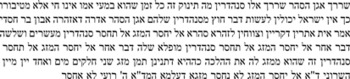
“Your navel is like a round goblet (Songs 7:3)”—this refers to the Sanhedrin. Just as a fetus, as long as it is in its mother's womb, it does not live except through its navel [cord], so too Israel cannot do [any]thing except through their Sanhedrin. “A round goblet [agan ha-sahar]”—the threshing floor of enlightenment [adrah de-azharah].Footnote 75 Avun b. Hisdai said, “There are places that call and term the moon, “sehara'.Footnote 76 “In which no mingled wine is wanting [yehaser ha-mezeg]”—the Sanhedrin should not lack twenty-three (members for a quorum). Another opinion: “In which no mingled wine is wanting”—the Sanhedrin should not lack its mufla'. Footnote 77 Another opinion: “In which no mingled wine is wanting”—The Sanhedrin should not lack this one who “dilutes the Law.” As it is taught there [in a Mishnah],Footnote 78 “‘mezeg’ means two parts water and one part wine using Sharon wine.” Another opinion: “In which no mingled wine is wanting,”—Let us not lack the butler of the world,Footnote 79 as it says, “the Lord is my shepherd; I will not lack (Psalms 23:1).”Footnote 80
As is typical in midrash, the beginning of the next stich is interpreted differently in a number of sources.Footnote 81 “Your belly is like a heap of wheat” is seen as referring to the book of Leviticus, the people of Israel, or, once again, the Sanhedrin. However, all the sources interpret the final phrase, “like a hedge of roses,” as somehow related to the challenge of observing the menstrual laws.
I have described the Palestinian exegesis of Songs 7:3 in some detail in order to demonstrate an interesting structural correlation between these sources and B. Sanhedrin 37a. Rav Kahana's discussion with the min takes place in a sugya that is primarily concerned with the seating arrangement of the Sanhedrin. M. Sanhedrin 4:3, the Mishnah that is the focus of the sugya in which the Rav Kahana anecdote is found, requires the Sanhedrin to sit in a semicircle. Accordingly, R. Aha b. Ḥanina begins the sugya by searching for a biblical prooftext for this requirement. He subsequently quotes a baraita' that is quite similar to the midrash found in Songs Rabbah 10 and is later expanded in the Pesikta Rabbati parallel. Once again, the lover's navel is interpreted as a metaphor for the Sanhedrin—though here it supports the Sanhedrin's location on the Temple Mount. Similarly, the word sahar is understood via a homonym—sehara (the moon). In addition, mezeg, the diluted wine, is employed to require a quorum of twenty-three members. The image of the belly, which most Palestinian sources do not relate to the Sanhedrin, in the Bavli is connected to the benefit derived from the Sanhedrin. It is possible that, initially, the Bavli even connects the phrase “hedged with lilies” to the Sanhedrin.Footnote 82 On the other hand, Rav Kahana's response to the min is based on an alternative reading of the conclusion of Songs 7:3 that is related not to the Sanhedrin but rather to the menstrual laws.Footnote 83
In other words, the Bavli's structure generally follows the Palestinian midrashic model in which Songs 7:3 is initially understood as referring to the Sanhedrin, and is later connected to Israel and the menstrual laws. This is explicated in Avot de-Rabbi Nathan B (ARNB), which introduces the “menstrual interpretation” as a preferred alternative to reading “hedged with lilies” as a metaphor for the sages.Footnote 84 According to our understanding of Rav Kahana's response to the min, the Bavli also shifts the meaning of Songs 7:3 in the same direction by first interpreting the verse as referring to the highest court and then to the lowest element of Jewish society.
Another element of the Rav Kahana anecdote is also expressed most clearly in the ARNB parallel. Unlike the Bavli, which cites the midrashic treatment of Songs 7:3 because of its reference to the Sanhedrin, ARNB is primarily interested in the lily metaphor as it relates to rabbinic enactments aimed at protecting the menstrual laws from even inadvertent violation. Indeed, as a unit, ARNB 3 is devoted to a discussion of “biblical fences”—that is, biblical enactments aimed at protecting more serious prohibitions from being transgressed. The chapter opens with two examples of such fences. First, there is the prohibition against secluding oneself with a close relative in order to prevent a violation of the incest laws. Second, there are the rules against any kind of playful contact with a menstruant. This leads into the exegesis of Songs 7:3, cited earlier.
Although all of the Palestinian sources highlight the lack of social pressure to keep the menstrual laws because of the fact that the temptation to transgress them occurs in the privacy of one's bedroom, the passage in ARNB explicitly contrasts the stringent “fence” that forbids seclusion with relatives with the permission granted to a husband and wife to be alone even when she is menstruating. Thus, ARNB calls the fence aimed at protecting the menstrual laws a “weak fence,” as a man may be alone in his house with his menstruant wife even though no one is around to prevent them from becoming intimate.
Of course, the most fundamental connection between the Rav Kahana anecdote and the Palestinian sources is the understanding that “hedged with lilies” somehow refers to the menstrual laws. The root of this association is explicated in some of the Palestinian parallels:

R. Levi said, “According to the custom of the world a man marries a woman when he is thirty [or] forty years old. After spending his money [on the wedding feast] he comes to unite [himself] to her. And [if] she says, “I have seen [a drop of blood] like a red lily,” he separates himself from her immediately.Footnote 86
What is particularly interesting about this source is that although it stems from the ancient association of red lilies with menstruation, the actual midrashic mechanism reads the lilies in terms of the flowers' softness, and it understands the metaphor as expressing the vulnerability of certain “soft,” in other words, vulnerable, commandments. While Rav Kahana's response to the min also focuses on the flowers' “softness” and does not explicate the lily–menstruation association, it departs from the Palestinian sources and identifies the lily metaphor with morally weak Jews.
XII. The Reworking of the Sources of the Rav Kahana Tale
In sum, the Bavli passage and the Palestinian sources share much in terms of content and structure, namely the lily–menstruation association, the structural similarity of the interpretation of Songs 7:3, and, finally, the concern that the menstrual laws are vulnerable because of the privacy granted to a husband and wife.Footnote 87 At the same time, the Rav Kahana narrator reworks his sources in a distinct way. First, an initially “internal” concern is “externalized” through its transformation into a dialogue between a rabbi and a Zoroastrian-style min. In addition, the lily metaphor is shifted from referring to commandments to referring to Jews. An interesting feature of the ARNB parallel is that although it raises the issue that the menstrual laws are in constant danger of transgression because of seclusion, it does not solve the problem. In other words, the passage is essentially descriptive—it states that there are certain “biblical fences” that are weaker than others, and leaves the discussion at that.Footnote 88 This is in contrast to Rav Kahana's response, which solves the problem by claiming that the Torah testifies to inherent Jewish piety.
As in the Rava-Ifra Hormiz tale, the “Zoroastrianization” of previously anonymous characters or concerns signifies that the Jewish–Zoroastrian encounter constituted a new source of anxiety for old problems. Here, a concern that already existed in Palestine is placed “in the mouth” of a Zoroastrian-style min—that is, someone who represents an external threat to rabbinic authority. Recent research by Christine Hayes has demonstrated that talmudic narrators strategically employ “Others,” such as Romans and minim, in order to express controversial ideas that lie outside normative rabbinic tradition but were indeed entertained by the rabbis—or at least their constituents. It seems plausible that the presence of Zoroastrian menstrual “huts” in Babylonia encouraged some Jews to consider adopting the stringency of forbidding seclusion with a menstruant. The narrator of the Rav Kahana anecdote first marginalizes this suggestion by placing it in the mouth of a min. He then responds to the argument by expressing a form of religious pride. The narrator implicitly claims that although, when secluded, a man and woman normally cannot be trusted to keep their sexual passions in check, the Torah assures that “we Jews”—even the lowly ones—are able to resist this temptation.
The tale thus simultaneously acknowledges the libidinous dangers of permitting menstruating women to remain at home with their husbands as well as Zoroastrian pragmatism in relegating them to menstrual “huts”—while it claims that Jews need not worry about these issues. This, too, can be related to the dynamics of the Rava–Ifra Hormiz tale. Like the Rav Kahana anecdote, the Rava story also attempts to instill confidence in the exceptionality of Jews—here, rabbis—to diagnose bloodstains successfully against a background of rabbinic and Zoroastrian unease with this very practice.
The goal of this paper has been to demonstrate through source critical and “contextual” analysis that both tales mirrored the dynamics of Sasanian Mesopotamia and its complex net of cultural and religious tensions. Beyond our immediate conclusions, we hope that the paper will encourage further research concerned with the Bavil and its place in the culturally effervescent world of Sasanian Mesopotamia.



