The current study used the letter-detection task to examine whether word recognition and comprehension in a connected text change as a function of a reader's language proficiency. In letter detection, participants are instructed to read for comprehension while circling all instances of a target letter, such as t. Previous studies using letter detection have examined the cognitive processes that occur during identification of letters, phonemes, and words (i.e., perceptual units); the syntactic or structural roles of the words; and the semantic roles of words (Healy, Reference Healy1994; Koriat & Greenberg, Reference Koriat and Greenberg1994; Saint-Aubin & Poirier, Reference Saint-Aubin and Poirier1997). The letter-detection task is useful for exploring processing demands during reading because letter-detection accuracy systematically varies as a function of word frequency (more detection errors as frequency increases), word length (more detection errors as length decreases), syntactic class (more detection errors for function words than content words), and general properties of the text, such as overall difficulty (more detection errors as difficulty decreases; Greenberg, Healy, Koriat, & Kreiner, Reference Greenberg, Healy, Koriat and Kreiner2004). A robust finding is that the target letter is missed (a detection error) more often in function words than in content words. This is called the missing-letter effect (MLE) and has been found in a variety of conditions, including in children in first grade (Foucambert & Baillé, Reference Foucambert and Baillé2011; Saint-Aubin, Klein, & Landry, Reference Saint-Aubin, Klein and Landry2005) and in several languages (Chitiri & Willows, Reference Chitiri and Willows1997; Greenberg & Saint-Aubin, Reference Greenberg and Saint-Aubin2004; Krech Thomas, Healy, & Greenberg, Reference Krech Thomas, Healy and Greenberg2007).
The specific purpose of the current study is to examine whether readers of different proficiency levels approach the letter-detection task in different manners and whether the addition of the letter-detection task reduces reading comprehension relative to normal reading. Several researchers have explored how letter-detection accuracy interacts with the readers’ language proficiency (Chitiri & Willows, Reference Chitiri and Willows1997; Greenberg & Saint-Aubin, Reference Greenberg and Saint-Aubin2004, Reference Greenberg and Saint-Aubin2008; Hatch, Polin, & Part, Reference Hatch, Polin and Part1974; Tao, Healy, & Bourne, Reference Tao, Healy and Bourne1997). These studies have produced mixed findings, ranging from a slightly reduced MLE in the second language relative to the first language to a reversed MLE in the second language (fewer errors for function words than content words). If the readers’ word-processing ability changes with proficiency, comprehension might also be affected. We aim to clarify past results regarding letter-detection accuracy and to further explore reading comprehension during the letter-detection task as a function of language proficiency.
MODELS OF LETTER DETECTION
There are two prominent models of letter detection. Although the current study is not designed to test these models, a brief overview of them is helpful in understanding how language proficiency might interact with the letter-detection task. The guidance–organization model of reading accounts for the MLE in two key ways, both of which are derived from the hierarchical nature of text processing (Greenberg et al., Reference Greenberg, Healy, Koriat and Kreiner2004). High-frequency words are more likely to be processed as a single unit (unitized), rather than letter by letter, than are low-frequency words. Unitization occurs because as people become more proficient readers and more familiar with a word, the size of the reading unit is increased from individual letters to groups of letters to entire words, for short, common words. This allows unitized words to be recognized before all their constituent letters are identified. Once the word is identified, attention is directed to the next word in the text, regardless of whether the letter-identification process was completed for every letter. If attention shifts before the target letter is identified, the target letter will go undetected. Because function words have higher average word frequencies than content words and tend to be shorter in length, function words are more likely to be processed as a unit; therefore, the target letter is less likely to be identified (Healy, Reference Healy1994; Greenberg et al., Reference Greenberg, Healy, Koriat and Kreiner2004). The role a word plays in the sentence is a second source of the MLE. Readers use function words as cues to help create a structural organization of the text, and these cues guide attention to the more meaningful content words. Therefore, function words will receive less attention than content words, and the time spent fixating function words will be less than content words. The reduced attention and fixation time leads to shallower depth of processing for function words than for content words. The reduced attention and processing time given to function words reduces the likelihood that letters in function words are completely identified, which increases the likelihood that target letters are undetected. In short, when a word is processed before its constituent letters are processed, an omission (detection error) is more likely (Greenberg et al., Reference Greenberg, Healy, Koriat and Kreiner2004).
The attentional disengagement model (Roy-Charland, Saint-Aubin, Klein, & Lawrence, Reference Roy-Charland, Saint-Aubin, Klein and Lawrence2007) places emphasis on how much time is needed to recognize a word. The shifting of attention from one word to the next is the proximal factor responsible for the MLE in this model, and word frequency and grammatical class are downgraded to more distal factors. These distal factors indirectly affect the MLE by influencing when the reader disengages attention from a word. In essence, when the reader has recognized a word, whether it has been fixated on or not, the amount of attention devoted to the word rapidly decays. Recognition and processing of words that require less attention, such as high-frequency words and function words, may be finished before a target letter is detected. If a target letter in a word was not detected before attention shifts to the next word, it is more likely to be missed because the information accumulated about the word will quickly decay. This explanation differs from the guidance–organization model in that in the attentional disengagement model there is still the possibility, albeit a small one, of the reader detecting the target letter after the word is recognized.
Both models can be used to predict what might happen when readers are second language learners and read in their less proficient language. The more knowledge and familiarity a person has for a language, such as knowledge of word frequency and syntactic roles, the more top-down processing can facilitate word processing, which should increase letter-detection errors. In the case of second language learners, this type of knowledge is limited, and they will have to rely more on bottom-up processing, such as letter by letter word identification. This could lead to more attention on individual words, which leads to more complete identification of letters and, consequently, fewer errors in the letter-detection task.
BILINGUAL LETTER-DETECTION ACCURACY
Several researchers have used the letter-detection task to study second language proficiency. For example, Hatch et al. (Reference Hatch, Polin and Part1974, Experiment 2) tested the role of word and syllable stress on letter detection as a function of language proficiency. Participants were native English speakers, intermediate English language learners, or beginner English language learners. For overall error rates, native speakers made the most errors and the beginner group the fewest errors. All groups demonstrated the typical MLE, but the MLE was largest for the native speakers (35%), next largest for the intermediate English group (22%), and smallest for the beginner group (7%). They concluded that less proficient speakers rely more on function words for help understanding the relation between the content words. This increased the attention given to function words and, consequently, reduced letter-detection errors. An alternative interpretation is that the less proficient group was reading letter by letter and treating the task as more of a visual discrimination or search task. Although Hatch et al. state that participants answered comprehension questions for each passage, no details were provided regarding the formatting or the content of the questions. In addition, no comprehension data were provided that might help explain differences in reading processes across groups.
Tao et al. (Reference Tao, Healy and Bourne1997) compared letter-detection performance of native English speakers to three groups of native Chinese speakers: a no-English language knowledge group comprising elementary school children with exposure to the English alphabet, but not to the language; an intermediate knowledge group comprising adults who had taken at least 6 years of English classes while they were in school; and an advanced knowledge group comprising adults with at least 15 years of experience with English who currently used English on a regular basis. Native speakers made more errors overall and had a much larger MLE (55%) than the nonnative groups. For the no-English knowledge group, there was no difference in the number of target letters detected in function words compared to all other words (i.e., no MLE). Participants who had knowledge of English (Groups 2 and 3) exhibited the typical MLE (10% and 38%, respectively). These results are generally consistent with the expectation that as readers gain experience with a language, they increase the size of their reading units and use the syntactic roles of the words to guide word processing, which supports the development of the MLE. Unfortunately, children do not serve as a good comparison to the other participants, so the absence of the MLE in the elementary school children could be due to their lack of knowledge about English or less general knowledge. Because there was no measure of comprehension, we cannot make any conclusions about the amount of attention devoted to comprehension of the text versus letter detection.
Chitiri and Willows (Reference Chitiri and Willows1997) had native Greek high school students who were advanced learners of English complete letter detection on a passage in English and a passage in Greek. Participants showed the standard MLE for Greek passages (~3.5%) but a reversed MLE (−2.5%) for English passages (fewer errors on function than content words). Participants answered six multiple-choice questions about each passage, but the comprehension data were only used to exclude participants who answered three or more questions incorrectly; therefore, how letter-detection performance relates to comprehension again cannot be determined.
Greenberg and Saint-Aubin (Reference Greenberg and Saint-Aubin2004) examined how bilinguals process interlingual homographs (e.g., words such as “or,” which is a function word in English and a content word meaning “gold” in French). In their Experiment 1, 18 participants were English monolinguals, 24 were French–English bilinguals (French dominant), and 18 were English–French bilinguals (English dominant). Participants performed the letter-detection task with English and French passages. Overall letter-detection accuracy did not vary in a predictable manner as a function of language group and text language, but the MLE did vary based on language experience. Monolingual English speakers had a very large MLE in English (63%) and a reversed MLE in French (−41%). French-dominant bilinguals showed a large MLE in English (45%) and a smaller MLE in French (27%). English-dominant bilinguals showed a similar pattern as their French-dominant counterparts (MLE in English = 56%, MLE in French = 10%) The MLE decreased systematically as proficiency level decreased and was reversed for monolingual English readers in French. Comprehension was not measured, so no conclusion can be made about how well the texts were processed or understood.
Greenberg and Saint-Aubin performed a follow-up study (Reference Greenberg and Saint-Aubin2008, Experiment 1) using mixed-language passages (sentences alternated between French and English languages in a random order). Unlike in the 2004 study, participants answered three multiple-choice questions, with three alternatives each, after reading each passage. Questions tested knowledge of facts stated in the text. For the English sentences, English monolinguals demonstrated the typical MLE (21%), but a reversed MLE for the French sentences (−23%). Bilinguals, who were native French speakers, made fewer errors on the English than on the French sentences and showed a standard MLE in both languages (English = 8%, French 10%). Bilinguals performed better than monolinguals on the comprehension tests, although this is not surprising given that monolinguals could only understand the half of the text in English. Thus, the comprehension questions cannot be used to make conclusions about how the texts were processed. Taken together, these two studies support Greenberg and Saint-Aubin's (Reference Greenberg and Saint-Aubin2004) conclusion that for the monolinguals reading in the unfamiliar French language, the task changed from one that tests the readers’ knowledge of the words’ role to one that was based on orthographic pattern (finding letters).
Krech Thomas et al. (Reference Krech Thomas, Healy and Greenberg2007) had English speakers who were intermediate learners of Spanish read a text normally and then reread it while searching for a target letter. The authors suggested that the first reading freed attentional resources during the second reading that could be used to more accurately search for target letters. The first and second readings could vary with respect to language of the text. Participants answered two, three-alternative comprehension questions about details contained in the passage following each passage. Averaged across the first and second readings, comprehension was highest when the first passage was in English. Participants also answered more questions correctly for the English passages than for the Spanish passages. Because normal reading always preceded letter detection on a passage, how letter detection affects comprehension cannot be determined because participants were familiar with the passage when they performed letter detection. Of the most importance, there was a typical MLE for English (32%) and Spanish (35%) passages. This suggests intermediate bilinguals processed passages in both languages similarly, at least as reflected by similar MLEs.
As can be seen from past research, error rates for content and function words varies greatly as a function of language proficiency even within first or second language groups. This suggests the need to more tightly control language background. In addition, some of the studies placed an emphasis on comprehension by presenting questions after the passages. Therefore, differences in letter-detection error rates between studies could be due to how participants allocated their attentional resources to text comprehension versus letter detection. Furthermore, even when comprehension was measured, comprehension was not always analyzed. Of the six studies summarized above, only four measured comprehension. Of these, only two analyzed comprehension as a function of language background (Greenberg & Saint-Aubin, Reference Greenberg and Saint-Aubin2008; Krech Thomas et al., Reference Krech Thomas, Healy and Greenberg2007). Greenberg and Saint-Aubin (Reference Greenberg and Saint-Aubin2008) used mixed-language texts and found that bilinguals comprehended more of mixed-language texts than did monolinguals. Krech Thomas et al.'s (Reference Krech Thomas, Healy and Greenberg2007) participants never completed letter detection on a “novel” text, only on one they had already read. Thus, neither of these studies can speak directly to how letter detection changes comprehension of a text in a second language. In addition, comparing patterns of letter-detection errors between studies that do not measure or emphasize comprehension in the instructions to studies that do emphasize comprehension is problematic. In a monolingual letter-detection study, Oliver, Healy, and Mross (Reference Oliver, Healy and Mross2005) found that letter detection marginally reduced reading comprehension compared to normal reading when participants were explicitly told to read for comprehension and make as few errors as possible. However, when participants were instructed to focus exclusively on letter detection and not read for comprehension, the reduction in reading comprehension performance was significant during letter detection compared to normal reading only. This indicates the importance of task demands. We aimed to minimize limitations of previous research by precisely controlling language background, measuring comprehension in a detailed manner, and including a normal reading task for comparison.
COMPREHENSION
In the current study, we aim to more finely measure changes in reading comprehension as a function of task type (letter detection and normal reading) and language proficiency. Our comprehension questions were designed based on Kintsch and van Dijk's (Reference Kintsch and Van Dijk1978) levels of representation; therefore, we will briefly summarize their model. According to Kintsch and van Dijk, there are three levels of comprehension: surface form, text base, and situation model. The surface form contains the wording used in the text and reflects lexical and syntactic analysis of a text (Fletcher & Chrysler, Reference Fletcher and Chrysler1990; van Dijk & Kintsch, Reference Van Dijk and Kintsch1983). The text base represents the meaning of the words and phrases in a text (i.e., concepts) as an organized network of propositions, but it is independent of the actual words (Kintsch, Reference Kintsch1974; Kintsch & van Dijk, Reference Kintsch and Van Dijk1978). For example, the sentences “Jane sat on the couch” and “Jane sat on the sofa” have different surface forms but similar text bases because these sentences express essentially the same concepts. This is relevant to bilingual reading because words from each language can be thought of as synonyms that express the same concept, such as dog (English) and perro (Spanish). The situation model is an integration of the text base with a reader's prior knowledge and reflects how the reader interprets a text. The situation model includes information that is not part of the original text, such as general knowledge of the topic, inferences, and other by-products of text comprehension (Fletcher, Reference Fletcher and Gernsbacher1994; Kintsch, Reference Fletcher and Chrysler1988; Kintsch, Welsch, Schmalhofer, & Zimny, Reference Kintsch, Welsch, Schmalhofer and Zimny1990). Because letter detection focuses attention on the letters and words in the text, one could envision letter detection emphasizing surface form comprehension over text base and situation model comprehension. One could also predict that letter detection will affect each level of comprehension equally through a general reduction in attention to text features. The present study is the first to address this issue. In our study, participants read four texts in English (their proficient language) and four texts in Spanish (their less proficient language) while reading normally or completing a letter-detection task. Participants also answered six comprehension questions after reading each passage (two surface form, two text base, and two situation model level). Experience with Spanish was tightly controlled (described below). With this design, we can compare how letter-detection accuracy changes as a function of proficiency as well as how a person's comprehension is affected by the addition of the letter-detection task. This will allow us to test whether the letter-detection task changes in nature as comprehension/proficiency degrades. In addition, it allows us to investigate what has been repeatedly found, but not thoroughly evaluated: a reversed MLE. To obtain reliable estimates of the MLE, we had participants read multiple passages in each language.
We expected overall letter-detection error rates to be larger in Spanish (our participants’ less proficient language) than in English. Moreover, we expected to replicate the finding of a larger MLE (more errors on function words than content words) for the proficient language (English) than for the nonproficient language (Spanish). Because our participants have only a basic proficiency level in Spanish, the MLE should be absent (function = content) or even reversed (function < content) for Spanish passages. For comprehension, we expected comprehension to be better for English passages than for Spanish passages and comprehension to be better during normal reading than during letter detection.
METHOD
Participants
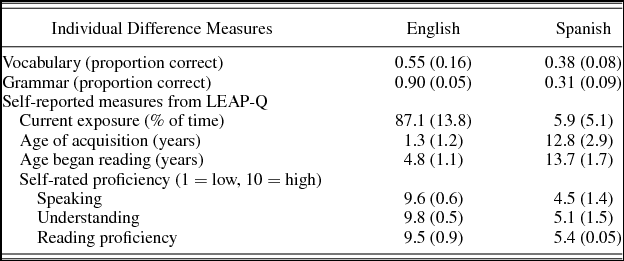
Fifty-one undergraduates (25 women, 26 men) enrolled in an introductory psychology course participated for course credit. Eleven participants were excluded because they were not native English speakers. This left 40 (19 women, 21 men) participants who were native English speakers and who were not highly proficient in Spanish. To ensure basic knowledge of Spanish, participants were required to have taken at least 2 years of high school Spanish or two semesters of college Spanish. Half of the participants reported having knowledge of an additional language besides English and Spanish. These languages included Arabic, Cantonese, Farsi, Hindi, Korean, Malayalam, Polish, Portuguese, Tagalog, and Urdu. Table 1 presents descriptive statistics for participants for the various measures of proficiency described below.
Means (standard deviations) of vocabulary quiz scores, cloze-like grammar test scores, and key variables from the LEAP-Q

Materials and design
Proficiency measures
Proficiency for each language was measured using a combination of vocabulary tests and cloze tests. The English vocabulary quiz (developed by Raney) has been used in several prior studies (Minkoff & Raney, Reference Minkoff and Raney2000; Therriault & Raney, Reference Therriault and Raney2007) and is moderately correlated with comprehension ability (r = .40 to .52). The Spanish vocabulary quiz and the English and Spanish cloze tests were adapted by Montrul (Reference Montrul2005) from the Diplomas de Español como Lengua Extranjera exam (http://www.dele.org/) to assess proficiency. To assess word knowledge, participants completed 30-item multiple-choice vocabulary tests in English and Spanish. For the English test, participants were required to choose the best definition for a given word from five alternatives. For the Spanish test, participants had to choose a word from the four options that would best fit in a blank in the sentence. To assess grammatical knowledge, participants completed cloze-like tests. Participants read a passage in each language that had several words missing. After reading the entire passage, participants returned to each blank and chose the best fitting word from three possible answers. We followed Montrul's (Reference Montrul2005) guidelines for defining low proficiency. Participants were defined as low Spanish proficiency if they had a composite vocabulary and cloze test score above chance accuracy (25%) but below 50% correct.
Language History Questionnaire
All participants completed the Language History Questionnaire (Marion, Blumenfeld, & Kaushanskaya, Reference Marion, Blumenfeld and Kaushanskaya2007). This questionnaire consists of questions relating to language acquisition, proficiency, exposure, environment, and so on.
Text passages and comprehension questions
Eight English passages with accompanying multiple-choice comprehension questions (six per passage) were taken from a set of normed stimuli by Daniel and Raney (Reference Daniel and Raney2014). The topics of the approximately 400 word expository texts involve descriptions of procedures or common events such as making coffee or having a baby. For each set of six questions, two fill in the blank questions were designed to test readers’ memory for the surface form (i.e., memory for wording). Participants were required to select the exact word that had been in the text. Two questions were designed to test readers’ understanding of the text base (i.e., memory for meaning). Participants were required to select the answer based on information explicitly stated in the passage. Two questions were designed to test readers’ development of a situation model (i.e., ability to apply knowledge to a new topic). Participants were required to infer what could happen in a novel situation based on what they had learned from the passage. Each question had four alternatives and was presented in the same language as the text that had just been read. The questions had previously been normed so that average comprehension was equivalent across levels of comprehension during normal reading (Daniel & Raney, Reference Daniel and Raney2007). The passages and questions were translated into Spanish independently by two native Spanish speakers who were proficient in English. The two translators then compared versions and created one agreed-upon translation. The language of the questions was matched to the language of the passages to maintain the language mode. Matching language was also important because the surface form questions required memory for specific words in a passage. The text base and situation model questions could also benefit from including words and phrases that exactly matched the passages.
Reading tasks
Participants read four texts in English and four in Spanish. Passage language and task type were blocked and counterbalanced across participants. One group of participants completed the English normal reading task on two passages and then the English letter detection on two different passages. They then completed the normal reading task in Spanish on two new passages and finally completed letter detection on two additional new passages in Spanish. Another group completed English letter detection, then English normal reading, followed by Spanish letter detection and Spanish normal reading. A third group started with Spanish letter detection, then completed Spanish normal reading, then English letter detection, and finally English normal reading. A fourth group completed Spanish normal reading, then Spanish letter detection, then English normal reading, and finally English letter detection. This resulted in eight different versions of the experiment with each passage used twice for each language and each task type.
For the normal reading task, participants were instructed to read normally for comprehension. For the letter-detection task, participants were instructed to read for comprehension while circling every instance of the target letter (t in English and l in Spanish) as quickly and accurately as possible. Different target letters were used for each language to ensure similarity of letter frequency across languages (the letters t and l are one of the three most common letters in the English and Spanish languages, respectively; see http://subtlexus.lexique.org; Brysbaert & New, Reference Brysbaert and New2009; and http://www.lexiteria.com/word_frequency/spanish_word_frequency_list.html). Participants were instructed not to correct any mistakes they made (i.e., circling a target letter they previously missed) and that a six-question multiple-choice comprehension test would follow each passage.
Procedure
Participants were tested in small groups (one to three participants). To begin, all participants completed the Language History Questionnaire in English. The proficiency measures were then presented via computer (using SuperLab 4.5, Cedrus Corp.). Participants began each language block by completing a short practice letter-detection passage to help instantiate the language to be used. All passages were presented on paper to ensure the presentation format for normal reading and letter detection was identical. Passages were presented double-spaced in Courier 12-point font across two pages. Before reading a passage, participants were presented with task instructions (read normally or detect the target letter) on an otherwise blank page in the packet. They then turned the page in the packet to the passage and pressed the space bar on a keyboard to signal they were starting a passage. They pressed the spacebar again when they finished the passage and turned the page in the packet. Comprehension questions were then presented on the computer. Participants were not allowed to refer back to the passage while answering the comprehension questions and responded by pressing the key on the keyboard that corresponded to the multiple-choice alternative they chose.
RESULTS
Letter-detection error rate (proportion of target letters not detected) and comprehension question accuracy (proportion of questions correct) were collected. Participants were excluded from the data set if they did not meet proficiency requirements, did not follow instructions (e.g., skimmed as opposed to reading normally as indicated by a reading time three or more standard deviations below the mean or circled incorrect target letters throughout the task), or detected fewer than 50% of either function or content target letters within a language. Eleven participants were removed based on these criteria, leaving 29 participants in the data set.
Letter-detection error rate
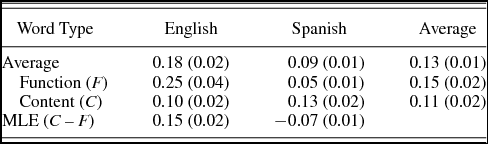
Letter-detection error rate (proportion incorrect) was analyzed using a 2 (word type: function or content) × 2 (language: English or Spanish) repeated measures analysis of variance (see Table 2 for means). There was a main effect of language, F (1, 28) = 43.60, MSE = 0.005, p < .01, such that participants made 8% more errors on the English passages than the Spanish passages. As expected, there was a main effect of word type, F (1, 28) = 8.80, MSE = 0.01, p < .01. Participants made 4% more errors on content words than on function words.
Mean (standard errors) error rate (proportion incorrect) for letter detection as a function of passage language and word type
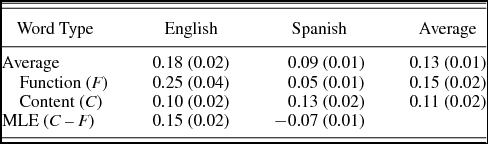
The main effect of word type was qualified by a significant Word Type × Language interaction, F (1, 39) = 70.00, MSE = 0.01, p < .01. Pairwise comparisons showed that for English passages, participants made approximately 15% more errors in function words than in content words, F (1, 28) = 64.38, MSE = 0.005, p < .01. This is the typical MLE. The reverse occurred for Spanish passages, such that participants made 7% fewer errors in function words than in content words, F (1, 28) = 14.62, MSE = 0.01, p = .01. This is a reversed MLE.
Comprehension
Comprehension data were analyzed with a 3 (question type: surface form, text base, or situation model) × 2 (language: English or Spanish) × 2 (task type: letter detection or normal reading) repeated measures analysis of variance with the proportion of comprehension questions answered correctly as the dependent measure (see Table 3 for means).
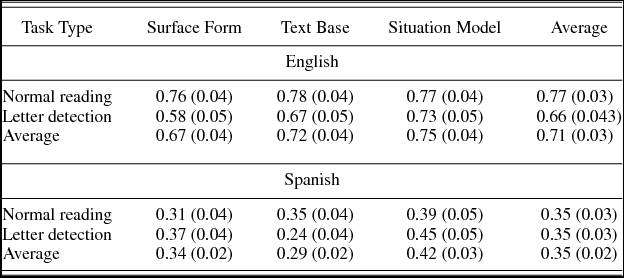
Mean (standard errors) comprehension scores (proportion correct) as a function of question type, passage language, and task type
There was a main effect of question type, F (2, 56) = 4.76, MSE = 0.05, p < .01. Pairwise comparisons revealed that comprehension was better for the situation model level questions (M = 0.58, SE = 0.03) than for either the surface form (M = 0.50, SE = 0.03) or the text base questions (M = 0.51, SE = 0.03; ps < .01). There was no difference in comprehension between surface form and text base level questions (p = .86).
As expected, there was a main effect of language, F (1, 56) = 234.61, MSE = 0.05 p < .01, such that readers comprehended the English passages (M = 0.71, SE = 0.03) much better than the Spanish passages (M = 0.35, SE = 0.02). For both languages, comprehension was above chance accuracy (chance = 0.25; z = 2.02, p < .05), which indicates participants were able to read for comprehension while performing the letter-detection task, even in their less proficient language.
There was a main effect of task type, F (1, 56) = 4.49, MSE = 0.05, p < .05, with comprehension being better during normal reading (M = 0.56, SE = 0.02) than during letter detection (M = 0.51, SE = 0.03). More interesting, there also was a Task Type × Language interaction, F (1, 56) = 5.57, MSE = 0.05, p < .05. Pairwise comparisons showed that participants comprehended English passages better when reading normally (M = 0.77, SE = 0.03) than when detecting letters (M = 0.66, SE = 0.04), F (1, 56) = 3.32, p < .05. In contrast, comprehension of Spanish passages was equivalent across tasks (normal reading: M = 0.35, SE = .02; letter detection: M = 0.35, SE = 0.3), F (1, 56) < 1, ns.
The Question Type × Language, Question Type × Task, and Question Type × Language × Task interactions were not significant (all Fs < 2.2, ns).Footnote 1 This demonstrates that the pattern of comprehension (situation model > text base = surface form) did not systematically vary as a function of language proficiency or task type (letter detection versus normal reading).
In summary, the addition of the letter-detection task significantly reduced comprehension for English, but not for Spanish. Overall, comprehension was better at the situation model level, but all levels of comprehensions were reduced for letter detection relative to normal reading.
DISCUSSION
Language proficiency clearly influenced letter-detection error rate, the MLE, and comprehension. Several key findings emerged. First, overall letter-detection error rate was smaller in the less proficient (Spanish) language. This indicates that readers were less likely to process words as a single unit and more likely to attend to the individual letters when performing letter detection in Spanish than in English. Second, the size of the Spanish MLE was not simply smaller than the English MLE, but was reversed in direction. The reversal indicates participants were processing some features of the text in a different manner in their nonproficient language than in their proficient language. When performing letter detection in Spanish, participants might have focused more attention on lower level text properties, such as letters, and less attention on other features, such as grammatical class. Third, comprehension was much better in the proficient (English) language than in the nonproficient (Spanish) language. What is interesting is that performing the letter-detection task caused a significant reduction in comprehension of English passages but not Spanish passages. Furthermore, comprehension based on all three question types was degraded equally by adding the letter-detection task to normal reading. These results demonstrate that how function and content words are processed changes as a function of proficiency, that adding the letter-detection task to normal reading has a larger impact on comprehension of the proficient language than the nonproficient language, and that comprehension at each level was similarly reduced during letter detection relative to normal reading (i.e., a general reduction in comprehension).
Our results complement previous findings by Greenberg and Saint-Aubin (Reference Greenberg and Saint-Aubin2004, Reference Greenberg and Saint-Aubin2008) and Chitiri and Willows (Reference Chitiri and Willows1997). They found a normal MLE in the native/proficient language and a reverse MLE for the less proficient language. Their nonproficient language data, along with ours, seems to be at one end of the spectrum of word processing, a point in which the task emphasizes visual search for specific orthographic features for the low-proficiency language. At the other of the end of the spectrum is the high-proficiency language. Both monolinguals and bilinguals demonstrate a reliable MLE when reading in their first/proficient language. Although the pattern of MLEs is consistent, the size of the MLE in our study (−7% to 15%) and Chitiri and Willows's study (−2.5% to 3.5%) is much smaller than the MLE in Greenberg and Saint-Aubin's studies (−40% to 63%). It's worth noting that in our study and Chitiri and Willows's study participants were given six-question comprehension tests after reading a passage whereas Greenberg and Saint-Aubin did not report giving comprehension tests. Emphasizing comprehension might slow reading rates, which would lead to more time focused on each word and fewer letter-detection errors overall.
Of course, comprehension is affected by language proficiency, but our results demonstrate that the letter-detection task differentially affects comprehension as a function of proficiency. For the English passages, comprehension decreased for all three question types with the addition of the letter-detection task. In contrast, for the Spanish passages, there was no overall difference in comprehension between normal reading and letter detection. Average comprehension accuracy was above chance for the Spanish passages, which indicates the task readers did not give up on trying to comprehend the passages and focus all their attention on the letter-search task. Although there was no statistical difference between question types for Spanish, comprehension of the text base (24%) matches chance level. Perhaps there is a balance between attention devoted to comprehension and letter detection that varies as a function of proficiency. Specifically, as proficiency increases, knowledge of word roles increases, less attention is required to process words, higher level integrative process become easier, and more attention is available to devote to all levels of comprehension. When proficiency is low and comprehension is limited, fewer resources are devoted to comprehension and more resources are devoted to the letter-search component. It should be noted that statistical chance here (25%) might not be the same as performance when the passage is not read. The comprehension questions were originally designed to ensure that they could not be answered correctly at a rate above chance if the passages had not been read (Daniel & Raney, Reference Daniel and Raney2014). It is possible that the translation of the questions into Spanish did not preserve the original selection rate of the multiple-choice alternatives. For example, there could be cues in the questions that help readers eliminate an option for some questions, which would increase the odds of guessing the correct answer. Performance in Spanish ranged from 24% for text base questions (clearly at statistical chance) to 45% for situation model questions during letter detection. It seems reasonable to assume that readers could not answer 45% of the situation model questions, which require application and inferences, if they did not obtain at least minimal knowledge of the meaning of a passage. Nonetheless, it is possible that participants are at floor for comprehension in Spanish. Future research could address this issue by including an intermediate level of proficiency.
To evaluate the hypothesis that readers emphasized the search process for Spanish passages, we compared the correlations between letter-detection error rate and word length for each language. If search processes are emphasized, more errors should occur on longer words than on shorter words due to increased visual distraction from additional letters in the word. We found this exact pattern. For Spanish, there was a significant positive correlation between word length and error rate (r = .28, df = 857, p < .01), which indicates more errors were made on longer words. The opposite occurred for English texts: there was a significant negative correlation between word length and error rate (r = −.34, df = 1395, p < .01), which indicates fewer errors were made on longer words. For English, this pattern might reflect something like a word-superiority effect, with the additional letters in longer words providing a context that was helpful for processing the individual letters (Reicher, Reference Reicher1969; Wheeler, Reference Wheeler1970).
When we examined the word-length correlations as a function of word type, we found that the relationship between word length and accuracy was stronger for function words than for content words for both Spanish (r = .17, df = 487, p < .001; r = .01, df = 368, p = .81, respectively) and English (r = −.16, df = 463, p < .001; r = −.07, df = 931, p < .05, respectively). This supports the conclusion that how function words are processed changes more than how content words are processed as language proficiency increases. This is consistent with the idea that readers learn to use function words to guide their attention to content words (Roy-Charland et al., Reference Roy-Charland, Saint-Aubin, Klein and Lawrence2007). Although the word-length correlations are not definitive evidence for an emphasis on the letter-search component of the letter-detection task, the reversal in correlations for Spanish and English provides strong support for the conclusion that the processes used for letter detection change dramatically as a function of language proficiency. To better understand how letter detection changes as a function of proficiency, future research could track participants in a longitudinal design. This would allow one to track whether changes in the MLE are linear or nonlinear as proficiency increases while controlling for potentially confounding individual differences such as age of second language acquisition. As proficiency increases, we would predict that the MLE would change from being reversed to approaching zero (no MLE), and eventually become positive (a standard MLE). This would be consistent with previous studies based on between-subject comparisons (e.g., Hatch et al., Reference Hatch, Polin and Part1974; Tao et al., Reference Tao, Healy and Bourne1997).
In summary, we propose that when readers struggle with word processing and comprehension, they focus more attention on recognizing individual letters to decipher the words and focus less on general comprehension processes. That is, less proficient readers emphasize the visual search component of the letter-detection task. This is consistent with Greenberg and Saint-Aubin's (Reference Greenberg and Saint-Aubin2004, Reference Greenberg and Saint-Aubin2008) conclusion that reading in an unfamiliar language changes the task to emphasize the analysis of orthographic patterns. In addition to focusing more attention on letter-level processes, less-proficient readers likely read words more slowly, which would support more complete letter identification and lead to an overall decrease in letter-detection errors. Our findings highlight differences in cognitive processes during reading related to language proficiency, demonstrate a change in the focus of attention or manner of word recognition during reading as a function of language proficiency, and enhance our understanding of the letter-detection task itself by demonstrating a reduction in comprehension at multiple levels relative to normal reading.
APPENDIX A SAMPLE PASSAGE AND COMPREHENSION QUESTIONS
Going on a first date in high school
While a first date commences with the ringing of a doorbell, hours of preparation will occur prior to the date. For most high school students, plans are conducted via telephone. Indeed, for the event to be successful, certain elements must be in place before it begins. An appropriate time, for example, must be mutually agreed upon between the parties involved. In addition, information such as name, address, and occupation are exchanged. In most cases, these preliminary details are determined days prior to the event, and final preparations do not begin until the day of the affair. Actually, the very hour before the doorbell rings is generally the most frenzied for both parties. Daily primping routines are followed with special care and attention in this hour, and tasks that have been neglected are undertaken. Washing, scrubbing, and brushing, for example, are conscientiously completed. Both parties for the most part use the same products to complete these tasks. Creams, razor blades, and clippers are employed. If preparations run on schedule, the date will begin as planned, with the ringing of the doorbell. According to students, this particular moment is the most anxiety-ridden of the entire occasion. Often, individuals’ careful preparations become undone. Sweat glands overproduce, hearts begin to race, and dexterity is fatally reduced. Ironically, if both students are pleasantly surprised at the start of the date, such nervous bodily responses will not dissipate for the rest of the evening. Disappointment, however, is often a guaranteed remedy for these physiological reactions. The anxiety associated with this event may seem extreme to inexperienced daters. It is important to recognize, however, that a successful date is entirely dependent on chance. Whether the event turns out to be promising or a total disaster is quite often independent of any one party's influence. Still, students like to speculate on what elements contribute most to a successful date. Some believe strongly that appearance is paramount, while others believe character is essential. Regardless, if the date is a dreadful disaster, no further communication will take place between the students. If the event is enjoyed by both students, however, an additional date will likely follow. In this case, the entire process begins again. Preliminary details are laid down via telephone. Daily routines are undertaken prior to the event. Heart rate, blood pressure, and sweat production all elevate. As compared with the first date, however, the students’ anxiety levels are generally significantly lower.
Surface form
1. Which word was in the original sentence?
An appropriate time, for example, must be _____agreed upon between the parties involved.
a. jointly
b. individually
c. mutually*
d. equally
Text base
3. Which of the following is involved in the preparation for the affair?
a. Parties extreme anxiety associated with the event.
b. Parties paying special attention to daily routines.*
c. The speculation involved on what contributes to the success.
d. The possibility that additional events will occur.
Situation model
5. What could happen if one encounters a party from unsuccessful events?
a. The encounter will be socially unacceptable.
b. The encounter will cause confusion among elders.
c. The encounter could be socially awkward.*
d. The encounter will cause joy among elders.