Introduction
The parent–child bond in humans is exceptionally long-lasting, far exceeding the point at which offspring reach physical maturity and nutritional independence. Evolutionary studies of human parenting have tended to focus on investment directed toward very young children, with significant emphasis on the realms of direct care and provisioning. Mothers have almost always been shown to be the primary providers of direct care, whereas paternal provisioning and the effects of paternal care on child survival vary substantially across cultures (Marlowe, Reference Marlowe2000; Sear & Mace, Reference Sear and Mace2008). However, as children age and investment needs change, fathers may have increasing opportunities to provide alternative forms of care. This is particularly true in societies where men control access to resources linked to children's adult status and success. Therefore, in the context of extended investment, paternal care may be skewed later than maternal care, in either proportion or frequency.
Some of the most important components of adult success across human societies are the acquisition and retention of a high-quality spouse, and securing a position in locally relevant status hierarchies. Both of these are expected to improve reproductive success, measured as having more or more high-quality offspring (Petrie, Reference Petrie1994; Kokko & Johnstone, Reference Kokko and Johnstone2002; Smith, Reference Smith2004). Parental efforts to aid offspring in both these arenas are common in humans, indicating a net benefit to continuing care for both parents and children (Blurton Jones et al., Reference Blurton Jones, Hawkes, O'Connell, Standen and Foley1989). Fathers in particular have been shown to have a positive effect on educational attainment, adult income, age of initiation and other status outcomes (e.g. Harris et al., Reference Harris, Furstenberg and Marmer1998; Shenk, Reference Shenk2004; Scelza, Reference Scelza2010). They also participate in marriage arrangements and provide marriage payments in the majority of cultures where these phenomena exist (e.g. Apostolou Reference Apostolou2007, Reference Apostolou2010a). Fathers are often called upon to invest in these arenas because they control the wealth or social networks necessary to complete such transactions. Furthermore, because of inclusive fitness benefits, downward transfers and effort are also more likely to go to offspring than to nieces, nephews or other young relatives, as long as paternity certainty is reasonably high. In addition, men may receive auxiliary benefits to marrying their children to high-quality spouses or situating their children in hierarchical structures within society (Betzig, Reference Betzig1986; Apostolou, Reference Apostolou2007, Reference Apostolou2010b; Shenk, unpublished). While the specific costs and benefits will vary widely across cultural contexts, this suite of incentives makes fathers particularly likely to engage in these later, status-related forms of care.
If paternal care is likely to enhance later investment outcomes, it should also be true that father absence has the opposite effect. Several studies have shown such effects when fathers are absent early in their children's lives. Evolutionary anthropologists and psychologists have shown that children with absent fathers, particularly those who lose their fathers between ages 0 and 5, are more likely to exhibit a suite of alternative behavioural strategies when they reach adolescence, including earlier age at menarche, early sexual activity and an increased likelihood of teen pregnancy in daughters, and increased aggression and same-sex competitiveness in sons (Draper & Harpending, Reference Draper and Harpending1982; Ellis et al., Reference Ellis, Bates, Dodge, Fergusson, Horwood, Pettit and Woodward2003; Quinlan, Reference Quinlan2003). Investment-related outcomes have also been shown to differ according to father's role. Children whose mothers are either widowed or divorced have lower educational attainment than children in two-parent families (Pong, Reference Pong1996; Steele et al., Reference Steele, Sigle-Rushton and Kravdal2009). Divorce or death of a father has also been linked to poorer economic outcomes, including less employment and lower wage rates (McLanahan & Sandefur, Reference McLanahan and Sandefur1994; Fronstin et al., Reference Fronstin, Greenberg and Robins2001; Lang & Zagorsky, Reference Lang and Zagorsky2001). These results stand in sharp contrast to other studies of paternal investment that focus on health and fertility, where father absence during childhood rarely has a significant effect on either childhood (Sear & Mace, Reference Sear and Mace2008) or adult outcomes (Winking et al., Reference Winking, Gurven and Kaplan2011). These findings suggest that father absence may have particularly detrimental effects on investment outcomes in contexts where paternal effort is less substitutable. The effects should be most pronounced in settings where women control little wealth, where patrilineal inheritance rules are strict, or where kin or other social support systems are lacking.
This study assesses whether father absence has a detrimental effect on investment outcomes, and further postulates that a father's absence may be particularly detrimental in older children whose need for the types of investment fathers provide is greatest. Father absence is typically defined quite broadly, including fathers who are still alive but are no longer (or sometimes were never) co-resident with their children. This paper limits its exploration of father absence to cases of paternal death. This is an important distinction in a study of direct investment because genetic fathers who are not co-resident frequently contribute to offspring care (Anderson et al., Reference Anderson, Kaplan, Lam and Lancaster1999a, Reference Anderson, Kaplan, Lam and Lancasterb). This paper also focuses on investment outcomes that are either cumulative over the life course or occur in adolescence or adulthood, hypothesizing that paternal care may be particularly critical in these arenas. To assess whether there is a ‘critical period’ of direct investment by fathers, analyses are stratified according to the timing of father's death, to allow determination of whether losing a father at certain ages is more harmful than others. This method will also reveal any cumulative effects of paternal loss.
Paternal investment in India
Forms of parental investment
In the social context of modern urban India, there are three primary ways of enhancing the prospects of one's children. First, one can help them obtain human or embodied capital in the form of skills training or formal education, which can be used to earn income or secure a good marriage partner (e.g. Kaplan, 1996). Second, one can enhance a child's wealth or lifetime income by making direct resource transfers to that child, which can be either used by the child directly or invested so that they produce more wealth. Finally, a parent can invest in a child by arranging his or her marriage to a high-quality spouse, thus increasing long-term investment in the child's own children.
Education can be very costly in India, yet higher levels of education can result in greater income (Kingdon & Unni, Reference Kingdon and Unni2001; Dhesi, Reference Dhesi2002; Duraisamy, Reference Duraisamy2002), higher social status, a better position on the marriage market (Caldwell et al., Reference Caldwell, Reddy and Caldwell1983) and possibly greater efficiency in investment in the education of grandchildren (Kaplan, Reference Kaplan1996; Kaplan & Lancaster, Reference Kaplan, Lancaster, Cronk, Chagnon and Irons2000). The education of sons is of direct economic and social benefit not only to the sons themselves but also to their parents (e.g. Caldwell et al., Reference Caldwell, Reddy and Caldwell1983). This is because sons, who are typically the primary and often exclusive breadwinners, remain socially tied to and economically responsible for their natal family. An educated son with a good income is therefore in great demand in the marriage market, able to command an educated, beautiful and/or wealthy bride, an expensive wedding and potentially significant wealth transfers from his bride's family (e.g. Caldwell et al., Reference Caldwell, Reddy and Caldwell1983; Caplan, Reference Caplan1983; Shenk, Reference Shenk2004; Dalmia & Lawrence, Reference Dalmia and Lawrence2005). Educating daughters may have either direct economic benefits (e.g. Duraisamy, Reference Duraisamy2002) or may primarily be motivated by matchmaking considerations (Caldwell et al., 2003). In some social classes, daughters may be able to use their education to obtain employment, though their income will generally be under the control of their parents before marriage and may be used by them to help defray the costs of her wedding (e.g. Dickey, 2010). If a woman works after marriage, her income will often be under the control of her husband or her in-laws (Caldwell et al., Reference Caldwell, Reddy and Caldwell1983; Rao, Reference Rao1993). Even if a woman does not work, education can improve her position in the marriage market as better-educated grooms often demand better-educated brides (e.g. Shenk, Reference Shenk2004; Dalmia & Lawrence, Reference Dalmia and Lawrence2005).
Wealth can be invested directly in the quality of children or grandchildren, or can be invested to produce more wealth thus creating a renewable source of income (Mace, Reference Mace, Cronk, Chagnon and Irons2000; Luttbeg et al., Reference Luttberg, Borgerhoff Mulder, Mangel, Cronk, Chagnon and Irons2000). Parents in India often help to set their children up in businesses or occupations that will then provide the livelihood for that child's own family. Additionally, a child may receive income from rent or interest on land, property or investments that their parents have given them (e.g. Caplan, Reference Caplan1983). Wealthier parents also use their resources to enhance income opportunities available to educated children. For instance, parents who are well-educated may invest in a son's medical degree, but if they are also wealthy they may use their resources to additionally set him up with his own medical clinic (e.g. Shenk, Reference Shenk2004). Finally, a child with greater capital may be able to attract better mates in the marriage market. This is especially important for sons, who may be able to attract a bride from a higher status family or one who will bring a large dowry (Caldwell et al., Reference Caldwell, Reddy and Caldwell1983; Dalmia & Lawrence, Reference Dalmia and Lawrence2005; Edlund, Reference Edlund2006).
In modern Indian society, it is almost always necessary to pay high marriage costs to get one's daughter married, especially if she is to be married in a socially acceptable manner and to a socially acceptable groom (e.g. Caldwell et al., Reference Caldwell, Reddy and Caldwell1983; Srinivas, Reference Srinivas1984; Uberoi, Reference Uberoi1994; Oldenburg, Reference Oldenburg2002). Families spend the largest sums on costly silk saris and gold jewellery for the bride, renting and decorating a large hall for the wedding, and feeding several meals to hundreds of guests over two or more days. They also give gifts to most members of the wedding party, and may transfer large amounts of wealth to the bride, groom or groom's family in the form of furniture, appliances, vehicles, other consumer items or cash (e.g. Srinivas, Reference Srinivas1984; Shenk, Reference Shenk2007). Although investment in marriage costs is not of direct economic benefit to a bride's family, it can be viewed as a form of mate competition or parental investment because after marriage the daughter will share in the benefits of her husband's income and that of his family, thus affecting her ability to reproduce successfully and invest in her own offspring (Dickemann, Reference Dickemann1979; Gaulin & Boster, Reference Gaulin and Boster1990; Shenk, Reference Shenk2004, Reference Shenk2007). Parents also invest in costly gifts and smaller functions related to the marriages of sons (e.g. Caplan, Reference Caplan1983; Edlund, Reference Edlund2006); one measure shows that in south India this is usually around one-third of what they invest in the marriage costs of daughters (Shenk, Reference Shenk2004).
The role of fathers
In modern urban India most forms of parental investment are at least partially reliant on level of income, which in the Indian context is primarily provided by fathers (e.g. Saraff & Srivastava, Reference Saraff and Srivastava2008; Sriram, Reference Sriram2011). While middle-class women increasingly work outside the home in white collar jobs, and poor women perform many kinds of skilled and unskilled labour, the vast majority of urban Indian women remain housewives. Thus the loss of a father, along with the father's income and social support, has the potential to strongly impair investment in children.
In addition to income, fathers provide children with social connections through their social networks of kin (including blood relatives, in-laws and fictive kin), friends, business associates and other individuals or families who may be important in local social contexts (e.g. Saraff & Srivastava, Reference Saraff and Srivastava2008; Sriram, Reference Sriram2011). A father's social connections can help children in finding good jobs and high-quality, socially appropriate marriage partners. Fathers may be especially important in this capacity as men are much more public figures than women with broader social networks acquired through work and travel.
Finally, fathers often engage in direct teaching, play and other forms of interaction with their children (e.g. Saraff & Srivastava, Reference Saraff and Srivastava2008; Sriram, Reference Sriram2011). This may be especially valuable to a child's educational prospects, as evidence shows that interactions with parents may allow children of better-educated parents to be more efficient at schoolwork and educational achievement (Kaplan, Reference Kaplan1996; Kaplan & Lancaster, Reference Kaplan, Lancaster, Cronk, Chagnon and Irons2000). Since mothers are generally less well educated than fathers, fathers may be especially important in the ability of older children to acquire higher levels of education.
Paternal death
Upon the death of a father, local custom dictates that his economic and social roles be taken on by other relatives, usually the father's father or father's brother, or if one of these is not available, the mother's father or mother's brother (e.g. Uberoi, Reference Uberoi1994). Yet the help of such relatives is not guaranteed. Grandfathers are likely to be dead, aged or no longer working. One or both of the parents may lack brothers, or existing uncles may be too poor, live too far away, or have too many children of their own to help their nieces and nephews very much. Additionally, as women traditionally leave their natal families at marriage, married women are thought to become members of their husbands' families, lessening familial obligations from parent to daughter (e.g. Sharma, Reference Sharma and Uberoi1993; Uberoi, Reference Uberoi1994). While women's parents generally do help their impoverished or widowed daughters, if the family is economically stressed they may preferentially channel their investment into sons and son's children who are considered full members of their own family and moreover will take care of parents in their old age (e.g. Sharma, Reference Sharma and Uberoi1993; Lamb, Reference Lamb, Mines and Lamb2010; Wadley, Reference Wadley, Mines and Lamb2010).
Replacement of investment by stepfathers is generally not an option in the Indian context. There are longstanding taboos against widow remarriage among Hindus, and even in modern India where this stigma is decreasing widows often find it very difficult to remarry, especially if they have children. If a widow does remarry, custom dictates that she leave her children to be raised by her husband's family, or, more rarely, by her own natal family. It is thus very unusual for a woman to take her children with her into a new marriage.
Methods
Study population and sample
Data were collected in 2001–2002 in Bangalore, India, a city of approximately 5.7 million people located in India's south–central Deccan plateau (Haub & Sharma, Reference Haub and Sharma2006). Bangalore experienced rapid economic and population growth in the late 20th and early 21st centuries, especially following the liberalization of the Indian economy in 1991. Most striking has been the growth of the booming Indian software and technology industry centred in the city.
Data come from detailed survey interviews with 403 respondents between the ages of 45 and 70, each of whom had at least one married child. Respondents were interviewed about their marriage, the demographic and socioeconomic characteristics of their current family, their own natal family and that of their spouse, and the marriages and families of their adult children. Respondents were recruited through personal contacts and referrals via snowball sampling (Bernard, Reference Bernard1995) within several major caste groups in Bangalore. This method is appropriate for use when particular target populations are needed but random sampling is not possible. This was the only feasible way of collecting detailed data as enumerated lists of Bangalore residents are rare and problematic, and a personal introduction is often necessary to secure an interview of any length or depth. Attention was paid throughout the data collection process to the breadth of the sample, and interviewees came from a broad range of social classes and from all major caste groups in Bangalore.
Data and variables
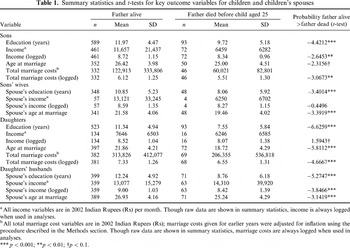
Summary statistics for key outcome variables for both children and children's spouses are presented in Table 1. Education is given in years completed. Income is given in 2002 Indian Rupees per month, regardless of the source of the income. Most sons and daughter's husbands in the sample have jobs, but many daughters and son's wives do not. Results for daughters and son's wives are only given if there is a large enough sample size to achieve reliable results. Total marriage costs is the combined total of all marriage expenses as reported by the respondent and standardized to 2002 Indian Rupees based on the 1960 base All-India Consumer Price Index (see Shenk, Reference Shenk2005b, for details). Both income and total marriage costs are logged (natural log) to adjust for high variance and non-normal distribution, primarily the high degree of right-skew. Age at marriage is in years as reported by respondents.
Summary statistics and t-tests for key outcome variables for children and children's spouses
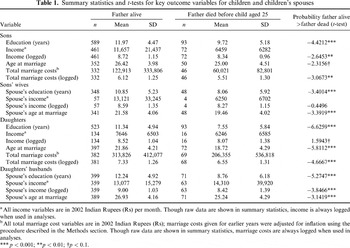
a All income variables are in 2002 Indian Rupees (Rs) per month. Though raw data are shown in summary statistics, income is always logged when used in analyses.
b All total marriage cost variables are in 2002 Indian Rupees (Rs); marriage costs given for earlier years were adjusted for inflation using the procedure described in the Methods section. Though raw data are shown in summary statistics, marriage costs are always logged when used in analyses.
***p<0.001; **p<0.01; †p<0.1.
The analyses here compare children whose fathers were alive until the children were full adults with children whose fathers died at various points during their childhood, adolescence and young adulthood. The effects of parental divorce or father desertion are not considered formally in this paper because (a) they are quite rare in this sample, and (b) there is no way to control for how much paternal investment fathers may have provided after divorce. However, it is important to note that both divorce and desertion are very rare in the Indian context compared with the death of fathers, which is comparatively common. The main predictor variable is a categorical variable that stratifies the age of the child when his or her father died, compared with a reference category of children whose fathers were alive until they were at least 25 years old. As discussed above, many types of investment discussed in this paper (higher levels of education, income coming from adult occupations, and ages and costs of marriages) occur and come to fruition during a child's adolescence or early adulthood. For this reason this paper considers ages older than the conventional adult age of 18 since investment at young adult ages clearly has important implications for children's long-term social status, especially through their marriages and the characteristics of their spouses.
Control variables used in these analyses include the following: father's education in years completed; father's income in 2002 Indian Rupees per month, logged to adjust for high variance and strong right skew. If a father who had previously worked was retired, his income before retirement was used. Both father's education and father's income were used as controls for the family's socioeconomic status while the father was alive, and as proxies for socioeconomic status after the father's death. This seemed reasonable given that the children's mother and other relatives were likely to have a social status similar to that of the dead father. This results in a conservative test of the effects of father death since in many cases it is likely that socioeconomic status of children would have been reduced after the death of the father.
Child's age is included in models of child characteristics to control for age effects on child's income and other temporal effects such as secular trends in education. Year of marriage is included in models of child's marriage or spouse characteristics to control for time effects on income as well as other temporal effects such as changing norms in the marriage market. Number of children and child's birth order are included in the models to control for the effects of family demography on investment outcomes. The proportion of daughters is operationalized as the number of daughters in the family divided by the total number of children in the family, and is intended to control for gender-biased investment within families. A dummy variable indicating maternal death controls for situations in which it is the mother rather than the father who is dead (due to the research design one of the parents had to be alive as they were the interviewee). Maternal deaths were much less common in this sample (37 cases) than paternal deaths (187 cases).
Analytical methods
The initial analysis compared mean values of the outcome variables for two groups of children: those whose fathers died before they turned 25 and those whose fathers survived until they were at least 25. Two-group mean comparison t-tests were used. These bivariate analyses provide a baseline understanding of how paternal death affects investment outcomes. The t-tests were performed using logged versions of income and total marriage cost variables since unlogged versions were not normally distributed.
To understand the effects of timing of a father's death on child outcomes, a series of regression models were constructed using a categorical variable as the key predictor. Here, the reference category, to which all other categories are compared, includes children whose fathers survived until they were at least 25 years old. The other categories include children whose fathers died when they were between the ages: 0–5, 6–10, 11–15, 16–20, and 21–25. Regressions using the same categorical variable were then run with spousal outcomes as the dependent variables. Models of most outcome variables utilize all six categories of the predictor variable, but models of outcome variables related to a son's marriage (including son's wife's characteristics) only use five categories: death of father from ages 0–10 was collapsed into a single category due to small sample size in the 0–5 category. Finally, the regressions for children's spouses were run with and without child's education and marriage costs as controls in order to assess whether father's death was causing a direct or indirect effect on spousal characteristics. All statistical tests were run using Stata 10.0 and figures were constructed using Graphpad Prism.
Results
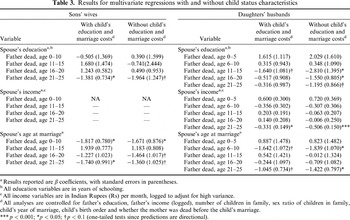
Children of dead fathers have lower levels of education, lower incomes (though the effect is marginal for daughters), lower ages at marriage (though the effect is marginal for sons) and lower total marriage costs than children whose fathers survived until they were at least 25 years old (Table 1). Spouses of children whose fathers have died show similar patterns: lower levels of education, lower incomes (though the effect is marginal for sons' wives) and lower ages at marriage.
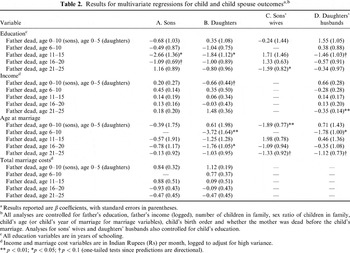
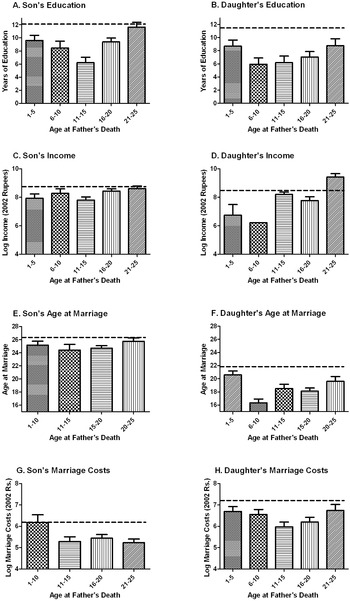
Table 2 and Fig. 1 show regression results for sons and daughters for the outcome variables education, income, age at marriage and total marriage costs; significance levels are calculated for a one-tailed test since predictions are directional. Results for both son's and daughter's education show a clear pattern. Children whose fathers died have less education than those whose fathers lived, and the loss of a father at a very young age, or over the age of 20, has a less negative effect than loss of a father during the intervening years. Level of education for both sons and daughters was significantly lower for those whose fathers died between ages 11 and 15, with a continuing negative result for sons whose fathers died when they were between 16 and 20 years of age. Results for child income show clear negative effects of father's death for children who lost their fathers before age 20; however, the results are not significant. There is no clear temporal patterning for sons, but daughter's income shows a J-shaped curve, similar to that seen for children's education results. Results for son's and daughter's age at marriage also show clear negative effects of father's death, and echo the pattern found for education in which children at intermediate ages have lower ages at marriage than children whose fathers died either early or late in the child's life. This pattern is more pronounced and is statistically significant for daughters whose fathers died in middle childhood and adolescence. For both sons and daughters, losing one's father between ages 16 and 25 appears to be more detrimental than losses at earlier ages, though the trend is not significant. Daughter's marriage costs show a pattern of intermediate loss being worse than early or late loss, while the results for son's marriage costs suggest that early loss is less problematic while intermediate or late loss are equally disadvantageous.
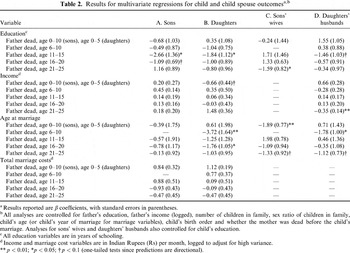
a Results reported are β coefficients, with standard errors in parentheses.
b All analyses are controlled for father's education, father's income (logged), number of children in family, sex ratio of children in family, child's age (or child's year of marriage for marriage variables), child's birth order and whether the mother was dead before the child's marriage. Analyses for sons' wives and daughters' husbands also controlled for child's education.
c All education variables are in years of schooling.
d Income and marriage cost variables are in Indian Rupees (Rs) per month, logged to adjust for high variance.
**p<0.01; *p<0.05; †p<0.1 (one-tailed tests since predictions are directional).
Regression results for child outcome variables. Graphs show the predicted value of the outcome variable, adjusting for controls, for children whose fathers died during several 5-year periods in their childhood, adolescence and early adulthood. The dashed line in each graph represents the mean for children whose fathers survived until the child reached age 25.
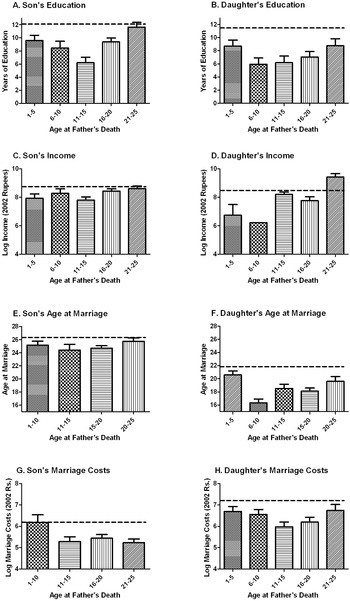
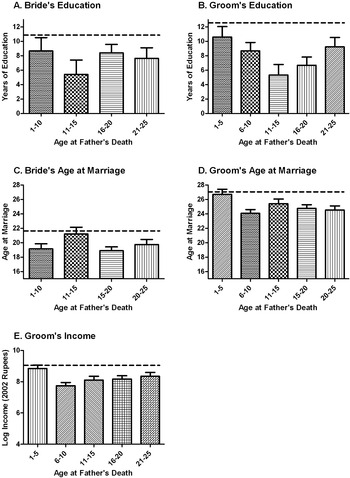
Table 2 and Fig. 2 show regression results for sons' and daughters' spouses for the outcome variables education, income and age at marriage. Results for spouse's education suggest that father death leads to lower child spouse education. Results for both sons' wives and daughters' husbands follow a similar pattern suggesting that paternal loss at intermediate or older ages may have the strongest negative effects, though the effects are only significant for the wives of sons whose fathers died when they were 21–25 and for the husbands of daughters who lost their fathers at ages 11–15. Results for daughter's husband's income follow a similar pattern with the loss of a father in late childhood associated with the lowest income while the loss of a father before age 5 shows little disadvantage, though the effects only achieve significance for daughters who lost their fathers at 21–25. Data are not sufficient to provide good estimates for sons' wives income since most women do not work after marriage. Finally, results for the age at marriage of both son's wives and daughter's husbands show lower ages at marriage for spouses of children with dead fathers when compared with the children of living fathers. Loss of a father before age 5 has little effect on a daughter's husband's age, while loss of a father at intermediate or older ages is more disadvantageous, reaching significance for daughters whose fathers died when they were 6–10 and showing a similar trend for loss at 21–25. For son's wives the effects are significant when fathers died between the ages of 0–5 and show a similar trend for loss at 21–25.
Regression results for spouse outcome variables. Graphs show the predicted value of the outcome variable, adjusting for controls, for spouses of children whose fathers died during several 5-year periods in their childhood, adolescence and early adulthood. The dashed line in each graph represents the mean for the spouses of children whose fathers survived until the child reached age 25.
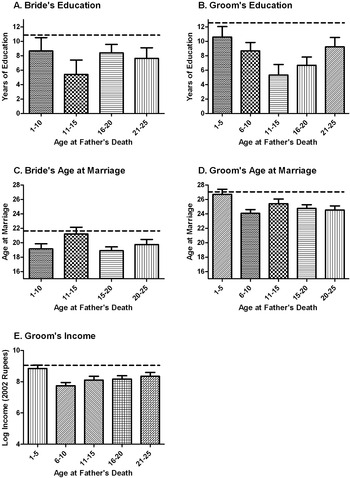
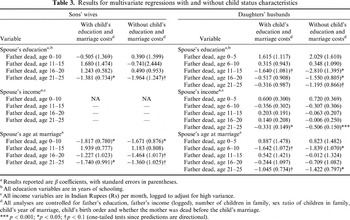
Table 3 shows results for spousal characteristics with and without controls for child characteristics that may play an intervening role. Results for sons' wives' education and age at marriage suggest that father's death has an appreciable but limited direct effect since a model with only father and family characteristics often shows weaker effects of the age at which a father died than does a model including son's characteristics. These findings suggest that sons' characteristics may be key to the characteristics of their wives and that the direct and indirect effects of father's death are more moderate.
Results for multivariate regressions with and without child status characteristics
a Results reported are β coefficients, with standard errors in parentheses.
b All education variables are in years of schooling.
c All income variables are in Indian Rupees (Rs) per month, logged to adjust for high variance.
d All analyses are controlled for father's education, father's income (logged), number of children in family, sex ratio of children in family, child's year of marriage, child's birth order and whether the mother was dead before the child's marriage.
***p<0.001; *p<0.05; †p<0.1 (one-tailed tests since predictions are directional).
Results for daughters' husbands' education, income and age at marriage show a different pattern. They suggest that the effects of paternal death on sons-in-law act indirectly through the daughter's characteristics, because there are more and stronger direct effects of father's deaths when child characteristics are not controlled for. Controlling for the daughter's characteristics lessens or removes the effects of paternal death, thus suggesting a mediating role for the education and marriage costs of daughters.
Discussion
These results substantiate previous findings that paternal death has negative effects on children. However, two aspects of the findings deserve further discussion: the effects of the timing of father death, and the stronger effects of father's death on daughters than sons.
The behavioural and physiological outcomes of father absence, particularly those tied to a faster life-history, are often hypothesized to occur as a response to cues in early life that signal reduced support from men toward women and children in their local environment (Draper & Harpending Reference Draper and Harpending1982; Belsky et al., Reference Belsky, Steinberg and Draper1991; Chisholm et al., Reference Chisholm, Quinlivan, Petersen and Coall2005). These studies emphasize a critical period in early life (typically age 0–5 years) where father absence will be most tightly linked to future psychological and developmental outcomes such as early menarche. The results presented here show a different pattern. When status-linked outcomes of direct investment are measured, father absence often has more detrimental effects when it begins in middle childhood through adolescence than if it begins when children are very young. Additionally, these results indicate that children who lose their fathers very early or very late often do nearly as well, in terms of investment outcomes, as those with living fathers. Together, these results and those of previous studies indicate a pattern of differential risk. There are negative effects of paternal loss across a child's lifespan, but the magnitude of these effects varies according to the type of outcome and the age of the child at the time of paternal loss. That the potential ‘critical period’ varies even across the outcome measures in this dataset emphasizes this point. However, this variation also suggests that cultural context is critical to understanding when, how and to what degree paternal loss affects child outcomes.
These data illustrate this pattern across most outcome variables; however, only a few cases reach statistical significance. Although this is a relatively large sample overall, the number of paternal deaths occurring in a given age category is small, ranging from 5 to 28 cases for sons and 1 to 23 cases for daughters. While numbers of paternal deaths were more robust for education, where the study had its most consistent and significant results, for variables such as age at marriage and total marriage costs, sample sizes were more limited because some members of the sample were unmarried (41% of sons and 24% of daughters). Similarly, the number of daughters in the sample who had a reported income was also small (24%) and only 17% of those had fathers who died before the daughter was age 25. Therefore, while a consistent pattern of negative outcomes can be emphasized for those who lost fathers during middle childhood and adolescence, larger samples are needed to verify this trend as consistently significant.
Detailed qualitative interviewing was conducted alongside the survey data collection on which the results presented here are based. Ethnographic evidence from these interviews suggests that children whose fathers die when they are very young may be adopted, formally or informally, by close relatives of either the mother or father. Such relatives may also undertake certain expenses, such as school fees, even without adopting the child or bringing him or her to live with them. Thus the period of socioeconomic disruption experienced by a very young child may take place too early to have much effect on investment in the long-term social status of that child through education, income, age at marriage, marriage costs or other outcomes requiring cumulative or late investment. By the time investment in these outcomes begins in earnest, the child will probably already be established in a new family situation where a combination of investment from his mother and/or other relatives has been put in place. Paternal death at such a young age may also have fewer psychological effects, since the child may not understand or be aware of what has happened. Moreover, there will be more time for the child to bond with alternative caregivers.
Children whose fathers die when they are already young adults (i.e. ages 20–25), on the other hand, may have already acquired key social attributes – high levels of education, a good job, a competitive position on the marriage market – and the family may have already accumulated savings for the child's marriage. Therefore, the death of a father may be less disruptive to a child's social status than it would have been at younger ages. While the child may still be psychologically upset by the death, the socioeconomic consequences may not be very grave. This is especially true given that the child, or his or her siblings, may be able to earn their own income and thus help to support the family even after the loss of the father's income. Yet it is important to note that children who lose their fathers at these young adult ages are still often disadvantaged compared with those whose fathers survived, or whose fathers were lost in early childhood (0–5). Thus older age may only be a mitigating, rather than a protective, factor.
Across most of the outcome variables, those who lose their father in later childhood and adolescence appear to be at the greatest risk of diminished adult outcomes, whether individually or through the marriage market. The socioeconomic and psychological disruptions they experience may come at key periods in their acquisition of higher levels of education, during apprenticeships or the job search, or just prior to or during the search for a marriage partner. Paternal death occurring in later childhood (6–10) and early adolescence (11–15) has particularly strong effects on education. This is a time when key school examinations take place, which determine children's ability to go on to higher levels of education, gain admission to better institutions, and enter certain kinds of occupations. High educational outcomes are the product of sustained investment over many years, thus disruption during these critical periods may be especially problematic as it will be difficult to regain lost ground later on. This may also explain reduction in income for children who lose their fathers during adolescence.
Disruption in later adolescence (16–20) or even early adulthood (21–25) may continue to have negative effects on marriage outcomes because investments in and decisions regarding marriage are often made at older ages. Across cultures, parents, and in particular fathers, play a key role in arranging their children's marriages (Broude & Greene Reference Broude and Greene1983; Apostolou Reference Apostolou2007, Reference Apostolou2010a). While saving for marriages can take years, most often marriage negotiations are concentrated in a period of a few months just previous to marriage. The results presented here are consistent with this perspective. For example, the most negative effects on marriage costs occur for children who lost their father between 11 and 20 for girls and 11 and 25 for boys (Fig. 1, panels G and H), a time during which families are saving for the marriages of their children.
The results for age at marriage further suggest the importance of the role of fathers in arranging and paying for marriages. Children whose fathers have died marry consistently younger than those with living fathers (Fig. 1, panels E and F). They also tend to marry younger spouses (Fig. 2, panels C and D). They also marry less well-educated spouses with lower incomes (Table 1). Taken together, these results suggest that father death, rather than causing a delay in marriage, is associated with earlier marriage to lower quality spouses, consequences that connote a loss of power in the marriage market. Similar results among families of lower socioeconomic status in Bangalore (Shenk, Reference Shenk2004, Reference Shenk2005a) strengthen the case that sons and daughters without fathers are at a disadvantage similar to that of membership in a lower social class. Other studies have also shown associations between an earlier age of marriage and lower social status or class (Notestein, Reference Notestein1931; Mukherjee, Reference Mukerjee and Glass1954; Bergstrom & Schoeni, Reference Bergstrom and Schoeni1996). Children of divorce also tend to marry earlier, a result that has been linked to the reduced resources available to them (Keith & Finlay, Reference Keith and Finlay1988).
The results for many of the outcome variables presented here suggest that paternal death has a more strongly negative effect on daughters and daughters' spouses than on sons and sons' spouses. There are three possible reasons for this. First, since sons are often the primary breadwinners for their families, and have the additional obligation to support widowed mothers in their old age, investment in sons (and particularly older sons) is often viewed as a high priority. Thus sons may be partially buffered from the negative effects of paternal loss, even if this comes at the expense of household living standards or investment in daughters.
Second, parents often exert more control or influence over the marriages of daughters than those of sons, both in Bangalore (Shenk, unpublished) and in many other cultures (Apostolou, Reference Apostolou2007). This suggests that the loss of a father may disproportionately affect his daughters' performance on the marriage market through one of two mechanisms: either the loss of the father's ability to invest in the marriage (for which an effort has been made to control here), or the loss of the father's presence in the process of finding a spouse and negotiating a marriage. Since son's performance on the marriage market is not as closely linked to parental investment or social help (e.g. Table 2), sons' marriage market outcomes should not, and do not, show as strongly negative a response to father death. Finally, since daughters' marriages are more expensive and difficult to negotiate than those of sons, they may require more consistent investment over time either through saving or through sustained involvement in the marriage market. Thus it may be that the negative effects on daughter's marriages are related to the lack of sustained investment over time rather than simply to the loss of the father and his income per se.
Yet despite the greater impacts of paternal loss on daughters, the results presented here contain no clear evidence that paternal investment preferentially affects sons. In fact, these findings suggest that high levels of paternal investment are important to both sons and daughters. This should perhaps not be surprising, as avenues for greater economic stability and social status exist through both sons and daughters in modern India. Sons compete for higher levels of education, higher incomes and higher status occupations, all of which will have positive and lasting effects on their parents, siblings and children. Daughters also sometimes compete for occupational success, but more commonly they compete for eligible grooms in the marriage market. Since marriage is monogamous and divorce is rare, the stakes of such social competition can also be quite high as they will probably affect the economic and social status of the family over generations.
Thus fathers clearly play a key role in parental investment in Bangalore, especially in forms of investment that take place during late childhood, adolescence and even into early adulthood. These forms of investment – in education, income and high-quality spouses – are of primary importance in India's developing economy as people increasingly exit agriculture and other traditional occupations and enter education-based wage-labour occupations (Haub & Sharma, Reference Haub and Sharma2006). This suggests that the importance of paternal investment is likely to increase in India in the near future, as parents increasingly adopt low fertility, high parental investment strategies typical of the demographic transition (Haub & Sharma, Reference Haub and Sharma2006). Moreover, arranged marriage remains very common in urban India (95% of the Bangalore sample) and divorce rates remain very low, suggesting that parental influences on marriage market decisions are likely to persist for some time to come.
Paternal investment continues to be a subject of much debate in the evolutionary literature. Whereas in some cases fathers have been shown to provide significant amounts of direct care (Hewlett, Reference Hewlett1993) and to frequently provision their offspring (Hurtado & Hill, Reference Hurtado, Hill and Hewlett1992; Marlowe, Reference Marlowe1999; Gurven & Hill, Reference Gurven and Hill2009), in many others their help appears negligible, and they have little effect on child survival (Sear & Mace, Reference Sear and Mace2008). The results presented here show that in the context of a modern patrilineal complex society, fathers in urban India play a critical role in preparing their children for adulthood. Their absence is associated with across the board losses in educational attainment, adult income and the acquisition of a high-quality spouse. Further, these results show consistently stronger effects when paternal death occurs when children are in late childhood or adolescence. Together, these results suggest that paternal care across the lifespan is critical, and that the paternal loss differentially affects children of different ages. They moreover suggest that in wealth-based subsistence systems paternal investment may be particularly important as children age.
While these results do not resolve the empirical confusion in the paternal investment literature, they suggest that future research attempting to understand the role of fathers across societies should pay special attention to (a) broadening the types of care and outcomes examined, and (b) evaluating outcomes for children at many ages.
Acknowledgments
Dr Shenk would like to acknowledge fieldwork funding from National Science Foundation Dissertation Improvement Grant No. BCS-0001523. She would also like to thank the Institute for Social and Economic Change (ISEC), Bangalore, as well as G. K. Karanth, Gayathri Devi, P. Rajeswari, Padma Sastry and Sangeetha V. for invaluable advice and assistance in the field. Both authors would like to acknowledge comments from conference session attendees at the American Anthropological Association and the Human Behavior and Evolution Society on earlier versions of the paper.