C. R. M. Butt comments: In their recent paper, Lacinska & Styles (Reference Lacinska and Styles2013) described in detail the geological setting, mineralogy and petrology of ‘silicified serpentinite’ in the Hajar Mountains, United Arab Emirates (UAE). They note that their ‘silicified serpentinite’ is essentially the same unit as ‘birbirite’ and other informally named quartz-rich outcrops that overlie ultramafic rocks in this and other regions. Some authors have suggested such silicification to be hydrothermal in origin, but it is now generally accepted to be due to weathering. Lacinska & Styles (Reference Lacinska and Styles2013) concluded that ‘silicified serpentinite’ is a silcrete; this is correct, but it is a purely descriptive term and, without qualification, has no specific genetic implications other than being silica-cemented regolith (Butt & Zeegers, Reference Butt and Zeegers1992; Eggleton, Reference Eggleton2001). The materials illustrated are more correctly termed a silicified saprolite as they preserve the fabric of the protolith.
Lacinska & Styles (Reference Lacinska and Styles2013) discussed possible chemical mechanisms by which the serpentinite has been leached, principally of magnesium, and pseudomorphically replaced by silica. They concluded that this occurred in a single process of slow dissolution of the silicates and immediate precipitation of silica, under a temperate, seasonally humid climate during the middle Eocene to late Miocene. This is a plausible explanation, but it does not adequately consider or discuss the regolith environment under which silicification occurred. The authors dismiss the possible role of lateritic weathering in the formation of these silicified units, largely because of a lack of evidence that a lateritic regolith was present in this region. It is the purpose of this discussion to suggest that perhaps the silicified units are in fact that evidence. They are the only remnants left of a former lateritic regolith owing to their resistance to the erosion that followed uplift and a change to an increasingly arid climate. This then has broader implications for the weathering and climatic history of the region.
Silicified saprolites are found in deep regoliths developed on ultramafic rocks world-wide, most commonly over dunites or serpentinized dunites. The author has observed them in numerous localities, including Western Australia (Mt Keith, Cawse, Ravensthorpe), Queensland, Australia (Marlborough), Tanzania (Haneti), India (Sukinda) and Brazil (Niquelandia, Barro Alto), developed over dunitic units of komatiites, ophiolites and layered complexes. Similar silicification is reported over weathered kimberlites in Namibia and Tanzania (Gregory & Janse, Reference Gregory, Janse, Butt and Zeegers1992). In many occurrences, the original adcumulate fabric is almost perfectly preserved, despite the olivine being pseudomorphed successively by serpentine, iron oxides and silica. In many, however, the original lithic fabric has been modified, or partially or wholly destroyed owing to collapse and compaction prior to silicification, or to later recrystallization of the silica. Silicification is commonly described in reports of nickel sulphide exploration in deeply weathered terrane (Brand & Butt, Reference Brand and Butt2001) and of nickel laterite deposits (e.g. Freyssinet et al. Reference Freyssinet, Butt, Morris, Piantone, Hedenquist, Thomson, Goldfarb and Richards2005; Thorne, Herrington & Roberts, Reference Thorne, Herrington and Roberts2009; Golightly, Reference Golightly, Goldfarb, Marsh and Monecke2010), although their characteristics and origin are rarely discussed in detail. In some Ni laterite deposits (e.g. Cawse and Ravensthorpe, Western Australia), silicification dilutes the ore, although some upgrading is possible by crushing and screening to remove barren silica. Gem-quality chrysoprase is formed by the silicification of deeply weathered serpentinites owing to the incorporation of nickel in the silica (Eggleton, FitzGerald & Foster, Reference Eggleton, Fitz Gerald and Foster2011).
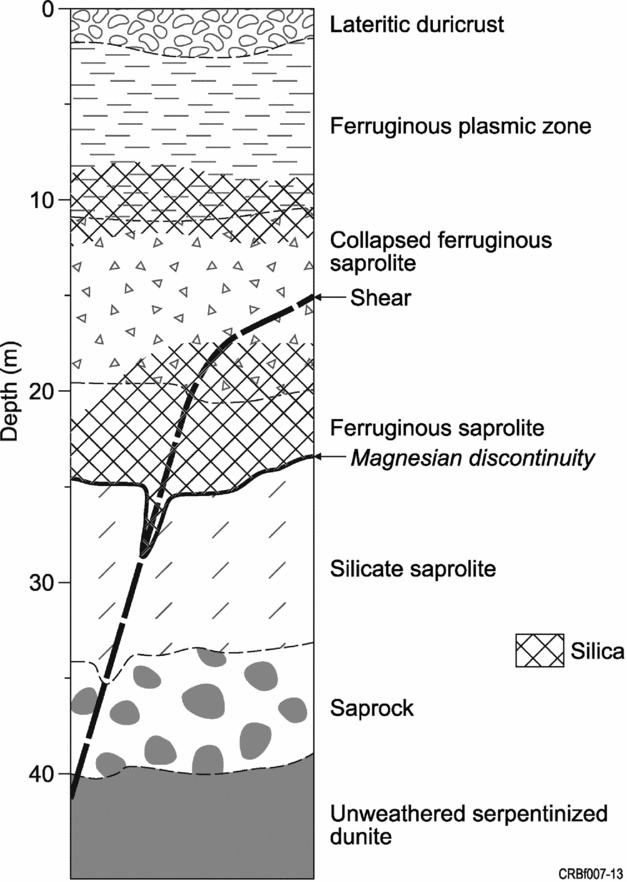
Lateritization is generally associated with seasonally humid tropical climates, with annual rainfall >900–1800 mm. Over dunites and serpentinized dunites, a deeply weathered lateritic regolith typically has all or many of the following horizons (from the base): unweathered serpentinite, saprock, silicate saprolite, ferruginous saprolite, collapsed ferruginous saprolite, ferruginous plasmic zone and Fe-rich lateritic duricrust (Fig. 1). In places, some serpentinization may itself be due to weathering. These horizons develop sequentially, each formed from a progenitor similar to that immediately beneath it, and a complete profile may require several million years in which to form. Silica is released during weathering of serpentine and remnant olivine and pyroxene at the weathering front and through the saprolite, continuing until the final destruction of serpentine at the transition from silicate to ferruginous saprolite. This transition is termed the magnesian discontinuity, and is marked by a sharp decline in concentrations of Mg, from >15% MgO to <2% MgO, and silica. Over peridotites (i.e. amphibole- and pyroxene-bearing ultramafic rocks), some of the released silica combines with Mg, Al and other elements to form clay minerals, whereas over dunites, the silica is leached. Owing to mass loss by leaching, the ferruginous saprolite is soft, highly porous and of low density (< 1.0–1.5). The resultant instability causes collapse, with the lithic fabric replaced by a denser, massive plasmic zone, within which nodular, pisolitic or vesicular structures develop, in time hardening to form lateritic duricrust.
Diagrammatic representation of a silicified lateritic regolith profile developed over dunite. Depth of the profile, relative thicknesses of horizons and distribution of introduced silica vary between sites.

Silicification generally occurs in the ferruginous saprolite and plasmic zone, commonly forming massive, semi-continuous sheets, precipitated above the permeability barrier marked by the magnesian disconformity, although veins penetrate along fissures into the silicate saprolite below (Butt & Nickel, Reference Butt and Nickel1981; Thorne, Herrington & Roberts, Reference Thorne, Herrington and Roberts2009). Silica precipitation and hardening evidently post-dated the formation of these host units, and its resistance to continuing weathering halted the dynamic processes of leaching and collapse, so that sequential horizon development no longer continued. The conditions that led to silicification are unclear, although it is commonly considered to be due to silica saturation of groundwater. Lateritization, and especially saprolite formation, of ultramafic rocks does not require acidic conditions, as argued by Lacinska & Styles (Reference Lacinska and Styles2013), hence silicification would not be precluded by a low pH. Indeed, the high buffering capacity of these rocks generally implies near-neutral conditions even where they contain disseminated sulphides (Brand & Butt, Reference Brand and Butt2001). Silica saturation of groundwater was more probably due to concentration by evaporation, occurring in response to reduced drainage due to a drying climate, possibly enhanced by a location low in the landscape or within impervious wallrocks, rather than to fluid mixing.
Ultramafic rocks, especially dunites, tend to weather more rapidly than other lithologies, because of (1) their more reactive mineralogy, even where serpentinized, and (2) their more open texture, which allows more rapid solute loss. In consequence, over time, weathering of dunites produces depressions and valleys. Under drier conditions, silica derived from ongoing weathering concentrates in groundwater, precipitates and hardens, rather than being leached. This results in an absolute concentration of silica in the regolith, rather than loss by leaching. The silica cannot be derived from the ferruginous horizons above, and the mass is greater than could be supplied by ongoing formation and weathering of the silicate saprolite below. It is thus probably derived from dunite along strike and from adjacent lithologies, accumulating in zones of groundwater ponding. If lateritic weathering conditions later resume, ferruginous saprolite may continue to form beneath silicified saprolite (Golightly, Reference Golightly, Goldfarb, Marsh and Monecke2010), whereas above it, perched water-tables develop, causing Mn oxide precipitation and, in places, further silicification.
Subsequently, uplift and/or a change to an arid climate result in erosion of the upper horizons of the regolith, including lateritic duricrust. Silicified horizons over serpentinites are exposed and, because they are more resistant to erosion than horizons at similar depths on most other lithologies, they may form mesas, hills and ridges: a local inversion of relief. Such landforms are present in many deeply weathered terranes but, in arid regions in particular, these ‘silica caps’ and the underlying saprolite may be the only remnants of a previously widespread regolith, with unsilicified regolith on other lithologies, including serpentinized peridotite, being entirely eroded. This appears to be the situation in the Hajar Mountains, where the silicified saprolite is depicted to outcrop as low ridges. However, at Jebel Faiyah, only 25–30 km WSW, an unsilicified weathering profile developed in siltstones and underlying ophiolites is preserved within a sedimentary sequence (Alsharan & Nasir, Reference Alsharan and Nasir1996), implying that this lateritic regolith was formerly extensive.
This scenario suggests that silicification is likely to have taken place whilst the regolith was still largely complete, possibly even buried by colluvial–alluvial sediments, prior to significant erosion. However, the actual climate and time of silicification are uncertain. In this region of the Arabian Peninsula, ‘lateritization’ is considered to have occurred during the Maastrichtian (Alsharan & Nasir, Reference Alsharan and Nasir1996), perhaps continuing to the early Eocene (Nolan et al. Reference Nolan, Skelton, Clissold, Smewing, Robertson, Searle and Ries1990, quoted by Lacinska & Styles, Reference Lacinska and Styles2013) or possibly as late as the middle Oligocene as suggested by Brown, Schmidt & Huffman (Reference Brown, Schmidt and Huffman1989). As seen in sub-Saharan northern Africa, the waning stages of lateritic weathering would be characterized by a decline in annual rainfall to 900–500 mm or less, typical of seasonally humid, tropical dry savanna climates. Slower weathering and reduced leaching then provided conditions conducive to silicification. The timing is conjectural, but could date from the early–middle Eocene as proposed by Lacinska & Styles (Reference Lacinska and Styles2013) or from after the middle Oligocene. There may have been several phases of silicification, due to fluctuations in climate during the Eocene to Oligocene (e.g. Zachos et al. Reference Zachos, Pagani, Sloan, Thomas and Billups2001; Beauvais et al. Reference Beauvais, Ruffet, Hénocque and Colin2008). However, it will have ceased prior to significant erosion of the lateritic regolith; consequently if sediments derived from such erosion can be identified and dated, then this might provide more direct evidence for the timing of weathering and silicification.
In conclusion, it is probable that the silicified saprolite observed in the UAE represents the remnants of a late Cretaceous – early Tertiary lateritic regolith. It thus provides further evidence for lateritic weathering in the UAE, Oman and elsewhere on the Arabian Peninsula during this period. The timing of silicification is probably related to a late stage of this event, prior to erosion, rather than a separate later weathering episode, but there is insufficient evidence for a more specific date.
Acknowledgements
C. R. M. Butt thanks Robert Thorne and an anonymous referee for comments on earlier versions of the text.