Introduction
Wild oat (Avena fatua L.) and sterile oat [Avena sterilis ssp. ludoviciana (Durieu) Gillet & Magne] are the second most widespread grass weeds of the winter season, after rigid ryegrass (Lolium rigidum Gaudin), in Australian agriculture (Anderson Reference Anderson2003). It has been estimated that A. fatua, A. ludoviciana, and slender oat (Avena barbata Pott ex Link) combined cost Australian agriculture A$28 million every year from both loss of crop yield and cost of control (Llewellyn et al. Reference Llewellyn, Ronning, Ouzman, Walker, Mayfield and Clarke2016). In Australia, A. fatua is the dominant species in southern Australia, and A. ludoviciana is the dominant species in northern New South Wales and southern Queensland (Nugent et al. Reference Nugent, Storrie and Medd1999). Most wild oat populations in Australia (about 80%) contain both A. fatua and A. ludoviciana, while A. barbata is mostly found on roadsides and in nonagricultural areas (Cousens Reference Cousens2003; Nugent et al. Reference Nugent, Storrie and Medd1999).
The maximum yield potential in Avena spp.–infested winter crops could be obtained if cohorts of A. fatua and A. ludoviciana were controlled as early as possible (Anderson Reference Anderson2003). Several herbicides are available for A. fatua and A. ludoviciana control; however, there are documented cases of A. fatua and A. ludoviciana developing resistance to herbicides (Heap Reference Heap2020). A study on Avena spp. revealed that populations that have experienced repeated use of acetolactate synthase inhibitors over the last 15 yr are at a high risk of developing resistance to these herbicides (Storrie Reference Storrie2007). A range of integrated weed management (IWM) techniques are available for managing herbicide-resistant populations; however, a successful management program is needed to manage the weed seedbank. The development of an IWM program must be supported by a thorough understanding of the population dynamics operating within weed seedbanks (Swanton et al. Reference Swanton, Mahoney, Chandler and Gulden2008), but information on the population dynamics of A. fatua and A. ludoviciana concerning weed seedbanks is lacking in eastern Australia.
Recruitment of seeds from seed rain and seed persistence in the soil are the driving force for the maintenance of weed seedbanks in the soil (Mahajan et al. Reference Mahajan, Singh and Chauhan2020). Dormancy in seeds may also contribute to the formation of a persistent seedbank, as it maintains seed viability within the soil (Jensen Reference Jensen2004). However, certain studies have shown that no correlation exists between dormancy and persistence in the seedbank (Honda Reference Honda2008; Thompson et al. Reference Thompson, Cerianai, Bakker and Bekker2003). These studies suggested that the seed longevity of Avena spp. and the effects of environmental conditions on seed decay must be determined to understand the dynamics of the seedbank (Vázquez-Yanes and Orozco-Segovia Reference Vázquez-Yanes, Orozco-Segovia, Mulkey, Chazdon and Smith1996). Furthermore, under field conditions, the emergence time of weeds is dependent on the germination requirements of individual species and biotypes as well as seed burial depth, soil disturbance (Roberts and Feast Reference Roberts and Feast1972), and environmental conditions (Forcella Reference Forcella1992). Seeds in no-till systems remain near the soil surface, rather than being deeply buried. Therefore, seedlings are more likely to emerge under favorable conditions and be depleted from the seedbank (Chauhan et al. Reference Chauhan, Singh and Mahajan2012; Morris et al. Reference Morris, Miller, Orson and Froud-Williams2010). Weed emergence timing is a crucial factor in making IWM strategies, as it assists with decisions such as planting time, fertilizer inputs, cultivation, and POST herbicide applications (Dyer Reference Dyer1995; Mahajan and Chauhan Reference Mahajan and Chauhan2021; Webster et al. Reference Webster, Bryant and Earnest1999).
The combination of non-inversion tillage and the use of more winter cereals in the crop rotation allows a high infestation of Avena spp. within fields. This creates a demand for an effective weed control strategy to keep Avena spp. at a low level (Cussans et al. Reference Cussans, Moss and Wilson1987). If this is to be achieved by chemical control, a very high herbicide efficacy level is required. However, the required herbicide efficacy in non-inversion tillage systems is difficult to achieve if the weed control strategy relies solely on herbicides (Rydahl Reference Rydahl and Andrews2004). For a sustainable control program for Avena spp., the program must focus on integrated control methods. Therefore, knowledge about understanding the emergence patterns and the seedbank is an important step for developing strategies for sustainable weed control of Avena spp. In this context, more information is required on emergence patterns and weed seed longevity under various soil and climatic conditions to make better decisions for weed control (Schafer and Chilcote Reference Schafer and Chilcote1969).
Determining seed longevity involves a multiyear study and is heavily influenced by environmental factors. Therefore, seed longevity research needs to be conducted across varied soil and climatic conditions. It was hypothesized that seed longevity and emergence patterns of A. fatua and A. ludoviciana may vary in response to burial depth and environmental conditions. The seeds of A. fatua are single, while the seeds of A. ludoviciana seeds grow in pairs (Whalley and Burfitt Reference Whalley and Burfitt1972). Therefore, seed longevity and emergence patterns may also vary according to species, as seed structure varies by species. This study investigated (1) the seed persistence of A. fatua and A. ludoviciana when buried at different depths (0, 2, and 10 cm) at three locations (Gatton, Narrabri, and St George) in Australia and (2) the emergence pattern of A. fatua and A. ludoviciana with respect to seed burial depths (0, 2, 5, and 10 cm) under field conditions.
Materials and Methods
Seed Collection
The populations of A. fatua and A. ludoviciana were collected from paddocks in the eastern region of Australia in November 2017. The GPS coordinates of A. fatua populations AF1/17 and AF7/17 were 29.6075°S, 150.6888°E and 29.6011°S, 150.7136°E, respectively, and these two sites were about 2.5 km apart. The GPS coordinates of A. ludoviciana populations AL1/17 and AL2/17 were 29.6075°S, 150.6888°E and 29.6542°S, 149.7405°E, respectively, and these two sites were about 100 km apart. All populations were collected from a chickpea (Cicer arietinum L.)–fallow no-till field. After collection, seeds were air-dried for 7 d in a ventilated area. Seed germination and dormancy of fresh seeds from the different populations were evaluated in the laboratory. Seeds were found to be 100% dormant at the start of the experiments (data not shown).
Experiment 1. Effect of Burial Duration and Depth on Seed Fate (Field and Laboratory Study)
This study was initiated at three locations, Gatton (27.5514°S, 152.3428°E), Narrabri (30.3065°S, 149.8114°E), and St George (28.3150°S, 148.6892°E) in November 2017 after the collection of fresh seeds. Fifty seeds of A. ludoviciana (AL1/17) and A. fatua (AF1/17) were placed in permeable nylon bags (9 cm by 6 cm) and buried at soil depths of 0, 2, and 10 cm in the field at the three locations. There were three replicates for each treatment per location. The soil properties of the selected fields at different locations are described in Table 1. The nylon bags were used to create an ideal environment similar to that of natural soil conditions, as they allow for water and air diffusion as well as microorganism attack. The study commenced in November 2017, coinciding with the harvest of winter crops (wheat [Triticum aestivum L.], barley [Hordeum vulgare L.], chickpea) and the sowing of subsequent summer crops (maize [Zea mays L.], grain sorghum [Sorghum bicolor (L.) Moench ssp. bicolor], and mungbean [Vigna radiata (L.) R. Wilczek]) in eastern Australia. This is considered the natural shedding time for A. fatua and A. ludoviciana. Bags were exhumed at 6, 12, 18, 24, and 30 mo after placement, and nongerminated seeds from the bags were retrieved, moved into petri dishes, and incubated in the laboratory at fluctuating day/night temperatures of 20 /10 C under light/dark conditions for 14 d. Temperature and light conditions for incubation were decided on the basis of winter-season weed germination (Alshallash Reference Alshallash2018; Storrie Reference Storrie2007). Comparisons among seed burial depths over time (number of days after seed burial) were made for different components of seed fate (germination in the laboratory, decayed seed, and dormant seed). The decayed component comprised nonviable seeds from the laboratory germination test and seeds that had germinated in the field. Nongerminated and nonviable seeds in the laboratory test were discerned by using a simple crush test to determine whether the embryos were still viable (Taylor et al. Reference Taylor, Peters, Aadkins and Walker2004). If the seeds were hard after the crush test, they were considered dormant (viable), otherwise they were considered nonviable (Borza et al. Reference Borza, Westerman and Liebman2007).
Physical and chemical properties of soils at different locations in eastern Australia.

Experiment 2. Emergence Behavior (Field Study)
The effect of seed burial depth on seedling emergence was studied only at the Gatton site using fresh seeds from two populations each of A. ludoviciana (AL1/17 and AL2/17) and A. fatua (AF1/17 and AF7/17). For each population, in three replicates, 50 seeds were placed at different soil depths (0, 2, 5, and 10 cm) in an area of 25 cm by 25 cm of surface soil at the time of their natural seed shedding (November 23, 2017). To bury the seeds, the soil was removed with an auger at 2-, 5-, or 10-cm depths, seeds were placed, and soil was placed back in the holes. Seeds were placed on the soil surface for the 0-cm depth. Seedlings were counted at 7-d intervals during the summer fallow and in the subsequent winter season. Emerged seedlings were killed using glyphosate (720 g ae ha−1) after counting. Daily air temperatures and rainfall were recorded at the field site throughout emergence time. Emergence data were recorded for 2 yr from November 2017 to November 2019.
Weather Parameters
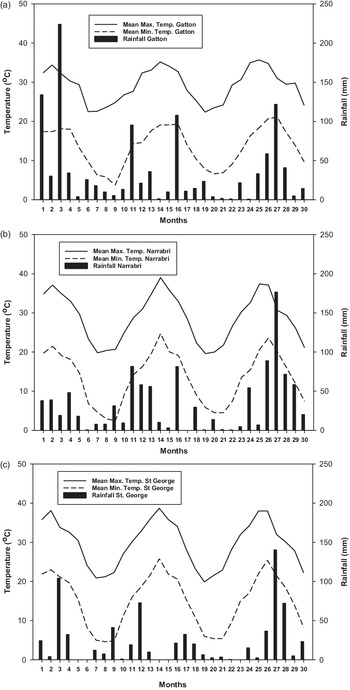
During the period of the seedbank study (Experiment 1), weather parameters (maximum and minimum air temperature and rainfall) were recorded from the Bureau of Meteorology, Australia (http://www.bom.gov.au/climate/dwo) for Gatton, Narrabri, and St George (Figure 1). The weather data for the Gatton site were also used for the weed emergence study (Experiment 2).
Weather conditions at (A) Gatton, (B) Narrabri, and (C) St George, Australia, during the nylon bag seed persistence study (starting November 2017 and ending May 2020).

Statistical Analyses
In the nylon bag experiment (Experiment 1), analyses were performed based on the total number of seeds (i.e., 50 seeds per replication) for (1) germination in the laboratory at 20/10 C, (2) seed decay, and (3) dormant seeds (firm or hard seeds). A nonlinear regression analysis was used to determine the relationships between the viable seed percentage and the duration of seed burial. Data were best fit with a two-parameter exponential decay model, using SigmaPlot v. 14.0 (Systat Software, San Jose, CA, USA):
 $G = a^*exp^{(-b^{*}x)$
In this equation, G is the viable seed (%), x is the duration in months, a is the maximum viable seed (%), and b is a constant. ANOVA was also performed using a randomized complete block design (factorial) (Supplementary Table 1).
For the emergence behavior (Experiment 2), graphs were plotted using SigmaPlot v. 14.0 (Systat Software). Daily emergence counts were converted into a cumulative percentage of total seedlings, and means were compared with standard errors (Wu et al. Reference Wu, Walker, Rollin, Tan, Robinson and Werth2007). ANOVA was also performed using a randomized complete block design (factorial) (Supplementary Table 2).
The cumulative emergence was described as a function of growing degree days (GDD), using Sigma Plot v. 14.0. GDD were calculated using the formula:
 $GDD = [(T_{max}+ T_{min})/2 - T_{b}]$
where T max and T min are the maximum and minimum air temperatures, and T b is the base temperature for winter species (5 C; Vigil et al. Reference Vigil, Anderson and Beard1997).
Results and Discussion
Weather Conditions
At Gatton during the study period, the monthly mean maximum air temperatures varied from 22.4 to 35.7 C, and monthly mean minimum air temperatures varied from 3.7 to 21.1 C (Figure 1). The coldest month at Gatton was August, and the hottest month was December. At Narrabri, the maximum and minimum monthly mean air temperatures varied from 19.6 to 37.1 C and 2.5 to 24.7 C (Figure 1). The coldest month at Narrabri was August, and the hottest month was January. At St George, the maximum and minimum monthly mean air temperatures varied from 19.9 to 38.7 C and 4.6 to 23.0 C. The coldest month at St George was July, and the hottest month was January. During the period of the nylon bag study, Gatton, Narrabri, and St George received total rainfall of 1,122, 1,038, and 710 mm, respectively (Figure 1).
Experiment 1. Effect of Burial Duration and Depth on Seed Fate (Field and Laboratory Study)
For A. fatua, a significant interaction of burial depth and duration was observed at each location (Supplementary Table 1). For A. ludoviciana, a significant interaction of burial depth and duration was observed only at Gatton and St George (Supplementary Table 1). This revealed that at each exhumation, seed decay of A. ludoviciana at Narrabri was similar with respect to burial depth.
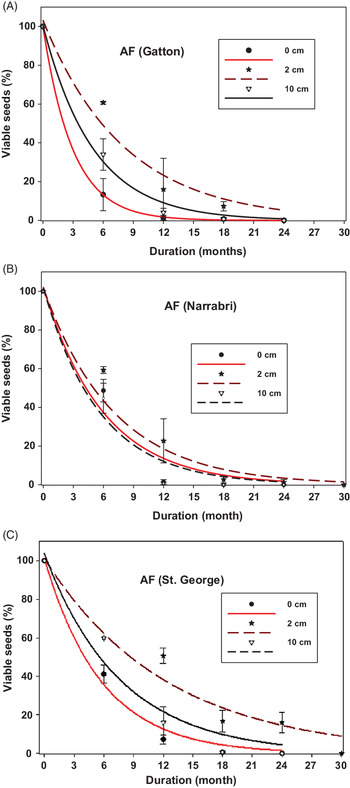
At 0- and 10-cm burial depths, 50% (based on exponential decay model) of the seeds of A. fatua at all locations decayed within 6 mo of seed placement in the soil (Figure 2; Table 2). At Gatton, seed decay of A. fatua was very fast for the surface seeds, as 50% and 90% seed decay was estimated after 2 and 7 mo, respectively, after seed placement. At St George, the estimated seed decay at 2 cm was 50% and 90% after 9 and 29 mo, respectively (Figure 1; Table 2). However, at Gatton and Narrabri, 50% and 90% of seed decay of A. fatua at this soil depth was faster (6 and 17 mo of seed burial, respectively). This differential response might be due to the interaction of varying soil moisture (St George location was relatively drier) and soil texture at different locations. It was observed that after 9 mo of seed placement in the soil, the amount of rainfall at the Narrabri and St George sites was similar (Figure 1), but seed decay at 2 cm was slower at St George compared with Narrabri (Figure 2). This slower decay might be attributed to a higher clay content in the St George soil (47%) compared with the Narrabri soil (40%) (Table 1). These results suggest that the physical properties of the soil may influence the seed ecology of A. fatua buried at shallow depths (e.g., 2 cm) and, consequently, seedbank dynamics in the agroecosystem. Benvenuti (Reference Benvenuti2003) observed that the partial removal of germination inhibitors of buried seeds is facilitated by increased oxygen availability, suggesting that aeration of the surface soil, or soil that had better aeration, facilitated seed germination. The high clay content in the soil at St George might have affected the oxygen availability in the soil at depth and increased the seed longevity of A. fatua (Mentges et al. Reference Mentges, Reichert, Rodrigues, Awe and Mentges2016).
Viable seeds of Avena fatua at three locations, (A) Gatton, (B) Narrabri, and (C) St George, Australia, in response to seed burial duration and depth starting November 2017 and ending May 2020. Curves represent an exponential decay model fit to the data for depths of 0, 2, and 10 cm. Parameter estimates are shown in Table 2.

Parameter estimates of Avena fatua and Avena ludoviciana in the nylon bag study (data were subjected to two-parameter exponential decay model, G = a*exp(−b*x)). a

a a is the maximum viable seed (%); b is a constant; R2 is coefficient of determination.
On the basis of exponential decay model, the pattern of seed decay for A. ludoviciana was similar at all locations, and 50% of the seeds of A. ludoviciana at each depth had decayed within 6 mo of seed placement in the soil (Figure 3; Table 2). At Gatton, the decay of surface seeds of A. ludoviciana was faster when compared with Narrabri and St George. At Gatton, 90% of seeds had decayed after 7 mo of seed placement; however, at Narrabri and St George, 90% of seeds decayed after 11 mo of seed placement (Figure 3; Table 2). A previous study suggested that at greater depths (12 cm), secondary dormancy in weed seeds is independent of soil texture (Benvenuti Reference Benvenuti2003); a similar pattern of seed decay was found in the present study for A. fatua and A. ludoviciana at 10 cm for all locations. Seedling recruitment of Avena spp. and seedbank decline were found to be greater in sandy soils compared with heavy soils (McGillion and Storrie Reference McGillion and Storrie2006), again suggesting that high clay content in the soil may increase the persistence of Avena spp. in this study. We observed that at Narrabri, 90% of the seeds at 2 cm decayed after 13 mo; however, at St George, 90% of the seeds decayed after 17 mo (Table 2). The higher clay content in the St George soil, when compared with the soil found in Narrabri, could be the reason for the slow decay of the seeds at 2-cm depth.
Viable seeds of Avena ludoviciana at three locations, (A) Gatton, (B) Narrabri, and (C) St George, Australia, in response to seed burial duration and depth starting November 2017 and ending May 2020. Curves represent an exponential decay model fit to the data for depths of 0, 2, and 10 cm. Parameter estimates are shown in Table 2.

Various studies suggested that the seeds of Avena spp. are relatively short-lived and have a half-life of only 6 mo (McGillion and Storrie Reference McGillion and Storrie2006; Medd Reference Medd1996). Nietschke (Reference Nietschke1997) observed that the seedbank decline of Avena spp. followed an exponential pattern. Similarly, we also observed an exponential decay pattern for A. fatua and A. ludoviciana seeds in our study (Figures 2 and 3). Loss of seedbank on the surface could be achieved through seed germination. In addition to this, death through metabolic failure and predation could also be the reason for seedbank loss. Various studies have reported that burial depth had little influence on the seed survival of A. fatua and A. ludoviciana (DelArco et al. Reference Del Arco, Torner and Quintanilla1995; Quail and Carter Reference Quail and Carter1968). Conversely, some works also reported that the seed persistence of Avena spp. is greater below 5 cm (Chepil Reference Chepil1946; Miller and Nalewaja Reference Miller and Nalewaja1990; Thurston Reference Thurston1961). This suggests that the varied environmental conditions may affect the seed persistence of Avena spp. at burial depths of 2 and 10 cm.
Experiment 2. Emergence Behavior (Field Study)
Emergence data were recorded for 2 yr from November 2017 to November 2019, and the last cohorts of A. fatua and A. ludoviciana were observed on October 10, 2018 (4,863 GDD).
On the surface, the germination of AF1/17 occurred from June 27, 2018 (3,715 GDD), and it increased to 5% on October 10, 2018 (4,863 GDD) (Figure 4; Table 3). However, AF7/17 started to germinate from May 23, 2018 (3% germination at 3,364 GDD) through October 10, 2018 (9% germination at 4,863 GDD). Both populations started to emerge from May 23, 2018 (6% to 8% at 3,364 GDD) through October 10, 2018 (34% to 36% at 4,863 GDD) from a 2-cm depth (Figure 4; Table 3). At this depth, the high emergence (>5%) of both populations was observed between May 23 (3,364 GDD) and June 27 (3,715 GDD) 2018 (6% to 18% for AF1/17 and 8% to 25% for AF7/17). The second high emergence for both populations of A. fatua occurred between June 27, 2018 (3,715 GDD) and October 10, 2018 (4,863 GDD), and emergence increased from 24% to 36% for AF1/17 and from 27% to 34% for AF7/17 (Figure 4; Table 3). Both populations of A. fatua emerged from May 23, 2018 (3,364 GDD) through October 10, 2018 (4,863 GDD) from the 5-cm depth. At this depth, the emergence of AF1/17 was 5% in May 23, 2018, and increased to 22% by October 10, 2018. Similarly, from the 5-cm depth, the emergence of AF7/17 was 6% in May 23, 2018 (3,364 GDD), which increased to 18% by June 27, 2018 (3,715 GDD). AF7/17 did not emerge from 5 cm by October 10, 2018 (4,863 GDD). Both populations of A. fatua emerged from May 23, 2018 (3,364 GDD) from a depth of 10 cm, and emergence was 4% for AF1/17 and 2% for AF7/17. The emergence of AF1/17 from the 10-cm depth increased to 9% by October 10, 2018 (4,863 GDD); however, no such increase was found for AF7/17 during this month (4,863 GDD).
Emergence pattern of two populations of Avena fatua (AF1/17 and AF7/17) in relation to burial depth and cumulative growing degree days starting November 23, 2017, and ending May 2020. Mean ± SE shown in Table 3.

Mean ± SE for cumulative seedling emergence (%) of different populations of Avena fatua and Avena ludoviciana in relation to time, burial depth, and cumulative growing degree days starting November 23, 2017, and ending November 23, 2019.

a Last cohort of Avena fatua and Avena ludoviciana was observed on October 10, 2018.
The last cohort of A. ludoviciana germinated/emerged on October 10, 2018 (4,863 GDD) from each burial depth. On the surface, germination of AL1/17 occurred from June 13, 2018 (3,598 GDD) through October 10, 2018 (4,863 GDD) (Figure 5; Table 3). However, the germination of AL2/17 on the surface (0 cm) occurred from May 23, 2018 (3,364 GDD) through October 10, 2018 (4,863 GDD). On the surface, the cumulative germination was 10% and 8% for AL1/17 and AL2/17, respectively, when observed on October 10, 2018. The emergence of AL1/17 from the 2-cm depth occurred from June 13, 2018 (3,598 GDD) through October 10, 2018 (4,863 GDD). However, the emergence of AL2/17 from this depth occurred from May 23, 2018 (3,364 GDD) through October 10, 2018 (4,863 GDD). From the 2-cm depth, the cumulative emergence of AL1/17 and AL2/17 was 29% and 36% when observed on October 10, 2018. Greater emergence of A. ludoviciana was observed from 5-cm compared with 2- and 10-cm depths. From the 5 cm depth, A. ludoviciana emergence started from March 14, 2018 (˜1%), and it was 5% and 11% for AL1/17 and AL2/17, respectively, on May 23, 2018, which further increased to 43% and 29% for AL1/17 and AL2/17, respectively, on October 10, 2018. From the 10-cm soil depth, AL1/17 emergence occurred from May 23, 2018 (3,364 GDD) through to October 10, 2018 (4,863 GDD). However, the emergence of AL2/17 from 10 cm occurred from July 11, 2018 (3,870 GDD) through to October 10, 2018 (4,863 GDD). From the 10-cm depth, cumulative emergence up to October 10, 2018 was 7% and 3% for AL1/17 and AL2/17, respectively.
Emergence pattern of two populations of Avena ludoviciana (AL1/17 and AL2/17) in relation to burial depth and cumulative growing degree days starting November 23, 2017, and ending November 23, 2019. Mean ± Standard error are shown in Table 3.

Our results suggest that the emergence behavior of Avena spp. differed between populations and burial depths. In this study, it was observed that A. ludoviciana populations emerged from the 5-cm depth in March (2,253 GDD) (autumn season in Australia); however, A. fatua did not emerge in March (2,253 GDD). Contrary to this, an earlier study conducted by Medd (Reference Medd1996) suggested that A. fatua germinates from autumn to spring, whereas A. ludoviciana germinates only from winter to early spring. As for March 2018 (2,253 GDD), the emergence of A. ludoviciana was only observed from the 5-cm burial depth. The highest emergence of A. fatua was observed from a burial depth of 2 cm (34% to 36% at 4,863 GDD). However, A. ludoviciana had the greatest emergence from the 5 cm-burial depth (39% to 43% at 4,863 GDD). Our study also suggested that the emergence of A. fatua and A. ludoviciana was decreased at both the surface and the 10-cm burial depths when compared with the 2- and 5-cm burial depths. Lower emergence of Avena spp. at the surface may possibly be attributed to the exposure of the seeds to greater environmental extremes on the surface when compared with burial (Roberts and Neilson Reference Roberts and Neilson1980). Furthermore, burial could shield seeds from unfavorable environments, reduce seed weathering, and increase seed longevity (Facelli et al. Reference Facelli, Chesson and Barnes2005; Wijayratne and Pyke Reference Wijayratne and Pyke2012). Crist and Friese (Reference Crist and Friese1993) reported higher levels of seed decomposition on the surface of the soil when compared with seeds that were buried. The depletion of the seedbank at the soil surface could be attributed to the decomposition facilitated by weathering and fungal pathogens in addition to attacks by insects and birds. Lower emergence of Avena spp. from the 10-cm burial depth might be linked to poor gas exchange in the environment surrounding the buried seeds (Benvenuti Reference Benvenuti2003) and the absence of a light trigger (Benvenuti and Macchia Reference Benvenuti and Macchia1995). Lower emergence from the 10-cm burial depth might also be due to fatal germination, as it is likely that the seeds that germinated at 10-cm would die before reaching the soil surface (Davis and Renner Reference Davis and Renner2007). These results suggest that the seedbank of Avena spp. could be depleted by promoting no-till systems, as shallow tillage in the field could cause higher emergence of Avena spp. in the field.
From February 3 to March 7, 2018, there were eight incidences when rainfall was >10 mm, suggesting that enough moisture in the soil profile facilitated the emergence of A. ludoviciana from the 5-cm burial depth during March 2018 (autumn season) (Figure 2). However, A. fatua did not emerge from the 5-cm burial depth in March 2018, despite having enough soil moisture in the soil profile. This suggests that A. ludoviciana tends to germinate during the autumn season if enough soil moisture is available within the soil profile. Water is a catalyst for seed germination, and the potential density of weed flora is highly dependent on water (Hadas Reference Hadas and Khan1982; Ego et al. Reference Ego, Thomas and Swanton2000). Therefore, increasing soil moisture to levels near those of field capacity is very important for weed emergence. Our results implied that A. ludoviciana could be more problematic in the autumn-season irrigated crops.
The first high emergence of A. fatua and A. ludoviciana was observed between May and June 2018 (3,364–3,715 GDD), indicating that both species attained favorable environmental conditions in June (start of winter season). The second high emergence was noticed in October (4,863 GDD); however, the emergence behavior varied within populations and species, suggesting that populations have environmental plasticity or ecotype effect for emergence. It was observed that from July to September 2018, although the temperature was lower and favorable for Avena spp., no emergence was recorded, because there was no incidence of rainfall >10 mm during that time (Figure 2). However, from October 1 to October 8, 2018, there were again two incidences when the rainfall was >10 mm, and high moisture in the soil profile again created favorable conditions for the second high emergence.
In eastern Australia, winter crops (wheat, barley, and chickpea) are generally planted from the first week of May. Based on the results of this study, the early emergence of A. ludoviciana could pose severe competition to slow-growing crops such as chickpeas. Therefore, more emphasis should be placed on in-crop management, especially in fields with wider rows and slow-growing crops, by implementing IWM practices with selective PRE and POST herbicides. Our results suggest that early control of Avena spp. is essential for the successful establishment of autumn and winter crops in the region. Results also revealed that early cohorts of A. ludoviciana could occur before the planting of winter crops if sufficient rainfall is available. These cohorts provide the opportunity to control A. ludoviciana with nonselective herbicides or tillage before planting a winter crop. Changes in the emergence pattern of A. fatua and A. ludoviciana over time and across populations and seed burial depths indicate adaptive characteristics of the species and suggest that management practices in crop production might have promoted environmental plasticity in these populations across burial depths (Owen et al. Reference Owen, Michael, Renton, Steadman and Powles2010; Sbatella and Wilson Reference Sbatella and Wilson2010; Schutte et al. Reference Schutte, Regnier, Harrison, Schmoll, Spokas and Forcella2008). Different emergence patterns across seed burial depths suggest that light, critical temperature, and moisture availability in the soil profile could influence the emergence pattern (early and late cohorts) of Avena spp. (Dille et al. Reference Dille, Stahlman, Du, Geier, Riffel, Currie, Wilson, Sbatella, Westra, Kniss, Moechnig and Cole2017). The present study suggests that late cohorts (June to October) of Avena spp. in the growing season are most likely to escape from preplant nonselective herbicides and tillage. In such situations, a season-long residual weed control program could be recommended. A vigorous crop could reduce the competitiveness of Avena spp. and reduce the weed seedbank by reducing seed production for further infestation.
Results from this study could be utilized for improved forecasting of Avena spp. emergence patterns that could aid in decision making for managing its herbicide-resistant seedbank. Information on high emergence periods, with respect to GDD, can be utilized during decision making for timing and management strategy for A. fatua and A. ludoviciana control. The extended emergence periods of A. ludoviciana from early March to October and of A. fatua from May to October observed in this study suggest that a significant proportion of emerged seedlings can escape in fallows and from in-crop weed control and potentially set seed. Therefore, control of Avena spp. in fallow (winter or summer) or postharvest strategies for A. fatua and A. ludoviciana also need to focus on preventing seed production from late-emerging cohorts of Avena spp. Our results demonstrated that information on the periodicity and pattern of A. fatua and A. ludoviciana emergence could contribute to designing multitactic strategies to manage Avena spp. seedbanks, especially with the increased occurrence of herbicide-resistant biotypes in this region.
This study provides knowledge on the emergence dynamics of A. fatua and A. ludoviciana from various depths and the timing of their emergence that allows for more sustainable weed management decisions with strategic tillage systems, making the best use of all principles of IWM, and maintaining weed populations at economically acceptable levels. The results implied that in southeast Australia, and under similar environmental conditions, May–June (start of winter season) is the best time for POST application of herbicides against both Avena species. With careful choice of the crop rotation in terms of competitiveness (e.g., sowing time, crop density, and early canopy closure), late-emerged Avena spp. seedlings could suffer competition and be suppressed by an already established crop, and its related interventions, resulting in lower weed seed production. The results obtained are of practical relevance for farmers willing to change from no-till to shallow-tillage systems that retain weed seeds in the surface layer.
In conclusion, our studies suggest that from shallow depths (e.g., 5 cm), A. ludoviciana can emerge early in the winter season or autumn season if sufficient rainfall is available. Avena fatua and A. ludoviciana seeds did not emerge after 1 yr if fresh seed production was not allowed in the field. The extended emergence periods of A. ludoviciana from early March to October (2,253–4,863 GDD) and A. fatua from May to October (3,364–4,863 GDD) observed in this study suggest that a significant proportion of emerged seedlings can escape in fallows and from in-crop weed control and potentially set seed. The management of A. fatua and A. ludoviciana should focus on reducing seed shattering; management of seedbank from shallow depths (2 to 5 cm), where germination may occur for prolonged periods; adjusting tillage systems; and following harvest weed seed control practices. It is preferable to leave Avena spp. seeds on the surface soil by following a zero-till system, as this will lead to a more rapid decline in the seedbank. Management strategies that control all emerged seedlings over 2 yr and restrict seed rain in the field could lead to complete control of Avena spp. in the field.
Acknowledgments
The authors are grateful to Michael Walsh, director, Weed Research, University of Sydney, Narrabri, and growers of St George for granting permission to conduct the nylon bag study at respective locations. This research received funding from Grains Research and Development Corporation (GRDC) under Project US00084. The authors declare no conflicts of interest.
Supplementary material
To view supplementary material for this article, please visit https://doi.org/10.1017/wsc.2021.7