Introduction
Second couplehood in old age is an emerging phenomenon likely to develop further with the ongoing increase in life expectancy. It includes three main forms (e.g. de Jong Gierveld Reference de Jong Gierveld2004): remarriage (e.g. Cooney and Dunne Reference Cooney and Dunne2001), co-habitation (e.g. Brown, Lee and Bulanda Reference Brown, Lee and Bulanda2006) and living apart together (LAT), which refers to couples who live in separate homes while perceived by their social network as being in a couplehood relationship (e.g. Duncan and Phillips Reference Duncan and Phillips2010; Levine and Trost Reference Levine and Trost1999). In the United States of America (USA), about 0·6 per cent of all adults had remarried at the age of 65 or above in 2010 (Cruz Reference Cruz2012). In addition, approximately 4 per cent of the unmarried population over 50 are co-habiting (Brown, Bulanda and Lee Reference Brown, Bulanda and Lee2012; Brown, Lee and Bulanda Reference Brown, Lee and Bulanda2006) and 14 per cent of the unmarried are in a dating relationship (Brown and Shinohara Reference Brown and Shinohara2013). Drawing on the Survey on Living Arrangements and Social Networks (Netherlands) of men and women aged 55–89 (N=4,494), a total of 21 per cent are partnered. Men repartnered more frequently (41%) than women (10%). Most men were remarried, whereas most women were living apart together (de Jong Gierveld Reference de Jong Gierveld2004). These differences are probably due to men remarrying younger women.
Second couplehood in old age has no universally agreed definition. Some studies related broadly to the phenomenon by including persons over age 50 (Brown, Bulanda and Lee Reference Brown, Bulanda and Lee2012; Brown, Lee and Bulanda Reference Brown, Lee and Bulanda2006) or over 55 (de Jong Gierveld Reference de Jong Gierveld2004). Others (Koren and Eisikovits Reference Koren and Eisikovits2011; Moustgaard and Martikainen Reference Moustgaard and Martikainen2009) restricted the phenomenon to statutory definitions of old age, determined, for example, by the mandatory retirement age (Biggs et al. Reference Biggs, Phillipson, Money and Leach2006; Hazan Reference Hazan1994).
Second couplehood in old age has been linked to the fulfilment of universal needs such as love, intimacy, friendship, companionship, emotional support and mutual help (de Jong Gierveld Reference de Jong Gierveld2002). Gender differences were also found in second couplehood relationships regarding motivations, health issues and living arrangement preferences. For older, wealthy men, poor health was not necessarily a barrier to repartnering. However, for women to attract a later-life partner, good health was considered essential and a supportive network a bonus (Davidson Reference Davidson2002). Men were found to seek emotional intimacy with a partner as well as someone to come home to, and thus preferred co-habitation. Women were found to seek someone to go out with and thus preferred separate living arrangements to preserve autonomy and to avoid gender-based tasks (Davidson Reference Davidson2002). Men and women had different ways of bridging between these contrasting priorities in their chosen living arrangements. Men in LAT arrangements emphasised the romantic aspect of being constantly reunited, and women co-habiting with their partners explained how they preserved their autonomy by performing household chores out of choice rather than out of obligation (Koren Reference Koren2011).
Differences relating to forms of couplehood have been found according to country. Literature referring to research in the USA provides prevalence rates and distinguishes between later-life remarriage and co-habitation (Brown, Bulanda and Lee Reference Brown, Bulanda and Lee2012; Brown, Lee and Bulanda Reference Brown, Lee and Bulanda2006; Calasanti and Kiecolt Reference Calasanti and Kiecolt2007; Cooney and Dunne Reference Cooney and Dunne2001). No reference is made in US literature to living apart together (Levine and Trost Reference Levine and Trost1999). However, Dutch (de Jong Gierveld Reference de Jong Gierveld2004), Scandinavian (Levine and Trost Reference Levine and Trost1999; Levine Reference Levine2004), British (Davidson Reference Davidson2002; Haskey and Lewis Reference Haskey and Lewis2006) and Israeli (Koren Reference Koren2011; Koren and Eisikovits Reference Koren and Eisikovits2011) literature does refer to later-life LAT relationships, in addition to remarriage and co-habitation. Such distinctions might indicate cultural differences regarding tolerance towards various forms of couplehood relationships besides remarriage. Second couplehood in old age is more common within modern societies (de Jong Gierveld Reference de Jong Gierveld2002) than in traditional societies, such as the Far East (Mehta Reference Mehta2002) and certain more traditional parts of the USA (van den Hoonaard Reference van den Hoonaard2002), and is controversial in societies located between tradition and modernity, such as Israel (Koren and Eisikovits Reference Koren and Eisikovits2011). Traditional aspects of the family are reflected in Israel by intra-familial involvement such as care-giving expectations across the lifecourse, which are perceived as normative; modernity is reflected by an increase in individuality as a value, and by some family functions being transferred to the community (Cohen Reference Cohen2003). Furthermore, some families lean towards the traditional pole of the continuum, some lean towards the modern pole and others are located at various points in between (Lavee and Katz Reference Lavee and Katz2003). Hence, this lack of a clear-cut normative status causes older people to feel the need either to make excuses and justifications for their second couplehood or to keep it a secret (Koren and Eisikovits Reference Koren and Eisikovits2011). Such reactions, along with the disregard of LAT relationships in US studies, are latent testimonies to the gaps between personal and societal perceptions of old age within such societies (Diehl and Wahl Reference Diehl and Wahl2010).
In recent decades, a shift has occurred from perceiving old age as a negative period of deterioration and decline (Erikson Reference Erikson1998) towards a period of balancing between gains and losses (Baltes Reference Baltes1987; Baltes and Carstensen Reference Baltes and Carstensen1996). This changing perception offers diverse identities (Biggs Reference Biggs2005) and multi-dimensionality (Diehl and Wahl Reference Diehl and Wahl2010; Ebner, Freund and Baltes Reference Ebner, Freund and Baltes2006), presenting a new face of ageing (Biggs et al. Reference Biggs, Phillipson, Money and Leach2006). Balancing between gains and losses refers to selective optimisation with compensation (Freund and Baltes Reference Freund and Baltes2002), which is directed towards the growth of ageing individuals. Growth is achieved by maximising selected functions that are still intact to compensate for those that were lost. Older people optimise their abilities and their performance by finding new ways to accomplish their loss-prevention goals (Ebner, Freund and Baltes Reference Ebner, Freund and Baltes2006). The Awareness of Age-Related Change perspective (AARC) (Diehl and Wahl Reference Diehl and Wahl2010) suggests that individual diversity of ageing depends on the contexts in which older persons experience change along dimensions such as health and physical functioning, cognitive functioning, interpersonal relationships, social and emotional functioning and lifestyle engagement. AARC also adds a societal dimension relating to old-age stereotypes (Diehl and Wahl Reference Diehl and Wahl2010), whereas socio-emotional selectivity theory (Carstensen Reference Carstensen1992) refers to interpretations of change. For instance, a decrease in social contacts in old age is interpreted as a positive outcome of the wisdom of life; i.e. maximising quality of life through maintaining only meaningful contacts, thus making the most of time left (Carstensen, Isaacowitz and Charles Reference Carstensen, Isaacowitz and Charles1999). However, society often perceives a decrease in social contacts as negative, placing older people outside the social discourse (Fealy et al. Reference Fealy, McNamara, Treacy and Lyons2012). This indicates a gap between the self-perception and societal perceptions of older people.
Accordingly, older peoples’ individual perceptions of age-related change depend on the context in which it occurs (Diehl and Wahl Reference Diehl and Wahl2010) and how they interpret it (Carstensen Reference Carstensen1992), while balancing between gains and losses to optimise their overall functioning (Freund and Baltes Reference Freund and Baltes2002). As such, it could be assumed that older people living in a second couplehood relationship experience old age in the context of this relationship. However, they also experience their second couplehood relationship in the context of old age. This idea of interchangeability is based on existential phenomenology.
Second couplehood and old age are perceived as intertwining and mutually constitutive. This means that they are not perceived as separate entities but as one defined through the other, creating mutual dependency (Valle and King Reference Valle, King, Valle and King1978), similar to the Gestalt figure–ground concept. A figure has an object-character that is spatially cohesive and enclosed, filling a space inside its border; a ground has a material character that extends behind the figure (Shapiro and Hamburger Reference Shapiro and Hamburger2007). In the figure–ground conceptualisation, old age and second couplehood can shift (Valle and King Reference Valle, King, Valle and King1978).
The existential-phenomenological concept of the ‘life world’ (Lienenswelt) includes three modes (May Reference May1983): (1) the physical world (Umwelt) in second couplehood in old age relates to issues such as the ageing body and changing health; it also relates to spatiality expressed in diverse living arrangements; (2) the interpersonal world with others (Mitwelt) relates to how persons in second couplehood in old age interact and communicate with their partner, their children and the society they inhabit; (3) the intrapersonal world (Eigenwelt), also known as ‘the sphere of owness’ (Sokolowski Reference Sokolowski2000), relates to awareness of self-perceptions in old age. From an existential perspective of temporality as relative and subjective (May Reference May1983), second couplehood is experienced through the awareness of the limited time left to live.
Biological age-related change (Gullette Reference Gullette2003) is acknowledged as a situation over which individuals have no influence. This is existentially seen as ‘thrownness’, meaning that individuals do not have control over being thrown into a world in which people grow old and die. However, they do possess ‘situated freedom of choice’, meaning that they can choose how to deal with age-related change and how to live the time they have left within the limitations of their life situation (Sartre Reference Sartre1991).
The aim of this article is to examine how old age is perceived in the context of second couplehood and how second couplehood is perceived in the context of old age. Societies that are located between tradition and modernity, such as Israel (Lavee and Katz Reference Lavee and Katz2003), and contain the three forms of second couplehood outlined above, are still dealing with reservations about the phenomenon (Koren and Eisikovits Reference Koren and Eisikovits2011). Findings from a study conducted in such a society can contribute to understanding second couplehood within both traditional (e.g. Mehta Reference Mehta2002; van den Hoonaard Reference van den Hoonaard2002) and more modern societies (de Jong Gierveld Reference de Jong Gierveld2004). The research questions were as follows: How do older people in second couplehood experience the time left to live and how does limited time influence their experience of second couplehood? How do they experience their physical world in terms of changing health? How do they experience being in the world with others? How does being in a second couplehood relationship influence self-image and awareness?
Method
This article is based on data from a larger qualitative study conducted in Israel that addressed the meaning of second couplehood in old age from a dyadic perspective. Data are drawn from a theme identified in the larger study entitled: ‘Second couplehood influencing old age and old age influencing second couplehood’. The Ethics Committee of the University of Haifa Research Authority approved the study.
A phenomenological approach based on interpretive phenomenological analysis (IPA) (Smith, Flowers and Larkin Reference Smith, Flowers and Larkin2009) was used to capture the participants’ experiences as individuals and as part of a couple (Eisikovits and Koren Reference Eisikovits and Koren2010). This approach was chosen because of its theoretical foundation for studying the experience of second couplehood in old age and its hermeneutics for relating to the interpretive aspect of examining how second couplehood and old age intertwine. Although 20 dyads (40 participants) is a relatively large sample for an IPA study (Smith, Flowers and Larkin Reference Smith, Flowers and Larkin2009), emphasis was placed also on idiography; the in-depth of the particular.
Participants and recruitment
Criterion sampling (Patton Reference Patton2002) was used according to the following six criteria:
1. Participants who had entered the relationship at age 65 or above for men and 60 or above for women.
2. Participants who were in the late-life family stage (i.e. entering second couplehood after widowhood or divorce, after raising families, having adult children who were raising families of their own and after retirement).
3. Participants belonging to one of the three forms of living arrangements and formalities of the relationship: (a) remarriage (Cooney and Dunne Reference Cooney and Dunne2001; de Jong Gierveld Reference de Jong Gierveld2004), (b) co-habitation under the same roof (Brown, Bulanda and Lee Reference Brown, Bulanda and Lee2012; Brown, Lee and Bulanda Reference Brown, Lee and Bulanda2006) or (c) living apart together (Duncan and Phillips Reference Duncan and Phillips2010; Levine and Trost Reference Levine and Trost1999) in separate homes;
4. Participants were independent in terms of daily functioning.
5. Participants were fluent enough in Hebrew to provide in-depth descriptions.
6. Both members of the couple had to agree to participate to serve the dyadic aim of the study.
Participants were identified using connections with informal networks of colleagues and friends, and through the assistance of professionals working with older persons, who have access to the relevant population in communities throughout the country, such as in neighbourhood clubs for older persons. After potential participants were identified and gave permission to contact them, the author contacted each member of the couple by phone, explained about the topic of the study and the dyadic purpose. If both members of the couple agreed to participate then the author scheduled a separate interview with each participant at his/her home.
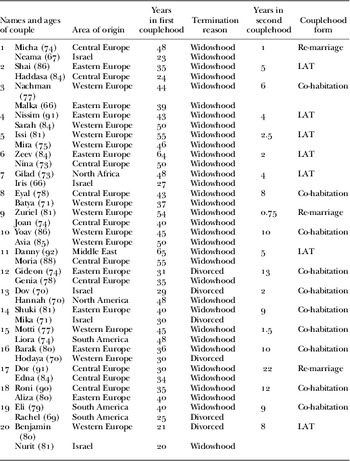
The sample (see Table 1) included 20 couples (40 individuals). The men's ages ranged from 70 to 92 and the women's ages ranged from 66 to 88. Participants’ marital status when entering second couplehood included 34 widowed, whose lifelong marriages ranged from 27 to 65 years, and six divorced, whose marriages ranged from 20 to 31 years. The partners of all the divorced participants had been widowed. Three couples were remarried, ten were co-habiting under the same roof and seven were living apart together.
Demographic information

Note: LAT: living apart together.
Data analysis revealed that eight participants perceived their long-term marriage as better than their second couplehood, 12 participants perceived their second couplehood as better than their first and 20 stated that the two relationships were different and could not be compared (Koren Reference Koren2011).
Participants perceived themselves to be in good to very good health and reported their socio-economic status as middle to upper-middle class. All were Jewish. Most declared themselves as ‘secular’, about a quarter ‘traditional’ and the remainder ‘religious’.
Data collection procedures
An interview guide was developed, drawing on key issues relating to second couplehood in old age identified in the literature. This served as the basis for 40 semi-structured interviews to collect data from 20 couples. The ‘grand-tour’ opening question (Spradley Reference Spradley1979) was: ‘Tell me the story of your second couplehood in old age’. A key content domain relevant to the theme presented in this article is: ‘The dyadic unit’, including such questions as: ‘What needs does the relationship include (e.g. friendship, emotional and sexual intimacy, care-giving, support) and how are they fulfilled’? Another relevant content domain is: ‘The experience of old age’, including such questions as: ‘What does being old mean to you’?, ‘How do you perceive yourself and your partner in terms of being old’?
Each of the participants signed a letter of consent after reading a brief explanation of the study and of how confidentiality would be ensured. The interviews lasted 1·5–2·5 hours and were conducted separately to enable each member of the couple to narrate freely and discuss their own unique experiences. Thus, each participant could introduce material that might not have emerged in joint interviews, especially when discussing sensitive topics or criticising their partner (Eisikovits and Koren Reference Eisikovits and Koren2010).
Data analysis process
The couple was the unit of analysis. Therefore, although interviews were conducted separately they were analysed both individually, based on IPA methods (Smith, Flowers and Larkin Reference Smith, Flowers and Larkin2009), and dyadically for overlaps and contrasts (Eisikovits and Koren Reference Eisikovits and Koren2010). Data were organised and coded using ATLAS.ti 5·0 (2005). First of all, the transcribed interview of one member of a couple was read and reread whilst listening to the recording and notes were made in relation to ideas that arose during the process. Headings were given to sentences and paragraphs according to their main ideas, and initial descriptive, linguistic and conceptual notes were made. In the next step, emergent themes and sub-themes were developed from the individual interview and connections between them were found by identifying and grouping units of meaning, moving towards an interpretive level. The same procedure was followed for the other member of the dyad. Overlaps and contrasts between the members of the dyad were noted. The entire process was repeated for all of the interviews and analysis that cut across interviews was performed. This included examining how each individual participant, as part of a dyad, addressed each cross-case theme and sub-theme, reaching a dyadic level at which two individual perspectives were combined to create a third perspective (Eisikovits and Koren Reference Eisikovits and Koren2010). Theoretical saturation (Patton Reference Patton2002) was reached after 17 couples (34 interviews) were analysed. Data from three more couples (six interviews) were collected and analysed, ending with a total of 20 couples (40 interviews) to confirm theoretical saturation.
Trustworthiness
Trustworthiness was achieved in several ways. Firstly, to ensure referential adequacy, tape-recorded interviews and their verbatim transcriptions enabled verification from the original (Lincoln and Guba Reference Lincoln and Guba1985). Secondly, the researchers working on the larger study simultaneously performed separate analyses. The identified themes were compared and negotiated until agreement was achieved. Thirdly, peer debriefing was achieved by a group of colleagues familiar with qualitative methods, who asked provocative questions relating to the analysis. This provided additional insights beyond those of the researchers (Lincoln and Guba Reference Lincoln and Guba1985). Fourthly, dyadic analysis provided a means of achieving trustworthiness similar to triangulation based on the principle that the greater number of sources that are available for interpreting data, the more reliable the findings become. In addition to the researcher's interpretation of each individual partner's quotes, a third interpretation was derived by combining the two individual perspectives; as each interpretation had to be analysed in light of the other, this meant that they were interdependent and mutually restrictive, being both enriching and limiting (Eisikovits and Koren Reference Eisikovits and Koren2010).
To present the experience from a dyadic perspective, data are presented using quotes from both partners for each theme addressed. All quotes were translated from Hebrew, and identifying details have been altered to maintain confidentiality.
Findings
The theme of second couplehood in the context of old age and old age in the context of second couplehood emerged from data analysis through the following five sub-themes: (a) enjoying life while still possible; (b) living with changing health issues; (c) relationships with adult children: autonomy versus dependency; (d) loneliness: living as a couple is better than living alone; (e) self-image: feeling young–feeling old.
The interaction between second couplehood and old age in its various forms (sub-themes) was prevalent in the interviews. The excerpts used here were chosen from several quotes, each illustrating one sub-theme, but they are by no means the only relevant examples from the interviews.
Enjoying life while still possible
The necessity to enjoy life while still possible has a unique time-related meaning in the experience of old age (Carstensen, Isaacowitz and Charles Reference Carstensen, Isaacowitz and Charles1999). What will not be accomplished in the here and now might never occur because of the limited time left to live. These perceptions reflect how second couplehood is experienced:
We are now playing the extra time given to us, like in a football match after the official 90 minutes. I tell him that he should take advantage of that time; he has my permission. This is different from the approach I had with my first husband; it never occurred to me that he would be unfaithful to me. I give him [my current partner] this freedom. (Rachel, woman, age 71, divorced, nine years in co-habiting second couplehood)
Rachel experiences old age as time granted beyond the official allocation. Therefore, she believes that it should be optimised and that every opportunity should be seized. She conveys the message to her partner that, if he wishes to be with other women, he should seize the day before his time is up and it is too late. This differs from how she related to life in her first marriage. As far as she is concerned, old age influences couplehood in two ways: the first regarding the limited time left to live, and the second regarding her wisdom that comes with lifelong experience. She learned that nothing is completely secure and that anything is possible. Her way of coping with these realisations is to bring them out into the open to try to avoid unpleasant surprises.
Her partner relates to the additional time granted as follows:
Whatever I do now, I should enjoy life as much as possible. My wife says it's like the extra time given in football after the official 90 minutes are over; that's the time we're living in now. (Eli, man, age 79, widowed, nine years in co-habiting second couplehood)
Eli adopts his partner's metaphor relating to the present time as an extension to life, of which he should therefore take advantage. Although they are not married, he describes his partner as his wife. This might be a way of psychologically ensuring his security, as according to the common perception, betraying a wife does not necessarily end the relationship, whereas the betrayal of a girlfriend is more likely to lead to such an outcome.
Both partners relate to the greater potential of old age to be fun when living in a second couplehood relationship and that second couplehood in old age leaves room for permissiveness.
The following quotes illustrate the ability to enjoy life in old age and how living in second couplehood in old age influences life's enjoyment.
Since being with Barak, I do all kinds of things that interest me. I don't have to prove anything to anyone any more, including myself. My whole life I had to prove myself; nowadays, I don't have to prove anything to anyone. I think this is a function related to age; live your life quietly, and do what is good for you. (Hodaya, woman, age 70, divorced, ten years in co-habiting second couplehood)
Hodaya's ability to enjoy life in old age is a result of two intertwining factors. One is her life experience that taught her to focus on her own interests without having to prove herself. The other is the serenity she found with her second couplehood partner, who makes it easier for her to live according to her life wisdom. Thus, second couplehood and old age intertwine. Her partner reinforces this:
As long as the mechanism here (points towards his head) and the body allows you to enjoy life, then you should, and we do. We have people over and we visit others, we travel abroad, go to good restaurants, and are happy for each other. I think everyone should live like this at our age. (Barak, man, age 80, widowed, ten years in co-habiting second couplehood)
Barak draws on the temporary nature of health and functionality in old age as a reason to enjoy life while still possible. The mutuality of being happy for one another when each is enjoying life together and apart, and their ability to be themselves within their couplehood relationship, contributes to their satisfaction.
Living with changing health issues
Changes in health are a common concern of older people and can take on a distinct character in a second couplehood relationship, as illustrated through quotes from the interviews with the following couple:
I'd like to say that I think I would deteriorate much faster if I didn't have this relationship. I repress the problem of getting old and sick and what can happen. Mika [my partner] is much younger than I am and I will probably die first. There are all kinds of problems. I feel guilty because I think that, at some point, I could become a burden to her. We don't talk about it, but she does not accept it and I know that it could happen anyway and it bothers me, but there's nothing that can be done. (Shuki, man, age 81, widowed, nine years in co-habiting second couplehood)
Shuki believes that second couplehood contributes to his vitality, emphasising the age difference between him and his partner. His concern regarding this issue could be relevant to any couplehood relationship in old age. However, the uniqueness of second couplehood compared to lifelong marriage is the issue of mutual commitment. In long-term marriage, couples usually take it for granted that they will take care of their spouse if the need should arise, even if they would prefer not to assume the care-giving role. In contrast, caring for the other in second couplehood is usually out of willingness rather than obligation (Koren Reference Koren2011). Therefore, the need to receive care from one's partner has a different meaning when it is not taken for granted, and as such, second couplehood influences old age accompanied by illness and functional deterioration. The need for help might change the nature and meaning of the relationship. Care provided willingly might eventually become a burden, potentially leading to physical and functional changes as well as distancing between the partners. Hence, the disabilities accompanying old age influence second couplehood.
The following quote illustrates his partner's perspective:
Unfortunately, at our age, we all face possible changes in health. I am also aware of the age difference between us and this certainly bothers me in the sense that I'm frightened. At the moment, it's OK, you know, but these things are out of our control … when I was younger, I always said that I'd be willing to die after one year of happiness, but after living with Shuki, I'm so happy that I ask for extensions … I'd be happier if we could step back in time together at least ten years. The current situation troubles me. (Mika, woman, age 71, divorced, nine years in co-habiting second couplehood)
Second couplehood has changed Mika's outlook on life as she has found happiness that she did not believe was possible. This happiness causes her to wish to maintain the status quo, an experience that is different from at other stages in her life. As such, second couplehood influences how she experiences her old age. Similar to her partner, however, Mika is aware not only of what might lie ahead, but also of their age difference, and wishes that things will remain as they are. Old age accompanied by illness threatens her happiness, and could worsen her situation. Old age influences second couplehood in the sense that instead of looking towards the future, the wish is to go back in time or at least to stay in the present, where all is still well.
For both partners, old age influences second couplehood due to the fear of what the future holds regarding health issues and how these could affect their relationship and their present happiness. For Shuki, couplehood influences old age because he feels the ageing process slowing down. For Mika, couplehood influences old age because it has made her happier than she has ever been before.
The following quotes illustrate the intertwining of old age and second couplehood regarding wisdom acquired through previous life experience with changing health situations in a lifelong marriage:
Interviewer: Which title would you give to this period of your life?
Zuriel: Autumn. It comes after spring and summer and is not yet winter. We're both aware that we're old. Even though we are still mentally intact, we're old and we are aware that the unexpected could happen any time; just like what happened suddenly with my first wife. Autumn is still comfortable, although winter is at the threshold. (man, age 81, widowed, nine months remarried in second couplehood)
Zuriel relates simultaneously to the interplay of old age and second couplehood by using autumn as a metaphor for the phenomenon. Autumn symbolises a period of vicissitudes in health and functionality without too much warning. Old age turns second couplehood into something temporary due to the awareness that deterioration and death are near. Previous experience in his lifelong marriage facilitates greater awareness of what might lie ahead. Finally, second couplehood helps him to experience old age in a more enjoyable way.
His spouse illustrates this as follows:
Interviewer: How did you make the decision to move here?
Joan: Practicality. I thought it would not be a good idea to remove him from his familiar environment, where he will receive a lot of social support, in case he needs medical care. I wouldn't be able to care for him on my own. Besides, I found quite a few interesting activities in the community here, which I participate in. (woman, age 74, widowed, nine months remarried in second couplehood)
The interplay here between second couplehood and old age regarding health issues relates to the decision about living arrangements, which is influenced by care-giving options, if and when they become necessary. This, in turn, influences the type of activities experienced in her daily life. Both partners relate to how old age influences second couplehood and helps older people to cope with the uncertain future.
Relationships with adult children: autonomy versus dependency
Dependency on adult children is one of older peoples’ main support sources, and increases with old age-related changes and losses. Difficulties related to role reversal, especially in modern cultures, are well established in theories on ageing families (e.g. Berman Reference Berman1993). Therefore, the option of depending on significant others who are not one's children could add quality to old age. Second couplehood influences old age by assisting the preservation of autonomy, in liberating older persons from dependency on children as their primary care-givers. This is illustrated by the following quotes:
When we decided we were getting serious about each other, I called my daughters to tell them. The older one said: ‘Go ahead’. The younger one said: ‘If I could hug you through the phone, I would’. I got full support, not only because they wouldn't have to worry about taking care of me, but if that had been their motive, I say why not? There's nothing wrong with that, either. (Micha, man, age 74, widowed, one year remarried in second couplehood)
Micha is thrilled that his daughters accepted his decision to become involved in a second couplehood relationship, out of concern for his happiness. Nevertheless, he does not rule out the possibility that being primary care-givers could become a burden. If second couplehood can assist in reducing part of this burden, this could be considered another benefit of the phenomenon, showing how it influences the experience of old age; reducing some of the possible parent–child tensions stemming from emotional and physical dependence on adult children.
His partner relates to autonomy in the context of emotional dependence on adult children:
I think that when you're older, it's much more important to have a couplehood relationship, especially when the children reach an age when they no longer need your help. They manage on their own, they are happy when you visit, but it's difficult to feel that they need you less, and I think it's important not to reach such a state, but to be in a situation where you can say: ‘I have a boyfriend’. It's not that I'm not important to the children; I am – but I know exactly where I stand and what it's like to feel not needed. (Neama, woman, age 74, widowed, one year in remarried second couplehood)
Neama speaks of the need for liberation from emotional dependence on adult children, which could be created due to role reversal among parents and children in old age. When old age first arrives, the parent fulfils grandparent roles. As ageing proceeds, older parents feel less needed, regardless of their health or of their ability to assist. Neama is aware of this process and tries to avoid it by creating an emotional alternative in the form of second couplehood. This has dual benefits. It assists in creating autonomy, releasing parents from emotional dependence on children, and it helps to free the children from emotional and instrumental obligations towards parents. Hence, second couplehood influences the experience of old age. Neama feels that it is preferable to develop an emotional relationship with a partner in addition to her relationships with her adult children, instead of being mainly dependent on them emotionally – something she sees so often among other older people.
Neama and Micha complement each other; Micha raises the issue of freeing adult children from having to be primary care-givers, whereas Neama speaks of older parents’ autonomy, avoiding dependence on adult children for emotional support. Both situations are addressed by involvement in a meaningful second couplehood relationship, therefore demonstrating another way of how second couplehood influences the experience of old age.
Whereas the previous quotes illustrated future expectations, the following quotes illustrate practical experience:
When Hadassa had a heart attack … her daughter came from abroad, but I was there in the hospital. I was with her all the time, for two weeks, morning and evening. I also had surgery, blood vessels. She was with me also, for a few days. For two or three days, she was by my side, with me, which is very good in the third [old] age, that you have someone to talk to, to relate to. (Shai, man, age 86, widowed, five years in LAT second couplehood)
Shai described how his caring for his partner released her from dependence on her children whilst in hospital. His choice to remain by her side liberated her daughter from having to be constantly present, thus enabling her to be in touch with her mother, not out of obligation but out of choice. Interdependence between the partners served a dual function: it reiterated the older people's autonomy in relation to their biological family and satisfied their mutual need for a significant other. This kind of relationship not only provided the partners with companionship, but also gave meaning to their life. Hadassa's perspective reinforced this interpretation:
And I told them [my children] that I have a friend here, and they were satisfied that I was not alone, and the truth is, we help each other. I had a heart attack and he was by my side. Of course, the children came; two of my children live abroad, but he was here every day. He also had problems. At our age, you can't get through without any problems at all. I was by his side, also. (Hadassa, woman, age 84, widowed, five years in LAT second couplehood)
Hadassa confirmed her partner's narrative regarding mutual help. As an outcome of this meaningful relationship, she believed that her children were released from the obligation to care for her, and she was not dependent solely on them.
Both partners agree on how second couplehood influences their old age by releasing them from dependence on their adult children for practical and emotional assistance.
Loneliness: living as a couple is better than living alone
One of the issues most frequently related to old age is emotional loneliness created due to the loss of a spouse, friends and relatives. Second couplehood is a possible solution for being alone, thereby influencing the experience of old age. However, fear of loneliness as the primary motive for creating second couplehood will have implications for the nature of the relationship. Quotes from interviews with the following couple are illustrative:
To be honest, my satisfaction might be due to the mere fact that I have a partner and that I'm not lonely, but there are many things I am not satisfied with in this relationship. (Nurit, woman, age 81, widowed, eight years in LAT second couplehood)
For Nurit, old age brings loneliness. To avoid such feelings, she becomes involved in a second couplehood relationship. Although this helps to prevent the loneliness, many other aspects of the relationship are unsatisfactory, reflecting the functional aspect of second couplehood at the expense of its satisfying nature. Her partner adds the dimension of ‘making do with what you get’, as follows:
At my age, you take what you get. I think that, in a way, this is true about my relationship with Nurit. There's a proverb in the Talmud that says: ‘It is better to sit in twos than to sit alone’, and I think this is true. It doesn't matter if the other is not your ideal. I'm in second couplehood, so let's say I take what I get, but it definitely is not my ideal. (Benny, man, age 80, divorced, eight years in LAT second couplehood)
Old age influences the nature of second couplehood through the choice to remain in the relationship in spite of its flaws, merely to avoid experiencing loneliness. Neither partner views the present couplehood as ideal, but it has the advantage of reducing loneliness in old age. The way in which they experience this lack of ideal influences their experience of the relationship. A dyadic analysis of this couple's remarks shows congruence in their perception of the relationship and its purpose, which could explain their remaining together.
Second couplehood serves as a solution to aloneness also when the relationship is more satisfying:
It's not that I can't manage on my own, that I don't have someone to prepare my meals or do my laundry, these things I can manage on my own. There is an old Talmudic saying: ‘It is better to sit in twos than to sit alone’. (Micha, man, age 74, widowed, one year remarried in second couplehood)
Micha uses Jewish sources to justify his emotional need to not be alone. Second couplehood influences old age by helping the person not to be alone. The instrumental tasks are taken care of; he needs a partner for emotional reasons. His spouse elaborates on this theme:
When people get older, they need someone beside them. It's not for the physical instrumental help because both partners are old. It's a matter of friendship, to have someone to talk to and share with. When I was a younger widow, it was difficult at first, but I got used to it. I had good friends, siblings and my children, and I didn't feel the need for a spouse. Things change in old age. It becomes more difficult, you feel that people don't need you anymore. I see other older women who are alone and I feel sorry for them. (Neama, woman, age 67, widowed, one year remarried in second couplehood)
Neama is aware of her reason for entering second couplehood: as a way to prevent the possibility of future loneliness. Thus, old age influences second couplehood. This awareness influences her actions in old age, and being in a second couplehood relationship influences how she will experience this period. Both partners perceive second couplehood as an answer to possible loneliness in old age and, as such, old age influences the mere creation of such a relationship.
Self-image: feeling young–feeling old
Self-image in old age influences social norms relating to what makes someone feel old. Quotes from the interviews with the following couple illustrate how love in second couplehood influences the perception of old age and how it assists in constructing a self-image of feeling young:
Liora: There are times when I think that I should behave like a 74-year-old woman, but I don't.
Interviewer: How should a 74-year-old woman behave?
Liora: Perhaps I should be more serious, behave more formally, but I can't be like that with him. We walk around with our arms around each other. He never had this before in his life. It's new for him that someone loves him like this. I tell him every day that I love him and age isn't important, I love him, we're like two teenagers, it's love. Listen, a 74-year-old woman doesn't write ‘I love you’ on the mirror with her lipstick. (woman, age 74, widowed, 1·5 years in co-habiting second couplehood)
Liora describes falling in love in old age, leading to a series of subsequent behaviours. Being in love influences her self-perception as an old woman and she feels that, according to social norms, her behaviour is inappropriate to her chronological age. Being in love helps her construct a self-image of a much younger woman, even an adolescent. She states that, due to second couplehood, her partner is able to experience new feelings and explains how having the opportunity to love again, and for her partner to love for the first time, influences how she perceives their old age in a manner different from normative expectations.
The next quote confirms her perception of her partner:
I don't feel old, no, I feel younger every day … it's my woman, I'm really lucky, everyone says so, it's a gift, like winning the lottery, they accept her like their mother, we're 74 and 77, like a gift from heaven, it's what makes the difference between one old man and another. There are those who don't find it [love]. (Motti, man, age 77, widowed, 1·5 years in co-habiting second couplehood)
Second couplehood has impacted on Motti's old age through his relationship with his partner, constructing a self-image that is younger every day. However, this self-image in old age also influences his couplehood in the sense that, to enjoy the relationship, his family's approval is important.
Both partners refer not only to the micro level of how their good fortune in finding each other has reflected on their self-images in old age, but also relate to the mezzo and macro levels. Motti relates to the mezzo. He emphasises that his family's acceptance makes it easier for him to enjoy second couplehood, thus demonstrating how self-image approved by family members in old age influences second couplehood. Liora, relating to the micro level, enjoys behaving in a manner that is contrary to the socially acceptable way of expressing love in old age. The declaration of the contrast between her self-image constructed through second couplehood and the accepted social image of old age adds to the unique nature of their second couplehood relationship.
The following quote explores self-image when the relationship is not necessarily so fulfilling.
I think that if I weren't in a second couplehood relationship, I would think of myself as older. The fact that someone my age, not someone who is a hundred years old, fancies me, at my age, and wants a couplehood relationship with me, makes me feel good … however, at my age, I'd be satisfied with friendship, someone to talk to, have a meal with, but between men and women, it is usually not that way; it either develops into something more intimate or it withers. (Nurit, woman, age 81, widowed, eight years in LAT second couplehood)
Nurit expresses ambivalence regarding old age and second couplehood. On the one hand, second couplehood influences her old age by helping her feel desired, especially since she and her spouse are the same age, rather than being significantly younger than her partner, which is against what she believes to be normative. These two aspects make her feel younger than her age. On the other hand, she wishes that her relationship would have less emphasis on physical intimacy, with a stronger emphasis on friendship, although she does not really believe that this is possible.
We participate in a gathering that is supposed to be for singles, as we were ten years ago. I claim that now we are old men and women, there are different expectations from life, different types of entertainment from ten years ago. The most obvious is that we don't dance anymore; people don't feel the need to dance. (Benny, man, age 80, divorced, eight years in LAT second couplehood)
Benny uses the metaphor of dancing to explain how old age influences couplehood, by changing expectations of life and of couplehood. People who perceive themselves as old do not perceive couplehood as romantic, and thus do not seek to dance.
Both partners sense a gap between their ideal experience of second couplehood and how they experience it in practice. Benny would like a romantic relationship. Nurit enjoys not appearing to be old by being in a couplehood relationship, but would prefer a relationship without physical intimacy. They are both ambivalent regarding their second couplehood in old age and they seem to feel as though they must choose between the two, rather than experiencing them as intertwining.
Discussion
The phenomenological perspective perceives components of reality as mutually constitutive, each essentially defined through the other (Valle and King Reference Valle, King, Valle and King1978). In this study, old age and second couplehood intertwine, shifting alternately between figure and ground. The findings illustrate this through five different sub-themes: (a) enjoying life while still possible; (b) living with changing health issues; (c) relationships with adult children: autonomy versus dependency; (d) loneliness: living as a couple is better than living alone; (e) self-image: feeling young–feeling old.
In each of these themes, we can see how the phenomenon fulfils universal needs in various forms, as mentioned by de Jong Gierveld (Reference de Jong Gierveld2002), such as love, intimacy, friendship, companionship, emotional support and mutual help. In addition, through these themes we are able to see how living in second couplehood enables a unique perspective on old age and how its construction in old age creates unique meanings for experiences of second couplehood. We have also discussed the components of the ‘life-world’ (May Reference May1983) of those experiencing second couplehood in old age.
More specifically, the findings reveal different ways of relating to temporality and time. The time remaining versus the time that has past produces two types of reactions: either making the most of the time that is left to enjoy life (Carstensen, Isaacowitz and Charles Reference Carstensen, Isaacowitz and Charles1999) or focusing on temporality and future uncertainties regarding deterioration of health and functionality. A person's ‘being in the world with others’ (Mitwelt) changes along with change in the physical world (Umwelt). When health deteriorates in old age, care-giving responsibility usually falls on the older persons’ adult children and a role-reversal situation emerges (Williams Reference Williams1990). Role reversal is a controversial concept (e.g. Berman Reference Berman1993), viewed by some as a negative stereotype of frailty and of parent–child relationships in old age. These researchers claim that such relationships manifest change, but not a complete reversal of roles (Seltzer Reference Seltzer1990). Others validate the concept and consider it to be useful (Jarvik Reference Jarvik1990), emphasising intergenerational reciprocity. The first approach could be perceived as representing a modernist perspective and the second a more traditional one. Thus, older persons creating second couplehood in Israel could be perceived as belonging to the modernist side of this society. Others suggest a hermeneutic perspective, viewing role reversal as a metaphor for facilitating meaning making of the parent–child relationship (Berman Reference Berman1993). Although the traditional aspect of society expects adult children to provide care-giving services to their ageing parents, many older persons who live according to modern Western cultural norms of individualism (Cooney and Dunne Reference Cooney and Dunne2001) prefer to be autonomous and to remain non-dependent on their adult children. The study findings strengthen this notion; second couplehood is shown to provide a significant other who can help to lessen the adult children's care-giving burden and to reduce reliance on formal help. This contradicts previous findings that indicated the willingness of women and men in second couplehood in old age to care for a partner with a temporary illness, but who were unwilling to commit themselves to providing care-giving or nursing services in cases of chronic illness (Karlsson and Borell Reference Karlsson and Borell2002; de Jong Gierveld Reference de Jong Gierveld2002). This was emphasised especially by women (Davidson Reference Davidson2002). Findings from the larger study (Koren Reference Koren2011) indicated that care-giving in second couplehood is based on willingness and personal choice, as opposed to the participants’ lifelong relationships, where it had often stemmed from mutual obligation. However, the findings presented here indicate that, as health and functionality deteriorate in second couplehood, the motivation to provide care through willingness and personal choice might shift towards the sense of obligation, thus potentially changing the nature of the relationship.
Such a situation could cause difficulties that call for psycho-social interventions. This is because older persons living in second couplehood were found to have less contact with their social network compared to persons living in lifelong marriages or single older persons who were widowed or divorced (de Jong Gierveld and Peeters Reference de Jong Gierveld and Peeters2003). It is not clear, however, what preceded what: did second couplehood weaken the social network or did an already weak social network enhance the need for second couplehood? Whatever the chronology of events, recent findings have indicated that co-habiters with a disability are less likely to receive partner care than those in lifelong marriages (Noel-Miller Reference Noel-Miller2011) and that remarried care-givers face support challenges, isolation and demoralisation (Sherman Reference Sherman2012), which could discourage fulfilling the role. Thus, interventions are likely to be needed if the partner in second couplehood does not become involved in care-giving.
For some people, the sole reason for entering a second couplehood relationship is to avoid the increasing loneliness in ones ‘sphere of ownness’ (Eigenwelt) (Sokolowski Reference Sokolowski2000) associated with old age (Cohen-Mansfield, Shmotkin and Goldberg Reference Cohen-Mansfield, Shmotkin and Goldberg2009). The literature mentions various types, including romantic loneliness, following the loss of a significant other and of the intimate partner relationship. The result is the sense of absence of other and of emptiness in the environment (Drennan et al. Reference Drennan, Treacy, Butler, Byrne, Fealy, Frazer and Irving2008). The greatest degree of protection against loneliness is a positive marital relationship (Hawkley et al. Reference Hawkley, Hughes, Waite, Masi, Thisted and Cacioppo2008). Loneliness as the ‘pain of being alone’ (Heidegger [Reference Heidegger1927] 1962) becomes a major negative component of existence, and as such has the potential to limit the nature of the relationship, in the sense of ‘be happy with what you get rather than striving for greater fulfillment’. This view coincides with developmental models that perceive the purpose of life review to be acceptance of the one and only lifecourse that a person has lived (e.g. Erikson Reference Erikson1998).
A more optimistic view may substantiate the ways in which second couplehood influences one's inner world (Eigenwelt) and self-perception by assisting in the construction of a younger self-image. As older people living in second couplehood are often not considered part of a mainstream phenomenon (Koren and Eisikovits Reference Koren and Eisikovits2011), the ‘rebellious’ and possibly ‘illegitimate’ nature of their falling in love and being in love at this stage of their lives is rejuvenating. Falling in love and being in love as ‘off time’ (Settersten Reference Settersten and Settersten2003) in old age is strengthened in the theme of self-image regarding the couple which is experiencing love for the first time.
In summary, some aspects of second couplehood, such as making do with what you get and the possible consequences for the relationship in the face of deteriorating health, are in keeping with the public discourse and some of the developmental perspectives of old age. Other aspects of the couplehood, such as falling and being in love and the carpe diem philosophy, challenge these common societal perspectives.
Limitations
The study has limitations regarding the participants’ socio-demographic backgrounds as well as the reasons for not agreeing to participate in the study. Theoretical sampling ensured diversity of the sample based on the criteria that evolved from the literature review. Nonetheless, the demographic variables lacked sufficient diversity regarding the participants’ socio-economic and multi-cultural backgrounds. Although these variables were not included in the initial participation criteria, they might have altered the overall picture to some extent. It should be stressed, however, that this being a qualitative study, representativeness is not an issue and can be somewhat compromised for the benefit of depth (Smith, Flowers and Larkin Reference Smith, Flowers and Larkin2009).
As participation was based on voluntary consent, we have no information about those who refused to participate and who might have produced some alteration in the understanding of the phenomenon. Most of those who did consent appeared to be in good quality second couplehood relationships. Additional findings from the larger study showed that most participants tended to experience emotional closeness and fewer tended to experience emotional distance. The findings reported in this article, however, also include participants who tended towards emotional distance, thus painting a diverse picture of intertwining between old age and second couplehood. It is recommended that further research consider larger diversity in relationship quality and in multicultural and socio-economic backgrounds, if such diversities exist within the phenomenon of second couplehood in old age.
Implications
Perceptions of old age are reflected through various kinds of phenomena, each contributing to the multiple faces of its reality. Researching second couplehood in old age contributes by emphasising its complexity, moving away from perceiving old age as either mainly a negative burden or a positive asset. The findings of the present study acknowledge the existence of positive and negative aspects of being old, but lean towards the positive, as the phenomenon grants the older persons a sense of vitality rather than of uselessness, through falling and being in love.
As a new emerging phenomenon, second couplehood in old age is yet to become recognised as a normative option in societies located between tradition and modernity (Koren and Eisikovits Reference Koren and Eisikovits2011), which could add to theories on the family. Revealing the various ways in which old age and second couplehood intertwine could assist in realising how the phenomenon has the potential to contribute to the wellbeing of older persons on the personal–micro level, the familial–mezzo level and the social–macro level. Findings also strengthen the socio-emotional selectivity theory (SOC) relating to the experience of time (Carstensen, Isaacowitz and Charles Reference Carstensen, Isaacowitz and Charles1999). SOC (Freund and Baltes Reference Freund and Baltes2002) is demonstrated, for example, by happiness gained through love found in a second couplehood relationship, which could be perceived as compensation for the loss of a lifelong spouse.
On the personal level, second couplehood has the potential to assist older persons to feel happier, younger and less lonely. On the familial level, it could assist in reducing adult children's filial responsibility towards their ageing parents, presenting another option for care-giving. On the social level, by living in a couple-oriented society, second couplehood could help promote older persons’ social status and potentially reduce prejudice against them.