Introduction
Community ambulation, or independent ambulation that takes place outside the home and yard (Lord, McPherson, McNaughton, Rochester, & Weatherall, Reference Lord, McPherson, McNaughton, Rochester and Weatherall2004), is regularly reported as a key goal by a majority of stroke survivors (Lord et al., Reference Lord, McPherson, McNaughton, Rochester and Weatherall2004). However despite its importance, only 32%–66% of stroke survivors achieve this goal following rehabilitation (Lord et al., Reference Lord, McPherson, McNaughton, Rochester and Weatherall2004; Perry, Garrett, Gronley, & Mulroy, Reference Perry, Garrett, Gronley and Mulroy1995; Viosca et al., Reference Viosca, Lafuente, Martinez, Almagro, Gracia and Gonzalez2005). Clinical measures of gait and function do not accurately reflect community ambulation outcomes (Lord et al., Reference Lord, McPherson, McNaughton, Rochester and Weatherall2004; Viosca et al., Reference Viosca, Lafuente, Martinez, Almagro, Gracia and Gonzalez2005) and therefore accurate and reliable measurement of community ambulation after stroke is required.
There is currently no gold-standard method for measurement of community ambulation after stroke. Thus far, the most common measurement of community ambulation after stroke has been through self-report (Bijleveld-Uitman, van de Port, & Kwakkel, Reference Bijleveld-Uitman, van de Port and Kwakkel2013; Lord et al., Reference Lord, McPherson, McNaughton, Rochester and Weatherall2004; Perry et al., Reference Perry, Garrett, Gronley and Mulroy1995; Robinson, Shumway-Cook, Matsuda, & Ciol, Reference Robinson, Shumway-Cook, Matsuda and Ciol2011; Viosca et al., Reference Viosca, Lafuente, Martinez, Almagro, Gracia and Gonzalez2005). However, this has been deemed inaccurate after stroke (Gebruers, Vanroy, Truijen, Engelborghs, & De Deyn, Reference Gebruers, Vanroy, Truijen, Engelborghs and De Deyn2010; Murphy, Reference Murphy2009). More recently, accelerometers and global positioning systems (GPS) have demonstrated potential for valid and reliable community ambulation measurement after stroke in both the research (English, Manns, Tucak, & Bernhardt, Reference English, Manns, Tucak and Bernhardt2014; McCluskey, Ada, Dean, & Vargas, Reference McCluskey, Ada, Dean and Vargas2012) and clinical settings (Evans, Hanke, Zielke, Keller, & Ruroede, Reference Evans, Hanke, Zielke, Keller and Ruroede2012; Roos, Rudolph, & Reisman, Reference Roos, Rudolph and Reisman2012). Accelerometers have been used to quantify daily walking activity after stroke through step count and activity duration (Gebruers et al., Reference Gebruers, Vanroy, Truijen, Engelborghs and De Deyn2010). These devices are unable to provide information on location however, so walking that takes place within community environments cannot be isolated from total daily walking activity. GPS devices are able to provide information on location of activity (Evans et al., Reference Evans, Hanke, Zielke, Keller and Ruroede2012; McCluskey et al., Reference McCluskey, Ada, Dean and Vargas2012). Thus, together, accelerometers and GPS devices may be able to provide isolated measures of walking within the community.
Accelerometers such as the ActivPAL™ (Roos et al., Reference Roos, Rudolph and Reisman2012) and Sensewear Pro2 Armband (Moore et al., Reference Moore, Hallsworth, Plotz, Ford, Rochester and Trenell2013) have been used to measure walking after stroke. The ActivPAL™ has excellent agreement with direct observation for time spent sitting, lying and standing and postural transitions (absolute percent error = 0%) in older adults with impaired function, including people with subacute stroke (Taraldsen et al., Reference Taraldsen, Askim, Sletvold, Einarsen, Bjastad, Indredavik and Helbostad2011). However, validity and reliability of walking measures such as time spent walking and step count after stroke, in both indoor and outdoor environments has not been investigated. The Sensewear Pro2 Armband has demonstrated good to excellent agreement with gold standard measures for energy expenditure in two small studies of people with chronic stroke (Manns, Tomczak, Jelani, & Haennel, Reference Manns, Tomczak, Jelani and Haennel2010; Moore et al., Reference Moore, Hallsworth, Bluck, Ford, Rochester and Trenell2012). However, a more recent study found variable accuracy of the Sensewear Pro2 Armband for energy expenditure (Vanroy et al., Reference Vanroy, Vissers, Cras, Beyne, Feys, Vanlandewijck and Truijen2014). Similarly, accuracy of the Sensewear Pro2 Armband in outdoor environments has also not been investigated. Feasibility of accelerometers for free-living walking measurement (i.e., independent don and doffing, ease of data analysis) has received limited investigation after stroke and is an important consideration (Evans et al., Reference Evans, Hanke, Zielke, Keller and Ruroede2012; Fini, Holland, Keating, Simek, & Bernhardt, Reference Fini, Holland, Keating, Simek and Bernhardt2015).
GPS can provide real-time information on location, trips, distance, terrain, patterns and purpose of walking within the community (Evans et al., Reference Evans, Hanke, Zielke, Keller and Ruroede2012; Le Faucheur et al., Reference Le Faucheur, Abraham, Jaquinandi, Bouye, Saumet and Noury-Desvaux2008; Maddison & Ni Mhurchu Reference Maddison and Ni Mhurchu2009; McCluskey et al., Reference McCluskey, Ada, Dean and Vargas2012). GPS devices have demonstrated good to excellent agreement with direct observation for the number and purpose of community trips and appear feasible for community ambulation measurement in people with stroke (McCluskey et al., Reference McCluskey, Ada, Dean and Vargas2012). However, GPS devices are yet to be validated for measures such as time spent walking, participant location and distance walked after stroke. Further, issues related to feasibility of use, including limited battery life and accuracy of data obtained require further investigation (Webber & Porter, Reference Webber and Porter2009).
Thus, the aim of this study was to determine the concurrent validity, retest reliability and feasibility of the ActivPAL™, Sensewear Pro2 Armband and Garmin GPS during walking tasks that impose demands similar to those encountered during free-living community ambulation.
Method
Participants
Fifteen community-dwelling, independently mobile individuals diagnosed with a unilateral stroke at least 6 months prior, were recruited through stroke support groups and a community rehabilitation clinic. Individuals were excluded if they scored less than 24/30 on the Mini-Mental State Examination (Folstein, Folstein, & McHugh, Reference Folstein, Folstein and McHugh1975), or suffered any neurological or medical condition other than stroke that limited home and community-based ambulation function. This study was approved by the institutional Medical Research Ethics Committee and all participants provided informed consent.
Procedure
Participants attended two clinic-based assessment sessions (initial and retest assessment) that were 1 week apart. At each assessment, participants donned the three devices (ActivPAL™, Sensewear Pro2 Armband, Garmin Forerunner GPS sports watch + foot pod) and completed three walking tasks: a 6-minute walk test, a treadmill walk test and a 200-m outdoor circuit. The three walking tasks were designed to simulate walking conditions that would be encountered during usual community ambulation (Patla & Shumway-Cook, Reference Patla and Shumway-Cook1999; Shumway-Cook et al., Reference Shumway-Cook, Patla, Stewart, Ferrucci, Ciol and Guralnik2002). The order of the walking tests was randomised between participants, but remained the same within the individual for the retest session. Participants were able to use gait aids if needed and a registered physiotherapist and research assistant walked beside participants at all times for safety.
Walking tasks
The 6-minute walk test (Enright, Reference Enright2003) was completed along an indoor, quiet, 30-m corridor. The treadmill task was completed on a flat incline. Speed settings began at 0.27 m/s and were gradually increased to each participant's self-selected slow, comfortable and fast speeds. Data was recorded for 1-minute when the participant had achieved a steady state of walking at each speed. Self-selected speed was chosen, as treadmill walking was deemed potentially challenging after stroke (Bayat, Barbeau, & Lamontagne, Reference Bayat, Barbeau and Lamontagne2005; Brouwer, Parvataneni, & Olney, Reference Brouwer, Parvataneni and Olney2009). The 200-m outdoor circuit included walking up a ramp (23.3 m, incline 1:19), ascending two steps with bilateral rails, walking along a busy footpath (7.6 m), traversing grass terrain (22.2 m), descending seven steps with bilateral rails, crossing a road without designated traffic signals (7.1 m) and negotiating curbs. Participants completed the circuit at a comfortable pace.
Four-day free-living community ambulation
Feasibility of use of each device for both participants and investigators was assessed over a 4-day period of usual free-living community ambulation. Investigators affixed the ActivPAL™ encased in a waterproof casing at the start of the 4-day period. Participants affixed the Sensewear Pro2 Armband on waking in the morning; and donned the Garmin GPS device prior to any community trip. Community trips were classified as any trip that was outside the home and yard (Lord et al., Reference Lord, McPherson, McNaughton, Rochester and Weatherall2004). Participants were phoned daily to remind them to don devices and for any troubleshooting purposes. Participants recorded information on any episodes of difficulty or discomfort when using the devices across the 4-days via a diary.
Measures
The ActivPAL™ and Sensewear Pro2 Armband collected measures during all clinic-based walking tasks. Data was collected by the Garmin GPS for the outdoor circuit only, as GPS satellite reception was only available outdoors. Concurrent measures collected via direct observation by the investigators included time spent walking (calibrated stop watch), number of steps (manual step counter), distance travelled (trundle wheel) and location of the participant (documented by the investigators on field notes).
Feasibility of the use of these devices in both clinical and research settings was determined during clinic-based walking tasks and during a 4-day free-living community ambulation period. Feasibility was determined by frequency of adverse events, participant-reported difficulty with the device (don/doff and ease of use) during the 4-day community ambulation period, time requirements to setup, charge, and download data and device malfunction (for example, the number of times the device had no data or provided an error message during the data collection period or during raw data analysis).
Devices
The ActivPAL™ (PAL Technologies Ltd©, Glasgow, UK) is a uniaxial accelerometer which records at a frequency of 10 Hz based on the acceleration resulting from gravity and inclination of the thigh. This data is then interpreted by proprietary software to provide measures at 15-second intervals (Dahlgren, Carlsson, Moorhead, Häger-Ross, & McDonough, Reference Dahlgren, Carlsson, Moorhead, Häger-Ross and McDonough2010). The ActivPAL™ was affixed on the middle of the non-paretic thigh (Dahlgren et al., Reference Dahlgren, Carlsson, Moorhead, Häger-Ross and McDonough2010). Measures collected from this device included number of steps, time spent walking and energy expenditure (METS).
The Sensewear Pro2 Armband (Bodymedia Inc., Pittsburgh, PA) is a biaxial accelerometer, which records measures at 1-minute intervals. It was worn over the triceps muscle of the paretic arm to allow independent use, as this would be required during free-living community ambulation measurement (Almeida, Wasko, Jeong, Moore, & Piva, Reference Almeida, Wasko, Jeong, Moore and Piva2011; Jakicic et al., Reference Jakicic, Marcus, Gallagher, Randall, Thomas, Goss and Robertson2004). The Sensewear Pro2 Armband provided measures of number of steps and energy expenditure (METS).
The Garmin Forerunner 405CX (Garmin Ltd., Olathe, Kan) is a GPS enabled sports watch. For this study, the Garmin footpod accessory was also used (an accelerometer accessory which communicates with the watch to improve accuracy of cadence and distance measures). Data and graphs obtained from the Garminconnect website (www.garminconnect.com.au) were used to determine number of steps (average cadence multiplied by time spent walking), time spent walking, distances traversed and participant location during walking tasks.
Data Analysis
Concurrent validity for step count, time spent walking, distance walked and participant location during walking tasks was determined using intra-class correlation coefficients (ICC3,1) to test for agreement between measures obtained from devices with direct observation (Rankin & Stokes Reference Rankin and Stokes1998). Retest reliability for step count, time spent walking, METS, distance walked and participant location during walking tasks was determined using intra-class correlation coefficients (ICC2,1) to test for agreement between measures obtained from devices at the initial and retest assessments (Rankin & Stokes Reference Rankin and Stokes1998). Coefficients of 0.80–1.0 were interpreted as excellent; 0.60–0.79 as good; 0.4–0.59 as fair and 0.10–0.39 as poor (Manns and Haennel, Reference Manns and Haennel2012; Weir, Reference Weir2005).
Analyses of variance (ANOVA) were used to determine differences between device and directly observed measures for validity, as well as between device measures across the two assessment sessions for reliability. Bland–Altman plots (Bland and Altman, Reference Bland and Altman1986) were used to visually quantify the mean differences and upper and lower limits of agreement (mean difference +/– (1.96 × SD)). Absolute percentage error (APE) was also calculated using the formula ((absolute mean difference/mean) × 100). Descriptive analyses were undertaken and proportions calculated of feasibility measures using field notes from clinic-based walking tasks and the diary kept by participants during the 4-day free-living community ambulation period. SPSS v.19.0 (SPSS Inc., Chicago, IL) was used for all analyses and a p-value of p < 0.05 was used.
Results
Participants
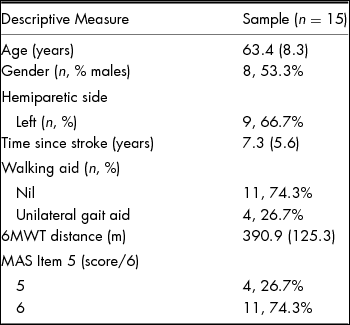
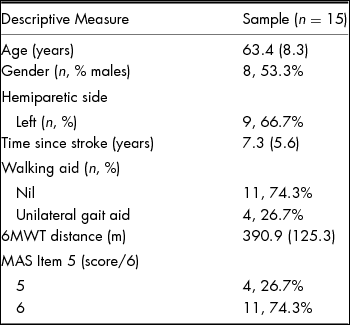
Fifteen participants with mean age 63.4 years (SD 8.3) and mean time after stroke of 7.3 (SD 5.6) years were recruited (see Table 1). Fifty-three percent of the sample was male and sixty-seven percent had a left hemiplegia. Four participants (26.7%) used a unilateral gait aid during all walking tests.
Characteristics of Participants
Validity
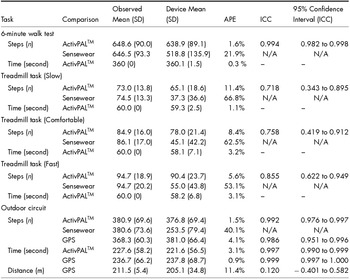
Table 2 shows the mean (SD), ICC scores, 95% confidence intervals and the absolute percentage of error for measures of step count, time spent walking and distance travelled used to assess validity of devices.
Comparison of Measures Between Direct Observation and the Three Devices Across Walking Tests (Validity)

Notes: APE: absolute percentage error, ICC: intra-class correlation coefficient, 95% CI (ICC): 95% confidence interval for intra-class correlation coefficient, Sensewear: Sensewear Pro2 Armband, N/A: not applicable, as the Sensewear data did not have a normal distribution for ICC statistics.
The ActivPAL™ demonstrated excellent agreement with direct observation for all measures of time spent walking (ICC: ≥ 0.997, APE: 0.3% to 3.0%) and most measures of step count during walking tasks (ICC: 0.855 to 0.994, APE: 1.5% to 5.6%). Good agreement was demonstrated with direct observation for step count during comfortable (ICC = 0.758, APE = 8.4%) and slow (ICC = 0.718, APE = 11.4%) treadmill walk speeds only. The mean (SD) self-selected slow, comfortable and fast treadmill speeds were 0.31 (0.11) m/s, 0.42 (0.17) m/s and 0.54 (0.25) m/s, respectively.
The Sensewear Pro2 Armband failed to collect any data for 21% of all walking tasks. When data was detected, a bimodal distribution was found (that is, it recorded either very few steps or hundreds of steps) and thus statistical assumptions for ICCs were not met. The Sensewear Pro2 Armband demonstrated a high APE for measures of step count during all walking tasks (APE ranging from 21.9% to 66.8%) (see Table 2).
The Garmin GPS watch showed excellent agreement with direct observation for measures of step count (ICC = 0.986, APE = 4.1%) and time spent walking during the outdoor circuit (ICC = 0.999, APE = 0.9%). It accurately identified the location of start and stop points during the outdoor circuit for all participants (APE = 0%). However, maps on the Garmin connect website demonstrated that the Garmin GPS was not consistently accurate for the exact route taken by participants. Further, the GPS device demonstrated poor agreement with direct observation for distance (ICC = 0.120, APE = 11.4%) (see Table 2).
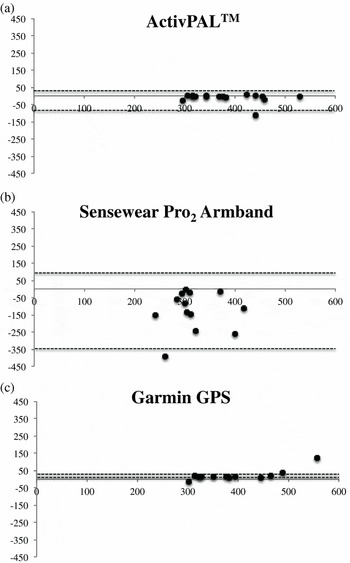
Bland–Altman plots for number of steps recorded during the outdoor circuit by the three devices are presented in Figure 1. It demonstrates that the Sensewear Pro2 Armband consistently undercounted steps (95% LOA: 92 to 346 steps), the Garmin GPS over-counted steps to a lesser degree (95% LOA: 5 to 38 steps) and no trend was evident for the ActivPAL™ (95% LOA: 44 to 66 steps) with the latter two most often within 5% error (see Table 2).
Bland–Altman plots for measure of step count during the outdoor circuit for (a) ActivPAL™, (b) Sensewear and (c) Garmin Forerunner GPS.

Reliability
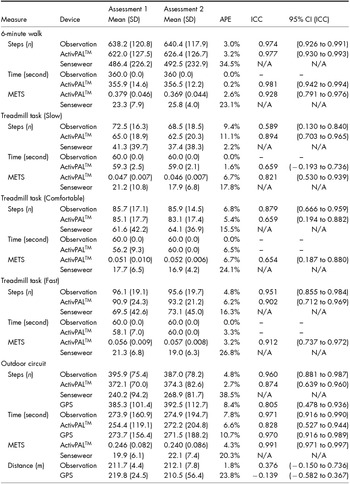
Table 3 shows the mean (SD), ICC scores, 95% confidence intervals and the absolute percentage of error for measures of step count, time spent walking, METS and distance for all devices across the two assessment sessions. No trends were observed on Bland–Altman plots for reliability measures collected during walking tasks.
Comparison of Measures at the Two Assessments During Walking Tasks (Reliability)

Notes: APE: Absolute percentage error, ICC: intra-class correlation coefficient, 95% CI: 95% Confidence interval for ICC scores, METS: Metabolic equivalents, N/A: not applicable, as the Sensewear data did not have a normal distribution for ICC statistics.
The ActivPAL™ demonstrated excellent retest reliability for most measures of step count (ICC: 0.874 to 0.977, APE: 2.7% to 11.1%), time spent walking (ICC: 0.828 to 0.999, APE: 0% to 6.6%) and METS (ICC: 0.821 to 0.991, APE: 2.6% to 6.7%). It had good reliability for step count and METS during comfortable treadmill speeds (ICC: 0.654 to 0.659, APE: 5.4% to 6.7%) and time spent walking during the slow treadmill speed (ICC: 0.659, APE: 1.6%) only (see Table 3).
The Sensewear Pro2 Armband had missing values for 27% of recordings and did not satisfy the statistical assumptions for ICC calculations due to a bimodal distribution. Further, the Sensewear Pro2 Armband data had a high absolute error across all but one test situation (average of 22% error, range 2.2% to 38.5%).
The Garmin GPS demonstrated excellent retest reliability for step count (ICC = 0.805, APE = 8.4%), and time spent walking (ICC = 0.970, APE = 10.7%). However, it demonstrated poor reliability for distance walked (ICC: −0.139, APE: 23.8%). Observation of maps on the garmin connect website demonstrated that the GPS watch recorded the same start and stop locations between test sessions for all participants, though map routes recorded differed between test occasions for each participant.
Feasibility
All participants used all devices across the 4-day community ambulation period. No difficulty was reported using the ActivPAL™, which was worn continuously. Two participants (13%) either forgot to don, or reported discomfort with the Sensewear Pro2 Armband. Five participants (33%) reported difficulty with using Garmin GPS. Reasons included difficulty with navigating the ‘touch-sensitive bezel’ (n = 4), forgetting to don (n = 1) or charge (n = 1) the device and the battery losing charge during community trips (n = 2). One adverse event was documented, with one participant reporting ‘itchy skin’ under the Sensewear Pro2 Armband.
All devices required less than 5-minutes to setup, don and doff. Participants were phoned daily across the 4-day period (total of 20 minutes) to encourage compliance with wearing the Sensewear Pro2Armband and Garmin GPS. The ActivPAL™ and Sensewear Pro2 Armband did not require charging over the 4-day period. The Garmin GPS required charging after each trip. Both the ActivPAL™ and Garmin GPS took approximately 3 hours to charge from a flat battery. The Sensewear Pro2 Armband required 2 × AAA batteries every 2–3 participants. Data download time was less than 5-minutes for all devices. The ActivPAL™ and Sensewear Pro2 Armband provided excel summary data sheets at 15-second and 1-minute epochs, respectively. Also, the ActivPAL™ and Garmin GPS had no occasions of device error or malfunction during clinic-based walking tasks. The Sensewear Pro2 Armband malfunctioned during 27% of all clinic-based walking tasks. Reasons for malfunction were most often due to the device automatically switching off prior to cessation of the task.
Discussion
This study demonstrated that the ActivPAL™ is a valid, reliable and feasible accelerometer to measure community ambulation in individuals with chronic stroke. The Garmin GPS is valid and reliable for step count, time spent walking and location, but requires further investigation for measurement of distance. Further, it is a feasible device for free-living community ambulation measurement, with assistance required to encourage compliance and assist with any troubleshooting. The Sensewear Pro2 armband appears to have poor concurrent validity and is unreliable for community ambulation measurement after stroke. Together, the ActivPAL™ and Garmin GPS may be able to provide accurate and repeatable measures of community ambulation in stroke survivors.
Clinic-Based Walking Tasks
The ActivPAL™ demonstrated good to excellent validity and reliability for all measures of walking in people with stroke, similar to earlier studies in healthy adults (Grant, Dall, Mitchell, & Granat, Reference Grant, Dall, Mitchell and Granat2008; Ryan, Grant, Tigbe, & Granat, Reference Ryan, Grant, Tigbe and Granat2006). Measures were most accurate for walking speeds greater than 0.42 m/s, which enable stroke survivors some ability to walk in the community (Lord et al., Reference Lord, McPherson, McNaughton, Rochester and Weatherall2004; Perry et al., Reference Perry, Garrett, Gronley and Mulroy1995). Greatest error (8.4% to 11.1%) was observed only for measures of step count during self-selected slow and comfortable treadmill speed conditions. Slower gait speeds may alter gait kinematics (Wagenaar & Beek Reference Wagenaar and Beek1992), resulting in insufficient thigh acceleration to register an activity recording by the ActivPAL™. Undercounting of steps by the ActivPAL™ at similar slow speeds (< 0.47 m/s) has previously been reported in people with mobility limitations (Taraldsen et al., Reference Taraldsen, Askim, Sletvold, Einarsen, Bjastad, Indredavik and Helbostad2011). Alternatively, the higher error may be due to a short data collection time. Measures in the current and previous study (Taraldsen et al., Reference Taraldsen, Askim, Sletvold, Einarsen, Bjastad, Indredavik and Helbostad2011) were collected over a 1-minute interval and 5-m distance, respectively. Longer measurement periods have reported excellent validity and reliability of ActivPAL™ with absolute error below 1.1% in healthy adults (Grant et al., Reference Grant, Dall, Mitchell and Granat2008; Ryan et al., Reference Ryan, Grant, Tigbe and Granat2006). Regardless, in the current study, the ActivPAL™ still demonstrated good to excellent validity and reliability at speeds slower than 0.42 m/s. Future studies investigating optimal algorithms when walking at gait speeds below 0.42 m/s and the minimum measurement period or number of steps needed for reliable measures when walking at slow speeds may be useful.
The current study found that the Sensewear Pro2 Armband was not valid or reliable for independent community ambulation measurement after stroke when worn on the paretic arm. This device under-estimated step count during all test situations and recorded with high absolute error regardless of environment or gait speed. This is similar to previous studies who have found the Sensewear to be inaccurate in measuring step count (Manns & Haennel Reference Manns and Haennel2012; Vanroy et al., Reference Vanroy, Vissers, Cras, Beyne, Feys, Vanlandewijck and Truijen2014), despite being accurate in measuring energy expenditure after stroke (Manns & Haennel Reference Manns and Haennel2012; Moore et al., Reference Moore, Hallsworth, Bluck, Ford, Rochester and Trenell2012). The placement of the Sensewear Pro2 Armband on the paretic arm during this study may have contributed to its high absolute error. Additionally, current algorithms have been developed based on young- and middle-aged healthy adults (Andre et al., Reference Andre, Pelletier, Farringdon, Safier, Talbot, Stone and Teller2006). Modified algorithms to detect steps at lower amplitudes of arm swing after stroke (Keenan, Perry, & Jordan, Reference Keenan, Perry and Jordan1984) and slower gait speeds may be of benefit for future use. Since the completion of this study, Bodymedia Inc. has released the Sensewear Pro3 Armband, which may have different algorithms that could be applied to stroke populations. If so, these devices would benefit from investigation.
The Garmin GPS demonstrated excellent validity and reliability for all measures except distance walked. Accurate location information during all outdoor walking tests suggests it could assist with the separation of ambulation that occurs in the community from total daily activity. Distance walked was, however, not accurate when measured with the Garmin GPS. The circuit used in the current study was limited to a shorter distance (200 m) than previously studied (2000 m) (Le Faucheur et al., Reference Le Faucheur, Abraham, Jaquinandi, Bouye, Saumet and Noury-Desvaux2007); contributing to the lower validity and reliability reported here. GPS accuracy has been shown to improve with greater distance walked in adults with reduced walking ability (Le Faucheur et al., Reference Le Faucheur, Abraham, Jaquinandi, Bouye, Saumet and Noury-Desvaux2008) and in open environments (Webber & Porter Reference Webber and Porter2009). During the circuit participants walked between two buildings which may have interrupted the satellite, and thus accounted for differences in map routes recorded. The effect of environment density on GPS accuracy and reliability requires more investigation (Le Faucheur et al., Reference Le Faucheur, Abraham, Jaquinandi, Bouye, Saumet and Noury-Desvaux2008).
Feasibility
It appears that accelerometers and GPS devices used in the current study are feasible tools for free-living community ambulation measurement after stroke. In particular, devices that can be applied by clinicians or researchers and left to record over an extended period of time are likely to have better compliance. Donning and doffing increases the risk of missing data if this is forgotten or not able to be completed by stroke survivors. Participants reported difficulty manipulating the touch-sensitive bezel and small buttons and remembering to charge the Garmin GPS. In future, GPS devices with manual press buttons may be easier for stroke survivors. Frequent recharging increases burden on participation and decreases compliance (Rodriguez, Brown, & Troped, Reference Rodriguez, Brown and Troped2005; Webber & Porter Reference Webber and Porter2009). Ongoing regular contact with patients may be needed to overcome these limitations, but will increase the time requirements for clinicians and researchers during free-living ambulation measurement. In support, a survey of stroke survivors has reported forgetfulness to be a barrier to the use of home-based health technology, and thus needs to be addressed in device design (Pandey et al., Reference Pandey, Bretz, Jensen, Henasey, Troung, Lushbough and Levine2013). Recent alternative options for collecting location data such as smart phones or similar devices, may also help overcome this limitation (McCluskey et al., Reference McCluskey, Ada, Dean and Vargas2012).
Data retrieved from all devices can easily be used to derive measures of volume of walking, such as time spent walking or step count per day. However, isolated measures of community ambulation required further analysis of raw accelerometer, GPS and diary data. The benefits of triangulating GPS and diary data for community ambulation measurement, including improved accuracy and deriving purpose of community outings has already been reported (McCluskey et al., Reference McCluskey, Ada, Dean and Vargas2012). This may not be feasible for clinicians to complete as an outcome measure within the clinical setting, but would be useful within the research setting to measure characteristics of ambulation based on community locations and purpose of trips.
Limitations
This study is limited by its small sample size (n = 15), however, the sample did include a mix of age, gender and gait ability. Further documentation of limb function using a standardised measure may have been useful to determine whether validity and reliability were related to functional ability of the participants. Assessment of the devices at set treadmill speeds similar to earlier studies may have provided a more consistent methodological approach to assess the effect of controlled gait speeds on device accuracy and reliability. However, as not all participants could achieve treadmill speeds identified in earlier treadmill protocols (0.9 m/s to 1.78 m/s), slower gait speeds were allowed in this study. The study used set tasks rather than free-living community ambulation to assess validity and reliability of the ActivPAL™, Sensewear Pro2 Armband and Garmin GPS. This was to ensure the variability of the devices, rather than the participants, was measured.
Conclusions
The ActivPAL™ and the Garmin GPS watch are valid and reliable in people with stroke for measures of time spent walking and step count during tasks that are reflective of community ambulation. The Garmin GPS can be accurately and reliably used to complement the ActivPAL™ for information on location, but further investigation is required for exact routes taken and distances ambulated, especially in dense urban areas and during short walking trips. The Sensewear Pro2 Armband recorded with high error when worn on the paretic arm. It is feasible to measure free-living community ambulation outcomes with portable accelerometers and GPS devices.
Financial Support
This research received no specific grant from any funding agency, commercial or not-for-profit sectors.
Conflict of Interest
None.
Ethical Standards
The authors assert that all procedures contributing to this work comply with the ethical standards of the relevant national and institutional committees on human experimentation and with the Helsinki Declaration of 1975, as revised in 2008.