Introduction
In classical biological control concerns regarding potential non-target effects of arthropod biological control agents (Howarth, Reference Howarth1991; Simberloff & Stiling, Reference Simberloff and Stiling1996; Thomas & Willis, Reference Thomas and Willis1998; Stiling & Simberloff, Reference Stiling, Simberloff, Follet and Duan2000; Louda et al., Reference Louda, Pemberton, Johnson and Follett2003; Stiling, Reference Stiling2004) have led to more studies investigating non-target effects, and efforts have been made to standardize methods for risk assessment studies (Babendreier et al., Reference Babendreier, Bigler and Kuhlmann2005; Simberloff, Reference Simberloff2005; Wright et al., Reference Wright, Hoffmann, Kuhar, Gardner and Pitcher2005; Kuhlmann et al., Reference Kuhlmann, Mason, Hinz, Blossey, De Clerck-Floate, Dosdall, McCaffrey, Schwarzlaender, Olfert, Brodeur, McClay and Wiedenmann2006a). Understanding the trophic relationships between parasitoids, the target pest species they are aimed at, and potential non-target species is a key requirement prior to any introduction of candidate biological control agents. An important constraint biological control practitioners frequently encounter is that the taxonomy of the organisms involved is often unclear (Van Driesche & Reardon, Reference Van Driesche and Reardon2004).
The subfamily, Ceutorhynchinae (Coleoptera: Curculionidae), contains about 1316 species (Colonnelli, Reference Colonnelli2004), of which some are considered to be herbivorous pests of high economic importance in agricultural crops (Dieckmann, Reference Dieckmann1972; Mason & Huber, Reference Mason and Huber2002). A number of Ceutorhynchus species, such as the cabbage seedpod weevil Ceutorhynchus obstrictus (Marsham) (=C. assimilis (Paykull); see Colonnelli (Reference Colonnelli2004)), the cabbage stem weevil Ceutorhynchus napi (Marsham), the cabbage seedstalk curculio Ceutorhynchus pallidactylus (Marsham), and the turnip gall weevil Ceutorhynchus pleurostigma (Marsham) are economically important pests of cruciferous crops. Simultaneously, a number of Ceutorhynchinae species are used worldwide for classical biological control of weeds in crop and non-crop habitats (Julien & Griffiths, Reference Julien and Griffiths1998). In North America, Ceutorhynchinae released to reduce the impact of weed species include Mogulones crucifer (Pallas) for houndstongue Cynoglossum officinale (L.) (Boragincaceae) (De Clerck-Floate & Schwarzlaender, Reference De Clerck-Floate, Schwarzlaender, Mason and Huber2002), Hadroplontus litura (Fabricius) for Canada thistle Cirsium arvense (L.) Scopoli (Asteraceae) (McClay et al., Reference McClay, Bourchier, Butts, Peschken, Mason and Huber2002a), and Microplontus edentulus (Schultze) for scentless chamomile Tripleurospermum perforatum (Merat) Lainz (Asteraceae) (McClay et al., Reference McClay, Hinz, De Clerck-Floate, Peschken, Mason and Huber2002b). The presence of pests and beneficial agents belonging to the same subfamily adds one level of complexity to the work of biological control practitioners.
The Chalcidoidea (Hymenoptera) contains over 800 different species that have been associated with biological control programmes in one way or another (Noyes, Reference Noyes2006). A number of Mesopolobus (Pteromalidae) species are associated with several Ceutorhynchinae species (Murchie & Williams, Reference Murchie and Williams1998). For instance, Mesopolobus morys (Walker) is one of the most important parasitoids of the cabbage seedpod weevil natural enemy complex in Europe (Williams, Reference Williams and Alford2003). Ceutorhynchus obstrictus is a pest of oilseed rape, Brassica napus L., in Europe and was accidentally introduced in North America where it is now widespread (Kuhlmann et al., Reference Kuhlmann, Dosdall, Mason, Mason and Huber2002). In Canada, C. obstrictus has been recently reported from Alberta (Carcamo et al., Reference Carcamo, Dosdall, Dolinski, Olfert and Byers2001), Saskatchewan (Dosdall et al., Reference Dosdall, Weiss, Olfert and Carcamo2002), Quebec (Brodeur et al., Reference Brodeur, Leclerc, Fournier and Roy2001), and Ontario (Mason et al., Reference Mason, Baute, Olfert and Roy2004). As an invasive alien species, C. obstrictus has been a prime target for classical biological control (McLeod, Reference McLeod1962), and several larval ectoparasitoids, including M. morys, were released into British Columbia in 1949 (McLeod, Reference McLeod1953). This species was considered to be established in North America until recently when the first follow-up studies were conducted (Gibson et al., Reference Gibson, Baur, Ulmer, Dosdall and Muller2005, Reference Gibson, Gillespie and Dosdall2006). A review of the parasitoid–C. obstrictus associations in North America determined that reported recoveries of M. morys, after its initial introduction in 1949, were misidentifications of the previously undescribed Mesopolobus (Xenocrepis) moryoides Gibson, which presumably is of North American origin (Gibson et al., Reference Gibson, Baur, Ulmer, Dosdall and Muller2005). Thus, M. morys, an important natural regulator of C. obstrictus in Europe, is not present in North America. Presently, C. obstrictus is controlled using broad-spectrum chemical insecticides (Dosdall et al., Reference Dosdall, Moisey, Carcamo and Dunn2001; Carcamo et al., Reference Carcamo, Dosdall, Johnson and Olfert2005). Classical biological control is being reconsidered with the aim to reduce pesticide use.
The importance of systematics to biological control has been reported previously (Knutson & Murphy, Reference Knutson and Murphy1988; Huber et al., Reference Huber, Darbyshire, Bisset, Footit, Mason and Huber2002; Bigler et al., Reference Bigler, Baleb, Cock, Dreyer, Greatrex, Kuhlmann, Loomans and Van Lenteren2005). Accurate identification of natural enemies is essential when exotic biological control agents are introduced, especially when morphological variation among species is slight, as in the genus Mesopolobus. For successful biological control of C. obstrictus in North America, it is crucial to clarify the taxonomic status of associated Mesopolobus species because it has: (i) implications for providing accurate ecological baseline data on parasitoid species associated with Ceutorhynchinae hosts in Europe, the area of origin, and (ii) applications towards ensuring safety of classical biological control initiatives.
In this paper, we provide illustrated keys to identify females and males of all European Mesopolobus species known from Ceutorhynchinae hosts. We additionally include the North American species M. moryoides in the keys in case it is eventually discovered in Europe. For our treatment of European species, we include lists of type material and voucher material examined, a comprehensive description of a new species and short diagnoses for females and males of the other recognized species and remarks.
Material and methods
Material studied is primarily from surveys in Switzerland, Germany, France, Austria, Hungary, Romania and Ukraine during 2000–2004. Specimens ‘individually reared’ were obtained by dissecting food plants of Ceutorhynchus hosts and then rearing any discovered ectoparasitoid individually to the adult stage. Specimens ‘mass collected’ were obtained by placing host plants in boxes and collecting parasitoids as they emerged. Adult parasitoids emerged from the boxes into glass vials and were collected, killed, air-dried, pinned, labelled and curated for later identification. All voucher specimens stated as collected by F. Muller, B. Klander, M. Grossrieder and M. Cripps were obtained during the 2000–2004 field surveys and are deposited in the Natural History Museum in Bern, Switzerland (NMBE). Additional material, including type specimens of relevant species, was obtained either from the NMBE or from The Natural History Museum (BMNH) in London, UK.
Descriptions are based on observations made using a Leica MZ16 stereo-microscope coupled to a Leica CLS 150× incandescent light source and with a light diffuser placed over the specimen to reduce the effects of glare. Several images of a specimen were taken through the stereo-microscope at different focal planes using a JVC KY-F70BU triple CCD digital camera and processed using the Syncroscopy Auto-montage™ software suite. This enabled production of a single, composite, focused image, which allowed us to overcome the problems historically associated with inadequate depth of field for three-dimensional imaging of tiny specimens. Images obtained from the Syncroscopy Auto-montage™ software suite were retouched using Adobe Photoshop CS™ to enhance clarity of the illustrations.
Terms for morphological features and sculpture follow Gibson et al. (Reference Gibson, Huber and Woolley1997) and Goulet & Huber (Reference Goulet and Huber1993). Terms for colours of various body parts are taken from Graham (Reference Graham1969). Measurements for each species were taken from about 6–10 air-dried specimens, depending on availability.
Identification keys
Females
- 1.
- 2.
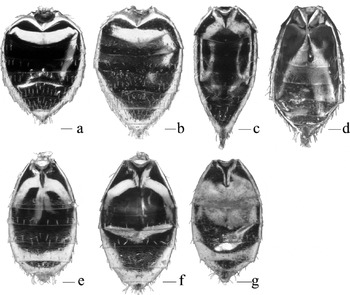
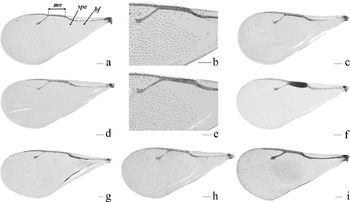
Median area of propodeum smooth, plica indicated in posterior third only (Gibson et al., Reference Gibson, Baur, Ulmer, Dosdall and Muller2005: 389, fig. 16). Fore wing basal fold with at least 2 and often several setae (fig. 4i). Gaster lanceolate (fig. 2d)M. trasullus (Walker)
Median area of propodeum with distinct mesh-like sculpture and plica more or less complete (Gibson et al., Reference Gibson, Baur, Ulmer, Dosdall and Muller2005: 389, fig. 15). Fore wing basal fold bare. Gaster broader basally, more subcircular (cf. fig. 2a,b)M. moryoides Gibson
[Note: M. moryoides presently known only from North America.]
- 3.
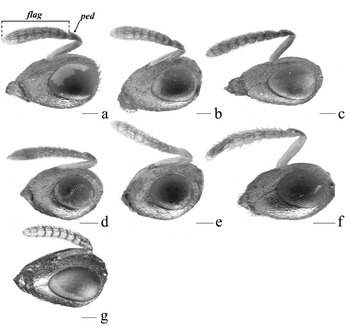
Tip of hypopygium extending two thirds along gaster. Gaster 2.0–2.7× as long as broad (fig. 2c). Pedicel plus flagellum (fig. 3c) about 0.85–0.95× as long as head breadthM. incultus (Walker)
Tip of hypopygium extending about half way along gaster. Gaster 1.35–1.9× as long as broad (fig. 2a,b). Pedicel plus flagellum (fig. 3a,b) about 0.7–0.8× as long as head breadth4
- 4.
Speculum extending about to middle of marginal vein (fig. 4a,b); basal fold with 2–5 setae (fig. 4a,b). Flagellum slightly infuscate (fig. 3a)M. gemellus sp. n.
Speculum extending about to distal end of marginal vein only (fig. 4d,e); basal fold without or with only 1 seta (fig. 4d,e). Flagellum slightly paler (fig. 3b)M. morys (Walker)
Males
- 1.
- 2.
Tegula except sometimes basally, palpi and femora yellow (fig. 6d)M. morys (Walker)
Tegula, palpi and all but extreme apices of femora darkM. moryoides (Gibson)
[Note: M. moryoides presently known only from North America.]
- 3.
- 4.
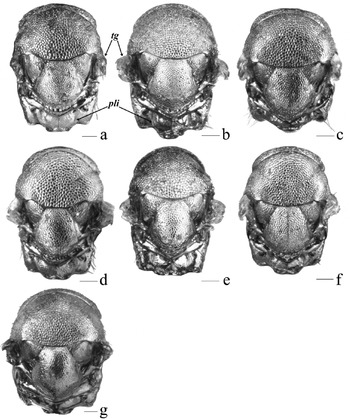
Mesosoma (dorsal) of (a) ♀ Mesopolobus gemellus Baur & Muller sp. n.; (b) ♀ Mesopolobus morys (Walker); (c) ♀ Mesopolobus incultus (Walker); (d) ♂ M. gemellus; (e) ♂ M. morys; (f) ♂ M. incultus; (g) ♀ Mesopolobus trasullus (Walker). Scale bars=100 μm. tg, tegula; pli, plica.

Mesopolobus gemellus Baur & Muller sp. n. (Figs 1a,d, 2a,e, 3a,d, 4a–c, 5a, 6a,b)
Diagnosis
Female (fig. 6a). Length: 1.5–2 mm. Flagellum weakly infuscate (fig. 3a). Pedicel plus flagellum about 0.75–0.8× as long as head breadth. Tegula pale (fig. 1a). Speculum extending, at most, to middle of marginal vein (fig. 4a,b); basal fold with 2–5 setae (fig. 4a,b). Median area of propodeum finely reticulate, plica more or less complete. Gaster 1.3–1.6× as long as broad (fig. 2a); tip of hypopygium reaching about halfway along gaster.
Male (fig. 6b). Length: 1.55–1.85 mm. Head in frontal view 1.21–1.31× as broad as high (fig. 5a) with gena curved; in dorsal view about 1.95–2.05× as broad as long, occiput rather strongly excavate. Marginal vein more than 6× as long as broad, not inflated (fig. 4c). Tegula pale (fig. 1d). Median area of propodeum finely reticulate, plica more or less complete. Gaster with indistinct pale spot at base (fig. 2e).
Description
Holotype male. Length: 1.85 mm. Head bright green with blue tinge in some lights; scape citron yellow; pedicel and flagellum slightly infuscate dorsally, paler below. Mesosoma bright green with bluish tinge. Tegula yellow. Veins light testaceous. Legs with coxae concolorous with body; femora, tibiae, and tarsi citron yellow except for dark apical tarsal segments. Gaster green with indistinct pale spot at base.
Head in dorsal view 1.97× as broad as long, 1.27× as broad as high; occiput rather strongly excavate; POL 2.07× OOL; malar space 0.63× eye height; eye 1.23× as high as broad; face finely reticulate, clypeus reticulate with anterior margin truncate. Antenna with lower edge of torulus very slightly above level of lower ocular line; antennal formula 11353; scape not quite extending to ventral margin of anterior ocellus, about 5× as long as broad and 0.91× eye height; pedicel in dorsal view 1.8× as long as broad, slightly longer than anelli plus first funicular segment; combined length of pedicel plus flagellum 0.92× as long as head breadth; flagellum distinctly clavate; anelli strongly transverse; first funicular segment slightly transverse and distinctly smaller than second segment; second funicular segment slightly longer than broad, fifth transverse; clava 2.1× as long as broad, slightly shorter than combined length of 3 apical funicular segments (collapsed in holotype), funicular and claval segments with single row of longitudinal sensilla. Mesosoma 1.5× as long as broad. Pronotal collar differentiated but rounded anteriorly, about one-ninth as long as mesoscutum, reticulate with a smooth strip along posterior margin; mesoscutum 0.6× as long as broad, finely reticulate with meshes only very slightly smaller in anterior part; scutellum about as long as broad, 0.92× as long as mesoscutum, finely reticulate with minute meshes along median line and larger meshes on frenum; frenal line indicated laterally; dorsellum alutaceous. Fore wing basal cell with 2 setae, basal setal line lacking; costal cell with complete setal line on lower side, upper side bare; speculum extending to middle of marginal vein, open below; marginal vein about 6.3× as long as broad, not inflated, 1.33× as long as stigmal vein and 0.95× as long as postmarginal vein. Propodeum with superficial but complete plica, median area superficially reticulate, 1.7× as broad as long, 0.47× as long as scutellum; median carina distinct, straight; nucha angulate medially; spiracular sulcus superficial; right spiracle deformed and tooth-like raised in holotype. Gaster slightly ovate, 1.78× as long as broad; tergite 1 smooth, tergites 2–6 alutaceous; first tergite occupying two-fifths of length of gaster.
Female (paratype no. 2212) differs from male as follows. Length 1.8 mm. Head bright green to blue green; scape testaceous; pedicel and flagellum infuscate. Femora broadly fuscous in middle. Gaster blue-green. Head in dorsal view more transverse, 2.15× as broad as long, 1.3× as broad as high; occiput less strongly excavate; POL 2.3× OOL; malar space 0.5× eye height. Antenna with lower edge of torulus inserted distinctly above level of lower ocular line; scape not extending to ventral margin of anterior ocellus, about 4.9× as long as broad and 0.75× eye height; pedicel in dorsal view about as long as anelli plus first funicular segment; combined length of pedicel plus flagellum 0.79× as long as head breadth; first funicular segment about as long as broad and of same size as second. Gaster ovate-pointed, 1.57× as long as broad; first tergite occupying one-third of length of gaster; hypopygium extending to about middle of gaster.
Material examined
Holotype male labelled: ‘ALE 2 coll. 28.VI.2004/61(1) found as larval parasitoid [ink, Muller's hand]; Alle/ALE2 Jura (Ajoie)/Switzerland GPS lat. N47.436608 long. E07.141965 [print]; Ex.: Ceuto. floralis in: C. bursa-pastoris leg. F. Muller/CABI-CH [print]; Holotype ♂ Mesopolobus gemellus sp. n. det. Baur & Muller 2005 [ink, Baur's hand; label with red left and right margin]’.
Gaster (dorsal) of (a) ♀ Mesopolobus gemellus Baur & Muller sp. n.; (b) ♀ Mesopolobus morys (Walker); (c) ♀ Mesopolobus incultus (Walker); (d) ♀ Mesopolobus trasullus (Walker); (e) ♂ M. gemellus; (f) ♂ M. morys; (g) ♂ M. incultus. Scale bars=100 μm.

Head and antennae (front-lateral) of (a) ♀ Mesopolobus gemellus Baur & Muller sp. n.; (b) ♀ Mesopolobus morys (Walker); (c) ♀ Mesopolobus incultus (Walker); (d) ♂ M. gemellus; (e) ♂ M. morys; (f) ♂ M. incultus; (g) ♀ Mesopolobus trasullus (Walker). Scale bars=100 μm. ped, pedicel; flag, flagellum.

Fore wings of (a) ♀ Mesopolobus gemellus Baur & Muller sp. n.; (b) ♀ M. gemellus: detail of speculum; (c) ♂ M. gemellus; (d) ♀ Mesopolobus morys (Walker); (e) ♀ M. morys: detail of speculum; (f) ♂ M. morys; (g) ♀ Mesopolobus incultus (Walker); (h) ♂ M. incultus; (i) ♀ Mesopolobus trasullus (Walker). Scale bars=100 μm. bf, basal fold; mv, marginal vein; spe, speculum.

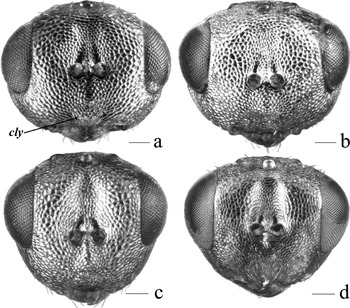
Head (frontal) of (a) ♂ Mesopolobus gemellus Baur & Muller sp. n.; (b) ♂ Mesopolobus morys (Walker); (c) ♂ Mesopolobus incultus (Walker); (d) ♀ Mesopolobus trasullus (Walker). Scale bars=100 μm. cly, clypeus.

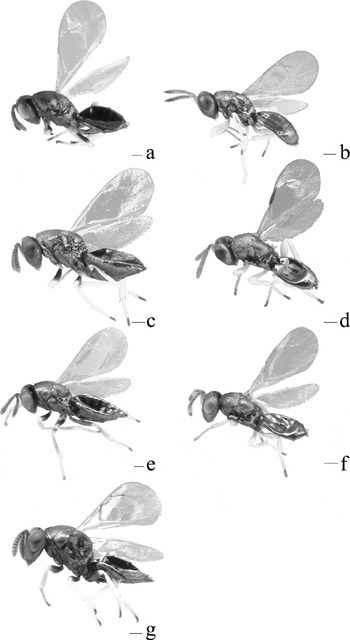
Habitus of (a) ♀ Mesopolobus gemellus Baur & Muller sp. n.; (b) ♂ M. gemellus; (c) ♀ Mesopolobus morys (Walker); (d) ♂ M. morys; (e) ♀ Mesopolobus incultus (Walker); (f) ♂ M. incultus; (g) ♀ Mesopolobus trasullus (Walker). Scale bars=200 μm.

Paratypes: CZECH REPUBLIC: Bohemia, Holovousy, coll. 26.vii.1953; leg. Hostounsky (1♀) (BMNH). ENGLAND: Middlesex, Hampton, coll. 8.vi.1964; leg. Bouček (1♀) (BMNH). GERMANY: Ostholstein, Nähtkampf, coll. 14.vi.2000; leg. B. Klander; indiv. reared from larval parasitoids, ex Ceutorhynchus typhae (Herbst) (=C. floralis) in fruits of Capsella bursa-pastoris (L.) Medik. (17♂; 15♀). Schleswig-Holstein, Kiel, Scharnhagen, coll. 16–22.vi.2001; leg. B. Klander; indiv. reared from larval parasitoids, ex C. typhae (=C. floralis) in fruits of C. bursa-pastoris (14♂; 25♀). SWITZERLAND: Canton Jura, Alle, Les Genavrats, 490 m, N47°26′ 11.79″ E7°8′ 31.07″, 28.vi.2004, leg. F. Muller, ex C. typhae in fruits of C. bursa-pastoris (23♂; 15♀). Mass collected material from various sites in: FRANCE: Alsace, Faverois, FAV, N47°31′ 8.21″ E7°3′ 11.94″ & SWITZERLAND: Valais, valley from Martigny to Sion; coll. 9–29. vi. 2004; leg. F. Muller; mass collected adults emerged from pods of C. bursa-pastoris placed in emergence boxes (33♂; 25♀, incl. paratype no. 2212); (4♂; 4♀deposited in BMNH, and 3♂; 3♀ deposited in Askew collection).
Other material: SWITZERLAND: Valais, Martigny, N46°6′ 36.49″ E7°6′ 12.82″; coll. 29.VI.2004; leg. F. Muller, ex Ceutorhynchus turbatus Schulze in fruits of Lepidium draba L. (1♀).
Etymology
The specific name ‘gemellus’, meaning twin in latin, refers to the similarity of this species with M. morys. The name is treated as a noun in apposition, which is why agreement in gender with the generic name is not needed.
Comments
The male of M. gemellus sp. n. is readily separated from all other Mesopolobus species treated here by the combination of characters given in the key and the diagnosis. However, the female is very similar to M. morys, from which it can only be separated by the slightly reduced fore wing speculum and greater number of setae on the basal fold. Because the male sex is much more distinct, a male was chosen for the holotype. The female reared from Ceutorhynchus turbatus on Lepidium draba fits the type series quite well, except for a slightly longer gaster (1.92× as long as broad), and for this reason it was not included in the type series.
Mesopolobus incultus (Walker) (Figs 1c,f, 2c,g, 3c,f, 4g,h, 5c, 6e,f)
Platyterma incultum Walker, Reference Walker1834: 340, lectotype male in BMNH (B.M. TYPE HYM. 5.1864), designated by Graham (Reference Graham1957: 229) (examined by Baur).
Platyterma femorale Walker, Reference Walker1834: 341–342, lectotype female in BMNH (B.M. TYPE HYM. 5.1865), designated by Graham (Reference Graham1957: 229) (examined by Baur). This specimen has the values of two ratios slightly below the range of variation we determined for other M. incultus: combined length of pedicel plus flagellum to head breadth (0.83) and length to breadth of gaster (1.86). Furthermore, the lower side of the gaster is hidden and thus the extension of the hypopygium, another diagnostic character, could not be examined. However, the straight and relatively long gena leaves no doubt concerning the identity of the specimen.
Amblymerus stupidus Walker, Reference Walker1834: 348–349, lectotype female in BMNH (B.M. TYPE HYM. 5.1866), designated by Graham (Reference Graham1957: 229) (examined by Baur).
Pteromalus leodocus Walker, Reference Walker1839: 237, lectotype male in BMNH (B.M. TYPE HYM. 5.1868), designated by Graham (Reference Graham1957: 229) (examined by Baur).
Pteromalus ergias Walker, Reference Walker1839: 238, lectotype male in BMNH (B.M. TYPE HYM. 5.1869), designated by Graham (Reference Graham1957: 229) (examined by Baur).
Pteromalus amyntor Walker, Reference Walker1845: 263, lectotype female in BMNH (B.M. TYPE HYM. 5.1870), designated by Graham (Reference Graham1957: 229) (examined by Baur).
Pteromalus urgo Walker, Reference Walker1845: 263, lectotype female in BMNH (B.M. TYPE HYM. 5.1871), designated by Graham (Reference Graham1957: 229) (examined by Baur).
Pteromalus belesis Walker, Reference Walker1848: 125, 189, lectotype male in BMNH (B.M. TYPE HYM. 5.1872), designated by Graham (Reference Graham1957: 229) (examined by Baur).
Pteromalus berecynthos Walker, Reference Walker1848: 125, 190, lectotype male in BMNH (B.M. TYPE HYM. 5.1873), designated by Graham (Reference Graham1957: 229) (examined by Baur). The specific name was actually misspelled by Walker (Reference Walker1848: 125) as ‘berycynthos’, which had gone unnoticed by Graham (Reference Graham1957, Reference Graham1969) and Noyes (Reference Noyes2006). We here chose the alternative spelling ‘berecynthos’, on page 190, as the correct original spelling, which is also linguistically correct (from ‘Berecynthes’, the latin name for an ancient Phrygian people).
Pteromalus lissos Walker, Reference Walker1848: 125, 196, lectotype male in BMNH (B.M. TYPE HYM. 5.1874), designated by Graham (Reference Graham1957: 229) (examined by Baur).
Pteromalus clavicornis Walker, Reference Walker1874: 318, holotype female in BMNH (B.M. TYPE HYM. 5.726) (examined by Baur), syn. n. Re-examination of the holotype confirmed the tentative synonymy suggested by Graham (Reference Graham1969: 654).
Eutelus (Amblymerus) crassicornis Thomson, Reference Thomson1878: 80–81, lectotype female (type number 264:1) in Lund University, Zoological Museum, Lund (Sweden), designated by Graham (Reference Graham1957: 230) (examined by Baur).
Diagnosis
Female (fig. 6e). Length: 1.5–2.4 mm. Flagellum infuscate (fig. 3c). Pedicel plus flagellum about 0.85–0.95× as long as head breadth. Tegula pale (fig. 1c). Speculum extending to proximal quarter or distal end of marginal vein (fig. 4g); basal fold with 0–5 setae, sometimes with additional 1–3 setae in distal part of basal cell. Median area of propodeum finely reticulate, plica more or less complete. Gaster 2.0–2.7× as long as broad (fig. 2c); tip of hypopygium reaching about two-thirds along gaster.
Male (fig. 6f). Length: 1.4–1.8 mm. Head in frontal view 1.13–1.18× as broad as high (fig. 5c) with gena rather straight; in dorsal view about 2.2× as broad as long, occiput rather strongly excavate. Marginal vein not inflated, more than 6× as long as broad (fig. 4h). Tegula pale (fig. 1f). Median area of propodeum finely reticulate, plica more or less complete. Gaster without pale spot medially (fig. 2g).
Material examined
GERMANY: Ostholstein, Nähtkamp, coll. 14.vi.2000; leg. B. Klander; indiv. reared ex Capsella bursa-pastoris (1♀). ITALY: Novara, Antronaplana, V. Loranco, W.Rif Andolla, 648.1/105.0, 2300m.; coll. 6.viii.1992; leg. H. Baur (NMBE); collected by sweeping (3♀); Lago d'Orta, 678.72.4, 310m.; coll. 24.vi.1993; leg. H. Baur (NMBE); collected by sweeping (2♀). MOROCCO: Talasoltane, Rif. 1850m.; Coll. 4–11.vii.1961; leg. V. Delucchi (NMBE); collected by sweeping (4♀). SWEDEN: Akarp, coll. 4.vii.1961; leg. H. Von Rosen (NMBE); collected by sweeping (1♂; 1♀). SWITZERLAND: Bern, Bremgarten, 599.4/202.9,550M.; coll. 12.v–18.vii.1992; leg. H. Baur (NMBE); collected by sweeping (6♀); Diemtigen, SW Griemialp, 602.9/157.1, 1240m.; coll. 9.vi.1992; leg. H. Baur (NMBE); collected by sweeping (1♀); Eymatt, 596.7/201.45, 510m.; coll. 20.v.2004; leg. H. Baur (NMBE); collected by sweeping (1♀); Kandersteg, Undere Allme, 616.025/149.175, 1790m.; coll. 28.viii.1991; leg. H. Baur (NMBE); collected by sweeping (3♀); Ruemendingen, 614.9/217.5, 510m.; coll. 26.v.1992; leg. H. Baur (NMBE); collected by sweeping (1♀); Vauffelin, 591/226, 720m.; coll. 16.vii.1996; leg. H. Baur (NMBE); collected by sweeping (1♀); Wohlen b. B., Schürhubel, 588.9/202.35, 520m.; coll.14.v.1992; leg. H. Baur (NMBE); collected by sweeping (3♀); Neuchatel, La Brévine, SW Le Maix Rochat, 539.4/205.0, 1050m.; coll. 3–10.viii.1992; leg. C. Vaucher (NMBE); collected by sweeping (1♀); Valais, Bitsch, Schwarzes-Flesh, 643.3/133.25, 1620m.; coll. 17.viii.1992; leg. H. Baur (NMBE); collected by sweeping (1♀); Ferden, Torbu, 623.55/138.7, 2010m.; coll. 2.viii.2003; leg. H. Baur (NMBE); collected by sweeping (1♀); Gryon, SE La Chaux, 574.5/126.85, 1720m.; coll. 29.vi.2003; leg. H. Baur (NMBE); collected by sweeping (1♀); Gryon, Frience, 574.4/126.4, 1550m; coll. 29.vi.2003; leg. H. Baur (NMBE); collected by sweeping (1♀); NE Hohtenn, 625.65/130.75, 1460m.; coll. 30.vi.1992; leg. H. Baur (NMBE); collected by sweeping (3♂; 2♀); Vaud, Burlignère, Le Chenit, 502.3/156.8, 1050m.; coll. 17–24vii.1994; leg. C. Vaucher (NMBE); collected by sweeping (1♀); Zurich, Maschwanden, Rüss-Spiez-Ried, 388m.; coll. 21.viii.1989; leg. Rezbanyai-reser (NMBE); collected by sweeping (1♀);
Comments
The male of M. incultus is most similar to M. gemellus sp. n., but is separated by a less transverse head in frontal view (see fig. 5a,c). From the female of both M. gemellus and M. morys, it is differentiated by a longer flagellum and gaster, and the hypopygium extending about two-thirds along the gaster. Furthermore, the gena of M. incultus is straighter and relatively longer. In contrast to M. gemellus and M. morys, the extension of the fore wing speculum varies considerably in females of M. incultus. In some specimens, it extends only to the proximal quarter of the marginal vein, whereas in others it extends to the beginning of the stigmal vein. Because certain individuals show intermediate states (for instance 1♀ from Valais, Gryon, SE of La Chaux) and the specimens are otherwise indistinguishable, we assume that only one species is involved.
Mesopolobus morys (Walker) (Figs 1b,e, 2b,f, 3b,e, 4d–f, 5f, 6c,d)
Pteromalus morys Walker, Reference Walker1848: 125, 197, lectotype male in BMNH (B.M. TYPE HYM. 5.1879), designated by Graham (Reference Graham1957: 235) (examined by Baur).
Encyrtus ceutorhynchi Rondani, Reference Rondani1872: 207, lectotype female in Zoological Museum ‘La Specola’ in Florence (Italy), designated by Bouček (Reference Bouček1974: 247) (examined by Baur).
Disema pallipes Förster, Reference Förster1878: 54, lectotype male (mounted with a micro-pin on a small pith block; left metatarsus lacking, right flagellum and wings partly damaged by pest insects, e.g. marginal vein of left fore wing lacking; specimen otherwise entire) in Museum für Naturkunde, Humboldt Universität, Berlin (Germany) labelled ‘17 [hand]/198. [print]; Frst [print]; Det. S. Novickij [sic, print] Xenocrepis pura Mayr ♂ [pencil, Novicky's hand]; Lectotype ♂ Disema pallipes Förster, Reference Förster1878 des. H. Baur 2006 [ink, Baur's hand; label with red left and right margin]’, synonymized with M. morys by Rosen (Reference Rosen1961: 32–33) (examined by Baur). Rosen examined this specimen, but he did not designate it lectotype. Because Förster did not specify the number of specimens he had, we regard it only as a syntype which is here designated lectotype. It fits the original description well, except that Förster mentioned only two anelli instead of three. However, the first anellus is hardly discernible in the lectotype, even with a modern stereo-microscope; hence he may simply have overlooked it. According to the original description, the material was collected in Switzerland (‘Aus der Schweiz.’) and not in Germany, as stated by Noyes (Reference Noyes2006).
Disema pallidipes Dalla Torre, 1898: 201, unjustified emendation of D. pallipes Förster.
Xenocrepis pura Mayr, Reference Mayr1904: 584–586, holotype male, synonymized with M. morys by Graham (Reference Graham1957: 235). Mayr (Reference Mayr1904: 586) described a single specimen which was collected by Förster near Aachen (Germany). According to Graham (Reference Graham1969: 654) the holotype should be in the Natural History Museum, Vienna (Austria). Manuala Vizek, curator of Hymenoptera in Vienna, kindly informed us that the holotype is not traceable in their collection. However, the detailed description by Mayr (Reference Mayr1904) leaves no doubt concerning the identity of the species.
Diagnosis
Female (fig. 6c). Length: 1.6–2.5 mm. Flagellum weakly infuscate (fig. 3b). Pedicel plus flagellum about 0.7–0.8× as long as head breadth. Tegula pale (fig. 1b). Speculum extending to distal end of marginal vein (fig. 4d,e); basal fold with 0–1 seta. Median area of propodeum finely reticulate, plica more or less complete. Gaster 1.4–1.9× as long as broad (fig. 2b); tip of hypopygium reaching about halfway along gaster.
Male (fig. 6d). Length: 1.4–2.1 mm. Head in frontal view 1.22–1.33× as broad as high with gena curved (fig. 5b); in dorsal view about 2× as broad as long, occiput weakly excavate. Marginal vein inflated and only about 4.5× as long as broad (fig. 4f). Tegula pale (fig. 1e). Median area of propodeum finely reticulate, plica more or less complete. Gaster without pale spot medially (fig. 2f).
Material examined
FRANCE: Alsace, Boron, BRN3, N47°32′ 11.34″ E7°0′ 24.09″; coll. 21.vi.2004; leg. F. Muller, indiv. reared from larval parasitoids, ex. Ceutorhynchus obstrictus in pods of Brassica napus (1♀). Faverois, FAV, N47°31′ 8.21″ E7°3′ 11.94″; coll. 6.vii.2004; leg. F. Muller; mass. coll, ex. C. obstrictus in pods of B. napus (7♂; 3♀); coll. 28.vi.2004; Leg F. Muller; indiv. reared from larval parasitoids, ex. C. obstrictus in pods of B. napus (3♂; 5♀). GERMANY: Schleswig-Holstein, Rastorfer Passau, RP, N54°16′ 58.80″ E10°20′ 60.00″; coll. 24–28.vi.2002 & 1.vii.2002; leg. F. Muller; indiv. reared from larval parasitoids, ex. C. obstrictus in pods of B. napus (4♂; 1♀). SWITZERLAND: Jura, Chatillon, La Prîre CHA1, N47°20′ 3.43″ E7°19′ 56.28″; coll. 9–27.vi.2002 & 01.vii.2002; leg. F. Muller; indiv. reared from larval parasitoids, ex. C. obstrictus in pods of B. napus (21♂; 17♀); CHA-LP2; coll. 9–26.vi.2002, em. 23–27.vi.2003 & 1–12.vii.2002; Leg. F. Muller; indiv. reared from larval parasitoids, ex. C. obstrictus in pods of B. napus (7♂; 6♀); coll. 10–22.vi.2003, em. 16.vi–27.vii.2003; Leg. F. Muller, indiv. reared from larval parasitoids, ex. C. obstrictus in pods of B. napus (15♂; 32♀); CHA-LP3; coll. 10–25.vi.2002, em. 25–27.vi.2003 & 1–20.vii.2002; Leg. F. Muller, indiv. reared from larval parasitoids, ex. C. obstrictus in pods of B. napus (9♂; 14♀); Coeuve, COE1, N47°27′ 55.00″ E7°6′ 40.01″; coll. 21.vi.2004; leg. F. Muller, indiv. reared from Larval parasitoids, ex. C. obstrictus in pods of B. napus (1♂); Courrendlin, COUR1, N47°20′ 47.55″ E7°17′ 36.21″; coll. 15.vi.2004; leg. F. Muller; indiv. reared from larval parasitoids, ex. C. obstrictus in pods of B. napus (1♂; 1♀); Courroux, CRX11, N47°22′ 1.64″ E7°22′ 3.90″; coll. 21.vi.2004; leg. F. Muller; indiv. reared from larval parasitoids, ex. C. obstrictus in pods of B. napus (2♂; 1♀); Delémont, Le Chavelier DEL-DOM; coll. 10–20.vi.2003, em. 21.vi–11.vii.2003; Leg. F. Muller; indiv. reared from larval parasitoids, ex. C. obstrictus in pods of B. napus (11♂; 22♀); Valais, Martigny, MAR1A, N46°6′ 25.60″ E7°4′ 19.33″; coll. 29.vi.2004 & 5.vii.2004; Leg. F. Muller; indiv. reared from larval parasitoids, ex Ceutorhynchus turbatus in pods of Lepidium draba (9♂; 4♀). MAR2, N46°6′ 47.04″ E7°6′ 54.24″; coll. 15.vi–5.vii.2004; Leg. F. Muller; indiv. reared from larval parasitoids, ex C. turbatus in pods of L. draba (7♂; 11♀). Ecône-Riddes, VS-Eco, N46°10′ 28.87″ E7°12′ 54.19″; coll. 17.vi.2004, em. 3.vii.2003; Leg. F. Muller; indiv. reared from larval parasitoids, ex C. turbatus in pods of L. draba (2♀); Saxon, VS-Sax; coll. 17&22.vi.2004, em. 27.vi–11.vii.2003; Leg. F. Muller; indiv. reared from larval parasitoids, ex C. turbatus in pods of L. draba (14♂; 20♀); Sion, SIN11, N46°13′ 11.80″ E7°20′ 43.09″; coll. 29.vi.2004 & 5.vii.2004; Leg. F. Muller; indiv. reared from larval parasitoids, ex C. turbatus in pods of L. draba (14♂; 7♀); Sion VS-SW1; coll. 17&22.vi.2004, em. 3–11.vii.2003; Leg. F. Muller; indiv. reared from larval parasitoids, ex C. turbatus in pods of L. draba (2♂; 2♀). HUNGARY: Csongrad, Lep-HU36, N46°24′ 50.80″ E20°0′ 3.24″; coll. 24.vi–11.vii.2004; Leg. F. Muller; indiv. reared from larval parasitoids, ex C. turbatus in pods of L. draba (8♂; 6♀); Hödmezövazarhely, Lep-HU61, N46°15′ 41.62″ E20°12′ 24.52″; coll. 22.vi–11.vii.2004; leg. F. Muller; indiv. reared from larval parasitoids, ex C. turbatus in pods of L. draba (4♂; 4♀). Pest, Apaj, Lep-HU65, N47°12′ 9.12″ E19°13′ 50.22″; coll. 24.vi.2004 & 11.vii.2004; leg. F. Muller; indiv. reared from larval parasitoids, ex C. turbatus in pods of L. draba (1♂; 1♀). Kiskunlachaza, Lep-HU66, N47°11′ 48.19″ E19°6′ 36.40″; coll. 19.vi.2004; Leg. F. Muller; indiv. reared from larval parasitoids, ex C. turbatus in pods of L. draba (1♂). Budapest, Lep-HU7B, N47°12′ 30.24″ E19°13′ 6.06″; coll. 30.vi.2004 & 11.vii.2004; leg. F. Muller; indiv. reared from larval parasitoids, ex C. turbatus in pods of L. draba (2♂).
Comments
The male of M. morys is readily distinguished from other European species of Mesopolobus by its inflated marginal vein (fig. 4f), and the colour differences given in the key easily differentiate it from M. moryoides. However, the female is very close to M. gemellus sp. nov., as is discussed under the latter species.
Mesopolobus trasullus (Walker) (Figs 1g, 2d, 3g, 4i, 5d, 6g)
Ormocerus trasullus Walker, Reference Walker1839: 207, lectotype female in BMNH (B.M. TYPE HYM. 5.1867), designated by Graham (Reference Graham1957: 229) (examined by Baur and Gibson).
Mesopolobus roseni Graham, Reference Graham1984: 512–513, holotype female in BMNH (B.M. TYPE HYM. 5.3028) (examined by Baur and Gibson).
Diagnosis
Female (fig. 6g). Length: 2.1–2.3 mm. Flagellum yellowish-brown to brown, sometimes slightly paler on lower side (fig. 3g). Pedicel plus flagellum about 0.4–0.8× as long as head breadth. Tegula brown (fig. 1g). Speculum extending from about basal quarter to middle of marginal vein (fig. 4i); basal fold with 2–7 setae. Median area of propodeum smooth and shiny, plica indicated in posterior quarter to third only. Gaster 1.7–2× as long as broad (fig. 2d); tip of hypopygium reaching, at most, slightly more than halfway along gaster.
Male. Length: 1.1–1.7 mm. Head in frontal view about 1.2× as broad as high with gena slightly curved; in dorsal view about 2.15–2.2× as broad as long, occiput moderately strongly excavate. Marginal vein not inflated, more than 6× as long as broad. Tegula yellow to brown. Median area of propodeum feebly alutaceous, plica indicated in posterior quarter only. Gaster with a large testaceous spot basally on ventral side, hence basal half of dorsal side appears slightly paler than apical half.
Material examined
CZECH REPUBLIC: Bohemia, Praha-Butovice, Prokopskè Udoli, lat. N50°02.609″ long. E014°21.348′, 100m; coll. 7.vi.2004; leg. H. Baur (NMBE); collected by sweeping (1♀). Koda u Berouna; coll. 17.v.1953; leg. Z. Bouček (BMNH) (1♀); Hor. Lipka–Králic, Sneznik; coll. 16.viii.1962; leg. Z. Bouček (BMNH) (1♀). ITALY: South Sardinia, Villasimius; coll. vi.1975; leg. Z. Bouček (BMNH) (1♂, 1♀). SPAIN: Zaragoza, Retuerta de Pina, 10.ix.1992; leg. J. Blasco-Zumeta, swept from Gypsophila hispanica Willk. [Caryophyllaceae] (2♂, 4♀). SWITZERLAND: Basel, Bottmingen; coll. 22.vii.1935; leg. W. Wittmer (NMBE) (1♀).
Comments
Gibson & Baur (Reference Gibson and Baur2005) pointed out that M. trasullus was erroneously synonymized under M. incultus by Graham (Reference Graham1957) and recognized it as the senior synonym of Mesopolobus roseni. Because only three males of this species were available for study, the characters given in the key and the diagnosis are partly based on the description by Askew et al. (Reference Askew, Blasco-Zumeta and Pujade-Villar2001).
Discussion
Results of this study provide a basis for accurate Mesopolobus spp.–Ceutorhynchinae host associations in Europe, which is essential for a renewed classical biological control initiative against C. obstrictus in North America. In this context, it was documented that the previously undescribed M. gemellus, and not M. morys (as previously reported by Klander, (Reference Klander2001)), parasitizes C. typhae (=C. floralis) in Europe. Furthermore, M. morys is for the first time accurately associated with the seed weevil C. turbatus, a potential agent for classical biological control of hoary cress, Lepidium draba, in North America. This information is of significant interest to the scientific community involved in the classical biological control of C. obstrictus in North America (Kuhlmann et al., Reference Kuhlmann, Schaffner, Mason, Bigler, Babendreier and Kuhlmann2006b) because biological control practioners now have to assess potential non-target impacts of invertebrate biological control agents to justify their release.
It should be noted that, in general, an understanding of the population dynamics of Ceutorhynchinae species of economic importance is still hampered by insufficient knowledge of natural enemy complexes that may play an important role in regulating these herbivorous insects (Vidal, Reference Vidal and Alford2003). The clarification of the taxonomy of the Mesopolobus species presented here provides a sound basis for understanding these dynamics, leading towards the safe use of Mesopolobus species against Ceutorhynchinae pest species.
Acknowledgements
The authors acknowledge Emmanuel Cuenot (France), Virginia Larraz (Spain), Leonore Lovis (Switzerland), Gabor Nagy (Hungary), Fezekas Janos (Hungary), Alicia Leroux (Canada), Tara Gariepy (Canada), Kim Riley (Canada), Lars Andreassen (Canada), Leyla Valdivia Buitriago (Peru), Rike Stelkens (Germany) and Stephen Maggins (Ireland) for their valuable help as part of the CABI Agricultural Pest Research dissection team, and also thank Maren Belde (Technische Universität, Munich, Germany) and Beate Klander (Christian Albrechst Universtity, Kiel, Germany) for finding collection sites of Canada thistle in Germany. Dr. Scheibelreiter (Wien, Austria) assisted with collections of scentless chamomile in Austria in 2003. The authors appreciated the fruitful discussions with André Gassmann, Hariet Hinz, Stefan Toepfer and Esther Gerber (all CABI, Delémont) and acknowledge them as well for information exchanged on collection sites of scentless chamomile, hoary cress, Canada thistle, garlic mustard and other Ceutorhynchinae host plants in various European countries. This work was funded by Agriculture and Agri-Food Canada, AAFC's Pest Management Research Centre Project PRR03-370, and the Alberta Agricultural Research Institute. Technical support was provided by the Natural History Museum at Bern, Switzerland. For the loan of and information on specimens, the authors are grateful to: Richard R. Askew, Beeston, Tarporley (UK); Luca Bartolozzi, Zoological Museum ‘La Specola’, Florence (Italy); Roy Danielsson, Lund University, Zoological Museum, Lund (Sweden); Frank Koch, Museum für Naturkunde, Humboldt-Universität Berlin, Berlin (Germany); Andreas Muller, Institute for Plant Science, Swiss Federal Institute of Technology, Zürich (Switzerland); John S. Noyes, The Natural History Museum, London (UK); and Manuela Vizek, Natural History Museum, Vienna (Austria).