Introduction
At the southern edge of the Amazonian Forest, in eastern Mato Grosso, co-occurrence of savanna (called cerrado in Brazil) and forest formations is common (Ratter, Reference Ratter and Ferri1971; Ratter et al., Reference Ratter, Richards, Argent and Gifford1973, Reference Ratter, Askew, Montgomery and Gifford1978; Marimon-Junior & Haridasan, Reference Marimon-Junior and Haridasan2005; Marimon et al., Reference Marimon, Lima, Duarte, Chieregatto and Ratter2006). The transition between the two largest Brazilian plant biomes (Cerrado and Amazonian Forest) is a zone of ecological tension (ZET) (Radambrasil, 1982), where environmental factors, such as climatic seasonality, fire frequency and edaphic characteristics, determine the distribution of cerrado sensu stricto and cerradão (augmentative of cerrado, i.e. a dense and tall formation of savanna woodland with many characteristic species) (Ratter et al., Reference Ratter, Richards, Argent and Gifford1973; Ratter, Reference Ratter, Furley, Proctor and Ratter1992; Marimon-Junior & Haridasan, Reference Marimon-Junior and Haridasan2005; Marimon et al., Reference Marimon, Marimon-Junior, Feldpausch, Oliveira-Santos, Mews, Lopez-Gonzalez, Lloyd, Franczak, Oliveira, Maracahipes, Miguel, Lenza and Phillips2014), and the evergreen Amazonian Forest itself.
In 1967, 1968, 1972 and 1978, i.e. beginning nearly 50 years ago, Ratter (Reference Ratter and Ferri1971), Ratter et al. (Reference Ratter, Richards, Argent and Gifford1973) et seq. studied the floristic composition of the Cerrado–Amazonian Forest transition zone in Mato Grosso in the drainage of the rivers Araguaia and Xingu, and showed that the Amazonian Forest was advancing into the cerrado (a process already well understood by the few local inhabitants of the region at that time). Despite massive human destruction of the habitat, later studies, often carried out in protected areas (Ratter, Reference Ratter, Furley, Proctor and Ratter1992; Marimon et al., Reference Marimon, Lima, Duarte, Chieregatto and Ratter2006), confirmed the continued advance of the Amazonian Forest into cerrado vegetation, probably favoured by the current climatic conditions and supported by evidence of pollen paleo-stratigraphy (Mayle et al., Reference Mayle, Burbridge and Killeen2000; Behling, Reference Behling2003; Cárdenas et al., Reference Cárdenas, Gosling, Sherlock, Poole, Pennington and Mothes2011) and the isotopic composition of soil organic carbon (Pessenda et al., Reference Pessenda, Boulet, Aravena, Rosolen, Gouveia, Ribeiro and Lamotte2001). Marimon et al. (Reference Marimon, Lima, Duarte, Chieregatto and Ratter2006) give precise figures based on the position of the Xavantina-Cachimbo Expedition base camp (sited intentionally at the Cerrado–Amazonian Forest transition) in 1968, and the position of the transition area 36 years later when it had moved 7 km further into the cerrado (the continued existence of the ruined remains of the expedition base camp guaranteed the accuracy of this figure).
The establishment of dystrophic cerradão is sometimes related to soil texture in sites with higher clay levels retaining more water (Marimon-Junior & Haridasan, Reference Marimon-Junior and Haridasan2005) while increase in annual precipitation and average temperature also favours the expansion of forests into cerrado vegetation (Mayle et al., Reference Mayle, Burbridge and Killeen2000; Behling, Reference Behling2003; Cárdenas et al., Reference Cárdenas, Gosling, Sherlock, Poole, Pennington and Mothes2011). On the other hand, the advance of forest into cerrado can be controlled by frequent fires because, as is well known to natives of such areas, forest species are relatively intolerant of them (Geiger et al., Reference Geiger, Gotsch, Damasco, Haridasan, Franco and Hoffmann2011). In the absence of fire, however, succession of cerrado vegetation by forest species usually occurs (Durigan & Ratter, Reference Durigan and Ratter2006; Geiger et al., Reference Geiger, Gotsch, Damasco, Haridasan, Franco and Hoffmann2011).
The vegetation of the Cerrado–Amazonian Forest transition zone is under constant human disturbance and has been considered ‘intrinsically hyperdynamic’ and ‘sensitive to shifting precipitation patterns’ (Marimon et al., Reference Marimon, Marimon-Junior, Feldpausch, Oliveira-Santos, Mews, Lopez-Gonzalez, Lloyd, Franczak, Oliveira, Maracahipes, Miguel, Lenza and Phillips2014). Thus, the dynamics of forest expansion in the transition between the Cerrado and Amazonian Forest is a process that still requires further study. Thus, the aim of this study was to assess whether the colonisation of cerrado areas by cerradão and forest species continues. In particular, we want to determine which species contribute to the initial advance of the forest into the cerrado at the southern border of the Brazilian Amazonian Forest and how its speed may vary.
Materials and Methods
The study was conducted at the Bacaba Municipal Park, Nova Xavantina-MT (14°41′S, 52°20′W, 306 m.a.s.l.), a protected area of 500 ha in the Cerrado–Amazonian vegetation transition zone (Marimon et al., Reference Marimon, Marimon-Junior, Feldpausch, Oliveira-Santos, Mews, Lopez-Gonzalez, Lloyd, Franczak, Oliveira, Maracahipes, Miguel, Lenza and Phillips2014). The climate is Aw, according to the Köppen classification, with very marked rainy and dry seasons, average annual precipitation between 1300 and 1500 mm and average annual temperature of 25°C (Marimon et al., Reference Marimon, Felfili, Lima, Duarte and Marimon-Junior2010).
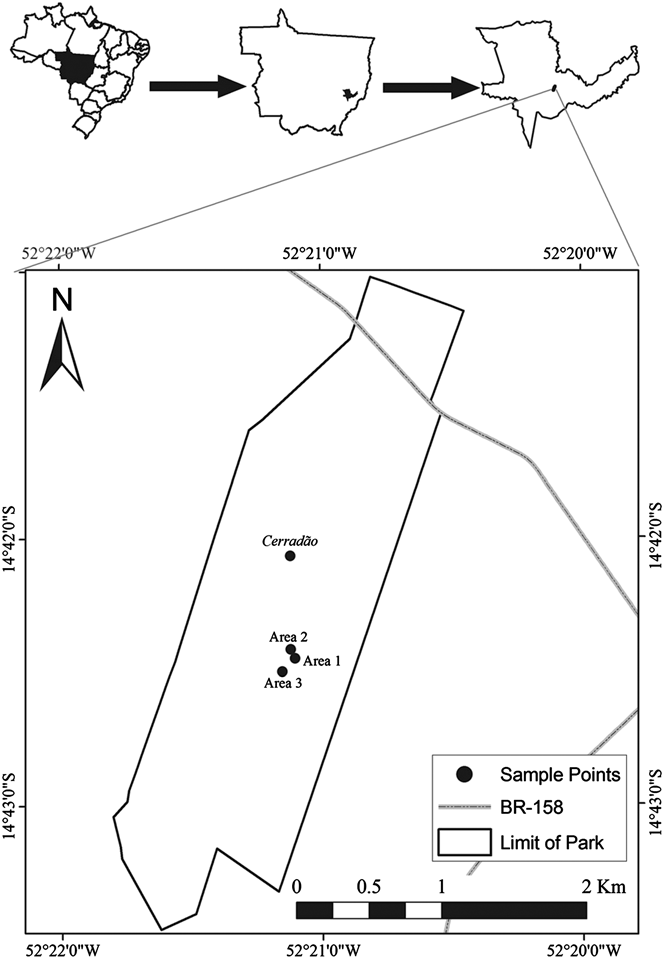
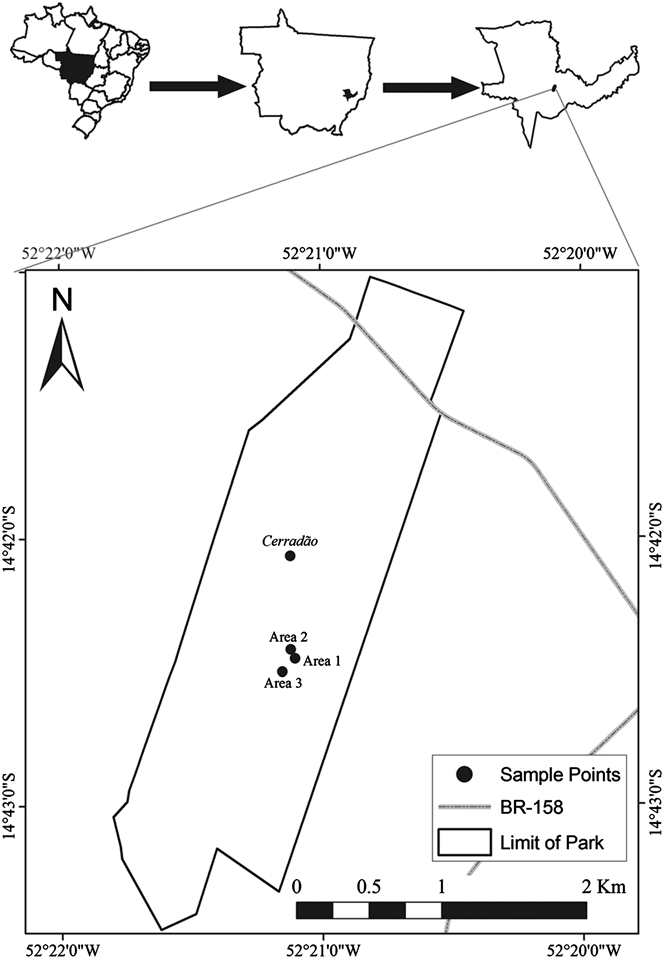
Tree data (≥ 5 cm diameter at 0.3 m above soil level) from three areas of cerrado sensu stricto situated approximately 800 m from cerradão were studied (Fig. 1). We evaluated 150 subplots of 10 × 10 m, 50 in each area, totalling 1.5 ha. Area 1 was first inventoried in 2002 (Marimon-Junior & Haridasan, Reference Marimon-Junior and Haridasan2005) and remeasured in 2006 (Mews et al., Reference Mews, Marimon, Maracahipes, Franczak and Marimon-Junior2011), 2008, 2011 and 2013. The first inventory of Area 2 was made in 2008 (E. A. Oliveira, unpublished data) with later measurements in 2011 and 2013. Area 3 (the present study) was inventoried in 2011 and 2013.
Location of the study areas in Nova Xavantina, state of Mato Grosso, Brazil. Areas 1, 2 and 3 = cerrado sensu stricto.
This work was also based (species list, Importance Value Index (IVI) and description of the advance of the forest species into the cerrado) on studies by Ratter (Reference Ratter and Ferri1971, Reference Ratter, Furley, Proctor and Ratter1992), Ratter et al. (Reference Ratter, Richards, Argent and Gifford1973, Reference Ratter, Askew, Montgomery and Gifford1978), Marimon-Junior & Haridasan (Reference Marimon-Junior and Haridasan2005), Marimon et al. (Reference Marimon, Lima, Duarte, Chieregatto and Ratter2006) and Franczak et al. (Reference Franczak, Marimon, Marimon-Junior, Mews, Maracahipes and Oliveira2011) in areas of the Cerrado–Amazonian Forest transition (e.g. cerradão and seasonal evergreen forests). Whether the most important species (i.e. those with the highest IVI) of the cerradão were advancing and/or increasing population density in adjacent areas of cerrado sensu stricto was investigated and their average diameter and height, basal area and IVI were recorded, as were their habitat preferences using the overall species list of Mendonça et al. (Reference Mendonça, Felfili, Walter, Silva-Júnior, Rezende, Filgueiras, Nogueira, Fagg, Sano, Almeida and Ribeiro2008). A Partition Chi-square (χ2) test was also used to check differences between the categories in the proportion of individuals recruited in each inventory.
Results
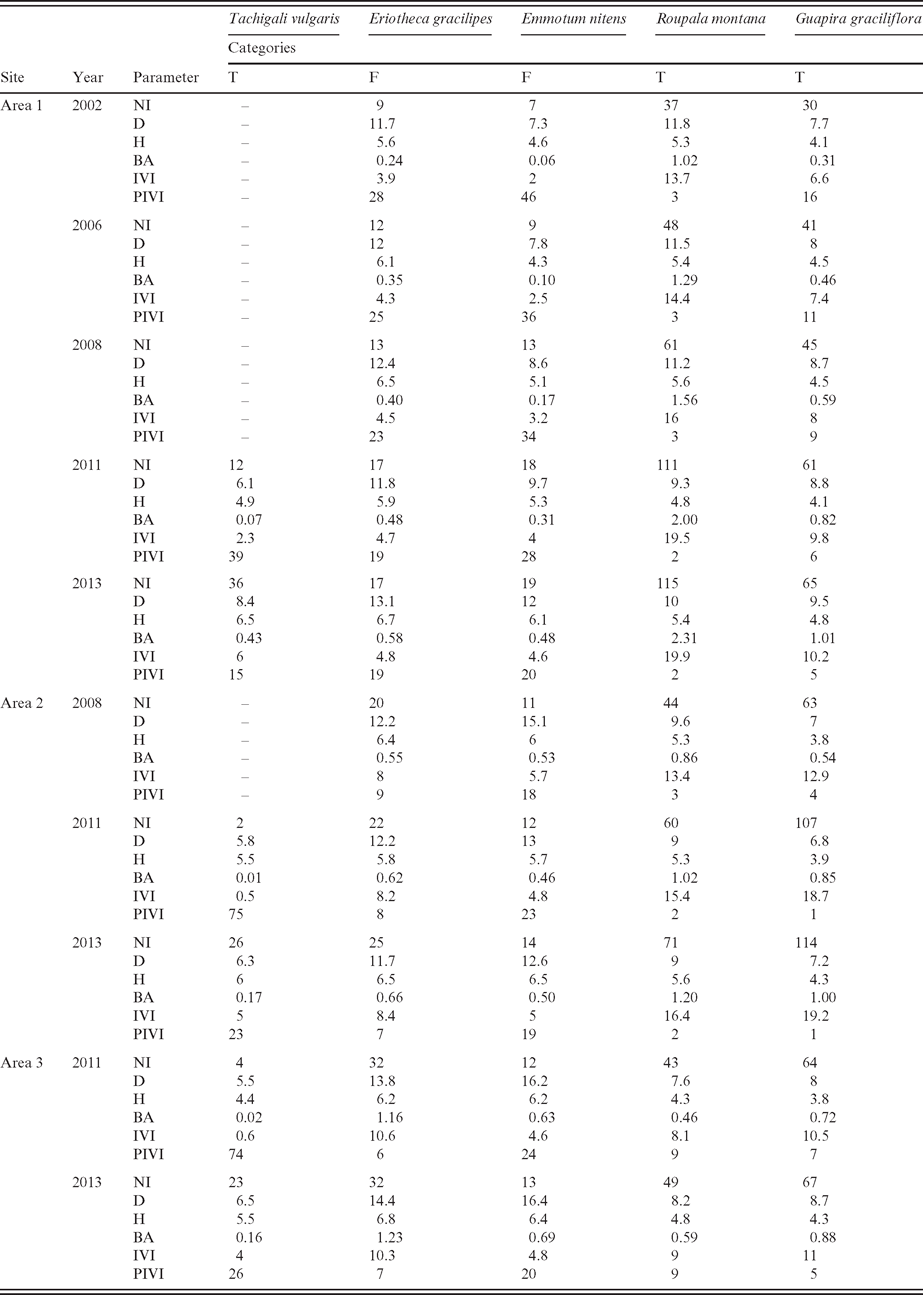
Typical forest/cerradão species, such as Eriotheca gracilipes (K.Schum.) A.Robyns and Emmotum nitens (Benth.) Miers, and typical transition species between forest and cerrado, such as Roupala montana Aubl. and Guapira graciliflora (Mart. ex Schmidt) Lundell, have established in the areas studied since the first inventory, and are gradually increasing (Table 1). They have doubled their populations in at least one of the areas studied and have also been recorded among the most important in a nearby cerradão (Marimon-Junior & Haridasan, Reference Marimon-Junior and Haridasan2005). They can grow into large trees dominating the vegetation and outcompeting the smaller typical cerrado species (Fig. 2). In contrast to this is Tachigali vulgaris L.F.Gomes da Silva & H.C.Lima (syn. Sclerolobium paniculatum Vogel), a typical species of the Cerrado–Amazonian Forest transition (Ratter et al., Reference Ratter, Richards, Argent and Gifford1973), which showed the largest increase in abundance in our last two inventories (between 100 and 1200%) (Table 1). It is an extremely fast-growing, short-lived, massively fruiting tree that is probably usually monocarpic (some of its congeners are certainly always monocarpic) and its seed production is enormous.
Phytosociological parameters of five species typical of the Cerrado–Amazonian Forest transition that have increased their populations

T = typical transition species; F = typical forest species; NI = number of individuals; D = average diameter (cm); H = average height (m); BA = basal area; IVI = Importance Value Index; PIVI = position of the species in the community related to the IVI. Dashes (–) indicate that the species was not recorded in this inventory.
Proportion of individuals of the cerrado, transition and forest species in three areas of cerrado sensu stricto (considering only plots with Tachigali vulgaris present), Nova Xavantina-MT. Open symbols ( ): cerrado species; grey symbols (
 ): transitional species; black symbols (
 ): forest species. A1, A2 and A3 = Areas 1, 2 and 3.
Besides density, it was noted that the average diameter and IVI values of species are increasing, especially in Area 1. In addition, some species have increased their IVI positions (PIVI), particularly Tachigali vulgaris, which increased to positions 52 and 48 in Areas 2 and 3, respectively, and Emmotum nitens, which rose by 26 positions in Area 1 (Table 1).
Considering only subplots with Tachigali vulgaris present, young plants of all species entering the community in each inventory are typical of forest or transitional formations, while cerrado species are decreasing (∑χ2 between partitions = 92.59; 26.48; 40.99 and overall P < 0.001 for Areas 1, 2 and 3, respectively) (Fig. 2).
Discussion
This study showed the succession of typical cerrado species by those characteristic of forests or transitions, as also recorded in other Brazilian states, such as São Paulo (Durigan & Ratter, Reference Durigan and Ratter2006), Distrito Federal (Ratter, Reference Ratter, Furley, Proctor and Ratter1992; Geiger et al., Reference Geiger, Gotsch, Damasco, Haridasan, Franco and Hoffmann2011), and Mato Grosso (Marimon et al., Reference Marimon, Lima, Duarte, Chieregatto and Ratter2006), and similar to the succession in African savannas (e.g. Khavhagali & Bond, Reference Khavhagali and Bond2008), where areas protected from fire were colonised by forest species. Besides the absence of disturbance, nowadays the increase in average precipitation and temperature may also be contributing to forest expansion of the cerrado (Mayle et al., Reference Mayle, Burbridge and Killeen2000; Behling, Reference Behling2003; Cárdenas et al., Reference Cárdenas, Gosling, Sherlock, Poole, Pennington and Mothes2011).
Tachigali vulgaris is the most successful species in terms of recruitment in the areas already occupied by cerrado vegetation and is important in the beginning of the succession process in cerrado sensu lato and cerradão at the southern Amazonian border (Franczak et al., Reference Franczak, Marimon, Marimon-Junior, Mews, Maracahipes and Oliveira2011). Ratter (Reference Ratter, Furley, Proctor and Ratter1992) also reported the occurrence of Tachigali vulgaris in Cerrado–Amazonian Forest transition areas in Northeastern Mato Grosso, in addition to cerrado species such as Curatella americana in cerradão dominated by T. vulgaris. In another study conducted in an ecotone in Amazonia, Tachigali vulgaris was registered at the forest margin and in open areas, and was recognised as a bioindicator of the advance of forest into open areas (Vidotto et al., Reference Vidotto, Pessenda, Ribeiro, Freitas and Bendassolli2007).
In this case, we suggest that Tachigali vulgaris may facilitate the growth and development of other plants (Connell & Slatyer, Reference Connell and Slatyer1977) by settling in a cerrado where it grows rapidly in more open areas (Roitman et al., Reference Roitman, Felfili and Rezende2008), accumulating litterfall (B. Oliveira, unpublished data) including its own, partly as a result of its monocarpic life cycle. During the succession process, some species provide enhancement of the habitat quality under their canopies, such as the increase of litter layer and nutrients, adding to the likelihood of other species colonising the site (Connell & Slatyer, Reference Connell and Slatyer1977; Passos et al., Reference Passos, Lopes, Aquino and Ribeiro2014). Large trees of Eriotheca gracilipes, Emmotum nitens, Roupala montana and Guapira graciliflora, typical cerradão and transitional species, can also facilitate establishment of other species.
Thus, the initial advance of the forest into the cerrado at the southern edge of the Amazonian Forest occurs (Ratter et al., Reference Ratter, Richards, Argent and Gifford1973; Marimon et al., Reference Marimon, Lima, Duarte, Chieregatto and Ratter2006; Franczak et al., Reference Franczak, Marimon, Marimon-Junior, Mews, Maracahipes and Oliveira2011) leading to the establishment of forest species (e.g. Emmotum nitens) and transition species (e.g. Roupala montana), and especially Tachigali vulgaris itself.
Acknowledgements
The authors thank CAPES (Coordination of Improvement of Personnel in Higher Education) for providing the first author with a scholarship; CNPq (National Counsel for Scientific and Technological Development) for financial support (PELD – Programme for Long-Term Ecological Research, Project Transição Cerrado/Floresta Amazônica: bases ecológicas e sócio-ambientais para a conservação (etapa II) – Proc No. 403725/2012-7); all students of LABEV (Laboratory for Vegetation Ecology) who collaborated in field collections; and Eduardo Q. Marques, for the elaboration of Fig. 1. We gratefully appreciate the critical comments and suggestions of the referees.