I. INTRODUCTION
Convent pharmacies played a pivotal role in Renaissance Italy by producing and marketing medicines to public (Strocchia, Reference Strocchia2011). In the late 17th century, there were 45 convent pharmacies in Rome. Roman people preferred these establishments to the secular pharmacies that proliferated since the beginning of the 15th century because they sold their medicines more cheaply and sometimes for free. This was possible because convent pharmacies were exempted in paying taxes. On the contrary, secular establishments had to pay taxes and this fact explains why their owners complained to the Collegio degli Speziali Romano, arguing that convent pharmacies or spezierie had to be closed. According to their arguments, convent pharmacies did not respect both the Antidotarium romanum (the fixed price for each medicine) and the rerum petendarum, being able to sell substances that could represent a health hazard (Colapinto, Reference Colapinto2007). Since 1722–1735, several decrees prohibited convent pharmacies to selling all types of medicine except apoplastic balsam and the well-known antidote Theriaca (Colapinto, Reference Colapinto2007). Certain religious establishments, however, were unaffected by these decrees thanks to the importance they had acquired in 18th century Rome. Among these establishments, two convent pharmacies were founded by the Discalced Carmelites. An authorization granted by Pope Alexander VI (1492–1503) enabled this religious order of Spanish origin to find, some years later, a pharmacy in the convent Santa Maria della Vittoria and another in the convent Santa Maria della Scala (Pedrazzini, Reference Pedrazzini1934). Undoubtedly, the latter became very famous in Rome during the 18th and 19th centuries, when it was frequented not only by the humble classes but also by the nobility and church dignitaries. Indeed, in 1829, Pope Pius VIII awarded the pharmacy Santa Maria della Scala the privilege to becoming the Roman supplier of medicines for the Pontiff, the Pontiff's family, and the Swiss Guard (Spotti, Reference Spotti2007). For this reason, the pharmacy continued the activity throughout the 19th century and until the middle of the 20th century.
The research project entitled Antichi Minerali nell'arte degli Speziali di “De Medicamentaria Officina” di Santa Maria della Scala: indagini Chimico-Fisiche e studio Storico-Culturale (Ancient minerals in the “pharmaceutical laboratory” of Santa Maria della Scala: physical–chemical analysis and historical–cultural research) was designed for the following scopes:
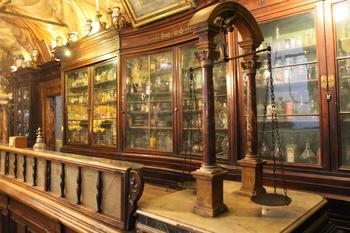
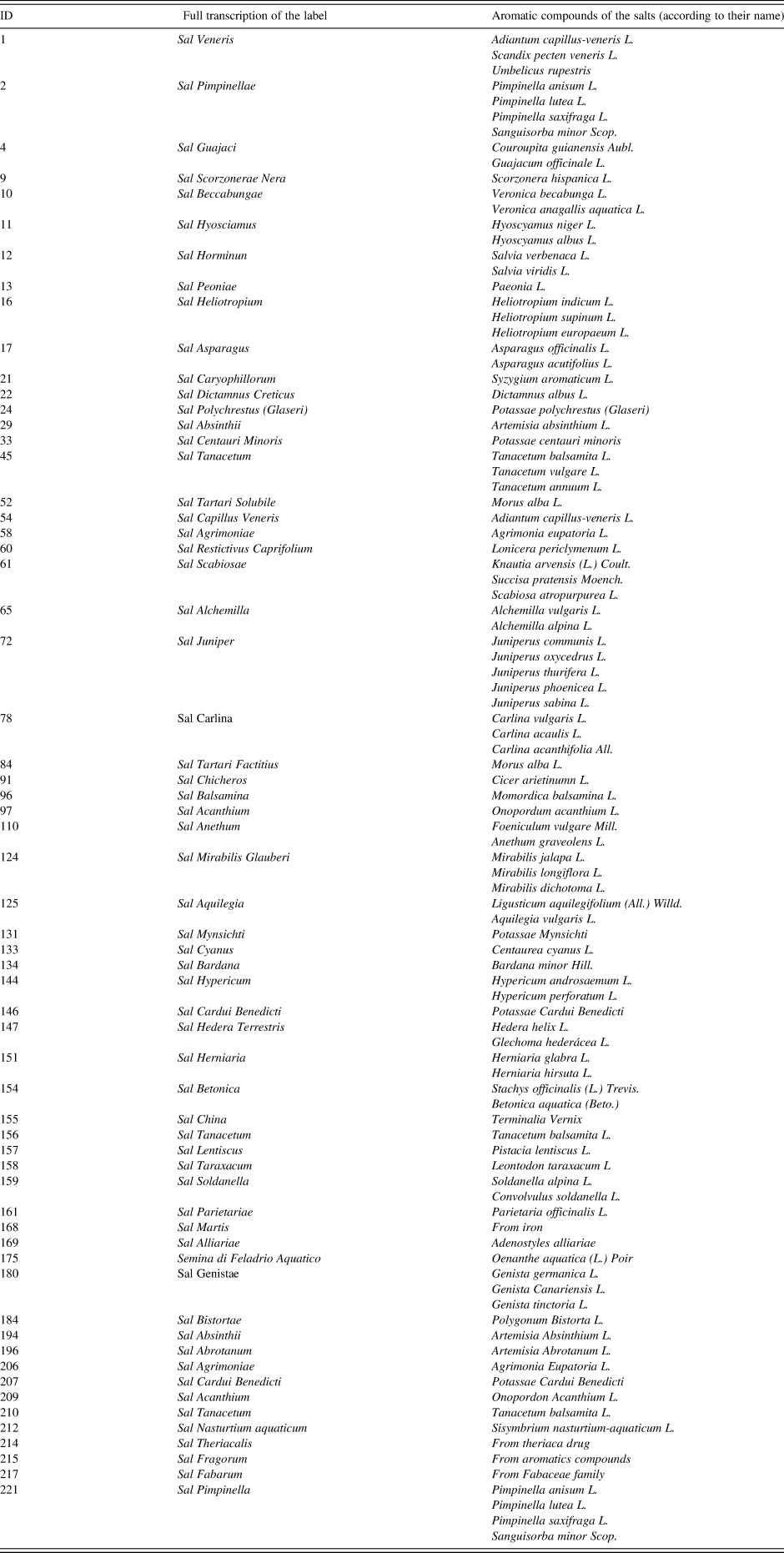
- To perform physical–chemical identification of 231 medicines preserved in their jars in this ancient Roman pharmacy (Figure 1) for understanding their composition and the chemical formulation;
- To identify the range of medical knowledge gathered at this Roman convent pharmacy from the ancient Mediterranean area (especially Greece), the ancient Middle East and Egypt, a wealth of which trickled through to the Modern Era via the Islamic tradition as, in the 17th and 18th centuries, the Order of the Discalced Carmelites controlled the trading routes towards the Far East and the New World (Zupanov and Barreto, Reference Zupanov and Barreto Xavier2014).
- To understand the use of the stored compounds as medicines and artistic materials (it is not surprising that, from the Middle Ages to the Renaissance, painters and pharmacists were members of the same guild as in the 15th century Florence, for instance).
(Color online) Pharmacy (spezieria) Santa Maria della Scala, Rome (Italy). Interior of the main hall.
The specific focus of this research paper is the Quantitative Phase Analysis (QPA) of the inorganic fraction of about 100 compounds in order to know the amount of each mineral in the polycrystalline mixtures. In addition, the following issues have been tackled: the relationship between the label reported on the glass jar and the mineralogical composition, the amount of specific mineralogical groups, their use as mineral medicines, and/or mineral pigments.
II. MATERIALS AND METHODS
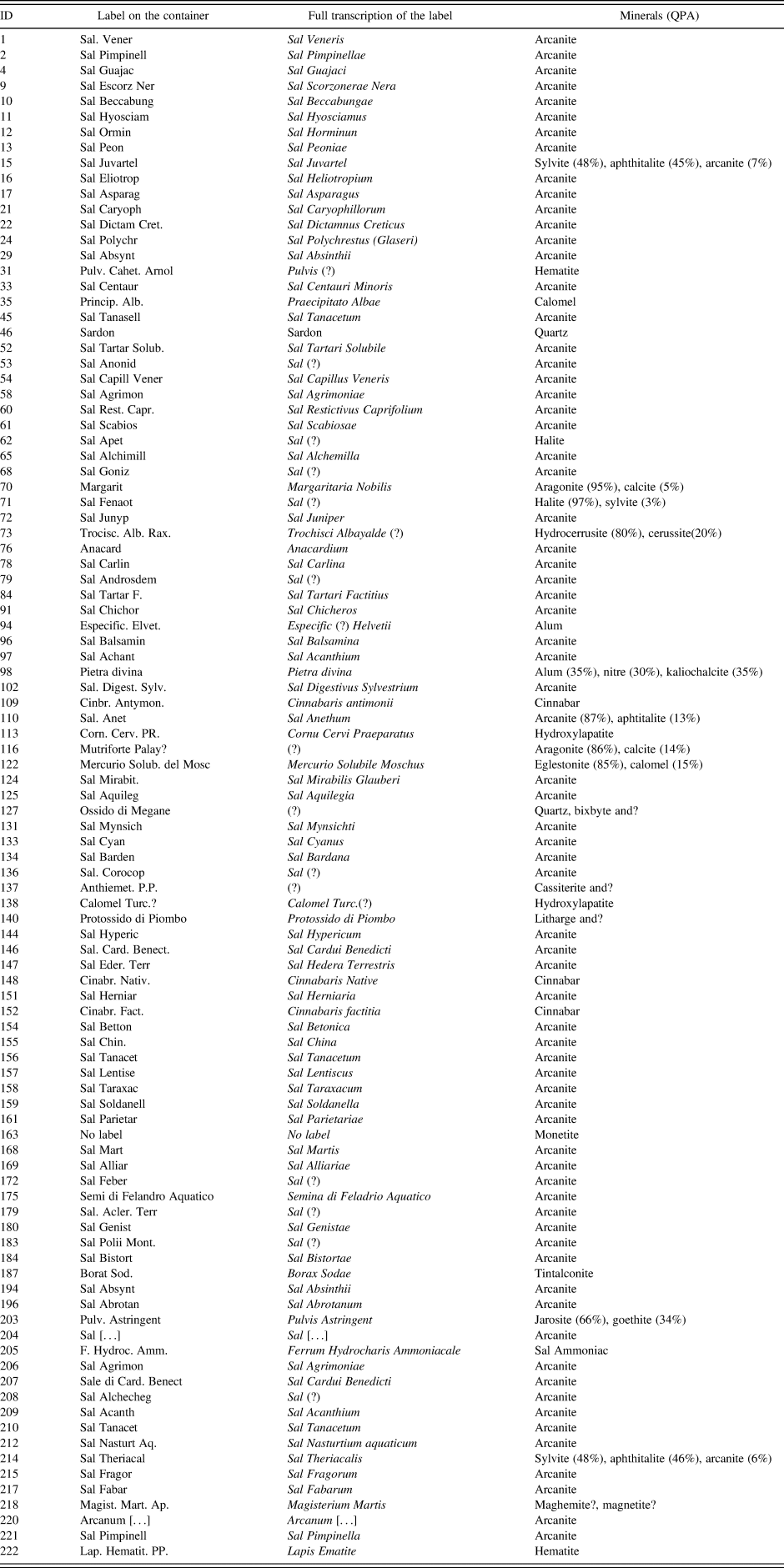
The analysed samples are listed in Table I including the label reported on the glass container, the full name found in treatises (Paláu y Verdéra, Reference Paláu y Verdéra1784; Hernández de Gregorio, Reference Hernández de Gregorio1803; Carbonell, Reference Carbonell1805; Gray, Reference Gray1821), and the mineralogical composition. The samples discussed here represent about 70% of the (primarily) inorganic materials available at the pharmacy; the remaining 30% samples will be the object of further in-depth studies, also using complementary analytical techniques.
Quantitative Phase Analysis (QPA) of the analysed samples.

(?) = full transcription is not known.
X-ray powder diffraction (XRPD) was carried out on randomly oriented samples after grinding the powder samples in an agate mortar. A Bruker D8 Advance system, operating in θ:θ mode was used; generator setting 40 kV, 40 mA, Cu anode (CuKα = 1.5418 Å), Ni filter, 2θ range 5–80°, step size 0.01°, scan speed 0.5° min−1. Qualitative phase determination was carried out using the software QualX2.0 (Altomare et al., Reference Altomare, Corriero, Cuocci, Falcicchio, Moliterni and Rizzi2015) and the correlated COD database (Gražulis et al., Reference Gražulis, Chateigner, Downs, Yokochi, Qiurós, Lutterotti, Manakova, Butkus, Moeck and Le Bail2009). QPA was carried out using the software Quanto (Altomare et al., Reference Altomare, Burla, Giacovazzo, Guagliardi, Moliterni, Polidori and Rizzi2001).
III. RESULTS
Mineral phase identification and QPA of polycrystalline mixtures are listed in Table I.
Results of the mineral phases will be presented according to their chemical group.
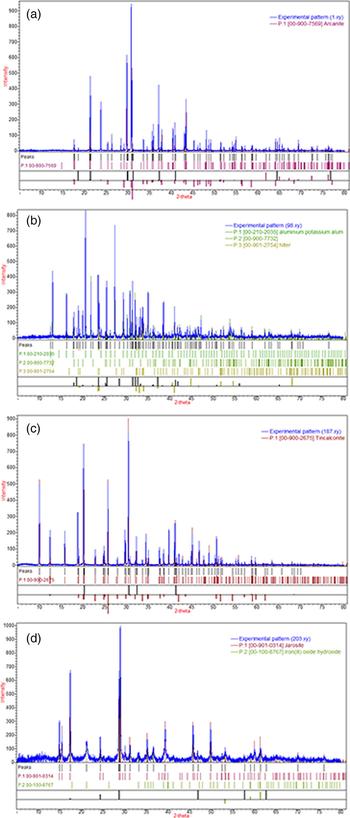
Sulphates. Most of the mineralogical species belonging to sulphates and reported with different identification names in Table I is composed of arcanite (K2SO4). In 71 samples, arcanite is an individual phase with very sharp reflections indicating a well-crystallized material [Figure 2(a)]. In three samples (samples 15, 110, and 214), arcanite is associated with sylvite (KCl) and aphthitalite [NaK3(SO4)2]. In particular, in the sample 110, arcanite is the principal component (87%), whilst in the samples 214 and 15, it is an accessory mineral (6 and 7%, respectively).
(Color online) XRPD profiles of selected samples. (a) Arcanite (sample 1); (b) Pietra divina composed of alum-K, nitre, and kaliochalcite (sample 98); (c) tintalconite (sample 187); (d) jarosite and goethite (sample 203).

Alum-K, a hydrated (KAl)-sulphate with chemical formula KAl(SO4)2·12(H2O) is the individual mineralogical phase detected in the sample 94. It was also detected in Pietra divina [sample 98; Figure 2(b)] where it is associated with kaliochalcite KCu2(SO4)OH and nitre KNO3 (Table I), with the following proportions: alum-K = 35%; kaliochalcite = 35%; nitre = 30%.
Chlorides. Halite (NaCl) is the individual constituent of sample 62 and it is associated with sylvite (KCl) in the sample 71 (halite = 97%; sylvite = 3%). Calomel (Hg2Cl2) is the individual constituent of the sample 35, whilst in the sample 122, it is associated with an Hg-oxychloride, eglestonite, with formula [Hg2]3Cl3O2H (Mereiter et al., Reference Mereiter, Zeimann and Hewat1992), with the following proportion: eglestonite = 85%; calomel = 15%. Finally, the ammonium chloride salt (NH4Cl) was identified as the individual component of the sample 205.
Carbonates. Ca-carbonates occur in the samples 70 and 116 where the two polymorphs (rhombohedral) calcite and (orthorombic) aragonite with chemical formula CaCO3 are simultaneously present. In these samples, aragonite is the primary mineralogical phase (Table I). Hydrated Pb-carbonate hydrocerussite [Pb3(CO3)2(OH)2] was detected in the sample 73 (80%) associated with 20% of the anhydrous equivalent (PbCO3).
Phosphates. Ca-phosphate was detected in the samples 113 and 138 as hydroxylapatite, the latter displaying very low crystallinity. The sample 163 is composed of monetite with chemical formula CaHPO4.
Borates. One sample (187) is composed of tintalconite [Figure 2(c)], a hydrated Na-(tetra)borate with chemical formula Na2(B4O7)·5H2O.
Oxides. Hematite (α-Fe2O3) is the individual constituent of the samples 31 and 222. The low crystallinity of the sample 218 does not allow for a clear distinction between maghemite (γ-Fe2O3) and magnetite (Fe3O4), though it is possible they are co-present as a result of aerial oxidation (Frison et al., Reference Frison, Cernuto, Cervellino, Zaharko, Colonna, Guagliardi and Masciocchi2013).
Quartz (SiO2) is the mineral detected in the sample 46. It is associated with bixbyite (FeMnO3) in the sample 127. Mineral cassiterite with chemical formula SnO2 is the constituent of the sample 137. For the samples 127 and 137, QPA was not possible because there are other minerals whose identification is not clear.
Sulphides. The mineral cinnabar (HgS) was identified in the samples 109, 148, and 152 as individual mineral.
Mixtures. Mixtures of salts have been discussed earlier in the sulphate group. The remaining samples 140 and 203 [Figure 2(d)] are, respectively, composed of litharge (PbO) associated with undetected minerals, and jarosite in combination with goethite (α-FeOOH), with the following proportion: jarosite = 66%; goethite = 34%.
IV. DISCUSSION
The mineralogical analysis carried out on 99 inorganic samples collected from the glass containers stored in the laboratory of the pharmacy Santa Maria della Scala in Rome allowed for a clear definition of the mineralogical nature of the studied materials.
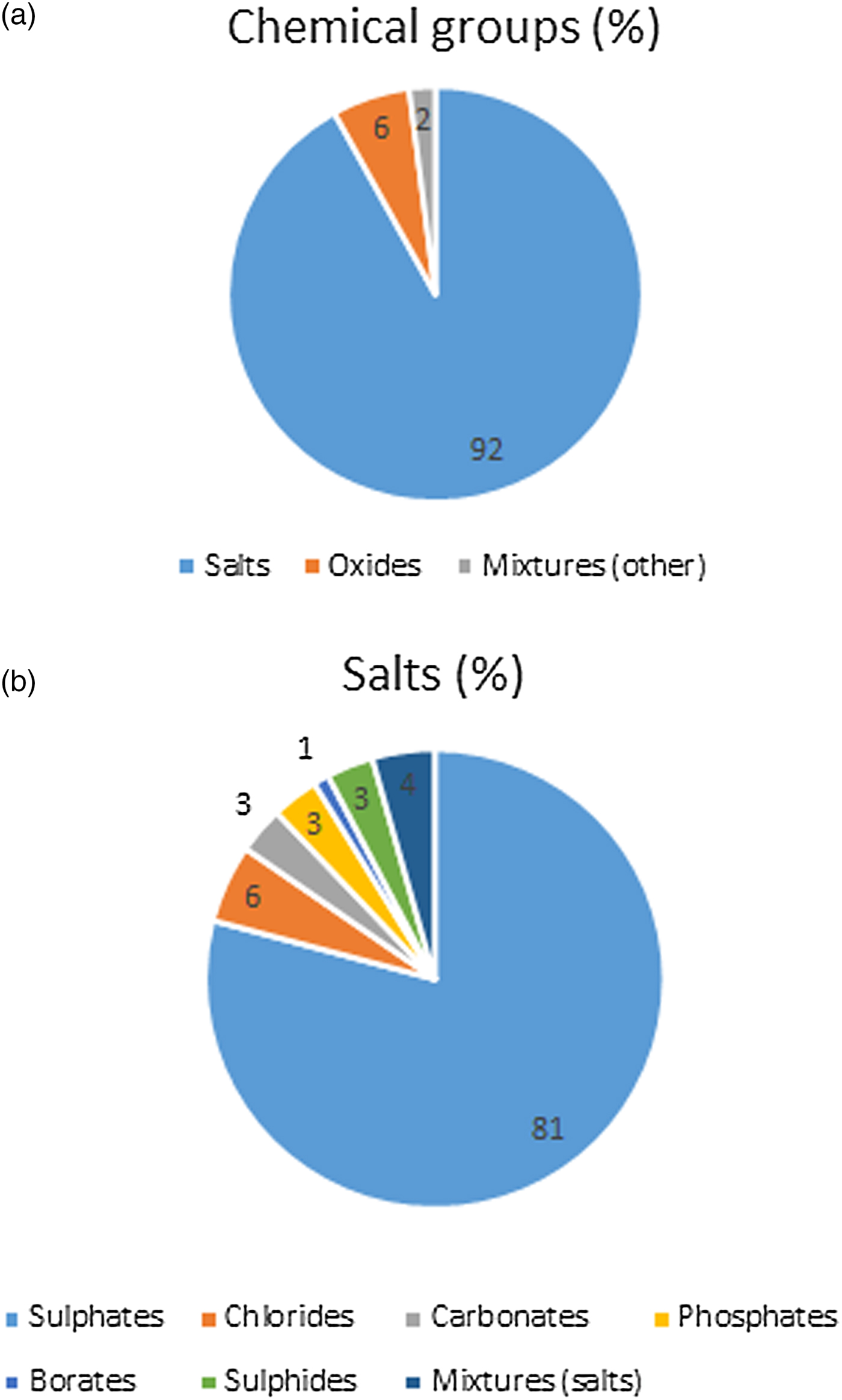
The most immediate evidence emerged after the interpretation of the XRPD profiles is that the inorganic fractions of almost all the analyzed samples are primarily in the form of salts (92% of the total analyzed in the present study) and the remaining are oxides and mixtures of different chemical compounds [Figure 3(a)].
(Color online) Grouping of the analysed samples. (a) Chemical groups identified after XRPD; (b) chemical composition of the diverse detected salts.

Most of the analyzed salts are sulphates [81%; Figure 3(b)] and almost all are in the form of arcanite (K2SO4), generally detected as individual mineral. The name of this salt derives from the Latin Arcanum duplicatum (double secret), a Medieval alchemical name, and was given for the first time by the mineralogist W. K. von Haidinger in 1845 (Frondel, Reference Frondel1950).
In nature, this mineral is associated with deposits from fumaroles and hot springs. High contents of arcanite were found in exhalations of the Arsenatnaya fumarole, Tolbachik Volcano in Russia associated with langbeinite, aphthitalite, hematite, tenorite, and others (Zubkova et al., Reference Zubkova., Pekov, Ksenofontov, Yapaskurt, Pushcharovsky and Sidorov2018). Arcanite can be manufactured from sylvite and a sulphate component in a single or multistage process, according to the following reaction (Fezei et al., Reference Fezei, Hammi and M'nif2008a, Reference Fezei, Hammi and M'nif2008b)
 $$2{\rm KCl} + {\rm MgS}{\rm O}_4\,\leftrightarrow \,{\rm K}_2{\rm S}{\rm O}_4 + {\rm MgC}{\rm l}_2$$
As reported in Goncharik et al. (Reference Goncharik, Shevchuk, Krut'ko, Smychnik and Kudina2014), the process was developed by Kurnakova and Luk'yanova and first published in 1949.
The production of salts by plants as reported in Junius (Reference Junius1986) requires further in-depth studies.
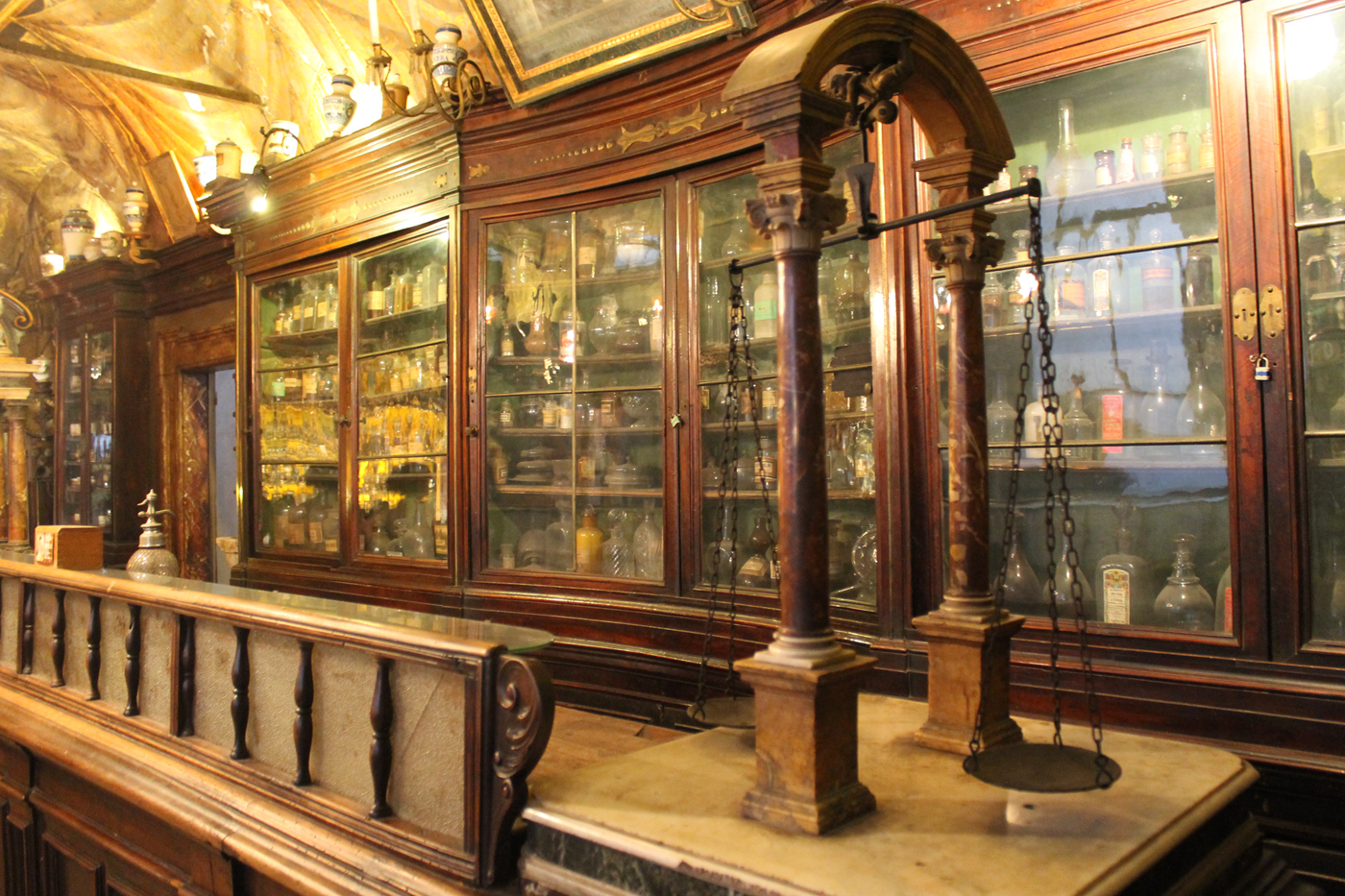
The intriguing question is to understand the reason why the same mineral arcanite is listed with different names as in Table I. The most plausible reason is that the same salt was used as a vehicle for organic compounds thus explaining the various colours of the same and nominally white chemical compound. In fact, the various names (of arcanite) are tied to those of plants and flowers (Paláu y Verdéra, Reference Paláu y Verdéra1784) as reported, for most of them, in Table II. Some of these label inscriptions suggest that ancient deities, planets, or luminaries were indeed incidental in the name given to the drug and probably inspired its alleged therapeutic properties. Inscriptions such as the abbreviation “Mart” (i.e. sample 218), “Ven(er)” (i.e. sample 1), “Juvartel” are a clear reference to the deity and planets Mars, Venus, and Jupiter. The name of these salts recall mythological Greco-Roman beliefs, as also occurs with the rest of the drugs conserved (Vázquez de Ágredos Pascual et al., Reference Vázquez de Ágredos Pascual, Rojo Iranzo, Van-Elslande, Walter, Pagiotti, Cavallo, Rusu Mircea Teodor Nechita, Niculina and Apostolescu2017, Reference Vázquez de Ágredos Pascual, Cavallo, Rojo Iranzo, Van-Elslande, Walter and Pagiotti2018).
Full transcription of the (medicinal) salts and correlation with flowers and plants.

The hydrated sulphates are in the form of alum-K (Al,K-sulphate) and jarosite (K,Fe-sulphate). Potash alum has been used as an ingredient (reagent to form the substrate for dyestuff) in recipes for the production of red lake pigments in Western Europe easel painting since the 12th century (Kirby et al., Reference Kirby, Spring and Higgitt2005). In addition, K-alum is an extremely astringent compound. Ancient medical and health care professionals often used it to treat injuries and illness as it is antiseptic and prevents the growth of bacteria. Jarosite was used as a yellow pigment since Middle Paleolithic (of Iberia) corresponding to 50 000 years B.P. (Zilhão et al., Reference Zilhão, Angelucci, Badal-García, Daniel, Dayet, Douka, Higham, Martínez-Sánchez, Montes-Bernárdez, Murcia-Mascarós and Zapata2010). It is important to point out that jarosite in association with goethite is called “Pulvis Astringent” (Astringent powder; sample 203), indicating its possible use in pharmacology. On the other hand, jarosite was used as a cosmetic (and pigment) in the Roman world (Ambers, Reference Ambers2004; Gamberini et al., Reference Gamberini, Baraldi, Palazzoli, Ribechini and Baraldi2008).
Several species of chlorides (Na, K, Hg, and NH4) were detected and among these the most interesting is calomel, a poisonous purgative.
Carbonates – both calcium and lead – and phosphates were commonly used as white pigments. Evidence of calcite and aragonite (shell white) use can be found, for example, as raw materials in Pompeian paintings (Mazzocchin et al., Reference Mazzocchin, Orsega, Baraldi and Zanini2006; Giachi et al., Reference Giachi, De Carolis and Pallecchi2009) whilst hydrocerussite (and cerussite), known as lead white, are the most important white pigment mentioned from ancient times to the present (Gettens et al., Reference Gettens, Kühn, Chase and Roy1993a), also used as a cosmetic. Analyses on 3000–5000 years old cosmetics of Ancient Egypt indicate that cerussite is the principal white component (Dooryhée et al., Reference Dooryhée, Martinetto, Walter and Anne2004). Furthermore, the physicochemical analyses of Roman cosmetics from Pompeii revealed that the white powder is principally calcite and gypsum, sometimes cerussite and aragonite (white shell). Calcite was described as a foundation, and it is more common than the lead carbonate (cerussa), rare in analysed samples from the Roman period, but often mentioned in the literature. The pink make-up was a mixture of several products, often hematite (ochre) lightened with a white pigment (often calcite; Welcomme et al., Reference Welcomme, Walter, van Elslande and Tsoucaris2006).
Hydroxylapatite, known as bone white, was used since Prehistoric times (Henshilwood et al., Reference Henshilwood, d'Errico, van Niekerk, Coquinot, Jacobs, Luritzen, Menu and García-Moreno2011). It is important to point out that the corresponding sample 138 was incorrectly labelled calomel.
Tintalconite, a pseudomorph of borax [Na2(B4O7)·10H2O], belongs to the borate group used as a flux in cobalt ore processing for blue pigment manufacture process (Matin and Pollard, Reference Matin and Pollard2017), and more in general in melting processes. Moreover, the use of boric acid (after dissolution of borates in water) is well known for its antiseptic properties and eye salves; recent applications as antibacterial agent are very promising (Photos-Jones et al., Reference Photos-Jones, Keane, Jones, Stamatakis, Robertson, Hall and Leanord2015). Finally, it was also an alchemical compound (Testi, Reference Testi1980).
Among the Mn-oxides possibly used since Prehistory (Chalmin, Reference Chalmin2003), bixbyite is a black pigment obtained after heat treatment. The use of cassiterite is not reported elsewhere.
Sulphides are in the form of cinnabar, a red pigment well known to Romans but also in Greece at least since 6th century B.C. (Gettens et al., Reference Gettens, Feller, Chase and Roy1993b). Notwithstanding, mercury is a well-known toxic heavy metal, cinnabar has been used for 2000 years in traditional Chinese and Indian Ayurvedic medicine (Liu et al., Reference Liu, Shi, Yu, Goyer and Waalkes2008).
Hematite, beside its use since Prehistory as a pigment and other utilitarian and not utilitarian applications (Cavallo, Reference Cavallo2016), was maybe the first mineral medicine used by early human beings (Velo, Reference Velo1984).
The yellow pigment litharge was used since antiquity (Burgio et al., Reference Burgio, Clark and Firth2001).
Finally, the composition of Pietra divina (Divine stone, sample 98) matches very well that reported in Testi (Reference Testi1980).
V. CONCLUSIONS
The analysis reported in this study allowed for a clear identification of the inorganic materials stored at the pharmacy Santa Maria della Scala in Rome.
It is evident that the pharmacy sold medicines (or principles for medicines), artistic materials, and also products for pigment manufacture (alum-K or borate). This was very common in Italy before the 15th century when a specific profession called vendecolori (sellers of pigments) was established in Venice that become the most important centre where artists and agents could get artistic materials (Matthew and Berrie, Reference Matthew, Berrie, Kirby, Nash and Cannon2010). Similarly, in German-speaking area, artists’ pigments were available at pharmacies during the Middle Ages (Burmester et al., Reference Burmester, Haller, Krekel, Kirby, Nash and Cannon2010). However, the abundance of sulphates and other salts such as chlorides indicates that the commerce of artistic material was not the primary practice in the pharmacy.
The minerals here identified generally occur as individual phases. QPA allowed for the determination of the amount of each component in the polycrystalline mixtures.
There are several aspects that require additional in-depth considerations. First, the salt arcanite is referred to with different (71) names, probably as it is used like a substrate for essences of plants but the following questions remain still open: where did the minerals come from? Did it come from natural or artificial sources? Was the pharmacy a supplier for other pharmacies in Italy or did it purchase mineral pigments from other pharmacies? These and other questions will be the subject of further investigations, where complementary analyses and historical information will be achieved for a more in-depth understanding of the social–economic and trade activities occurring in the preindustrial Mediterranean environment, also including the research on precious stones.
Acknowledgements
The authors are grateful to Valetino Mercati, President of Aboca (Sansepolcro, Italy) for the financial support of this research. The authors would like to thank Dr. Alicia Maria Mestre Segarra of the University of Valencia for her support in collecting XRPD data at the Scientific Park in Burjassot (Valencia). The authors thank the two anonymous reviewers whose suggestions and detailed comments contributed to improve the quality of the original manuscript.