1. Introduction
Since the growing scarcity of water is becoming a major obstacle to alleviating poverty and food insecurity in developing countries, efficient water resource management is receiving increasing attention (e.g., the series of the World Water Forum). This is the case in sub-Saharan Africa (SSA), where 25 per cent of the undernourished people in the world live. Because of increasing population pressure on limited land resources in this region, crop yields must be increased to improve food security, and efficient allocation of water is expected to play an important role in this (Gowing, Reference Gowing2003).Footnote 1 Thus, as in Asia, where efficient irrigation management is widely considered to be the key strategy for improving production efficiency in agriculture (Wang et al., Reference Wang, Xu, Huang and Rozelle2005), how to improve the efficiency of irrigation water management is becoming a critical issue in SSA.
Gravity irrigation is the most popular irrigation system in SSA, which is characterized by common-property or common-pool resources (CPRs) and, hence, it is used jointly by a group of farmers. To manage irrigation facilities effectively and allocate water resources efficiently, it is critically important to set and enforce the rules of water allocation and the maintenance of irrigation and drainage channels (Ostrom, Reference Ostrom1990). Yet, it is often pointed out that government officials in government-owned irrigation projects do not have enough incentive or information to deal with local management of irrigation schemes, including setting and enforcing rules (Coward, Reference Coward1980; Wade and Chambers, Reference Wade and Chambers1980). Recent studies emphasize the ability of the community to organize and mobilize local resources to manage irrigation schemes. Communities that are characterized by the close personal ties of their members often set and enforce rules effectively for irrigation management by such means as social sanction and peer supervision among community members (Seabright, Reference Seabright1993; Baland and Platteau, Reference Baland and Platteau1996). These studies have served as theoretical support for the policy of irrigation management transfer (IMT), which promotes the handover of the management of irrigation systems from the government to groups of local beneficiaries.
The results of IMT policies, however, are a mixture of successes and failures, as summarized by Vermillion (Reference Vermillion1997) and Garces-Restrepo et al. (Reference Garces-Restrepo, Vermillion and Muñoz2007) on the results of IMT in many countries regarding financial performance, quality of operation and management (O&M), and agricultural and economic productivity. However, in these studies, evidence about impacts is based on qualitative reports, without in-depth quantitative investigation at farm level. Therefore, it is important to examine empirically under what conditions communities can manage irrigation schemes effectively and what are the determinants of individual contributions for collective irrigation management.
Several empirical studies examine the characteristics of a community that is successful in irrigation management and find that small size, the social homogeneity of a community represented by the same caste or ethnic group, and economic inequality are important determinants (Bardhan, Reference Bardhan2000; Dayton-Johnson, Reference Dayton-Johnson2000; Meinzen-Dick et al., Reference Meinzen-Dick, Raju and Gulati2002; Fujiie et al., Reference Fujiie, Hayami and Kikuchi2005). Most of these studies focus on community-level analyses and use the level of activity of water-user groups or the level of maintenance of the irrigation channels, which is measured subjectively by ‘good’ or ‘poor’, as an indicator of the performance of community irrigation management. The determinants of the contribution of individual users to collective irrigation management and the allocation of water among them are seldom explored.Footnote 2 It must also be pointed out that studies on irrigation management in SSA are scanty.
In this study, we investigate important characteristics of water-user households and the group characteristics that affect their contribution to irrigation management and the availability of irrigation water at the plot level by using the data collected in an irrigation scheme in Uganda. We use the directly measured water depth at the plot level during the flowering stage as an objective indicator of the performance of the collective action, as the availability of sufficient water during this stage is critical for a good harvest. We aim to reveal the mechanism by which specific characteristics of water-user households affect the extent of collective action, which community-level analyses cannot reveal. For this purpose, we conducted a household survey in the Doho Rice Scheme (DRS) in Uganda.
DRS is a large-scale irrigation scheme which was formally owned and managed by the government and whose management was transferred to a farmers' organization. Therefore, careful examination of this scheme as a case study would give us some insights into identifying the key to successful irrigation management transfer from the government to the community, although our data were collected only after the management transfer and, hence, we cannot directly compare the situations before and after IMT.
The rest of the paper is organized as follows. Section 2 provides a general description of the study site and explains the data collection method. In section 3, we develop testable hypotheses based on a literature review and field observations. Section 4 presents the results of the statistical analyses of the determinants of household contributions to collective irrigation management and water depth. The paper ends with the conclusions in section 5.
2. The structure of the study site and the data
2.1 The structure of the study site
Rice cultivation in Doho started in the 1940s. The Chinese government began to construct the irrigation scheme in 1976 and completed it in 1989. The DRS is the largest irrigation scheme in Uganda and is designed to serve irrigation water to 1,000 ha of paddy fields. It is located 260 km to the east of the capital city of the country, Kampala, and about 4,340 farmers have engaged in double-cropping of rice for more than a few decades. The first cropping season is from March to August and the second is from September to February. The rainfall and water supply in the scheme are abundant in the first cropping season and farmers occasionally suffer from flooding, whereas the water supply is scarce in the second season. Most of the farmers live in nearby villages and grow various crops in their upland fields, in addition to rice grown in lowland plots in the DRS.
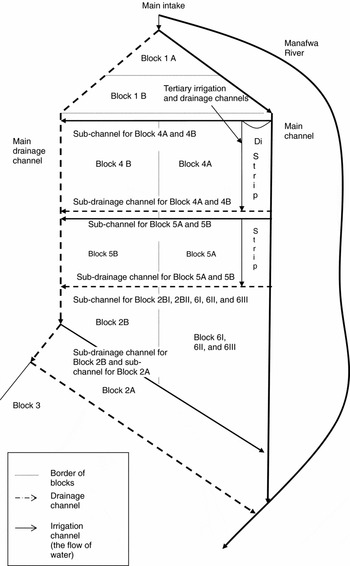
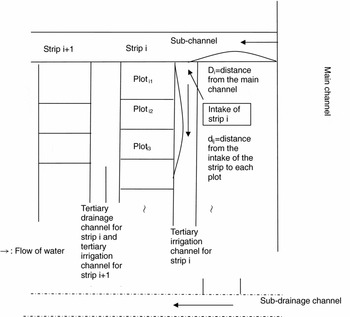
Figure 1 shows the structure of the DRS, which consists of 13 blocks connected by three layers of channels: main, sub and tertiary channels. The main channel provides irrigation water from the Manafwa River to the scheme. It branches out into the sub-channels, which provide irrigation water to each block. Basically, each block has one sub-channel and consists of 5–15 smaller zones called strips. As figure 2 shows, each strip is surrounded by a tertiary channel that provides irrigation water to the plots of 20–30 farmers by a tertiary drainage channel. The tertiary drainage channel for one strip serves as the tertiary irrigation channel for the strip next to it. After flowing through paddy fields, water is collected in the main drainage channel through the tertiary and sub-drainage channels and drained into the Manafwa River again (figure 1).
Structure of DRS.

Enlarged figure of a strip.

The scheme is still owned by the government, and farmers are entitled only to 99-year leases for their plots. There is a government irrigation management office where several staff members work. The main responsibilities of government officials are to provide extension services for rice production technologies to farmers and to report the conditions of the irrigation infrastructure to the government. Except for their salaries and occasional support for the maintenance of the channels, the government provides no financial support for the scheme.
A farmers' organization called DORSEFA (Doho Rice Scheme Farmers' Association) was established in 2003 in order for the government to hand over management authority. All the farmers in the scheme are supposed to be members of DORSEFA. However, in reality, less than 20 per cent of the rice farmers were members of DORSEFA in 2007 because a membership fee was charged. DORSEFA is responsible for maintenance activities and appoints 10 executive members and a chairperson and 10 counselors in each block elected by member farmers.
DORSEFA is responsible for collecting the irrigation fee. If a farmer does not pay the fee, he is reported to the DORSEFA disciplinary committee and is not allowed to cultivate his plot for two seasons. However, this punishment for the non-payment of irrigation fees is not fully implemented in practice, and only 40 per cent of the irrigation fees are collected on average. DORSEFA does not have a long-term budgetary plan, and repairs of irrigation infrastructure that go beyond its budgetary capacity are made by the Ministry of Agriculture based on the request of a government official. When the main intake from the water source to the main channel was broken in 2004 because of a flood, repairs were not made immediately and the farmers suffered from floods several times until the government finally repaired it in 2007.
Because of the breakdown of the water gates that control the water flow from the main channel to the sub-channels, there is no effective means to divert water into desired sub-channels. Thus, there is no clear water rotation system implemented among the blocks. Furthermore, almost no strip has any explicit rules on water distribution among farmers in the strip.
Although there is no effective means to divert water into desired channels, according to the farmers and local key informants, the level of the maintenance of the channel is critically important for the efficient distribution of water. This is because the channels are made of soil and, if they are not cleaned and weeded, water cannot run through them. The cleaning of the main channel and sub-channels and the main drainage and sub-drainage channels is supposed to be carried out collectively by the farmers in the block. DORSEFA organizes a chairpersons' and counselors' meeting to set a date, and the chairperson and counselors in each block are responsible for mobilizing farmers. However, the participation of the chairpersons and counselors at the meeting itself is limited and the participation of farmers is also not active.
Each farmer is responsible for cleaning the tertiary irrigation and drainage channels that his plot faces. The chairperson and counselors in each block are also responsible for monitoring whether the tertiary irrigation and drainage channels are cleaned. If a farmer does not clean the tertiary irrigation and drainage channels along which his plot is located for a long time, he is reported to the DORSEFA disciplinary committee by the chairperson or counselors and is not allowed to cultivate the plot for two seasons. However, this punishment is rarely implemented in practice.
The downstream area of the scheme, covering 200 ha, is cultivated informally by a group of farmers using water drained from the main scheme. These farmers are called out-growers. The channels in the out-growers' areas have structures similar to those of the DRS, and the out-growers collectively and voluntarily maintain the channels. Thus, we include the out-growers in our analysis and treat their whole plots as one block.Footnote 3
2.2 Data
Three rounds of field surveys were conducted by the senior author: from April to June in 2007, in November 2007 and in March 2008. Out of 13 blocks in the DRS, we excluded three blocks (namely Blocks 1A, 1B and 3) from our sample because there was no main drainage channel in Block 3, and the channels have different structures in these blocks. Therefore, our survey covers the remaining 10 blocks and the out-growers' area. We randomly sampled 55 strips in the 11 blocks out of 121 strips. We sampled plots from each strip, which are located at 200, 400, 600, 800 and 1,000 m from the water intake of the strip along the tertiary channel (figure 2). The total length of the strip varies, ranging from 400 to 1,000 m, and is on average about 600 m. We sampled three plots from one strip on average. Doing so enables us to investigate how the contributions of the household to the cleaning of the channels and the availability of water differ at different points in the irrigation scheme.
The first round of the survey was done after the harvest of the second season of 2006, and we interviewed 158 cultivators to collect data on their household income and household contribution to the cleaning of the channels in the first and the second seasons of 2006. The second round of the survey was done during the second season of 2007, and we physically measured the water depth in the sample plots 90 days after rice seedlings were planted, because water availability is critically important at the flowering stage of rice cultivation that takes place 90 days after planting.Footnote 4, Footnote 5, Footnote 6 We measured the water depth in 103 plots.Footnote 7 In the third round of the survey, which was conducted after the harvest of the second season of 2007, we again attempted to interview the original sample cultivators to collect detailed data on rice cultivation in the sample plots, such as harvest, input use and the contribution to the cleaning of the channels in the first and second season of 2007. We interviewed 142 households for the first season of 2007 and 146 households for the second season of 2007.Footnote 8 In this survey, we also collected some additional information about the cultivators in 2006. We could revisit and collect the recall data of 138 and 140 households for the first season and the second season of 2006, respectively. For the analyses of household contributions, we are going to use the pooled data of four seasons in 2006 and 2007. Since water depth was measured only in the second season of 2007, we use the data of only one season for the analyses of water depth.
3. Descriptive analyses and testable hypotheses
Let us begin our analyses by developing hypotheses based on a literature review and field observations. Existing studies suggest that the scarce supply of irrigation water is an important determinant of the degree of cooperation among farmers (Fujiie et al., Reference Fujiie, Hayami and Kikuchi2005). We can expect that the longer the distance from the main channel to the intake of the strip (Di), the scarcer water is at the intake of the strip (figure 1). The availability of irrigation water in the j th plot in the i th strip (Wij) further depends on the distance from the intake of the strip to each plot along the tertiary channel (dij). The longer the distance is, the less water is expected to be available due to the use of water by upstream farmers, as well as due to infiltration and evaporation losses. The availability of water also depends on the total contribution to the cleaning of the tertiary channel made by the upstream farmers in the strip and the cultivator's own contribution to the cleaning of the tertiary channel (Cij). When the tertiary channels are well maintained, less water is lost and even plots far away from the intake of the strip can receive sufficient water. When irrigation water is scarce, the marginal value product of water is high, and hence farmers may have more incentive to contribute to the cleaning of the irrigation channels in order to increase available irrigation water.
Unlike cleaning of irrigation channels, farmers seem to have incentives to clean drainage channels, particularly when flooding occurs. Thus, the marginal gain from cleaning drainage channels tends to be large when flooding is severe, which is the case near the main drainage and sub-drainage channels as well as near the intake.
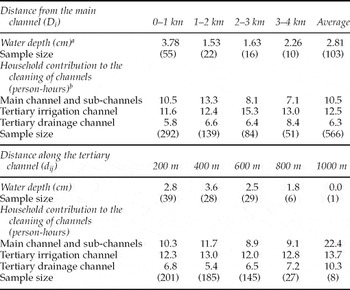
Table 1 examines the relationship between the distance from the main channel to the intake of the strip (Di) and water depth. Consistent with our expectation, water depth first decreases as the distance from the main channel to the intake of the strip increases. Contrary to our expectation, however, water depth increases as the distance increases to more than 2 km. This may be because the land slopes downward away from the main irrigation channel, and water tends to accumulate near the main drainage channel, especially where the drainage channels do not function well. Therefore, we observe a U-shape relationship between the distance from the intake of the strip and water depth.
Water depth and household contribution to cleaning of channels by distance from main channel and along tertiary channel

aThe water depth was measured in the second season of 2007; sample size is 103.
bFor the household contribution to the cleaning of irrigation and drainage channels (person-hours), we use pooled data of the first and second seasons of both 2006 and 2007; sample size is 566.
Table 1 also summarizes the relationship between the distance from the main channel to the intake of the strip and the household contribution to the cleaning of the main channel and sub-channels, the tertiary channel and the tertiary drainage channel.Footnote 9 The household contributions to the cleaning of the main channel and sub-channels have inverted-U relationships with the distance from the main channel to the intake of the strip, with the peak around 2–3 km. The fact that water depth first decreases and then starts to increase, whereas the household contribution initially increases but gradually decreases, can be explained by the tendency, when the irrigation water is scarcer and, hence, the marginal productivity of irrigation water is higher, for farmers to work harder to clean the channel in order to obtain more irrigation water. On the other hand, the household contribution to the tertiary drainage channel increases as the distance becomes longer. This may be because, in the downstream area where plots are located near the sub-drainage channels, farmers have more incentive to contribute to the cleaning of the tertiary drainage channel to avoid flooding.
The lower half of table 1 shows the relationship between the distance from the intake of the strip to each plot (dij) and water depth and household contribution to the cleaning of the irrigation and drainage channels. Although an unexpected peak in water depth at 400 m is observed, less water is provided to the farther plot as we expected. On the other hand, we cannot observe any clear tendency in household contribution to the cleaning of the main channel and sub-channels or the tertiary irrigation channel. As can be expected, households increase their contribution to the cleaning of tertiary drainage channel as the distance becomes longer. These observations lead us to the following hypothesis:
Hypothesis 1. The scarcer the irrigation water is, the more households contribute to the cleaning of irrigation channels. On the other hand, households in the downstream area of the main channel and sub-channels and tertiary channel contribute more to the tertiary drainage channel in order to avoid flooding.
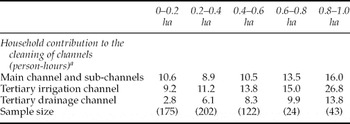
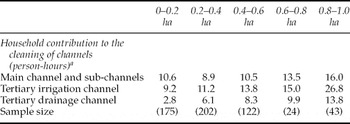
Another important determinant of water management discussed in the literature is the private benefit associated with plot size (White and Runge, Reference White and Runge1994; Gaspart et al., Reference Gaspart, Jabbar, Mélard and Platteau1998), as farmers with larger plots enjoy greater benefits of well cleaned irrigation and drainage channels. Hence, large cultivators would have more incentive to contribute to the cleaning of channels than small ones. Table 2 examines the relationship between the size of the cultivated area in the sample strip and household contribution to the cleaning of irrigation and tertiary drainage channels. It seems clear that the larger the size of the cultivated area is, the more contribution a household makes to the cleaning of both irrigation and drainage channels. Therefore, the second hypothesis is postulated as follows:
Hypothesis 2. The larger the plot size in the sample strip is, the more households contribute to the cleaning of irrigation and drainage channels.
Size of cultivated area in a sample strip and household contribution to cleaning of channels
aFor the analyses of the household contribution to the cleaning of irrigation and drainage channels (person-hours), we use pooled data of the first and second seasons of 2006 and 2007; sample size is 566.
One issue related to plot size is inequality in cultivation size or landholdings. The theoretical predictions of the impact of inequality in landholdings on the provision of public goods such as well cleaned channels are mixed. Olson (Reference Olson1965) argues that inequality might be beneficial to the provision of public goods when a few members obtain a significant proportion of the total benefit from the public goods and, hence, have strong incentives to provide them, even if they have to pay almost all of the cost. Bardhan et al. (Reference Bardhan, Ghatak, Karaivanov, Baland, Bardhan and Bowles2007), in contrast, argue that a threshold level of landholdings exists such that a group member who has more land than this threshold contributes to the collective effort to increase irrigation water. They predict that equality among contributors may be beneficial to the provision of public goods to the extent that the average landholding exceeds the threshold level.
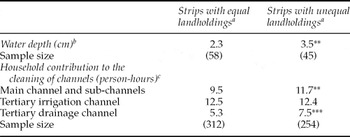
Table 3 compares water depth and household contribution to the cleaning of irrigation and drainage channels between strips with relatively equal and unequal land distributions. Strips with equal or unequal land distributions are defined as strips with a coefficient of variation of plot size less than or more than its average value, 75 per cent. A plot in a strip with larger inequality of plot size receives more irrigation water. Furthermore, a household that is in a strip with unequal distribution of plot size contributes more to the cleaning of the main and sub-channels and tertiary drainage channel. These findings may be consistent with the argument of Olson (Reference Olson1965), who predicts that inequality may enhance the likelihood of collective action.
Coefficient of variation of plot size in a strip and water depth and household contribution to cleaning of channels

aStrips with equal or unequal landholdings are defined as strips with a coefficient of variation of plot size in the strip less than and equal to or more than its average value, 75%.
bThe water depth was measured in the second season of 2007; sample size is 103.
cFor the household contribution to the cleaning of irrigation and drainage channels (person-hours), we use pooled data of the first and second seasons of both 2006 and 2007; sample size is 566.
**significant at 5%; ***significant at 1% in the t-test comparing households in strips with equal and unequal landholdings.
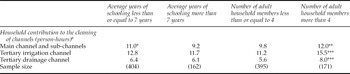
The household contribution also depends on the opportunity cost of labor associated with non-farm income and upland crop cultivation (Bardhan, Reference Bardhan2000; Dayton-Johnson, Reference Dayton-Johnson2000; Fujiie et al., Reference Fujiie, Hayami and Kikuchi2005). Farmers with high opportunity costs of labor may have lower incentive to cooperate in irrigation management. Since educational attainment is a good proxy of the opportunity cost of labor associated with non-farm income, table 4 summarizes the relationship between the average years of schooling of household members who are older than 15 years of age and household contributions to the cleaning of irrigation channels and tertiary drainage channels.Footnote 10 For descriptive analysis, we compare cases in which the average years of schooling of household members are less than or more than seven years, which corresponds to the completion of primary education in Uganda. Table 4 demonstrates that households with highly educated members contribute less to the cleaning of irrigation and tertiary drainage channels.
The number of adult household members, average years of schooling of adult household members and the household contribution to cleaning of channels

aFor the household contribution to the cleaning of irrigation and drainage channels (person-hours), we use pooled data of the first and second seasons of both 2006 and 2007; sample size is 566.
*significant at 10%; **significant at 5%; ***significant at 1% in the t-test comparing households with average years of schooling of adult household members less than or equal to and more than seven years and those with less than or equal to four and more than four adult household members.
A related determinant of household contribution to the cleaning of channels is the number of adult household members. Since the agricultural labor market is imperfect due to the high monitoring cost of wage workers in ecologically diverse and spatially dispersed agricultural environments (Hayami and Otsuka, Reference Hayami and Otsuka1993), the supply of labor is significantly affected by the endowment of family labor. Thus, the number of adult household members may have a positive impact on the household contribution to the cleaning of channels. In table 4, we compare the household contribution to the cleaning of irrigation and tertiary drainage channels between the two groups, where the number of adult household members is less than or more than its average of four people. Households with a large number of adult members are expected to contribute more to the cleaning of all types of channels than those with a small number of adult members. Therefore, we hypothesize that:
Hypothesis 3. Households with highly educated members and with fewer members contribute less to the cleaning of irrigation and drainage channels.
Although an individual household may determine the household contribution to the cleaning of a channel based on its private benefit and cost, the availability of irrigation water will be determined importantly by the behavior of other farmers. In fact, if upstream farmers in a strip do not clean the channel or overuse water, downstream households cannot receive much irrigation water. Therefore, it seems reasonable to argue that water depth is determined primarily by the collective effort of strip members. Based on this reasoning, the fourth hypothesis is postulated as:
Hypothesis 4. Since the availability of irrigation water in a particular plot depends critically on the collective effort of strip members, measured water depth depends on the characteristics of strip members more than individual household characteristics.
4. Regression analyses
4.1 Methodology
In order to examine the determinants of household contributions to the cleaning of channels and water depth in each plot, we estimate two types of regression function: the household labor contribution function and the water depth function. The dependent variables in the household labor contribution functions are the household labor contribution to the cleaning of the main channel and sub-channels, tertiary irrigation channels or tertiary drainage channels in a season measured by person-hours, whereas the dependent variable in the water depth function is the water depth (cm) in the sample plot.
As independent variables, we include the distance from the main channel to the intake of the strip (Di) and its squared term, as well as the distance from the intake of the strip to each plot (dij) and its squared term. One can expect that water depth decreases as both distances from the main channel to the intake of the strip (Di) and from the intake of the strip to each plot (dij) increase. However, as was discussed earlier, there is a possibility that water depth first decreases and then increases as the distance from the main channel increases (Di), because water tends to accumulate near the drainage channel. If so, we will observe a U-shape relationship between the distance from the main channel to the intake of the strip and water depth. Our first hypothesis argues that the scarcer the irrigation water, the more a household contributes to the cleaning of the irrigation channel. Therefore, if the distance from the main channel has a U-shape relationship with water depth, it should have an inverted-U-shape relationship with the household contribution to the cleaning of irrigation channels. On the other hand, if water depth decreases as the distance from the intake of the strip (dij) increases, then the household contribution should increase as the distance becomes longer.
In order to statistically test our second hypothesis that the private benefit associated with plot size influences the household contribution to the cleaning of channels, we include the total size of the cultivated area in the sample strip, including the sample plot. We also include their squared term. The size of the cultivated area in the sample strip is expected to have a positive impact on the household contribution to the cleaning of irrigation and drainage channels.
In order to test our third hypothesis, we include educational attainment, which is measured by the average years of schooling of adult household members, and the number of adult household members. The former should have a negative impact on the household contribution, while the latter should have a positive effect.
We also include a set of variables explaining strip characteristics. According to existing studies, the size and economic inequality of community members are identified as important determinants of the success of irrigation management (Bardhan, Reference Bardhan2000; Fujiie et al., Reference Fujiie, Hayami and Kikuchi2005). Therefore, we include the number of farmers in the strip to indicate the size of the user group, and the coefficient of variation of plot size in the strip as an indicator of the inequality of landholdings.
Existing studies also point out the importance of community mechanisms such as social sanctions and peer supervision working among group members (Fujiie et al., Reference Fujiie, Hayami and Kikuchi2005). We include the ‘density of farmers with close personal ties’ in the same strip. More specifically, we consider the number of relatives and the number of the same village members in the same strip, both of which are divided by the distance of the strip.Footnote 11 If the density of farmers with close personal ties has a positive impact on the household contribution to the cleaning of irrigation and drainage channels, then we can attribute this to some kind of community mechanism for enforcing collective action.
In order to control for the effects of other factors, we include the size of the cultivated area in other strips in DRS and the size of the cultivated area in the upland area and their squared terms. These variables have negative effects on the household contribution, because the larger the size of these areas, the higher the opportunity cost of labor would be. Season dummies are also included.
Note that our fourth hypothesis predicts that strip characteristics such as membership size of the strip and the coefficient of variation of plot size in the strip may have significant impacts on water depth, but not necessarily characteristics of individual households such as the land endowment and educational attainment of household members. Also note that the coefficients of the labor contribution function will be different among the three cases – cleaning of the main channel and sub-channels, tertiary channel and tertiary drainage channel. A particular difference occurs between the cleaning of irrigation and drainage channels, because the former pertains to the allocation of scarce water whereas the latter is related primarily to reducing excess water during flooding.
4.2 Regression results
4.2.1. The determinants of water depth
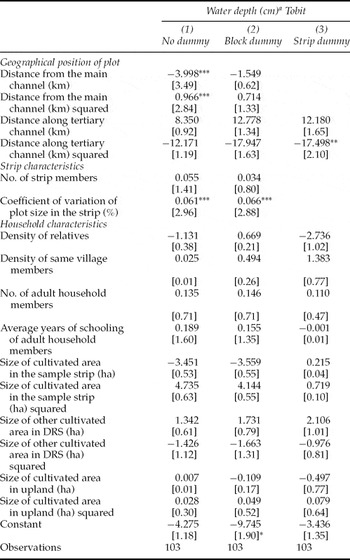
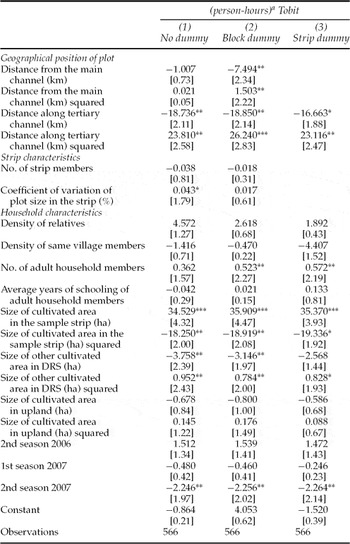
Table 5 shows the regression results of the water depth function. We estimate the models using Tobit estimation since the observations are censored at zero. We report the results, which include no dummy, block dummies and strip dummies, respectively, from (1) to (3).
Determinants of water depth

Note: Absolute value of t-statistics in brackets.
aWater depth was measured in the second season of 2007; sample size is 103.
*significant at 10%; **significant at 5%; ***significant at 1%.
According to model (1), the coefficient of distance from the main channel is negative and significant and that of its squared term is positive and significant, implying that distance has a U-shape relationship with water depth. In other words, water depth first decreases as the distance from the main channel to the intake of the strip increases up to 2 km, after which it increases. This relationship is not observed when we include the block dummies in model (2), because they capture the impact of distance from the main channel.
According to model (3), the distance from the intake of the strip to each plot has an inverted-U-shape relationship. Although we are not sure why water depth increases initially up to 350 m, it decreases after this point, as we expected.
Consistent with the fourth hypothesis, household characteristics such as cultivated areas and educational attainment of adult household members do not have significant impacts on water depth in all of the models from (1) to (3). On the other hand, strip characteristics such as the coefficient of variation of plot size have a significant and positive impact on the water depth in models (1) and (2). These observations suggest that the water depth of an individual plot is determined primarily by the contribution of group members but not by the effort of the individual household. The positive and significant coefficient of variation of plot size implies that inequality of plot size in the strip increases water depth at the plot level. As will be discussed later, households with larger plots contribute more than proportionately to the cleaning of the tertiary channel. This may be the reason why the coefficient of variation of plot size has a positive impact on water depth.
4.2.2. The determinants of the cleaning of irrigation channels
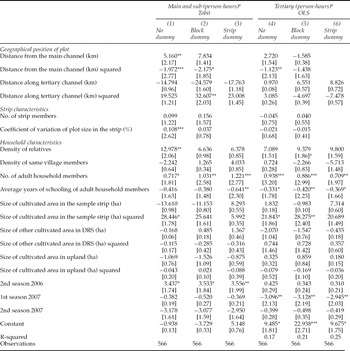
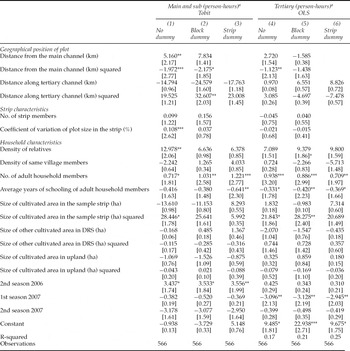
Table 6 summarizes the regression results of the determinants of household contributions to the cleaning of the main channel and sub-channels (models (1)–(3)) and tertiary irrigation channel (models (4)–(6)). We estimate models (1)–(3) by employing the Tobit estimation method because some of the farmers do not contribute to the cleaning of the main channel and sub-channels at all, whereas we use OLS to estimate models (4)–(6). We report the results, which include no dummy, block dummies and strip dummies.
Determinants of household contribution to the cleaning of irrigation channels
Note: Absolute value of t-statistics in brackets.
aWe use pooled data of the first and second seasons of both 2006 and 2007; sample size is 566.
*significant at 10%; **significant at 5%; ***significant at 1%.
The distance from the main channel to the intake of the strip has an inverted-U-shape relationship with household contribution to the cleaning of the main channel and sub-channels, as well as the tertiary channel, with the peak around 1.5 km in models (1), (2) and (4). As we found earlier, water depth has a U-shape relationship with the distance from the main channel to the intake of the strip. Therefore, households contribute more to the cleaning of irrigation channels when irrigation water is scarcer, which is consistent with our first hypothesis.
The distance from the intake of the strip to each plot has a U-shape relationship with the household contribution to the cleaning of the main channel and sub-channels, with its peak around 350 m in model (2). Considering that water depth has an inverted-U-shape relationship with the distance from the intake of the strip to each plot at a peak around 350 m, this is also consistent with our first hypothesis that the household contribution is determined by the scarcity of irrigation water. Unexpectedly, however, the distance from the intake of the strip to each plot does not have any significant impact on the household contribution to the cleaning of the tertiary channel in models (4)–(6).
The density of relatives has a positive impact on the household contribution to the cleaning of the main channel and sub-channels and the tertiary channel in models (1) and (5). Also, t-statistics are not low in models (4) and (6). These findings suggest that the community mechanisms of enforcement are effective among closely related strip members, especially for the cleaning of the tertiary channel. This is consistent with existing studies, which emphasize the importance of community relations in collective irrigation management (Fujiie et al., Reference Fujiie, Hayami and Kikuchi2005).
It is important to realize that the coefficients of the squared term of size of the cultivated area in the sample strip are positive and significant in models (1), (4) and (5). This means that households increase their contribution to the cleaning of channels more than proportionately as the cultivated area in the strip becomes larger. This seems to explain why the coefficient of variation of plot size has a positive impact on water depth. These findings are consistent with the argument of Olson and Zeckhauser (Reference Olson and Zeckhauser1966), who predict that inequality may be conducive to an increased provision of public goods because economic agents with large endowments may bear a larger portion of costs associated with cooperative action.
The coefficients of the average years of schooling of adult household members are all negative and four of them are significant for the household contribution to the cleaning of channels. The number of adult household members significantly increases the household contribution to the cleaning of the main channel and sub-channels and the tertiary channel in all the models. These findings are consistent with our third hypothesis regarding the opportunity cost of labor.
The coefficients of the second-season 2006 dummy are significant and positive for the cleaning of the main channel and sub-channels, while those of the first-season 2007 dummy are significant and negative for the cleaning of the tertiary channel. This indicates that farmers contribute more to the cleaning of the main channel and sub-channels in the second season in 2006 when water is scarce, while they contribute less to the tertiary irrigation channel in the first season in 2007 when the water supply is abundant. This is consistent with our observations that farmers work more when the supply of irrigation water is scarce.
4.2.3. The determinants of the cleaning of tertiary drainage channels
In Table 7, we show the regression results of the determinants of the household contribution to the cleaning of tertiary drainage channels. We estimate the models using Tobit estimation as some of the sample farmers do not contribute at all. We report the results, which include no dummy in model (1), block dummies in model (2) and strip dummies in model (3).
Determinants of the household contribution to the cleaning of tertiary drainage channel

Note: Absolute value of t-statistics in brackets.
aWe use pooled data of the first and second seasons of both 2006 and 2007; sample size is 566.
*significant at 10%; **significant at 5%; ***significant at 1%.
Both the distance from the main channel to the intake of the strip and the distance from the intake of the strip to each plot have U-shape relationships with the household contribution to the cleaning of tertiary drainage channels. This is likely because, in the extreme upstream and downstream areas of the sub- and tertiary channels, flooding is occasionally serious due to heavy rain so that farmers have strong incentives to contribute to the cleaning of tertiary drainage channels to reduce floodwater.
The size of cultivated area in the sample strip has an inverted-U relationship with its peak at 1 ha in all three models. Since almost no household cultivates more than 1 ha in a sample strip, this means that the size of the cultivated area has a positive impact on the household contribution to the cleaning of tertiary drainage channels. This is consistent with our second hypothesis regarding the effect of plot size.
The size of other cultivated area in DRS has a U-shape relationship with its peak at 2 ha. Since less than 1 per cent of sample households have other cultivated area larger than 2 ha in DRS, this almost implies that the size of other cultivated area in DRS has a negative relationship with the household contribution to the cleaning of tertiary drainage channels. This may be because, when the size of other cultivated area is large, the opportunity cost of labor becomes high. Furthermore, since flooding tends to occur everywhere in the whole scheme more or less at the same time, farmers with many large plots in DRS contribute less to the cleaning of tertiary drainage channel in the sample strip than farmers with small plots.
The coefficient of the second-season 2007 dummy is negative and significant, presumably because the whole scheme suffers from low rainfall and a shortage of water in this particular season. As a result, farmers may have more incentive to clean the irrigation channels rather than drainage channels.
5. Conclusions
This study examined the determinants of household contributions to the cleaning of irrigation and drainage channels as well as the water depth in each plot. By doing so, we aimed to identify critically important household characteristics that affect collective irrigation management. The empirical results demonstrated that the scarcity of irrigation water, private benefit associated with plot size and the opportunity cost of labor are the important determinants of household contributions to the cleaning of irrigation channels, even though the selected measure of water scarcity may not be accurate enough to draw a definitive conclusion. This is consistent with other studies that suggest the importance of private incentive to provide a collective good (White and Runge, Reference White and Runge1994, Reference White and Runge1995; Gaspart et al., Reference Gaspart, Jabbar, Mélard and Platteau1998). Our empirical results also suggest that the community mechanisms of enforcing collective action are effective to some extent among closely related strip members, especially for the cleaning of tertiary channels. This is also consistent with existing studies that emphasize the importance of community relations for collective irrigation management (Fujiie et al., Reference Fujiie, Hayami and Kikuchi2005).
In addition, we estimated the water availability function. We found that strip characteristics, rather than household characteristics, are important determinants of water depth in each plot. In particular, inequality in plot size in a strip has a positive and significant impact on water depth, largely because a household with a large plot contributes more than proportionately to the cleaning of irrigation channels. These findings are consistent with the argument of Olson (Reference Olson1965), who predicts that inequality may be conducive to an increased provision of public goods. However, we should be careful regarding the conclusion that inequality in landholdings always improves collective irrigation management. Since no strong collective action is organized in DRS, a reasonable interpretation of the results may be that people are responding to their private benefit under weakly organized institutions.
Our results suggest that farmers are responsive to their private benefit and cost when they determine their contribution to the cleaning of channels. This implies that, in order to make collective irrigation management more effective, we should set rules of punishment or reward so as to make farmers' private benefit and cost consistent with the social benefit and cost. Sethi and Somanathan (Reference Sethi and Somanathan2006) suggest that the prospect of punishment against non-contributors should be sufficient to induce the cooperative behavior of farmers. In DRS, punishment for non-contributors to the cleaning of irrigation channels is seldom imposed. Tachibana et al. (Reference Tachibana, Upadhyaya, Pokharel, Rayamajhi, Otsuka, Otsuka and Place2001) emphasize that support from the local government for a communal forest users' group, particularly the punishment of violators of management rules, is conducive to the effective management of non-timber forest resources in Nepal due to the high psychological and social costs of punishing each other among community members. The government may be able to support DORSEFA in implementing punishment more strictly.
Furthermore, the mobilization of farmers is poorly done, especially for the cleaning of the main channel and sub-channels, where the benefits of cleaned channels are shared by many farmers. Some chairpersons and counselors who are responsible for mobilizing the farmers do not even attend the meeting where they are supposed to discuss the date of the cleaning of the channels. Fujiie et al. (Reference Fujiie, Hayami and Kikuchi2005) suggest that giving some incentive to community leaders who mobilize farmers is important to induce farmers' cooperation for collective action. An incentive such as a monetary reward for chairpersons and counselors based on the number of farmers who join the cleaning of the main channel and sub-channels from their respective blocks could help to improve the performance of those leaders to mobilize farmers in their block.
In addition to the weak enforcement of the punishment and incentives of leaders, neither DORSEFA nor the government has a long-term budgetary plan for maintenance activities. The experience of DRS clearly shows that the simple transfer of management from the government to the community does not guarantee better management of irrigation schemes. National and international support to strengthen the institutional capacity of the community and government is probably needed for better management of irrigation schemes.