Introduction
Weaning is a stressful period for young mammals, which supposes the separation from the mother, milk withdrawal and adaptation to a new solid feed. These changes increase the susceptibility of the young ones to diseases. This phenomenon is of particular importance in rabbits, a species in which the prevalence of digestive disorders after weaning is very high. It has been hypothesised that an inappropriate digestive maturation to nutritional changes could be responsible for this sensitivity to enteropathies (Gidenne and Fortun-Lamothe, Reference Gidenne and Fortun-Lamothe2002). For instance, low levels of amylase activity in the young rabbit would be responsible for its low ability to digest starch. However, it has been shown that 35-day-old rabbits weaned for 10 days presented a higher amylolytic activity than still-suckling rabbits of the same age (Gutiérrez et al., Reference Gutiérrez, Espinosa, García, Carabaño and De Blas2002), which would mean a certain capability to adapt to nutritional changes. But this adaptative response was associated with a decrease in mucosal maltase activity, an enzyme also implicated in the digestion of starch. Other authors found conversely that pancreatic enzymes would not be adaptable to amounts of nutrients incorporated in diet from 25 to 42 days of age (Debray et al., Reference Debray, Le Huérou-Luron, Gidenne and Fortun-Lamothe2003). Due to these discrepancies and the scarceness of data in rabbits, we aimed at studying the early digestive maturation process, as well as its plasticity to feed in the young. To induce important changes, we chose to stimulate the dry feed intake by comparing an early weaning at 21 days to a late weaning at 35 days of age. In this study, the development of the enzyme digestive potential was investigated from 14 to 49 days of age in the small intestinal content and mucosa. The caecal microbial activity was evaluated by measuring fermentation pattern and bacterial fibrolytic activity. These data were related in a second part (Gallois et al., Reference Gallois, Fortun-Lamothe, Michelan and Gidenne2008) to the in vivo abilities of rabbits to digest the diet.
Material and methods
Animals, diet and experimental design
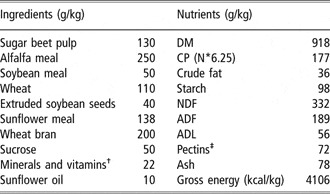
Animals were handled according to the care of animals in experimentation, in agreement with French national legislation (decree 2001-486, 06/06/2001). This experiment was carried out with INRA 1067 × PS Hyplus 39 (Grimaud group) rabbits. Twenty-four litters of nine young rabbits were reared in special cages allowing a solid feed distribution to the kits independently from their mother (Fortun-Lamothe et al., Reference Fortun-Lamothe, Gidenne, Lapanouse and De Dapper2000). The access of pups to the does’ feed was surely avoided, and inversely, a special area for pups did not allow the access to the kits’ feeder by the mothers. Young rabbits, weighing 217 ± 35 g on day 14, were weaned either at 21 days (W21 group, 12 litters) or at 35 days (W35 group, 12 litters) of age. The environmental temperature was maintained at 19°C, and the light was on between 0700 and 2300 h. From 14 till 49 days of age, the young rabbits from both groups had access to the same experimental feed (Table 1), whereas does were fed a commercial feed without antibiotics. Water and feed were provided ad libitum. Does were moved to other cages on the day of weaning, whereas young rabbits remained in the same cage until the end of the experiment (49 days). Does were inseminated 25 days after kindling to avoid interactions between gestation and milk production. From 14 till 49 days of age, once a week and before the suckling, the rabbits were weighed individually and the solid feed intake was recorded per litter. Caecotrophy was not prevented in order to evaluate digestive function under physiological conditions. The milk consumption was measured weekly per litter by weighing does before and after the suckling.
Composition of experimental diet fed to young rabbits (as-fed basis)

†Contained: 6 g/kg of salt, 5 g/kg of calcium carbonate, 1 g/kg of dl-methionine, 5 g/kg of vitamin premix (retinol 1.5 × 10⁶ IU/kg, cholecalciferol 2 × 10⁵ IU/kg, tocopherol 3000 mg/kg, thiamin 200 mg/kg), 5 g/kg of AL132® (containing 13.2 g/kg of robenidine).
‡Water-insoluble pectins, calculated according to Gidenne (Reference Gidenne2003).
Measurements and sampling
Fourteen and 21 days after kindling, one rabbit each in 50% of the litters from both treatments was slaughtered by cervical dislocation according to the Report of the AVMA Panel on Euthanasia (2001). Thereafter, one rabbit per litter in each weaning group was slaughtered weekly till 49 days. The litter size was maintained constant until the last weaning, by replacing dead (till 21 days) or slaughtered (till 28 days) animals with rabbits of similar age, weaning age and bodyweight from replacement litters. Slaughtered rabbits were representative of the average litter weight, not adopted and clinically healthy. Animals were deprived of feed intake, either milk or solid feed, for 3 h before the slaughter (between 1000 and 1430 h), and special care was taken to maintain the extent of such period for all rabbits.
The length of the small intestine was recorded and its whole content collected and weighed. After rinsing with a saline solution (NaCl, 9 g/l), 20 cm of duodenal and jejunal mucosa (considered as the first 20% and the following 60% of the total length of the small intestine, respectively) were sampled by gentle scraping with a glass slide. Weight of the retrieved biological material was reported in proportion to the length of the removed digestive segment to estimate the mucosa density. The fresh mucosa and the small intestinal content were immediately frozen in liquid nitrogen and stored at –20°C. The intestinal content was freeze-dried and weighed before enzyme measurements.
The pH of the caecal content was taken with a glass electrode pH meter. The caecum was weighed before and after emptying to determine the weight of its content. The dry matter (DM, 24 h at 103°C) was determined on 3 to 5 g of content. From 21 days of age onwards, two 1 g of caecal contents were diluted in H3PO4 (2 ml, 2%) or in H2SO4 (3 ml, 2%), and were stored at −20°C until further analysis of volatile fatty acid (VFA) and ammonia (NH3), respectively. Portions of the caecal content were placed in tubes containing a pre-cooled (4°C) anaerobic 2-N-morpholino-ethane-sulfonic acid (0.025 mol/l) dithiothreitol (0.2 mg/l) buffer (pH 6.5) with a concentration of 0.25 g/ml for analysis of bacterial cellulolytic, xylanolytic and pectinolytic activities. These samples were then homogenised 30 s at 8000 trs/min (Ultra-Turrax, Janke and Hunkel, Staufen, Germany) under CO2 atmosphere, before being stored at −80°C until further analysis.
Chemical analysis
The following chemical analyses were carried out on feed (EGRAN, 2001): DM (24 h at 103°C), ash (5 h at 550°C), gross energy (adiabatic calorimeter PARR, Moline, Illinois, USA), fibrous fractions (neutral detergent fibre (NDF), acid detergent fibre (ADF)) and acid detergent lignin (ADL) according to the sequential method of Van Soest et al. (Reference Van Soest, Robertson and Lewis1991) with an amylolytic pre-treatment, and crude fat according to the method described by Alstin and Nilsson (Reference Alstin and Nilsson1990). Starch was hydrolysed enzymatically and the resulting released glucose was measured using the hexokinase glucose-6-phosphate dehydrogenase system (D-Glucose®; Boëhringer, Mannheim, Germany). Nitrogen was determined according to the DUMAS combustion method using the Leco auto-analyser (model FP-428, Leco Corporation, St Joseph, MI, USA) and converted to crude protein (CP; N ×6.25).
Small intestinal enzyme activities determination
Intestinal content was homogenised in distilled water (66.7 mg/ml), then centrifuged (12 min, 1000 × g, 4°C). Enzyme measurements were realised on supernatants. Amylase activity was determined in small intestinal contents according to the procedure of Corring and Saucier (Reference Corring and Saucier1972). Lipase activity was analysed by the titrimetric method, with tributyrylglycerol as a substrate (Rathelot et al., Reference Rathelot, Julien, Canioni, Coeroli and Sarda1975). Trypsin activity was spectrophotometrically determined, using the N-α-benzoyl-l-arginine-p-nitroanilide as a substrate (Lainé et al., Reference Lainé, Beattie and LeBel1993). As measurements were carried out on intestinal contents, no colipase was added for assay of lipase, and no activation of trypsin was necessary.
One gram of mucosa was homogenised in 5 ml of distilled water. Maltase and sucrase activities were measured according to Dahlqvist (Reference Dahlqvist1964), using maltose and sucrose as substrates, respectively. The activity of aminopeptidase N (APN) was determined according to Maroux et al. (Reference Maroux, Louvard and Baratti1973). The method described by Pierce and Suelter (Reference Pierce and Suelter1977) was used to estimate the protein concentration of mucosa samples.
Determination of fermentation products and enzyme activities of the caecal flora
Ammonia concentration was measured with the procedure of Verdouw et al. (Reference Verdouw, Van Echteld and Dekkers1978) using an auto-analyser (Technicon, Domont, France). VFA concentrations were determined by gas chromatography (CP9000, Chrompack, Middelburg, Pays-Bas, The Netherlands) according to the method of Jouany (Reference Jouany1982) adapted to a semi-capillary column. The fibrolytic activity of the caecal flora was investigated by measuring cellulase, xylanase and pectinase activities as previously described (Jehl et al., 1996). Briefly, samples were submitted to two cycles of freezing/thawing to make breakable bacterial walls. An ultrasonic disintegration with an MSE Sonirep 150 disintegrator (MSE instruments, Crawley, UK) under CO2 atmosphere was applied to caecal digesta solutions in order to disrupt bacterial cellular membranes and to release enzymes (Martin and Michalet-Doreau, Reference Martin and Michalet-Doreau1995). Polysaccharidase activities were then determined by measuring the release of reducing sugars from the carboxymethylcellulose, xylan and citrus pectin. Reducing sugars were spectrophotometrically quantified at 410 nm according to the p-hydroxybenzoic acid hydrazide method (Lever, Reference Lever1977).
Calculations and statistical analysis
When mortality occurred, measurements of solid feed intake were corrected assuming that a rabbit did not eat during the 2 days before its death. The milk intake for a period corresponds to the mean of two measurements done at the beginning and at the end of the period. Activities of enzymes of pancreatic origin were expressed in relative (per mg of freeze-dried small intestinal content) and global activities (corresponding to relative activities × freeze-dried content). Activities of small intestinal mucosal enzymes were expressed in both specific (per mg of protein contained in mucosa) and global (for the whole mucosa of the digestive segment considered) activities.
Data on ill and replacement rabbits were not considered in statistical analysis. Data were analysed according to the GLM procedure of Statistical Analysis System (SAS online®, SAS Inc., Cary, NC, USA). Concerning growth, statistical analyses were led for each period. A split-plot model was used, the effect of weaning age being tested according to the residual variability between litters. The bodyweight of 14-day-old rabbits was introduced as a covariate. Weaning age and parity of does (3 levels: level 1 = parity 1, level 2 = parity 2 to 4 and level 3 = parity > 4; mean = 3.1) were the main factors considered for feed intake analysis. Concerning data of small and large intestine, a general statistical analysis combined both effects of age and weaning age. From 28 till 49 days, data were subjected to the GLM procedure using a model including the effects of age, weaning age and their interaction. From 14 till 49 days, the age effect was tested for both weaning ages confounded if no significant interaction (P > 0.05) was detected in the general analysis, or separately for each weaning group in case of significant interaction. Multiple means comparisons were then carried out using the Scheffe test to compare ages. Finally, for each age, the effect of weaning age was tested. Mortality rates were analysed according to the method of Pearson (distribution of χ 2).
For all statistical analyses, P values were considered to be significant if P < 0.05. Tendencies were assigned at 0.05 < P < 0.10.
Results
Effect of weaning age on feed intake and growth
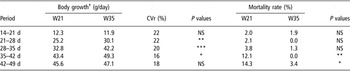
The solid feed intake was 57% higher in the W21 group from 21 to 35 days (Figure 1, P < 0.01) when compared with suckling rabbits, whereas no significant difference between groups was detected thereafter. The global intake of DM (milk + solid feed) was also higher in the W21 group from 21 to 35 days of age (+21.4% at 28 days of age, P < 0.01, and +14.3% at 35 days of age, P < 0.05). The weight gain from 21 to 42 days was 17% lower for rabbits weaned at 21 days (Table 2, P < 0.05). Accordingly, bodyweights of W21 rabbits remained lower than those of W35 rabbits from 28 to 49 days (1365 ± 234 in the W21 group v. 1490 ± 183 g in the W35 group on day 49, P < 0.05). The mortality rate was low and not influenced by the weaning age until 35 days of age (Table 2), while from 42 to 49 days of age, the mortality was much higher in the W21 group (P < 0.05).
Intake pattern of rabbits according to their weaning age. Values are mean ± s.d. For each period, the effect of weaning age was tested on solid feed intake level in left figure and on dry matter intake (milk + solid feed) in right figure (*P < 0.05, **P < 0.01, ***P < 0.001).

Body growth and mortality rate of rabbits according to their weaning age

W21 = weaning at 21 days; W35 = weaning at 35 days; values are means; CVr = coefficient of residual variation.
†n = 33 to 101 according to the weaning age and the period studied.
NS = P > 0.10, *P < 0.05, **P < 0.01; ***P < 0.001.
Digestion in the small intestine
Effect of age and weaning age on characteristics of the small intestine
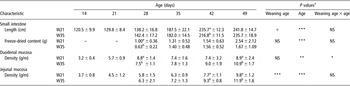
The small intestine lengthened and its freeze-dried content increased with age (P < 0.001, Table 3) in both weaning groups. The small intestine of W21 rabbits was however 9% longer on day 42 (P < 0.01) than that of W35 rabbits. The small intestinal freeze-dried content of the small intestine was 58% higher on day 28 (P < 0.05) in the W21 group compared with the W35 group. The development of the duodenal mucosa density (g/m) differed according to the weaning age (significant interaction in the global analysis from 28 till 49 days, P < 0.05). It increased progressively from 14 till 49 days of age in the W35 group, while it only rose from 14 till 28 days then remained stable in the W21 group. Thus, the density of the duodenal mucosa was higher on day 28 (+18%, P < 0.05) and lower on day 49 (−19%, P < 0.05) in the W21 group. The density of the jejunal mucosa increased with age (P < 0.001), but values were 14% lower for the W21 group (P < 0.001). Protein concentrations of both duodenal and jejunal mucosa were affected neither by the age nor by the weaning age (P > 0.10).
Changes in the small intestinal characteristics of rabbits according to their weaning age: length, digestive content and mucosal density

W21 = weaning at 21 days; W35 = weaning at 35 days; values are mean ± s.d.; n = 7 to 12 according to the age and the weaning age.
†P values for the general analysis from 28 to 49 days; For a characteristic, means among groups and within the same age with different superscript are different (P < 0.05); NS = P > 0.10, + = P < 0.10, *P < 0.05, **P < 0.01; ***P < 0.001.
Effect of age on pancreatic enzymes
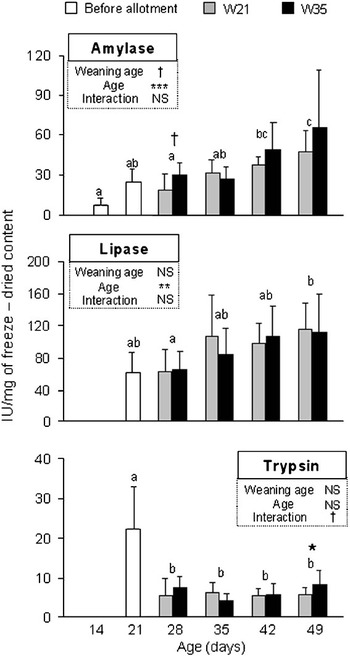
Lipase- and amylase-related activities were both constant until 28 days of age, then increased until 49 days of age (P < 0.01 and P < 0.001, respectively), whereas trypsin-related activity showed a four-fold decrease between 21 and 28 days, and then remained constant until 49 days (Figure 2).
Changes in the relative enzyme activities in the small intestinal content of rabbits according to their weaning age. Values are mean ± s.d.; n = 5 to 12 according to the age and the weaning age; IU: μg of degraded starch/min for amylase, nmol of released acid function/min for lipase, nmol of degraded N-benzoyl-l-arginine p-nitroanilide/min for trypsin. P values in box correspond to effects of weaning age, age and interaction tested from 28 to 49 days of age. Age effects were analysed from 14 to 49 days: mean values with different superscript letters differed (P < 0.05). Within each age, the effect of weaning age was tested (*P < 0.05, †P < 0.10).

Effect of weaning age on pancreatic enzymes
Amylase-related activity tended to be lower in the W21 group at 28 days of age (−36%, P = 0.064, Figure 2), but was similar thereafter to activities measured in the W35 group. No difference was noticed for lipase between both weaning groups, whereas trypsin-related activity was lower in the W21 group only on day 49 (−31%, P < 0.05). When considering global activities of those three enzymes, no difference was highlighted between the two weaning ages (data not shown).
Effect of age on mucosal enzymes
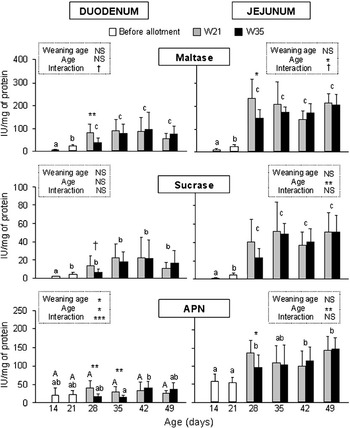
Specific maltase activities in both duodenum and jejunum, as well as jejunal sucrase activity, increased from 14 till 28 days of age (P < 0.05), then flattened out until 49 days (Figure 3). The duodenal and jejunal sucrase activities increased between 14 and 21 days and between 14 and 28 days of age (P < 0.05), respectively, then remained stable. The development of APN activity with age depended on the weaning group (interaction: age × weaning age between 28 and 49 days of age, P < 0.001). The specific activity of APN in the duodenum increased two-fold after weaning (unsignificantly between 21 and 28 days in the W21 group; between 35 and 42 days in the W35 group, P < 0.05), then remained relatively stable. In the jejunum, the activity of APN was constant until 21 days, then increased until 49 days of age in both weaning groups (P < 0.01).
Changes in specific enzyme activities in the small intestinal mucosa of rabbits according to their weaning age. Values are mean ± s.d.; n = 7 to 12 according to the age and the weaning age; IU: nmol of degraded maltose, sucrose or leucine p-nitroanilide/min, respectively, for maltase, sucrase or aminopeptidase N. P values in box correspond to effects of weaning age, age and interaction tested from 28 to 49 days of age. Age effects were separately analysed from 14 to 49 days: mean values with different superscript letters differed (P < 0.05), with capital letters for W21 group and small letters for W35 group if significant interaction in the general analysis from 28 till 49 days of age; within each age, the effect of weaning age was tested (*P < 0.05, **P < 0.01, †P < 0.10).

Effect of weaning age on mucosal enzymes
Specific maltase activity was higher in the W21 group compared with the W35 group for both intestinal sites on day 28 (2.0-fold, P < 0.01, and 1.6-fold, P < 0.05, for the duodenum and the jejunum, respectively), whereas the same tendency was noticed for duodenal sucrase activity (2.2-fold, P = 0.08, Figure 3). The specific activity of duodenal APN was higher in the W21 group compared with the W35 group only on days 28 and 35 (2.4-fold and 2.0-fold, respectively, P < 0.01). Its activity in jejunum was 44% higher in the W21 group than in the W35 group only on day 28 (P < 0.05). When considering global activities, the same trends as for specific activities were observed between the weaning groups in the duodenum on days 28 and 35 (data not shown). Moreover, global activities of duodenal maltase and APN were lower in the W21 group compared with the W35 group on day 49 (−39% and −44%, respectively, P < 0.05). For the jejunum, the differences between the weaning groups observed for specific activities on day 28 were not reflected in the global activity of maltase (P = 0.14). Jejunal APN global activity only tended to be higher in the W21 group compared with the W35 group on day 28 (P = 0.07). Jejunal maltase global activity was 28% lower on day 42 (P < 0.05) and the activity of APN tended to be lower on day 49 (−44%, P = 0.07) in the W21 group, when compared with the W35 group.
Digestion in the caecum
Effect of age and weaning age on characteristics of the caecum
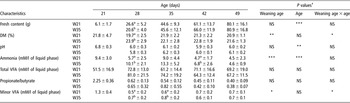
The fresh digesta content of the caecum increased with age irrespective of the weaning age (P < 0.001, Table 4). At 28 days of age, the caecum of the W21 rabbits contained 30% more fresh matter than the caecum of the W35 rabbits (P < 0.05). The caecal DM percentage remained stable with age, but it was, however, lower in the W21 than in the W35 group on day 28 (−4.2 points, P < 0.01). Thus, the caecal DM content was unaffected by the weaning age on day 28 (5.2 ± 1.1 and 4.9 ± 0.9 g, respectively, for the W21 and W35 groups, P = 0.49).
Changes in the caecal characteristics of rabbits according to their weaning age: digestive content, volatile fatty acid (VFA) and ammonia contents, pH

W21 = weaning at 21 days; W35 = weaning at 35 days; values are mean ± s.d.; n = 7 to 12 according to the age and the weaning age.
†P values for the general analysis from 28 to 49 days; For a characteristic, means among groups and within the same age with different superscript are different (P < 0.05); *P < 0.05, **P < 0.01; ***P < 0.001.
Effect of age on the fermentation pattern and bacterial fibrolytic activity
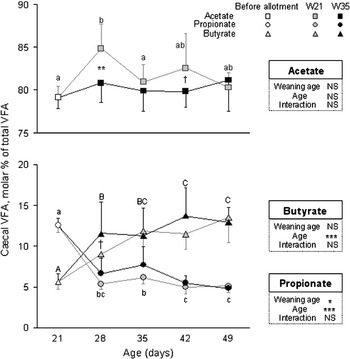
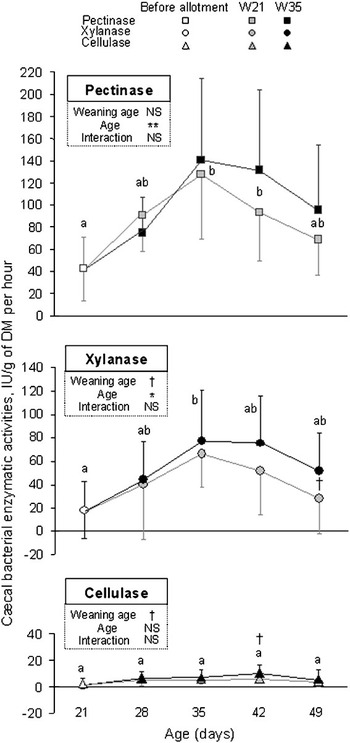
The caecal fermentation pattern mainly changed between 21 and 28 days and then stabilised. For instance, the pH dropped from 6.8 to 5.9 (P < 0.05, Table 4), the total VFA concentration increased by 47% (P < 0.05) and the propionate-to-butyrate ratio reversed (2.25 v. 0.63, respectively, P < 0.001) due to both an increase in butyrate proportion and a decrease in propionate proportion (P < 0.05, Figure 4). The relative bacterial activities of pectinase and xylanase first increased between 21 and 35 days (P < 0.05), and then tended to decrease until 49 days of age (Figure 5).
Changes in the molar proportions of acetate, propionate and butyrate in the caecal content of rabbits according to their weaning age. Values are mean ± s.d.; n = 7 to 12 according to the age and the weaning age. P values in box correspond to effects of weaning age, age and interaction tested from 28 to 49 days of age. Age effects were analysed from 21 to 49 days: mean values with unlike superscript letters differed (P < 0.05). Within each age, the effect of weaning age was tested (**P < 0.01, †P < 0.10).

Changes in bacterial enzyme activities in the caecal content of rabbits according to their weaning age. Values are mean ± s.d.; n = 7 to 12 according to the age and the weaning age; IU: μmol of released galacturonate, xylose and sucrose, respectively, for pectinase, xylanase and cellulose. P values in box correspond to effects of weaning age, age and interaction tested from 28 to 49 days of age. Age effects were analysed from 21 to 49 days: mean values with unlike superscript letters differed (P < 0.05). Within each age, the effect of weaning age was tested (†P < 0.10).

Effect of weaning age on the fermentation pattern and bacterial fibrolytic activity
The weaning age did not influence the caecal pH or the total VFA level (Table 4), while ammonia concentration was lower in the W21 group on days 28 and 42 (−43% and −32%, P < 0.01 and P < 0.05, respectively). The proportion of acetate was 5% greater on day 28 (P < 0.01) and it tended to be higher on day 42 (+3%, P = 0.08) in the W21 group (Figure 4). No effect of the weaning age was found on the propionate–to-butyrate ratio (Table 4). The concentration of minor VFA was lower in the W21 group compared with the W35 group on days 28 and 35 (−26% and −25%, respectively, P < 0.05). The relative activities of cellulase and xylanase tended to be lower in the W21 group from 28 till 49 days (−27% and −26%, P = 0.06 and P = 0.07, respectively, Figure 5). Pectinase-related activity was similar between the two weaning groups.
Discussion
Effects of weaning age on performances
A higher solid feed intake from 21 to 35 days was observed in rabbits weaned early (21 days) as a compensation for the withdrawal of milk, leading to a higher total DM intake (milk + solid feed) until 35 days of age as compared with the classically weaned rabbits. However, despite this increased solid feed intake, early-weaned rabbits presented lower body growth than classically weaned rabbits until 42 days of age, in agreement with previous studies (Piattoni et al., Reference Piattoni, Maertens and Mazzoni1999; Xiccato et al., 2000). Besides, the early withdrawal of milk may have affected the growth of rabbits by an indirect effect on health, as it is shown by the higher mortality rate of early-weaned rabbits. This suggests that nutrient intake and/or digestive capacities would be unsuitable for solid feed in the rabbits around three weeks of age. The higher mortality rate of early-weaned rabbits presumed a higher sensitivity to digestive disturbances. This agreed with the recent results of Gallois et al. (Reference Gallois, Gidenne, Tasca, Caubet, Coudert, Milon and Boullier2007) showing the protective effect of milk intake in the young rabbit challenged with an enteropathogenic strain of Escherichia coli.
Digestion in the small intestine
Development of the digestive potential with age
Postnatal development of the digestive potential has scarcely been studied in rabbits. Our results showed that availability of pancreatic amylase and lipase for substrates in the small intestine increased with age, which is in agreement with the age increase of their activities previously described in the pancreas (Corring et al., Reference Corring, Lebas and Courtot1972; Dojană et al., Reference Dojană, Costache and Dinischiotu1998; Debray et al., Reference Debray, Le Huérou-Luron, Gidenne and Fortun-Lamothe2003). The increase in amylase activity probably results from the higher starch intake with age (Marounek et al., Reference Marounek, Vovk and Skřivanová1995; Scapinello et al., Reference Scapinello, Gidenne and Fortun-Lamothe1999), and should correspond to an increasing capability of rabbits to digest starch. Conversely, in our study, the increasing lipase activity with age was not parallel to crude fat intake, which sharply decreased at weaning (from milk having 9% to 16% lipids to solid vegetal feed with 3% to 5% lipids). However, our results are in agreement with the increase in lipase production by the pancreatic gland, as previously shown (Corring et al., Reference Corring, Lebas and Courtot1972; Debray et al., Reference Debray, Le Huérou-Luron, Gidenne and Fortun-Lamothe2003). Results of Dojană et al. (Reference Dojană, Costache and Dinischiotu1998) were more consistent with the evolution of lipid intake as they observed first a fall in pancreatic lipase production (between 15 and 43 days), then a constant production level. As gastric lipase is very active in the young rabbit but less after weaning (Bernadac et al., Reference Bernadac, Moreau and Verger1991; Dojană et al., Reference Dojană, Costache and Dinischiotu1998), we hypothesised that pancreatic lipase would relieve gastric lipase, an enzyme more specialised in milk triglycerides digestion (Perret, Reference Perret1980). We observed an important drop in trypsin activity between 21 and 28 days of age, which may be due to the diversification of the intestinal content and the presence of vegetal material. An action of anti-trypsic factors provided by vegetal diet cannot be discarded. In fact, in the literature, the postnatal evolution of trypsin activity varies widely: a progressive decrease until 32 days followed by a sharp increase at 36 days (Corring et al., Reference Corring, Lebas and Courtot1972), no evolution from 25 till 42 days (Debray et al., Reference Debray, Le Huérou-Luron, Gidenne and Fortun-Lamothe2003), or first an increase between 15 and 43 days followed by a stabilisation (Dojană et al., Reference Dojană, Costache and Dinischiotu1998). From 14 till 49 days of age, the enzyme potential of duodenal and jejunal mucosa (estimated by global activities referred to the total segment) increased progressively, which is in agreement with the literature for dissacharidases (Keelan et al., Reference Keelan, Walker and Thompson1985; Debray et al., Reference Debray, Le Huérou-Luron, Gidenne and Fortun-Lamothe2003). To our knowledge, no literature deals with the activity of the APN in the young rabbit. In our study, the increasing activity of disaccharidases and APN is in part due to densification of the intestinal mucosa and the lengthening of the small intestine, but is also explained by a specialisation of enterocytes (increasing specific activities). This evolution seems parallel to the increasing solid feed intake level, and thus the availability of substrates for maltase and saccharase, and maltose and saccharose only provided by a vegetal diet. For APN, this increased activity with age may suggest that this enzyme would be more implicated in the digestion of protein of vegetal origin.
Effect of weaning age on the digestive potential
In the present study, the level of solid feed intake only slightly influenced the enzyme activities of pancreatic origin in young rabbits. We found a lower amylase activity in the intestinal content of the young rabbits having a high starch intake (W21) at 28 days of age, which is not in agreement with the results of Gutiérrez et al. (Reference Gutiérrez, Espinosa, García, Carabaño and De Blas2002) who showed a higher production of pancreatic amylase in early-weaned 35-day-old rabbits, and thus having a higher feed (and starch) intake than still-suckling rabbits. Gidenne et al. (2007) also found that the global intestinal amylase activity was lower for young rabbits having a high starch intake. Other authors showed, however, that an increased starch or lipid intake did not influence amylolytic and/or lipase activities around the weaning age (Scapinello et al., Reference Scapinello, Gidenne and Fortun-Lamothe1999; Debray et al., Reference Debray, Le Huérou-Luron, Gidenne and Fortun-Lamothe2003). These discrepancies may be due to differences in methods, time of sampling or target tissue for assays. Concerning trypsin activity, the absence of weaning age effect is in agreement with results reported by Corring et al. (Reference Corring, Lebas and Courtot1972). Enzymes of the small intestinal mucosa were more influenced by an increased solid feed intake than pancreatic enzymes. Stimulated disaccharidases activities resulted probably from a higher amount of substrates of these enzymes in the small intestine of early-weaned rabbits. Indeed, these substrates especially stem from the compounds included in the diet formulation. Conversely, Gutiérrez et al. (Reference Gutiérrez, Espinosa, García, Carabaño and De Blas2002) observed lower maltase and sucrase activities in weaned rabbits, compared with suckling 35-day-old rabbits, probably as a consequence of the negative impact of an early weaning on mucosa morphology. But, we found any detrimental effect of an early weaning on mucosa morphology (Gallois et al., Reference Gallois, Gidenne, Fortun-Lamothe, Le Huërou-Luron and Lallès2005). The increased activity of APN in early-weaned rabbits may result more from differences in the quality of peptides ingested than from their quantity. Indeed, amounts of ingested proteins by suckling rabbits with free access to pelleted feed were higher from 21 till 28 days of age, then similar between 28 and 35 days as compared with early-weaned rabbits (Gallois et al., Reference Gallois, Gidenne, Fortun-Lamothe, Le Huërou-Luron and Lallès2005). This observation reinforces the assertion that APN would be more implicated in the digestion of peptides of vegetal origin. As enzyme activities of pancreatic origin were not stimulated, mucosal enzymes might also compensate for the lower sugars and protein digestion by pancreatic secretions. Catala (1980) observed increased activities of maltase and glucoamylase from the intestinal mucosa of rabbits with ligated pancreatic duct, which supports the hypothesis of a compensatory phenomenon. This early functional answer of the digestive mucosa had no repercussions on further specific enzyme activities. Indeed, from 35 to 49 days of age, when solid feed intake was similar between groups, no differences were observed in specific enzyme activities. However, at 6 or 7 weeks of age, the global enzyme activities in mucosa tended to be lower in early-weaned rabbits, essentially explained by the lower duodenal and jejunal mucosa densities. The structural development of the small intestinal mucosa could be affected by the solid feed intake level, even if no relevant difference has been highlighted in villous length or area (Gallois et al., Reference Gallois, Gidenne, Fortun-Lamothe, Le Huërou-Luron and Lallès2005). As at these ages early-weaned rabbits were more sensitive to illness, sub-clinical infections may also have influenced the density of mucosa, although only clinically healthy rabbits were slaughtered. Conversely, a lower density of mucosa in early-weaned rabbits may have increased their sensitivity to disease.
Digestion in the caecum
Development of microbial activity with age
Most of the caecal changes occurred between 21 and 28 days, when the solid feed intake became significant irrespective of the nutritional status of young, weaned or suckling. As in the literature, VFA concentration increases then stabilises, mainly resulting from variations in acetate production (Padilha et al., Reference Padilha, Licois, Gidenne, Carré and Fonty1995). A reduction of the propionate-to-butyrate ratio (Padilha et al., Reference Padilha, Licois, Gidenne, Carré and Fonty1995; Piattoni et al., Reference Piattoni, Maertens and Demeyer1995; Gidenne et al., Reference Gidenne, Jehl, Segura and Michalet-Doreau2002), a decrease in minor VFA production (Padilha et al., Reference Padilha, Licois, Gidenne, Carré and Fonty1995) and a decrease in pH (Padilha et al., Reference Padilha, Licois, Gidenne, Carré and Fonty1995; Piattoni et al., Reference Piattoni, Maertens and Demeyer1995; Gidenne et al., Reference Gidenne, Jehl, Segura and Michalet-Doreau2002) are generally observed between 21 and 28 days of age. With respect to fibrolytic activities of caecal bacteria, we observed a peak for pectinolytic and xylanolytic activities on day 35, whereas cellulolytic activity remained stable from 21 to 49 days. Contrasting results were previously obtained about the effect of age on bacterial fibrolysis potential. Some authors observed a decrease in relative activities of cellulase and xylanase (Debray, 2002; Bennegadi-Laurent et al., Reference Bennegadi-Laurent, Gidenne and Licois2004) before a stabilisation, while others showed an increase in microbial enzyme activities (Gidenne et al., Reference Gidenne, Jehl, Segura and Michalet-Doreau2002). High individual variability in those measurements may partly explain those discrepancies.
Effect of weaning age on microbial activity
The stimulation of the solid feed intake affected the caecal fermentative activity. For instance, we found an earlier decrease in caecal ammonia concentration for early-weaned rabbits. Thus, the decrease in ammonia concentration seems more related to weaning than to the age of rabbits, as shown by Padilha et al. (Reference Padilha, Licois, Gidenne, Carré and Fonty1995). Ammonia concentration results from a balance between ammonia production and utilisation, and a large number of hypotheses may be expressed to explain this lower concentration in early-weaned rabbits. There may be a higher level of proteins flowing through the caecum in still-suckling rabbits and that may be due to a higher protein intake and/or a lower pre-caecal digestion/absorption, which would be responsible for higher protein fermentation in the caecum. In early-weaned rabbits, the caecal microflora may also be more a consumer of ammonia. The lower ammonia concentration in early-weaned rabbit was in accordance with the lower concentration of minor VFA, as those acids originate from protein catabolism. Contrary to VFA concentration, the fermentation pattern was affected by the level of solid feed intake. Propionate proportion and minor VFA content were lower on days 28 and 35 in early-weaned rabbits as previously described (Xiccato et al., Reference Xiccato, Trocino, Sartori and Queaque2003), and acetate proportion was higher on day 28. However, contrary to our results, a quicker decrease of the propionate-to-butyrate ratio has been reported by Xiccato et al. (Reference Xiccato, Trocino, Sartori and Queaque2003) when rabbits were stimulated for solid feed intake. Some authors found a quicker decrease in caecal pH of rabbits stimulated for solid feed intake (Piattoni et al., Reference Piattoni, Maertens and Mazzoni1999; Di Meo et al., Reference Di Meo, Stanco, Piccolo, Taranto, Gazaneo and Nizza2003; Xiccato et al., Reference Xiccato, Trocino, Sartori and Queaque2003), which was probably the consequence of a higher production of total VFA (Xiccato et al., Reference Xiccato, Trocino, Sartori and Queaque2003). An early stimulation of the solid feed intake tended to decrease the relative activities of xylanase and cellulase from 28 to 49 days. When expressed relative to the whole caecal content, which is more representative of the fibrolytic potential, these activities were significantly decreased. Thus, despite a higher fibre intake, potentialities to digest them would remain limited in the caecum. The changes in the caecum induced by an early stimulation of the solid feed intake attest that the caecal microflora activity of weaned and suckling rabbits would differ for a given age. The quantity and quality of substrates reaching the caecum, probably different according to the weaning age, would influence the composition of flora, and thus the fermentation pattern.
In conclusion, young rabbits showed some rapid and transient adaptative responses to a solid feed intake stimulation, which were not uniform regardless of the digestive segment considered. These adaptations were, however, insufficient to compensate for the milk withdrawal, as growth of early-weaned rabbits was slower. A more comprehensive view about plasticity and efficacy of the digestive function in the young rabbit will be obtained by connecting those results to in vivo measurements of digestive capabilities (Gallois et al., Reference Gallois, Fortun-Lamothe, Michelan and Gidenne2008).
Acknowledgements
This study was partly supported by Cybelia (Glon group, France). The authors thank the staff of the UMR 1289 ‘TANDEM’ (INRA Toulouse, France), Patrick Aymard, Carole Bannelier, Jacques De Dapper, Jean De Dapper, André Lapanouse, Muriel Segura, Véronique Tartié for technical help. The staff of the unit ‘Systèmes d’Elevage, Nutrition Animale et Humaine’ (INRA, Rennes, France), Lucile Brotier, Véronique Romé, Gérard Savary is also thanked for technical assistance in the small intestinal enzyme activities determination.