More than 1.3 million cases of community-acquired pneumonia (CAP) occur in the United States annually, accounting for a significant proportion of antibiotic use.Reference Pfuntner, Wier and Stocks 1 , Reference Yu, Rubin, Dunning, Li and Sato 2 In 2010, we conducted an antibiotic stewardship (AS) intervention directed at CAP that led to a reduction in median duration of therapy (DOT) from 10 to 7 days.Reference Avdic, Cushinotto and Hughes 3 Although sustained reductions in antibiotic use have been demonstrated following AS interventions for other infectious syndromes,Reference Trautner, Grigoryan and Petersen 4 – Reference Jenkins, Knepper and Moore 6 they have not been demonstrated for CAP. In the present study, we assessed whether reductions in DOT for CAP were sustained 3 years after the initial syndrome-focused intervention.
METHODS
This study was conducted at the Johns Hopkins Hospital, a 1,059-bed tertiary care center in Baltimore, Maryland. We included all patients aged at least 18 years who had CAP, excluding patients who met criteria for healthcare-associated pneumonia, cystic fibrosis, empyema, culture-confirmed Staphylococcus aureus pneumonia, and positive Legionella urinary antigen test. At least 1 infectious diseases physician and pharmacist adjudicated each case to ensure patients met criteria for CAP and to assess appropriateness of the antibiotic regimens.
At our institution, pre-prescription authorization (PPA) has been standard practice since 1982. Fluoroquinolones (moxifloxacin and levofloxacin), vancomycin, cefepime, and other broad-spectrum agents frequently used to treat CAP require prior approval; ceftriaxone and azithromycin do not. From February 1 through May 10, 2010, we added postprescription review and feedback (PPRF) to the existing PPA policy (PPA+PPRF arm). In PPRF, AS provided oral feedback to the primary team with recommendations for optimizing therapy 48 to 72 hours after antibiotic initiation. The intervention also included baseline surveys to assess knowledge and practices regarding CAP and provider education regarding evidence-based practices for managing CAP.Reference Avdic, Cushinotto and Hughes 3 After the intervention period, PPRF was discontinued and all patients returned to the standard PPA policy.
Follow-up data used to evaluate the sustainability of the baseline intervention were collected from September 8, 2013, through June 23, 2014 as part of a prospective crossover study evaluating different AS strategies. In the PPA arm, we continued our standard practice of antibiotic restriction to assess whether DOTs remained at the 2010 levels. In order to assess whether, in the same cohort of patients, reinitiating PPRF would lead to further reductions in DOTs, we performed PPRF for patients in this arm 48–72 hours after antibiotic initiation (PPRF arm), similar to the 2010 intervention. There were no electronic order sets for CAP and clinical pharmacists were not asked to specifically monitor CAP antibiotic regimens in any study arms.
Patient data were collected via electronic medical record review. The Johns Hopkins University Institutional Review Board approved the study, with a waiver of informed consent.
DOT included both inpatient and outpatient antibiotic days prescribed for CAP. Unnecessary antibiotic days were calculated using the following definitions of appropriate duration: 5 days for patients without structural lung disease or immunocompromise; 7 days for patients with structural lung disease or immunocompromise; and 10–14 days for patients who had poor initial clinical response or were significantly immunocompromised. The primary outcome measure was DOT. Secondary outcomes included unnecessary antibiotic days, hospital length of stay, and readmission or Clostridium difficile infection within 30 days.
Data were compared using χ2 or Fisher exact test for categorical variables and the Wilcoxon rank sum test for continuous variables. We further performed linear regression with log transformation of the outcome variables. Immunocompromised status and Pneumonia Severity Index score were selected a priori for inclusion in the multivariable model; variables with P≤.10 were also included. P values were 2-tailed; P≤.05 was considered statistically significant. Analyses were performed using Stata, version 13 (StataCorp).
RESULTS
There were 65 and 138 patients with CAP included from the baseline and follow-up periods, respectively.
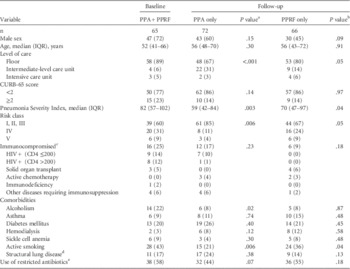
PPA patients had a lower median Pneumonia Severity Index score compared with PPA+PPRF patients (P=.003) (Table 1). One-fifth of sputum cultures were positive in both arms, with the most frequently isolated organism being Streptococcus pneumoniae (Supplemental Table 1). The most common initial antibiotic regimen in all arms was a nonpseudomonal β-lactam plus macrolide. Median DOT was 7 days in all arms; however, 62 PPA patients (85%) received 7 days or fewer of antibiotics compared with 36 PPA+PPRF patients (55%) (P=.001). PPA patients had a 1-day reduction in median unnecessary antibiotic days (P=.003) and a 2-day reduction in median length of stay (P<.001), compared with PPA+PPRF patients (Table 2). In the multivariable analysis, DOT and length of stay were significantly lower in the PPA arm compared with PPA+PPRF after adjustment for immunocompromised status, Pneumonia Severity Index score, smoking, alcohol use, and level of care.
Demographic Characteristics and Comorbidities for 65 Baseline and 138 Follow-Up Patients With Community-Acquired Pneumonia
NOTE. All values represent n (%), unless otherwise noted. HIV, human immunodeficiency virus; IQR, interquartile range; PPA, pre-prescription authorization; PPRF, postprescription review and feedback.
a Comparison of PPA arm with PPA+PPRF arm.
b Comparison of PPRF arm with PPA arm.
c Some patients had more than 1 diagnosis within this category.
d Structural lung disease defined as a history of chronic obstructive pulmonary disease, interstitial lung disease, bronchiectasis, or pulmonary fibrosis.
e Restricted antibiotics included fluoroquinolones, vancomycin, cefepime, piperacillin-tazobactam, and other broad-spectrum agents commonly used as empirical therapy for community-acquired pneumonia. Ceftriaxone and azithromycin were not restricted during the study period. There were no antibiotic restrictions in place in the PPRF arm; the proportion of patients receiving antibiotics that would have been restricted in the other study arms is displayed.
Duration of Antibiotic Therapy and Secondary Outcomes for 65 Baseline and 138 Follow-Up Patients With Community-Acquired Pneumonia

NOTE. IQR, interquartile range; PPA, pre-prescription authorization; PPRF, postprescription review and feedback.
a Comparison of PPA arm with PPA+PPRF arm.
b Comparison of PPRF arm with PPA arm.
Thirty-six AS-to-provider interventions occurred in the PPRF arm. The most common recommendations were to shorten DOT (21 [58%]), modify antibiotic selection (20 [56%]), and discontinue unnecessary agents (12 [33%]). There were significantly fewer AS-to-provider interventions in the PPRF arm compared with PPA+PPRF (36 [54%] vs 49 [76%], P=.04). PPRF patients had a higher median Pneumonia Severity Index score compared with PPA patients (P=.04) (Table 1). There were no differences between PPRF and PPA patients in DOT (Table 2).
DISCUSSION
Our study demonstrates that the reductions in antibiotic use observed during an AS intervention for CAP were sustained 3 years after discontinuation of the intervention. Further, there appeared to be no additive benefit to reinitiating PPRF. Our results suggest that AS interventions may positively influence prescribing culture, with effects persisting long after the interventions have ended.
Previous studies evaluating syndrome-focused AS interventions have shown sustained improvements in antibiotic use for asymptomatic bacteriuria and cellulitis.Reference Trautner, Grigoryan and Petersen 4 – Reference Jenkins, Knepper and Moore 6 The interventions in these studies and our own CAP intervention share many common features: (a) collection of preintervention surveillance data to assess baseline prescribing trends and prescriber knowledge, and use of these data to guide development of the intervention; (b) publication and dissemination of guidelines or lectures defining the scientific evidence supporting the intervention; (c) provision of personalized, detailed feedback to prescribers regarding their prescribing behaviors; and (d) endorsement of the intervention by respected attending physicians in various departments, bolstering acceptance amongst prescribers.Reference Damschroder, Aron, Keith, Kirsh, Alexander and Lowery 7 , Reference Grimshaw, Shirran and Thomas 8
The lack of difference in DOT between the PPA and PPRF arms suggests that median DOT reached a nadir in both arms, with or without additional PPRF. This suggests that when a rigorous, syndrome-focused intervention has been deployed and successfully adopted, resource-intensive AS strategies like PPRF can be refocused to target other areas in which improvement is needed.Reference Lesprit, de Pontfarcy and Esposito-Farese 9 We also noted significant reductions in length of stay in the follow-up arms compared with baseline. Although this may be related to non-AS interventions at our hospital promoting earlier patient discharge, shortening DOT and promoting intravenous-to-oral therapy conversion would certainly facilitate this process.
Our study has limitations. First, this was a single-center study at a tertiary care center with a well-established AS program; larger studies in more diverse settings are needed to improve generalizability. Second, given the rising awareness of the harms of antibiotic overuse, our findings may simply reflect a general trend towards shortening of antibiotic courses. However, national pharmaceutical sales data suggest that population-level consumption of most antibiotic classes has remained stable in the United States.Reference Van Boeckel, Gandra and Ashok 10
Overall, our study demonstrates that the positive impact of a multicomponent CAP intervention was sustained years after its discontinuation. This highlights the efficacy of syndrome-focused AS interventions in initiating cultural shifts amongst providers toward more judicious antibiotic use.
ACKNOWLEDGMENTS
Financial support. Pfizer Grants for Learning and Change and the Joint Commission (grant to P.D.T., E.A., and S.E.C.).
Potential conflicts of interest. All authors report no conflicts of interest relevant to this article.
SUPPLEMENTARY MATERIAL
To view supplementary material for this article, please visit http://dx.doi.org/10.1017/ice.2016.165