Implications
Rational choice of the most appropriate blowfly strike management strategy is essential on lowland sheep farms to reduce variable costs associated with treatment. Strategies that protect ewes at the start of each season and lambs in mid-summer reduce strike incidence and overall cost. The inclusion of a post-shearing ewe treatment may also be an important component of the lowest cost strategy, particularly when the blowfly season is extended, as is predicted due to changes in climate.
Introduction
Sheep blowfly strike (ovine cutaneous myiasis) is a widespread economic and welfare problem for sheep husbandry in many parts of the world. The primary agent of strike in most of northern Europe is the blowfly Lucilia sericata (Wall, et al., Reference Wall, French and Morgan1992a; Snoep et al., Reference Snoep, Sol, Sampimon, Roeters, Elbers, Scholten and Borgsteede2002). Eggs are deposited in the wool of the living host and, after hatching, the feeding activity of the larvae causes extensive epidermal tissue damage, anaemia and toxaemia; the resulting lesions rapidly attract further oviposition, leading to death, if untreated.
In general, the seasonal incidence of strike in ewes and lambs follows a relatively predictable pattern, determined by the interaction of fly abundance and the factors that influence sheep susceptibility (Broughan and Wall, Reference Broughan and Wall2007a and Reference Broughan and Wall2007b). Lucilia sericata overwinter as diapausing larvae, and pupate and emerge as adults in April/May as temperatures increase beyond 9°C each year in Spring (Wall, et al., Reference Wall, French and Morgan1992b). Flies pass through three or four generations of increasing abundance over summer until short daylengths and cold temperatures return in winter (Pitts and Wall, Reference Pitts and Wall2005 and Reference Pitts and Wall2006). At the start of the summer, relatively low L. sericata abundance may be the main factor limiting strike incidence (Smith and Wall, Reference Smith and Wall1998). Sheep susceptibility is determined by the interaction of wool length, fleece humidity and the accumulation of faeces in the wool, known as faecal soiling (French and Morgan, Reference French and Morgan1996; Broughan and Wall, Reference Broughan and Wall2007b). The degree of faecal soiling is affected by the consistency of the faeces and factors that allow its accumulation in the breech region, such as fleece length (French and Morgan, Reference French and Morgan1996), and this is, in turn, affected by the gastrointestinal (GI) nematode burden (Broughan and Wall, Reference Broughan and Wall2007b). In the spring, oviposition occurs predominantly on ewes, since they carry their long winter fleece, creating a humid microclimate at the skin surface that allows high rates of blowfly egg and larval survival. In mid-summer, ewes are sheared, and this reduces their susceptibility; shearing has been shown to result in a 95% reduction in the risk of ewe strike (Broughan and Wall, Reference Broughan and Wall2007a), largely as a result of reduced humidity in the fleece of shorn animal. However, the incidence of ewe strikes can increase again towards the end of the season because of the regrowing fleece, particularly if the autumn is warm and wet (French, et al., Reference French, Wall, Cripps and Morgan1992; Broughan and Wall, Reference Broughan and Wall2007a). For spring-born lambs, the initially short fleece results in lower susceptibility compared with ewes, but after weaning in summer, a combination of diarrhoea caused by temperature-dependent GI nematode infection and a growing fleece will lead to faecal soiling, rapidly increasing their susceptibility to strike. Lamb strikes, therefore, generally increase in incidence from mid-summer onwards.
A range of insecticides are available to control blowfly strike and can be used both prophylactically and reactively (Bates, Reference Bates2004; Bisdorff and Wall, Reference Bisdorff and Wall2008). These include the organophosphate (OP) diazinon, the pyrethroids high cis-cypermethrin, alpha-cypermethrin and deltamethrin, and insect growth regulators (IGRs) such as cyromazine and dicyclanil (Wall and Lovatt, Reference Wall and Lovatt2015). Insect growth regulators are specific to arthropods, disrupting larval moulting by interfering with chitin synthesis and cuticle formation. The existing IGRs do not prevent egg laying or hatching but are effective against developing larval stages as they moult. Therefore, they can be used effectively only for strike prevention, not for treatment of established strikes (Graf, Reference Graf1993). Although the majority of farmers use IGRs for strike control, the lower cost of pyrethroids has resulted in continued popularity (35% of farmers in 2003; Bisdorff and Wall, Reference Bisdorff and Wall2008), while others continue to summer-dip with OP (12% of farmers in 2003; Bisdorff and Wall, Reference Bisdorff and Wall2008) although parasiticide usage patterns may vary substantially by region (Chivers et al., Reference Chivers, Rose Vineer and Wall2018).
Despite the widespread use of prophylaxis by most farmers, sheep myiasis still affects >75% of farms in the UK with an estimated 1.5% of ewes and 3% of lambs struck each year (French, et al., Reference French, Wall, Cripps and Morgan1992; Bisdorff, et al., Reference Bisdorff, Milnes and Wall2006). The economic impact of flystrike to the UK sheep industry is, therefore, considerable with losses due to animal mortality and reduced growth rates leading to additional time spent on farm and costs due to reactive treatment and prophylactic control, as well as the time and labour involved in the frequent inspection of flocks and the need to catch and handle struck animals. Prophylactic treatment may represent a substantial contribution to the cost for each flock; so some farmers will attempt to forgo prophylaxis and rely on vigilance to identify infested animals and then apply reactive therapeutic treatment, particularly in ewes before shearing. However, even a low strike incidence on any farm may significantly increase the costs associated with sheep husbandry, which, given that the margin per lamb may be low, is likely to undermine the contribution to farm profit. It is important, therefore, that farmers are able to understand and compare the relative costs associated with different management strategies to allow them to make informed rational decisions about approaches to animal management.
The aim of the work reported here was to develop a simple model, based on existing data relating to fly abundance, sheep susceptibility, risk and strike incidence, and compare the variable costs of a range of potential strike management strategies.
Materials and methods
A deterministic partial budget simulation model was constructed in Excel (Microsoft Corp, Washington, USA). Partial budget models are commonly used in farm business management to help farmers evaluate the financial effect of incremental change. The model (Figure 1) first uses an estimate of the probability of strike (risk) for ewes or lambs, based on the expected pattern of fly abundance and animal susceptibility. Risk is multiplied by the number of ewes and lambs present to estimate the number struck, and the mortality is calculated from the numbers struck multiplied by the probability of death from strike.
Graphical summary of the simulation model. Each week the number of each age-class of sheep (open symbols represent lambs; and solid symbols, ewes) is multiplied by the expected probability of strike to estimate the numbers struck. When treatment is applied to any particular age-class, risk is reduced to zero for the period of residual activity of the product according to the manufacturer’s label claim. Costs of reactive treatment, labour or animal losses are then calculated from the numbers of struck animals and added to any prophylactic treatment costs.

Operationally, the model considered a lowland breeding flock of 250 ewes, lambing at an average ratio 1.5 lambs per ewe. Blowflies were assumed to emerge in spring in March/April, increasing in abundance over summer and entering diapause in October/November (Pitts and Wall, Reference Pitts and Wall2005). Ewes were sheared at the end of June. Previous work has found that on the lowland farms in southwest England, where no prophylactic strike control was used, 6% to 12% of ewes and 6% to 16% of lambs were struck (Broughan and Wall, Reference Broughan and Wall2007a). Hence as a baseline in the present model, under what may be described as a moderate level of strike risk, 8% of untreated ewes and 10% of untreated lambs were considered to be struck over the year. Lambs were born in April, matured and started to be sold to market in July, with the last lambs sold off in September. The seasonal pattern of strike incidence was described by French et al. (Reference French, Wall and Morgan1995) and Broughan and Wall (Reference Broughan and Wall2007a), with early-season strikes in ewes, followed by a post-shearing decline in ewe susceptibility, and a late-season increase in ewe strike associated with the growing fleece (Figure 1). For lambs, the incidence of strike increased over the summer to peak in July and August, followed by declining numbers, as lambs were sold to market (Figure 1).
A strong regional pattern of mortality among struck sheep has been reported, varying between 7.5% in the north and 1.5% in southeast England (French, et al., Reference French, Wall and Morgan1995). Hence, regardless of farmer vigilance, in the current model an average death rate of 5% among struck animals was assumed; all other struck animals are treated reactively. The loss associated with a lamb death due to strike was estimated at £140 based on the average deadweight value of lamb and the average cost of rearing a lamb (including vaccinations, labour, etc.) in a non-significantly disadvantaged area – an area without pasture restriction or rough grazing (Department for Environment, Food and Rural Affairs, 2018; Agriculture and Horticulture Development Board, 2016 and 2018).
The cost of death of a breeding ewe was estimated to be £200, based upon the cost of rearing a replacement ewe-lamb, plus the current value of a cull ewe (AHDB, 2016 and 2017). The labour cost to treat a struck animal was estimated at £10, based on the assumption that finding, removing and treating an infested animal would take one additional hour of farm time (Department of Agriculture, Environment and Rural Affairs, 2018). The cost of insecticide required to treat an infested animal curatively was calculated at £0.16. For struck lambs, an estimated additional cost of £10 was included, based on an anticipated reduction in growth rate and delay in getting struck lambs to market weight; however, there is a lack of clear quantitative analysis of the productivity costs associated with strike. No estimate was made for impacts of strike on the fecundity of ewes. The variable costs described above were applied in all model treatment scenarios; fixed costs were not included.
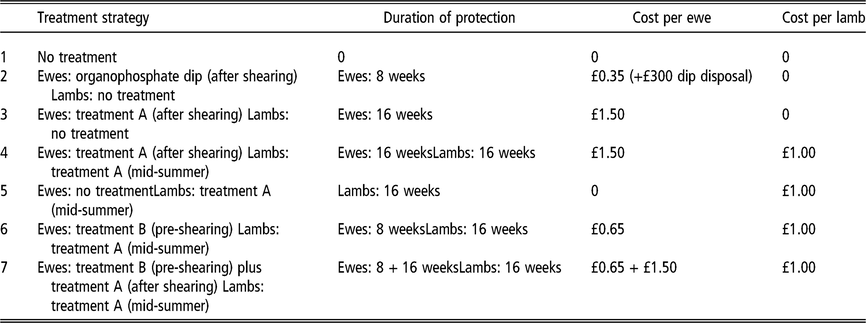
The model was used to estimate the effects of blowfly strike when using different treatment strategies (Table 1). These strategies were based on typical patterns of management used by UK farmers (French, et al., Reference French, Wall and Morgan1994; Bisdorff and Wall, Reference Bisdorff and Wall2008). For each management strategy, the model used the expected duration of protection from strike based on the label claim of the product in question to reduce the risk to zero, and added the costs of treatment, reduced productivity, labour and deaths. Comparisons were made among an OP immersion dip, which was considered to give 8 weeks of protection; a long-acting IGR-type product (product A), which was considered to give 16 weeks of protection; and a short-acting pyrethroid-type product (product B), which was considered to give 8 weeks of protection. Costs were obtained from a range of current supplier websites. The cost of OP dip was estimated at £0.35 per ewe, and an additional £300 was included for dip disposal. OP dip was not applied to lambs. The use of product A was considered to cost £1.50 or £1.00 for ewes and lambs, respectively; and that of product B was £0.65 and £0.40 for ewes and lambs, respectively. The model then examined the impact of zero treatment, or different combinations of these treatments applied either pre- or post-shearing in ewes and in mid-summer (June/July) in lambs, on strike incidence (Table 1).
Seven different prophylactic insecticide strategies used to model sheep blowfly strike management

The number of weeks of protection and the cost per ewe and lamb are shown for each strategy. Treatments A and B are able to prevent strike for 16 and 8 weeks, respectively; organophosphate dips are assumed to give protection for 8 weeks. All treatments are assumed to be 100% effective for the full duration of their residual activity.
To explore the impact of strike risk, treatment cost comparisons were made between flocks where the strike risk per month was reduced by half or doubled for both ewes and lambs. To investigate the potential impacts of changes in climate on the economics of strike treatment, the model was modified to extend the blowfly season, bringing fly emergence 1 month earlier and extending activity to 1 month later than in the baseline model. Extension of the blowfly season is predicted due to changes in the climate, particularly increased average temperatures (Broughan and Wall, Reference Broughan and Wall2007a), which significantly affects blowfly development (Wall, et al., Reference Wall, French and Morgan1992b), resulting in earlier spring emergence and increased numbers of struck animals (Broughan and Wall., Reference Broughan and Wall2007a). In the extended season model, shearing was moved from late June to late May, to reflect changes in management in response to warmer spring temperatures (Morgan and Wall, Reference Morgan and Wall2009), but lambing dates were unchanged.
Results
In the baseline scenario, for flocks at a moderate risk of strike, with no prophylactic treatment (strategy 1), the model predicted that 24 lambs and 19 ewes were struck each year with one ewe and two lamb deaths per year as a result of strike. The lowest cumulative strike incidence was achieved with strategy 7, which was able to reduce strike to three ewes and five lambs per year with no animal death. Where strike risk was higher or lower, the numbers of strikes were approximately doubled or reduced by half, respectively.
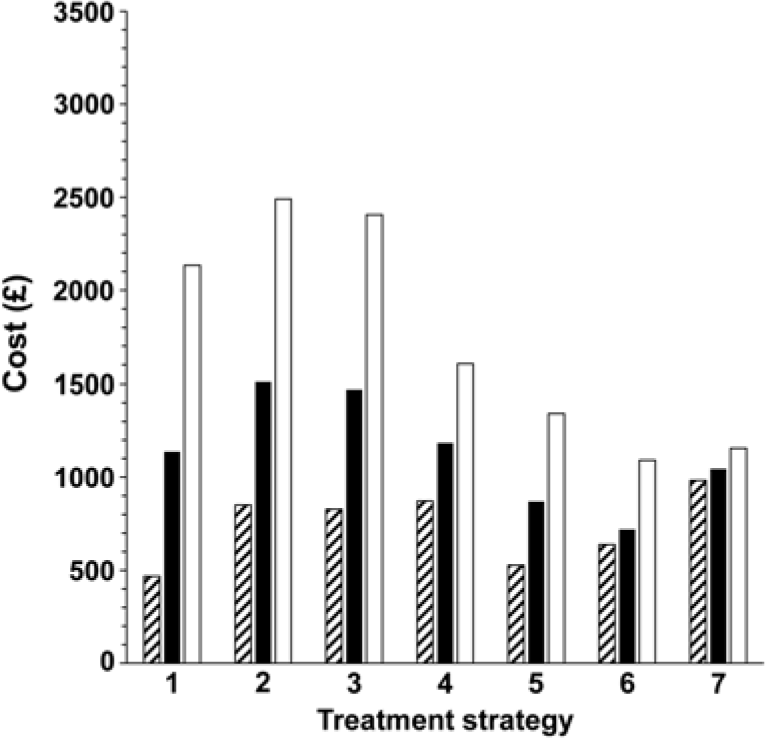
For flocks at a low risk of strike, the lowest cost option (£468) was for farmers not treating their animals prophylactically (strategy 1), and simply treating reactively, due to the relatively low number of animals struck (Figure 2). The highest cost strategy (£983) was early-season treatment of ewes followed by subsequent treatment of both ewes post-shearing and lambs in mid-summer (strategy 7).
Cost (£GBP) incurred from blowfly strike in a modelled sheep flock of 250 ewes giving birth to 375 lambs in April under conditions of low (striped bars), medium (solid bars) and high (open bars) strike risks, with a blowfly season in which flies emerge in March and enter diapause in November.

With moderate and high levels of strike risk, the cost of no treatment (strategy 1) was £1137 and £2133, respectively, over the course of the year. However, in both scenarios, OP treatment of ewes only after shearing (strategy 2) was the highest cost strategy at £1513 and £2490, respectively, because of the cost of dip disposal, early-season ewe strikes and the high number of lambs struck. In both cases, treating ewes at the start of the blowfly season before shearing with a short-acting product, then treating the lambs with a long-acting product in June (strategy 6), was the lowest cost strategy (£719 and £1092, respectively). Particularly when strike risk was high, the two strategies that used early-season treatment of ewes (strategies 6 and 7) gave the lowest strike incidence over the period of high ewe strike risk, when their wool was at its longest and when blowflies were increasing in abundance. Treating ewes at the start of the blowfly season with the short-acting product resulted in the lowest cumulative incidence of ewe strikes and ewe deaths for all flocks, regardless of risk. For flocks at a high risk, the cost difference between treatment strategies was larger; so selecting the most appropriate strategy to reduce cost becomes increasingly critical.
When the blowfly season was extended, under the moderate strike risk and no-treatment scenario, the cumulative number of ewe strikes increased to 22 and the number of lamb strikes to 36, with two deaths due to strike in each age-class. Not treating prophylactically (strategy 1) was never the lowest cost option, even when risk was low (Figure 3). Under low and moderate strike risk scenarios, treating ewes before shearing and then lambs in mid-summer (strategy 6) was again the lowest cost strategy (Figure 3). With a high strike risk, treating ewes at the start of the season with a shorter-acting product, then treating both ewes and lambs with a longer-acting product (strategy 7), was the lowest cost strategy (£1717; Figure 3). Notably, for all risk scenarios, the lowest cost strategy always required the treatment of lambs with long-acting product A in mid-summer, as this protected them during the period of highest lamb strike risk.
Cost (£GBP) incurred from blowfly strike in a modelled sheep flock of 250 ewes giving birth to 375 lambs in April under conditions of low (striped bars), medium (solid bars) and high (open bars) strike risks, with a blowfly season in which flies emerge in February and enter diapause in December.

Discussion
Given the low gross margins of many sheep-rearing enterprises, it is important to identify strategies that reduce cost while effectively managing disease incidence. Blowfly strike is one of the most prevalent parasitic infestations on most lowland sheep farms in the UK (French, et al., Reference French, Wall, Cripps and Morgan1992). However, while considerable amounts of work have been undertaken to identify the prevalence, distribution and risk factors associated with the strike, little work has related these data to the economic impact. Here, our existing understanding of the patterns and risks associated with the strike are incorporated into a model, parameterised with the current variable costs of prophylactic and therapeutic treatments.
The model suggests that when the strike risk is low, relying on the timely identification and spot treatment of struck animals, and not using prophylactic treatment, is the lowest cost strategy; this is because deaths are unlikely to occur with low numbers of strikes. Nevertheless, even under conditions of a low strike risk, small changes in challenge, driven, for example, by weather conditions (Broughan and Wall, Reference Broughan and Wall2007a), or a failure to detect all struck animals leading to the deaths of one or more animals, can reverse this cost calculation. This economic assessment also takes no account of welfare considerations associated with tolerating even a low strike incidence. In all other risk scenarios considered, not treating animals prophylactically against strike is always among the most expensive approaches to strike management.
Treatment of lambs had a particularly notable effect on strike and cost reduction, since lambs are the most abundant age-class of animals on the farm and are at the highest risk over the period when fly abundance is the greatest. Treatment of lambs with a longer-acting product, so that they are protected throughout the highest period of risk, was an essential component of all the lowest cost strategies. Not treating lambs in June will leave them vulnerable during the period of highest strike risk when their wool has grown longer and accumulated larger nematode burdens (Broughan and Wall, Reference Broughan and Wall2007b). Lamb treatment at this time is also important because when shearing would reduce ewe strike risk, lambs become the main available host for L. sericata, experiencing increased strike challenge (Broughan and Wall, Reference Broughan and Wall2007a).
At the start of the year, ewes are the most susceptible age-class, and spring strikes in ewes represent a particular practical problem. At present, most farmers in the UK do not treat their ewes prophylactically against blowfly strike before shearing (French, et al., Reference French, Wall, Cripps and Morgan1992; Bisdorff and Wall, Reference Bisdorff and Wall2008). By not wanting to treat ewes at this time, farmers attempt to minimise costs by relying on their ability to identify and spot-treat any struck animals reactively, until they reach shearing. Shearing usually occurs between May and July; and once sheared, protection is conferred until wool regrowth, when ewes can be treated with a long-acting product to protect them for the remainder of the season. However, the model used here suggests that in the moderate and high strike risk scenarios, early-season treatment of ewes was always a component of the lowest cost strategy. The lowest cost strategies were the early-season treatment of ewes combined with a June treatment of lambs, with the addition of a post-shearing ewe treatment when the blowfly season was extended. The nature of the product used for early-season ewe treatment needs to be considered with care because insecticidal wool-residues can cause contamination in the water used for wool processing (Environment Agency, 2009). Hence, the choice of a pyrethroid or a shorter-duration IGR should be evaluated carefully. Although not considered in this static model, early-season strikes, although relatively small in number, are also likely to be disproportionately important in terms of blowfly population dynamics relative to strikes later in the season, because they allow the L. sericata population to establish and contribute, potentially exponentially, to future generations. Any reduction in strikes in the spring period may, therefore, help to reduce fly challenge and potentially lamb strikes later in the year. Future dynamic modelling to explore this effect will be valuable.
Strike incidence is likely to be highly sensitive to even relatively small changes in climate (Rose and Wall, Reference Rose and Wall2011; Wall and Ellse, Reference Wall and Ellse2011). Models of the impact of climate change have predicted that, in the UK, higher temperatures and warmer, wetter winters are likely to lead to an extended blowfly season, with earlier-spring emergence and a higher cumulative incidence of strike, as well as an increased risk of strike at higher altitudes (Rose and Wall, Reference Rose and Wall2011). Such changes in the seasonal patterns of strike in the UK mean that understanding the changes in management that are required, and its economic implications, will be increasingly important.
Current blowfly management practices are often based on established historical practice, with little rational economic evaluation. The results presented here demonstrate that, unless strike risk is known to be low, not wanting to treat sheep against strike, with a view to reduce variable costs, is likely to be a high-risk strategy. Treatment based on an understanding of the seasonal pattern of fly abundance and sheep susceptibility, along with an understanding of the history of strike challenge on the farm, might result in lower cost compared to waiting until cases of strike are identified visually.
The model assumes that treatment will reduce strike risk to zero for the duration of its label claim; this may underestimate strike risks, since treatment efficacy could be reduced, for example, due to persistent rain. However, so long as this applies equally to all product classes, the assumption will not affect the relative outcome of the simulation or conclusion. Similarly, inflation of the precise treatment costs or expected losses is also likely to make little difference to the relative rank order of the economic impact of different treatment strategies.
While rational choice of the most appropriate strike management strategy is essential in the context of cost-sensitive farm economics, welfare considerations also lend added importance to the adoption of most appropriate treatment decisions. Ultimately, best practice animal management must be a compromise, which reduces costs while safeguarding welfare; and notably, here the treatment strategies with the lowest cost were usually those with the lowest cumulative strike incidence, giving the best welfare outcomes.
Acknowledgements
We are grateful to Andrew Little whose interest and support stimulated the initial stages of the work presented here, and to the two anonymous reviewers for helpful suggestions.
K. Lihou, 0000-0002-0739-9515
Declaration of interest
None
Ethics statement
Not applicable
Software and data repository sources
None of the data were deposited in an official repository.