

Introduction
This volume explores a series of linked themes that have wide relevance in world archaeology: sedentarisation, urbanisation and state formation. In this opening chapter we review some of the key background to recent debate on these themes and identify some of the Saharan particularities which complicate the application of models developed elsewhere.
A dominant discourse on the Sahara throughout history has been the idea of a ‘nomad menace’, coupled with a persistent emphasis on the Sahara as largely uninhabited and uninhabitable.Footnote 1 It is true that pastoralism has at all times been a key mode of life and mobile populations have underpinned the development of networks variously used for trade and raiding.Footnote 2 Yet the lifestyle and inter-relations of mobile peoples of the historic Sahara, such as the Tuareg, have always been contingent to a greater or lesser extent on the existence of sedentary communities, both within the Sahara and at its fringes. A second dominant discourse of the modern era has been the assumption of dependence of African societies on exogenous contact and colonisation in order to achieve social evolution.Footnote 3 Both of these discourses need to be challenged and re-evaluated in the light of recent advances in archaeological knowledge.
A third key issue concerns the chronology of key developments within the historic Saharan world – the emergence of trade and networks of connectivity, the movements of people and the cultural connections between them (including shared elements of a common Saharan cultural koine), the technological inventions and transfers within the zone and the emergence of sedentary oasis communities. These have commonly been viewed as only really taking off after the Islamic conquest of northern Africa. A prime contention of the Trans-SAHARA project is that the ultimate origins must be sought much earlier in the Protohistoric period. This volume follows already published monographs dealing with early trade in the SaharaFootnote 4 and burials, migration and identity.Footnote 5 The trade volume highlighted a much greater level of Saharan connectivity and inter-regional contacts in the pre-Islamic era. While incontrovertible evidence for commerce remains elusive (and impossible to quantify), this is not least because so much Saharan trade has involved organic items or high value commodities like gold and ivory that are under-represented in the archaeological record. However, archaeometrical analyses now provide us with a ‘smoking gun’ effect, connecting, for example, some Sub-Saharan metal artefacts with Mediterranean metal sources. Similarly, the review of burial practices and the isotopic signatures obtained from human remains highlighted a high degree of mobility and motion in the pre-Islamic Sahara. The final Trans-Saharan Archaeology volume covers questions relating to mobile technologies and likewise supports the conclusion of the other volumes that the Sahara was a much more populated and developed space in the Protohistoric period.Footnote 6 This volume completes the thematic review, by focusing on settlements and what they contribute to our understanding of Saharan societies. Each volume stands on its own, of course, but they are also part of an interlocking meta-analysis and frequent reference will be made in the following pages to contributions to the other volumes in the series.
The first part of this book focuses on the evidence for the early development of oases in different parts of the Sahara, as well as considering to what extent the largest or most complex oasis settlements merit identification as ‘urban’. In this volume we talk of a Protohistoric period of Saharan history and archaeology with proposed dates of c.1000 BC–650 AD.Footnote 7 In a concluding discussion at the end of the first section (Chapter 8), we draw together some ideas about what sort of models of urbanism are applicable to the ancient Saharan context.
The second section of the book then turns to a series of regional case studies from lands bordering the Sahara to look at the urban development of neighbouring societies and evidence of early state formation. The evidence of early Islamic urbanisation and oasis formation is also reviewed in detail, not least because much previous work on Saharan oases has focused on sites of this period.Footnote 8 A final concluding chapter returns to the nature of political and social complexity in desert environments and the vexed question of whether it is justifiable to identify states in the Sahara itself in antiquity. As a result of our detailed work on their heartlands in southern Libya, the Garamantes are a prime subject of interest, but the contributors to this volume also consider evidence from other times or places for complex levels of social organisation.
Sedentarisation and the Creation of Oases
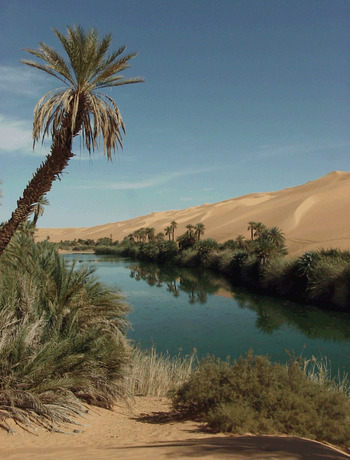
In the Sahara proper, sedentarisation is synonymous with the emergence of oases (Fig. 1.1). The oasis is a fundamental aspect of the Sahara, engrained in public perceptions of the desert.Footnote 9 One of the most enduring popular perceptions of the oasis is the perennial lake in the midst of sand dunes ringed by a thin band of vegetation – the equivalent of small uninhabited islands for ship-wrecked mariners. Though such extraordinary locations do exist outside mirages (Fig. 1.2), they are rare and exotic exceptions. Oases are more commonly well frequented places with more vegetation and accessible water, if often less available as surface lakes and streams than the archetypal image.Footnote 10 The derivation of the term ‘oasis’ (ouhat) is very ancient, going back to Pharaonic times and seeming to denote the specific location of the closest oases to the Nile. The term in ancient Egyptian also meant a ‘large open cauldron’, which correlates with the typical physical setting of those oases within depressions.Footnote 11 Despite, or perhaps because of, the early origin of the term, oases have no universal agreed definition. This is not normally a problem, they are so distinct from surrounding desert that a ‘know it when you see it’ attitude works for almost all case studies. However, when encompassing a view across the whole of the Sahara and ranging into areas of pre-desert, Sahel and river valleys we require something more robust if we are to achieve consistency. Published definitions include ‘a fertile green spot in a desert waste, especially a sandy desert’,Footnote 12 ‘an area in the midst of a desert which is made fertile by the presence of water’,Footnote 13 and ‘an area within a desert region where there is sufficient water to sustain animal and plant life throughout the year’.Footnote 14 Although fairly vague, these definitions share in common an interest in the potential for fertile plant growth and a corresponding availability of water, but there is no attempt to distinguish between naturally occurring and man-made phenomena. The definition of desert is also problematic as this is a botanical term suggesting therefore that oases are defined by pockets of non-desert plants (of which the most recognisable is undoubtedly the date palm). Biomes combining similar plants, animals and climates provide one route to distinguishing desert and oasis, so, for example, we can identify Saharan montane xeric woodlands, but it is hard to gather a satisfactory level of data for the entirety of the Sahara and this broad brush approach passes over many of the locally specific oasis environments that may be a square kilometre or less in area. Nor does this approach encompass the subtleties and connections that make up an oasis. Instead we prefer a multi-dimensional approach that identifies different types of oases through a number of factors.
Map of the principal oasis groups and areas of modern vegetation (as identified from a MODIS NDVI) in hyper-arid and arid areas of the Sahara.

The ‘archetypal’ oasis? Lake Umm al-Ma in the Ubari Sand Sea, Libya.
Oasis Vegetation
In keeping with botanical definitions the first factor in an oasis is fertile vegetation. In the classic form, oases have dense groves of date palms which provide the shade for fruit trees, cereals and other crops. These palmeries have such a dramatic effect that a climatic ‘oasis effect’ has been noted wherein the overall temperature of the oasis is lower during the day and higher at night and there is a higher humidity around the palms.Footnote 15 While palms can naturally wind pollinate and propagate there are distinct advantages to human cultivation: higher numbers of fruit bearing female plants and faster growing cuttings instead of seedlings. Oases in which date palms form the keystone species are therefore almost all anthropic to greater or lesser degree. Other vegetation forms are possible, particularly in the mountains where pools of standing water (guelta) or seasonal streams and rivers can form. These can have quite different combinations of tamarisk, shrubs and grasses to palm oasis and are far more reliant on the slightly higher, but less predictable rainfall that affects Saharan highlands – a wadi that turns green with vegetation for one month in an exceptional year may be dry for several years after. Recently, the development of centre pivot (‘crop circle’) irrigation wherein vegetation is watered with sprinklers on a rotating boom has created a new form of oasis based on monoculture or a limited range of crops.
Moreover, vegetation cannot be the only determinant as examples exist of oases with little or no cultivation such as modern al-Khalil on the Malian-Algerian frontier or the salt mines of Tawdenni and Taghaza also in Mali.Footnote 16 In these cases food and sometimes fresh water were imported to feed the inhabitants. While this is extreme, even for the Sahara, the movement of food to support oasis populations is common and probably has a long history.Footnote 17 This is a theme to which we return below.
Saharan Climate
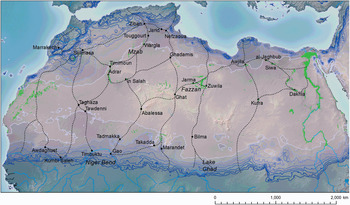
The lack of water is a key determinant of deserts. The 200 mm isohyet has long been used as a crude indicator between desert and non-desert (Fig. 1.3), but this is a highly mobile boundary and the vegetation it supports can expand or shrink hundreds of kilometres in a few years, for instance encompassing or excluding the major oases of Mauritania and Mali. The northern border is less mobile due to the rain shadow caused by the Atlas mountains that distinguishes well the start of oases in the Maghrib. The United Nations Environment Programme definition of desert relies on aridity rather than just precipitation. The centre of the Sahara can be classified as hyperarid and the northern and southern borders as arid. While the hyperarid zone is a good descriptor for the location of oases in the south, the northern oases sit fully within the arid zone which stretches into and over the Atlas and Aures mountains. The difference between the measures of precipitation and aridity is partly a reflection of the much higher winter temperatures that are experienced closer to the equator and the nature of the very different weather patterns between the southern fringe of the Mediterranean and the northern fringe of the tropics.
Major routes across the Sahara in relation to rainfall data.
While it remains difficult to find a suitable climatic description for the present, the problems are even greater in the past. Localised studies in Fazzan, the Niger Bend and Ennedi have allowed the construction of detailed climate histories showing that the changing nature of these biomes with types and extent of vegetation directly linked to the water histories of these places.Footnote 18
A few words are necessary at the outset concerning changes to the climate and environment of the Sahara in the past.Footnote 19 At various times in prehistory the Sahara has oscillated between wet and arid phases. The concept of a green Sahara is now well appreciated in relation to the pluvial phases, which created substantial river systems and vast lakes.Footnote 20 The last significant wet phase was in the Early-Middle Holocene period, broadly 10,000–3500 BC. During this period, the wide availability of water in the form of seasonal rivers, small lakes and a high water table supported Saharan connectivity and mobility.Footnote 21 As a general trend, mobile human communities of hunter-gatherers adapted to herding of domesticated animals – primarily cattle.Footnote 22 Although there is evidence for periodic climatic oscillations already within the Early-Mid Holocene phase, with a major abrupt arid spell recorded at around 6200 BC, it is apparent that with the Late Holocene, at c.3500 BC, there was a significant step in climatic change, which marked the start of the modern hyper-arid phase in the Sahara. Minor climatic oscillations are still recorded in some parts of the Sahara, such as certain of the mountain massifs, which received somewhat higher rainfall than the region as a whole, but the human experience of, and interaction with, the Sahara over the last 5,000 years has concerned a harsh desert environment that imposes limitations on settlement, movement and lifestyles. That is not to say, of course, that the desert denies long-range movements and contacts, but that these have necessarily become more focused along axes where water is more readily available in the form of springs and a high water table. There has been progressive decline in water availability in the Sahara as non-renewable sub-surface water sources have been diminished by natural and anthropogenic action and this has had implications for both Saharan populations and the ease of movement.Footnote 23
Interpolating the climatic data is not straightforward. In the north, the climate of the Neolithic humid phase or the ‘Green Sahara’ became progressively drier from 7000 BP/5000 BC with areas of desert expanding from the north-east. Palaeolakes in the Nubian Sahara appear to have dried up by around 3500 BP/2000 BC, marking the end of transhumant cattle herding in the Wadi Howar.Footnote 24 The palaeo-oasis of the Wadi Tanzzuft gradually contracted from 5000 BP/3000 BC until reaching something close to its current form around 2000 BP (first century AD), before contracting again in the last 25 years as a result of demographic pressure.Footnote 25 The drying of the Sahara has been heterogeneous, and in the case of West Africa may have occurred through two abrupt phases of desiccation at c.4000–3500 BP/2000–1500 BC and c.2500 BP/500 BC.Footnote 26 While the limits of the Sahara may have been more stable over the last 2,000 years there have been oscillations that affected all or parts of the region. In the Middle Niger, precipitation has oscillated between dry and wet phases with numerous severe droughts interspersed with floods.Footnote 27 The Middle Niger dry phase of 300 BC–AD 300 coincides with a slight increase in rainfall in Fazzan between 400 BC and AD 250.Footnote 28 But it must be emphasised that after 3000 BC, the minor fluctuations in rainfall have not changed the fundamental reality of the Sahara as a desert environment in which cultivation has generally been dependent on subterranean water sources or by stream flow from (sometimes distant) rainfall zones.Footnote 29
The oases of the Sahara must be recognised as an artificial phenomenon, created in the context of this Holocene aridification phase that extends down to present times. After the climate changed decisively around 5,000 years ago, we should first consider the significance of refugia, select environments within the desert that offered enhanced possibilities of supporting human or animal life and vegetation.Footnote 30 Examples of refugia in a drying out Sahara include the relict lakes of once larger bodies of water (gradually declining in size) or mountain massifs that received slightly higher rainfall, feeding water holes and providing seasonal vegetation. It is perfectly logical that people and animals will have congregated around such locations as the climate became more hostile. But as Purdue et al. recognise there are important distinctions between refugia and oases:
In anthropology, refugia are commonly regarded as isolated ecological niches where past populations retracted (allopatry) during hyperarid periods, while oases are commonly regarded as water-rich spaces in arid landscapes modified by humans (typically through cultivation and irrigation) in the form of artificial niches.Footnote 31
The importance of human actions in transforming refugia into oases is important, while, equally, it must be stressed that many refugia did not become oases. For example, most of the relict lakes of the third millennium BC eventually dried up and people were obliged to move on.Footnote 32 In recent years some scholars have used Niche Construction Theory (NCT) as a conceptual framework that bridges between deterministic environmental and anthropocentric explanations.Footnote 33 It is also very obviously suited to the fact that oases are essentially constructed niches within constrained environmental settings and this closely correlates with our approach in this volume.
Oasis Water-Sources
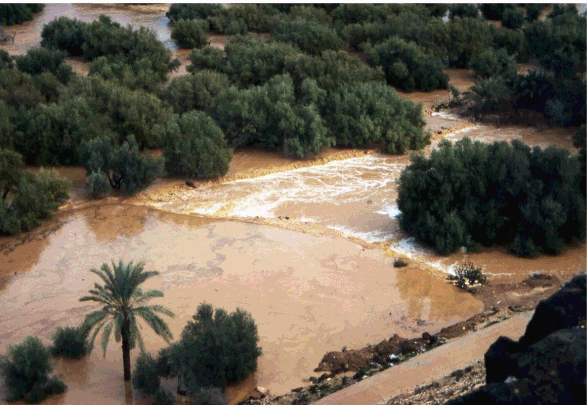
Just as the form of vegetation is variable, so too is the water that makes up the other component of an oasis. Several principal forms of hydraulic regime can be identified (Fig. 1.4):Footnote 34
diversion dam in the Wadi Draa;

Medieval irrigation canal Wadi Draa;

seasonal runoff irrigation, Bani Walid, Libyan pre-desert;
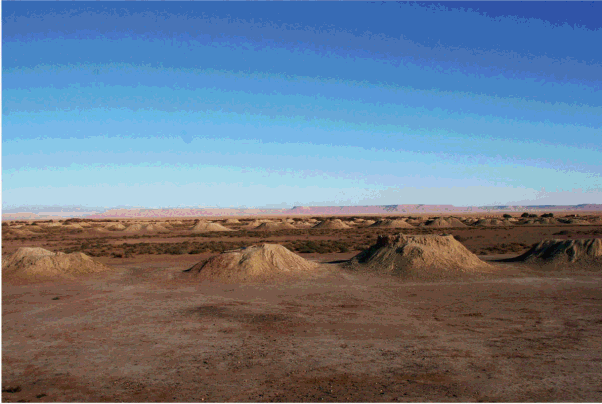
conical mounds marking vertical shafts of multiple foggaras, Tafilalat, Morocco;
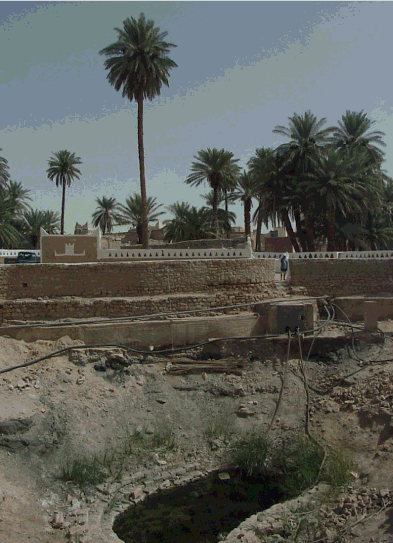
ancient artesian spring header basin, Ghadamis;
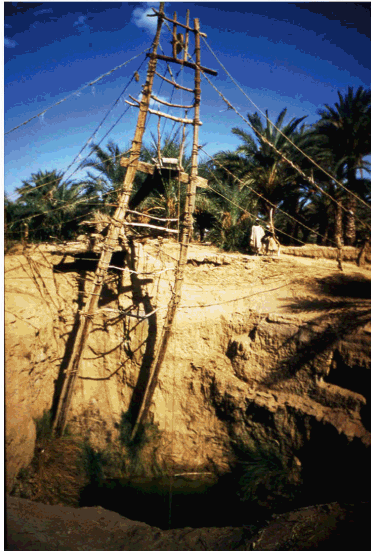
animal driven well (dalw), Fazzan;
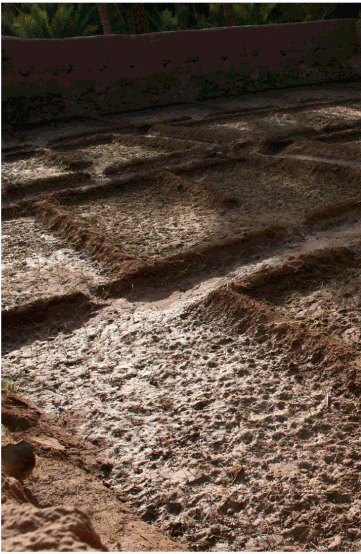
oasis gardens and distribution channels, Wadi Draa (photos a-e), g): D. Mattingly; photo f): C. Daniels.
Perennial Rivers
Active rivers with year-round flow are extremely rare in the Sahara. The exceptional instances are the two great rivers, the Nile and the Niger, with the Nile running right across the Sahara, while the Niger penetrates and runs along its southern margin before turning south again. Less celebrated is the Wadi Draa in Morocco, which is the only perennial river to flow into the Sahara from the north. It runs south-east for 200 km out of the High Atlas ranges, before turning abruptly westwards towards the Atlantic, though only in years of exceptional flood does water penetrate all the way to the Ocean. The Senegal is also worth noting as it currently delimitates the southern extent of the Sahara on the Atlantic coast. The exploitation of rivers for irrigation relies on the ability to divert or lift water from the main channel onto adjacent land (Fig. 1.4a). This may take the form of casual exploitation of periodic flood events or to engineered systems of barrages and diversion canals, linked to networks of channels (Fig. 1.4b) to distribute water in a controlled manner.
Seasonal Wadis
There are a number of important rivers that flow only seasonally or on an exceptional basis dependent on sporadic rainfall, sometimes resulting in spectacular flash floods. Some of the most important of these are wadi systems that flow from the Atlas ranges of Morocco and western Algeria, fed by seasonal rains and snow melt. The most celebrated examples are the Wadi Ziz (Sis) and the Wadi Rheris (Gheris) that feed the south-eastern Moroccan oasis of Tafilalat, of which Sijilmasa was the celebrated early Medieval capital. Another important seasonal wadi system c.150 km east of Sijilmasa comprised the Wadi Gir/Saoura, which in exceptional years carries floodwaters deep into the Sahara to augment the aquifer that feeds the Tuwat oases. In eastern Algeria there are numerous small wadi systems on the south side of Aurés Mountains. Beyond the Jabal in Tripolitania are the seasonal wadis of the Libyan Valleys with the Zemzem and the Sofeggin the largest (Fig. 1.4c). The exploitation methods for non-perennial streams include diversion of floodwaters onto adjacent terraces as with perennial rivers, though also commonly extend to cultivation of the dry river beds once the floodwaters have subsided. Floodwater or runoff farming varies in intensity, depending on the relative predictability or regularity of rain. At one extreme it is marked by adventitious scratch cultivation of wadis where floods have occurred, at the other it involves the construction of a complex infrastructure of walls to control the flow of water, limit erosion and gullying, along with water-storage features, like cisterns.Footnote 35 The former may relate to transhumant pastoral populations, the latter normally indicate sedentary farmers. Sedentary floodwater farming represents a fundamentally different hydrological approach to irrigation compared to oases that are dependent on groundwater sources.Footnote 36
Springs
After perennial rivers, the most valuable water resource in a desert environment is a perennial spring. Two major types of spring need to be differentiated, artesian and non-artesian sources. Artesian springs are those that reach the surface from deep water deposits under pressure. These can be prolific and long-lasting water sources and, once the springhead is contained and linked to a network of distribution channels, can potentially irrigate large areas (Fig. 1.4e). Non-artesian springs generally extract from higher perched water tables, have a less abundant flow and because of the non-renewable nature of the groundwater in much of the Sahara tend to have a more limited life span. There is a particularly important group of artesian springs in the northern Algerian/Tunisian Sahara (oases of the Wadi Rhir, Jarid, Nefzaoua). Artesian springs have often been improved by human enterprise, not only in constructing header tanks and canals, but also in digging additional deep shafts to tap the artesian waters (though such work is extremely hazardous and difficult). Spring-fed lakes exist in some sand seas, but the nature of such interdune depressions constrains the ability to use the water to irrigate wide areas.
Wells
Groundwater in areas lacking springs is most commonly tapped by the construction of wells. Where the water table lay close to the surface (at a depth of at most a few metres) the most common traditional water lifting device is the shaduf or balance beam well, in which a counterbalanced beam allows a bucket to be repeatedly dipped into the well and emptied into a distribution channel. Where water lies at greater depth, the mechanical effort of raising it is commensurately higher, involving either human or animal power (dalw wells) to draw up the water (Fig. 1.4f).Footnote 37 Irrigation that depends on wells and buckets tends to have a lower yield in water than that relating to systems exploiting flowing water and require far more labour on a day to day basis.
Groundwater Catchments
In the Suf oasis of the Great Eastern Erg a high water table beneath dunes has been exploited by the laborious mechanism of digging down in the interdune depressions to create micro-catchments where palms and other crops are irrigated by the groundwater.Footnote 38 This exploits in an extreme way a key characteristic of many oases. It is an underappreciated fact that in many oases the date palms are not watered directly, but rather, with their deeper root systems, are sustained by the generally higher groundwater level of the oasis. The main irrigation efforts are directed towards watering small garden plots where cereals and legumes are intensively cultivated. A serious decline in the level of the water table is often advertised by a catastrophic decline in the health of the date palms, as we witnessed first hand in Fazzan between 1996 and 2011.Footnote 39
Foggaras
The foggara is the Saharan variant of a technology known in Iran as the qanat. This is a distinctive form of irrigation, with high initial costs (and recurrent maintenance demands). It exploits a difference in level that is sometimes found between the water table beneath a valley or basin floor and surrounding hills or escarpments. Where the water table at the side of a valley is at a higher absolute level above the sea than the centre of the valley, a low gradient underground channel can be dug to carry water from a mother well to a point towards the centre of the valley where the channel breaks the surface, effectively forming an artificial spring. Foggara construction involves the digging of long lines of shafts (which can be spotted by distinctive donut-shaped rings of spoil at the surface) to allow regular access to the subterranean channel for the purposes of initial tunnelling and recurrent maintenance (Fig. 1.4d). The earliest foggaras in the Eastern Sahara can be dated to the mid first millennium BC, with the Garamantian heartlands of the Central Sahara containing some of best-documented and most extensive evidence for Protohistoric foggara construction.Footnote 40 They are also attested in many other parts of the Sahara, though the chronology of introduction of the technology within different regions is not generally closely dated. Foggaras were particularly important as a means of overcoming a shortage of local springs.
The scarce water generated by the different forms of irrigation described above is generally distributed by carefully measured volume or time allocation along minor channels into small garden plots, where cereals and other annual crops are cultivated shaded by palms and other fruit trees (Fig. 1.4g).
Distribution of Different Irrigation Techniques
As the detailed case studies that are presented in Chapters 2–7 show, Saharan regions made use of the different hydraulic resources available or suitable to the local topography and used a range of technologies for exploiting them. The overall distribution pattern of irrigation technologies in the Sahara is a complex mosaic, dependent on local hydrological resources, topography and social factors (Fig. 1.5). There was thus no uniform blueprint for creating oases in the Sahara, as the background hydraulic conditions varied so much. While the most abundant and most accessible sources of water (like rivers and springs) were favoured locations for early oasis development, every locality and each water source presented its own challenges and the costs of oasis agriculture were always high, both at start up and recurrently. Simple diffusionist models cannot explain the spread of the oasis, but at the same time the importance of the acquisition of the technological know-how that underpinned oasis farming should not be underestimated. This issue of mobile technologies is the focus of a separate volume in this series.Footnote 41 The important point for us here is that Saharan oases were enormously varied in their evolution, with many showing evidence of the addition of secondary irrigation works to supplement the primary hydraulic regime at some point. Such diversification could have been driven by population growth and a need to expand the cultivated area, or equally may have been a response to a declining water table impacting the primary irrigation system.
Distribution of different irrigation technologies across the Sahara: rainfall runoff (R), springs (A), wells (W), underground irrigation channels/foggaras (F), canals (C).

Oasis Networks
So far we have considered oases as zones of fertile vegetation within arid environments, with variability in the nature of both parts. However, one of the key differences between an oasis and an isolated well could be considered to be the presence of people on a permanent, semi-permanent or seasonal basis at oases, while wells sometimes receive only periodic visits. If we see oases as concentrations of people within a desert this opens up different dimensions that help to explain the variability we see archaeologically.
There is a common idea that oases were miraculously productive locations. The Roman writer Pliny the Elder is typical in his laudatory account of the fecundity of the oasis of Tacape on the Tunisian coast – extolling the multiple harvests produced by several layers of crops from palms, to grapes to cereals) grown in gardens with a premium price tag attached to such plots of land.Footnote 42 However, an important aspect of oasis agriculture is that its high capital investment and running costs were often not economically sustainable solely from the products of the land. Oases were ‘miraculous’ in that they represented humanly created or humanly enhanced vegetated niches within the desert wastes, but they were expensive to create and run. As Scheele has argued persuasively, oases were uneconomic without reference to other activities and networks in the desert environment – including symbiotic relations with pastoral groups and trade, creating value systems that could subsidise and sustain the elevated costs of oasis farming.Footnote 43
Scheele thus conceives oases as networks. Many, perhaps most, oases make little economic sense, as the costs of developing and maintaining hyper-intensive agriculture are not met by the potential crop returns.Footnote 44 This is certainly true of the early modern period as has been demonstrated with the malnutrition and starvation caused by the blocking of trade, and hence food to the Tuwat oases in the early twentieth century.Footnote 45 Mid-twentieth-century records of Ghadamis demonstrate that the town’s gardens could barely produce half the food needed for its small population (the rest had to be imported from Tripoli) and poverty was a commonplace of other oases under Italian colonial rule.Footnote 46 It is an open question to what extent this was true of earlier periods, but in any case, high investment costs for the development and maintenance of oases should be considered the rule in all oases.
There are three key points arising from this. Firstly, as we shall see also with cities, oases must always have existed as networks, rather than as isolated individual sites. The linkages to other points in the network were needed in order to cover initial outlay and growth and when necessary also to provide support for a struggling community. The domestication of key pack animals like donkeys, horses, mules and camels has been another crucial factor in facilitating the navigation of the arid spaces of the Sahara.Footnote 47 All the beasts of burden mentioned above were present in the Sahara by the later first millennium BC, though the importance of the camel increased over time with the progressive drop in water tables increasing the distance between and the delivery capacity of wells on Saharan trails.Footnote 48 It is precisely because of such constraints on movement and habitation that the Sahara is such an interesting theatre in which to explore themes related to human connectivity across space.
Secondly, the creation of new oases should be viewed as a conscious expansion of that network, with commercial contacts being a driving force. Here of course there is a strong convergence with the conclusions of the Trans-Saharan trade volume.Footnote 49
Thirdly, the rationale for creating oases was not solely dependent on fertile potential (that is, linked to the main botanical and climatic definition of oases), but rather reflected wider social and economic benefits perceived for the network. Thus, a number of oases are linked to salt-mining and others have a crucial role as staging posts along trade routes. In extreme cases this can lead to oasis settlements without an oasis, or rather with the oasis cultivation lying tens or even hundreds of kilometres distant.
As oases are intertwined between climatic, hydrological, botanical, technological, economic and social histories, it is perhaps no surprise that archaeological coverage is so patchy by region and period. Research into Saharan prehistory has tended to concentrate on studying the decline of pastoral communities in a drying environment, but while shrinking grasslands may in some cases have had the potential to become oases, in most cases the long-term water sources were lacking. The evidence of Late Neolithic communities (c.3000–1000 BC) tends to be best preserved precisely in the locations least suited for continuing human activity. Hence these studies have tended to paint a picture of decline into oblivion rather than evolution towards oasis landscapes. Meanwhile, studies that have looked at the recent and Medieval history of specific oases, may struggle to understand the nature of Protohistoric oases as the earliest activity is masked by later palimpsest oasis infrastructure and the logic of the modern oasis is sometimes distant from ancient climates, economies and communities. The Protohistoric period is thus often obscured, with important consequences for our understanding of the beginnings of Saharan agriculture, the evolution of oasis communities and the uptake of mobile technologies such as metallurgy and irrigation strategies.Footnote 50
Past Oases and Their Populations
As we shall see, the earliest oases in the Eastern Sahara date back to the third millennium BC. Yet the ultimate origins of the vast majority of Saharan oases and the identity of their first populations are unknown, or assumed but unproven. The default verdict, sometimes with the supporting ‘evidence’ of foundation myths, for many oases in the Sahara is that they were created no earlier than the Medieval period.Footnote 51 However, there is also an interesting persistence of legends of Jewish or Christian groups being responsible for the first irrigation works and fortified villages (qsur).Footnote 52 The linguistic evidence suggests that between the third millennium BC and the seventh century AD, many parts of the Sahara became dominated by Berber speaking groups (Amazigh), though there is considerable complexity and divergence concerning the links between the various Berber language branches.Footnote 53 The best fit interpretation of the data by Fentress notes a close correlation between major extension of Berber speaking zones and some of the dating of oasis foundations and expansions that are discussed in this volume (Fig. 1.6).Footnote 54 To the north and west of the Garamantes this relates to the territories traditionally ascribed to the peoples known collectively as the Gaetuli in the ancient sources. The Amazigh are often presented as the indigenous population of Mediterranean North Africa – that is, phenotypically white, but things appear to have been more complicated in the Saharan Berber-speaking zones. The skeletal evidence suggests these were ethnically very mixed communities of people with Mediterranean, Sub-Saharan and intermediate ethnic markers.Footnote 55 There were also areas of the Sahara, where non Berber populations held sway, most notably the Tubu/Teda of the Tibesti region on the Libyan/Chad border.Footnote 56
The distribution of Proto-East-West Amazigh language (orange) c.500 BC. The blue and purple colour zones represent earlier expansions of Proto-Amazigh and related languages.

As this volume will demonstrate, there is now increasing archaeological evidence of Protohistoric establishment of oasis communities – notably focused on the Garamantes. The heyday of the Garamantes coincided with the Roman Empire, but their heartlands in the Libyan Sahara lay far to the south of the Roman frontier.
Even if the Garamantes are now recognised as an important exception, Protohistoric development of oases elsewhere in the Sahara remains underappreciated. One of the reasons for the historiographical blindspot concerning precocious oasis development relates to the persistent belief in the modern colonial era that the desert was occupied in Roman times only by nomads.Footnote 57 This was sometimes presented as a reason why the Roman Empire chose not to conquer the desert regions – ignoring the evidence that significant sectors of the desert were actually incorporated into the frontier zone. Overall, there has been a general failure to consider either the possibility that oases already existed in these areas before contact with the Roman Empire or the implications of this.Footnote 58 Pastoralists there certainly were, but they were not alone and, in concert, pastoral and sedentary groups represented a much more significant scale of Saharan population than has traditionally been recognised. As we shall see there are plenty of indicators that oases existed in the Protohistoric period and in fact pre-Roman origins of many oases are indicated by among other factors the prominence of date palm iconography in Carthaginian artworks or the appearance of the date palm on Cyrenaican coinage.Footnote 59 Pliny’s famous account of the oasis of Tacape (Gabes) leaves no doubt about its pre-Roman origins.Footnote 60
Certain characteristics of the Garamantian oases, which have been conclusively dated to Protohistoric periods, are helpful in framing an agenda for tracing early sedentarism in other parts of the Sahara.Footnote 61 These include:
a concentration of population around water sources or potential hydraulic resources, evidenced by the appearance of new settlement forms such as hillforts or dense funerary landscapes;
the adoption of a developed agricultural package, with obvious affinities with the oases of the Western Egyptian Desert;
the association with people riding horses and driving chariots and slightly later also the camel, as evidenced in rock art studies;Footnote 62
the movement of ideas and competencies (pyrotechnologies, irrigation works including the foggara, spinning and weaving, a written Libyan script);
the construction of distinctive styles of fortified structures (qsur);
evidence of trade contacts.
In the following chapters, we focus primarily on the physical traces and chronology of settlements, but in some cases we shall make reference to wider sources of evidence, including some proxy markers. There are various strands of evidence that can be called on as indicative proxies of early origins for the oases. These include a number of sites where there was a Roman military presence, often supported by epigraphic finds and some investigation of the forts themselves.Footnote 63 Even without explicit demonstration that the adjacent oasis was already developed prior to the arrival of the army, the existence of an oasis would seem to be a sine qua non for the support of units posted to remote desert locations. Literary evidence also provides compelling evidence for Roman or pre-Roman era activity at a number of centres that can be identified with later oasis sites. Early European travellers in the Sahara, colonial administrators and mappers also reported on Protohistoric or Roman ruins and antiquities in many oasis clusters. Finds of Latin inscriptions, dressed stone blocks (including architectural elements such as bases, columns and capitals) are strong indicators at oases in the Roman frontier zone, but these probably only represent the tip of the iceberg, as mudbrick architecture was the norm in the oases and stone architecture the exception. Villages built entirely in mudbrick and which did not gain access to large quantities of imported Mediterranean goods like pottery will be difficult to place chronologically without radiocarbon dating. Nonetheless, all finds of Roman material in the Sahara merit careful consideration as potential markers of Protohistoric development.Footnote 64
Pre-Islamic burial monuments are an important category of evidence. Primarily cairns and drum-shaped tombs, these are typically dated to c.500 BC–AD 650, but earlier and later examples are known.Footnote 65 Especially when concentrated in dense cemeteries around oases, these are a potential indicator of early origins.Footnote 66 The organisation of these cairns and drum shaped tombs into regular and dense cemeteries, as opposed to more dispersed funerary zones, may be an indication of locations with permanent settlements.
Dating the irrigation technology used in the oases is incredibly difficult, but one particularly distinctive type of feature can be shown to have Protohistoric origins and to have played an important part in the early establishment of oases. This was the foggara, essentially a Saharan variant of the Persian qanat, which was introduced to Egypt by the Persians. Foggaras have had a long life in many oases down to the present and have regularly been assumed to be Medieval in date, but the possibility of a Protohistoric spread of the technology can no longer be ignored.Footnote 67
Finally, the abundant rock art of the Sahara includes a number of depictions of actual oases associated with images of people riding horses, driving chariots and sometimes also featuring camels.Footnote 68 There are also images of what appear to be schematic representations of fortified sites similar to the qsur of the Garamantes (on which see below). Detailed study of the Garamantian heartlands has demonstrated that there were dense concentrations of horse and camel imagery alongside the oasis, indicating a close social relationship between the two.Footnote 69 However, some of the rock art clusters occur far from oasis centres, showing that it was also produced by people living in remote locations and more mobile lifestyles.Footnote 70 In such cases, it may be that the imagery reflects more on the inter-relationships between pastoralists and oasis communities in terms of trade, raiding and other cultural aspects. The extensive distribution (reaching the Western Sahara) of this sort of historic era rock art (first millennium BC and later), associated with both pastoral groups and oasis locations, is another possible marker of more extensive oasis networks that underpinned successive phases of development. Since oasis networks were highly dependent on communication across the desert, the spread of horse and camel breeding was essential to their maintenance.
Libyan inscriptions in early variants of the Tuareg tifinagh script may be another sign of the emergence of complex societies and is a further behavioural trait that could be linked to early oasis cultivating and trading societies.Footnote 71 Whatever the specific meaning of inscriptions and rock art images, the commonalities between widely separated material within the Sahara indicates an already connected space in the Protohistoric period.Footnote 72
Urbanism
Towns are the second theme of this volume and are a defining characteristic of complex polities,Footnote 73 though with a multiplicity of definitions having been put forward. These include those built round checklists of urban traits,Footnote 74 those that emphasise the roles of towns within landscapes and people’s lives,Footnote 75 those that contrast rural and urban identitiesFootnote 76 and those that dismiss the idea that there are defining features.Footnote 77
Homogenising models, such as the consumer city that was once favoured by ancient historians for the Mediterranean in antiquity, have been increasingly abandoned in favour of comparative or particularist approaches.Footnote 78 The role of towns as centres or agglomerations remains important: whether of size and population density;Footnote 79 of particular functions and craft specialisations;Footnote 80 of economic networks and development;Footnote 81 of farming hinterlands or zones of raw material exploitation;Footnote 82 of social complexity and authority.Footnote 83 However, there is increasing interest in the cost of towns as a form of complexity,Footnote 84 the relationship between size and communication,Footnote 85 their legitimacy and resiliency within different social strategiesFootnote 86 and spatial forms such as clusters of settlements or low density settlement.Footnote 87 Above all, there is awareness that urban societies are not an inevitability, but one of many variations, with versions distinct to their ecologies. Cities and systems of cities are multi-scalar, often transformed by cross-scale interactions and sustained by urban innovation.Footnote 88 To investigate these requires substantial exploration and most likely excavation of both the urban centre and its hinterland.
New additions are still being made to the list of societies identified as urbanised, especially in regions of the world where archaeological data have been hitherto limited or under-explored. In such cases, it may be helpful to look on cities as ‘supernova’ that re-routed and transformed patterns of everyday life, changing the landscape of country-city interactions.Footnote 89 In archaeologically blank parts of the world, the search for cities should focus on settlements that are very distinct from other settlement types, promoting new forms of social life and changes in interactions with a hinterland zone.
Urban centres, even of small size, placed increased stress on their inhabitants’ ability to feed themselves and therefore had to be sustained or supplemented through other means. Such sites can quickly hit a limit and become what Fletcher describes as ‘stasis settlements’ – rare, very large settlements for the region that maintain their size for long periods of time.Footnote 90
This model is reminiscent of dendritic settlement systems in which flows of goods and information branch outward from a single large centre, but this ‘town’ monopolises economic development at the expense of its hinterland.Footnote 91 Junker has recently reformulated the model describing it as a concentration of political and economic power within primate centres that exert weakening authority over a series of linearly radiating settlements.Footnote 92 Most often they occurred because of the dominant role that long-distance trade played in the local economy. Finally, environmental and/or cultural constraints on transport can result in a linear convergence of trade networks on a single strategically located centre.
Saharan Urbanism and Urban Networks
There is a growing body of work questioning the applicability of European or Western models of urbanisation to the realities of Africa and to African societies.Footnote 93 What we hope to demonstrate in this book is that the Sahara not only underwent a process of localised sedentarisation in the first millennia BC/AD, but that some of the key oases that emerged merit consideration as urban centres. In the same way that oases have tended to belong to networks, rather than exist in splendid isolation, so it is plausible that nodal centres within those networks fulfilled roles that may be considered urban. The extent to which these urban centres were influenced by other urban societies in the Trans-Saharan zone is a more complicated issue. A feature of the debate among contributors to this book concerns the interplay of exogenous and endogenous factors. Other factors that are discussed by various contributors include an increase in social hierarchisation and inequality, issues of security, and the importance of trade in the emergence of Saharan urbanism. Slave-trading is an important and controversial aspect of early Saharan trading and urban systems – the possibility that the Garamantes were an early example of the sort of slaving state that later dominated the Sub-Saharan zone certainly merits consideration.Footnote 94
Trade network models also fit well with oasis centres, like the Garamantian capital Jarma.Footnote 95 Jarma was located in an area with accessible groundwater that could have supplied caravans as well as residents and was situated on a potential intersection of east-west and north-south communication routes through Fazzan. Comparative cases in the Hellenistic world suggest that these centres often underwent rapid population growth because they were connected to the outside world through trade or as colonial points of entry.Footnote 96
State Formation
It is a logical corollary to the identification of urbanisation in the Sahara and its neighbouring lands, to ask whether these urban societies merit recognition as early polities. The third big theme in this book is thus state formation. Much depends of course on what one means by this and how exactly we choose to define states.
What Do We Mean by ‘State’?
The debate about what constitutes a state is as heated as that concerning what defines a town. In the past, the tendency was to link state formation to an evolutionary vision of human societies moving from simple and scattered bands, to tribes, to chiefdoms, to polities.Footnote 97 More recently there has been a reaction against such evolutionary or neo-evolutionary models, at least when they are broadly drawn and crudely applied.Footnote 98 Nonetheless, it is hard to escape entirely from evolutionary judgements in assessing what marks early states and civilisations out from other ancient societies and a possible way to mitigate some of the issues with the western bias of evolutionary theory is to attempt to combine emic and etic perspectives.Footnote 99 Just as towns often stand out as different from other sorts of settlement, so early states may also have been differentiated from other contemporary communities. What is clear from the best recent work is that hierarchy, agriculture and urbanisation are key social components in defining the primitive state.Footnote 100 Much debate still focuses on two categories of state: the city state and the territorial state. The former relates to the formation of networks of self-governing polities based on a single main centre, while the latter concerns the emergence of more hierarchical urban structures and the coalescence of centralised nodes of power and authority. Territorial states could evolve out of networks of city states or independently of the prior existence of such smaller states.Footnote 101 Most city states tended to remain relatively small-scale societies (though with some notable exceptions) and were often parts of cultural koine with wider parameters. Territorial states could be very extensive and be responsible for significant cultural changes within their territories, leading to their recognition as civilisations.Footnote 102 Some states might thus be identified as civilisations, but not all. So an important supplementary question to the basic one about whether the Garamantes constituted a state concerns what sort of state model the evidence suits best and whether this also equates with recognition of a distinctive civilisation.
In their influential recent book, Flannery and Marcus have made a good case for the underpinning significance of the emergence and reinforcement of social inequality in the creation of kingdoms and empires.Footnote 103 Drawing on a wide array of examples from different parts of the world and varied periods, they demonstrate many commonalities in the formation of early states, and the human behaviour and physical structures that underpinned them.Footnote 104 A key point they make is that once a kingdom existed in a region, it provided a model for future kingdoms – the social knowledge could not be uninvented.Footnote 105 The Garamantes bear comparison with many of the examples of early kingdoms described by Flannery and Marcus, especially in the manner in which their society developed out of a base shared in common with contemporary groupings into something manifestly different and distinctive.Footnote 106
Examples of States
Mario Liverani, who has studied early state formation across a wide range of contexts from the Near East to North Africa, has been in no doubt about the recognition of the Garamantes as an early state.Footnote 107 He suggests that the concept of ‘mirror state’ may be useful in considering the Garamantian case.Footnote 108 This idea, developed specifically in the context of nomadic empires of the Asian steppe, saw them as examples of societies adapting ideas and structures of state organisation from neighbouring states/empires – not so much in terms of simple diffusionist emulation, but as a practical means of dealing effectively with such neighbouring powers. In organising things like tribute extraction from agriculture, livestock raising and commerce, military organisation and levying of troops, labour needs for the construction of monumental buildings and major irrigation works, religious foci, long-range communications, specialist craft production and markets, the Garamantes could have drawn on observations of a range of peoples they had contact with. In a connected Trans-Saharan world, they did not have to invent everything for themselves.
The Sahara was bordered by a variety of early states by the late first millennium BC: to east (Egypt),Footnote 109 south-east (Meroe/Kush),Footnote 110 south (Lake Chad area),Footnote 111 south-west (Niger Bend area)Footnote 112 and north (kingdoms of Cyrene; Numidia, Mauretania; empires of Carthage and Rome).Footnote 113 The histories, semantics and physical characteristics of these states vary considerably one from another. Given the central position of the Garamantes within the Trans-Saharan world, we should be careful neither to privilege nor to exclude any one of these from consideration. The key point we would make is that the Garamantes developed their society within a Trans-Saharan world of states and proto-states. Obviously, the lack of detailed historical documentation on their administrative organisation, legal provisions and so on, makes the assessment of the Garamantian state much more difficult than say the Roman one. However, we would argue that there are important markers that identify the Garamantes as certainly possessing some characteristics of early states and evidence hinting at the likely presence of other aspects.
A long standing view is the idea that segmented Berber societies have been antithetical to state formation. In part this has been a consequence of the modern colonial era’s attitude to indigenous North Africans, denying them an active role in history in favour of an emphasis on the creative contributions of incomers and colonists.Footnote 114 Brett and Fentress typify such views:
There is no evident progression from the relatively anarchic tribal structures to the Hellenistic state: nor, indeed, is there any reason to expect it. From what we have seen, the development of the Hellenistic monarchies in North Africa between the fourth and first centuries BC occurred in emulation of the major polities and was in no way a spontaneous occurrence.Footnote 115
In view of the new evidence of precocious agriculture, technological advances and proto-urbanism in Numidia, initially independent of Phoenician influence, it is a moot point whether such dismissive views of an African component in urbanisation and state formation are still sustainable.Footnote 116
The Structure of the Volume
In the next part of the volume, mostly written by the co-editors with contributions from a number of others, we offer an overall review of the evidence for early development of Saharan oases, starting in Chapter 2 with the heartlands of the Garamantes in the Central Sahara (Fig. 1.7). From there we move back in time and eastwards (Chapters 3–4), to review the evidence from the oases of the Western Desert of Egypt and eastern Libya. As well as an overall survey chapter by the editors, we include a more focused study by Anna Boozer of the important data from the highly developed Roman-era urban centres of the Western Egyptian oases. These represent outstanding, but in some ways atypical, examples of urban development in the Sahara, due to the close links between the Egyptian oases and the Nile Valley. Chapter 5 explores the northern oases that formed the Roman frontier from north-western Libya to central Algeria. Chapter 6 continues further west again to the oases of western Algeria and southern Morocco. Chapter 7 concludes our survey with a study of the Southern Sahara to the north of Chad, Niger, Mali and Mauritania, regions which were at various times dominated by the empires of Kanim and Songhay as well as the Tubu and Tuareg peoples (including the sultanate of Agadez).
Places discussed in Chapters 2–8.

The first half of this volume thus pulls together a vast dossier of information and bibliography relating to the main oases groups in the Sahara. We have also exploited the increasing availability of high resolution satellite imagery to make assessments of the archaeology, both where sites have been previously reported and frequently where there has been no systematic archaeological research of Protohistoric and early Medieval sites. We believe that these two aspects alone can provide a new starting point for future work.
One of the major problems with demonstrating Protohistoric origins is the lack of systematic archaeological investigation and scientific dating for the vast majority of these oasis groups, the notable exceptions being the Libyan Central Sahara and the Western Egyptian Desert. The dating of most sites is very crude and for many locations the best we can say is that there was activity at some point in the Roman period. As we shall see, the available evidence suggests that there was a broad chronological shift from east to west, with the earliest oases in the Western Egyptian Desert dated to the third and second millennium BC, the earliest indications from the Central Sahara dated to the end of the second millennium BC and more extensive development in the first millennium BC. A plausible working hypothesis might be that the initial development in the Algerian and Moroccan Sahara occurred in the late first millennium BC and early first millennium AD, but that remains to be verified.Footnote 117 It is also possible that the Western Sahara followed its own distinctive trajectory given the vast distances involved. For instance, the role of Tichitt culture in the wider Trans-Saharan sphere is still poorly understood.
Further discussion of the motivations and processes of oasis creation is the subject of Chapter 8.Footnote 118 Many uncertainties remain and particularly as our study progressed further to the west we have had to rely on hints and suggestions more than hard evidence. The picture is currently hypothetical in places, but at the same time we believe that the sheer volume of oasis sites for which Protohistoric development can be demonstrated (or plausibly argued) means that we must view the alternative picture of an underdeveloped and barren Saharan world prior to the Medieval period as equally unproven at present. What is needed is more work on Saharan oases – however remote a possibility that may seem at the present time – and especially a concerted approach to radiocarbon dating of sites (see below).
As well as examining other case studies of urbanisation in the Trans-Saharan world, the second half of this book explores the theme of state formation, again with a particular focus on African specificities and contexts. A series of case studies focusing on the lands bordering the Sahara and spanning the Protohistoric and Medieval eras is presented (Fig. 1.8).
Places discussed in Chapters 9–18.

In looking at the neighbouring zones in Part III, we have chosen to follow a broadly anticlockwise tour around the Sahara, starting from the Nile Valley. In Chapter 9, David Edwards presents a case study focused on the Nubian kingdom of Meroe, asking interesting questions about the nature of royal power and its manifestation in architecture and settlement organisation.
The next group of chapters have a focus on the Mediterranean hinterland of North Africa, once seen as a zone dependent on external influences and colonisation for its socio-economic evolution. However, it can now be argued that both exogenous and endogenous factors contributed to the emergence of urbanisation and state formation. Andrew Wilson in Chapter 10 presents an important new survey of the Greek, Phoenician and especially Roman influences in the development of the Classical cities of the Maghrib. He shows an awareness of the significance of the important work of Joan Sanmartí at the site of Althiburos, which is summarised in Chapter 11. Excavations beneath a small Roman town in western Tunisia have revealed a deeply stratified and complex settlement dating back to almost 1000 BC and associated from the outset with sedentary agriculture. The point at which this settlement might be deemed urban cannot be settled on current evidence, but the significance of the long endogenous proto-urban sequence is clear and establishes a very different sort of analysis. It invites us to explore what an African model of urbanism may have contributed to the Roman-era cities described by Wilson.Footnote 119 Althiburos is important not just as a type site for pre-Roman urbanism in the Maghrib, but also for the window it opens on the nature and early formation process of the Numidian kingdom that had emerged as a political force by the third century BC. Similar issues are raised in Chapter 12 by Youssef Bokbot, discussing the nature of first millennium BC settlement in Morocco and its relation to the emergence of social complexity there. The narrative is clearly intertwined with that of Phoenician entrepôts along the North African coast, but again he argues persuasively that in the past we have too much emphasised the contributions of external groups and underestimated the role of indigenous society in early urbanism. Here too, an early state, the Mauretanian kingdom, had appeared by the later centuries BC.
The following three chapters all deal with aspects of urbanisation in and bordering the Southern Sahara. In Chapter 13, Kevin MacDonald reviews the evidence for the emergence of complex settlements in the Southern Sahara and the Niger Bend area, starting with the precocious Tichitt settlement sequence from the second millennium BC. A complementary view is offered by Susan McIntosh in Chapter 14, though with a greater focus on the early Medieval developments in the Niger Bend area and Senegal Valley. She also highlights the long distance trading contacts of the early centres as being important in their development. Although neither MacDonald nor McIntosh can identify precise evidence of direct contacts between the early West African polities and the Garamantes, in general they are supportive of the view that there were significant contacts with the Saharan world in this period that need further evaluation in future work. In Chapter 15, Carlos Magnavita provides an overview of the emergence of large fortified sites in the Lake Chad basin in the first millennia BC/AD. Again, there is a lack of direct evidence of contact with the Garamantes, though one of the possible explanations of the fortified sites is that they were a response to slave raiding from the north, whether direct by Garamantian expeditions or sub-contracted by them to the people of the Kawar oases. It must be recognised, however, that a key problem in evaluating the trade contacts between the Sub-Saharan zone and the Sahara is that so much of Saharan trade is in archaeologically invisible or vestigial materials (slaves, salt, gold, other metals, textiles, leather goods, etc.).Footnote 120
The next pair of chapters has a focus on the Medieval Sahara. We noted already how interpretation of town formation in Phoenician/Roman Africa has been skewed hitherto by a dominant colonialist discourse that has obscured or marginalised indigenous developments. New evidence is prompting a reappraisal of the role of local actors. Similar themes of competing narratives of endogenous and exogenous urban foundation and state formation are explored for the late first millennium AD in Morocco by Chloé Capel in Chapter 16. The town of Sijilmasa was one of the key northern portal cities of Medieval Trans-Saharan trade and attracted alternative foundation myths. There has been a general consensus that this was an ex novo creation of town and oasis landscape in the mid-eighth century. While Capel’s analysis offers an important reinterpretation of different elements of the historiography, she highlights important evidence hinting at Protohistoric activity in the vicinity of Sijilmasa. The recent work in Wadi Draa, reported in Chapter 6, offers further support for the view that the early Medieval golden age of Sijilmasa built on an already established sedentary community in the Tafilalat oasis.
Chapter 17 by Sam Nixon provides a detailed review of the evidence of the early Medieval/Islamic trading towns in the Southern Sahara and on its edge, serving as portals into West Africa. He illustrates the distinctive features of such sites and how they differed from contemporary West African centres.
While we must be explicit at the outset in saying that we believe the sum of the evidence supports the idea that the Garamantian kingdom was a state, we have deliberately sought to consider and to engage with a diverse array of views in this volume. Judith Scheele makes a strong case in Chapter 18 for considering such an alternative viewpoint – arguing that the Sahara has for most of its history been essentially stateless and dominated by pastoral groups with shifting power structures and attachments, where control of people has tended to be more important than formal delimitation of territory. Her chapter serves as an important reminder that our goal is ultimately not to simply divide between state and non-state entities and confine activities to one or other of these, but rather to look at the full range of how power was held and used.
The concluding discussion by the editors in Chapter 19, attempts to pull together some of the key discussions about the potential linkages between urbanism and state formation in early historical settings in Africa. This volume is by no means intended as a comprehensive review of the many varieties of African urbanism and early polities, but we hope to have demonstrated the importance of enlarging the sphere of such debates, to take account of contemporary developments across the Trans-Sahara zone. We argue strongly that more attention needs to be given to local influences and models for the institutions that evolved in the Sahara, while also recognising the inherent connectedness of the Saharan world from the first millennium BC. The issue of state formation in the Trans-Saharan world, especially in the Protohistoric period and within the Sahara itself is controversial. We shall argue that some Protohistoric Saharan societies are better understood as states or polities, though again this seems to have been a rare development (Meroe, Siwa and the Garamantes are the outstanding early cases).
While the authors of the chapters in this book are not in entire agreement about the definitions of state that suit these African polities, there is a strong consensus that the conventional models of state formation developed in the context of Europe and Western civilisation are ill-suited to the African examples. As with urbanisation, we need to be more open to the importance of ‘African’ ways of defining and enshrining power within societies. ‘State’ and ‘state formation’ have to be reconceptualised to make sense of the Trans-Saharan world. To follow Lekson’s corollary – if we are arguing over whether the Garamantes or similar groups were or were not states, then they must be really interesting.Footnote 121
The Dating of Protohistoric and Historic Sites in the Saharan Zone
A crucial problem concerning the issues that this volume seeks to address is the lack of absolute dates from many of the oasis regions of the Sahara, bearing on their origins and evolution. Most application of radiocarbon dating in the Sahara has related to prehistory, with relatively little attempt to date Protohistoric and historic sites. It is not just the early chronology that is obscure, the Medieval phases of many key sites are equally poorly understood, with folklore outweighing scientific dating criteria. However, our investigations have revealed that there is more evidence now available than is perhaps currently appreciated. Since the late 1990s, our work in the Central Saharan heartlands of the Garamantes has involved a major programme of scientific dating of such sites, with 177 radiocarbon dates in total.Footnote 122 The Italian mission in the same broad region has published a further 85 relevant dates.Footnote 123 We have now initiated a similar programme of AMS dating in relation to our survey in the Moroccan Wadi Draa, with 77 dates already available.Footnote 124 These dating programmes have demonstrated the potential to differentiate between Protohistoric and Medieval settlements and underpin our new appreciation of the scale and complexity of Protohistoric Saharan sedentarism.Footnote 125
In the absence of diagnostic pottery and well dated excavated sequences in many areas of the Sahara, the close dating of sites and monuments is fraught with difficulties. Traditional radiocarbon dating, involving substantial amounts of material for analysis often suffered from the effects of mixed samples or ‘old wood’ charcoal. However, high precision AMS dates, often obtained from an individual seed or small amounts of grass temper and chaff used in the manufacture of mudbrick, offer much greater certainty that samples are not mixed and relate to annual or short-lived materials.Footnote 126 While a few anomalous dates have still been delivered, our experience is that a very high percentage of samples submitted (especially from temper included in mudbrick and pisé construction) have provided reliable dates for the construction. There are also plateaux effects in the radiocarbon calibration curve that extend the range in certain periods, but it is broadly possible to recognise activity phases and to distinguish between the early first millennium BC, the later first millennium BC, the early centuries of the first millennium AD, the later first millennium AD and the earlier centuries of the second millennium AD. Where sufficient dates are obtained, and especially where they come from an established stratigraphic sequence, it is possible to narrow the range through Bayesian modelling, as we did for phasing activity at the Garamantian capital of Old Jarma.Footnote 127
A supplementary, but highly important, contribution of this book is thus that we have systematically gathered all the available radiocarbon dates for the Sahara from c.1000 BC onwards and present them together here in a standardised and consistent manner.Footnote 128 All dates (both older radiometric and AMS) have been recalibrated using Oxcal 4.3 and calibration curve IntCal13 to two standard deviations (95.4 per cent confidence interval).Footnote 129 Dates are presented in a series of tables related to each region as described in Chapters 2–7. It is hoped that this will also encourage the spread of scientific dating and reporting to other Saharan sites. The contextual detail of some samples is lacking and a few samples yielded modern dates, a reminder that sites are constantly being reworked and modified down to the present. We hope that this resource of more than 1,000 absolute dates will be of value to the scholarly community and regional heritage organisations and that it will stimulate further attempts to date key sites and monuments of the historic Sahara. While our main focus in this book has been with the potential Protohistoric origins of urbanisation and state formation, it is self-evident from a glance at the tables of dates that the Medieval history of the Saharan oases can also be brought into much closer focus through improved dating. If there is an overriding conclusion of this volume, it is that urbanisation and state formation in the Trans-Saharan zone are themes that need to be studied in a diachronic and spatially extensive framework.


