Background
Depression among older adults is frequently under-estimated and under-diagnosed in the primary care, outpatient, and long-term institutional settings (Judd and Akiskal, Reference Judd and Akiskal2002; Wagenaar et al., Reference Wagenaar, Mickus, Gaumer and Colenda2002; Laks and Engelhardt, Reference Laks and Engelhardt2010). There are a number of reasons for this persisting problem. Among them is a relative lack of knowledge regarding appropriate screening instruments, although there have been many studies assessing the diagnostic properties of some depression scales in the elderly with and without dementia in many different settings and cultures (Vida et al., Reference Vida, Des Rosiers, Carrier and Gauthier1994; Pujol et al., Reference Pujol, De Azpiazu, Salamero and Cuevas2001; Schreiner et al., Reference Schreiner, Hayakawa, Morimoto and Kakuma2003; Lam et al., Reference Lam, Lim, Low, Ng, Chiam and Sahadevan2004; Barca et al., Reference Barca, Selbaek, Laks and Engedal2008; Reference Barca, Engedal and Selbaek2010; Debruyne et al., Reference Debruyne2009). However, this is not the case in Brazil. There is a dearth of knowledge about depression in late life in Brazil and Latin America. The validation of depression scales in an outpatient setting may be of great value in leading to better recognition and treatment of depression in older people with and without dementia.
Some scales, such as the Geriatric Depression Scale and the Nurses Observation Scale for Geriatric Patients (NOSGER; Spiegel et al., Reference Spiegel1991), have not been able to reach a consistent cut-off to recognize depression in the elderly with dementia, especially in its most severe stages (Müller-Thomsen et al., Reference Müller-Thomsen, Arlt, Mann, Mass and Ganzer2005; Debruyne et al., Reference Debruyne2009). On the other hand, the Montgomery-Åsberg Depression Rating Scale (MADRS; Montgomery and Åsberg, Reference Montgomery and Åsberg1979) and the Cornell Scale for Depression in Dementia (CSDD; Alexopoulos et al., Reference Alexopoulos, Abrams, Young and Shamoian1988) have been considered as useful screening tools which reach a satisfactory agreement with gold standard instruments to diagnose depression in persons with dementia, regardless of the severity of dementia (Müller-Thomsen et al., Reference Müller-Thomsen, Arlt, Mann, Mass and Ganzer2005). Most studies agree on the optimal cut-off scores for both scales to diagnose depression in elderly individuals (Müller-Thomsen et al., Reference Müller-Thomsen, Arlt, Mann, Mass and Ganzer2005; Leontjevas et al., Reference Leontjevas, van Hooren and Mulders2009). The MADRS is an observer-based scale whereas the CSDD is an informant-based scale to assess depression symptoms. There might be some differences in the appraisal of symptoms and diagnosis of depression from a medical or health professional viewpoint as compared to the caregiver opinion on the patient's behavior. First of all, the caregiver may over- or under-estimate the patient's symptoms according to his/her own burden of care and stress (Logsdon et al., Reference Logsdon, Gibbons, McCurry and Teri2002; Inouye et al., Reference Inouye, Pedrazzani, Pavarini and Toyoda2010; Silveira et al., Reference Silveira, Given, Given, Rosland and Piette2010; Watson et al., Reference Watson, Lewis, Moore and Jeste2011). Secondly, the objective examination of the subject by the health professional may also overlook some matters that are better seen in everyday contact with the patients such as those experienced by the caregivers (Relkin, Reference Relkin2000). Therefore, applying a rater-based scale and an informant-based interview may be useful to compare and to reach a better knowledge of the patient's status and proper diagnosis.
Although there are available versions of most depression scales in Spanish and Portuguese, we have been unable to find papers that studied the validity of the Cornell scale and the MADRS in elderly patients with or without dementia in Latin America in a MEDLINE search, except for screening for depression in Parkinson's disease patients (Silberman et al., Reference Silberman, Laks, Capitão, Rodrigues, Moreira and Engelhardt2006).
This study therefore aimed to investigate the validity of the MADRS and the CSDD in a Brazilian outpatient elderly sample with and without dementia and to find the cut-offs with respective sensitivity and specificity indices which are most suitable for recognizing depression in dementia by both scales.
Methods
Participants
The patients and their caregivers eligible for this study attended the outpatient unit seeking services and treatment for psychiatric morbidity. A convenience sample of 157 elderly patients aged 65 years and above was initially screened. Exclusion criteria were a diagnosis of bipolar disorder (n = 9), alcohol abuse (n = 6), epilepsy or any other neurological disorder (n = 3), and patients who did not complete all the assessments (n = 44). A total of 95 patients met the criteria for inclusion.
Procedures
Diagnosis of dementia was performed according to the Diagnostic and Statistical Manual of Mental Disorders – 4th ed., text revision (DSM-IV-TR) criteria (APA, 1994), and for depression according to DSM-IV-TR, the International Classification of Diseases – 10th revision (ICD-10) criteria (WHO, 1993), and the Provisional Diagnostic Criteria for depression in Alzheimer Disease (PDC- dAD; Olin et al., Reference Olin, Katz, Meyers, Schneider and Lebowitz2002). The PDC-dAD was considered only for the patients with dementia. The diagnosis of depression was obtained after a psychiatric interview by an experienced psychiatrist who had no knowledge of the results of the CSDD and MADRS scores. In short, we followed the same procedures described by Barca et al. (Reference Barca, Engedal and Selbaek2010) in a validation study of the CSDD in Norway.
Furthermore, to diagnose dementia and to rate its severity, the patients were screened with the Brazilian validated versions of the Clinical Dementia Rating Scale (CDR; Hughes et al., Reference Hughes, Berg, Danziger, Coben and Martin1982; Chaves et al., Reference Chaves2007), Mini-Mental State Examination (MMSE; Folstein et al., Reference Folstein, Folstein and McHugh1975; Bertolucci et al., Reference Bertolucci, Brucki, Campacci and Juliano1994), and the Neuropsychiatric Inventory (NPI; Cummings et al., Reference Cummings, Mega, Gray, Rosenberg-Thompson, Carusi and Gornbein1994; Camozzato et al., Reference Camozzato2008). The patients were also submitted to a complete neuropsychological and physical examination. Blood exams (including the red and white blood cell count, glucose, sodium, potassium, triglycerides, total and fractions cholesterol, creatinine, urea nitrogen, amylase, lipase, aspartate aminotransferase, alanine aminotransferase, gama-glutamyl transpeptidase, total and fractions proteins, bilirubins, uric acid, thyroid-stimulating hormone, free thyroxine level, vitamin B12, folic acid, and venereal disease research) and neuroimaging exams (either computerized tomography or magnetic resonance imaging) were also performed in every patient.
In addition, all patients were screened for depression using the Brazilian version of the MADRS (Dratcu et al., Reference Dratcu, da Costa Ribeiro and Calil1987), and the caregivers (spouse or son/daughter living in the same household) gave their account of the patient's mood status as measured by the Brazilian Portuguese translated and adapted version of CSDD (Carthery-Goulart et al., Reference Carthery-Goulart2007). The professionals involved in submitting patients and caregivers to the depression scales did not have any access to the files with the diagnoses. The depression scales were carried out independently by different trained professionals (experienced psychiatrists) who also did not have any access to any other data on the patients. The professionals who applied the MADRS did not have access to the data on the CSDD, and vice-versa. Both scales were applied on the same day that the diagnostic procedures took place.
The MADRS is able to rate the symptom intensity and is sensitive to early changes of depressive symptoms based on clinician observation. This scale was designed to avoid emphasis on the somatic symptoms of depression. It consists of ten items scored from 0 to 6 (Montgomery and Åsberg, Reference Montgomery and Åsberg1979). In turn, the CSDD relies mostly on the caregiver account of the patient's symptoms and consists of 19 items each rated as absent, mild, or intermittent and severe, ranging therefore from 0 to 2. Items are ranked in four domains, namely mood and related signs, behavioral disturbance, cyclic function and ideational disturbance, and physical signs. The scores of the individual items are summed and a mean score of 8 or more indicates depression in the original study (Alexopoulos et al., Reference Alexopoulos, Abrams, Young and Shamoian1988).
Statistics
Mean scores with standard deviation or proportions were calculated for demographic and clinical characteristics of participants as applicable.
We estimated the sensitivity, specificity, and the percentage of correct classification of depression and internal consistency for each scale. Receiver Operating Curves (ROC) were used to calculate the area under the curve (AUC) and to assess the MADRS and CSDD cut-offs for each diagnostic criterion, which served as the clinical gold standard. This first analysis was performed with all the participants. We further proceeded to assess the impact of the severity of dementia on the performance of the instruments. For this purpose, the patients with dementia were categorized as mild and moderate/severe according to CDR staging and the MADRS and CSDD cut-off scores for each of these two groups were compared. We did not evaluate the non-dementia group separately because of the small number of participants.
Accuracy, sensitivity, specificity, and likelihood ratios for positive (LR+) and negative (LR–) tests for various cut-off points were calculated. Sensitivity is the probability of having a positive test if one has the disorder. Specificity is the probability of having a negative test and not having the disorder. LR+ and LR– are calculated using sensitivity and specificity. LR+ is the probability of a person who has the disorder testing positive divided by the probability of a person who does not have the disorder testing positive (true positive/false positive). LR– is the probability of a person who has the disorder testing negative divided by the probability of the person who does not have the disorder testing negative (false negative/true negative). Accuracy refers to the sum of all the correctly classified test results (both positive and negative) in the study, and provides information on how well the test is able to distinguish the patients into groups depending on whether they have the disorder or not. The internal consistency of each scale was evaluated by Cronbach's α. It represents the average of the correlations among the items of the scale. All analyses were conducted using STATA statistical software – version 10 (Stata Corp., 2007).
Ethics
Written informed consent for all procedures was obtained from both patients and caregivers and the study was approved by the Regional Ethics Committee.
Results
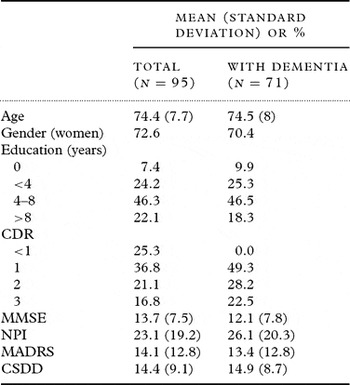
Patients (n = 95) were mostly women with first grade education, and 71 had dementia, most of them in the mild to moderate stage. Alzheimer's disease (n = 29), mixed dementia (n = 26), vascular dementia (n = 12), and Lewy body dementia (n = 4) were the etiological diagnoses for dementia, while mild cognitive impairment was found in 15 patients. Depression was diagnosed in 35 patients according to ICD-10, 30 according to DSM-IV-TR, and 51 of the 71 dementia patients according to PDC-dAD. Table 1 depicts the socio-demographic characteristics and the scale scores of the sample, as well as the caregiver burden.
Demographic characteristics of the total sample and of the subgroup with dementia

CDR = Clinical Dementia Rating Scale; MMSE = Mini-Mental State Examination; NPI = Neuropsychiatry Inventory; CSDD = Cornell Scale for Depression in Dementia; MADRS = Montgomery-Åsberg Depression Rating Scale.
The MADRS and CSDD showed a correlation of 0.46 (p = 0.0001), whereas no other correlation was found between the scales with the NPI.
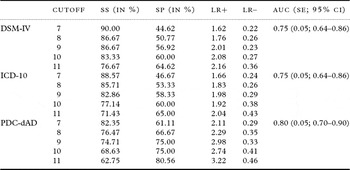
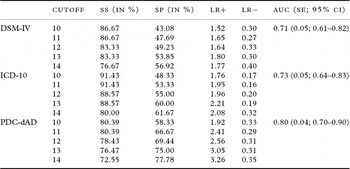
The MADRS cut-off score of 10 was able to diagnose correctly 67.4% and 66.3% patients as depressed according to DSM-IV and ICD-10, whereas a cut-off of 9 correctly identified 74.7% of the patients following the PDC-dAD criteria. The cut-off score of 13 in the CSDD yielded the best sensitivity and specificity to diagnose depression according to DSM-IV and ICD-10, whereas 11 seemed better for diagnosing depression according to PDC-dAD. These cut-offs correctly identified 63.2%, 70.5%, and 74.7%, respectively. The internal consistency measured by Cronbach's α was 0.86 for both scales. The data are summarized in Tables 2 and 3.
Range of MADRS cutoffs according to DSM-IV, ICD-10, and PDC-dAD criteria for depression (n = 95)

SS = sensitivity; SP = specificity; LR+ = positive likelihoods ratio; LR– = negative likelihoods ratio; AUC = area under the curve.
Range of CSDD cut-offs according to DSM-IV, ICD-10, and PDC-dAD criteria for depression (n = 95)

SS = sensitivity; SP = specificity; LR+ = positive likelihoods ratio; LR– = negative likelihoods ratio; AUC = area under the curve.
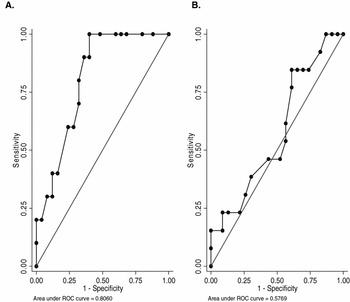
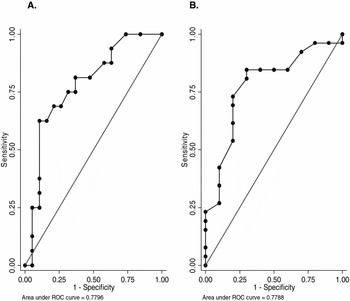
We assessed the MADRS and CSDD cut-off scores only for dementia patients (n = 71) and according to severity of dementia. The MADRS score of 9 was the cut-off which best recognized depression in any of the three diagnostic criteria, whereas the CSDD did not show any change in the cut-off when only dementia patients were considered. However, CSDD was more efficient in showing depression in the mild cases as compared to the moderate/severe dementia groups according to DSM-IV and ICD-10. However, the scale was efficient for any severity stage of dementia to diagnose depression when the PDC-dAD was used. This pattern was not as consistent when we examined the MADRS. Therefore, we decided to show just the CSDD data, which are depicted in Figures 1 and 2. Also, we only display the curves for ICD-10 and PDC-dAD, since DSM-IV curves are similar to ICD-10 ones.
CSDD ROC curves considering the severity of dementia using ICD-10 criteria for depression (A. mild; B. moderate and severe).

CSDD ROC curves considering the severity of dementia using PDC-dAD criteria for depression (A. mild; B. moderate and severe).

Discussion
The present study shows that a MADRS score of 10 and a CSDD score of 13 were the optimal cut-offs to recognize a depressive disorder in a sample of elderly outpatients according to any of the available diagnostic criteria. The only exception was the case of CSDD taking PDC-dAD into account, for which the cut-off was 11, although there was no difference in the CSDD ROC curves for the PDC-dAD criterion when severity of dementia was taken into account. ROC curves better discriminated depression in mild as compared to moderate/severe dementia cases when using DSM-IV and ICD-10 criteria for depression. Despite the difference in cut-offs using the PDC-dAD as compared to the other two diagnostic criteria, there was actually a slight change in all the validity indices. Hence, we have opted to use the MADRS and CSDD cutoffs found for ICD-10 and DMS-IV due to their wider use in clinical practice.
The MADRS cut-offs were lower than the ones found in the available literature on depression in the elderly. In Parkinson's disease, for example, our group has found a cut-off of 10 (Silberman et al., Reference Silberman, Laks, Capitão, Rodrigues, Moreira and Engelhardt2006), whereas other researchers have also provided results of a score of 18 to 20 for diagnosing depression in elderly with and without dementia (Leentjens et al., Reference Leentjens, Verhey, Lousberg, Spitsbergen and Wilmink2000; Slawek et al., Reference Slawek, Derejko and Lass2003). Likewise, our results on CSDD cut-offs do not match with the existing literature in many different settings and cultures. Overall, several studies have found a CSDD cut-off between 5 and 8 for depression in dementia (Alexopoulos et al., Reference Alexopoulos, Abrams, Young and Shamoian1988; Schreiner et al., Reference Schreiner, Hayakawa, Morimoto and Kakuma2003; Barca et al., Reference Barca, Selbaek, Laks and Engedal2008; Reference Barca, Engedal and Selbaek2010). A Chinese study, however, found a 6/7 optimal cut-off score in the mild dementia group and a 12/13 cut-off in the more advanced dementia group (Lam et al., Reference Lam, Lim, Low, Ng, Chiam and Sahadevan2004). Another interesting study, comparing four different depression rating scales, presented data showing that the MADRS and the CSDD were equally consistent in detecting depression in dementia, regardless of the severity stage. However, this study did not try to assess cut-off points, but instead focused on the established scores and the correlation between scales (Müller-Thomsen et al., Reference Müller-Thomsen, Arlt, Mann, Mass and Ganzer2005). In our study, this correlation between MADRS and CSDD was significant and moderate, as was the case in the reported study. Recently, a study based on a large cohort of Spanish elderly has presented evidence that the best CSDD cut-off for depression was >12 considering DSM-IV criteria as the gold standard. The optimal CSDD cut-off score to detect depression according to DSM-IV was calculated using baseline data and assigning equal weight to false-positive and negative results. Using a predefined CSDD cut-off score of >8, the authors found a good sensitivity but lack of specificity to detect a DSM-IV diagnosis of depression, whereas the opposite happened when applying a cut-off score >12 (Porta-Etessam et al., in press).
Although our results on the CSDD cut-offs are rather surprising, given the wealth of data that generally agrees on the issue, we can presently only bring forward some tentative explanations. First, the CSDD is based on caregiver information. As the patients and caregivers were not only screened for depression but also admitted to the outpatient service, caregivers might have provided information so as to somehow force admittance to the unit for their patients. This is possible especially if we consider the cut-off scores of the clinician-based scale, the MADRS, which did not show the same behavior. Another possibility would relate to cultural reasons. Cultural peculiarities may explain several cut-offs to diagnose depression in dementia in different populations (Krause and Goldenhar, Reference Krause and Goldenhar1992; Tran and Dhooper, Reference Tran and Dhooper1997). Some Brazilian and possibly Latin American characteristics might explain why the caregivers are more overt and express more complaints than those in other cultures. Of note, the Spanish study (Porta-Etessam et al., in press) was able to find a cut-off score of 12, quite near to the one we have found to be the optimal one.
This study has some limitations that deserve mentioning. We have gathered information from an outpatient sample, and the results should not be generalized to community-dwelling and/or institutionalized elderly populations. We have been unable to compare our data with other studies in the same cultural setting as ours, since we did not find any published data to date.
To the best of our knowledge, this is the first study on the MADRS and CSDD cut-offs for depression in elderly with and without dementia in Latin America. The MADRS cut-off score of 10 was the optimal one to diagnose depression in elderly with and without dementia. The CSDD cut-off was 13, and this scale was able to recognize depression in patients with mild dementia rather than in elderly with moderate/severe dementia. Since either LR+ was low and LR– high for any cut-off point on both scales, the two tests should be viewed as screening instruments rather than as diagnostic measures in samples similar to ours. Our results certainly have to be discussed and compared in further studies within Brazil and in other Latin American countries. Also, we believe that our results may raise the question of cross-cultural reasons for higher or lower cut-offs to diagnose depression in the elderly taking into account the caregiver report.
Conflict of interest
None.
Description of authors' roles
M.G. Portugal collected the data and drafted the paper. E. Coutinho carried out the statistical analysis and contributed to writing the paper. C. Almeida collected the data and contributed to the writing of the paper. M.L. Barca, A. Knapskog, and K. Engedal contributed to the interpretation of the data and assisted with writing the paper. J. Laks supervised the data collection and wrote with M.G. Portugal all the drafts as well as assisted in the editing of the paper.
Acknowledgments
We thank the Brazilian National Council of Research (CNPq) for supporting the researchers Jerson Laks and Evandro Coutinho.