INTRODUCTION
Habitat fragmentation can lead to reduction in plant population size in remnant fragments (del Castillo et al. Reference DEL CASTILLO, TRUJILLO-ARGUETA, SÁNCHEZ-VARGAS and NEWTON2011), which in turn can affect the genetic structure of plant populations (Hamrick Reference HAMRICK2004) due to genetic drift (Ezard & Travis Reference EZARD and TRAVIS2006, Young et al. Reference YOUNG, BOYLE and BROWN1996). However, whether and how the genetic structure is affected by drift depends on the level of gene flow within and among populations (Choo et al. Reference CHOO, JUENGER and SIMPSON2012, Nason et al. Reference NASON, ALDRICH, HAMRICK, Laurance and Bierregaard1997). Thus, potential fragmentation effects strongly depend on the mating system, pollen and seed dispersal distances and the effective population size of a species (Kettle et al. Reference KETTLE, HOLLINGSWORTH, JAFFRÉ, MORAN and ENNOS2007). For tropical tree species it has been repeatedly shown that gene flow into forest fragments is larger than into comparable areas of continuous forest, through effects on pollen vectors or pollinator behaviour (Dick et al. Reference DICK, HARDY, JONES and PETIT2008, Hamrick Reference HAMRICK, DeWoody, Bickham, Michler, Nichols, Rhodes and Woeste2010, White et al. Reference WHITE, BOSHIER and POWELL2002).
Fragmentation leads to an increase of edge length relative to area in small habitat fragments (Laurance et al. Reference LAURANCE, NASCIMENTO, LAURANCE, ANDRADE, EWERS, HARMS, LUIZÃO and RIBEIRO2007, Murcia Reference MURCIA1995). Edge effects can have serious impacts on species diversity and composition, community dynamics, ecosystem functioning and interactions (Menke et al. Reference MENKE, BÖHNING-GAESE and SCHLEUNING2012, Saunders et al. Reference SAUNDERS, HOBBS and MARGULES1991, Vasconcelos & Luizaõ Reference VASCONCELOS and LUIZÃO2004). However, whether edge effects also extend to the genetic level in trees has rarely been studied. Since gene dispersal and the build-up of small-scale genetic structure (SGS) are often closely associated with seed-dispersal mutualisms (García & Grivet Reference GARCÍA and GRIVET2011), responses of animal seed-dispersers to edge effects may be a major determinant of genetic edge effects. In fragmented tropical forests, both reduced (Kirika et al. Reference KIRIKA, BLEHER, BÖHNING-GAESE, CHIRA and FARWIG2008, Lehouck et al. Reference LEHOUCK, SPANHOVE, VANGESTEL, CORDEIRO and LENS2009) and increased seed removal by avian frugivores have been reported at edges of forest fragments (Farwig et al. Reference FARWIG, BÖHNING-GAESE and BLEHER2006, Menke et al. Reference MENKE, BÖHNING-GAESE and SCHLEUNING2012). Thus, genetic edge effects of animal-dispersed tropical plants are expected; their direction, however, is not easy to predict.
Although Kramer et al. (Reference KRAMER, ISON, ASHLEY and HOWE2008) reported a considerable body of literature that does not show effects of fragmentation on genetic variability in long-lived plant species, these effects may be visible only in some life stages (Ramos et al. Reference RAMOS, DE LIMA, ZUCCHI, COLOMBO and SOLFERINI2010, van Rossum & Triest Reference VAN ROSSUM and TRIEST2006, van Geert et al. Reference VAN GEERT, VAN ROSSUM and TRIEST2008). Considering that fragmentation may have occurred after the adult plants had established, their genotype will reflect historical rather than current genetic patterns. Therefore, only recent cohorts may show consequences of fragmentation (Farwig et al. Reference FARWIG, BRAUN and BÖHNING-GAESE2008). For instance, lower genetic diversity and higher inbreeding and genetic differentiation have been found in seedlings and juveniles than in adults in fragmented forests (Aldrich et al. Reference ALDRICH, HAMRICK, CHAVARRIAGA and KOCHERT1998, Hensen et al. Reference HENSEN, CIERJACKS, HIRSCH, KESSLER, ROMOLEROUX, RENISON and WESCHE2012, Kettle et al. Reference KETTLE, HOLLINGSWORTH, JAFFRÉ, MORAN and ENNOS2007).
The tropical montane forests of South America are considered one of the world's main biodiversity hotspots (Kessler & Beck Reference KESSLER, BECK, Kappelle and Brown2001, Myers et al. Reference MYERS, MITTERMEIER, MITTERMEIER, FONSECA and KENT2000) and have been vastly deforested in many areas, including Bolivia (Killeen et al. Reference KILLEEN, SILES, SORI and BORREA2005). In montane cloud forests Clusia species form a common element (de Roca Reference DE ROCA, Killeen, Beck and Garcia1993). Clusia species depend on animal mutualists for seed dispersal (Gustafsson et al. Reference GUSTAFSSON, WINTER, BITTRICH and Lüttge2007). Thus, changes in seed-dispersal mutualisms between forest edges and forest interior likely influence the population genetic structure of Clusia species. Here, we use Clusia sphaerocarpa and C. lechleri to evaluate genetic variation and SGS in edge and interior populations and we hypothesize that (1) genetic diversity differs and genetic differentiation is present between forest edge and forest interior and that (2) small-scale genetic structure (SGS) differs between forest edge and interior and among age classes.
METHODS
Study species
The species Clusia sphaerocarpa Planch. & Triana and C. lechleri Rusby (Clusiaceae) are common, medium-sized (11 m) trees in montane cloud forests of Bolivia (de Roca Reference DE ROCA, Killeen, Beck and Garcia1993). In the study area, they occur in sympatry in a clumped spatial distribution. They are dioecious, flower between March and July and the fruiting is from December to March. Male flowers of C. sphaerocarpa are c. 5 cm diameter with white petals while in C. lechleri diameter is c. 2.5 cm and petals are light yellow. In both species the female flowers are around c. 1 cm smaller than male flowers. Pollination in Clusia species is mainly carried out by bees collecting resin, but also by beetles, flies, lepidoptera, wasps and hummingbirds (Gustafsson et al. Reference GUSTAFSSON, WINTER, BITTRICH and Lüttge2007). Fruits are globular capsules that dehisce to expose six or seven diaspores in C. sphaerocarpa and five in C. lechleri. The diaspores contain up 12 seeds for C. sphaerocarpa and up to six seeds for C. lechleri (Saavedra, unpubl. data). Due to their red lipid-rich aril, diaspores are primarily dispersed by small-to medium-sized birds, which mainly defecate the seeds. Some of them (e.g. Anisognathus somptuosus, Diglossa cyanea, Myonectes striaticollis) may move between forest fragments. Seeds are not dormant since they germinate directly after fruiting.
Study sites and sampling design
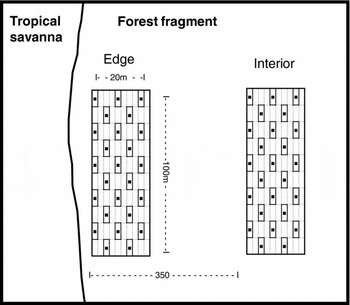
The study was conducted near Chulumani, province South Yungas, La Paz, Bolivia. As a result of the continuous action of anthropogenic fire, this region is characterized by huge deforested areas dominated by the bracken ferns Pteridium aquilinum var. arachnoideum and Lophosoria quadripinnata in the slopes of the valleys (so-called ‘tropical savannas’; Killeen et al. Reference KILLEEN, SILES, SORI and BORREA2005) and forest mainly remains on the montane tops and in gorges. The cover of the forest is further fragmented to grow coca, coffee and citrus fruits (Killeen et al. Reference KILLEEN, SILES, SORI and BORREA2005). There is no exact information about the age of the fragments but information from local people indicates that the latest fires at edges can have happened no more than 5 y ago. The two Clusia species are quite common in the study area with densities of around 42 and 105 adult trees ha−1. We sampled at two sites in fragments of c. 200 ha (site 1: 16°23′35.26″S, 67°33′44.26″W, 2440 m asl; site 2: 16°24′43.29″S, 67°34′03.34″W, 2450 m asl), and located at a distance of 2 km from each other. At each site, we installed a plot of 100 × 20 m in two habitat types: forest edge (3 m into the forest) and forest interior (300–400 m from the edge). Each plot was divided in 100 subplots of 2 × 10 m (Figure 1) in order to obtain accurate distances among individual for the analysis. We considered three age classes: seedlings (dbh ≤ 10 cm), juveniles (dbh > 10 cm and < 30 cm) and adults (dbh > 30 cm or flowering/fruiting). We counted, mapped and sampled all adult trees within the whole plot and we included adult trees as potential parents in a buffer area of 20 m around the plot. Juveniles were mapped and sampled in 25 regularly spaced subplots of 2 × 10 m (Figure 1). Seedlings were sampled in each of these subplots in a randomly positioned 1 × 1-m area. We collected fresh leaves of all mapped individuals and stored them separately in plastic bags with silica gel until further genetic analysis.
Schematic representation of the study design at two sites (forest fragments) of a Bolivian montane forest. At each site, we compared interior and edge plots adjacent to the deforested habitat matrix. Adults were sampled in the whole plot of 100 × 20 m and surroundings (20-m buffer). Juveniles were sampled in the smaller 25 subplots of 2 × 10 m inside of the whole plot and seedlings were sampled in subplots of 1 × 1 m randomly positioned inside of the subplots for juveniles.

DNA extraction and microsatellites analysis
The extraction method followed a standard protocol (Doyle & Doyle Reference DOYLE and DOYLE1987) with modifications (Hensen et al. Reference HENSEN, TEICH, HIRSCH, VON WEHRDEN and RENINSON2011). The individuals were genotyped using eight microsatellite markers (Clm1, Clm2, Clm5, Cln2, Cln5, Cln3, Cln7 and Cln8) previously developed from C. minor and C. nemorosa (Hale et al. Reference HALE, SQUIRRELL, BORLAND and WOLFF2002). Amplification was performed with 25 μl of reaction medium containing 1 μl of DNA (20 ng μl−1), 0.8 μl (1 μl Cln8) of fluorescence labelled forward primer (5 pmol μl−1) and 0.8 μl (1 μl Cln8) of reverse primer (5 pmol μl−1) (metabion international, AG, Germany), 2.5 μl 2 mM dNTPs (QBiogene), 2.5 μl polymerase buffer with 2 μl (1.5 μl Clm1) MgCl2 (Qbiogene), 0.2 μl (0.125 μl Cln8) Taq polymerase (Fermentas) and 13.6 μl (15.7 μl Clm1, 14.9 μl Cln8) double-distilled H2O. For primers Clm1, Clm2 and Clm5 the PCR program was 94 °C for 3 min followed by 35 cycles with 30 s of denaturation at 94 °C, 30 s of annealing at 50 °C (55 °C for Cln2, Cln5 and Cln8), a 60-s elongation step at 72 °C, and a final elongation at 72 °C for 3 min in a Mastercycler (Eppendorf). For primers Cln3 and Cln7 the PCR program was 95 °C for 12 min followed by 10 cycles with 15 s at 94 °C, 15 s at 55 °C, 15 s at 72 °C, followed by 30 cycles with 15 s at 89 °C, 15 s at 55 °C, and 15 s at 72 °C and a final elongation at 72 °C for 10 min. PCR products were diluted 1 : 5 (1 : 10 for Clm2 and Clm5) and separated using capillary electrophoresis (MegaBace 1000, Amersham Bioscience, Uppsala, Sweden) with MegaBACE-ET ROX 400 (Amersham Bioscience) as a size standard. We used the MegaBace Fragment Profiler Software 1.2 (Amersham Bioscience) for genotyping.
Species identification
Since Clusia sphaerocarpa and C. lechleri co-occur in the plots and have similar vegetative characteristics, species identification was impossible in the field for non-flowering individuals. Therefore, we used the genotype data and applied Bayesian clustering of all individuals for the identification using the software STRUCTURE v. 2.3.3 (available at http://pritch.bsd.uchicago.edu/structure.html). STRUCTURE assigns individuals into genetically homogeneous clusters without prior knowledge of their affiliation. For all individuals, we carried out 10 independent runs per K using a burn-in period of 50 000 and collected data for 50 000 iterations for K = 1 to 5. We used the individual Q-values of the analysis at K = 2. Bayesian clustering of all 669 Clusia individuals identified two clusters that clearly distinguished the two species with membership coefficient of 0.937 of C. sphaerocarpa and C. lechleri for the two clusters respectively. We thus used the Q-values for K = 2 to assign individuals to species using 0.8/0.2 as a threshold to distinguish pure species from putative hybrids. Individuals identified in field fell in the correct resulting group by STRUCTURE. Finally, we obtained 434 individuals for C. sphaerocarpa (191 seedlings, 142 juveniles, 101 adults) and 196 individuals for C. lechleri (123 seedlings, 20 juveniles, 53 adults); 39 putative hybrid seedlings and juveniles (site 1 with 10 at the edge and 11 in the interior, site 2 with 12 and 6 respectively) were excluded from further analyses.
Population genetic analysis
We investigated genetic diversity and differentiation for both species at the habitat level (edge vs. interior) and for C. sphaerocarpa also at the level of age classes as it had sufficient sample size. Genetic diversity within populations was characterized by expected and observed heterozygosity (H e, H o) and fixation index (FIS) using Genealex v. 6.5 (available at http://biology.anu.edu.au/GenAlEx/Welcome.html). To allow comparison between populations, that differed in sample sizes, we computed allelic richness (Ar), obtained with a rarefaction method (Hurlbert Reference HURLBERT1971) with identical sample size in FSTAT v.2.9.3.2 (available at http://www2.unil.ch/popgen/softwares/fstat.htm). Genetic differentiation was analysed by two approaches. First, as genetic differentiation among all populations estimated as G ST (Nei Reference NEI1987) with FSTAT v.2.9.3.2 and a non-hierarchical analysis of molecular variance (AMOVA). Second, we used hierarchical AMOVA to jointly assess differentiation among sites and habitats. For C. sphaerocarpa, we combined data of the two sites that were not differentiated and jointly assessed differentiation among habitats and age classes. AMOVA analyses were performed with GenAlex v. 6.5, with 999 permutations.
Small-scale genetic structure (SGS) was investigated both at the species level and for C. sphaerocarpa at the level of habitat (edge vs. interior) and age class (seedlings, juveniles and adults). These latter analyses could not be performed for C. lechleri due to low sample size. The SGS analyses included all age classes at species and habitat level. For all analyses, we used distance class limits of 10, 20, 30, 50, 90 and 200 m in order to assure a sufficient number of pairs of individuals per distance class. We applied two approaches to evaluate SGS. First, we used spatial genetic autocorrelation of correlation coefficients among genetic and spatial distance matrices in GenAlex v. 6.5 (Smouse et al. Reference SMOUSE, PEAKALL and GONZALES2008). Where appropriate, 999 permutations were performed. As suggested by Banks & Peakall (Reference BANKS and PEAKALL2012), significance of the heterogeneity test can be declared when P < 0.01. Second, we used spatial genetic autocorrelation of pairwise kinship coefficients (Fij) (Loiselle et al. Reference LOISELLE, SORK, NASON and GRAHAM1995) in SPAGeDi v. 1.3d (available at http://ebe.ulb.ac.be/ebe/SPAGeDi.html) to quantify SGS with the Sp statistic. Sp was calculated as Sp = −blog/(1−F (1)), where blog is the slope of the regression of kinship coefficients on log geographic distance and F (1) is the mean kinship coefficient between individuals of the first distance class. Following Fenster et al. (Reference FENSTER, VEKEMANS and HARDY2003) and Michalski & Durka (Reference MICHALSKI and DURKA2012), we calculated approximate confidence intervals of Sp using b log ± twice the SE of b log estimated by jack-knifing over loci.
RESULTS
Genetic diversity and population structure
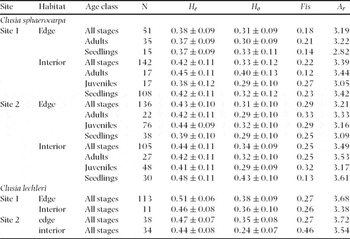
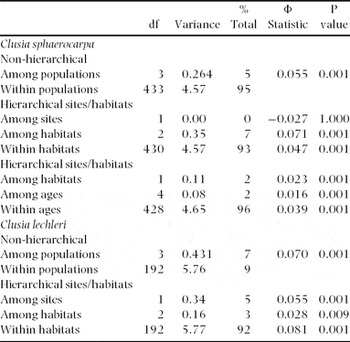
Genetic diversity of C. sphaerocarpa and C. lechleri was high in all sites and habitats (Table 1). FIS values did not show a consistent variation either between habitats or among class ages. FIS values were positive, indicating lack of heterozygotes, most likely due to null alleles, which are commonly found when microsatellites are transferred between species.Values of allelic richness were very similar across sites, habitats and age classes. Considering all populations, genetic differentiation among populations was low but significant with overall G ST = 0.038 and ΦRT = 0.055 (P = 0.001) for C. sphaerocarpa and G ST = 0.033 and ΦRT = 0.070 (P = 0.001) for C. lechleri. In a hierarchical AMOVA, C. sphaerocarpa was not significantly differentiated among sites, but 7% of variation resided among habitats (Table 2). In contrast, C. lechleri, was differentiated both among sites (5% of variation) and among habitats (3%). When habitat and age were analysed in C. sphaerocarpa, both habitat and age were differentiated with a variation of 2% (ΦRT_habitats = 0.023, P = 0.001; ΦRT_ages = 0.016, P = 0.001) (Table 2).
Genetic diversity of Clusia sphaerocarpa and C. lechleri at two sites (forest fragments) in a montane forest near Chulumani, South Yungas, Bolivia. Comparison of habitats (edge vs. interior) in each site and only for C. sphaerocarpa, of age classes (adults, juveniles and seedlings). Ar was obtained with a rarefaction sample size of 11.

Analysis of molecular variance (AMOVA) for Clusia sphaerocarpa and C. lechleri among two sites (forest fragments), habitats (edge vs. interior) and only for C. sphaerocarpa, at age classes (adults, juveniles and seedlings) in a Bolivian montane forest (Chulumani, South Yungas).

Small-scale genetic structure
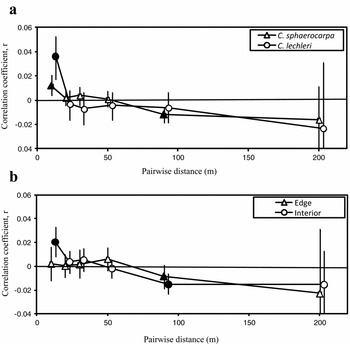
Small-scale spatial genetic autocorrelation was observed at the species level for both C. sphaerocarpa (ω = 39.0; P = 0.001) and C. lechleri (ω = 31.1; P = 0.004). In both species, positive autocorrelation was detected only in the first distance class (10 m; Figure 2a). Separate analyses at the habitat level revealed significant spatial structure for C. sphaerocarpa in interior plots (ω = 43.2; P = 0.001) but not so in edge populations (ω = 21.3; P = 0.045). This was due to a higher autocorrelation coefficient in the first distance class in interior habitats (Figure 2b). The analysis across age classes in C. sphaerocarpa showed a significant spatial structure for both seedlings (ω = 39.5; P = 0.002) and juveniles (ω = 28.9; P = 0.009) but not so for adults (ω = 21.9; P = 0.06).
Significant small-scale spatial genetic autocorrelation (SGS) of Clusia sphaerocarpa and C. lechleri in edge and interior populations at two sites (forest fragments) in a Bolivian montane forest was detected in the first distance class (a) and, for C. sphaerocarpa, in the interior plots (b). The analysis includes individuals of all age classes. Filled symbols denote individually significant (P < 0.05) spatial autocorrelation, empty symbols indicate non-significant values. Error bars bound the 95% confidence interval as determined by bootstrap resampling.

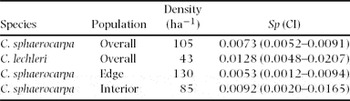
The Sp values indicated overall weak SGS (Table 3) which tended to be lower in C. sphaerocarpa (Sp = 0.0073) than in C. lechleri (Sp = 0.0128). For C. sphaerocarpa, Sp values were slightly higher in the forest interior (0.0092) than in the forest edge (0.0053).
Estimates of small-scale genetic structure (Sp) of Clusia sphaerocarpa and C. lechleri in two sites (forest fragments) of a Bolivian montane forest (Chulumani, South Yungas) comparing edge and interior forest in each site. Density was extrapolated from plots of 100 × 20 m. CI = confidence intervals.

DISCUSSION
Edge and fragmentation effects
Neither sympatric Clusia species showed differences in genetic diversity between populations at the edge and in the interior of forest fragments. This finding essentially shows that the investigated populations and fragments are still large enough to maintain genetic diversity and had not yet undergone strong genetic drift. In fact, the forest fragments analysed are large and the two Clusia species are quite common in the study area. The temporal maintenance of genetic diversity is additionally fostered by life-history traits such as the outcrossing breeding system of the dioecious species and the longevity of the trees which allows for transgenerational gene flow (Bawa Reference BAWA1992, Kramer et al. Reference KRAMER, ISON, ASHLEY and HOWE2008). Our study is also in line with Ramos et al. (Reference RAMOS, DE LIMA, ZUCCHI, COLOMBO and SOLFERINI2010) who reported no significant differences in genetic diversity neither for Psychotria tenuinervis nor for Guarea guidonia among fragment interior, natural and anthropogenic edge areas in an Atlantic Forest. Similarly, genetic diversity was similarly high in populations of Prunus africana growing in forest fragments and in continuous forests (Farwig et al. Reference FARWIG, BRAUN and BÖHNING-GAESE2008).
Both Clusia species showed low but significant levels of genetic differentiation among populations. Differentiation was in the range previously observed for outcrossing tropical and subtropical tree species studied with microsatellites (Debout et al. Reference DEBOUT, DOUCET and HARDY2011, Shi et al. Reference SHI, MICHALSKI, CHEN and DURKA2011). The hierarchical AMOVA showed that in C. sphaerocarpa this differentiation does not exist between sites but between edge and interior habitats, indicating that edge effects may extend to the genetic level via effects on gene flow (Lowe et al. Reference LOWE, BOSHIER, WARD, BACLES and NAVARRO2005). According to Dick et al. (Reference DICK, HARDY, JONES and PETIT2008), low population density together with density-dependent animal pollination contributes to population genetic differentiation in tropical forest trees. Thus, differences in population density of the studied Clusia species and composition and activity of animal pollinators between edge and interior in our study area (Kambach et al. Reference KAMBACH, GUERRA, BECK, HENSEN and SCHLEUNING2013) could foster genetic differentiation between habitats. In C. sphaerocarpa, age classes were also slightly differentiated indicating that not all resident adults were similarly represented in the offspring gene pool. Other studies have also shown that fragmentation has effects on genetic structure and differ among age classes. In Prunus africana, differentiation was higher in seedlings than in adults (Farwig et al. Reference FARWIG, BRAUN and BÖHNING-GAESE2008) and in Symphonia globulifera only populations of seedlings were genetically differentiated (Aldrich et al. Reference ALDRICH, HAMRICK, CHAVARRIAGA and KOCHERT1998). Thus, the seedling generation may be more sensitive than adults to indicate fragmentation effects.
Small-scale genetic structure
Our results showed significant albeit weak SGS for both Clusia species. The Sp values quantifying SGS were typical for outcrossing species (Kloss et al. Reference KLOSS, FISCHER and DURKA2011, Michalski & Durka Reference MICHALSKI and DURKA2012) and in particular for trees (Vekemans & Hardy Reference VEKEMANS and HARDY2004, Shi et al. unpubl. data). SGS is expected to be weak in plant species with high adult densities, high pollen dispersal distances, overlapping seed shadows and homogeneous distribution of suitable recruitment sites (Dyer Reference DYER2007, Hamrick & Nason Reference HAMRICK, NASON, Rhodes, Chesser and Smith1996, Hamrick et al. Reference HAMRICK, MURAWSKI and NASON1993). Thus, several life-history traits contributed to the weak SGS in Clusia. First, the high density of adults which reduces the distance between flowering and fruiting trees and produces overlapping pollen clouds and seed shadows (Doligez et al. Reference DOLIGEZ, BARIL and JOLY1998, Gonzales et al. Reference GONZALES, HAMRICK, SMOUSE, TRAPNELL and PEAKALL2010). Second, pollination by a large guild of insects and birds which supports long-distance pollen dispersal (Gustafsson et al. Reference GUSTAFSSON, WINTER, BITTRICH and Lüttge2007, Kettle et al. Reference KETTLE, HOLLINGSWORTH, BURSLEM, MAYCOCK, KHOO and GHAZOUL2011). Finally, seed dispersal by frugivorous birds is efficient in Clusia and will also blur SGS (García & Grivet Reference GARCÍA and GRIVET2011, Hamrick & Trapnell Reference HAMRICK and TRAPNELL2011).
In both species, positive genetic autocorrelation up to a distance of 10 m was detected. In C. sphaerocarpa, SGS was more pronounced in the two early life stages than in adult trees. This suggests that while gene flow in general prevents the build-up of local SGS, locally, more closely related individuals have established, likely influenced by demographic thinning between life stages. In other Clusia species a clumped spatial distribution was associated with the dispersal of diaspores containing multiple seeds (Bittrich & Amaral Reference BITTRICH and AMARAL1996). Thus, contiguous establishment of codistributed halfsibs may lead to local SGS. Seeds of Clusia are also displaced secondarily by ants (Passos & Oliveira Reference PASSOS and OLIVEIRA2002) which has also been observed in the study area (Gallegos, unpubl. data). Ants move seeds over short distances and may increase recruitment success by dispersing seeds to suitable establishment sites (Hanzawa et al. Reference HANZAWA, BEATTIE and CULVER1988, Passos & Oliveira Reference PASSOS and OLIVEIRA2002). However, it is difficult to predict whether ant-mediated secondary seed dispersal will lead to strong or weak SGS as it may increase establishment success of closely related bird-dispersed halfsibs but may also lead to small-scale mix of seeds from different bird droppings.
In C. sphaerocarpa, we found significant SGS and higher Sp values for populations in the forest interior compared with forest edges. This may be due to two non-exclusive factors. First, it is consistent with the interior population having lower adult densities. Second, an edge effect of enhanced gene flow that could be mediated by increased pollinator or seed-disperser activities. An analysis of pollinator guilds in our study area found an increase in bee species richness and abundance from forest interior to deforested habitat types (Kambach et al. Reference KAMBACH, GUERRA, BECK, HENSEN and SCHLEUNING2013). At forest edges, bee richness and abundance tended to be higher than in the forest interior (Kambach et al. Reference KAMBACH, GUERRA, BECK, HENSEN and SCHLEUNING2013). Higher acitivity of pollinators and increased pollen flow would be consistent with the observed edge effect on SGS in this study. This is also supported by the trend to a higher gene flow by long-distance pollen movement in disturbed and isolated trees reported for Swietenia humilis in tropical dry forest (White et al. Reference WHITE, BOSHIER and POWELL2002). Similarly, frugivorous birds may congregate at forest edges, leading to an increase in seed removal rates (Menke et al. Reference MENKE, BÖHNING-GAESE and SCHLEUNING2012). Similar patterns of an increase in frugivore activity at forest edges have been found in the study area (Saavedra, unpubl. data). It is therefore likely that the SGS of populations of Clusia is blurred at forest edges because these populations receive higher gene flow than those in the forest interior, mediated by both increased pollination and seed-dispersal functions at forest edges.
In conclusion, our study provides evidence for edge effects in populations of Clusia species because edge and interior populations were genetically differentiated and weak patterns of SGS were wiped out at forest edges. These effects were most likely due to changes in plant–animal mutualisms at forest edges and an associated increase in pollination and seed-dispersal functions. While levels of genetic diversity were not affected in the large populations of Clusia, changes in the patterns of genetic structure suggest that changes in biotic interactions at forest edges extend to the genetic level in Clusia populations. Considering the importance of Clusia as a common element in montane forests, modified genetic structures at the edges of forest remnants are relevant for future conservation measures.
ACKNOWLEDGEMENTS
We thank the local participants of the community Chulumani who allowed and collaborated to our research. We also thank Humbert Alberto and Marcelo Reguerin for assisting field work, Birgit Mueller, Matthias Hartmann and Arely Palabral for assisting laboratory work and the Herbario Nacional de Bolivia for the technical support. Alfredo Fuentes advised species identification. This study was funded by the German Academic Exchange Service (DAAD) and by the DFG project Regeneration of Tropical Montane Forest Species at Burned Sites in the Eastern Cordillera of Bolivia (HE3041/20-1). M.S. was also supported by the research funding program Landes-Offensive zur Entwicklung Wissenschaftlich-ökonomischer Exzellenz (LOEWE) of Hesse's Ministry of Higher Education, Research, and the Arts.