Introduction
Epidemiological and experimental studies have shown that the growth profile of an individual before birth and in early infancy confers a predisposition to obesity and metabolic disease later in life.Reference Pietilainen, Kaprio and Rasanen1–Reference McMillen and Robinson5 These studies have shown that the individuals at greatest risk of poor metabolic outcomes are those who grow poorly before birth [intrauterine growth restriction (IUGR)], as a result of poor intrauterine nutrition and/or placental insufficiency, and then undergo a period of rapid ‘catch-up’ growth in early postnatal life.Reference Parsons, Power, Logan and Summerbell2, Reference Flanagan, Moore and Godsland6 A series of experimental animal studies have shown that the development of insulin resistance in IUGR offspring is preceded by a period of enhanced whole-body insulin sensitivity.Reference Ozanne7, Reference De Blasio, Gatford, McMillen, Robinson and Owens8 The mechanisms that underlie the switch from increased insulin sensitivity to later insulin resistance in peripheral tissues remain unclear.
The association between IUGR, rapid postnatal growth and an increased risk of metabolic disease is thought, at least in part, to be the result of an increased accumulation of adipose tissue in visceral adipose depots.Reference Fall, Osmond and Barker4, Reference Malina, Katzmarzyk and Beunen9 In rodents, growth restriction induced by a maternal low protein diet is associated with higher basal glucose uptake and increased insulin receptor (IR) abundance, as well as basal and insulin-stimulated insulin receptor substrate-1 (IRS-1) associated phosphatidyl inositol 3-kinase (PI3 K) activity, in visceral adipocytes from 3-month-old offspring.Reference Ozanne, Nave and Wang10 At 15 months of age, the adipocytes from low-protein diet offspring exhibit a higher basal glucose uptake, however, activation of PI3 K and Protein Kinase B (PKB/Akt) is reduced.Reference Ozanne, Dorling, Wang and Nave11 These findings suggest that there is a switch from increased insulin sensitivity in the adipocytes in early life to an insulin resistant phenotype in adult life in offspring exposed to growth restriction in utero.
We have previously used an experimental model of restricted placental growth in the sheep that results in IUGR lambs which undergo accelerated postnatal ‘catch-up’ growth.Reference Muhlhausler, Duffield and Ozanne12 It has also been demonstrated that these IUGR lambs have an increased peripheral insulin sensitivity in the early postnatal period and a higher visceral fat mass by 45 days of age.Reference De Blasio, Gatford, McMillen, Robinson and Owens8 In a recent study, we showed that there was a greater abundance of IRs and insulin signaling molecules in the skeletal muscle of IUGR lambs undergoing catch-up growth.Reference Muhlhausler, Duffield and Ozanne12 It is not known, however, whether there is a similar increase in insulin signaling within visceral adipose depots, such as the omental depot, following growth restriction in utero.
The rate of fat accumulation within adipose cells is not only regulated by the insulin sensitivity of the fat depot, but also by the availability of substrate, and the expression and activity of adipogenic and lipogenic genes. Insulin sensitivity, in turn, is determined by both the abundance of the IRs and downstream signaling molecules and the actions of accessory molecules, including the metabolic master switch AMP-activated protein kinase (AMPK).Reference Daval, Foufelle and Ferre13, Reference Hardie, Hawley and Scott14 AMPK is activated by a reduction in cellular energy stores, resulting in a downregulation of energy consuming processes within these cells.Reference Hardie, Hawley and Scott14 In adipocytes, activation of AMPK acts to limit fatty acid efflux from adipocytes by suppressing lipolysis and lipogenesis and favoring fatty acid oxidation.Reference Daval, Foufelle and Ferre13 The key adipogenic and lipogenic enzymes which act to stimulate fat accumulation include peroxisome proliferator activated receptor-γ (PPARγ), glycerol-3-phosphate dehydrogenase (G3PDH) and lipoprotein lipase (LPL).Reference Kersten15 The impact of IUGR on the expression of these genes in omental adipose tissue has not yet been determined.
The aim of the present study, therefore, was to determine the impact of IUGR on mRNA expression and protein abundance of the insulin signaling molecules in omental adipose tissue in the IUGR lamb. We have also determined whether IUGR results in altered activity of AMPK or mRNA expression of key adipogenic and lipogenic enzymes in the visceral adipocyte at 21 days of age, that is, well before weaning and before the onset of increased visceral adiposity. A secondary aim was to determine whether these effects were sex-specific, since there is evidence that the long-term effects of IUGR are more strongly expressed in males than in females.Reference Flanagan, Moore and Godsland6, Reference Laitinen, Pietilainen, Wadsworth, Sovio and Jarvelin16, Reference Duffield, Vuocolo and Tellam17
Methods
Animals and surgery
All procedures were approved by The University of Adelaide Animal Ethics Committee. Twenty three singleton bearing Merino ewes were used in this study. Nine non-pregnant ewes underwent surgery to remove the majority of endometrial caruncles from the uterus, leaving three to eight caruncles in each horn in order to induce IUGR by experimental restriction of placental and fetal growth.Reference Edwards, Simonetta, Owens, Robinson and McMillen18, Reference Morrison, Botting and Dyer19 After a recovery period, ewes were mated, and pregnancy confirmed in early gestation. Pregnant ewes that did not undergo carunclectomy surgery were used as Controls (n = 14).
From around 109-days gestation, all ewes were housed in individual pens in rooms in an indoor housing facility with a 12 h light/dark cycle and a daily temperature of ∼20°C. Each pregnant ewe was supplied with a diet, which consisted of 1 kg lucerne chaff (85% dry matter, metabolizable energy (ME) content = 8.3 MJ/kg) and 500 g concentrated pellets containing: straw, cereal, hay, clover, barley, oats, lupins, almond shells, oat husks and limestone (90% dry matter, ME content = 8.0 MJ/kg; Johnsons and Sons, Kapunda, SA, Australia). The diet was calculated to provide 100% of the energy requirements for the maintenance of a pregnant ewe bearing a singleton fetus, as specified by the Ministry of Agriculture, Fisheries and Food, UK.Reference Aldermann, Morgan, Harvard, Edwards and Todd20 After giving birth to her lamb, the ewe was fed 1 kg of lucerne chaff and 1 kg of concentrated pellets at 0900–1100 h each day in order to meet the additional energy demands of lactation.Reference Aldermann, Morgan, Harvard, Edwards and Todd20 If the ewe consumed all of her morning feed ration before 1500 h, then an additional 1 kg of lucerne chaff was provided to the ewe on that day. After birth, each ewe and her lamb were housed in an individual pen in the same indoor housing facility.
All lambs born to ewes that underwent placental restriction were confirmed as being IUGR, based on a birth weight that was >2 SD below the mean birth weights of a separate cohort of Control singleton lambs (n = 45) studied in this laboratory over the preceding 5 years (IUGR: < 4.3 kg). Similarly, all lambs born to Control ewes were normally grown, defined as a birth weight within 2 SD of the mean of the same cohort (Control: 4.5–6.7 kg).Reference Duffield, Vuocolo and Tellam17
After birth, Control (n = 14, 8 males, 6 females) and IUGR (n = 9, 5 males, 4 females) lambs were weighed and measured daily between 1000 and 1400 h. Venous blood samples were collected in chilled tubes after ∼60 min of non-suckling on alternate days between 0900 and 1300 h, beginning on the day of birth (day 1). All blood samples were centrifuged at 1500 g for 10 min, and plasma stored at –20°C. On postnatal day 21, lambs were humanely killed with an overdose of sodium pentobarbitone (Virbac Pty Ltd, Peakhurst, NSW, Australia) and samples of omental adipose tissue were dissected. One sample of omental adipose tissue was fixed in 4% paraformaldehyde for subsequent processing and determination of fat cell size as previously described.Reference Muhlhausler, Roberts, McFarlane, Kauter and McMillen21 A second sample was snap frozen in liquid N2 and stored at –80°C for subsequent determination of gene expression by qRT-PCR. All tissue collections were performed by the same investigator in order to ensure consistency of the sampling site. All other fat depots (perirenal, retroperitoneal, epigonadal, axillary, pericardial, interscapular, subcutaneous) were also dissected out and weighed, and the combined weight of all these depots was used as a measure of total body fat mass. Detailed information on the phenotype of the lambs and effects of IUGR on growth and gene expression profile in the perirenal adipose depot,Reference Duffield, Vuocolo and Tellam17 skeletal muscleReference Muhlhausler, Duffield and Ozanne12 and heartReference Wang, Zhang and McMillen22 have been published previously. There was no effect of IUGR on either total relative fat mass or the relative mass of the perirenal or subcutaneous fat depot.Reference Duffield, Vuocolo and Tellam17
Plasma non-esterified fatty acids (NEFAs), glucose and insulin assays
Plasma NEFAs were measured by an in vitro enzymatic colorimetric method (Wako Pure Chemicals Industries Ltd, Osaka, Japan). The sensitivity of the assay was 0.25 mEq/l and the intra- and inter-assay coefficients of variation were both <10%. Plasma glucose was measured by an in vitro enzymatic colorimetric method (COBAS MIRA automated analysis system, Roche Diagnostica, Basel, Switzerland). The sensitivity of the assay was 0.01 mmol/l. Plasma insulin concentrations were measured using a radioimmunoassay (Linco Research, Inc., Missouri, USA) previously validated for sheep plasma.Reference Muhlhausler, Adam, Findlay, Duffield and McMillen23 The sensitivity of the assay was 0.1 ng/ml. The intra- and inter-assay CV for the glucose and insulin assays were each <10%.
Isolation of RNA, production of cDNA and qRT-PCR analysis
RNA was extracted from ∼100 mg of omental adipose tissue (Trizol reagent, Invitrogen Australia Pty Limited, Australia) from all lambs. RNA was purified using the RNeasy Mini Kit (QIAGEN, Basel, Switzerland). The quality and concentration of the RNA was determined by measuring absorbance at 260 and 280 nm, and RNA integrity confirmed by agarose gel electrophoresis. cDNA was synthesized using the purified RNA (∼2 μg) and Superscript 3 reverse transcriptase (Invitrogen Australia Pty Limited, Mount Waverley, Australia) with random hexamers.
The relative expression of mRNA transcripts of the AMPK (α1 and α2), IR (IRA and IRB), GLUT-1, GLUT-4, leptin, adiponectin, PPARγ, LPL, G3PDH, as well as the housekeeper gene acidic ribosomal protein large subunit P0 (RPPO) were measured by quantitative real-time reverse transcription-PCR (qRT-PCR) using the Sybr Green system in an ABI Prism 7500 Sequence Detection System (PE Applied Biosystems, Foster City, CA, USA).
All primer sequences have been published previously and validated for use in sheep tissues.Reference Muhlhausler, Duffield and Ozanne12, Reference Duffield, Vuocolo and Tellam24, Reference Philp, Muhlhausler and Janovska25 Each amplicon was sequenced to ensure the authenticity of the DNA product and a dissociation melt curve analysis was performed after each run to demonstrate amplicon homogeneity. Each qRT-PCR reaction well contained: 5 μl Sybr Green Master Mix (PE Applied Biosystems, Foster City, CA, USA); 2 μl primer (forward and reverse), 2 μl molecular grade H20 and 1 μl of cDNA (50 ng/μl). Controls for each sample containing no cDNA were also used to confirm the absence of DNA contamination. The cycling conditions consisted of 40 cycles of 95°C for 15 min and 60°C for 1 min.
The abundance of each mRNA transcript was measured and expression relative to RPPO were calculated using the Q-gene qRT-PCR analysis software, which provides a quantitative measure of the relative abundance of a specific transcript in different tissues by the comparative threshold cycle (C t) method which takes into account any differences in the amplification efficiencies of the target and reference genes. The C t value was taken as the lowest statistically significant (>10 SD) increase in fluorescence above the background signal in an amplification reaction. There was no effect of IUGR or sex of the lambs on the expression of the housekeeper gene, RPPO.
Determination of protein abundance
The abundance of protein for the AMPKα1, AMPKα2, total AMPK and Phospho-AMPKα and insulin signaling molecules were determined using Western Blotting protocols described in detail previously.Reference Philp, Muhlhausler and Janovska25 Briefly, tissue samples (∼150–200 mg) were homogenized in lysis buffer and equal volumes of protein (10 μg) were subjected to SDS-PAGE, transferred to polyvinylidene difluoride membrane (Millipore, MA, USA) and then incubated with primary antibody against: insulin receptor β subunit (IRβ), PI3Kinase p85, Akt1, Akt2, Ser473 phosphoAKT, protein kinase C zeta (PKCξ) and GLUT4Reference Forhead, Lamb and Franko26 or AMPKα1, AMPKα2, total AMPKα (which detects both the α1 and α2 isoforms) or phospho-AMPKα (Cell Signaling Technology, Boston, USA).Reference Philp, Muhlhausler and Janovska25 The relative proportion of total-AMPKα in the phosphorylated form was calculated by dividing the abundance of phospho-AMPK by total AMPK abundance in the tissue sample (%phospho-AMPKα). This ratio provided a measure of the proportion of AMPKα in the phosphorylated form for each experimental animal, and thus a measure of baseline AMPKα activity.Reference Philp, Muhlhausler and Janovska25, Reference Park, Gammon and Knippers27, Reference Steinberg, Rush and Dyck28
Statistical analyses
All data are presented as mean ± standard error of the mean (s.e.m.).
Daily growth rate (%) was calculated as body weight gained per day as a percentage increase from the previous days’ body weight ((Body Weightn/Body Weightn −1 × 100) − 100)%.Reference Duffield, Vuocolo and Tellam17 The effects of IUGR and sex on mRNA and protein abundance were determined using two-way analysis of variance (ANOVA). In the presence of an interaction between the effects of IUGR and lamb sex, the effects of IUGR were determined separately in male and female lambs. Relationships between variables were determined using linear regression and partial correlation analyses. A probability <5% (P < 0.05) was accepted as statistically significant. All analyses were performed using SPSS for Windows Version 16 (SPSS Inc., Chicago, USA).
Results
IUGR, postnatal growth and glucose, NEFA and insulin concentrations
As reported previously,Reference Duffield, Vuocolo and Tellam17 IUGR lambs were lighter at birth (Control, 5.86 ± 0.12 kg; IUGR, 3.76 ± 0.17, P < 0.001) and had a higher fractional growth rate during the first 3 weeks of postnatal life (Control, 4.26 ± 0.14%; IUGR, 5.26 ± 0.16%, P < 0.01) when compared with Control lambs. The body weight of IUGR lambs was, however, still lower than Control lambs at 21 days of age (Control, 13.22 ± 0.17 kg; IUGR, 10.00 ± 0.40 kg, P < 0.01).
Mean plasma NEFA concentrations during the first 3 weeks after birth were lower in IUGR than Control lambs, but there were no differences in plasma glucose or insulin concentrations between groups in either males of females.Reference Duffield, Vuocolo and Tellam17
IUGR, insulin and omental fat deposition
There was no effect of IUGR on either the total or relative mass of omental fat at 21 days of age in either males (total omental fat mass: Control, 81.3 ± 10.0 g; IUGR, 74.5 ± 8.6 g; relative omental fat mass, Control, 6.06 ± 0.76 g/kg; IUGR, 7.37 ± 0.74 g/kg) or females (total omental fat mass: Control, 72.6 ± 8.3 g; IUGR, 78.7 ± 20.7 g; relative omental fat mass, Control, 5.60 ± 0.60 g/kg; IUGR, 8.02 ± 2.10 g/kg). There was also no difference in the mean size of omental adipocytes between Control and IUGR lambs in either males (Control, 1566 ± 146 μm2; IUGR, 1762 ± 350 μm2) or females (Control, 1675 ± 177 μm2; IUGR, 1534 ± 219 μm2).
When data from all lambs were combined, there was a direct relationship between insulin concentrations in the first 24 h after birth and omental fat cell size at 21 days of age (omental fat cell size = 202 insulin + 1123; r 2 = 0.31, P < 0.03) and this relationship persisted after controlling for the effect of birth weight and NEFA concentrations during this period.
IUGR and the abundance of the insulin signaling molecules and glucose transporters in omental adipose tissue at 21 days of age
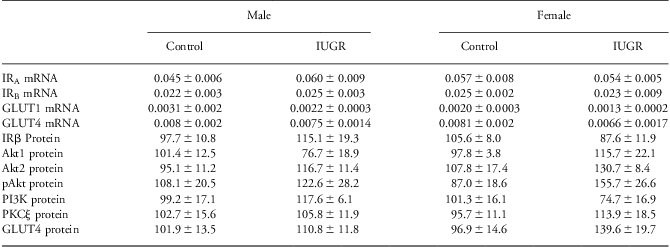
The mRNA expression of both the A and B isoforms of the IR in omental adipose tissue was not different between Control and IUGR lambs (Table 1). The protein abundance of the IR and downstream signaling molecules, p85α subunit of PI3K, Akt1, Akt2, phosphoAkt, and PKCξ in omental adipose tissue was also not different between Control and IUGR lambs in either males or females (Table 1).
The expression of IRA, IRB, GLUT1 and GLUT4 mRNA normalized to RPPO and abundance of insulin receptor, insulin signaling proteins and GLUT4 in omental adipose tissue in male and female Control and IUGR lambs at 21 days of age

IRA, insulin receptor A; IRB, insulin receptor B; GLUT1, glucose transporter 1; GLUT4, glucose transporter 4; RPPO, ribosomal protein PO; IUGR, intrauterine growth restriction; IRβ, insulin receptor β subunit; PI3K, phosphatidylinositol 3-kinase; PKCξ, protein kinase C ξ; Akt, protein kinase B; pAKT, phosphorylated protein kinase B.
Protein abundance expressed in arbitrary units normalized to mean level in control group.
There was no difference in mRNA expression of the glucose transporters, GLUT1 and GLUT4, or protein abundance of GLUT4 in omental adipose tissue at 21 days of postnatal age between Control and IUGR lambs in either males or females (Table 1). When data from all lambs were combined, there were direct relationships between the abundance of Akt2 and GLUT4 protein abundance in the omental adipose depot (GLUT4 protein = 0.80 Akt2 + 22.8; r 2 = 0.47, P < 0.001).
IUGR and the expression of AMPKα1 and AMPKα2 mRNA in omental adipose tissue at 21 days of age
The effect of IUGR on the mRNA expression of AMPKα2 was different between males and females. In male lambs, the expression of AMPKα2 mRNA was higher in IUGR lambs compared with Controls (Fig. 1, P < 0.001) and was inversely related to birth weight (AMPKα2 mRNA = 0.0034 birth weight (kg) + 0.028, r 2 = 0.74, P < 0.001). There was also a direct relationship between AMPKα2 mRNA expression and mRNA expression of both IRA (IRA = 3.4 AMPKα2 mRNA + 0.18, r 2 = 0.64, P < 0.001) and IRB (IRA = 1.14 AMPKα2 mRNA + 0.11, r 2 = 0.39, P < 0.05) isoforms of the IR in this adipose depot in male, but not female lambs.
The expression of AMPKα2 mRNA normalized to RPP0 in male and female Control (open bars) and IUGR (closed bars) lambs at 21 days of age. The expression of AMPKα2 mRNA was higher in low-birth weight males compared with Control males (P < 0.001), but tended to be lower (P = 0.07) in low-birth weight females compared with Control females. Asterisks denote a significant difference between Control and IUGR groups (P < 0.05). AMPK = AMP-kinase; IUGR = intrauterine growth restriction.
In female lambs the expression of AMPKα2 mRNA in omental adipose tissue tended to be lower in IUGR lambs compared with Control lambs (Fig. 1, P = 0.07) and was directly related to insulin (AMPKα2 mRNA = 0.002 insulin + 0.005, r 2 = 0.82, P < 0.005) and NEFA concentrations (AMPKα2 mRNA = 0.008 NEFA + 0.001, r 2 = 0.80, P < 0.001) in the first 24 h after birth. AMPKα2 mRNA expression was also directly related to relative total fat mass in female lambs [relative total fat mass (g/kg) = 5226 AMPKα2 mRNA + 9.3, r 2 = 0.72, P < 0.002].
There was no effect of IUGR on the mRNA expression of AMPKα1 in omental adipose tissue at 21 days of postnatal age in either males (Control, 0.0024 ± 0.0005; IUGR, 0.0029 ± 0.0009) or females (Control, 0.0025 ± 0.0008; IUGR, 0.0021 ± 0.0008). The expression of AMPKα2 mRNA in the omental adipose tissue was ∼fourfold higher than expression of AMPKα1 independent of treatment group and sex (AMPKα1, 0.0025 ± 0.0003; AMPKα2, 0.0091 ± 0.0008, P < 0.0001).
IUGR and the abundance of AMPKα1, AMPKα2, total AMPK and phosphoAMPK protein in omental adipose tissue at 21 days of age
There was no effect of IUGR or sex on the abundance of AMPKα1, AMPKα2 (Fig. 2) or total AMPK protein in omental adipose tissue. The abundance of phosphoAMPK protein was not different between IUGR and Control lambs in either males or females, and tended (P < 0.07) to be higher in females compared with males in both Control and IUGR lambs.
The abundance of AMPKα2 protein normalized to β-actin in male and female Control (open bars) and low-birth weight (closed bars) lambs at 21 days of age. There was no significant difference in the abundance of AMPKα2 protein between low-birth weight and Control lambs in either males or females. AMPK = AMP-kinase.
The ratio of phosphoAMPK:total AMPK (%phospho-AMPKα) was significantly lower in the omental adipose tissue of IUGR lambs in both males and females (Fig. 3).
The ratio of Phospho:total AMPK protein (%phospho-AMPKα) in male and female Control (open bars) and IUGR (closed bars) lambs at 21 days of age. The %phospho-AMPKα was lower in the low-birth weight lambs compared with Control lambs, independent of sex (P < 0.05). Asterisks denote a significant difference between Control and IUGR groups (P < 0.05). AMPK = AMP-kinase; IUGR = intrauterine growth restriction.
IUGR and the expression of adipogenic and lipogenic genes in omental adipose tissue at 21 days of age
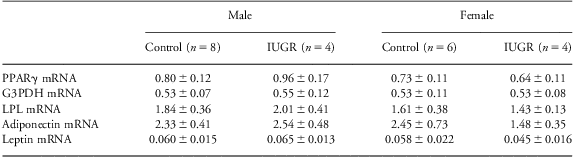
There was no difference in the expression of G3PDH or PPARγ mRNA between Control and IUGR lambs in either males or females (Table 2). In male lambs, however, G3PDH mRNA expression was directly related to plasma insulin concentrations in the first 24 h after birth (G3PDH mRNA = 0.19 insulin + 0.07, r 2 = 0.53, P < 0.05). This relationship was not present in females. When the data from all lambs were combined, there was a positive relationship between PPARγ mRNA expression in omental adipose tissue and the expression of adiponectin (adiponectin mRNA = 3.9 PPARγ mRNA – 0.64, r 2 = 0.61, P < 0.001), LPL (LPL mRNA = 1.4 PPARγ mRNA + 0.64, r 2 = 0.24, P < 0.001) and leptin mRNA (leptin mRNA = 0.09 PPARγ mRNA – 0.02, r 2 = 0.48, P < 0.001) in this depot. There was no difference in the expression of leptin, adiponectin or LPL mRNA between Control and IUGR lambs in either males or females (Table 2).
The expression of adipogenic and lipogenic genes in omental adipose tissue in male and female Control and IUGR lambs at 21 days of age
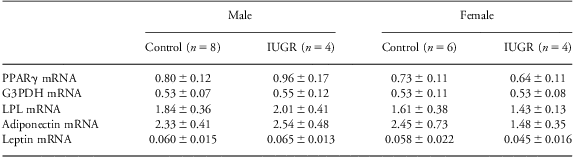
IUGR, intrauterine growth restriction; PPARγ, peroxisome proliferator-activated receptor γ; G3PDH, glycerol 3 phosphate dehydrogenase; LPL, lipoprotein lipase; RPPO, ribosomal protein PO.
Expression of all genes was normalized to the housekeeper gene, RPPO.
Discussion
We have shown that there is no effect of IUGR on either the mean omental adipocyte size or omental fat mass at 21 days of age in either male or female lambs. This is consistent with our previous finding that there is no effect of IUGR on the mass of perirenal adipose tissue, the other major visceral adipose depot, in this same cohort of animals,Reference Duffield, Vuocolo and Tellam17 but differs from the results of studies in IUGR lambs at 45 days of age, when the total and relative mass of both perirenal and omental adipose tissue is significantly increased in both male and female IUGR lambs.Reference De Blasio, Gatford, McMillen, Robinson and Owens8 These results indicate, therefore, that the IUGR lambs accumulate greater amounts of fat in the perirenal and omental adipose depots during the period from 21 to 45 days of age compared with Controls.
The effect of IUGR on expression of lipogenic genes in omental adipose tissue
We found that the mean size of the omental adipocytes, but not omental fat mass, was directly related to the early nutritional environment as represented by insulin concentrations in the first 24 h after birth. This is similar to our previous findings of a direct relationship between the early insulin environment and fat cell size in the perirenal adipose depot in this same group of animals.Reference Duffield, Vuocolo and Tellam17 Although a positive relationship between omental fat cell size and insulin concentrations on postnatal day 1 was present in both male and female lambs, the mechanisms through which the early insulin environment influences fat cell size appear to be sex specific. In male lambs, insulin concentrations in the first 24 h after birth were directly related to G3PDH mRNA expression in omental adipose tissue at 21 days of age, suggesting that insulin may act to increase lipid deposition in omental fat via the upregulation of de novo lipogenesis. This relationship was not present in female lambs.
One possibility is that in female lambs, in which the insulin concentration at any given fat mass is lower than in males,Reference Duffield, Vuocolo and Tellam17 intracellular fatty acid concentrations may be relatively higher resulting in a reduced requirement for de novo lipid synthesis when compared with males. We found no effect of IUGR on the expression of the adipogenic/lipogenic transcription factor, PPARγ, or the lipogenic enzymes, LPL or G3PDH, in omental adipose tissue.
The effect of IUGR on insulin signaling pathways in omental adipose tissue
We found no effect of IUGR on the mRNA expression or protein abundance of IRs, the insulin-responsive glucose transporter, GLUT4, or key proteins in the insulin signaling pathway in omental adipocytes at 21 days of age. These results at a very early neonatal time point are different to previous observations in the maternal low-protein model of fetal growth restriction in the rat, which have reported increased abundance of the IR and the activity of the downstream signaling molecules, PI3K and Akt, in epididymal and intra-abdominal adipocytes of low-protein offspring in young adulthood.Reference Ozanne, Nave and Wang10, Reference Shepherd, Crowther, Desai, Hales and Ozanne29 It has also been reported that the adipocytes of low-protein offspring exhibit an increased basal and insulin-stimulated glucose uptake in young adulthood, before any increase in visceral adiposity.Reference Ozanne, Wang, Dorling and Petry30 It is possible that in the sheep, which matures at a slower rate after birth, that these differences do not emerge until after weaning.
Previous studies have reported that IUGR increases insulin sensitivity and insulin disposition indices for glucose and NEFAs in lambs at 1 month of age, and that the degree of insulin sensitivity is predictive of the rate of catch-up growth in these animals.Reference De Blasio, Gatford, McMillen, Robinson and Owens8 However, these studies measured whole body disposal of glucose and NEFAs, and thus do not provide information regarding the relative uptake by visceral adipocytes as distinct from other insulin-sensitive peripheral tissues. We have shown previously that the protein abundance of the IR, GLUT4 and insulin signaling molecules was significantly increased in skeletal muscle of the IUGR lambs in this same cohort of lambs.Reference Muhlhausler, Duffield and Ozanne12 This would therefore imply that the partitioning of nutrients in IUGR lambs is directed toward muscle growth, rather than fat growth, at 21 days of age, and that an increased partitioning of nutrients toward fat deposition in IUGR lambs begins after 21 days of age. This may be related to the fact that the IUGR lambs in this study were studied during the suckling period, and changes in nutrient partitioning may occur during the transition from milk (high fat content) to solid food (low fat content). It should also be noted that the abundance of the insulin signaling proteins in omental adipose tissue was measured in the basal state, and we therefore cannot exclude the possibility that the insulin signaling pathways in the omental adipocyte are more responsive to post-prandial increases in glucose concentrations.
The effect of IUGR on AMPKα1 and AMPKα2 mRNA and protein in omental adipose tissue
A key finding of the present study was that IUGR was associated with altered mRNA expression of the catalytic α2 isoform of the cellular fuel-sensing molecule, AMPK, and a decrease in the proportion of the total AMPK pool that was phosphorylated. The AMPKα2 catalytic subunit is principally involved in the regulation of insulin sensitivity and glucose uptake,Reference Viollet, Andreelli and Jorgensen31 while AMPKα1 appears to be involved primarily in inhibiting lipolysis.Reference Daval, Foufelle and Ferre13 Previous studies have reported that the AMPKα1 isoform is the predominant isoform in adult adipose tissue.Reference Daval, Foufelle and Ferre13 Interestingly, this does not appear to be the case in the lamb at 21 days of age, as AMPKα2 was more abundant than AMPKα1 in the omental adipose tissue in both Control and IUGR lambs. This suggests that the relative abundance of the two AMPK isoforms expressed is developmentally regulated.
We found a sex-specific effect of IUGR on the expression of AMPKα2 mRNA in omental adipose tissue; in males, the expression was higher in IUGR lambs, whereas in females expression tended to be decreased in IUGR lambs compared with Controls. In males, AMPKα2 mRNA expression was inversely related to birth weight. One possibility, therefore, is that the sub-optimal environment experienced by the low-birth weight lamb before birth, in particular the lower glucose and insulin concentrations,Reference Duffield, Vuocolo and Tellam24 may have contributed to the increase in AMPKα2 mRNA expression in early postnatal life. In female lambs, there were direct relationships between AMPKα2 mRNA and both insulin and NEFA concentrations in the first 24 h after birth, suggesting that in females there may be a greater dependence on the nutritional environment in the early neonatal period in determining the subsequent expression of AMPKα2 mRNA in omental fat. In contrast to mRNA expression, we found no effect of IUGR on the protein abundance of AMPKα2 in either males or females. This suggests that the translation of the AMPKα2 mRNA was maintained, and may be indicative of sex-specific effects of IUGR on the turnover rate of this protein in omental adipose tissue. It will be interesting in future studies to determine whether the changes in AMPKα2 mRNA expression in male and female IUGR lambs at 21 days of age persist at older ages, and whether changes in the AMPKα2 protein abundance emerge.
The effect of IUGR on AMPK phosphorylation in omental adipose tissue
Although the abundance of AMPK mRNA and protein is important for regulating the capacity of a tissue to respond to decreased substrate availability, the actions of AMPK are dependent upon its activation by phosphorylation.Reference Hardie, Hawley and Scott14, Reference Steinberg, Macaulay, Febbraio and Kemp32 We found that the percentage of AMPK in the phosphorylated state in omental adipose tissue was reduced in IUGR lambs in both males and females. As phosphorylation of AMPK is driven by a reduction in cellular energy (increased AMP:ATP ratio within cells),Reference Hardie, Hawley and Scott14 this implies that the energy content within omental adipocytes at 21 days of age was relatively higher in IUGR lambs. Glucose and insulin concentrations are lower in IUGR fetuses compared with normally grown fetuses in utero.Reference Duffield, Vuocolo and Tellam24 Therefore, it would appear that the reduced AMPK phosphorylation at 21 days of age reflects a response to an increase in nutrient supply at 21 days, which is consistent with the growth rate of these lambs,Reference Duffield, Vuocolo and Tellam17 rather than the nutritional environment experienced before birth. Future studies that directly assess the AMP/ATP ratio in the omental adipocytes of Control and IUGR animals will be important to elucidate the mechanisms that underlie the changes in AMPK phosphorylation observed in IUGR lambs.
AMPK is known to stimulate glucose uptake in skeletal muscle.Reference Jørgensen, Viollet and Andreelli33 In the adipocyte, however, activation of AMPK has been shown to inhibit glucose uptake, lipogenesis and fatty acid β-oxidationReference Gaidhu, Fediuc and Ceddia34 such that a decreased phosphorylation of AMPK in omental adipocytes would be expected to result in an increase in glucose uptake and increased lipogenesis. We found no change in GLUT4 mRNA expression or protein abundance. However, there is evidence that AMPK may regulate glucose uptake by modulating the translocation of GLUT4, rather than GLUT4 transcription or translation,Reference Kramer, Witczak and Fujii35 which was not measured in this study. Previous studies have proposed that one of the central purposes of AMPK inhibition of fatty acid β-oxidation is to spare fatty acids for export to other metabolic tissues.Reference Gaidhu, Fediuc and Ceddia34 AMPK is also known to inhibit lipolysis in the adipocytes.Reference Daval, Foufelle and Ferre13 Therefore, it is possible that the decrease in AMPK phosphorylation in the omental adipose tissue of IUGR lambs is a mechanism to increase fatty acid supply to the growing skeletal muscle, to support the catch-up growth of muscle tissue in early postnatal life.Reference Parsons, Power, Logan and Summerbell2, Reference Flanagan, Moore and Godsland6
Summary
We have demonstrated that IUGR is associated with sex-specific alterations in the mRNA expression of AMPKα2 and a reduction in the total pool of AMPK that is phosphorylated in the omental adipose tissue at 21 days of age. The reduction in AMPK phosphorylation is likely to be a response to the nutritional environment immediately preceding tissue collection, rather than the nutritional environment experienced before birth, and suggests that nutrient supply to the omental adipocyte may be higher in IUGR lambs compared with Controls at this stage of development. This is also consistent with the higher daily growth rate during this period. The reduced AMPK phosphorylation within the omental adipocyte, in turn, may contribute to increased glucose uptake and lipogenesis, thereby increasing accumulation of lipid in the omental adipocytes and increasing fatty acid release.
Acknowledgments
The authors are grateful to Laura O'Carroll and Anne Jurisevic for their expert assistance with animal surgery and experimental protocols.
Financial Support
This work was funded by grants from the National Health and Medical Research Council of Australia (NHMRC) (ICMcM) and the Channel 7 Children's Research Foundation (B.S.M.). Dr Beverly Muhlhausler is supported by a Career Development Award (NHMRC). A/Prof. Janna Morrison was funded by a South Australian Cardiovascular Research Network Fellowship (CR10A4988). Dr Susan Ozanne is a British Heart Foundation Senior Fellow.
Conflicts of Interest
None.
Ethical Standard
The authors assert that all procedures contributing to this work comply with the Australian code of practice for the care and use of animals for scientific purposes (2004) and has been approved by The University of Adelaide Animal Ethics Committee.