1 Huariapano
Huariapano is an extinct Panoan language, spoken in the Peruvian Amazon until the death of its last known speaker in 1991 (Parker Reference Parker1994, Loos Reference Loos, Dixon and Aikhenvald1999).Footnote 1 The phonology of Huariapano is of interest for metrical theory because it exhibits two rhythmic phenomena: alternating secondary stress, and alternating epenthesis of coda [h]. Both of these processes are plausibly foot-based; however, previous work has argued that the footing that determines rhythmic stress must be distinct from the footing that conditions the appearance of coda [h] (Parker Reference Parker1994, Reference Parker1998a, Reference Parkerb; see also González Reference González2003, Reference González2005, Reference González, Miestamo and Wälchli2007, Vaysman Reference Vaysman2009, Wolf Reference Wolf2012). It would appear, then, that surface forms in Huariapano are parsed into two layers of feet, belonging to independent dimensions of metrical structure.
I demonstrate here that the phonology of Huariapano can and should be analysed without resorting to disjoint metrical tiers of this sort. By rethinking the prosodic motivation behind rhythmic [h]-insertion, and the metrical structure behind stress assignment, it becomes possible to reconcile stress and coda [h]-epenthesis within a single system of footing. The core claims of this reanalysis are (i) that coda [h]-epenthesis targets foot-initial syllables, but has no direct dependence on stress, (ii) that footing is minimally bisyllabic, (iii) that the rhythmic type of feet (iambic or trochaic) varies systematically based on phonological and lexical factors and (iv) that Huariapano exploits recursive footing as a last-resort strategy to achieve exhaustive parsing of syllables into feet.
2 Phonology of Huariapano
This section provides a brief overview of syllable structure and stress in Huariapano. For more detailed discussion of the phonetics and phonology of Huariapano, see Parker (Reference Parker1994, Reference Parker1998a, Reference Parkerb), which are the sources for the data and descriptive generalisations given here. Some transcriptions taken from those works have been altered to better match IPA conventions.
2.1 Syllable structure
Syllables in Huariapano are maximally [CGVC] (where G=glide) and minimally [V], as illustrated in (1).
-
(1)

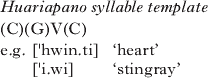
Licit codas are nasals, glides and sibilant fricatives [s ʃ ʂ] (Parker specifies that [ʂ] is ‘retroflex alveopalatal’). Coda [h] is also permitted, but its distribution is non-contrastive and largely predictable (much more on this below).
Content words in Huariapano are minimally [CVC] or [CVː]. Vowel length is non-contrastive: apart from [CVː] words, where vowel length is clearly a reflex of a prosodic minimality condition, long vowels are unattested.
Coda nasals in Huariapano sometimes undergo a variable process of nasal coalescence, in which a /VN/ rhyme is realised as a single nasalised vowel [Ṽ]. These nasalised vowels are prosodic chimeras: they behave as closed [ṼN] rhymes for stress placement, but as open [Ṽ] for coda [h]-epenthesis (see §2.2 and §2.3 for details). I abstract away from these facts in this paper – see Parker (Reference Parker1998a) and González (Reference González2003) for discussion. Vowel nasality is not contrastive in Huariapano, which is atypical for a Panoan language (Shell Reference Shell1965, Loos Reference Loos, Dixon and Aikhenvald1999, González Reference González2003).
2.2 Stress placement
The phonetics of stress in Huariapano are unknown. Acoustic studies of the language are scarce, being limited to Parker (Reference Parker1998b). Furthermore, very few audio recordings have survived, making it almost impossible to directly investigate the phonetics of spoken Huariapano.
In §5 I discuss some methodological issues posed by the lack of good instrumental evidence for stress in Huariapano. For now, I simply adopt Parker's description of the Huariapano stress system without critique (though cf. §4.1.3).
2.2.1 Primary stress
When the final syllable is open (i.e. a light, monomoraic syllable), primary stress falls on the penult.
-
(2)

When the final syllable is closed (i.e. a heavy bimoraic syllable), primary stress falls on the ultima. Primary stress in Huariapano is thus quantity-sensitive.
-
(3)

When a word ends in two closed heavy syllables, primary stress again falls on the ultima.
-
(4)

The basic pattern of primary stress assignment can thus be summarised as in (5).
-
(5)
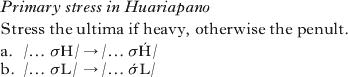
There are some lexical exceptions to regular primary stress assignment. A number of words ending in a light open syllable bear irregular final syllable stress.
-
(6)
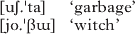
Exceptional forms of this sort are a statistical minority: in Parker's corpus, 25% of bisyllabic nouns and adjectives ending in a light syllable have exceptional final stress as in (6). There are no verbs with exceptional final stress (Parker Reference Parker1998a: 5–6, 19–21).Footnote 2
An even smaller number of words show exceptional antepenultimate stress.
-
(7)
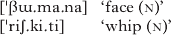
Only twelve words of this sort are attested in Parker's corpus, and four of them are also attested with regular penultimate stress (Bennett Reference Bennett2012). There are no known words in Huariapano with pre-antepenultimate primary stress.
Primary stress therefore has the potential to be surface-contrastive in Huariapano, though stress assignment is largely regular and carries a very small functional load.
2.2.2 Secondary stress
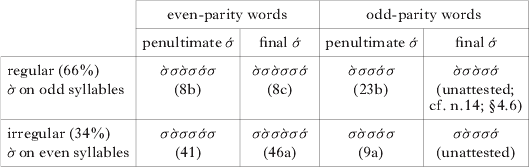
Unlike primary stress, secondary stress in Huariapano is entirely quantity-insensitive. There are two distinct patterns of secondary stress assignment. In the first pattern, secondary stress is assigned to odd-numbered syllables, counting from the beginning of the word. As (8c) shows, secondary stress does not occur on syllables adjacent to primary stress. This is because Huariapano absolutely prohibits stress clash.
-
(8)

This is the most frequent pattern of secondary stress, occurring in around 66% of eligible words in Parker's corpus. Following Parker (Reference Parker1998a), I will therefore refer to the pattern in (8) as ‘regular’ secondary stress assignment.
The other pattern of secondary stress in Huariapano targets even-numbered syllables, also counting from the beginning of the word.Footnote 3
-
(9)

I refer to this pattern of stress assignment as ‘irregular’ secondary stress, again following Parker (Reference Parker1998a). It occurs in the remaining 34% of relevant words in Parker's corpus. Since odd-syllable and even-syllable secondary stress are both fairly common, it might be more accurate to distinguish between ‘major’ and ‘minor’ patterns of stress assignment in Huariapano. With this point noted, for consistency with Parker's work I will continue to use the terms ‘regular’ and ‘irregular’ to distinguish these two types of rhythmic stress.
Whether a word manifests the regular or irregular pattern of secondary stress is determined idiosyncratically by the root morpheme of the word. This variation is lexical in nature, and cannot be predicted from the phonological content of the root or following suffixes. See Parker (Reference Parker1998a) and Bennett (Reference Bennett2012) for discussion and exemplification.
Table I outlines the attested patterns of secondary stress in Huariapano, with references to examples in this paper. Given that secondary stress is strictly binary (up to clash avoidance), secondary stress is sensitive to the position of main stress and to the number of syllables in each word.
Schematic secondary stress patterns in Huariapano.

I will eventually argue that all of these stress patterns involve the exhaustive parsing of syllables into minimally bisyllabic feet (§4). In particular, I contend that some apparently underparsed syllables are actually integrated into a recursive metrical foot, giving complex structures like [( σ)(σ(
 σ))]. Medial lapse patterns like [σσσσ] will also prove important, as they support my claim that irregular secondary stress parses out left-to-right iambs, [(σ)σσ(σ)] (§4.1.3 and §4.5).
2.3 Coda [h]-epenthesis
The segment [h] has a narrowly circumscribed distribution in Huariapano. Onset [h] is only permitted word-initially.Footnote 4 Word-initial [h] is phonemic: it contrasts with Ø and with other consonants.
-
(10)
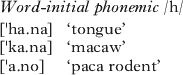
Coda [h] is permitted in Huariapano, but it must satisfy a number of phonotactic constraints.Footnote 5 Furthermore, whenever coda [h] is permitted in the language, it is obligatory. This provides an initial indication that coda [h] is an epenthetic segment.
The restrictions on coda [h] are as follows. First, coda [h] is only allowed before a voiceless obstruent.
-
(11)

In this respect, coda [h] closely resembles preaspiration, as first pointed out by Parker (Reference Parker1998a). As I argue below, the interaction of [h]-insertion with syllable structure shows that coda [h] is nonetheless a full-fledged segment in Huariapano.
Second, [h] never appears in a coda cluster. This restriction is entirely expected, as complex codas are prohibited in Huariapano.
-
(12)

Patterns like (12) provide a strong argument that preconsonantal [h] is a true coda consonant. The impossibility of *[ʂohʂ.ˈka] indicates that [h] is a full segment, and not just subsegmental preaspiration on an obstruent, [ʰC]. Otherwise, the contrast between *[ʂohʂˈka] and [pohˈʂoj] would be inexplicable, given that the local phonetic environment for [h] is identical in the two cases. (The fact that [ʂ] belongs to a stressed syllable in [pohˈʂoj] is immaterial, because stress does not directly condition the distribution of [h]; see (16).)
Furthermore, preconsonantal [h] is clearly a coda rather than an onset. If [h] were an onset, then tautosyllabic [h]+obstruent clusters must be well-formed, as in [nɰhˈtɰno] ‘day (loc)’. This suggestion runs completely contrary to the observation that Huariapano does not allow obstruent clusters in onsets (1). It also fails to account for the blocking effect of a preceding coda consonant. If [ht] were an acceptable onset, forms like [nɰˈhtɰno] and *[majˈhtiʂo] should be equally grammatical, being parsed [nɰ.ˈhtɰ.no] and *[maj.ˈhti.ʂo] respectively. They are not, precisely because ungrammatical *[majh.ˈti.ʂo] would contain a coda cluster (cf. [maj.ˈti.ʂo] ‘hats’).
The third condition on coda [h] is that it never appears in word-final syllables. This too is expected if coda [h] is a kind of preaspiration: if coda [h] is sponsored by a voiceless obstruent within the same word, then word-final coda [h], which has no licensing obstruent, should be illicit. The ban on complex codas also prevents [h] from being licensed by a tautosyllabic obstruent in final position (13c).Footnote 6
-
(13)

Fourth, and most important, is that the distribution of coda [h] is rhythmic. Coda [h] only appears in odd-numbered syllables, counting from the left. Furthermore, when coda [h] is licensed in an odd-numbered syllable, it must appear there. These generalisations hold true regardless of where stress falls (with one small caveat; see (17) below).
-
(14)

In contrast, coda [h] never appears in even-numbered syllables, even when all other phonotactic restrictions on [h] are satisfied. Compare (14b) and (15): the penult of (14b) is an odd-numbered syllable, and so undergoes [h]-epenthesis; the penult of (15), though otherwise identical, resists epenthesis, because it is even-numbered.
-
(15)

The distribution of coda [h] in Huariapano is thus ‘rhythmic’, in the sense that it picks out every other syllable in the word. This is of course strikingly similar to the distribution of secondary stress, which also targets alternating syllables, and also counts from the left edge. This remarkable parallelism, which points to a metrical basis for coda [h], will form the crux of the theoretical issues addressed in this article.
Despite the commonalities between secondary stress and coda [h], stress itself does not directly condition [h]-insertion. Coda [h] may appear in stressed and unstressed syllables alike, and is insensitive to different degrees of stress.
-
(16)

Finally, coda [h] is prohibited in word-initial syllables that also bear primary stress, i.e. [#].
-
(17)
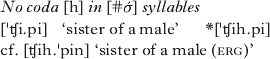
This is a joint effect of initial position and main stress; neither condition is sufficient on its own to block coda [h], as the examples in (16) show. The generalisation seems to be that word-initial syllables carrying main stress are somehow too prominent to license coda [h] (see Parker Reference Parker1998a, de Lacy Reference de Lacy2001, Bennett Reference Bennett2012).Footnote 7
To summarise, coda [h] is only permissible in Huariapano if it satisfies the phonotactic restrictions in (18).
-
(18)
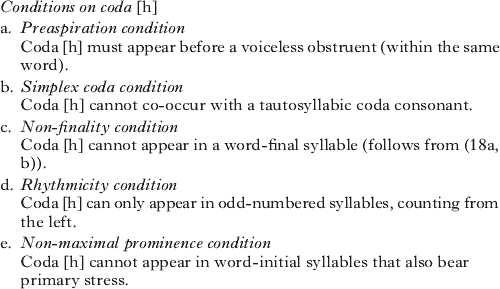
Coda [h] occurs wherever these conditions are met. The distribution of coda [h] is thus non-contrastive, predictable and rule-governed: if coda [h] can appear in a particular syllable, it necessarily surfaces there.Footnote 8 For this reason, I follow Parker in assuming that coda [h] is always epenthetic. Alternations like (17) and (19) are therefore due to a productive phonological process of coda [h]-insertion.
-
(19)

Another argument for an epenthetic treatment of these facts is that coda [h] appears in assimilated loanwords from Spanish, even in the absence of a plausible source consonant.
-
(20)

There are nevertheless a few cases where coda epenthesis fails to apply, despite satisfaction of the conditioning criteria in (18).
-
(21)

Words with exceptional non-epenthesis are a clear minority in Huariapano: Parker (Reference Parker1998a) reports that 93% of testable morphemes (115/124) show the expected pattern of [h]-insertion. For reasons of space I will not address these exceptions in any detail here; see Bennett (Reference Bennett2012) for arguments that the failure of epenthesis in such forms can be attributed to morphological and/or prosodic factors.
3 Disjoint footing in Huariapano?
All extant accounts of [h]-epenthesis in Huariapano attribute its rhythmic character to conditioning by foot structure. The hitch is that [h]-epenthesis follows a single rhythmic pattern, while stress varies between two different subsystems, neither of which perfectly coincides with the distribution of coda [h]. These proposals therefore share a core analytical problem: given that coda [h] appears in both stressed and unstressed syllables, can the feet behind [h]-epenthesis be reduced to the feet responsible for stress placement?
For some researchers, the answer to this question is decidedly negative. On the basis of mismatches between stress and [h]-epenthesis, Parker (Reference Parker1998a) and González (Reference González, Miestamo and Wälchli2007) conclude that epenthesis is conditioned by a system of metrical structure that is completely distinct from stress placement. This approach is ‘multiplanar’, because it relies on two separate levels of metrical representation, one for stress, and one for [h]-epenthesis.
§3.1 and §3.2 outline past multiplanar treatments of Huariapano. In §4 I propose a different, single-tier account of stress and [h]-epenthesis, which I defend on language-internal and typological grounds (§4 and §6).
3.1 Stress placement
All prior analyses of Huariapano have assumed that primary stress is assigned in a right-aligned quantity-sensitive trochee. This assumption explains (i) why primary stress is normally limited to a word-final two-syllable window, (ii) why default primary stress falls on the penult in words ending in a light syllable and (iii) why primary stress shifts to word-final heavy syllables.
-
(22)

Secondary stress, in contrast, is quantity-insensitive: stress is placed by counting syllables, without any reference to moraic weight. In the regular pattern of parsing, stress falls on the first syllable and every other syllable that follows (up to clash, which is avoided). Since initial stress suggests a left-aligned trochaic foot, a natural assumption is that regular secondary stress parses out iterative, quantity-insensitive trochees from left to right.
-
(23)
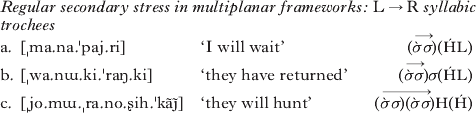
Irregular secondary stress differs minimally from the regular, odd-syllable pattern: here, stress falls on every even-numbered syllable, again counting from the left. In Huariapano, this is roughly equivalent to counting even-numbered syllables, right to left, from the position of primary stress. (The two algorithms yield different results when primary stress is preceded by an even number of syllables; see §4.1.3.)
-
(24)
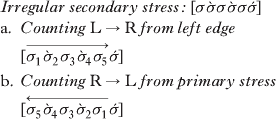
Past analyses have exploited this near equivalence: irregular secondary stress is taken to be exactly like regular secondary stress (that is, quantity-insensitive and trochaic), but with a non-default right-to-left direction of parsing.
-
(25)
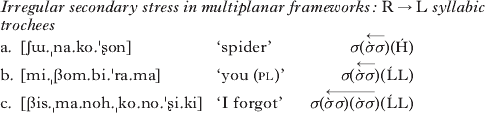
Multiplanar approaches thus assume that lexical items may differ in the direction of parsing for secondary stress. Barring some sporadic exceptions, all other parameters of stress assignment remain fixed across lexical items.
3.2 Coda [h]-epenthesis
Recall that coda [h] has a rhythmic distribution: it appears only in odd-numbered syllables, counting from the left. This prosodic condition on [h]-insertion closely tracks regular secondary stress, which also targets odd-numbered syllables. As a consequence, stress and coda [h] coincide exactly in some forms, other phonotactics permitting; see (18) and §4.3. (σ h is a syllable closed by coda [h].)
-
(26)

Inspired by this parallelism with regular secondary stress, multiplanar analyses assume that [h]-insertion is likewise conditioned by syllabic trochees, parsed left to right.
A key premise of this analysis is that [h]-epenthesis, like stress, targets foot heads. Taken with the preceding assumptions about parsing, this correctly limits coda [h] to odd-numbered syllables. It also has the virtue of providing a motivation for epenthesis: [h]-insertion converts open [CV] foot heads into closed [CVh], rendering them bimoraic, in accord with the cross-linguistic preference for heavy stressed syllables (the Stress-to-Weight Principle: Hammond Reference Hammond1986, Prince Reference Prince1990).
For these reasons, multiplanar frameworks adopt the view that coda [h]-epenthesis occurs in the heads of bisyllabic trochees, built left to right. Despite the tantalising similarities between [h]-epenthesis and secondary stress, the assumptions sketched above turn out to be jointly inconsistent with a single-tier treatment of Huariapano phonology. Instead, they lead to the conclusion that [h]-insertion depends on a distinct system of foot parsing, one which bears no relation to the feet behind stress assignment.
The problem is that there are many words in which stress and coda [h] do not coincide. For example, [h]-epenthesis and stress may diverge in even-parity words when primary stress falls on the ultima rather than an odd-numbered penult.
-
(27)

Mismatches also occur in odd-parity words. Clash avoidance can block stress assignment on an odd-numbered syllable, but such syllables are still targeted by epenthesis.
-
(28)

Examples (27) and (28) demonstrate that epenthesis can occur in syllables that should be left unparsed, given the strictly binary footing needed for secondary stress. Underparsing of this sort will occur whenever an odd number of syllables precede the main stress. Since these apparently unfooted syllables are nonetheless in an odd-numbered position, epenthesis applies unfettered.
The most dramatic mismatches between stress and epenthesis are found in words with irregular secondary stress. Words in this class bear stress on even-numbered syllables, counting left to right. This has no effect on [h]-epenthesis, which is restricted to odd-numbered syllables in all lexical items, regardless of where stress happens to fall. At least some of these mismatches occur in syllables that are unstressed, but nonetheless footed (a point that remains true under the alternative view of parsing I develop in §4).
-
(29)
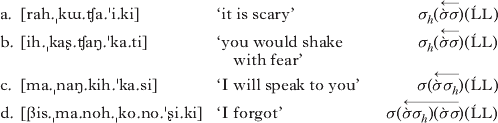
These facts rule out any direct correspondence between stress and coda [h]-epenthesis: mismatches include both cases where coda [h]-epenthesis fails to apply in an otherwise eligible stressed syllable and cases where it applies in unstressed syllables (see e.g. (28a)).
We are thus faced with a conundrum: coda [h]-epenthesis in Huariapano appears to be foot-based, but the feet required to determine the locus of epenthesis are not isomorphic to the feet that determine surface stress assignment. This dilemma leads to the central proposal of multiplanar frameworks, the claim that the phonology of Huariapano makes use of two distinct metrical tiers. One of these tiers determines stress assignment, while the other determines the location of coda [h]-epenthesis.
-
(30)
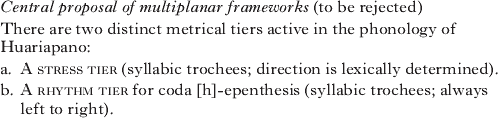
These tiers are ‘metrical’ in having characteristics typical of foot structure. Both tiers host rhythmic alternations, and both show evidence of head prominence (stress assignment on the stress tier; augmentation of foot heads with coda [h] on the rhythm tier). On this view of Huariapano prosody, words are parsed into metrical constituents in two different phonological planes: stress feet ‘( )’ on the stress tier, and epenthesis feet ‘{ }’ on the rhythm tier.
-
(31)
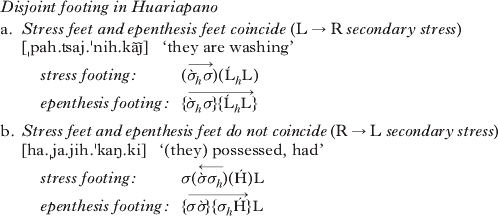
The rhythm tier is thus ‘process-specific’ in that it conditions only a single phonological pattern, while also being autonomous from, and inconsistent with, the structural parse needed for stress placement.
4 A unified account of Huariapano
Multiplanar frameworks achieve good empirical coverage of stress assignment and coda [h]-epenthesis in Huariapano. But on the theoretical side, the appeal to a separate ‘rhythm’ tier governing [h]-epenthesis leaves something to be desired.
For one, the proposed rhythm tier has no phonological effects apart from epenthesis itself. There is no corroborating evidence for such a tier in Huariapano, and therefore no independent language-internal reason to posit an extra layer of metrical structure.Footnote 9 The typological evidence for the rhythm tier is also slim. As far as I know, Huariapano is the only attested language with a process of rhythmic epenthesis that systematically deviates from stress placement.Footnote 10 The empirical motivation for a dedicated epenthesis tier is thus limited to fairly parochial facts about Huariapano.
Second, a conceptual weakness of multiplanar frameworks is that they reduce the foot to a mere counting device, and one with no particular connection to stress (a point also made by Dresher & Lahiri Reference Dresher and Lahiri1991, though in a different context). In doing so, they misconstrue the reasons for adopting a metrical theory of stress in the first place. Stress is unlike most phonological properties in being relational: whether a given syllable is stressed depends on the larger, global context in which it is embedded. Stress is also uniquely hierarchical, in that natural languages classify stressed syllables by their relative strength, distinguishing at least primary and secondary levels of stress. These observations (among others) make it clear that stress assignment is something altogether different from other phonological processes.
To reiterate, stress is a feature of structure, an expression of abstract hierarchical relations. This truism justifies the use of a special, structural representation for stress – the metrical foot (Liberman Reference Liberman1975, Liberman & Prince Reference Liberman and Prince1977, Selkirk Reference Selkirk1980, Hayes Reference Hayes1995, etc.). Epenthesis, being a process rather than a syntagmatic relation, does not equally motivate a metrical representation of its own.
The foot isn't just a tool for generating rhythmic alternations. It is also a way of compactly representing the cluster of properties that make stress different from other, non-relational aspects of phonology. Multiplanar frameworks, and the related notion of process-specific feet, thus extend the notion of ‘foot’ well beyond its original conceptual underpinnings.Footnote 11 In this regard, multiplanar frameworks represent a major departure from standard metrical theory. It is of course an empirical question whether this departure is justified. Still, we should be loathe to take such a step until all other analytical avenues have been exhausted (a point that Parker Reference Parker1998a would appear to agree with).
In the remainder of the article I defend an alternative analysis of Huariapano that avoids these pitfalls. The analysis begins with the conservative assumption that metrical structure is unique: any single language can make use of at most one system of metrical parsing. As such, metrically organised stress cannot coexist with a second, disjoint, metrical system operating within the same language. I call this assumption the unity of footing hypothesis. (This idea also appears in Dresher & Lahiri Reference Dresher and Lahiri1991 under the name metrical coherence.)
-
(32)

This hypothesis is clearly at odds with multiplanar treatments of Huariapano. After all, the sole motivation for a multiplanar approach comes from the apparent impossibility of reconciling stress assignment with rhythmic [h]-epenthesis under a single metrical parse. As it turns out, a coherent single-tier account of Huariapano prosody is possible, if we accept two general claims: first, that footing in Huariapano is more flexible than usually assumed, and second, that rhythmic coda [h]-epenthesis, while being foot-based, does not target foot heads (contra previous multiplanar approaches). Rather, [h]-epenthesis targets foot-initial syllables, even when unstressed; it is an instance of the broader phenomenon of domain-initial strengthening (e.g. Fougeron & Keating Reference Fougeron and Keating1997, Beckman Reference Beckman1998, Smith Reference Smith2005, Becker et al. Reference Becker, Ketrez and Nevins2011, Gordon Reference Gordon2011, etc.).
Before presenting my account of Huariapano, I should mention that some of the intuitions I have drawn on here are implicit in Parker (Reference Parker1998a, Reference Parkerb) and González (Reference González2003), albeit in a very embryonic form (and see Bennett Reference Bennett2012 for a critique of the specific proposals in González Reference González2003). That acknowledgement aside, the analysis that I advocate is rather different from the alternatives that have been offered in earlier work on Huariapano, as will become clear.
4.1 Stress placement: uniform parsing, variable headedness
4.1.1 Primary stress
In contrast with previous multiplanar approaches, I assume that the foot bearing primary stress is always bisyllabic in Huariapano. Default penultimate stress then reflects a bisyllabic word-final trochee.
-
(33)

Assuming invariant bisyllabic footing at the right edge leads to a different analysis of word-final primary stress. Recall that word-final syllables bear main stress if heavy. Past analyses have viewed final stress as the expression of a monosyllabic moraic trochee [… ( )]. The alternative I pursue here is that final stress represents trochaic–iambic rhythmic reversal: instead of building a bisyllabic trochee, Huariapano constructs a non-default bisyllabic iamb when needed to stress a final heavy syllable.Footnote
12
-
(34)

In §4.7 I argue that non-final syllables are always light in Huariapano. As such, better representations of the feet in (33b) and (34b) would be (ĹL) and (L) respectively.
There is some empirical support for the idea that word-final stress is assigned in a bisyllabic foot in Huariapano. First, there are apparently no trisyllabic words that bear both final primary stress and initial secondary stress.Footnote 13
-
(35)

While only a handful of trisyllabic words are attested in Parker (Reference Parker1994, Reference Parker1998a, Reference Parkerb), they all contain just one stress peak (cf. note 13 for some complications). The lack of initial secondary stress in forms like (35) is surprising if final stress results from constructing a monosyllabic trochee: after parsing out a final monosyllabic foot, the remaining syllables should be parsed into a foot of their own (36a).
-
(36)

On the other hand, an analysis of final stress in terms of rhythmic reversal (36b) correctly predicts that secondary stress should be impossible in trisyllabic words, provided that degenerate feet are banned (as suggested by the bimoraic word-minimality condition; §2.1).Footnote 14
A second argument for this approach to final stress is that weight-driven rhythmic reversals are attested in other closely related Panoan languages – some of which were mutually intelligible with Huariapano (Parker Reference Parker1994, Loos Reference Loos, Dixon and Aikhenvald1999, Elías-Ulloa Reference Elías-Ulloa2006). The claim that Huariapano makes use of both trochaic and iambic footing is thus less radical than it might first seem. See §4.5 and §4.6 for discussion of [h]-epenthesis in trisyllabic words.
4.1.2 Regular secondary stress
I assume that regular secondary stress (on odd-numbered syllables) is due to the left-to-right parsing of syllabic (i.e. quantity-insensitive) trochees. This portion of my analysis is shared with multiplanar approaches.
-
(37)

However, where previous work has simply stipulated that secondary stress is quantity-insensitive (Parker Reference Parker1998a, McGarrity Reference McGarrity2003), in §4.7 I show that this fact can be derived from other assumptions about coda weight in Huariapano.
4.1.3 Irregular secondary stress
I depart from past analyses of Huariapano in assuming that irregular secondary stress (even-numbered syllables) still involves left-to-right parsing – that is, the direction of footing for secondary stress is fixed across all lexical items. Instead, I propose that irregular secondary stress stems from non-default, quantity-insensitive iambic parsing.Footnote 15
-
(38)

Lexical items in Huariapano thus differ in the shape of footing rather than the direction, which is uniformly left to right throughout the language. In typological terms, Huariapano belongs to the class of bidirectional stress systems (Elenbaas & Kager Reference Elenbaas and Kager1999, Gordon Reference Gordon2002a, etc.).
Modelling lexically determined secondary stress as variation in foot form actually provides better empirical coverage of Huariapano. In particular, rigidly trochaic footing predicts just one pattern of secondary stress for words in which main stress is preceded by an even number of syllables. The reason is simple: with an even number of syllables to parse, trochaic footing can only place stress on odd-numbered syllables, regardless of the direction of parsing.Footnote 16
-
(39)

If feet are always trochaic, the regular and irregular subsystems of footing should be indistinguishable in words with an even-parity span (39): both directions of parsing predict odd-syllable stress. In contrast, an iambic analysis of irregular secondary stress predicts that words of this shape could also bear even-syllable stress, as in (40). Observe that iambic footing further predicts underparsing of medial trapped syllables, as a consequence of clash avoidance (where ‘trapped’ means ‘unfootable’; Mester Reference Mester1994).
-
(40)

It is not immediately clear whether words like (40) existed in Huariapano. Parker (Reference Parker1998b: 13–14) gives the examples in (41a), which show even-parity spans bearing irregular stress.
-
(41)

As shown in (41b), these examples – which have a medial lapse – are consistent with an iambic parse for secondary stress (as in my account), but not with a right-to-left trochaic parse (as in previous multiplanar analyses).
However, Parker (Reference Parker1998a: 9) explicitly claims that words with the iambic stress pattern in (41b) were systematically unattested in Huariapano. Even so, words of this length were rare to begin with in the language (Parker Reference Parker1998a: 32), so Parker's observation is based on just a handful of lexical items. Given this fact, and the attested examples in (41), I believe we have sufficient reason to doubt Parker's generalisation. I conclude that the available evidence supports an iambic treatment of irregular secondary stress in Huariapano.
To summarise the discussion so far, I am claiming that feet are always bisyllabic in Huariapano, specifically as in (42).
-
(42)
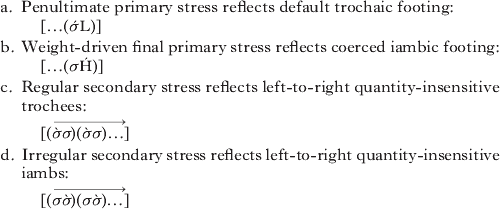
These proposals may be condensed to a simple slogan: foot-headedness is variable in Huariapano; foot boundaries are not.
These proposals will be refined slightly in the following sections. For now, this basic account of stress placement will allow us to move ahead with the analysis of coda [h]-epenthesis.
4.2 Coda [h]-epenthesis targets foot-initial syllables
As discussed in §3.2, multiplanar frameworks assume that coda [h]-epenthesis derives bimoraic foot heads, where the ‘headedness’ relevant for epenthesis is determined on the rhythm tier, independent of stress. This idea has some typological backing, given that there are other languages with trochaic footing that require stressed syllables to be heavy (e.g. Lahiri & Dresher Reference Lahiri and Dresher1999, Mellander Reference Mellander2003; cf. Hayes Reference Hayes1995: 83–84).
On the other hand, footing on the rhythm tier in Huariapano does not otherwise care about syllable weight: foot parsing for epenthesis is quantity-insensitive, just like secondary stress. This argues against the view that coda [h]-epenthesis is motivated by pressure for bimoraic foot heads (as Parker Reference Parker1998a points out).
Here, I offer a different take on the motivation behind coda [h]-epenthesis. If feet are always bisyllabic, and parsing proceeds from left to right, odd-numbered syllables will normally be foot-initial (with one important complication, to be discussed in §4.5).
-
(43)

Odd-numbered syllables are, of course, precisely those syllables that are eligible for [h]-epenthesis. Drawing on this result, I contend that [h]-epenthesis occurs in foot-initial syllables, whether or not those syllables are stressed. This derives the parallelisms between coda [h]-epenthesis and secondary stress, because both phenomena are conditioned by exactly the same underlying metrical structure (cf. §3.2).
By assuming that foot boundaries are fixed in words of a given length, regardless of where stress falls, this single-tier analysis also explains why stress and epenthesis only sometimes coincide. Stress and epenthesis align in trochaic feet, where stress is foot-initial, but diverge in iambic feet, where stress is foot-final.
In §6, I justify this analysis on typological grounds. For now, I show that it derives the full distribution of coda [h]-epenthesis in Huariapano without the need for disjoint footing.
4.3 When stress and epenthesis align
As a first illustration, consider cases in which coda [h] is limited to stressed syllables. This occurs in even-parity words (so that exhaustive parsing into bisyllabic feet is possible) in which all feet are trochaic (so that stress and epenthesis coincide on odd-numbered syllables, in foot-initial position).
This configuration requires penultimate primary stress, regular secondary stress (L→R trochees) and an even-parity span preceding the main stress. This pattern is exemplified in (44). Words with final primary stress may involve a mismatch between stress and epenthesis, (σ
h
); I consider them in the next section.
-
(44)

Each stressed syllable is foot-initial in (44), and therefore correctly predicted to undergo epenthesis if eligible. This is the simplest pattern to account for, as it involves a perfect correspondence between stress and epenthesis. To fully motivate the claim that [h]-epenthesis targets foot-initial syllables, we now turn to discrepancies between stress and epenthesis.
4.4 Mismatches under iambic footing
Mismatches between stress and [h]-insertion arise in iambic feet. This occurs when main stress is word-final (under pressure from quantity-sensitivity), or when secondary stress follows the irregular (even-numbered) pattern.
4.4.1 Final primary stress (iambic head foot)
I previously argued that primary stress in Huariapano is always assigned in a word-final bisyllabic foot. This amounts to the claim that foot parsing is fully quantity-insensitive, though stress placement within a foot can be determined by syllable weight. Recall the slogan: foot-headedness is variable; foot boundaries are not.
If the head foot always extends over the last two syllables of the word, penults should be foot-initial whether they carry stress or not: […(L)#] and […(σ)#]. Assuming that epenthesis targets foot-initial position (as I contend), it follows that words differing only in the position of primary stress should have epenthesis in the same locations, ceteris paribus. This prediction is borne out.
-
(45)

If foot construction is uniform (with variable headedness), then odd-numbered penults will be foot-initial, and correctly eligible for [h]-epenthesis, as a matter of course. (I return to even-numbered penults in §4.5.) The essential insight here is that stress and coda [h] sometimes coincide because they are based on the same foot structure; the fact that stress itself has no direct influence on [h]-epenthesis then explains why the two phenomena are only imperfectly correlated.
4.4.2 Irregular secondary stress (iambic non-head feet)
Mismatches most obviously arise in words bearing irregular secondary stress. Words obeying this pattern have stress on even-numbered syllables, derived by left-to-right parsing of syllabic iambs. This leads to discrepancies between stress and epenthesis, as in (46).Footnote 17
-
(46)

The proposed analysis of coda [h]-epenthesis again captures these facts straightforwardly. Odd-numbered syllables are targets for epenthesis because they are foot-initial (§4.5 extends this claim to the odd-numbered but apparently unfooted antepenults in words like (46b, c)). Whether stress is trochaic or iambic simply has no bearing on the locus of epenthesis, because it has no bearing on the position of foot boundaries. This basic insight is only expressible in a theory of metrical structure that divorces foot size and position from rhythmic type, and allows for systematic heterogeneity in foot form both within and across words. There is wide precedent for these ideas (see e.g. Kager Reference Kager1993 and note 12); a more novel aspect of the analysis is the claim that prosodically determined epenthesis may be conditioned by linear position within a foot, independent of stress or headedness.
4.5 Mismatches due to underparsing
I have so far proceeded on the assumption that footing is strictly and maximally binary in Huariapano. However, there is reason to believe that Huariapano exploits a somewhat richer inventory of metrical structure – in particular, a limited amount of recursive footing. The evidence comes from the distribution of coda [h] in words with an odd number of syllables preceding the main stress.
In words with an odd-parity span, we find that strictly binary footing undergenerates epenthesis in some antepenultimate syllables. As (47) illustrates, the problem is wholly independent of the secondary stress pattern of the word.
-
(47)

The examples in (47) should have unfooted antepenults, given a strictly binary system of parsing. Unfooted syllables are clearly not foot-initial, so the ‘trapped’ antepenults in (47) should not be targets for [h]-epenthesis. Nevertheless, these odd-numbered antepenults do contain a coda [h]. This suggests that the assumption of strictly binary parsing needs to be amended in some way.
As hinted above, this issue disappears if we assume that the antepenults in (47) are in fact recursively adjoined to the foot to their right (the foot bearing primary stress).
-
(48)
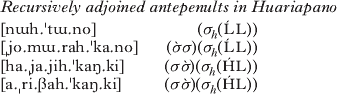
This refinement solves the undergeneration problem posed by strictly binary footing. Prosodically ‘trapped’ antepenults end up being parsed after all, but only as an adjunct in a recursive foot. Importantly, such antepenults are initial in the higher recursive foot derived by adjunction. These syllables are thus correctly predicted to be epenthesis sites, as in (48). Since recursively parsed antepenults are dependent adjuncts rather than prosodic heads, we also correctly expect that they should be unstressed.
I claim that Huariapano exploits recursive adjunction as a last-resort strategy to ensure exhaustive parsing. Without recursive footing, antepenultimate syllables in odd-parity spans would be prosodically trapped, given the inviolable prohibition on degenerate feet. Recursive adjunction thus serves to foot otherwise unfootable syllables. Importantly, there is good evidence that Huariapano prefers exhaustive parsing of words: the existence of iterative secondary stress, which results from the maximal parsing of syllables into feet.
An additional wrinkle is that penults in words of this prosodic shape – which are also foot-initial, under the current set of assumptions – are not eligible for coda [h]-epenthesis. This is consistent with the basic descriptive generalisation that [h]-insertion is blocked in even-numbered syllables.
-
(49)

The lack of penultimate coda [h]-epenthesis in (49) can be explained if epenthesis only targets syllables at the edges of maximal feet (Selkirk Reference Selkirk1980, Jensen Reference Jensen2000, Ito & Mester Reference Ito, Mester, Honma, Okazaki, Tabata and Tanaka2003, Yu Reference Yu2003).
-
(50)

The intuition here is that epenthesis is limited to syllables that are strictly foot-initial. Syllables at the left edge of a non-maximal foot (σ(σσ)) are also medial within the superordinate maximal foot; as such, they do not qualify as ‘foot-initial’ in the most stringent sense. In this respect, coda [h]-epenthesis in Huariapano is demarcative: it is a segmental cue to the boundaries between successive feet, much like the fortition processes found in Yupik languages (§6.2).
-
(51)

In words that necessitate recursive adjunction of trapped antepenults, penults will not be eligible for epenthesis, but antepenults, which are initial in Ftmax, will. Recursive footing thus reconciles the distribution of coda [h] with the claim that [h]-epenthesis is an augmentation process that targets foot-initial syllables.
4.5.1 More on recursive footing
Recursive feet have a long pedigree in generative phonology. In early work on metrical stress, it was assumed that syllables left unfooted by a language's core parsing algorithm were recursively adjoined to a neighbouring prosodic constituent (‘stray syllable adjunction’; e.g. Liberman & Prince Reference Liberman and Prince1977, Prince Reference Prince1985). My analysis of Huariapano draws on the same intuition, in that exhaustive parsing is taken to be the motivation for foot-level recursion. This view is made plausible by the fact that Huariapano has a robust system of secondary stress assignment. In contrast, the epenthesis-specific feet proposed in multiplanar frameworks serve no larger phonological purpose – there is no credible principle that compels the existence of a second metrical tier, apart from the need to account for rhythmic epenthesis itself.
Recursive feet have also been used for a range of analytical purposes. They can be found in models of ternary stress (Rice Reference Rice1992, Reference Rice, Blaho, Bye and Krämer2007, Caballero Reference Caballero2008, Martínez-Paricio Reference Martínez-Paricio2012, in preparation), prosodic morphology (McCarthy Reference McCarthy1982, Yu Reference Yu2004), segmental phonotactics (Hammond Reference Hammond1997, Jensen Reference Jensen2000, Davis & Cho Reference Davis and Cho2003, Harris Reference Harris2013, Martínez-Paricio in preparation) and tone (Leer Reference Leer1985c, Morén-Duolljá Reference Morén-Duolljá2013, Martínez-Paricio in preparation). The distinction between maximal and non-maximal feet has precedent in this literature as well (see Jensen Reference Jensen2000, Yu Reference Yu2004, Martínez-Paricio in preparation). This is unsurprising, since the maximal/non-maximal dichotomy is well motivated for other levels of the prosodic hierarchy. A sample of relevant work includes Ito & Mester (Reference Ito and Mester2007, Reference Ito, Mester, Grijzenhout and Kabak2009a, Reference Ito, Mester and Parkerb, Reference Ito and Mester2013), Selkirk (Reference Selkirk, Goldsmith, Riggle and Yu2011), Elfner (Reference Elfner2012) and Padgett (Reference Padgett, Borowsky, Kawahara, Shinya and Sugahara2012). Bennett (Reference Bennett2012) also argues that the distinction between minimal and maximal prosodic words is needed in Huariapano to account for the phonological behaviour of the aspectual suffix [-ʂiki] (see Footnote notes 3 and Footnote 17). This counts as language-internal support for the claim that Huariapano phonology refers to different ‘heights’ of recursive prosodic structure.
It should be noted that admitting recursive feet into the analysis of Huariapano does not lead to a proliferation of recursive structure. Exhaustive parsing can often be achieved without resorting to recursion – for example, even-parity words can be fully parsed into bisyllabic feet without leaving behind stray syllables, as in [(ˌpah.ʦaj)(ˈnih.kã )] ‘they are washing’. When recursion is not required for exhaustive parsing it is gratuitous, and therefore banned by economy considerations. See Bennett (Reference Bennett2012) and Martínez-Paricio (in preparation) for discussion and formalisation of this point.
A remaining issue concerns the direction of adjunction. It is crucial for the analysis of Huariapano that trapped antepenults adjoin to the right rather than to the left. To correctly derive the distribution of coda [h], these antepenults must be initial in Ftmax, which in turn requires left-adjunction (52a) rather than right-adjunction (52b).
-
(52)

The question, then, is how to rule out right-adjunction (52b). One possibility is that unparsed syllables preferentially adjoin to the foot bearing primary stress. That is, the head foot may be the best host for an adjoined syllable. This would account for the fact that antepenults adjoin to the right in Huariapano (52a), since the foot to the immediate right of the antepenult will always be the foot bearing main stress.Footnote 18 I will assume that this analysis is correct for Huariapano; see Martínez-Paricio (Reference Martínez-Paricio2012, in preparation) for an alternative approach, based on edge-alignment of feet.
One last word before concluding this section. In example (41) above I provided two even-parity words containing a medial stress lapse. An obvious question is how these words should be parsed, given the drive toward exhaustive footing in Huariapano. For the sake of explicitness, I assume that medial syllables participating in this type of lapse are both recursively adjoined to the right, as in (53).Footnote 19
-
(53)

Provided that epenthesis only targets maximal feet, these structures correctly predict the lack of coda [h] in the stressed penult of (53a), [ˈka], and in the unstressed antepenult of (53b), [ma]. The failure of epenthesis in the initial syllable of (53a) is more puzzling: this word may simply belong to the small set of lexical items in the language that prohibit epenthesis absolutely (see Footnote note 3 and §2.3).
4.6 Trisyllabic words
I argued in §4.1.1 that trisyllabic words with final stress contain a bisyllabic iamb, e.g. [ʂɰ(roj.ˈʃin)] ‘soul, spirit’. Now that the case for recursive footing has been made, a fuller structural parse for these examples would include recursive adjunction of the antepenult, e.g. [(ʂɰ(roj.ˈʃin))].
While I believe this analysis is correct, there is some question as to whether words like [ʂɰ.roj.ˈʃin] might have carried an initial secondary stress, consistent with the alternative parse [(ˌʂɰ.roj)(ˈʃin)] (note 13). Interestingly, these two parses – recursive (σ(σ)) and non-recursive ()(σ) – predict exactly the same epenthesis sites under my analysis. Coda [h] never appears in final syllables, so in either case epenthesis should target only the initial syllable in an [σσH] word. (Sadly, none of the attested [σσH] words allow us to test this prediction, given the additional phonotactic restrictions listed in (18).)
-
(54)

The message is simple: whether [σσH] words have initial secondary stress or not, my single-tier account of Huariapano makes the same predictions regarding the position of epenthesis. These predictions are consistent with the distribution of coda [h] elsewhere (non-final, odd-numbered syllables).
In fact, this congruity holds for all odd-parity words ending in a heavy syllable: the non-recursive parse (55a) has exactly the same left-edge Ftmax boundaries as the recursive parse (55b) (setting aside the final syllable, which is ineligible for epenthesis anyway).
-
(55)

It may be that recursive feet are limited to odd-parity words with penultimate stress: given the ban on degenerate feet, there is no way to exhaustively parse a string like [σσσ(ĹL)] without recursive adjunction. Parsing schemas consistent with my analysis are given in (56); form (56b.ii) shows that recursive footing is needed in any case to predict epenthesis in pretonic antepenults.
-
(56)
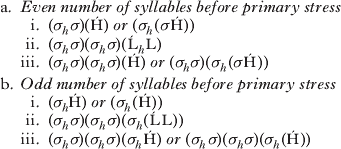
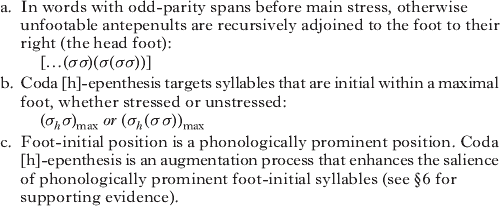
This concludes the heart of my reanalysis of Huariapano. To recap, I have made the major claims about coda [h]-epenthesis in (57).
-
(57)
4.7 Is epenthetic [h] moraic?
At various points I have alluded to the idea that coda [h]-epenthesis is domain-initial strengthening at the level of the foot. So far, nothing has been said about how [h]-epenthesis contributes to the salience of the syllables that it targets. One obvious possibility is that epenthetic [h] is moraic, with coda [h]-insertion ensuring that foot-initial syllables will be heavy (cf. Parker Reference Parker1994, Reference Parker1998a, Reference Parkerb, Smith Reference Smith2005).
Though seemingly reasonable, this assumption proves untenable. If coda [h] is moraic, then epenthesis creates (HĹ) and (H) iambs – feet that are very badly formed from the perspective of structural markedness (Prince Reference Prince1990, Hayes Reference Hayes1995, Prince & Smolensky Reference Prince and Smolensky2004).Footnote
20
-
(58)

Indeed, many languages actively avoid parsing heavy syllables into the weak, unstressed branch of a foot (e.g. Hayes Reference Hayes1981, Reference Hayes1995, Kager Reference Kager and Roca1997, Bennett Reference Bennett2012, Norris to appear, etc.). Since primary stress is quantity-sensitive in Huariapano, any account of the language that assumes […(H )#] footing should be viewed with scepticism.
Given these difficulties, I suggest that coda [h] is never moraic in Huariapano. My view is that the non-moraic nature of coda [h] stems from a more general property of the language: only word-final consonants sponsor an independent mora. Several important consequences follow from this assumption. Limiting moraic codas to final position means that [CVC#] ultimas are the only heavy syllables in Huariapano (setting aside long vowels, which are exclusive to monosyllabic [CVː] words). This is a valuable result, because it derives the fact that only primary stress is sensitive to syllable weight.
Heavy syllables, being restricted to the ultima, always belong to the right-aligned foot that carries main stress. Non-head feet are then trivially quantity-insensitive, because they never contain heavy syllables. Assuming positionally restricted coda weight thus obviates the need for specialised constraints that enforce quantity-sensitivity for primary stress, but not secondary stress (cf. Parker Reference Parker1998a, McGarrity Reference McGarrity2003, Pruitt Reference Pruitt2012).
It also follows that there are no moraic [h]'s in Huariapano, since (i) only word-final codas sponsor a mora, and (ii) [h] is never word-final.Footnote 21 By restricting moraic codas to final position, we derive the fact that only primary stress interacts with syllable weight, while also guaranteeing that coda [h]-epenthesis does not create prosodically ill-formed feet.
There is ample precedent for assuming that moraic codas may be limited to specific positions (see especially Rosenthall & van der Hulst Reference Rosenthall and van der Hulst1999). Of particular relevance are languages with the same finality condition on coda weight that I propose for Huariapano. In Goroa, for example, closed syllables only attract stress when in final position (Hayes Reference Hayes1981). In tandem with these observations, work in Government Phonology and related frameworks has often observed that word-final consonants may behave differently than word-medial codas for a range of phonological phenomena (see Kaye Reference Kaye1990, Harris & Gussmann Reference Harris, Gussmann and Cyran1998, Piggott Reference Piggott1999, Gussmann Reference Gussmann2002: ch. 5 and citations there). Finally, contextual syllable weight is attested in other Panoan languages, making its occurrence in Huariapano somewhat less surprising (Elías-Ulloa Reference Elías-Ulloa2006, Reference Elías-Ulloa2009). I conclude that there is both language-internal and typological support for the claim that only word-final codas are moraic in Huariapano.
This proposal raises an important question regarding the function of epenthesis in Huariapano: if coda [h] isn't moraic, how does it ‘augment’ foot-initial syllables? My claim is that coda [h]-epenthesis enhances the prominence of foot-initial syllables by increasing their raw segmental content. Put differently, epenthesis adds to overall syllable duration (and thus perceptual salience), but does so in a non-moraic fashion (Gordon Reference Gordon2002b).Footnote 22 This is not a novel idea: Beckman (Reference Beckman1998), Hall (Reference Hall2001), Bye (Reference Bye2005), Bye & de Lacy (Reference Bye, de Lacy, de Carvalho, Scheer and Ségéral2008) and Ryan (to appear) have proposed that there is independent pressure to maximise the amount of segmental material contained in prominent syllables, irrespective of moraic weight (cf. the constraint *Head/CV from González Reference González2003, and similar ideas in Munshi & Crowhurst Reference Munshi and Crowhurst2012). Coda [h]-epenthesis in Huariapano, then, is a prosodically determined but non-moraic strengthening process. In §6 I provide other cases of non-moraic augmentation in foot-initial syllables, further supporting this view of rhythmic [h]-insertion in Huariapano. See Bennett (Reference Bennett2012) for an OT implementation of these proposals using positional markedness constraints (Zoll Reference Zoll1998, Smith Reference Smith2005).
A so-far unanswered question is why [h], rather than some other segment, is chosen as the epenthetic consonant in Huariapano. I assume with Parker (Reference Parker1994, Reference Parker1998a) that [h] is chosen as the epenthetic segment for two reasons: first, [h] has no oral place features, and is thus relatively unmarked (e.g. de Lacy Reference de Lacy2006), and second, coda [h] is licensed by a following voiceless obstruent, as it is a species of (heterosyllabic) preaspiration. See Parker (Reference Parker1998a) for an OT formalisation of these views.
5 On the empirical evidence for stress in Huariapano
De Lacy (Reference de Lacy2007b, to appear) has recently revived long-standing concerns about impressionistic judgements of word-level stress (e.g. Chomsky & Halle Reference Chomsky and Halle1968: 24–26). First-hand descriptions of stress systems often rely on the fieldworker's perception of where stress falls, sometimes in conjunction with native speaker intuitions regarding the location and relative strength of stress peaks. But both of these methods are potentially flawed, as de Lacy argues at length.
First, native speaker judgements of stress are notoriously variable. Speakers of the same language may have divergent intuitions about where stress falls in a given word, and even a single speaker may offer conflicting judgements at different times. This problem is compounded by the fact that the stress pattern of any individual word may vary with sentential context, as evidenced by phenomena such as the English ‘rhythm rule’ (see references in Hayes Reference Hayes1995: ch. 9).
Second, fieldworker descriptions of stress patterns may be unduly influenced by the prosody of their own native language (Blaho & Szeredi Reference Blaho and Szeredi2011 and Newlin-Łukowicz Reference Newlin-Łukowicz2012 discuss two possible instances of this problem). L1 transfer of prosody is common in both production and perception, and can be seen clearly in contact situations (e.g. Irish influence on the prosody of Belfast English; Dalton & Ní Chasaide Reference Dalton, Chasaide, Solé, Recasens and Romero2003). The stubbornness of native language prosody may therefore impact the perception of non-native stress patterns even among very seasoned fieldworkers. My anecdotal impression, shared by de Lacy, is that these problems are more acute for secondary stress, which is often weakly cued and may be confounded with segmental prominence (e.g. unstressed long vowels may sound stressed to non-native speakers simply because they are long).
These observations suggest that many primary source descriptions of stress patterns are potentially unreliable (see Hayes Reference Hayes1995: ch. 2 for more discussion, and a somewhat more optimistic outlook). As a corrective, de Lacy recommends in-depth phonetic analysis, using modern instrumental methods, to determine where accentual prominences fall in the language being studied. In his view, such phonetic investigation is a necessary prerequisite to the formal analysis of any stress system. De Lacy thus takes the strong stance that impressionistic judgements of stress are not to be trusted, unless supported by convergent evidence from phonetics and (if available) from independent phonological diagnostics for stress placement.
So where does this quagmire leave the study of Huariapano? Phonetic description of the language is meagre, with Parker (Reference Parker1998b) being the only work I know of that investigates the acoustics of spoken Huariapano in quantitative terms. Parker's study analyses two spontaneous oral narratives, told by the last known fluent speaker of the language. These stories, which may well be the only audio recordings of Huariapano left to us, total about seven minutes in length.
Parker (Reference Parker1998b) is focused on segmental duration, and has little to say about the phonetic correlates of stress. Still, Parker does observe that stress has only a negligible effect on vowel duration in his audio corpus, even when primary and secondary stress are considered separately. This conclusion, though intriguing, should be taken with a grain of salt: the sample is limited (224 vowels, produced by one speaker), and Parker does not control for confounding factors like vowel quality, consonantal context, syllable structure or phrasal position (see also Footnote note 13). While Parker's phonetic findings must be viewed with caution (as he himself notes), the sad truth is that better evidence may never be forthcoming. Huariapano has been extinct for two decades, and, as mentioned above, hardly any audio records of the language remain. Though we might still use these sparse materials to investigate the phonetics of Huariapano stress in more detail, any results would be provisional at best. Parker's recordings are brief and uncontrolled, and probably too noisy for sensitive measures like spectral tilt (Sluijter & van Heuven Reference Sluijter and van Heuven1996) or vowel dispersion (Lindblom Reference Lindblom1963).
Thankfully, the evidence for stress and [h]-epenthesis in Huariapano goes beyond these two recordings. The descriptions in Parker (Reference Parker1994, Reference Parker1998a) are also derived from data that Parker collected using traditional elicitation methods (see Parker Reference Parker1992). Since Parker (Reference Parker1994, Reference Parker1998a, Reference Parkerb) doesn't mention any stress-conditioned phonotactics in Huariapano, it seems likely that his transcriptions of stress reflect his own impressionistic judgements, rather than the application of some phonological diagnostic for stress placement.
How reliable are Parker's transcriptions of stress, then? It's hard to say, given the fact that replication of his fieldwork is now impossible, and no one else has described the phonology or phonetics of Huariapano in any detail. That said, I am inclined to believe that Parker's characterisation of the data is essentially correct. De Lacy (to appear) mentions two extraneous factors that might lead a fieldworker to mistakenly posit a secondary stress: boundary-adjacent lengthening (e.g. Klatt Reference Klatt1976) and boundary-adjacent intonational targets unrelated to word-level stress (e.g. Pierrehumbert & Beckman Reference Pierrehumbert and Beckman1988, Gordon to appear). To this we can add the possibility that closed syllables might be misperceived as stressed by virtue of their relative duration (Gordon Reference Gordon2002b). But Parker transcribes many secondary stresses on medial open syllables, where none of these potential confounds come into play, as in (59).
-
(59)

Vowel height is another factor that might influence judgements of stress, since low vowels are intrinsically more sonorous than non-low vowels (e.g. Gordon Reference Gordon2002b, Parker Reference Parker2002). This too seems an unlikely explanation for Parker's transcriptions, as there are numerous examples in which he marks secondary stress on high vowels to the exclusion of adjacent low vowels, e.g. [a.ˌri.ʂah.ˈkaŋ.ki] ‘they repeated’, [ˌʂɰ.na.no.ˈʂi.ki] ‘he is going to seek, look for’, and (59a), among others.
Interference from native language prosody is also probably insufficient to account for Parker's transcriptions of secondary stress. Examples like (59a, b) follow a decidedly non-English pattern of stress, at least when compared to monomorphemic words like ˌTatamaˈgouchi (e.g. Pater Reference Pater2000). It's also unclear why influence from English would bias Parker toward even-syllable stress in words like [rah.ˌkɰ.ʧa.ˈi.ki] (60a), but toward odd-syllable stress in otherwise similar words like [ˌwa.nɰ.ki.ˈraŋ.ki] ‘they have returned’ and [ˌrah.kɰ.ˈa.naj] ‘to be afraid’.
Whatever the force of these arguments, I cannot rule out the possibility that Parker's work contains numerous errors in the transcription of secondary stress.Footnote 23 It's worth asking, then, how this worst-case scenario would affect the theoretical points made here. A major claim of this article is that the word-level prosody of Huariapano can be analysed without disjoint metrical tiers. But if the basic description of Huariapano stress is wrong, then the argument for disjoint metrical tiers is simply invalid, and no further discussion is needed. In either case, Huariapano ceases to be a strong counterexample to the unity of footing hypothesis in (32).
What about the positive proposals of the article? Whatever the stress system of Huariapano was, some account needs to be given for the alternating pattern of coda [h]-epenthesis identified by Parker. I have argued that [h]-epenthesis should be analysed with a combination of left-to-right binary footing and a limited amount of recursive metrical structure. These claims are largely independent of where stress actually falls. Indeed, one of my central points is that foot parsing and headedness are logically separable; this separation allows us to reconcile [h]-epenthesis with either odd- or even-syllable stress. Given this built-in flexibility, the core analysis can actually tolerate certain kinds of transcription errors. Some mistakes in the placement of secondary stress have no bearing at all on the location of foot boundaries: compare, for instance, the attested peninitial stress in [(rah.ˌkɰ)(ʧa(ˈi.ki))] with hypothetical initial stress in *[(ˌrah.kɰ)(ʧa(ˈi.ki))]. Along the same lines, §4.6 showed that my analysis is consistent with two different parses for trisyllabic words bearing final stress, recursive (σ(σ)) and non-recursive (σ)().
These proposals are even compatible with the view that Huariapano had no audible secondary stress at all, as has been suggested for other Panoan languages with rhythmic phonotactic alternations (Elías-Ulloa Reference Elías-Ulloa2006, González Reference González2009). In that case, most of the footing I propose for [h]-epenthesis would simply be covert (i.e. unstressed), with the exception of the word-final foot that carries main stress.Footnote 24
Though the approach I have developed is largely neutral with respect to the position of stress in any individual word, there are still stress patterns that would falsify my analysis. My proposals depend on the assumption that both secondary stress and [h]-epenthesis are quantity-insensitive. If secondary stress in Huariapano were instead quantity-sensitive, with clashes permitted, my analysis would wrongly predict the possibility of [h]-epenthesis in even-numbered syllables, as in (60). (For the sake of argument I am assuming that non-final [CVC] syllables are heavy, though there is no indication at all that this is true.)
-
(60)

The key difference between the hypothetical stress system in (60) and Parker's descriptions is that (60) freely builds monosyllabic feet over heavy syllables. This disrupts the strict binary parsing that I rely on to generate an alternating syllable count for [h]-epenthesis, and leads to incorrect predictions about the location of coda [h].
Of course, there's no actual evidence that Huariapano had quantity-sensitive secondary stress, much less the clash patterns in (60). Indeed, what little evidence we have speaks to quantity-insensitive parsing: namely Parker's judgements, as well as the system of [h]-epenthesis itself. I also take comfort in the fact that quantity-insensitive secondary stress is attested in other Panoan languages, as are quantity-insensitive, syllable-counting phonotactics (see González Reference González2009 for a helpful overview).
Exactly analogous problems would arise if prosodically ‘trapped’ antepenults were parsed into degenerate monosyllabic feet, as in (61).
-
(61)

But the parses in (61) are clearly implausible: Huariapano has a bimoraic word-minimality condition that argues against degenerate footing (§2.1), and Hyde (Reference Hyde2012) reports that stress systems like (61b) are otherwise unattested in natural language.
There are of course many other stress patterns that would be inconsistent with my proposals. Since the same basic criticisms would likely apply to those patterns too, I set them aside.
In the end, there is no escaping some degree of uncertainty over the empirical facts here – that's the price we pay for working with extinct languages, whether they be Latin, Huariapano or something else. The question is one of confidence, not absolute certainty. On that count, Parker's characterisation of the data seems trustworthy enough to merit serious consideration and analysis. In the interest of caution, I have also argued that my proposals can accommodate various transcription errors that may have crept into Parker's work. What's more, these data-sparsity problems have little impact on my larger claim that foot-initial syllables are phonologically strong, since foot-initial prominence effects are attested in a range of other languages, as I now show.
6 More evidence for foot-initial prominence
The foot-based analysis of Huariapano that I endorse hinges on the claim that foot-initial position is phonologically prominent, independent of whether the foot-initial syllable also bears stress. This proposal can be further grounded in cross-linguistic phonological and phonetic evidence, as I briefly outline in the following sections. These patterns are also discussed at greater length in Bennett (Reference Bennett2012).
6.1 Canela
In Canela (Jê; Central/NE Brazil), intervocalic consonants lengthen before stressed vowels, provided the pretonic vowel is short (Popjes & Popjes Reference Popjes and Popjes1971, Reference Popjes, Popjes, Derbyshire and Pullum1986). Vowel length is contrastive, though it doesn't carry a high functional load.
-
(62)
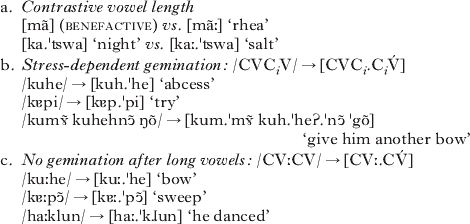
Gemination fails after a long vowel because [CVːC] syllables are banned outright. This is a good indication that consonant lengthening (62b) derives a true ambisyllabic geminate: otherwise, the blocking effect of a preceding long vowel would be rather puzzling.
Gemination thus provides a closing coda for pretonic open syllables, when permitted by general constraints on syllable shape. Stress is typically word-final in Canela (and uniformly so in nouns and verbs), which points toward iambic footing, e.g. [(kuh.ˈhe)]. Taken together, these observations indicate that gemination always closes a syllable in foot-initial position. This is exactly parallel to [h]-epenthesis in Huariapano: foot-initial open syllables are augmented with a closing coda.
The bottom line is that foot structure provides a rationale for why stressed onsets lengthen at all in Canela: foot-initial strengthening. Other explanations fall short on this point. In particular, gemination cannot be driven by a pressure to augment stressed syllables (cf. Bye & de Lacy Reference Bye, de Lacy, de Carvalho, Scheer and Ségéral2008). As argued above, it is clear that geminates are ambisyllabic in Canela, not ‘pure’ onset geminates belonging only to the stressed syllable (Topintzi Reference Topintzi2008). But it follows from this that gemination doesn't alter the structure of the stressed syllable itself, which is [C (X)] in any case. If gemination is triggered by prosodic structure in Canela, it must depend on footing, not just syllable structure or stress alone (cf. Giavazzi Reference Giavazzi2010).
Canela thus provides a striking case of coda augmentation in foot-initial syllables, of the same general sort proposed for Huariapano in §4. I suspect that other instances of this phenomenon are waiting to be identified: for example, Karo and Kaapor (two unrelated Amazonian languages) also have patterns of stressed onset gemination that are amenable to an analysis in terms of foot-initial strengthening (Bennett Reference Bennett2012).
6.2 Yupik
Yupik languages (Eskimo-Aleut; Alaska and Siberia) are well known for having fortition processes that mark foot-initial syllables (Jacobson Reference Jacobson1985, Leer Reference Leer1985a, Reference Leerb, c, Hayes Reference Hayes1995, van de Vijver Reference Vijver1998, etc.). This fortition may involve subphonemic consonant lengthening (with concomitant devoicing), or in the case of Norton Sound Yupik, neutralising changes in consonant manner. Fortition is clearly conditioned by metrical structure rather than stress: since footing is iambic in the Yupik languages, the foot-initial syllables that undergo fortition may be either stressed () or unstressed (LĹ).
Here I focus on Chugach Alutiiq, as spoken on Prince William Sound. According to Leer (Reference Leer1985b), fortis consonants are lengthened and realised with ‘preclosure’, which may involve preglottalisation (Leer mentions a ‘slight hiatus [and] gap in breath flow’ before fortis consonants). Fortition only affects short consonants: there are no fortis–lenis alternations for geminates. Though lengthened, fortis consonants remain audibly shorter than true geminates, so fortition is non-neutralising. Lastly, fortis consonants resist postvocalic voicing, which normally affects singleton voiceless obstruents (though voicing is only partial in such cases).
The distribution of fortis consonants is illustrated in (63) (examples from Leer Reference Leer1985b; ù indicates a fortis consonant).
-
(63)
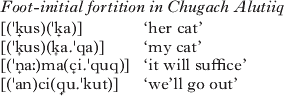
To reiterate a point made above, fortition is clearly conditioned by metrical structure rather than stress. Fortis consonants are found in stressed and unstressed syllables alike. Fortition is likewise indifferent to the stress profile of adjacent syllables. Fortis onsets occur after both stressed and unstressed syllables in (63), as well as word-initially. The presence of stress on the following syllable is similarly irrelevant. Fortition depends only on the position of foot boundaries: it is foot-initial strengthening par excellence.
This pattern of fortition is particularly interesting, because it is non-quantitative, having no effect on syllable weight. In that respect Yupik-type fortition is akin to coda [h]-insertion in Huariapano, though the subphonemic strengthening in (63) is clearly a lower-level process. Other instances of non-quantitative, foot-initial strengthening include allophonic stop aspiration in English (Jensen Reference Jensen2000, Davis & Cho Reference Davis and Cho2003) and phonetic lengthening in Japanese affricates (Shaw Reference Shaw, Trouvain and Barry2007).
As a closing observation, it is worth mentioning that initial consonant fortition is also attested for stressed syllables and word-initial syllables, two uncontroversially prominent positions (Lavoie Reference Lavoie2001, Smith Reference Smith2005, Giavazzi Reference Giavazzi2010). This is as expected, if foot-initial syllables belong to the class of strong positions. For general discussion of domain-initial articulatory strengthening, see Fougeron & Keating (Reference Fougeron and Keating1997) and Keating et al. (Reference Keating, Cho, Fougeron, Hsu, Local, Ogden and Temple2003).
6.3 Russian
In most Central and Southern dialects of Russian, unstressed [a] is permitted only in immediately pretonic syllables (Halle & Vergnaud Reference Halle and Vergnaud1987, Crosswhite Reference Crosswhite2000, Reference Crosswhite2001, Padgett & Tabain Reference Padgett and Tabain2005, Iosad Reference Iosad2012, among many others). This non-uniform pattern of vowel reduction is plausibly foot-based: assuming that footing is iambic in these varieties of Russian, we can conclude that the reduction of unstressed [a] (to [ə]) is inhibited in foot-initial syllables, (σ).Footnote
25
-
(64)

It is relevant here that [a] is a highly sonorous vowel, and as such tends to be licensed in phonologically strong positions (e.g. de Lacy Reference de Lacy2004, Reference de Lacy2006, Reference de Lacy and de Lacy2007a). If foot-initial position counts as phonologically prominent, as I propose, then the retention of underlying /a/ in pretonic syllables amounts to the preservation of sonorous vowels in a position of phonological strength – a typologically familiar pattern.
Indeed, in some dialects of Russian the mid vowels /e o/ actually lower to [a] when pretonic, thereby becoming more sonorous even at the cost of neutralisation.
-
(65)

This phenomenon can be interpreted as another case of foot-initial augmentation, given that it involves an active increase in the sonority of pretonic vowels.
Interestingly, these patterns of vowel allophony go against the clear typological preference for low-sonority vowels in unstressed, footed syllables (see e.g. Kenstowicz Reference Kenstowicz1996, Gouskova Reference Gouskova2003, de Lacy Reference de Lacy2004). In Dutch, for example, we find a mirror-image skew in vowel reduction: unstressed, but footed, syllables, (
σ)σ, are more prone to reduction than unfooted syllables (Kager Reference Kager1989: 312–317). This apparent discrepancy vanishes once we recognise that, in iambic systems, the push towards foot-initial prominence may trump the preference for low-sonority vowels in weak footed syllables. I conclude that the exceptional behaviour of pretonic vowels in Russian stems from the fact that foot-initial syllables are phonologically strong.
Similar conclusions can be drawn from positionally restricted contrasts in other iambic languages. In San Martín Itunyoso Trique, for example, pretonic syllables host a greater range of consonant, vowel and tone contrasts than other unstressed syllables. See DiCanio (Reference DiCanio2008: chs 2, 5) for details.
7 Conclusion
In this article I have argued that foot-initial syllables are in a position of phonological and phonetic strength. This proposal clears the way for a unified analysis of stress and coda [h]-epenthesis in Huariapano. Once it is recognised that [h]-insertion occurs in foot-initial syllables, regardless of stress, the rhythmic distribution of coda [h] can be captured without appeal to a distinct, epenthesis-specific metrical tier.
This single-tier analysis of Huariapano provides a cornerstone for the larger conception of foot structure defended in this article. According to the unity of footing hypothesis, phonological strings can be parsed into at most one layer of metrical constituents at a time. While various phonological processes can be sensitive to the foot structure that determines stress, no further metrical structure can be built over the very same syllables.
What, then, of those languages (mentioned in Footnote note 10) that do seem to require process-specific metrical tiers? The analysis of Huariapano developed here demonstrates that the apparent need for such tiers sometimes stems from an overly rigid view of foot structure. My monoplanar account of [h]-insertion assumes that a single language can make use of both iambs and trochees, even within the same word. This fruitful idea has been widely employed in previous literature. More surprisingly, Huariapano also provides evidence that feet, like other levels of the prosodic hierarchy, may have a richly articulated recursive structure, at least when needed to ensure exhaustive parsing. By accepting that a single language might exploit a range of different foot structures, we create an expanded analytical space in which it becomes possible to model seemingly irreconcilable rhythmic phenomena within one system of foot parsing.
Huariapano provides one of the most compelling cases of process-specific footing uncovered to date. I have argued that this conclusion is not only premature, but conceptually flawed. This serves as a proof of concept: if the phonology of Huariapano can be captured within a single system of footing, this casts serious doubt on the existence of multiplanar parsing in any language (see also Dresher & Lahiri Reference Dresher and Lahiri1991, Churchyard Reference Churchyard1999 and Bennett Reference Bennett2013). While other putative examples of metrical mismatch must be left for future research, I am optimistic that any remaining cases will be reducible to derivational opacity (e.g. Blumenfeld Reference Blumenfeld2006: §3.6.2, Dresher Reference Dresher, Raimy and Cairns2009), the morphologisation of a metrically conditioned phonological process (e.g. Werle Reference Werle, Gillon, Sawai and Wojdak2002) or the kind of flexible prosodic structure I have documented for Huariapano.