1. Introduction
During the Devonian Period, trilobite communities were strongly influenced by spatial and temporal ecological changes at the global scale as well as regionally (Crônier & van Viersen, Reference Crônier and van Viersen2007; Abe & Lieberman, Reference Abe and Lieberman2012; Crônier & François, Reference Crônier and François2014; Bignon & Crônier, Reference Bignon and Crônier2015). The development of hospitable shallow platforms during Early Devonian time led to a trilobite diversification (Chlupáč, Reference Chlupáč1994), but the sea-level changes and anoxic/hypoxic events during Middle Devonian time caused a sharp decrease in their diversity (Feist, Reference Feist1991; Lerosey-Aubril & Feist, Reference Lerosey-Aubril, Feist and Talent2012). These kinds of spatial and temporal palaeoenvironmental changes were observed in the trilobite communities from North Africa (Bault et al. Reference Bault, Crônier, Allaire and Monnet2021). This area was located on the continental shelf of northwestern Gondwana (McKellar & Chatterton, Reference McKellar and Chatterton2009) and was flooded during the Silurian transgression (Bultynck & Walliser, Reference Bultynck and Walliser2000) leading to a Devonian epicontinental sea (Kaufmann, Reference Kaufmann1998). Thus, an abundant and diverse trilobite fauna proliferated during Early Devonian time before a long decline due to events that occurred during Middle and Late Devonian times.
To understand the trilobite response to palaeoenvironmental changes and their biodiversity dynamics at a regional scale, our study is focused on the Devonian North African communities from two well-known areas, i.e. the Moroccan Anti-Atlas and the Algerian Ougarta Range. These two areas are famous for their detailed stratigraphy, their numerous faunal studies and their recognized environmental changes (Wendt et al. Reference Wendt, Aigner and Neugebauer1984; Wendt, Reference Wendt1985, Reference Wendt1993, Reference Wendt2021 a,b; Wendt & Belka, Reference Wendt and Belka1991; Benhamou et al. Reference Benhamou, Abbache, Elmi, Mekahli, Racheboeuf, Ouali-Mehadji and Boumendjel2004; Ouali Mehadji et al. Reference Ouali Mehadji, Atif, Bouterfa, Nicollin and Besseghier2011; Abbache et al. Reference Abbache, Ouali Mehadji, Crônier, Allaire and Monnet2019; Frey et al. Reference Frey, Pohle, Rücklin and Klug2019). The trilobite fauna from this North African area was first studied by Le Maître (Reference Le Maitre1952) followed by numerous publications by G. Alberti (e.g. Reference Alberti1964, Reference Alberti1966 a,b, Reference Alberti1967 a,b, Reference Alberti1969, Reference Alberti1970, Reference Alberti1981 a,b, Reference Alberti1982, Reference Alberti1983) and H. Alberti (e.g. Reference Alberti1972, Reference Alberti1973, Reference Alberti1974, Reference Alberti1975 a,b, Reference Alberti1976 a,b). This area is still studied nowadays, as is reflected in more recent publications by Becker et al. (Reference Becker, Aboussalam, Helling, Afhüppe, Baidder and El Hassani2018), Crônier et al. (Reference Crônier, Abbache, Khaldi, Oudot, Maillet and Ouali Mehadji2018 a,b), Feist & Belka (Reference Feist and Belka2018), Feist & Weyer (Reference Feist and Weyer2018), Zapalski & Klug (Reference Zapalski and Klug2018), van Viersen & Lerouge (Reference van Viersen and Lerouge2019) and Chatterton et al. (Reference Chatterton, Gibb and McKellar2020). There were many taxonomic changes in the study area throughout Devonian time, including periods of great taxonomic diversity among the trilobites, following trends identified on a global scale (Chlupáč, Reference Chlupáč1994; Bault et al. Reference Bault, Crônier, Allaire and Monnet2021). The Anti-Atlas Range and Ougarta Range also provided a high diversity of environments, exhibiting temporal and geographical changes because of sea-level fluctuations. The Variscan tectonic events led to different palaeotopographies (Hollard, Reference Hollard and Oswald1967, Reference Hollard1981; Wendt, Reference Wendt1985; Bultynck & Walliser, Reference Bultynck and Walliser2000).
The present work concentrates on trilobite occurrences to analyse the dynamics of trilobite faunas confronted with environmental changes in time and space and to thus understand how the diversity of trilobites may be influenced by the diversity and nature of environments. Trilobite associations were determined by performing multivariate analyses before their diversity and ecology were assessed.
2. Geological settings
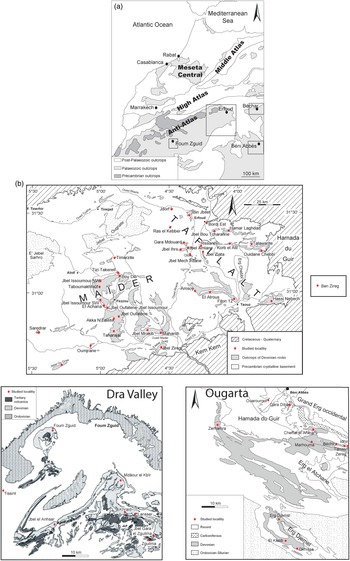
The Moroccan study area, i.e. the Anti-Atlas Range, extends from the Dra region in the southwest towards the northeast, to the Tafilalt in Morocco and ends below the Bechar Basin in Algeria (Hollard, Reference Hollard and Oswald1967). The Algerian study area, i.e. the Ougarta Range (Saoura Valley, Northwestern Algerian Sahara), extends towards the northwest, in the Anti-Atlas (Fig. 1a). During the Devonian Period, the study area included numerous marine basins, which were part of the Sahara platform, a passive continental margin of Gondwana (Wendt et al. Reference Wendt, Aigner and Neugebauer1984). From the southwest towards the northeast, these basins are the Foum Zguid area, the Maïder Basin and Tafilalt Basin in the eastern Anti-Atlas in Morocco, the Ougarta Basin and, to the north, the Bechar Basin (i.e. Ben Zireg area) in Algeria (Fig. 1b).
(a) Simplified geological map of Morocco and Algeria (modified from Crônier et al. Reference Crônier, Oudot, Klug and de Baets2018 b) and location of the five study areas in North Africa within the Anti-Atlas and Ougarta Ranges. (b) Geographical location of the 69 studied localities from the Maïder/Tafilalt area in Morocco and from the Ougarta area in Algeria.

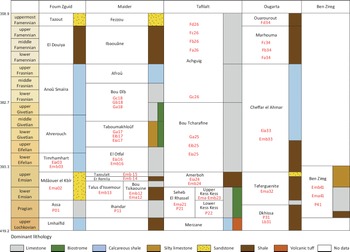
The current correlation based on conodonts between the Tafilalt and Maïder formations (Bultynck & Walliser, Reference Bultynck and Walliser2000) is associated here with their main environmental characteristics (Fig. 2). The succession of formations of Ougarta was described by Boumendjel et al. (Reference Boumendjel, Brice, Copper, Gourvennec, Jahnke, Lardeux, Le Menn, Melou, Morzadec, Paris, Plusquellec and Racheboeuf1997). Although the connection between the Devonian strata of the Ougarta Range and those of the Anti-Atlas region are covered by the Cretaceous ‘Kem-Kem Group’ (Benhamou et al. Reference Benhamou, Abbache, Elmi, Mekahli, Racheboeuf, Ouali-Mehadji and Boumendjel2004), the similar basinal facies found in these areas suggests a connection during Devonian time (Hollard, Reference Hollard and Oswald1967; Wendt et al. Reference Wendt, Aigner and Neugebauer1984). The northern and western parts of the Maïder region were continental during the main part of the Devonian Period and were only flooded during Famennian time when the sea level rose (Kaufmann, Reference Kaufmann1998). Figure 2 summarizes the formations studied along with their dominant lithologies.
Main lithology for each formation present in the five Moroccan Anti-Atlas and western Algerian basins for the Devonian. Formation names in black; ID of samples in red. Ages from Cohen et al. (Reference Cohen, Finney, Gibbard and Fan2013, updated).

2.a. Early Devonian
In the eastern Moroccan Anti-Atlas, the Lower Devonian is characterized by rather uniform facies (i.e. Maïder and Tafilalt; Fig. 2) varying mostly in thickness owing to a homoclinal carbonate ramp topography (Lubeseder et al. Reference Lubeseder, Rath, Rücklin and Messbacher2010). However, palaeocurrents indicate the presence of a shallow pelagic platform in the Tafilalt region with two distinct slope directions: one to the southwest and the other to the northeast (Wendt, Reference Wendt1995). The dominant sedimentology consists of shales interbedded with cephalopod limestones (Kaufmann, Reference Kaufmann1998). In Algeria, the Ougarta corresponded to a platform (Ouali Mehadji et al. Reference Ouali Mehadji, Atif, Bouterfa, Nicollin and Besseghier2011).
The Lochkovian deposits of the eastern Anti-Atlas are mainly composed of shales and black graptolite limestones (Fig. 2). These deposits reflect relatively deep environments, which are not favourable for benthic faunas (Morzadec, Reference Morzadec2001; Klug et al. Reference Klug, Korn, Naglik, Frey, de Baets, Becker, El Hassani and Tahiri2013; Frey et al. Reference Frey, Naglik, Hofmann, Schemm-Gregory, Frýda, Kröger, Taylor, Wilson and Klug2014). In the Tafilalt, the particular Hamar Laghdad area is characterized by volcanic tuff deposits (Hollard, Reference Hollard and Oswald1967; Klug et al. Reference Klug, Samankassou, Pohle, de Baets, Franchi, Korn, Klug and Korn2018). At the end of Lochkovian time and the beginning of Pragian time, a regressive phase enabled benthic faunas to develop (Hollard, Reference Hollard and Oswald1967; Morzadec, Reference Morzadec2001). Nevertheless, Bultynck & Walliser (Reference Bultynck and Walliser2000) reported a dominance of shales and hemipelagic limestones in the eastern part of the Anti-Atlas, whereas the western part was composed of neritic deposits. At the same time, in the Hamar Laghdad area, a reef system settled on volcanic shoals (Hollard, Reference Hollard1981; Brachert et al. Reference Brachert, Buggisch, Flügel, Hüssner, Joachimski, Tourneur and Walliser1992). In the Ougarta Basin, the late Lochkovian–Pragian regressive phase led to a mud-dominated platform environment subjected to storm and fair-weather waves, while to the north the Bechar Basin corresponded to a carbonate platform (Ouali Mehadji et al. Reference Ouali Mehadji, Atif, Bouterfa, Nicollin and Besseghier2011).
During early Emsian time (Fig. 2), limestones and argillaceous limestones still covered the Anti-Atlas without important environmental changes (Hollard, Reference Hollard and Oswald1967) and are very fossiliferous (Kaufmann, Reference Kaufmann1998; Klug et al. Reference Klug, Kröger, Korn, Ruecklin, Schemm-Gregory, de Baets and Mapes2008; de Baets et al. Reference de Baets, Klug and Plusquellec2010). Conversely, in the Foum Zguid area shallow environmental conditions above storm-wave base led to sandstone deposits despite transgressive sequences (Jansen et al. Reference Jansen, Becker, Plodowski, Schindler, Vogel, Weddige and El Hassani2004; Ouanaimi & Lazreq, Reference Ouanaimi, Lazreq, Ennih and Liégeois2008). In Algeria, the Ougarta Basin deepened from late Pragian time owing to a subsidence phase and was covered by shales and marls while the Bechar Basin became more siliciclastic (Ouali Mehadji et al. Reference Ouali Mehadji, Atif, Bouterfa, Nicollin and Besseghier2011).
The transition between the early and late Emsian was marked by a global transgression: in the Anti-Atlas the Daleje event (House, Reference House1985) led to green shale deposits in a basinal environment (Kaufmann, Reference Kaufmann1998). Hollard (Reference Hollard and Oswald1967) noted a difference in faunas and facies between the Maïder and the Tafilalt, with the Tafilalt becoming more argillaceous with a less diverse benthic fauna than the Maïder (Fig. 2). The northern Tafilalt was a pelagic platform with thinner deposits (Kaufmann, Reference Kaufmann1998). In Algeria, the Ougarta Basin remained deep and dominated by shales and marls (Ouali Mehadji et al. Reference Ouali Mehadji, Atif, Bouterfa, Nicollin and Besseghier2011), whereas the Bechar Basin was covered by shales and siltstones (Massa, Reference Massa1965). At the end of Emsian time, limestone deposits formed in the Anti-Atlas (Fig. 2) because of a fall in the sea level. Conversely, the Foum Zguid area was characterized by shales and nodular limestones corresponding to more open water and hemipelagic conditions (Jansen et al. Reference Jansen, Becker, Plodowski, Schindler, Vogel, Weddige and El Hassani2004). Based on trilobites, Chatterton et al. (Reference Chatterton, Fortey, Brett, Gibb and McKellar2006) confirmed the establishment of a relatively deep environment, which was below the storm-wave base but within the photic zone while the north of the Dra Valley was deepening. This area was influenced by the tectonic subsidence triggered by the Variscan extension phase (Ouanaimi & Lazreq, Reference Ouanaimi, Lazreq, Ennih and Liégeois2008). In Ougarta, the regression led to a shoreface or a foreshore environment with sandstone deposits (Ouali Mehadji et al. Reference Ouali Mehadji, Atif, Bouterfa, Nicollin and Besseghier2011).
2.b. Middle Devonian
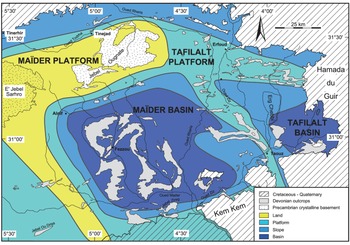
During Middle Devonian time, the collision of Gondwana and Laurussia resulted in the Variscan orogeny. In the Anti-Atlas, this episode is marked by the development of a neritic shelf followed by a platform and basin system, accompanied by palaeoenvironmental changes (Wendt et al. Reference Wendt, Aigner and Neugebauer1984; Kaufmann, Reference Kaufmann1998; Baidder et al. Reference Baidder, Raddi, Tahiri, Michard, Ennih and Liégeois2008; Wendt, Reference Wendt2021 a). The first phase of this tectonic movement occurred at the Emsian/Eifelian boundary (Lubeseder et al. Reference Lubeseder, Rath, Rücklin and Messbacher2010). The Maïder Basin separated the Tafilalt Platform in the northeast from the Maïder Platform in the southwest (Fig. 3). While the Maïder Platform was emerging, the Tafilalt Platform remained a pelagic platform with the northeastern Dra Valley and the Ougarta Basin deepening to a distal ramp (Limam et al. Reference Limam, Mehadji and Bendella2021).
Geographical map of the eastern Anti-Atlas in Morocco with the limits of the Maïder Platform and Basin and the Tafilalt Platform and Basin in Middle and Late Devonian times (modified from Wendt & Belka, Reference Wendt and Belka1991 and Frey et al. Reference Frey, Pohle, Rücklin and Klug2019).

The Foum Zguid area continued its transition towards a hemipelagic platform from Emsian time onwards (Jansen et al. Reference Jansen, Becker, Plodowski, Schindler, Vogel, Weddige and El Hassani2004). During Eifelian time, marlstones and shales became increasingly important. To the northeast, the environment was less uniform. Kaufmann (Reference Kaufmann1998) explained that three different facies occurred in the Maïder and the Tafilalt. A neritic facies characterized by argillaceous wackestones and numerous fossils was present in the northern and western parts of the Maïder near the emerged Maïder Platform. A neritic fauna including trilobites developed in the limestones of the western side of the Maïder Platform at Jbel Ou Driss (Bultynck, Reference Bultynck1985; Feist & Orth, Reference Feist and Orth2000). Condensed pelagic deposits, i.e. condensed nodular limestones and marls with abundant fossils, accumulated on the pelagic Tafilalt Platform. These two platforms corresponded to shallow-water environments (Wendt et al. Reference Wendt, Aigner and Neugebauer1984). Finally, a basinal facies existed in the centre of the Maïder Basin and to the east of the Tafilalt Platform in the Tafilalt Basin. It mainly corresponded to marlstones and shales with scattered faunas. Wendt et al. (Reference Wendt, Aigner and Neugebauer1984) specified that the Maïder Basin was deeper than the Tafilalt Basin. In Algeria, the Ougarta Basin became deeper during Eifelian time, from a foreshore environment at the end of Emsian time to a distal platform (Maillet et al. Reference Maillet, Tanjaoui-Arif, Milhau, Nicollin and Ouali Mehadji2013; Crônier et al. Reference Crônier, Abbache, Khaldi, Oudot, Maillet and Ouali Mehadji2018 a). Henceforth, hemipelagic deposits were found as marlstones interbedded with thin-bedded limestones.
The global transgression events of Middle Devonian time were well pronounced in the Anti-Atlas (Kaufmann, Reference Kaufmann1998). The successive Choteč and Kačák events corresponded to hypoxia, which was probably due to a sea-level rise during Eifelian time leading to black shale deposits (Kaufmann, Reference Kaufmann1998; S. Döring, unpub. Ph.D. thesis, Eberhard-Karls-Universität Tübingen, 2002).
The differentiation between platforms and basins in the eastern Anti-Atlas continued to intensify in Givetian time. On the edge of the Maïder Platform, coral-stromatoporoid limestones developed and extended to early Givetian time (Kaufmann, Reference Kaufmann1998). A second tectonic phase of early Variscan movements occurred during middle Givetian time (Lubeseder et al. Reference Lubeseder, Rath, Rücklin and Messbacher2010). It implied the subsidence of the Maïder Basin, which induced the extension of the basinal facies (Kaufmann, Reference Kaufmann1998). The mid-Givetian Taghanic event was identified in Morocco and Algeria, with shale deposits and condensed layers (Kaufmann, Reference Kaufmann1998). The distal platform of the Ougarta region continued to subside during Givetian time, with shale deposits interbedded with limestones (Maillet et al. Reference Maillet, Tanjaoui-Arif, Milhau, Nicollin and Ouali Mehadji2013). To the north, the Bechar Basin showed similar facies to the Tafilalt Platform with the appearance of pseudonodular limestones in the Givetian (Massa, Reference Massa1965).
2.c. Late Devonian
During Late Devonian time, the Anti-Atlas Range and Ougarta Range were influenced by the same regional events (Benhamou et al. Reference Benhamou, Abbache, Elmi, Mekahli, Racheboeuf, Ouali-Mehadji and Boumendjel2004). Variscan tectonics intensified in the eastern Anti-Atlas, which is reflected in differences of facies and thickness (Hollard, Reference Hollard1974; Wendt, Reference Wendt1985, Reference Wendt1988; Wendt & Belka, Reference Wendt and Belka1991; Belka et al. Reference Belka, Klug, Kaufmann, Korn, Döring, Feist and Wendt1999; Frey et al. Reference Frey, Pohle, Rücklin and Klug2019) resulting in the differentiation of basins and platforms (Wendt et al. Reference Wendt, Aigner and Neugebauer1984, Reference Wendt2021 a,b; Michard et al. Reference Michard, Saddiqi, Chalouan and de Lamotte2008). The active extensional dislocation of the former platform caused by early Variscan tectonic movements and differential subsidence (Wendt et al. Reference Wendt, Aigner and Neugebauer1984) led to the differentiation of two sub-basins, i.e. the Tafilalt Basin, a slowly subsiding shallow basin in the east, and the Maïder Basin, a rapidly subsiding basin in the west (Fig. 3). These two sub-basins were connected via the narrow N–S Cephalopod Ridge, i.e. the Tafilalt Platform with shallower water (Wendt, Reference Wendt1985, Reference Wendt1995; Wendt et al. Reference Wendt, Kaufmann, Belka, Klug and Lubeseder2006; Toto et al. Reference Toto, Kaabouben, Zouhri, Belarbi, Benammi, Hafid and Boutib2008; Lubeseder et al. Reference Lubeseder, Rath, Rücklin and Messbacher2010). At the beginning of Frasnian time, the Tafilalt Platform emerged before being flooded again (Michard et al. Reference Michard, Saddiqi, Chalouan and de Lamotte2008) and the Maïder Platform partly emerged (Wendt, Reference Wendt1985). On the northwestern margin of the Algerian Sahara, a tectono-eustatic control is reflected in differences in lateral facies and thickness in sediments accumulated on a distal platform and in basins (Abbache et al. Reference Abbache, Ouali Mehadji, Crônier, Allaire and Monnet2019). The Late Devonian period marked the most important phase of epeirorgenic movements in the Saoura, leading to an important subsidence (Benhamou et al. Reference Benhamou, Abbache, Elmi, Mekahli, Racheboeuf, Ouali-Mehadji and Boumendjel2004). The Upper Devonian is characterized by alternate deposits of clay-sand and limestone, especially including ‘griotte’ nodular limestones with benthic and pelagic faunas, which indicates an opening to marine environments (Crônier et al. Reference Crônier, Abbache, Khaldi, Oudot, Maillet and Ouali Mehadji2018 a; Abbache et al. Reference Abbache, Ouali Mehadji, Crônier, Allaire and Monnet2019).
In North Africa, a transgression occurred during Late Devonian time. In Morocco, the highest sea level occurred in late Famennian time (Wendt & Belka, Reference Wendt and Belka1991; Becker et al. Reference Becker, Jansen, Plodowski, Schindler, Aboussalam and Weddige2004). In the Ougarta, the highstand occurred at the end of Frasnian time, but the sea level stayed high with highstand deposits until late Famennian time (Ouali Mehadji et al. Reference Ouali Mehadji, Bendella, Atif, Belkacemi and Abbache2012) when a regression led to shallower environments in Morocco and Algeria.
During Frasnian time, in the Anti-Atlas a clay sedimentation with sideritic and nodular levels (Frey et al. Reference Frey, Pohle, Rücklin and Klug2019) developed in the Tafilalt and Maïder basins, and even occasionally on the Tafilalt Platform, reflecting rising sea levels (Wendt, Reference Wendt1988; Lubeseder et al. Reference Lubeseder, Rath, Rücklin and Messbacher2010; Frey et al. Reference Frey, Pohle, Rücklin and Klug2019). At the same time, sandy limestones, thick-bedded crinoid or cephalopod limestones rich in nektonic and planktonic faunas associated with black bituminous shales were deposited on the Tafilalt Platform (Wendt, Reference Wendt1985; Michard et al. Reference Michard, Saddiqi, Chalouan and de Lamotte2008; Frey et al. Reference Frey, Pohle, Rücklin and Klug2019). A condensed sedimentation took place in the southwestern Maïder Basin and on the northern Tafilalt Platform (Wendt, Reference Wendt1988; Wendt & Belka, Reference Wendt and Belka1991; Hüneke, Reference Hüneke2006), probably reflecting a differentiation in both water depth and oxygen availability (Frey et al. Reference Frey, Pohle, Rücklin and Klug2019). In late Frasnian time, shallow subtidal to supratidal deposits developed on the Tafilalt Platform that are characterized by strongly reduced thicknesses, and the Maïder Platform emerged (Wendt et al. Reference Wendt, Aigner and Neugebauer1984; Wendt & Belka, Reference Wendt and Belka1991). In the southeastern part of the Maïder Basin, the Kellwasser levels are represented by dark and massive cephalopod limestones (Wendt & Belka, Reference Wendt and Belka1991; Frey et al. Reference Frey, Pohle, Rücklin and Klug2019). The Ougarta Basin is the continuation of these Tafilalt and Maïder basins to the southeast in the Algerian Sahara (Wendt et al. Reference Wendt, Aigner and Neugebauer1984; Wendt, Reference Wendt1985; Abbache et al. Reference Abbache, Ouali Mehadji, Crônier, Allaire and Monnet2019). In this area, the top of the Cheffar el Ahmar Formation is a distal ramp sedimentation with green shales interbedded with nodular limestones followed by ‘griotte’ limestones interbedded with red shales. The fauna consists of ammonoids, ostracods and chitinozoans (Abbache et al. Reference Abbache, Ouali Mehadji, Crônier, Allaire and Monnet2019).
During Famennian time, a marly and nodular calcareous sedimentation developed in the Tafilalt Basin, in shallow environments. At the same time, basinal facies dominated by shaly and calcareous sedimentation with intercalations of siliciclastic turbidites were laid down in the Maïder Basin, in deeper environments (Wendt et al. Reference Wendt, Aigner and Neugebauer1984; S. Döring, unpub. Ph.D. thesis, Eberhard-Karls-Universität Tübingen, 2002) with diverse cephalopods (Korn & Bockwinkel, Reference Korn and Bockwinkel2017). On the Tafilalt Platform, deposits of quartz-rich brachiopod coquinas, crinoidal limestones, thick-bedded cephalopod limestones and nodular limestones formed during early Famennian time. Similar facies were found on the eastern Maïder Platform (Wendt, Reference Wendt1985). A deeper environment such as a slope or basin with shale deposits characterized the Ougarta region. Pyritized ammonoids and brachiopods were found in nodular limestones interbedded with shales (Abbache et al. Reference Abbache, Ouali Mehadji, Crônier, Allaire and Monnet2019). The deepening of the Ougarta trough was probably due to subsidence and not to transgression (Ouali Mehadji et al. Reference Ouali Mehadji, Bendella, Atif, Belkacemi and Abbache2012). The deepening continued during middle and late Famennian times on the Tafilalt Platform, where marls and nodular limestones were deposited in slightly deeper environments and debris flows and slumps on the margins during late Famennian time (Wendt et al. Reference Wendt, Aigner and Neugebauer1984). Locally, limestones varied greatly in thickness and fossil content (cephalopods, crinoids, brachiopods). The sedimentology documents phases of moderate to good aeration in more or less shallow-water conditions (Wendt et al. Reference Wendt, Aigner and Neugebauer1984; Wendt, Reference Wendt1988). The continuous deepening during late Famennian time led to the decrease in diversity of benthic faunas (Wendt et al. Reference Wendt, Aigner and Neugebauer1984), while the centre of the Maïder Platform was henceforth flooded and pelagic cephalopod limestone accumulated (Wendt, Reference Wendt1985). The Ougarta region remained deep during middle and late Famennian times and became a basin with a restricted water circulation (Benhamou et al. Reference Benhamou, Abbache, Elmi, Mekahli, Racheboeuf, Ouali-Mehadji and Boumendjel2004; Abbache et al. Reference Abbache, Ouali Mehadji, Crônier, Allaire and Monnet2019). In this environment, red ‘griotte’ limestones were deposited with shaly beds and turbidites (Ouali Mehadji et al. Reference Ouali Mehadji, Bendella, Atif, Belkacemi and Abbache2012; Abbache et al. Reference Abbache, Ouali Mehadji, Crônier, Allaire and Monnet2019). Ammonoids, brachiopods and trilobites were found within the nodular limestones (Benhamou et al. Reference Benhamou, Abbache, Elmi, Mekahli, Racheboeuf, Ouali-Mehadji and Boumendjel2004; Crônier et al. Reference Crônier, Malti, Francois, Benyoucef and Brice2013; Mottequin et al. Reference Mottequin, Malti, Benyoucef, Crônier, Samar, Randon and Brice2015; Allaire et al. Reference Allaire, Abbache, Crônier and Monnet2020). Although this facies is not an indicator of palaeobathymetry (Benhamou et al. Reference Benhamou, Abbache, Elmi, Mekahli, Racheboeuf, Ouali-Mehadji and Boumendjel2004), Abbache et al. (Reference Abbache, Ouali Mehadji, Crônier, Allaire and Monnet2019) concluded that these sediments were deposited in a basinal environment. The Nereites ichnofacies confirms this kind of deep environment (Bendella & Ouali Mehadji, Reference Bendella and Ouali Mehadji2015). Ouali Mehadji et al. (Reference Ouali Mehadji, Bendella, Atif, Belkacemi and Abbache2012) identified a narrow basin during middle Famennian time leading to a more homogeneous elongated basin in late Famennian time.
At the end of Famennian time, a fine-grained clastic sedimentation, the Hangenberg Black Shale, was sedimented in most parts of northwestern Africa (Kaiser et al. Reference Kaiser, Becker, Steuber and Aboussalam2011; Klug et al. Reference Klug, Frey, Korn, Jattiot and Rücklin2016). Sandy marls and cross-bedded sandstones covered the southern part of the Tafilalt Platform (Wendt et al. Reference Wendt, Aigner and Neugebauer1984). In Ougarta, sandstone beds occurred that were devoid of fossils and sometimes included channels (Abbache et al. Reference Abbache, Ouali Mehadji, Crônier, Allaire and Monnet2019). Within sandstones assigned to the ‘Grès de Ouarourout’ Formation, Ouali Mehadji et al. (Reference Ouali Mehadji, Bendella, Atif, Belkacemi and Abbache2012) identified the maximal regression surface.
At the beginning of Tournaisian time, the Tafilalt and southern Maïder platforms corresponded to a deltaic environment (Wendt et al. Reference Wendt, Aigner and Neugebauer1984). The Ougarta region corresponded to a siliciclastic platform (Abbache et al. Reference Abbache, Ouali Mehadji, Crônier, Allaire and Monnet2019) with temporary emersions leading to deltaic environments or lagoons (Ouali Mehadji et al. Reference Ouali Mehadji, Bendella, Atif, Belkacemi and Abbache2012).
In the southern Ougarta region, in the Erg Djermel area, no trilobites were found within the Upper Devonian deposits, i.e. in black shale deposits corresponding to deep environments from Frasnian to late Famennian times (Abbache et al. Reference Abbache, Ouali Mehadji, Crônier, Allaire and Monnet2019). In the north of Ougarta, in the Ben Zireg area, trilobites have not yet been recorded within ‘griotte’ calcareous deposits associated with rare shaly layers corresponding to a middle to distal platform (Abbache et al. Reference Abbache, Ouali Mehadji, Crônier, Allaire and Monnet2019). In Morocco, the Foum Zguid area and the Dra Valley deepened from Eifelian to late Famennian times due to a global transgression (Becker et al. Reference Becker, Jansen, Plodowski, Schindler, Aboussalam and Weddige2004). These deep environments are not favourable to the development of trilobite communities and thus fossils are rare, apart from ammonoids and crinoids (Hollard, Reference Hollard1963; Becker et al. Reference Becker, Jansen, Plodowski, Schindler, Aboussalam and Weddige2004).
3. Material and methods
3.a. Material
In order to analyse the trilobite records and their shifts, we completed an existing dataset (Bault et al. Reference Bault, Crônier, Allaire and Monnet2021) based on the occurrence of trilobites from Morocco and Algeria (Fig. 1). Seventy-seven studies from the literature were considered because of their updated taxonomy and/or good temporal resolution (online Supplementary Material Table S1). The dataset contains 2892 specimens (online Supplementary Material Table S1) from the Lochkovian to the Famennian distributed within 69 localities from five basins (Fig. 1). Sections separated by a few hundred metres were combined within the same locality. To avoid possible duplicates, the specimen count was restricted to only the highest number of complete exoskeletons plus the disarticulated cephala or pygidia per occurrence. Other parts of trilobites such as free cheeks or hypostomes were not included. For each relevant occurrence, the dataset contains the following information: taxonomic information, abundance, location, stratigraphic position (substages) and lithological information (formations). Throughout our data compilation work, only genera were considered to maximize potential correlations between the distinct assemblages, as many species are only described locally. Species level is often inadequate for biodiversity purposes (Cecca, Reference Cecca2002). As the Late Devonian Phacops Emmrich, Reference Emmrich1839 differs from the Early and Middle Devonian representatives of the genus, they were counted as a distinct genus called Phacops sensu lato (Crônier et al. Reference Crônier, Bignon and François2011). We used a preliminary revision of asteropygines in open nomenclature while waiting for the revision of the whole subfamily. As a result, previous Metacanthina species M. issoumourensis Morzadec, Reference Morzadec2001 and M. maderensis Morzadec, Reference Morzadec2001 are joined with Minicryphaeus giganteus Bignon et al. Reference Bignon, Corbacho and López-Soriano2014 in Genus 1, whereas Asteropyge wallacei Termier & Termier, Reference Termier and Termier1950 is included in Genus 2. Overall, the dataset comprises 135 genera (online Supplementary Material Table S1) used for the biodiversity indices (see Section 4.c). However, we excluded genera found in only one sample because they did not provide any linkage with others samples for the clustering, which led to a selection of 67 genera spread over 123 samples (or assemblages) used for cluster analysis.
3.b. Clustering
An analysis of associations was carried out using 123 samples at a given substage and formation to help us understand the temporal and spatial relationships between trilobite faunas and their environments. The term association is used here for recurrent assemblages of trilobites with a similar taxonomic composition (Brenchley & Harper, Reference Brenchley and Harper1998; Crônier & van Viersen, Reference Crônier and van Viersen2007; Crônier & François, Reference Crônier and François2014; Bignon & Crônier, Reference Bignon and Crônier2015). To reduce sampling bias, the relative abundances of 67 genera were quantified in seven classes, i.e. the percentage of the abundance of each genus in a sample (Harnik, Reference Harnik2009). Indeed, the number of specimens is influenced by the sampling effort (Thompson, Reference Thompson2004), which cannot be estimated as our data were obtained from various bibliographic references.
Data were analysed using a hierarchical cluster analysis (HCA). This agglomerating technique groups recurring samples according to their level of taxonomic similarity (Davis, Reference Davis1986; Harper, Reference Harper1999; Hammer & Harper, Reference Hammer and Harper2008). It produces dendrograms highlighting the relationships in two modes: an R-mode clustering, grouping the taxa according to their probability of co-occurrence, and a Q-mode clustering, grouping the samples, i.e. of similar generic composition. HCA was carried out using the average linkage algorithm and the Pearson correlation similarity index (Hammer & Harper, Reference Hammer and Harper2008).
To identify environmental gradients, a Detrended Correspondence Analysis (DCA) was carried out. Correspondence Analysis (CA) is suitable for grouping samples from taxonomic abundance (Greenacre, Reference Greenacre1984; Jongman & Jongman, Reference Jongman and Jongman1995; Legendre & Legendre, Reference Legendre and Legendre1998) but DCA is more reliable (Hammer & Harper, Reference Hammer and Harper2008; Holland et al. Reference Holland, Miller, Meyer and Dattilo2001; Bonelli & Patzkowsky Reference Bonelli and Patzkowsky2008) for reducing the Pinocchio (online Supplementary Material Fig. S1a) and arch effects (online Supplementary Material Fig. S1b). This ordination method maximizes the correspondences between taxa and samples. It also provides ordination scores for both taxa and samples according to the relative abundance of taxa by involving a compression of the total information along the first axis, which often reflects palaeoenvironmental gradients (Hammer & Harper, Reference Hammer and Harper2008). Unfortunately, several taxa need modern revision to clarify their generic determination. Moreover, microfacies analyses would be suitable for a better characterization of the environments. In their absence, an additional DCA would improve our determination of the relationships between some samples.
Finally, an analysis of similarities (ANOSIM) was carried out to statistically test the differences in the generic composition of groups of taxa. This non-parametric test is based on Bray–Curtis dissimilarity values as it only uses the rank order of dissimilarity values between groups and within groups (Clarke, Reference Clarke1993; Hammer & Harper, Reference Hammer and Harper2008). P-values were obtained through 5000 random permutations.
3.c. Diversity indices
To complete the multivariate analysis information and help understand the impact of migrations and environmental changes on the diversity, α and β diversities (Whittaker, Reference Whittaker1960) were estimated. The total taxa diversity is determined by the mean taxa diversity at the habitat level (α) and the differentiation among habitats (β). The Shannon index H′ of α diversity was used to take into account the number of taxa within a sample (taxa richness) and the individual distribution within these taxa (taxa equitability). It considers the relative abundance of each taxon and gives weight to rare species. This index varies from 0 for a sample with only one single taxon to high values for samples with many taxa.
 $H' = - \mathop \sum \limits_{i = 1}^S {p_i}lo{g_2}{p_i}$
, with S the number of taxa and
 ${p_i} = {{{n_i}} \over N}$
, with n
i
the number of individuals of the taxon i and N the number of individuals for all taxa. The Shannon index H′ of α diversity was estimated through time according to substages or formations and through environment according to associations. Diversity for associations is calculated as the mean taxonomic richness of samples of each association, while the diversity for substages or formations is calculated as the total taxonomic richness in these stratigraphic units.
Several measures related to compositional heterogeneity of β diversity were used to quantify differentiation (Baselga, Reference Baselga2010; Baselga & Orme, Reference Baselga and Orme2012). The first measure is an index of taxa replacement (i.e. turnover) emphasizing the role of rare taxa as the difference in taxa composition between localities measured as Simpson dissimilarity (i.e. the turnover component of Sørensen dissimilarity). This measure enables the identification of the environmental impact or spatial and temporal constraints on the number of taxa that are replaced between localities (Qian et al. Reference Qian, Ricklefs and White2005). The second measure is an index of nestedness, which occurs when taxa-poor assemblages are a subset of more diverse assemblages (Wright & Reeves, Reference Wright and Reeves1992; Ulrich & Gotelli, Reference Ulrich and Gotelli2007) measured as the nestedness-resultant component of Sørensen dissimilarity (Baselga, Reference Baselga2010). This measure indicates non-random species loss, as common species are less likely to disappear (Gaston et al. Reference Gaston, Blackburn, Greenwood, Gregory, Quinn and Lawton2000). The last measure is an index of the overall β diversity measured as Sørensen dissimilarity (Sørensen, Reference Sørensen1948) corresponding to the global taxonomic difference between samples. Components of β diversity were estimated through time between substages and through environment between associations.
HCA, ANOSIM, DCA and Shannon index H′ were achieved by using the software PAST v3.24 (Hammer et al. Reference Hammer, Harper and Ryan2001). β diversity was computed by using the ‘Betapart’ package (Baselga & Orme, Reference Baselga and Orme2012) in the R statistical environment (version 3.6.3; R Core Team, 2020).
4. Results
4.a. Delineated associations and faunal gradients
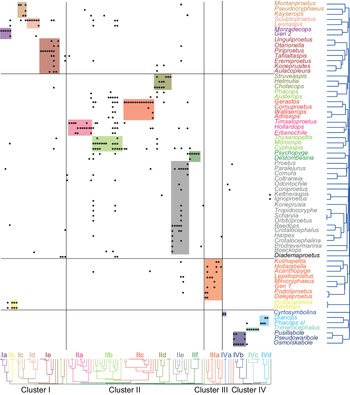
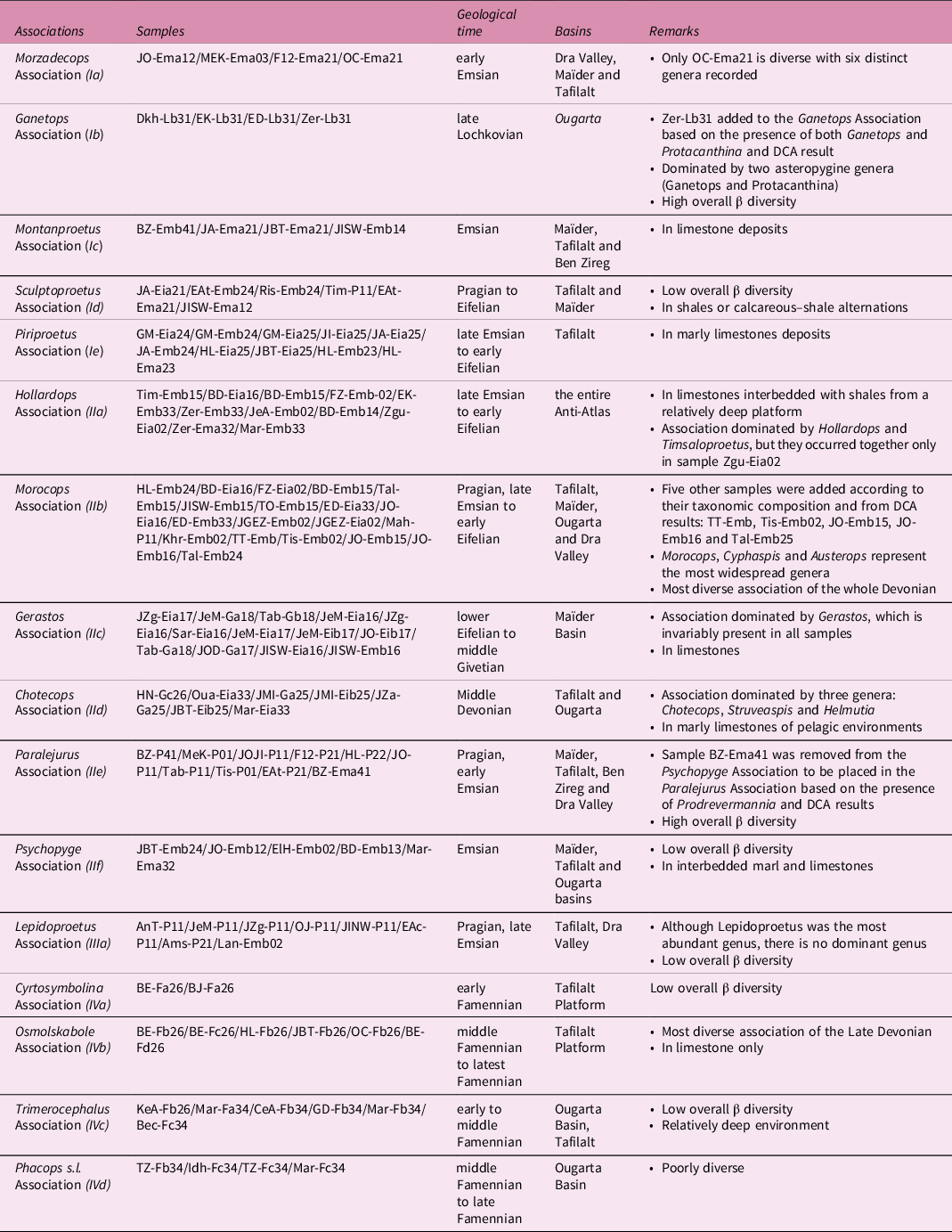
The 67 trilobite genera distributed within the 123 assemblages are grouped into 16 associations, or occurrences, in four main clusters by HCA (Fig. 4; details in online Supplementary Material Fig. S2). Details of each trilobite association are given in Table 1.
Simplified dendrogram with R and Q modes from hierarchical cluster analysis (HCA) using the average linkage method as correlation setting and the Pearson correlation index as similarity index (Hammer & Harper, Reference Hammer and Harper2008). Sixty-seven taxa (genera) are clustered according to 123 analysed samples (localities) from the Devonian of North Africa. Four clusters (I to IV) and 16 associations are identified. Sample names and proportions of each occurrence are given in online Supplementary Material Fig. S2).

Trilobite associations and their environmental, faunal and temporal features

Cluster I groups five associations (i.e. Morzadecops Association Ia, Ganetops Association Ib, Montanproetus Association Ic, Sculptoproetus Association Id and Piriproetus Association Ie), covering the entire Early Devonian and early Eifelian period; Cluster II groups six associations (i.e. Hollardops Association IIa, Morocops Association IIb, Gerastos Association IIc, Chotecops Association IId, Paralejurus Association IIe and Psychopyge Association IIf), from the Pragian to the Givetian; Cluster III groups only one association (Lepidoproetus Association IIIa) mainly found in the Maïder area during Pragian time. Finally, Cluster IV groups all four associations (Cyrtosymbolina Association IVa, Osmolskabole Association IVb, Trimerocephalus Association IVc and Phacops s.l. Association IVd) restricted to the Late Devonian (Famennian) of the Tafilalt and Ougarta areas. The ANOSIM results show a significant difference between the 16 associations (R coefficient = 0.59, p value = 0.0002).
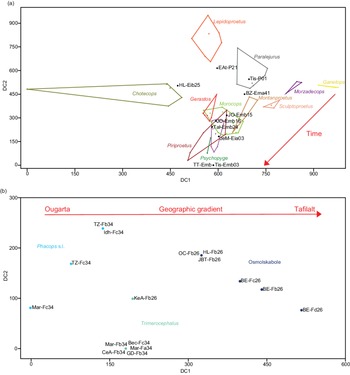
DCA enabled us to offset HCA limits and better understand the spatio-temporal distribution of the assemblages according to their taxonomic record. The Famennian samples did not share trilobites with the Early and Middle Devonian (Fig. 4) so they were removed from the DCA to avoid a Pinocchio effect and were analysed in an additional DCA (Fig. 5). Similarly, the early Famennian samples BJ-Fa26 and Be-Fa26 were removed.
Scatter plot of North African samples according to DCA for (a) the Early and Middle Devonian, and (b) the Famennian; DC1 and DC2 axes are reflecting potential environment gradient. Eigenvalues for DC1 and DC2 axes are, respectively, 0.96 and 0.91 for the Early and Middle Devonian with 105 samples, and 0.95 and 0.09 for the Famennian with 16 samples. Associations defined by clustering have been reported: 12 associations for the Early and Middle Devonian, and 4 associations for the Famennian.

For the Early and Middle Devonian, DCA shows a time trend (Fig. 5a). The Early Devonian (Lochkovian, Pragian and early Emsian) associations show the highest values on both the DC1 and DC2 axes, whereas the Middle Devonian associations show the lowest values on both the DC1 and DC2 axes (Fig. 5a). The Early Devonian associations mostly group the Order Phacopida, whereas the Middle Devonian associations mostly group the Order Proetida (Fig. 5a).
However, a look at the results in detail shows six associations are not overlapped by others along one axis of the DCA or another. The Chotecops, Morzadecops, Ganetops and Sculptoproetus associations are clearly independent along the DC1 axis, and the Paralejurus and Lepidoproetus associations alone appear along the DC2 axis in the higher values (Fig. 5a). These associations belong to either the Lochkovian or Pragian or early Emsian or Givetian. In contrast, late Emsian and Eifelian associations were strongly overlaid on both axes.
For the Famennian, the DCA shows a geographic gradient along the DC1 axis, from Ougarta with the lowest values to Tafilalt having the highest ones (Fig. 5b).
4.b. Temporal and spatial distribution of clusters
4.b.1. Early Devonian
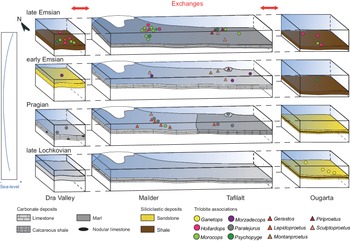
Details of temporal and spatial distributions are given in the supplementary figures (online Supplementary Material Figs S3–S8). During Lochkovian time, trilobites seemed to be restricted to the Ougarta Basin. They were few and dominated by the Ganetops genus (within Ass. IIb), which was the sole genus in the southern part of the Ougarta region (Fig. 6). To the north, Ganetops was associated with the Morzadecops genus at Zerhamra: the only genus capable of persisting in Pragian time, which thus occurs in another association (i.e. Morzadecops Association Ia).
At the beginning of Pragian time, trilobites flourished in the Anti-Atlas area but are unknown from the Ougarta Basin. Four associations covered this period but two were more dominant, widespread over all the Anti-Atlas and intersected (Fig. 4): the Lepidoproetus (IIIa) and Paralejurus (IIe) associations. The Paralejurus Association occurred in the Ben Zireg area and developed in the Tafilalt and the Maïder areas too, whereas the Lepidoproetus Association occurred predominantly in the Maïder area, although it occurred also in the southwestern part of the Tafilalt area (Fig. 6). These two widespread associations were strongly affected during the Emsian: the Paralejurus Association (IIe) disappeared and the Lepidoproetus Association (IIIa) occurred only in the Dra Valley (at the Lansser locality) for the last time in late Emsian time. The Sculptoproetus Association (Id) and Morocops Association (IIb) appeared in the Maïder area (respectively at the Timarzite and Maharch localities) during Pragian time but were rarer. They developed considerably during Emsian time where they occurred in almost all basins (Fig. 6). The Emsian is represented by nine associations (Fig. 4). In addition to the three associations, which had already occurred in Pragian time, five new ones appeared in early Emsian time and an additional association in late Emsian time. The Morzadecops Association (Ia) proliferated everywhere in early Emsian time but disappeared immediately afterwards. The Psychopyge (IIf) and Hollardops (IIa) associations originated in the early Emsian of Ougarta and then colonized the Anti-Atlas area during late Emsian time (Fig. 6). The Montanproetus (Ic) Association lasted until late Emsian time and extended from the Anti-Atlas towards the west (Ben Zireg). The two latter associations were rare during the Emsian period: the Piriproetus Association (IIe) is present only in two northwestern Tafilalt localities (Gara Mdouard – Jbel Issoumour) and the Gerastos Association (IIc) only during the late Emsian of the Maïder area (Jbel Issoumour SW).
Simplified diagrams exhibiting the different facies within the five studied areas and their spatio-temporal evolution during Early Devonian time. Associations defined by clustering have been reported.

4.b.2. Middle Devonian
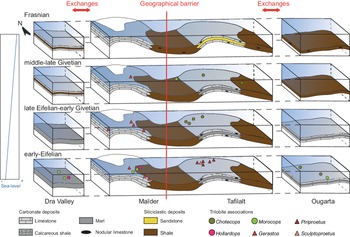
Five Early Devonian associations are still found in Eifelian time, but the Hollardops and Sculptoproetus associations disappeared after early Eifelian time. These associations were already rare and restricted to one basin: the Hollardops Association was restricted to the western part of the study area (i.e. Maïder and Foum Zguid areas) and the Sculptoproetus Association stayed confined to the Tafilalt area (Jbel Amlane; Fig. 7). In contrast, the Morocops Association continued to be widespread in different basins during early Eifelian time but also disappeared in late Eifelian time in many places despite a last occurrence (i.e. presence of Koneprusia) during late Givetian time in the northwestern Tafilalt area (Ras el Kebbar locality). Similarly, the Piriproetus Association (Ie), which appeared in the northern Tafilalt area during Emsian time, proliferated during early Eifelian time but has not been recorded in strata laid down later. They developed everywhere in the northern Tafilalt area but never occurred elsewhere. Conversely, the Gerastos Association (IIc) exclusively occupied the Maïder area where it appeared during late Emsian time, although some Gerastos were also found outnumbered in one Tafilalt locality and one Dra Valley locality. During Givetian time, the Gerastos Association (IIh) was still limited to the Maïder area but also developed in the western part of the platform at Jbel Ou Driss (Fig. 7). Finally, the Chotecops Association (IId) was first identified in the Ougarta area (Ouarourout) during early Eifelian time before invading the Tafilalt area during late Eifelian time (Fig. 7). The Chotecops Association (IIj) was still found in the western and southern Tafilalt area during Givetian time but was apparently no longer present in Algeria. All these associations disappeared at the end of Givetian time.
Simplified diagrams exhibiting the different facies within the five studied areas and their spatio-temporal evolution during Middle Devonian and Frasnian times. Associations defined by clustering have been reported.

4.b.3. Late Devonian
Only one genus occurred in the study area during Frasnian time, at Marhouma in the Ougarta region. Chlupacops is not found in another stage or in another locality and has not been attributed to a particular association.
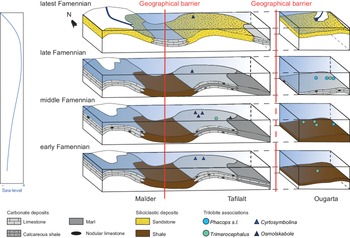
During early Famennian time, the Tafilalt area was only occupied in its northern part (at the Bin Jbilit – Bordj Est locality) by the genus Cyrtosymbolina (from Ass. IVa, Fig. 8). At the same time, in the western Ougarta area (Marhouma), the biodiversity was greater with three identified genera, which are equally abundant within the Trimerocephalus Association (IVc). When the Cyrtosymbolina Association disappeared during middle Famennian time, the Trimerocephalus Association invaded the Ougarta region but also the western edge of the Tafilalt area. In the extreme southeast of this area (Tamtert Zereg locality), the new Phacops s.l. Association (IVd) appeared. This genus is also associated with Trimerocephalus in the Tafilalt area (‘KeA-Fb34’ sample) (Fig. 4). The Phacops s.l. Association replaced the Trimerocephalus Association in many late Famennian localities, although Trimerocephalus remained only at the Béchir locality (Ougarta). However, none of these two associations have been found in the uppermost Famennian. In the Tafilalt area, the Osmolskabole Association (IVb) replaced the Cyrtosymbolina Association (IVa) in many places from the middle Famennian and persisted until latest Famennian time where they occurred only in the extreme northwestern part (at the ‘Bordj Est’ locality; Fig. 8). Osmolskabole was found with Trimerocephalus and Phacops s.l. only at Korb-el-Atil (Morocco) during middle Famennian time.
Simplified diagrams exhibiting the different facies within the five studied areas and their spatio-temporal evolution during Famennian time. Associations defined by clustering have been reported.

4.c. Evolution of biodiversity indices through time
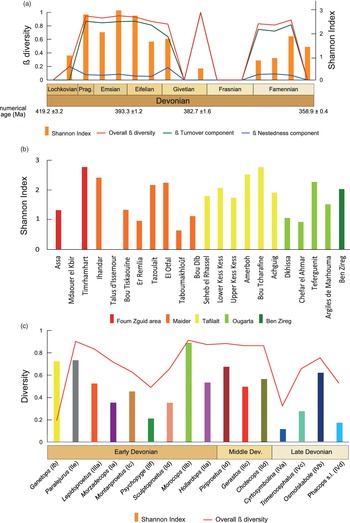
α and β diversity were low in late Lochkovian time with a Shannon index H′ of 1.06 and overall β diversity of 0.2 (Fig. 9a). Then, the diversity indices increased during Pragian time, reaching a plateau of high diversity until early Eifelian time with a Shannon index H′ > 2 and overall β diversity > 0.9. The diversity indices decreased progressively during late Eifelian to early Givetian times, before a sharp decrease from middle Givetian time to the end of the Frasnian with null or almost null values. In early Famennian time, both α and β diversity indices increased again. However, when the α diversity index stayed low compared to that of the Early and Middle Devonian with a Shannon index H′ of 0.84, overall β diversity reached values similar to the Early Devonian. In late Famennian time, α diversity increased to 1.89 before decreasing in latest Famennian time. During this period, overall β diversity evolved differently with a slight decrease in middle Famennian time followed by an increase in late Famennian time, the time of the highest disparity of the Late Devonian period (Fig. 9a). Components related to compositional heterogeneity of β diversity show different trends. The β turnover component follows the overall β diversity trends, whereas the β nestedness component always shows lower values (Fig. 9a), indicating that most of the β diversity corresponds to the replacement of genera by others in different localities (Baselga, Reference Baselga2010). Moreover, the β nestedness component changed in exactly the opposite way to the overall β diversity in Early and Middle Devonian times (Fig. 9a). Consequently, during periods of low diversity, the localities with smaller numbers of species were subsets of biotas found in localities with greater trilobite diversity.
Diversity indices. (a) Diversity through time: α diversity estimated with Shannon Index H′, overall β diversity and its components, i.e. β turnover component and β nestedness component determined with Sørensen dissimilarity. (b) α diversity per formation from five areas. (c) α diversity and overall β diversity per association. Ages from Cohen et al. (Reference Cohen, Finney, Gibbard and Fan2013, updated).

Trilobite associations of the Tafilalt area remained diverse during nearly all the Devonian Period contrary to the Maïder and Ougarta areas, where the associations contained in the formations were unevenly diverse (Fig. 9b). Although the presence of trilobites in the Ben Zireg and Foum Zguid areas were not continuous through time, the Shannon index H′ was relatively high as in the other basins (Fig. 9b). The upper Emsian and Eifelian formations contained the most diverse trilobite faunas in all the basins (Fig. 9b).
5. Palaeoenvironments of trilobite associations
It is widely known that trilobite associations vary between regions, but the ecological drivers are largely unknown. HCA performed on the Devonian trilobite taxa of Morocco and Algeria enabled us to delineate 12 Early and/or Middle Devonian associations and 4 Late Devonian associations. The associations reflect distinctive taxonomic affinities and palaeoenvironmental preferences. Similar analyses on Devonian trilobites from the Ardenne Massif showed that trilobite associations were dependent on palaeobathymetric domains and sea-level variations (Crônier & van Viersen, Reference Crônier and van Viersen2007). Subsequently, these associations (most particularly during Givetian time) where highlighted as equilibrated communities were able to maintain their organization during rather strong and short environmental perturbations. These associations were able to flourish again during similar favourable environmental conditions. Only global events influenced the trilobite associations (Bignon & Crônier, Reference Bignon and Crônier2015).
During Lochkovian time, trilobites were rare in the study area. Only Ganetops, Protacanthina and, to a lesser extent, Morzadecops proliferated during late Lochkovian time in the Ougarta region (Ass. IIa). These asteropygines preferred the shallow siliciclastic environment of the Saoura Valley (Fig. 6; Morzadec, Reference Morzadec1997) and similar environmental settings, also developing in the Iberian and Cantabric ranges and in the Armorican Massif (Morzadec, Reference Morzadec1992). Subsequently, an increasing number of trilobites began to populate the region. Their remains are frequently found in the strata, the carbonate content of which is also increasing. This suggests a lower sea level and concerns distinct invertebrate faunas (Frey et al. Reference Frey, Naglik, Hofmann, Schemm-Gregory, Frýda, Kröger, Taylor, Wilson and Klug2014). In such environments, the Lepidoproetus Association (IIIa) flourished; proetids such as Lepidoproetus, Dalejeproetus and Podoliproetus preferred these rather shallow environments with open marine conditions (Johnson & Fortey, Reference Johnson and Fortey2012). The Lepidoproetus Association survived during the late Emsian of the Dra Valley in deeper water environments. Trilobites of this association are usually found in calcareous shales deposited above the photic zone but probably below the storm-wave base (Chatterton et al. Reference Chatterton, Fortey, Brett, Gibb and McKellar2006). However, only Hollandiella was encountered in these deeper environments and in layers above the transgressive Daleje event (House, Reference House1985).
During Pragian time, the Paralejurus Association (IId) also established itself (Fig. 6). Paralejurus and Reedops were predominant in limestones at intermediate depth but also in shallower environments such as the bioherms of Hamar Laghdad (McKellar & Chatterton, Reference McKellar and Chatterton2009). Reedops was probably semi-infaunal or infaunal (McKellar & Chatterton, Reference McKellar and Chatterton2009), whereas Schraut & Feist (Reference Schraut and Feist2004) excluded a semi-endobenthic life habit for Paralejurus. Consequently, these two genera were rarely found together, notwithstanding some exceptions: Paralejurus co-occurred with Reedops cephalotes hamlagdadianus Alberti, Reference Alberti1983, but the latter species appears to have been ecologically more flexible with respect to the type of substrate (Chlupáč, Reference Chlupáč1977). During this period, the Sculptoproetus Association (IIe) developed and is often found in the nodular marly limestones from the northeastern part of Jbel Issoumour (Alberti, Reference Alberti1967 b, Reference Alberti1969), indicating a slightly deeper environment than those preferred Pragian associations. The Sculptoproetus Association evolved during Emsian time; Sculptoproetus abounds in marly limestones indicating an intermediate water depth environment (Fig. 6).
During Emsian time, Morzadecops first associated with other asteropygines during the Lochkovian, flourished and dominated the Morzadecops Association (Ia). Morzadecops occurs in marls and limestones interbedded with clay in moderately shallow water depth environments (Klug et al. Reference Klug, Kröger, Korn, Ruecklin, Schemm-Gregory, de Baets and Mapes2008). The Montanproetus Association (Ic) also developed during Emsian time, but it was mainly found in calcareous deposits in shallow carbonate environments (Fig. 6). The associated Kayserops preferred a more shallow environment (Morzadec, Reference Morzadec2001). Psychopyge is widely distributed in several marine basins during Emsian time. It was rarely associated with other genera (Fig. 4) and dominated the Psychopyge Association (IIf). The Psychopyge are present in marls or limestones interbedded in thick marl deposits from relatively distal environments dominated by pelagic faunas (Morzadec, Reference Morzadec1988).
Although the Morocops Association (IIb) was first encountered in the Pragian at the Maharch locality with the presence of Cyphaspis (van Viersen & Holland, Reference van Viersen and Holland2016), it proliferated in late Emsian and early Eifelian times. This association was dominated by Morocops, which co-occurred with Cyphaspis and Austerops. The presence of Austerops could indicate a pioneer community (Khaldi et al. Reference Khaldi, Crônier, Hainaut, Abbache and Ouali Mehadji2016). The Morocops Association also developed in the moderately deep-water environment of the Dra Valley (Chatterton et al. Reference Chatterton, Fortey, Brett, Gibb and McKellar2006) and the platform environment of Ougarta after the late Emsian transgression (Khaldi et al. Reference Khaldi, Crônier, Hainaut, Abbache and Ouali Mehadji2016). It was also able to live in the epicontinental basin between the fair-weather and storm-wave base of Hamar Laghdad (Brachert et al. Reference Brachert, Buggisch, Flügel, Hüssner, Joachimski, Tourneur and Walliser1992). Hence, the Morocops Association abounded in an environment below the fair-weather wave base. At the same time, the Piriproetus Association (Ia) was encountered at the edge of the pelagic Tafilalt Platform in moderate depth water below the fair-weather wave base (Figs 6, 7; Kaufmann, Reference Kaufmann1998; Chatterton et al. Reference Chatterton, Gibb and McKellar2020). Piriproetus occurred in a facies dominated by marly limestones, but they disappeared from this environment after early Eifelian time.
During late Emsian time, the Hollardops Association (IIa) also flourished and was dominated by Hollardops, Timsaloproetus and Erbenochile. These taxa proliferated in marls or limestones interbedded within marls. They were mostly present in Ougarta, an area considered relatively deep and dominated by shales (Ouali Mehadji et al. Reference Ouali Mehadji, Atif, Bouterfa, Nicollin and Besseghier2011) (Fig. 6). A similar environment developed in the western Dra Valley where Timsaloproetus was found (Chatterton et al. Reference Chatterton, Fortey, Brett, Gibb and McKellar2006). Hollardops enjoyed intermediate water depths below the fair-weather wave base like in the Maïder and Ougarta regions (Chatterton & Gibb, Reference Chatterton and Gibb2010), but they disappeared with a more open marine environment (Morzadec, Reference Morzadec2001). Finally, Erbenochile proliferated in relatively deep marine environments (Chatterton et al. Reference Chatterton, Fortey, Brett, Gibb and McKellar2006), which corroborates the moderately deep marine conditions, such as an offshore transition, for the Hollardops Association. The Gerastos Association (IIc) also flourished during Emsian time at Jbel Issoumour SW (Fig. 6). In this balanced community (Fig. 4), Morocops or Cyphaspis did not prevail over Gerastos contrary to many late Emsian assemblages affiliated with the Morocops Association. Conversely, the Gerastos associations from the Middle Devonian were dominated by Gerastos, which was the only genus in many localities (Fig. 4). Gerastos is found in limestones from the Maïder area where they found detritus for food in the shallow shelf marine environment (Gibb & Chatterton, Reference Gibb and Chatterton2010).
The Chotecops Association (IId) was the only association to appear and expand during Middle Devonian time and was dominated by Chotecops associated with Helmutia and Struveaspis. The Chotecops Association was encountered in Ougarta and Tafilalt (Fig. 7) in marls or in thin limestone layers in marl deposits from the quiet environments of a distal platform or basin (Feist & Orth, Reference Feist and Orth2000; Crônier et al. Reference Crônier, Abbache, Khaldi, Oudot, Maillet and Ouali Mehadji2018 a).
All the associations that appeared during Early or Middle Devonian times disappeared in late Givetian time. Only Chlupacops, a genus with reduced-eyed taxa, was found in the limestones of deep marine environments in the Ougarta Basin (Feist et al. Reference Feist, Mahboubi and Girard2016).
After the Kellwasser event, trilobites were rare in the study area. The first trilobite after the crisis was Cyrtosymbolina in early Famennian time. The increasing depth of water during Famennian time (Wendt et al. Reference Wendt, Aigner and Neugebauer1984; Wendt & Belka, Reference Wendt and Belka1991; Abbache et al. Reference Abbache, Ouali Mehadji, Crônier, Allaire and Monnet2019) led to trilobites flourishing again, which meant we could use them to examine the relationships between different basins over time. During early Famennian time, only cyrtosymbolines proliferated on the shallow pelagic Tafilalt Platform in the Cyrtosymbolina Association (IVa). They became common in the photic offshore environments of North Africa and many other places (Lerosey-Aubril & Feist, Reference Lerosey-Aubril, Feist and Talent2012). Members of the Cyrtosymbolina Association occur mainly in limestones but also in marlstones and argillaceous limestones, such as shallow carbonate marine environments (Fig. 8).
In the Ougarta Basin, blind trilobites such as Trimerocephalus, Trifoliops and Enigmapyge occurred since early Famennian time. The Trimerocephalus Association (IVc) established in many localities of the Ougarta Basin (Fig. 8) in deep marine environments of the slopes and basins. They were collected from rare often nodular limestones indicating a weak water circulation (Benhamou et al. Reference Benhamou, Abbache, Elmi, Mekahli, Racheboeuf, Ouali-Mehadji and Boumendjel2004; Crônier et al. Reference Crônier, Malti, Francois, Benyoucef and Brice2013). Trimerocephalus also occurred at Korb-el-Atil in the Tafilalt Basin associated with Osmolskabole and Phacops s.l. (Fig. 8) within a marine environment dominated by shales (Wendt & Belka, Reference Wendt and Belka1991). During late Famennian time, the Trimerocephalus Association is only found at Béchir, again in a deep marine environment, before its demise at the end of Famennian time.
The Osmolskabole Association (IVb) appeared during middle Famennian time in the limestones of the Tafilalt Platform (Fig. 8) because they appreciated the photic offshore environment. Consequently, this pelagic platform became convenient for the members of this association because of the sea-level rise (Wendt & Belka, Reference Wendt and Belka1991). The Osmolskabole Association also flourished in the deeper marine environments of the slowly subsiding Tafilalt Basin (at the Korb-el-Atil and Ouidane Chebbi localities), in argillaceous limestones. Nonetheless, this association did not occur in the Maïder Basin because this area was deeper than the Tafilalt Basin (Wendt et al. Reference Wendt, Aigner and Neugebauer1984).
During late Famennian time, Cyrtosymbolines were still abundant on the Tafilalt Platform. However, the Osmolskabole Association was no longer present in the Tafilalt Basin, probably due to a transgression (Wendt & Belka, Reference Wendt and Belka1991; Becker et al. Reference Becker, Jansen, Plodowski, Schindler, Aboussalam and Weddige2004). At the end of Famennian time, the Osmolskabole Association is still found in the limestones of the north Tafilalt Platform, whereas the south became a deltaic area (Wendt et al. Reference Wendt, Aigner and Neugebauer1984). Indeed, trilobites did not appreciate brackish water, although some attempts to colonize these environments happened in the clade history (Mángano et al. Reference Mángano, Buatois, Waisfeld, Muñoz, Vaccari and Astini2021). The Osmolskabole Association and cyrtosymbolines in general were restricted to moderate water depth environments from platform to slope, which are represented today by limestone deposits.
Finally, the Phacops s.l. Association (IVd) flourished in the Ougarta region (at Tamtert Zereg locality) during Famennian time, to the east of the location of the Trimerocephalus Association (Fig. 8) in nodular ‘griotte’ limestones corresponding to a basinal environment (Benhamou et al. Reference Benhamou, Abbache, Elmi, Mekahli, Racheboeuf, Ouali-Mehadji and Boumendjel2004). The Phacops s.l. Association extended into late Famennian time with the continuous deepening of this area (Wendt et al. Reference Wendt, Aigner and Neugebauer1984; Wendt & Belka, Reference Wendt and Belka1991; Abbache et al. Reference Abbache, Ouali Mehadji, Crônier, Allaire and Monnet2019) and replaced the Trimerocephalus Association (at the Marhouma locality). The Phacops s.l. Association still abounds in nodular limestones alternating with claystones, or in marlstones, in moderate to deep marine environments such as basins. Samples with Phacops s.l. are generally slightly younger than those of Trimerocephalus, even if these two genera may co-occur (Crônier et al. Reference Crônier, Malti, Francois, Benyoucef and Brice2013). Therefore, a progressive replacement occurred in the Ougarta Basin in the deeper offshore environment and is already recognized at the global scale (Crônier & François, Reference Crônier and François2014). At the end of Famennian time, a sea-level drop occurred and all the deep-water trilobites disappeared from the studied area.
6. Connection between basins and their history through time
6.a. Lochkovian
Trilobite diversity was low in the study area in Lochkovian time (Fig. 9a). They only occurred in the Saoura Valley where trilobites populated the sediment surface in late Lochkovian time after a regional regression (Ouali Mehadji et al. Reference Ouali Mehadji, Atif, Bouterfa, Nicollin and Besseghier2011). Only asteropygines lived in these shallow siliciclastic environments (Morzadec, Reference Morzadec1997). To the west, the eastern Anti-Atlas became too deep to allow benthic faunas to settle during Lochkovian time (Hollard, Reference Hollard and Oswald1967) and thus, this environment was neither favourable for asteropygines (Morzadec, Reference Morzadec1992) nor for other trilobites, as they were completely absent from this area.
6.b. Pragian
The Pragian regression led to a higher carbonate content with more sand in the Saoura Valley where asteropygines no longer proliferated (Morzadec, Reference Morzadec1997; Ouali Mehadji et al. Reference Ouali Mehadji, Atif, Bouterfa, Nicollin and Besseghier2011). Indeed, the composition of trilobite associations was linked to the sediment accumulation rate and the type of shelf (Bignon & Crônier, Reference Bignon and Crônier2015), and no other trilobites replaced them. The eastern Anti-Atlas became more carbonate-rich too (Hollard, Reference Hollard1963; Kaufmann, Reference Kaufmann1998). New trilobite communities were established (Hollard, Reference Hollard and Oswald1967; Morzadec, Reference Morzadec2001) in these favourable environments leading to a strong increase in their diversity in North Africa (Fig. 9a) simultaneously with the global Pragian diversification (Chlupáč, Reference Chlupáč1994, Bault et al. Reference Bault, Crônier, Allaire and Monnet2021). However, despite this high diversity, three genera dominated the shallow-water environments of the Anti-Atlas region: Paralejurus, Reedops and Lepidoproetus. These genera, and some other genera, constituted two associations: the Paralejurus Association was dominant in the Maïder area and the Lepidoproetus Association was dominant in the Tafilalt area (Fig. 6). Nevertheless, the Paralejurus Association developed to the west in the Tafilalt area and in the north of the Ougarta region at Ben Zireg and to the east near Foum Zguid. Thus, there was a strong connection between these different basins during Pragian time. This is owing to a relatively homogeneous environment in the Anti-Atlas region at this time, considered to be a homoclinal ramp (Kaufmann, Reference Kaufmann1998; Lubeseder et al. Reference Lubeseder, Rath, Rücklin and Messbacher2010). Exchanges also occurred with the neighbouring Bechar area, which was facilitated by the same carbonate platform environment (Ouali Mehadji et al. Reference Ouali Mehadji, Atif, Bouterfa, Nicollin and Besseghier2011) and with the SW Foum Zguid area where Reedops and Cyphaspis were reported. All the Pragian trilobites populated in a relatively shallow environment of various carbonate platforms. However, Paralejurus and its associated trilobites preferred slightly deeper environments than Lepidoproetus, which is why they rarely co-occurred. The shoal of Hamar Laghdad (Hollard, Reference Hollard1981; Brachert et al. Reference Brachert, Buggisch, Flügel, Hüssner, Joachimski, Tourneur and Walliser1992; Klug et al. Reference Klug, Samankassou, Pohle, de Baets, Franchi, Korn, Klug and Korn2018) showed a high diversity of trilobites.
6.c. Emsian
In early Emsian time, diversity decreased (Fig. 9a). While the Pragian dominant species almost disappeared from the studied area, other genera proliferated despite no important environmental changes in the Anti-Atlas (Kaufmann, Reference Kaufmann1998). Morzadecops spread over the entire eastern Anti-Atlas and Sculptoproetus lived in the Tafilalt area. In the Ougarta region, a local transgression (Ouali Mehadji et al. Reference Ouali Mehadji, Atif, Bouterfa, Nicollin and Besseghier2011) led to a comeback of trilobites with the moderately deep-water genus Psychopyge, but no connection existed with the Anti-Atlas; the Ougarta region remained isolated from other basins to the west and to the north. The Bechar Basin was also excluded from the trilobite dispersal, with Prodrevermannia the only genus occurring in that region (Alberti, Reference Alberti1983). Morzadecops, which preferred a shallow environment (Morzadec, Reference Morzadec2001), could not proliferate in the Ougarta region. However, although Sculptoproetus lived in moderately deep water (Chatterton et al. Reference Chatterton, Fortey, Brett, Gibb and McKellar2006), it was not found in the Ougarta region. Hence, the deep waters of the Tafilalt Basin between Ougarta and the Anti-Atlas prevented the dispersal of shallow- and moderately deep-water trilobites from one of these regions to the other.
In Morocco, the Maïder and Tafilalt platforms were still connected and the Morzadecops Association (Ia) flourished in both areas. However, the Sculptoproetus Association (Id) was restricted to the Tafilalt area while it appeared in the Maïder area during Pragian time. In the Tafilalt area, being typically shallower than the Maïder area (Wendt, Reference Wendt1995), trilobites migrated to shallower places, but no transgression occurred at this time (Kaufmann, Reference Kaufmann1998). There were no more dispersals to the southwest as the Foum Zguid area became shallower (Jansen et al. Reference Jansen, Becker, Plodowski, Schindler, Vogel, Weddige and El Hassani2004), where trilobites did not develop.
During the late Emsian Daleje transgression (Johnson et al. Reference Johnson, Klapper and Sandberg1985; Kaufmann, Reference Kaufmann1998; House, Reference House2002), the studied area became deeper (Kaufmann, Reference Kaufmann1998; Belka et al. Reference Belka, Klug, Kaufmann, Korn, Döring, Feist and Wendt1999). Trilobites developed in this new environment leading to the highest α diversity and a high β diversity (Fig. 9a) simultaneously with the global diversity peak (Chlupáč, Reference Chlupáč1994; Adrain, Reference Adrain, Rabano, Gozalo and Garcia-Bellido2008). Late Emsian trilobites constituted a stable equilibrium community. Some of the common trilobites of the Pragian persisted into early Emsian time, such as Paralejurus, Reedops and Sculptoproetus. However, no Pragian or early Emsian trilobite genus became common in late Emsian time; they were all declining and restricted to a few areas. The only exception was Psychopyge, which invaded the Anti-Atlas. Thus, during this period of diversification, the genera quickly renewed themselves by showing innovations and novelties (Chlupáč, Reference Chlupáč1994). Numerous genera appeared in late Emsian time, and among them, the phacopids Morocops and Hollardops, respectively, dominating the Anti-Atlas (Crônier et al. Reference Crônier, Oudot, Klug and de Baets2018 b) and the Ougarta region. Connections between the different basins were strong, favoured by the relatively homogeneous environments in North Africa, moderately deep water, with an important proportion of muddy regions (now shales) covering the platforms (Hollard, Reference Hollard and Oswald1967; Kaufmann, Reference Kaufmann1998; Jansen et al. Reference Jansen, Becker, Plodowski, Schindler, Vogel, Weddige and El Hassani2004; Chatterton et al. Reference Chatterton, Fortey, Brett, Gibb and McKellar2006; Ouali Mehadji et al. Reference Ouali Mehadji, Atif, Bouterfa, Nicollin and Besseghier2011). Exchanges between the Anti-Atlas and the deeper Ougarta region became possible: Hollardops and Erbenochile occurred in Ougarta, Maïder and Dra Valley (Morzadec, Reference Morzadec2001; Chatterton et al. Reference Chatterton, Fortey, Brett, Gibb and McKellar2006; Chatterton & Gibb, Reference Chatterton and Gibb2010; Khaldi et al. Reference Khaldi, Crônier, Hainaut, Abbache and Ouali Mehadji2016). Psychopyge were also found in both the eastern Anti-Atlas and the Ougarta region (Fig. 6). Although the Tafilalt and Maïder areas became different during late Emsian time in terms of both facies and fauna (Hollard, Reference Hollard and Oswald1967), a strong connection was present between these two areas. Sculptoproetus proliferated in the Maïder area, suggesting an invasion from the Tafilalt area. At the same time, Morocops, as well as Cyphaspis, flourished in the Tafilalt, Maïder and near Foum Zguid areas. Ben Zireg was also involved in the exchanges, with Montanproetus existing in the Bechar Basin and the Maïder area. Nevertheless, it remains difficult to demonstrate the supply of trilobites from one basin to another without a finer temporal resolution. Although trilobite exchanges were numerous, some trilobites remained restricted to one basin, such as Gerastos and Piriproetus in the Maïder Basin. Significant taxonomic turnovers occurred between the late Emsian localities, as is highlighted by the high β diversity (Fig. 9). More important local environment variability in the eastern Anti-Atlas (Hollard, Reference Hollard and Oswald1967) is a potential explanation for this high taxonomic turnover.
6.d. Eifelian
The transition between the Early and Middle Devonian periods was marked by the onset of tectonic events leading to a platform and basin topography (Wendt et al. Reference Wendt, Aigner and Neugebauer1984; Kaufmann, Reference Kaufmann1998; Lubeseder et al. Reference Lubeseder, Rath, Rücklin and Messbacher2010). This event is due to the Variscan orogeny, which disrupted the eastern Anti-Atlas. A deep basin (i.e. Maïder Basin) separated two platforms (i.e. the Maïder and Tafilalt platforms). As most trilobites lived in shallow environments, they did not cross the basin to invade other localities. More specifically, the deep Maïder Basin acted as a natural barrier, which led to the development of distinct trilobite communities in Middle Devonian time. This barrier also effectively prevented the dispersion of these communities by pelagic or planktonic larvae, which have been identified in several Devonian trilobites (Speyer & Chatterton, Reference Speyer and Chatterton1989; Chatterton et al. Reference Chatterton, Siveter, Edgecombe and Hunt1990; Chatterton & Speyer, Reference Chatterton, Speyer and Kaessler1997). Indeed, these protaspides could not cross this deep basin because of unfavourable palaeocurrents, palaeoenvironmental conditions and/or a too wide distance for their life duration. Consequently, in contrast to the Lower Devonian, trilobite distributions of the Eifelian show almost no connections between the Tafilalt and Maïder areas. To the west of the Maïder Basin, Gerastos and Cyphaspis evolved, whereas Piriproetus then Chotecops developed in the Tafilalt area (Fig. 7). The trilobites from the west of the Maïder Basin evolved in a relatively shallow environment (Gibb & Chatterton, Reference Gibb and Chatterton2010) and did not cross the deep Maïder Basin (Wendt et al. Reference Wendt, Aigner and Neugebauer1984). On the other hand, Cyphaspis occurred to the southwest at Foum Zguid (van Viersen & Holland, Reference van Viersen and Holland2016) showing a connection between the Maïder and western Anti-Atlas areas. Gerastos, which appeared in late Emsian time, proliferated in the Maïder area during Eifelian time and covered the edges of the Maïder Platform, including the western part at the Jbel Ou Driss locality (Fig. 7). Gerastos replaced Morocops during Middle Devonian time in the shallow neritic environments, while the distribution of this genus decreased from late Emsian time to be restricted in some Maïder localities. To the eastern side of the Maïder Basin, a community of trilobites dominated by the genus Piriproetus (Ass. Id) expanded on the pelagic Tafilalt Platform. The trilobites from this association living in a moderately deep environment were unable to cross the Maïder Basin. While no connection existed to the west of Tafilalt, trilobite exchanges still occurred to the east. Indeed, Chotecops, present in deep environments (Feist & Orth, Reference Feist and Orth2000; Crônier et al. Reference Crônier, Abbache, Khaldi, Oudot, Maillet and Ouali Mehadji2018 a), occurred in both the Tafilalt and Ougarta areas. The Variscan orogeny created a basin between the Tafilalt and the Ougarta areas, but this basin seems shallower than the Maïder Basin (Kaufmann, Reference Kaufmann1998), thus enabling Chotecops to cross this basin to invade new localities but not Piriproetus. Chotecops probably never settled in the Maïder area because this basin was too deep. Moreover, they did not flourish in the shallow environments of the Maïder Platform margins. Austerops, present in Ougarta, Maïder and Dra Valley, was the only genus living on both sides of the Maïder Basin (Chatterton et al. Reference Chatterton, Fortey, Brett, Gibb and McKellar2006; McKellar & Chatterton, Reference McKellar and Chatterton2009; Crônier et al. Reference Crônier, Abbache, Khaldi, Oudot, Maillet and Ouali Mehadji2018 a). Its presence in these areas was recorded since late Emsian time (Fig. 6).
In both the Tafilalt and Maïder areas, the Eifelian faunas replaced those of the Emsian, and the trilobite associations were influenced by the palaeobathymetry (Crônier & van Viersen, Reference Crônier and van Viersen2007). The origination rate and trilobite changes were not particularly high at the Emsian/Eifelian boundary on an overall scale (Chlupáč, Reference Chlupáč1994; Lerosey-Aubril & Feist, Reference Lerosey-Aubril, Feist and Talent2012). Thus, North African faunal changes rather seemed to be attributed to topographic changes where some trilobite genera took advantage of this new heterogeneous environment.
6.e. Givetian
The global Middle Devonian Choteč, Kačák and Taghanic events (House, Reference House2002; Becker et al. Reference Becker, Königshof, Brett, Becker, Königshof and Brett2016) had an impact on trilobites and their diversity at the overall scale (Lerosey-Aubril & Feist, Reference Lerosey-Aubril, Feist and Talent2012) and in North Africa (Fig. 9a). Most of them disappeared during Givetian time, and only three associations have been reported in the studied area: the Gerastos Association, with Gerastos sometimes associated with Cornuproetus or Cyphaspis in the Maïder area; the Chotecops Association dominated by Chotecops and Helmutia in the Tafilalt area; and the Morocops Association at the Ras el Kebbar locality (Maïder). The same distinction between areas was identified during Eifelian time. However, the presence of Gerastos at the Jbel Ziata locality in the Tafilalt (Feist & Orth, Reference Feist and Orth2000) associated with Chotecops showed that trilobite exchanges were rare but remained possible. The weak regressive regime during early Givetian time enabled such migrations from the Maïder to the Tafilalt area (Lubeseder et al. Reference Lubeseder, Carr and Redfern2003), as well as the proximity of the Maïder Platform to the Tafilalt Platform to the north of the Maïder Basin (Kaufmann, Reference Kaufmann1998). All the trilobites occurred in the eastern Anti-Atlas, whereas the Foum Zguid area and the Ougarta Basin seem relatively depopulated. Unlike in the Ardenne Massif (north of France), the Kačák event did not lead to a replacement of faunas in North Africa (Bignon & Crônier, Reference Bignon and Crônier2015) but instead to an extinction of existing faunas. However, like in the north of France, the environmental changes favoured Dechenella in the Tafilalt area (Feist & Orth, Reference Feist and Orth2000).
6.f. Frasnian
Overall, the Frasnian trilobite record is scarce (Feist, Reference Feist1991; Lerosey-Aubril & Feist, Reference Lerosey-Aubril, Feist and Talent2012). In the studied North African area, the reduced-eyed Chlupacops was the only genus encountered in the Ougarta Basin in deep environments (Feist et al. Reference Feist, Mahboubi and Girard2016). This basin seems to have been disconnected from the others. The low trilobite diversity recorded during Frasnian time could be explained by unfavourably shallow environmental conditions in the eastern Anti-Atlas (Wendt et al. Reference Wendt, Aigner and Neugebauer1984, Wendt & Belka, Reference Wendt and Belka1991), whereas Feist (Reference Feist2002) described trilobites from an outer platform environment in the neighbouring Meseta Central in Morocco.
6.g. Famennian
After the Kellwasser crisis, some trilobites developed worldwide. While, cyrtosymbolines proliferated on shallow outer platforms (Lerosey-Aubril & Feist, Reference Lerosey-Aubril, Feist and Talent2012), in deeper environments such as basins, reduced-eyed and blind phacopids and proetids developed (Chlupáč, Reference Chlupáč1994; Lerosey-Aubril & Feist, Reference Lerosey-Aubril, Feist and Talent2012). A similar process occurred in North Africa, where cyrtosymbolines appeared during early Famennian time on the shallow Tafilalt Platform and constituted a pioneer community. At the same time, in the deeper Ougarta Basin, the number of blind phacopids increased. No trilobites have been found in the Maïder area for this period. No dispersal routes seem to have existed between the different basins at that time: the Trimerocephalus Association was encountered in the Ougarta Basin, while the Cyrtosymbolina Association was encountered in the Tafilalt area. Cyrtosymbolines could not cross the deep Maïder and Tafilalt basins as the Tafilalt Platform acted as a natural barrier to stop deep-water trilobites coming from Ougarta. This trend remained through the Late Devonian period. In contrast, the distal platform of Ben Zireg (Abbache et al. Reference Abbache, Ouali Mehadji, Crônier, Allaire and Monnet2019) seems to have been a favourable environment to host trilobites, but none have been found yet in the nodular limestones and shales. Trilobite studies based upon localities at Ben Zireg since Alberti (Reference Alberti1983) remain scarce, and this could explain the absence of trilobites in addition to the sedimentary gaps (Abbache et al. Reference Abbache, Ouali Mehadji, Crônier, Allaire and Monnet2019). Trilobites were absent throughout Famennian time in the Maïder Basin, probably deposited in deeper water than that of the Tafilalt Basin (Wendt et al. Reference Wendt, Aigner and Neugebauer1984; Kaufmann, Reference Kaufmann1998). Crônier & François (Reference Crônier and François2014) suggested a depth greater than 60 m for blind genera (i.e. Trimerocephalus), and Feist et al. (Reference Feist, Mahboubi and Girard2016) indicated an offshore environment near or beyond the limit of the photic zone. However, with its depth of 200 to 400 m, the Maïder Basin had much deeper steep slopes according to stratigraphic studies (Wendt et al. Reference Wendt, Aigner and Neugebauer1984). The Tafilalt Platform also acted as a barrier to trilobite dispersal.
The sea-level rise of the middle Famennian (Wendt et al. Reference Wendt, Aigner and Neugebauer1984; Wendt & Belka, Reference Wendt and Belka1991; Abbache et al. Reference Abbache, Ouali Mehadji, Crônier, Allaire and Monnet2019) allowed the proliferation of deep-sea phacopids. They were present at that time in many Ougarta localities, and a connection appeared between the Tafilalt and Ougarta areas. Exchanges were possible because the Tafilalt Basin and the Ougarta Basin were probably interconnected during Late Devonian time (Wendt et al. Reference Wendt, Aigner and Neugebauer1984; Wendt, Reference Wendt1985; Abbache et al. Reference Abbache, Ouali Mehadji, Crônier, Allaire and Monnet2019). However, dispersal apparently only occurred from the Ougarta Basin to the Tafilalt area, i.e. from deeper to shallower environments. Indeed, this unidirectional supply of biodiversity suggests that only the deep-living taxa of Ougarta were able to cross the deep basin between the Ougarta and the Tafilalt areas. The moderately deep-water taxa Phacops s.l. and Trimerocephalus present in the Ougarta region were able to colonize the margins of the quite deep Tafilalt Basin. Shallower areas also enabled the development of other trilobite communities, with new cyrtosymbolines appearing in the Tafilalt Platform dominated by the Osmolskabole genus (Alberti, Reference Alberti1973, Reference Alberti1974, Reference Alberti1975 a, Reference Alberti1976 a,b; Lerosey-Aubril & Feist, Reference Lerosey-Aubril and Feist2005, Reference Lerosey-Aubril and Feist2006). Because of the deepening of this area, they were adapted to intermediate water depths and could have settled in the margins of the relatively shallow Tafilalt Basin (Wendt et al. Reference Wendt, Aigner and Neugebauer1984), although they were still unable to cross a deep basin to establish themselves in the Ougarta region. Moreover, in the intermediate water/depth, other taxa developed during middle Famennian time. These were the large-eyed Phacops s.l., which proliferated in the deeper part of the shallow Tafilalt Platform, associated with Trimerocephalus or Osmolskabole. On the other hand, Phacops s.l. only occurred in the shallower part of Ougarta region to the southeast.
During late Famennian time, this connection was disrupted, and the Tafilalt and Ougarta areas are represented by two separate communities (Fig. 8). Despite the deepening of the Tafilalt Basin at this time, no trace of deep-water phacopids has been found there, although they were still present in the Ougarta Basin. Two explanations are possible: first, that they were present but still not sampled; and secondly, that a natural barrier, which has still not been identified between the two basins, prevented any trilobite exchange. This kind of natural barrier could have resulted from the deepening between the Ougarta and Tafilalt areas, preventing any crossing of trilobites, or, alternatively, from a very shallow barrier, formed in the context of the Variscan orogeny, which was not favourable to Famennian trilobites (Hollard, Reference Hollard1974; Wendt et al. Reference Wendt, Aigner and Neugebauer1984). Unfortunately, this area was covered by Cretaceous deposits (Benhamou et al. Reference Benhamou, Abbache, Elmi, Mekahli, Racheboeuf, Ouali-Mehadji and Boumendjel2004), thus preventing any information on the evolution of this basin. Cyrtosymbolines were restricted to the shallowest part of Tafilalt, to the north. During this period of highstand sea level (Wendt & Belka, Reference Wendt and Belka1991), the rest of the Tafilalt area was probably too deep to host them. In contrast, Trimerocephalus has been recorded in the Ougarta region for this time in just one locality, while Phacops s.l. dominated the rest of this area. These phacopids tended to replace Trimerocephalus in late Famennian time (Crônier & François, Reference Crônier and François2014).
Finally, at the end of Famennian time, a regression occurred leading to a deltaic environment with sandstone deposits in the eastern Anti-Atlas and Ougarta region (Wendt et al. Reference Wendt, Aigner and Neugebauer1984; Kaiser et al. Reference Kaiser, Becker, Steuber and Aboussalam2011; Abbache et al. Reference Abbache, Ouali Mehadji, Crônier, Allaire and Monnet2019). This environment was unfavourable for many benthic organisms, and all deep-sea trilobites disappeared from these areas. Only two cyrtosymbolines (i.e. Pusillabole and Pseudowaribole) remained in the shallow-water environment of the northern Tafilalt and were apparently unable to migrate to the Ougarta Basin, which was probably too deep (Fig. 8). It is difficult to understand the facies distribution of the Tafilalt because of the scarce outcrops and the potential reworking owing to debris flows (Wendt et al. Reference Wendt, Aigner and Neugebauer1984).
Originations and migrations always occurred from the shallower part of the Tafilalt and Ougarta regions. In the Tafilalt area, trilobites appeared in the shallowest part of the Tafilalt Platform, located to the north (Wendt & Belka, Reference Wendt and Belka1991) before becoming a deeper basin in the south. Trilobite migrations seemed to have started in the southeastern part of the Ougarta Basin. The Trimerocephalus Association from the lower Famennian and the Phacops s.l. Association from the middle Famennian appeared, respectively, at the Marhouma and Tamtert Zereg localities (Fig. 8). These localities corresponded to an epicontinental platform (Benhamou et al. Reference Benhamou, Abbache, Elmi, Mekahli, Racheboeuf, Ouali-Mehadji and Boumendjel2004) and represented the shallowest part of the Ougarta Basin. Then, following their occurrences, each genus invaded the deepest northwestern part and dominated the basin (Fig. 8). However, an influence from the southwest was unlikely because the environment in the Gourara area was deep with basinal deposits (Benhamou et al. Reference Benhamou, Abbache, Elmi, Mekahli, Racheboeuf, Ouali-Mehadji and Boumendjel2004; Abbache et al. Reference Abbache, Ouali Mehadji, Crônier, Allaire and Monnet2019).
6.h. Tectonic impact on trilobite faunas
During Early Devonian time, the Anti-Atlas area had a rather homogeneous environment (Lubeseder et al. Reference Lubeseder, Rath, Rücklin and Messbacher2010). In this context, faunal changes were linked to global environmental changes with, first, the Pragian regression, which led to environmental changes driving faunal changes (Chlupáč, Reference Chlupáč1994; Morzadec, Reference Morzadec1997, Reference Morzadec2001). Similar changes occurred in Bohemia with the development of Reedops and Odontochile (Chlupáč et al. Reference Chlupáč, Luke, Paris and Schönlaub1985). Then, the Daleje transgression (Kaufmann, Reference Kaufmann1998; House, Reference House2002) affected the North African trilobites, with the development of new faunas dominated among others by Morocops and Hollardops, adapted to slightly deeper environments (Fig. 6). The same trend occurred worldwide, with diversifications and innovations, particularly in offshore facies (Chlupáč, Reference Chlupáč1994). From Middle Devonian time, the Variscan orogeny started to influence the regional topography (Wendt et al. Reference Wendt, Aigner and Neugebauer1984; Kaufmann, Reference Kaufmann1998), and global events (sea-level changes and continental drift) were no longer the only cause of biodiversity changes. Obviously, the Middle Devonian events influenced the trilobite faunas, both quantitatively (Bault et al. Reference Bault, Crônier, Allaire and Monnet2021) and qualitatively (Fig. 7). Similarly, an important turnover occurred with the Kellwasser events (Lerosey-Aubril & Feist, Reference Lerosey-Aubril, Feist and Talent2012), and, consequently, the Famennian trilobites had nothing in common with their predecessors in North Africa (Fig. 4). However, from the Eifelian, there were faunal differences between nearby areas (Fig. 7). These differences were well marked in Morocco and Algeria with strong differences between Maïder and Tafilalt, whereas in other places such as the Ardenne Massif, the faunas were still subject only to global changes (Bignon & Crônier, Reference Bignon and Crônier2015). The basin and platform topography affected the trilobites because of their bathymetric preferences (Morzadec, Reference Morzadec2001; Chatterton et al. Reference Chatterton, Fortey, Brett, Gibb and McKellar2006). Rapid changes and instability made unpredictable regional conditions, indicating that North African trilobite communities conform to Gleasonian models where ‘species-individualistic’ responses to environmental changes became prevalent in community ecology (Gleason, Reference Gleason1927). Regular local and/or global changes hampered the ecological stasis spotted in other communities (Brett et al. Reference Brett, Ivany and Schopf1996).
Unlike topography, the type of sedimentation had a low impact on North African trilobites, except for those due to global changes at the Lochkovian–Pragian boundary. Moreover, the associations seemed less dependant on the sedimentation type laterally. For instance, Gerastos has been found both in thick-layered limestones and in calcareous mudstones interbedded with shales (Gibb & Chatterton, Reference Gibb and Chatterton2010). This kind of equilibrium community has already been noted in the Middle Devonian trilobites of the Ardenne Massif (Bignon & Crônier, Reference Bignon and Crônier2015). Indeed, the Dechenella association arose and flourished when carbonate platform environments appeared at the end of the Eifelian period. This community was able to maintain its organization during several dismantling episodes of the platform during Givetian time, corresponding to a mixed carbonate–siliciclastic ramp. Only the global Taghanic event of the late Givetian period (House, Reference House1985) broke the stability of this community. A similar signal has currently been highlighted in Morocco regarding the stability of trilobite organization despite environmental variations restricted in local and temporal terms (Hollard, Reference Hollard1963, Reference Hollard and Oswald1967; Bultynck & Walliser, Reference Bultynck and Walliser2000; Lubeseder et al. Reference Lubeseder, Rath, Rücklin and Messbacher2010).
7. Conclusions
During the Devonian Period, the Anti-Atlas Range and its Algerian extensions were located on the Saharan Platform, a passive continental margin of Gondwana. This area underwent several ecological changes due to regional and global events with many sea-level changes, anoxic/hypoxic events and tectonic events occurring throughout the Devonian Period. All these changes affected the composition of trilobite communities and their diversity.
Trilobites were not well dispersed between the different areas of North Africa because of spatial and temporal environmental changes. Devonian trilobites can be assigned to 16 associations, with 12 of these associations existing during Early and Middle Devonian times and four exclusively during Famennian time. Each of these trilobite associations flourished in a specific environment that was favourable for some genera but less so for others. In siliciclastic environments, asteropygines prospered in the Ougarta region during Lochkovian time, while the Pragian regression allowed the diversification of many trilobites in shallow-water environments. Both trilobite diversity and the number of associations further increased during Emsian time. During this period, the different basins were well interconnected. Faunal exchanges were facilitated by the absence of strong ecological or topographical barriers and further favoured by a relatively homogeneous environment. The Variscan orogeny modified the palaeogeographic setting during Middle Devonian time towards a platform and basin topology. Geographical barriers formed and trilobite associations became restricted to smaller areas with poor connections between them. This regional tectonic context coupled with more widespread Middle Devonian events affected trilobites, which were almost eradicated from this area in Frasnian time. After the Kellwasser events, trilobites once again flourished regionally and globally, although not to the diversity levels of the Emsian or Eifelian periods. During the same period, cyrtosymboline associations proliferated in shallow platform environments, while phacopid associations proliferated in deeper water environments. Finally, new sea-level and sedimentological changes in latest Famennian time led to the disappearance of numerous trilobites in the North African area under study.
Supplementary material
To view supplementary material for this article, please visit https://doi.org/10.1017/S001675682100131X
Acknowledgements
The authors thank the reviewers Christian Klug (Switzerland) and Brian D. E. Chatterton (Canada), and the editor for their constructive remarks, which improved the manuscript. This work is a contribution to the IGCP 652 ‘Reading geologic time in Paleozoic sedimentary rocks’, to the ECOS Sud-MINCyT (Argentina) A17A01, and to the French CNRS UMR 8198 Evo-Eco-Paleo (Université de Lille). The authors thank the Région Hauts-de-France, the Ministère de l’Enseignement Supérieur et de la Recherche (CPER Climibio) and the Université de Lille for their financial support.