Statins (HMG-CoA reductase inhibitors) have become the first line agents for primary and secondary prevention of CHD in patients with elevated LDL-C levels due to its effectiveness, tolerability, and safety (Reference Jacobson7). The benefits of statin treatment seems independent of age, sex, and cholesterol baseline. Statins should be considered for everyone with an elevated cardiovascular risk irrespective of cholesterol level, moving away from treatment of hyperlipidemia per se (Reference Hirsch, O'Donnell and Olsson6). Others have stated that there is evidence that eligible patients are not provided with adequate treatment due to failure of identifying patients at risk, use of insufficient doses of statins, or prescription of more expensive lipid lowering drugs.
It has also been demonstrated that no specific brand of statins—when used at optimal doses—are superior to others in terms of long-term cardiovascular outcomes (Reference Jacobson7). However, the cost of equivalent doses of these pharmaceuticals vary greatly, which may result in irrational use of financial resources when more expensive drugs are prescribed rather than less expensive pharmaceuticals. Any health policy in the field should be informed by evidence.
This study, which is the first of its kind based on local data in the country of Lithuania, was performed to shed light on this issue in a health policy perspective by providing information on trends and current utilization of statins in Lithuania over a period of 3 years (2005–2007). The study also includes an economic analysis of optional basis for reference-based pricing and their potential economic implications.
MATERIALS AND METHODS
Data Sources
Data on sales of statins in Lithuania were obtained from a country-specific database (www.softdent.lt), which comprises all purchases of prescription and over-the-counter drugs from wholesalers and retailers in Lithuania. The data on sales were retrieved as units of statins and the cost of drugs where calculated at pharmacy price level. The data for comparison of statin consumption in Lithuania with other countries were obtained from the national healthcare databases of respective countries (3;5;9–Reference Senes and Penm11).
Measures of Statin Utilization
The Anatomical Therapeutic Chemical/Defined Daily Dose (ATC/DDD) methodology, cost minimization analysis, and alternative potential reference price levels were used in this study. Statin utilization was analyzed using ATC/DDD methodology. That methodology was developed and is regularly updated by the World Health Organization (WHO) Drug Utilization Research Group. The ATC/DDD system has been used in drug utilization studies since the early 1970s and has proven to be suitable for national and international comparisons of drug utilization, of evaluation of long-term trends in drug use, in assessment of impact of certain events related to drug use, and in provision of denominator data in investigation of drug safety. The purpose of the ATC/DDD system in this study is to use it as a tool in drug utilization research.
Utilization of statins was measured as the number of DDDs (expressed as a number of DDDs per 1,000 inhabitants per day and their percentage). DDD is the assumed average maintenance dose, when a drug is used for its key indication by an adult. Sales or prescription data presented in DDD/1000 inhabitants/day may provide a rough estimate of the proportion of the study population that may be treated with certain drugs on a daily basis. WHO Collaborating Centre for Drug Statistics Methodology (16) offers DDDs for a fixed unit of measurement independent of the price and formulation that enables a researcher to assess the trends in drug consumption and make comparisons among population groups. Instead of calculating the number of drug accounting for 90 percent of the use in DDDs (DU 90 percent), we calculated utilization for all types of statins available in the Lithuanian market over the 3-year period.
Methods for Price Limitation
Cost-Minimization Analysis. Wilson recommends that cost-minimization analysis is used in comparing the costs of two or more treatment alternatives with demonstrated equivalence in therapeutic outcome (Reference Wilson15). This type of calculation, used here, also reflects the cost of preparing and administering a dose. Units of utilization were multiplied by unit prices to estimate cost per DDD.
Reference Pricing. Reference pricing may be used to control drug expenditures. However, reference pricing does not necessarily limit the overall pharmaceutical expenditures, but could help controlling third-party expenditures on prescription drugs (Reference Danzon4). Despite different active ingredients, statins are a group of drugs that provides similar therapeutic benefits. Reference pricing was used in this study to demonstrate the potential economic benefits of limiting reimbursement for higher priced statins.
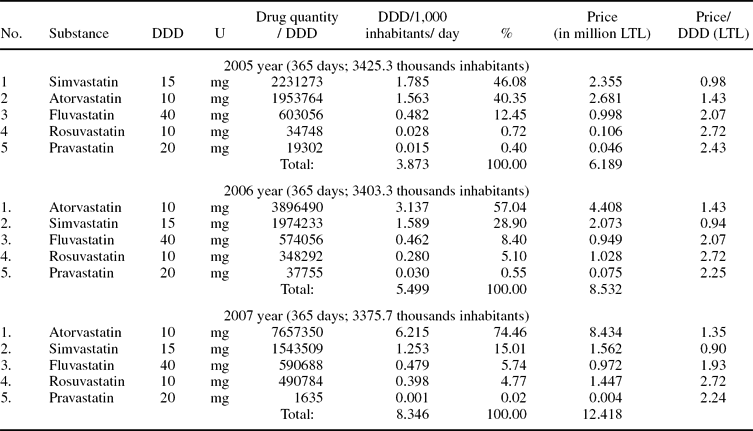
Results. In calculating total utilization of statins, measured as a number of DDDs per 1,000 inhabitants per day during 3 years, each year separate, we found that it was clearly different between the years as is shown in Table 1.
Prescribing Profiles and Expenditures for Statins in Lithuania over the 3-Year Period (2005—2007)

In summary, the use of statins has doubled over the 3-year period, that is, from 3.87 DDD/1,000 inhabitants/day (in 2005) to 8.35 DDD/1,000 inhabitants/day (in 2007). The findings also show that expenditures on statins have doubled during the 3-year period from LTL6.186 million in 2005 to LTL12.418 million in 2007 (an increase equivalent to approximately US$5.067 million). The calculated data on the prescribing profiles and expenditures for statins in Lithuania over the 3-year period are shown in Table 1.
During the 3-year period, utilization of atorvastatin and simvastatin remained at the top of the list. The consumption of atorvastatin increased from approximately 40 percent to close to 75 percent, whereas the consumption of simvastatin declined from approximately 46 percent to 15 percent. Such changes seem to have resulted from active promotional efforts of Atoris®. The use of other statins remained rather stable and variations in these were rather insignificant during the entire period.
The expense of one DDD of a certain statin ranged from LTL0.90 per DDD to LTL2.72 per DDD in 2007. Simvastatin (LTL0.90 per DDD) was the cheapest among statins, while atorvastatin was the second least expensive (LTL1.35 per DDD), and rosuvastatin was the most expensive statin priced at LTL2.72 per DDD.
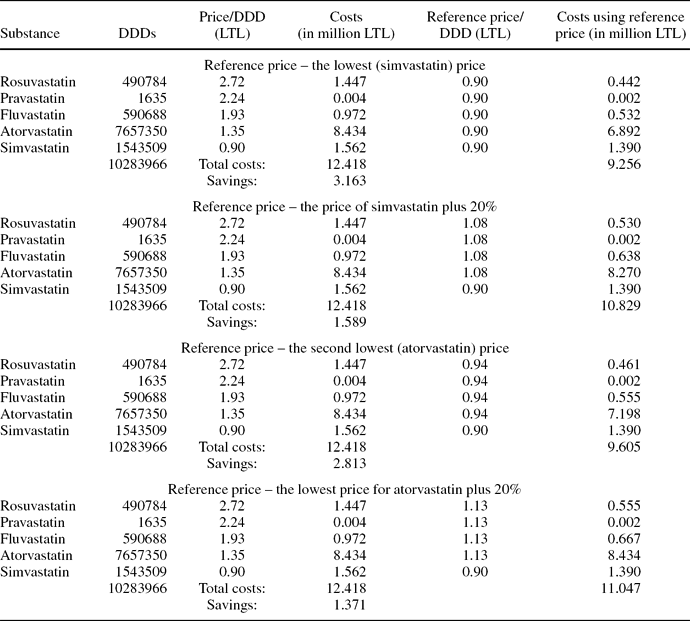
Economic Analysis. In calculating the potential economic effects of reference-based pricing atorvastatin and simvastatin seem to be the most suitable statins for this purpose due to similar safety and outcome, as well as broad prescription practices, and relatively low price per DDD in Lithuania. The economic calculations here are based on the lowest (simvastatin) and second lowest (atorvastatin) prices. A sensitivity analysis were also performed by using two more reference prices, namely the lowest price for simvastatin plus 20 percent, and the lowest price for atorvastatin plus 20 percent. The calculations are based on the data presented in Table 2.
Policy Implications of Reference Price Calculations

The total expenditure on statins amounted to approximately LTL12.4 million in 2007. The calculations show that it would be possible to reduce the total costs of statins by approximately LTL3.2 million per year or a reduction in cost by approximately 25 percent if the reference price is set at the lowest price for simvastatin. A reference price based on the lowest price of atorvastatin would yield savings in the order of approximately LTL2.8 million, equivalent to a cost reduction of approximately 23 percent. The cost savings by using a reference price based on lowest price of simvastatin plus 20 percent would lead to cost savings of approximately LTL1.6 million, and the equivalent for atorvastatin would save costs of approximately LTL1.4 million. In summary, the cost savings from reference-based pricing would achieve cost savings anywhere from LTL1.4 million to LTL3.2 million.
DISCUSSION
Coronary heart disease is common in many countries. It is a major cause of disability and the greatest cause of death among adults in Lithuania (Reference Jacobson7;8;10). Consequently, it comes with substantial direct and indirect costs for the society as well as for the individual. High cholesterol levels, in particular low-density lipoprotein cholesterol, are associated with increased risk of coronary heart disease, and many studies have demonstrated that lowering that level may reduce those risks significantly. There are several potential approaches at the health policy level to prevent coronary heart disease, including several socioeconomic, health promotion, and disease prevention programs in general.
In medical care, statins have become the first line agent in cholesterol lowering strategies, because of their effectiveness and relatively good tolerance, although there are both minor (Reference Silva, Matthews and Jarvis12) and significant risks (Reference Burne2) associated with these drugs.
This study shows that the consumption of statins in Lithuania has been very low compared to other countries, (3;5;9–Reference Senes and Penm11), see Figure 1, and still is low despite the observed increase in Lithuania from 2005 to 2007. Figure 1 show that in comparison with, for example with Norway and Denmark, the consumption is approximately 18 and 14 times lower in Lithuania. Nevertheless, there is a concern about increasing costs of drugs in general. In view of the huge number of patients who are potential candidates for treatment with statins, it is important to optimize the cost-effectiveness of treatment. The government has chosen to set the reimbursement rate for statins fairly low and at limited indications. This policy has recently been changed, and includes life-long reimbursement, which will further increase the cost of drugs.
Total utilization of statins in different countries.

Another policy to control the expanding cost of drugs in general is reference-based pricing (Reference Bonita, Beaglehole and Kjellström1). For statins in particular, this may be a good strategy. Although statins are called therapeutically equivalent drugs, the base prices for different active substances vary greatly in Lithuania. In this study, we found that the expenditures of one DDD for a certain statin ranged from 0.90 LTL/DDD (simvastatin) to 2.72 LTL/DDD (rosuvastatin). The availability of new generic drugs caused some decline in statin prices, except the prices of rosuvastatin and fluvastatin. The competition between different brands is weak in Lithuania due to insufficient information provided to patients, and to the fact that physicians generally seem insensitive to prices. The National Institute for Health and Clinical Excellence in the United Kingdom has, however, shown that generic versions of statins are as effective for most patients as their more expensive, branded counterparts (14).
Reference-based pricing was first introduced in Germany in 1989, then in other European countries, including Sweden, Denmark, Spain, Italy, and the Netherlands, as well as in the United States, Australia, New Zealand, and parts of Canada. A maximum price regulation was superimposed on the reference price system in the Netherlands, which resulted in price reductions averaging 15 percent (Reference Danzon4). New Zealand has set the reference price at the lowest price in each subgroup. The price index has declined, but the total spending has increased, reflecting the growth in volume and mix. In 2001 in Germany, drugs under the reference pricing scheme represented more than 60 percent of all prescriptions and close to 40 percent of total spending on drugs. In Germany, the share of prescriptions issued for generic drugs amounted to 47 percent in 1993 and increased to 78 percent in 2003.
In this study, we demonstrate that, for the country of Lithuania, cost savings in the order of approximately LTL1.4 to 3.2 million per year are feasible by reference-based pricing, which at the same time would reduce an important barrier for patient's continued treatment, namely the relatively high level of co-payment. Nevertheless, making statins available as an over-the-counter drug, may be part of future policy considerations. Currently statins are available without prescription in the United Kingdom; however, there seems to be a need of scientific studies on this issue to get evidence about the overall effects of such a policy (Reference Strom13).
CONCLUSION
The findings from this study demonstrate that the use of statins in Lithuania is very low compared with other countries, although there is a tendency that it is increasing. It also shows that the prices among different brands of statins vary substantially. It is on the one hand important to remove hurdles for effective treatment, such as patient's out-of-pocket cost of drugs, and on the other hand to control escalating costs of drugs. The Government's policies to control the increasing cost of pharmaceuticals should include serious considerations to reference-based pricing, which may lead to substantial cost savings.
CONTACT INFORMATION
Edmundas Kadusevicius, PharmD, MD, PhD (e610614@yahoo.com), Associate Professor, Basic & Clinical Pharmacology, Kaunas Medical University; Clinical Pharmacist, Kaunas Medical University Hospital, 2 Eiveniu, Kaunas Lt-50009, Lithuania
Danguole Jankauskiene, MD, PhD (djank@mruni.lt), Associate Professor, Strategic Management and Policy, Mykolas Romeris University, 20 Ateities, Vilnius LT08303, Lithuania
Inga Paulauskaite, PharmD (paulauskaite.inga@gmail.com), Assistant, Basic & Clinical Pharmacology, Rimvydas Slapikas, MD, PhD (rimvydas.slapikas@kmuk.lt), Professor, Department of Cardiology, Kaunas University of Medicine, Kaunas University of Medicine, Mickeviciaus 9, Kaunas, LT 5009, Lithuania