

In Australia, a colleague opens the doors of an overseas container and is confronted with the remains of a vigorously shaken tennis collection. In Canada, another is considering how to transport John Lennon's Rolls Royce, unscathed, across the country in the middle of winter. Meanwhile in France, a colleague is disappointed to discover that her favourite tool to move carriages and cars has nothing at all to do with the TV detective Kojak (Clue: when Go-Jack is misheard as Kojak!).Footnote 2

Collection manager – Workforce exotic
As diverse, exciting and sometimes absurd as the tasks of registrars and collections managers are, they are so similar everywhere in the world. And while there are a number of journals and special forums for conservation, for example, there is a lack of platform for this very practical aspect of collection management. Specialist literature is often only available in English, which hinders the further professionalization of registrars in non-English speaking countries. In their own institution, the registrar or collection manager is often a lone wolf whose work remains a mystery to most colleagues. The nitty gritty of customs conventions for international loans, the latest tricks for integrated pest management, and the triumph at finding the precise terminology to describe an obscure object in the collection database all tend to trigger restrained yawns in even the most attentive listeners. That was the situation at the end of 2012, when the idea for the blog project Registrar Trek presented itself during a lively email exchange between the Venezuelan professor Fernando Almarza Risquez and the author.
The establishment of Registrar Trek
The idea was to create a platform for registrars and related professionals to share aspects of their work. At the same time, the blog would ensure that the behind-the-scenes work becomes more tangible and understandable to people outside this narrow circle of colleagues. It would be international from the beginning, with the texts translated into as many languages as possible. Volunteer translators were sought through various collection lists and forums.
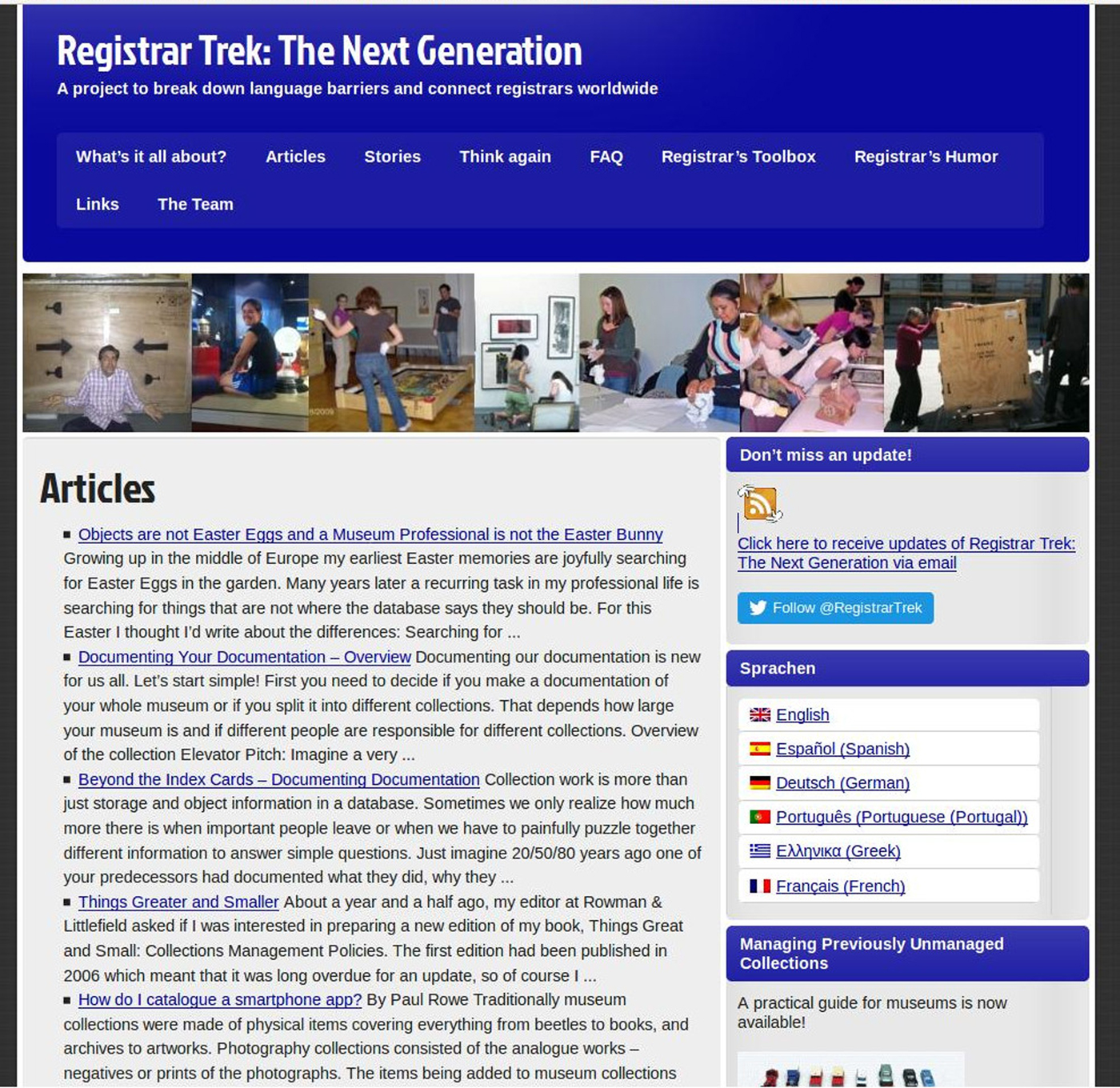
To implement its various aims, the blog devised four different categories of input: articles, stories, toolbox and registrar humour.
Articles are serious, usually longer texts, such as a report on the introduction of bar codes for objects at the National Galleries of Scotland. Articles might scrutinize a specific aspect of a collection manager's work, such as cataloguing contemporary artworks. This section also includes reviews of new books and reports about training events.
Stories are shorter pieces, often related with tongue firmly in cheek. This may be the bespoke box, which then does not quite fit through the door; or the thumbs of a pair of white gloves improvised as slippers for a moggy at home whose injured feet keep sliding around the parquet floor; or even the toddler who is already following in her registrar mother's footsteps – categorizing her toys. Everything finds a place here.
In the Toolbox one finds practical examples from everyday work, like storage solutions for pins, but also articles about how silica gel and buffered paper packaging function.
Let us not forget the section entitled Registrar Humour, where one finds the answers to many a vexed question, like how many registrars does it take to change a light bulb? Solution: One. We hold the bulb and the world revolves around us.
Overcoming language barriers
From the very beginning, the blog has relied on international cooperation and it strives to overcome language barriers. The translators come from 19 countries and, so far, 16 languages are represented. The front-runner for most-translated is the article “Collection and exhibition - a symbiotic relationship” by Anne T. Lane, which can be read in nine languages.
As the translation work is voluntary, it depends on whether someone has the time and desire to take on the difficult transfer of articles into another language. All posts in English are sent to the translation pool and the translator who signs up first in their preferred language translates it. Sometimes a contribution must be translated into English first, before it can be made available for translation into other languages. English is the team language, which does, unfortunately, restrict who can participate but, as the most widely-spoken ‘common language’, it is the most practical solution.
The stumbling blocks are always idioms and linguistic jokes, which cannot be translated literally into another language. However, the blog enables us to learn the technical terms of our profession in another language simply by reading an article on that subject in the other language. For other examples of jargon, the Toolbox contains a glossary of terms entitled American Registrars - International Registrars and is provided by a US museum.
International collaboration
Translation is not the only cross-border co-operation. For the book Managing previously unmanaged collections: A practical guide for museums, Footnote 3 the content was actively discussed on the blog and case studies were solicited, many of which were included in the final publication.
An indirect benefit is that a team translator can solve indecipherable foreign inscriptions in their own collections by asking for help from the translator of that language in the team. One such example can be found in ‘The case of the mysterious earphone’Footnote 4 on the blog.
A final advantage of the blog is that it also serves to maintain contact among colleagues because the team does not consist of random people, they are almost all museum people. And so a French translator on a courier trip to New York can arrange to meet her American counterpart for coffee. Or we can easily organize a blog team meeting during an international conference.
Always looking for new stories
The work of collection management is so varied there is no shortage of topics to write about, but the sensitivity of the work also ensures that it is not always so easy to publish about it. It's an old joke that a project that runs smoothly is wonderful for everyone involved, but does not provide for good stories. The learning curve is also not steep – one never knows if it was successful because of the professional work and planning or if it was just luck?

By contrast, great catastrophes and small mishaps provide endless conversation between colleagues. The accidental loan of 200 objects to a museum which had not requested them; the live scorpion in the transport box from overseas; or the art handling company that subcontracts to a furniture mover with whom you vowed never to work again - these are the stories that both amuse and lead to the implementation of further specifications and process checks for potential errors or problems in a registrar's work. However, stories comically relayed in a lively conversation should not necessarily appear on the Internet under one's own attribution. Furthermore, bosses do not like to see their own department, let alone the entire institution, shown in a bad light.
Resourceful emergency solutions for object storage, unfortunately, are often symptomatic of a desperate financial disregard for collection care. Divergence from the widely-accepted ‘best practice’ solutions on the basis of cost considerations risks losing museum accreditation and/or donor sympathy. This means many sound and creative solutions must remain the collection manager's secrets. Similarly, the publication of breakdowns in transport and safety precautions are open invitations to ne'er-do-wells hoping to take advantage of flaws in the system to land themselves a valuable cargo to sell onward.
So while the team seldom lacks enthusiasm, it often lacks material. This article is therefore also a call to write stories, articles, or ‘How to…’ tips for Registrar Trek, when something exciting in collection care occurs. Surely there can be nothing better than reading your own words in French or even Zulu/Ndebele?
This is a translation of the article ‘Registrar Trek – Sammlungsverwaltung konkret und international’ that first appeared in AKMB-News, 1 (2018): 16-18. The text has been translated by Erica Foden-Lenahan.


