INTRODUCTION
Several modern day environmental issues have been brought to public attention by natural scientists such as Rachel Carson (Reference Carson1962) (effects of pesticides) and Charles David Keeling (Reference Keeling1960) (global warming). But it is now widely accepted that environmental issues are also social issues, and that addressing the environmental predicament requires combining insights from the social and natural sciences (Janssen & Goldsworthy Reference Janssen and Goldsworthy1996; Liu et al. Reference Liu, Dietz, Carpenter, Alberti, Folke, Moran, Pell, Deadman, Kratz, Lubchenco, Ostrom, Ouyang, Provencher, Redman, Schneider and Taylor2007). Starting in the late 1960s, interdisciplinary (ID) programmes in environmental studies emerged in many universities worldwide (see Romero & Silveri Reference Romero and Silveri2006), and explicitly interdisciplinary environmental journals such as Environmental Conservation and Ambio emerged in the early 1970s.
The subsequent decades have, however, seen some ebb and flow in the popularity of and support for interdisciplinarity in environmental research. First, environmental research and teaching in general has received only limited support in the last few decades, especially as governments in the global North focused on unbridled growth and were unsympathetic to environmental issues. Governments in the global South have always been ambivalent about environmental issues anyway, and in many places such as India and China, there is also a stranglehold of the paradigm that ‘science and technology can solve all problems’. Second, the power of disciplinary structures and the innate centrifugal tendencies in academia have reasserted themselves, and study of the environment has been institutionalized in separate streams allied with traditional disciplines, such as environmental economics, ecological anthropology and conservation biology. The age-old divide in geography between physical and social geography has not yet been bridged either (Harrison et al. Reference Harrison, Massey and Richards2008). Yet, with the environmental challenge growing, the pressure to deliver an integrated understanding conducive to problem-solving has increased. Interdisciplinary journals have multiplied, and new interdisciplinary initiatives such as ‘sustainability science’ or ‘global change research’, defined in particular ways, are emerging. But it is not clear whether academia is prepared to (or knows how to) restructure itself to meet the challenge.
In this paper, we reflect on why interdisciplinarity research is needed in environmental research, what its forms and requirements are, how it is being practised and how it might be done better and expanded. We seek to contribute to this reflection by drawing on ID research in the tropical forest sector.
Amongst environmental issues, the study of tropical forests has been prominent, and has gained a large and diverse following. Along with botanists, zoologists, ecologists and silviculturists, soil scientists, hydrologists, economists, sociologists, anthropologists and historians are now engaged in the analysis of questions around deforestation and its causes, forest use and rural livelihoods, wider impacts of forest ecosystem change, historical and current conflicts over forest access and conservation, and so on. In addition to having a large share in broad environmental journals such as Environmental Conservation, Ambio or Human Ecology, the sector has produced its own interdisciplinary journals such as Forest Policy and Economics and Journal of Sustainable Forestry, and also expanded the disciplinary spread of older ‘forestry’ journals such as Forest Ecology and Management and UnaSylva. Forest-related literature also comprises a significant fraction of the papers in social science journals such as Ecological Economics, Society and Natural Resources and GeoForum, and natural science journals such as Bioscience, Conservation Biology and Biomass & Bioenergy, to name a few. Tropical forestry research therefore provides a ripe field for the study of interdisciplinarity in environmental research.
Our objective in this paper is to understand how ID research in the forest sector has been carried out, what challenges it faces, and what that indicates about the challenges for interdisciplinary environmental research in general. We begin by briefly summarizing the nature of disciplines and the terminology of interdisciplinarity. We then discuss the rationale for interdisciplinarity in environmental research, especially the linking of the natural with the social, and identify the challenges it poses. These include the challenges of reconciling values, theories and methods at the level of individual research, and the issues of defining rigour, turf and relevance at the institutional level. We then examine research on two core interdisciplinary questions in forestry, especially tropical forestry, namely the link between social cause and forest change, and that between forest change and social impact. We identify significant progress and innovative contributions, but uneven transmission of these advances, related to the higher level issues regarding how ID research is organized and supported. We conclude by offering some thoughts on how these challenges might be addressed.
DISCIPLINES AND INTERDISCIPLINARITY: CLARIFYING THE TERMS
The structure of disciplines in academia is complex, with no single organizing principle behind it (Kockelmans Reference Kockelmans and Kockelmans1979; Gulbenkian Commission 1996; Lélé & Norgaard Reference Lélé and Norgaard2005, box 1). Nevertheless, a grouping of knowledge into two blocks of ‘social’ and ‘natural’ sciences (where ‘natural’ includes physical, chemical and biological sciences and engineering) finds broad acceptance, because it corresponds with an intuitive sense that understanding how human beings behave is a fairly distinct exercise from trying to understand how the non-human world functions.
Within each block, the boundaries between disciplines are drawn differently, and are fuzzy and shifting. In the natural sciences that are relevant to environmental research, different disciplines may correspond to distinct, though linked, areas of enquiry (such as plants versus animals) or types of phenomena (such as chemical versus biological phenomena). This complementarity, and a belief in a single underlying reality, makes it relatively easy to build interdisciplinary bridges within the natural sciences block when required (Lélé & Norgaard Reference Lélé and Norgaard2005).
In the social sciences, however, the phenomenon studied is at one level the same, human behaviour, and the disciplinary differences are fuzzier. A focus on different scales, such as household, community and polity (Guha Reference Guha1994), or on different contexts, such as market and non-market situations, describes some of the differences. But the overlap is substantial, making these disciplines more competitive than complementary (Kockelmans Reference Kockelmans and Kockelmans1979, p. 77). Disagreements run deep, with the biggest divide seen as between ‘economists’ and ‘anthropologists’ (Bardhan Reference Bardhan1989), alternatively characterized as a divide between quantitative and qualitative methods (Kanbur Reference Kanbur2001) or between positivist and interpretative epistemologies (see Sociology Guide 2010).
Interdisciplinarity could therefore refer to the bridging of any disciplinary divide, including the divides within each block. But in this paper, the term is primarily used to mean the bridging of a big ‘divide’ (Snow Reference Snow1959) between the natural science-cum-engineering and the humanities-cum-social sciences blocks. If, however, this characterization of the non-complementary relationship amongst different social science disciplines is accurate, then it follows that the bridge from the natural to the social sciences will normally be to one of these social science disciplines. True interdisciplinarity will then require efforts to bridge a bigger divide within social sciences.
Different terms have also been used to characterize the strength of the crossings, namely multi‑, inter- and transdisciplinarity. Multidisciplinarity is recognized as simply the juxtaposition of the findings of different disciplines, without any attempt to reconcile or merge them. Interdisciplinarity involves making a clear linkage without necessarily changing each side very much, whereas transdisciplinarity requires going beyond individual disciplines (Kockelmans Reference Kockelmans and Kockelmans1979; Acutt et al. Reference Acutt, Ali, Boyd, Hartmann, Kim, Lorenzoni, Martell, Pyhala and Winkels2000). We focus on interdisciplinary or transdisciplinary research, referring to both as ID for the sake of brevity, except where the distinction is relevant.
In terms of scope, any study that poses a question relating social variables to natural ones or vice-versa can be called interdisciplinary. So can evaluative studies (such as impact assessments) that make use of known relationships between socioeconomic and biophysical variables. Studies may measure all variables themselves, or may use secondary data for one or both types of variables. We include all such studies. Arguably, those that generate primary data on both kinds of variables may generate more insights, a possibility that we examine. Since we are focusing on ID studies, not multidisciplinary studies, we include papers, monographs or dissertations, not edited volumes.
INTERDISCIPLINARITY IN ENVIRONMENTAL RESEARCH: RATIONALE AND BARRIERS
Rationale for interdisciplinarity and its implications
Why should bridging the social and nature sciences, an admittedly difficult task, be valued, promoted or demanded in environmental research? The conventional answer is that environmental problems are both natural and social problems. Human use of the environment changes ecosystem conditions and processes in various ways, and these changes result in impacts felt by society in various ways. A sufficiently ‘holistic’ understanding of this socio-environmental process therefore requires input from both the natural and the social sciences (see for example Kates et al. Reference Kates, Clark, Corell, Hall, Jaeger, Lowe, McCarthy, Schellnhuber, Bolin, Dickson, Faucheux, Gallopin, Grübler, Huntley, Jäger, Jodha, Kasperson, Mabogunje, Matson, Mooney, Moore III, O'Riordan and Svedlin2001; Kinzig Reference Kinzig2001). But it is worth noting that the framing of environmental problems as problems that straddle natural and social systems is not an inevitable one. After all, Keeling did not need to study social systems to observe that atmospheric CO2 concentrations were rising, nor is social science required to determine that fossil fuel burning is primarily causing this rise. It is when the ‘problem’ is phrased not as an academic puzzle but as a societal problem that is hurting society and therefore needs to be addressed, solved or mitigated, that it necessarily becomes an interdisciplinary socio-environmental problem. If climate change is adversely affecting society, then solving or mitigating it will also require an understanding of the socioeconomic drivers of fossil fuel use.
This does not imply that all individual pieces of research on environmental problems must cover both aspects. There is clearly space for disciplinary pieces, as long as they can be put together to solve the interdisciplinary puzzle. This suggests that multidisciplinary research might be enough. However, as a perusal of edited volumes emerging from multidisciplinary research projects will indicate, in multidisciplinary projects there is no guarantee that individual researchers will produce research that can really be linked. Disciplinarians tend to focus on questions that emerge from and are important to their own disciplines, rather than on a linked set of questions that is relevant to society. That is the rationale for interdisciplinary research. Further, there is an argument that framing and answering ‘integrated studies of coupled human and natural systems reveal new and complex patterns and processes not evident when studied by social or natural scientists separately’ (Liu et al. Reference Liu, Dietz, Carpenter, Alberti, Folke, Moran, Pell, Deadman, Kratz, Lubchenco, Ostrom, Ouyang, Provencher, Redman, Schneider and Taylor2007).
That environmental problems are societal problems and not just academic puzzles does not imply that all such research starts with a clear policy audience or activist agenda in mind, or that it must generate policy prescriptions or analysis of existing policies at the end. That would be too narrow a framing of the relationship between knowledge and social change. But it needs to be recognized that environmental research is no longer, and can no longer afford to be, curiosity-driven research. Societal support for it comes with a clear mandate to address social needs, and requires a new social contract from academics (Lubchenco Reference Lubchenco1998). And delivering on this social contract then requires that the research be interdisciplinary, because the problems cross conventional disciplinary boundaries both within and across the two blocks. Indeed, most of those who jump into interdisciplinary environmental research, accepting the attendant risks of being marginalized within their discipline, do so because they feel the need to contribute to mitigating what they see as looming or urgent environmental crises for humankind. This organic link between social relevance and interdisciplinarity in environmental research needs to be adequately recognized.
Some further clarifications are in order here. First, several analysts conflate the bridging of natural and social science with the bridging of the science-policy or science-action gap (see for example Bradshaw & Bekoff Reference Bradshaw and Bekoff2001; Hall & Wilkinson Reference Hall, Wilkinson and Wilkinson2009). This confusion originates in the ignorance of many natural scientists about what exactly social scientists do. Second, translating any analysis into action or policy requires an intermediate step of synthesis, so our grouping engineers along with natural scientists is not entirely appropriate (but it matters less in a paper on forests as compared to say water management). Third, while the reluctance of many academics from both sides of the divide to engage in socially-relevant research may be a problem (see for example Ehrlich & Daily Reference Ehrlich and Daily1993), it is equally a problem that those who do engage in such research are often insufficiently self-reflective about their objectives or values or problem framings, as we will discuss.
Barriers to interdisciplinary research
Accepting the need for interdisciplinarity does not automatically translate into easy or rigorous integration of the social and natural sciences. A substantial literature has emerged in the last five years on the ‘barriers to interdisciplinarity’ in environmental research (see Campbell Reference Campbell2005; Lélé & Norgaard Reference Lélé and Norgaard2005; Fox et al. Reference Fox, Christian, Nordby, Pergams, Peterson and Pyke2006). Using this literature, we summarize the main barriers, some of which are in the mindsets or capabilities of individuals attempting such research, thereby affecting the quality of what they do, whereas other barriers are institutional or systemic, disallowing or discouraging such attempts from the outset. This provides a lens with which to examine the adequacy or rigour of ID research on tropical forests.
The barriers in the minds of the disciplinary researchers are at three levels: values, models and epistemology. First, in applied research, problem definitions are supposed to emanate from society, and researchers are supposed to provide analytical input only. In other words, society should tell researchers whether it cares about climate change, and only then should researchers study why it is happening (biophysically and socially) and how it might be mitigated. But people differ enormously in the way they value the environment, so which values should the researcher respond to? Moreover, in practice, the reverse is also true. Researchers problematize phenomena for society, whether it is the decline of the bald-headed eagle or the hole in the ozone layer. But this is a value-laden process. Each discipline (or even school within a discipline) is likely to emphasize certain kinds of social problems and prioritize certain concerns. For instance, as a social scientist, Campbell (Reference Campbell2003) was ‘quite passionate about the trials of rural communities’, but when she ‘snorkelled on coral reefs in search of juvenile hawksbills [turtles]’ it helped her ‘appreciate where sea turtle enthusiasts are coming from’. Thus, ID research should ideally reflect the (multiple) values of the recipients of the research rather than those of the researchers, but, at the very least, would be clear about which values it is prioritizing, and about choosing the right variables to capture those values.
Second, neither social nor natural scientists come to interdisciplinary research with a blank slate about the ‘other’. Natural scientists and engineers also usually implicitly subscribe to certain ideas about human behaviour, and may casually apply them rather than seek to carefully understand social science theory. For example, biologists use carrying capacity models to assess human systems even though, unlike other animals, human beings constantly innovate and also respond to resource scarcity by varying consumption levels (Brush Reference Brush1975). Conversely, social science theories may ignore environmental variables altogether, or (in economics) may simplistically assume continuous substitutability between natural and human capital (Costanza & Daly Reference Costanza and Daly1992). However, there is also a certain timidity among social scientists towards the natural sciences (Heberlein Reference Heberlein1988; see also Lélé Reference Lele, Chopra and Dayal2009a). This may result in insufficient questioning of natural science propositions on matters that are very much at the interface of the two spheres. Finally, within the social sciences there are serious disagreements over the factors that shape human behaviour. Thus, the theoretical challenge when crossing the natural-social divide is to unlearn implicitly held models of the other while simultaneously pushing for adequate detail and relevance in the models provided by the other discipline to address the question at hand. The theoretical challenge within the social sciences is to allow for multicausality.
Finally, there are differences between the epistemologies and methods of the natural sciences and economics, and those of other social sciences. Natural scientists are realists, trained to believe that there is a reality out there to be discovered through an objective process, whereas (non-economics) social scientists learn that ‘(social) facts are constructed, not discovered’ (Bauer Reference Bauer1990). Ideas of ‘knowability’ and ways of knowing can be quite different. Natural scientists believe in general truths, whereas many social sciences emphasize context-specificity and historical contingency. For the anthropologist, it is both possible and essential to interpret behaviour from ‘within’ (i.e. empathizing with the subject's position or views), whereas natural scientists and economists believe that external observation is both necessary and sufficient to deduce causality. Natural scientists equate rigour only with quantitative analysis, although an analysis can be quantitatively correct yet badly framed (Harriss Reference Harriss2002). At a more practical level, there are questions of scale and variable mismatch between the research in the two disciplinary blocks (Heberlein Reference Heberlein1988). These differences have implications at two levels, namely doing and assessing ID research. Individuals or collaborators who engage in ID research make choices about which disciplines to link and how to reconcile different modes of enquiry, interpretation and research design. Journals that publish ID research have to decide whether this research is rigorous enough, using definitions of rigour that creatively balance disciplinary notions.
At another level, the structure of academic disciplines and academia in general is known to create several barriers to interdisciplinarity. These include society putting natural science and technology on a pedestal as compared to the humanities and social sciences, lack of support and incentives for interdisciplinary research, and unequal control of environmental research funding and agendas by natural scientists, even when it purports to address interdisciplinary questions (Heberlein Reference Heberlein1988). There are also major lacunae in most educational systems from high school upwards that make interdisciplinarity at a later stage difficult (Max-Neef Reference Max-Neef2005). Many of these issues are outside the scope of this paper, because we are focusing on the research that has been done and what we can learn from it, rather than the research not done because of these barriers. But there are several institutional issues that are pertinent to ongoing research, of which we shall explore a few. First, how the production and publication of ID research are currently organized has implications for both the quality and quantum of ID research. This includes the manner in which rigour is defined and also the manner in which ID learning is institutionalized. Second, whether the creation of an ID space is supported by individual academic disciplines or not is critical, since most researchers are still based in those disciplines. Third, resolution of the tension between academic and applied research influences ID environmental research because of its strongly applied nature.
We now turn to tropical forest research and explore work on two core ID questions, with a view to understanding whether, to what extent and how researchers have overcome the above challenges.
CORE INTERDISCIPLINARY QUESTIONS IN FOREST RESEARCH
Research on tropical forests has a long history, as do debates about tropical forest management (Grove Reference Grove1989). The bulk of the early research on forests has been in the natural sciences, taking the form of both ‘academic’ natural history and an ‘applied’ science of silviculture (Dargavel et al. Reference Dargavel, Hobley, Kengen, Dargavel and Simpson1985). Professional forestry journals have a long history and have encompassed debates about forest policy. Social science engagement, however, began about four decades ago. Unlike in temperate forests, where agricultural economists worked on (say) economically optimal rotations, the early engagement with tropical forestry came largely from historians or sociologists (see for example Guha Reference Guha1983a, Reference Guhab), reflecting the close connection between debates around tropical forests and those around colonialism. Other disciplines followed, and the subsequent debate has continuously straddled the academic and policy realms, and involved ecologists and foresters, social scientists as well as environmental and social activists. This has made tropical forestry a rich field of interdisciplinary exploration.
The main societal problem regarding tropical forests has usually been framed as ‘How should forests be managed or conserved?’ This may be broken into two linked but distinct research questions:
(1) What causes tropical forest degradation and deforestation?
(2) What are the consequences of tropical deforestation and degradation for society?
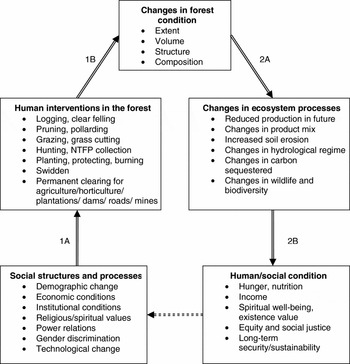
To highlight the interdisciplinary links involved (Fig. 1), the first of these questions can be subdivided as, firstly, how social factors shape human interventions in the forest (see Fig. 1, link 1A), and, secondly, how these interventions lead to changes in forest condition (Fig. 1, link 1B). Similarly, the second question can be subdivided as firstly how changes in forest condition affect various ecosystem processes (Fig. 1, link 2A), and secondly how changes in ecosystem processes affect things that society finds important (Fig. 1, link 2B). Note that in the last, we consider the basic concerns that drive the debate, including concerns about the spiritual or existence value of wildlife and about equitable distribution of benefits. We discuss examples of ID research around these two broad questions, and the lessons provided for ID work. As question 2 influences the construction of question 1, we begin there.
Framework linking social factors to forest outcomes and back to social condition. The dotted arrow indicates a possible feedback.

HOW DO FOREST LOSS AND DEGRADATION AFFECT SOCIETY?
It is normal to frame the core questions in terms of the causes and consequences of ‘tropical forest loss and degradation’, but we prefer the term ‘change in forest condition’ (Fig. 1). The terms ‘loss’ and ‘degradation’ involve value judgements, namely that forests are desirable and their loss or degradation is undesirable. But to say that forest loss is undesirable is to assume that the relationship between forests and society is always positive and forests contribute more to human well-being (however conceived) than alternative land uses. Similarly, using the term forest ‘degradation’ requires first a consensus on what is good forest. In the context of other environmental issues this may not be a big problem. For instance, ‘pollution’ is also a value-loaded term, but there is a reasonable consensus on the value attached to it, namely human health or health of other living organisms. Even if different pollutants harm human health in different ways, there is no disagreement that emissions of all of these pollutants should be abated. But the ideas of good forest and forest degradation can be framed in multiple ways that are at odds with each other. Clarifying this philosophical issue of framing has been a central contribution of ID research. And opening up the framing has created room for more systematic ID exploration of the social impacts of forest cover change.
What is forest loss and degradation?
Studying forest loss and degradation first requires a clear definition of what is a forest. Ecologists have a working definition as ‘any major (ecological) community in which the dominant plants are trees’ (Dictionary of Botany, see http://botanydictionary.org/forest.html). This works within their discipline, where it is assumed that the ‘community’ would consist of ‘naturally occurring species’. Even then, it does not provide a basis for defining what is a ‘good’ and what is ‘degraded’ until the ‘natural’ or ‘pristine’ condition is established as the ideal. But most ecologists, and conservationists in general, have consistently privileged naturalness and a pristine condition in debates around tropical forest conservation. This fits with (and is indeed reinforced by) the Clementsian view that ecosystems, when left undisturbed, move naturally towards a climax (Clements Reference Clements1936). Therefore, any deviation from climax is easily seen as degradation. It also fits with ideas that pristine systems are more diverse, more worthy of study, more protective of ‘rights of nature’, and so on. Even when the idea of climax has been questioned in recent times, the valorization of the ‘pristine-ness’ remains (see Adams & Hutton Reference Adams and Hutton2007).
Foresters, in contrast to ecologists, have always adopted the broader interpretation of a forest as any assemblage of trees, including mono-specific plantations, even of exotic species. This is consistent with their mandate, which in tropical countries was given to them by the colonial governments that established the profession, but is a mandate also held by foresters in temperate countries. Foresters believe that forests are to be managed to maximize timber yield, or resin yield, or other forms of revenue in the tropics. ‘Good’ forests were those that maximized timber yields under a ‘sustainable timber rotation’ or ‘stationary forests’ (where stationary referred to a steady state in which a sustained even flow of timber harvest could be obtained). Thus, even when debates on the wider environmental significance of forests (maintaining streamflows, conserving soil, maintaining the climate) did emerge in the tropics in the 1800s, clearfelling, planting and logging of forests was considered acceptable forestry practice. Shifting cultivation, which also had the potential to maintain a stationary forest, albeit with a different composition and over a longer cycle, was however suppressed as a ‘destructive practice’(see Guha & Gadgil Reference Guha and Gadgil1989; Jarosz Reference Jarosz1993).
It has required social scientists, particularly sociologists, historians, human geographers or interdisciplinarians, to point out that the ‘forest’ and ‘degradation’ are social constructs. Rejecting the ‘ideology of pristine-ness’ (Lélé & Norgaard Reference Lélé and Norgaard1996), they have provided empirical evidence that what were considered pristine forests in the Amazon or south-east Asia were, in fact, sites of centuries of human interference, including ‘shifting cultivation, tree planting, protection, or encouragement, landscape management by fire, hunting and gathering, and other human activities’ (Peluso & Vandergeest Reference Peluso and Vandergeest2001; see also Cronon Reference Cronon1983; Denevan Reference Denevan1992). They have shown that the idea of forest is contextual: in the Indus valley region, the meaning of the local term for forest (jungal) changed corresponding to changes in the way people managed uncultivated lands as they shifted from pastoralism to sedentary agriculture (Dove Reference Dove1992, Reference Dove and Guha1994).
It also required scholars from these disciplines to point out that there could be other views about what constituted a good forest, for example it could be considered to be a forest that best meets the needs of local communities whose livelihoods are heavily dependent on firewood, fodder and other non-timber forest products. A pioneering interdisciplinary investigation by a feminist economist highlighted the relationship between deforestation and increased drudgery for women (Agarwal Reference Agarwal1986). Eventually, meeting local needs even became a part of official state policy in some countries, such as India (Government of India 1988). In south-east Asia, shifting agriculture has been the predominant modifying force in forested landscapes, and anthropologists have pioneered work that questions the assumption that shifting cultivation is always destructive (Dove Reference Dove1983; Jarosz Reference Jarosz1993; Fox et al. Reference Fox, Truong, Rambo, Tuyen, Cuc and Leisz2000). Agro-forests, swidden forests and other anthropogenic forests are also legitimate forest types now.
More recently, the debate about the definition of forests has re-emerged in the context of climate change mitigation and the carbon sequestration potential of tree vegetation. Forests are being defined to include all kinds of tree cover, including timber plantations, roadside and home garden trees and even oil palm plantations (see for example Kant Reference Kant2005; Designated National Authority 2009). Conservation biologists’ worry that the kind of forest that will be encouraged by carbon finance will not be the kind they want to see saved (Putz & Redford Reference Putz and Redford2010) is reminiscent of the earlier conflicts between foresters and local communities over eucalyptus or pine based afforestation projects (Shiva et al. Reference Shiva, Bandyopadhyay, Hegde, Krishnamurthy, Kurien, Narendranath and Ramprasad1991). It is easy to dismiss such flexible use of the term as simply political jugglery. But the fact is that ‘a community in which dominant plants are trees’ can take many forms, each of which may maximize some features that some sections of society, and some discipline, considers desirable.
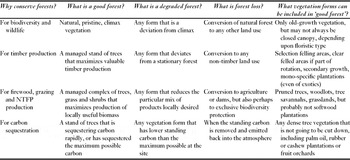
We identified four alternative framings of ‘forest’ and thereby of ‘conservation’, ‘loss’ and ‘degradation’ (Table 1). In each case, differing values underpin the idea of a good forest, leading to different, though partially overlapping, definitions. Definitions of degradation then vary significantly. Definitions of loss are less divergent because, in all the framings, some form of tree vegetation is still privileged. But unidimensional definitions of loss and degradation are clearly not possible.
Rationale and construction of definitions of a good forest, forest degradation and loss.

Not recognizing this problem has three implications. First, it results in bias in policies. Scientists hold power in the policy arena because they supposedly produce objective truths, and, if scientists define good forests in certain ways, policy may shift in that direction, thereby hurting weaker groups such as those who depend on disturbing forests for their livelihoods. This also reduces the capacity for meaningful dialogue, as the same term gets used in different ways by different stakeholders. Robbins (Reference Robbins2001), using a combination of interviews, field surveys and satellite image interpretation, showed foresters categorized land overrun by an invasive exotic shrub as ‘forest’, while local communities rejected this categorization as this shrub prevented them from using the land in traditional ways. Second, it results in bias in the ecology that gets done. The research focus in ecology has remained on pristine forests to the neglect of disturbed ecosystems. For instance, Lugo and Brown (Reference Lugo, Brown, Castri, Baker and Hadley1984) remarked on the tendency to dismiss ‘fallow and secondary forests [as] worthless brush’ and the consequent paucity of research on these ecosystems compared to undisturbed rainforests. More recent calls for research on secondary forests have continued to emphasize biodiversity as the variable of interest (see Chazdon et al. Reference Chazdon, Peres, Dent, Sheil, Lugo, Lamb, Stork and Miller2009) rather than other possible values (those in rows 2–4 in Table 1).
Third, it also risks the production of poor science, as the manner of measurement of forest condition is not sensitive to what is being measured and what needs to be measured. For instance, an exclusive focus on canopy cover in mapping forests can result in misclassification of lands that are relatively high density tree stands, but with a lopped morphology, as degraded (Lélé et al. Reference Lélé, Rajashekhar, Hegde, Kumar and Saravanakumar1998), or dry deciduous and scrub thorn forests that have inherently low canopy cover as deforested (Scales Reference Scales2008). Productivity estimates may go awry owing to the fact that productivity definitions vary between ecologists, foresters and villagers (Lélé Reference Lélé1994). More generally, use or disturbance is automatically equated to degradation, without empirical analysis (see in the next section discussion of link 1B in Fig. 1).
But working with the idea of ‘forest as a social construct’ is not easy. Ecologists have generally baulked at this, for several reasons. First, the bald phrasing is unfortunate, as it suggests that forests exist only in people's minds, when the ‘construction’ is in the way value is attributed and thereby the category defined (for example see Hull et al. Reference Hull, Richert, Seekamp, Robertson and Buhyoff2003). Second, ecologists are socialized to believe that science is objective, and so accepting that the term forest or forest degradation may be value loaded threatens the objectivity in their science. In an applied context, however, objectivity is only possible with reference to an objective. The same debate has emerged in the context of defining sustainability ‘objectively’. Essential features of a system need to be identified and maintained for sustainability, but these ‘essential features cannot be defined without reference to a set of external valuations of the system. Science can illuminate a decision-making process, but it cannot substitute for it’ (Levin Reference Levin1992; see also Lélé & Norgaard Reference Lélé and Norgaard1996).
Third, a large fraction of the ecology profession also identifies itself with the ethical position of ‘deep ecology’, that nature has intrinsic value. The prescription that pristine tropical forests must be saved comes not as a result of combining an ‘external valuation’ of what is desired with an internal science that says pristine tropical forests best provide those values, but on an internal value judgement (Shrader-Frechette & McCoy Reference Shrader-Frechette and McCoy1995). This is true not just for ecologists, but for virtually all scholars who work in the environmental arena; they personally value the environment in particular ways, and would like to see that kind of environmentalism promoted. But for all of them, lack of self-reflectivity results in promoting one kind of environmentalism, without reference to other kinds, or to other social values such as justice or democracy (Wilshusen et al. Reference Wilshusen, Brechin, Fortwangler and West2002). Conservation biologists fear that if left to society (read politicians), tropical forests will be devastated. That they may well be correct does not, however, absolve them of unthinkingly mixing their role as scientists with their role as citizens.
In the wake of efforts to set up funding mechanisms for carbon sequestration in tropical forests, some ecologists and foresters have begun to realize the ‘constructed’ nature of the ‘forest’. Some of them have accepted that all usages are value-loaded and suggested the use of more neutral terms such as ‘tree cover’ or ‘treeland’ as a way forward (Lund Reference Lund2002). Others still seek a ranking in which natural, pristine or old-growth forests are the reference state and everything else is defined with reference to that (Putz & Redford Reference Putz and Redford2010). Clearly, self-reflectivity about the values underpinning forest has begun to permeate in the field, albeit unevenly.
It seemed that the shift from ‘deforestation’ research to ‘land-use change’ research that occurred in the 1990s would neutralize the discourse, as the term land-use change does not come with any overt value judgements. But the framing has changed only partially. Land-use change researchers accept that ‘conversion of land to grow crops, raise animals, obtain timber, and build cities is one of the foundations of human civilization’, but they argue that it alters (read degrades) ‘the provisioning of freshwater, regulation of climate and biogeochemical cycles, maintenance of soil fertility, [and] . . . habitat for biological diversity’ (DeFries et al. Reference DeFries, Foley and Asner2004). It is not clear whether the biogeochemical cycles under unaltered land use were really sacrosanct or whether unaltered states are even definable. In the case of freshwater provisioning, there is ample evidence that provisioning is higher under some altered states, such as grasslands (Hamilton Reference Hamilton1983). Ramankutty et al. (Reference Ramankutty, Graumlich, Achard, Alves, Chhabra, DeFries, Foley, Geist, Houghton, Goldewijk, Lambin, Millington, Rasmussen, Reid, Turner, Lambin and Geist2006), a predominantly natural science group, pointed out the ‘myth of the natural’, but their suggestion to treat land-use change as a continuum may not go far enough, as continuum still suggests a ranking along a single dimension (more pristine to less pristine). If land-use change is to be a neutral term, then a priori judgements would have to be withheld, and the entire set of social impacts, positive and negative, associated with different land uses would have to be compared. The disadvantage is that land-use change is an all-embracing term covering too many different phenomena, change from forests to agriculture, agriculture to settlements, pastures to plantations, and rainfed to irrigated, with each phenomenon being of public interest for very different reasons (biodiversity, food security, water tables or air quality). Combining these different kinds of transitions and their underlying values is not very useful analytically.
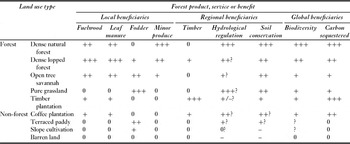
We offer an intermediate approach that involves some a priori judgements but is explicit about the values at stake. The starting point is that different combinations and forms of tree communities are considered valuable for different reasons by different groups in society. Rather than try to come up with a single or consensual definition of forest that works across various contexts, it may be better to identify the values that seem most commonly held, and then focus on understanding the relationship between different forms of forests (and non-forest land uses) and these values (see Table 2).
Trade-offs between benefits and beneficiaries from forest and non-forest uses of land (Source: Lélé Reference Lélé1994). 0 = no impact, + = positive benefits, – = negative impacts, the signs represent physical impacts and so are comparable only within a column, not across columns. ? = significant uncertainty about nature of impact.

The approach is ‘constructivist’ in the sense that the values (the columns in Table 2) are subjectively chosen and defined, as are the management choices (the rows in Table 2). It is ‘realist’ in the sense that it assumes that, given the set of values stated at the outset, it is possible to generate relatively objective scientific information on how different management options affect all the values. And it requires an interdisciplinary linking of variables that describe ecosystem functioning to variables that society recognizes as reflective of social value. Based on existing understanding of these relationships, our matrix contains indicative magnitudes and also flags uncertainties (Table 2).
In spite of the existing uncertainties, it is clear that no form of forest management can simultaneously maximize all benefits, hence tradeoffs are inevitable. Several benefits received from forest land uses may also be available under non-forest land use, and so ‘forest’ to ‘non-forest’ is a continuum, and the line separating these categories is somewhat arbitrary (Table 2). Finally, different benefits often accrue to different stakeholders or beneficiaries, who are at different physical and social distances from the forest, which may broadly be categorized as local, regional and global. Choosing a particular forest management regime means choosing to maximize the interests of certain stakeholders at some cost to others. We now review how ID research has addressed this issue (Fig. 1, link 2B).
How does forest change affect society?
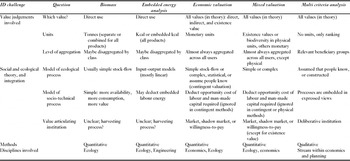
In a simple matrix representation (Table 2), details of the process that connects different forms of forest cover to the benefits are hidden. This process may be visualized as having two steps (see Fig. 1), where the type of forest cover influences ecosystem processes (link 2A), which in turn affect socially relevant variables (link 2B). Understanding these links has been a rich field for ID investigation. A number of different frameworks have emerged (Table 3). Following our analytical approach, we try to identify what value judgements, what theoretical models and what methods are used in which framework.
Relating forest change to social impact. Direct use values = all directly harvested products and tourism; indirect use values = watershed services, carbon sequestration and micro-climate regulation; existence value = biodiversity or related attributes valued for their own sake.

Note that stepping back from imposing a single definition of a good forest does not eliminate the need for value judgements. First, the researcher has to decide which definitions and underlying values to include in the analysis. Second, since different forest benefits accrue to different stakeholders (see local/regional/global columns in Table 2) and tradeoffs between them are inevitable, additional value judgements are required about how to weigh values held by or benefits accruing to different people or through what process these tradeoffs should be made. In other words, positions about equity, social justice and what constitutes a fair decision-making process are inevitable. The frameworks (columns in Table 3) differ in the value judgements they make on these dimensions. They also differ in the level of detail in their representation of the biophysical and socioeconomic process, and the methods they employ.
The initial focus of the literature was on direct tangible benefits to local communities, such as firewood, fodder and leaf manure in south Asia, firewood and grazing in Africa, and the nutrients from forest burning in shifting cultivation in south-east Asia. When natural scientists engaged in this question, they tended to use (and still often use) biophysical units (first two columns in Table 3). The simplest approach was quantifying the various products obtained in tonnes of biomass (see Moench Reference Moench1989). While these estimates of current biomass extraction could be linked to future biomass production (although even here tonnes of grass and tonnes of tree biomass cannot really be aggregated), it was hard to compare them with any other product or commodity to judge the importance of the forest's contribution to villagers’ lives.
A more popular approach was to extend Odum's energetics approach to these situations (Nkonoki & Sørensen Reference Nkonoki and Sørensen1984; Singh et al. Reference Singh, Pandey and Tiwari1984; Pandey & Singh Reference Pandey and Singh1984). The primary finding from this energetics approach was that forests provided a high level of energy subsidy to agriculture. Other researchers highlighted the nutrient subsidy from forests to agriculture through dung and leaf manure inputs (Saldhana Reference Saldhana1990). There was, however, no disaggregation by economic class: village society was treated as one unit, just when social scientists were showing enormous intra-village differences (see below). And there was no exploration of how changes in forest condition might actually affect the flow of benefits, i.e. there were no clear models of how extraction might change forest productivity or how forest condition might affect household decision-making about extraction.
Economists, of course, prefer to characterize benefits in monetary terms. But two different streams have evolved here. Development economists have focused much more on the contribution of forests to total household income, and its variation by class (Bhagavan & Giriappa Reference Bhagavan and Giriappa1987), occupation and gender (Agarwal Reference Agarwal1986). When the idea that the extraction of non-timber forest products (NTFPs) might be poverty alleviating and also ecologically benign emerged in the late 1980s, forestry specialists, development economists and ecologists worked together to examine the sustainability and development potential of NTFP-based livelihoods (Ruiz Pérez & Arnold Reference Ruiz Pérez and Arnold1996; Arnold & Pérez Reference Arnold and Pérez2001). Several dimensions of the problem, including structure of NTFP rights and markets, NTFP ecology and indigenous knowledge, commodity-chains and boom-and-bust cycles, are being studied using different theoretical frameworks.
Neoclassical environmental economists, meanwhile, have focused more on valuation rather than estimating dependence, on the net economic value of the forest per hectare rather than the forest's contribution to household incomes. Indeed, the economic valuation of tropical forests became a virtual cottage industry starting the late 1980s, with a special focus on non-timber forest products (NTFPs). Ecologists also got involved in this exercise (see for example Peters et al. Reference Peters, Gentry and Mendelsohn1989), although their inattention to economic theory was criticized (Sheil & Wunder Reference Sheil and Wunder2002). More sophisticated econometric models are now being used, with income as one of the independent variables (see Godoy et al. Reference Godoy, Brokaw and Wilkie1995). However, the normative question of equity has disappeared in these studies (Tacconi Reference Tacconi1995), and the amount of ecological and institutional detail has been limited. The focus in the valuation literature seems to be on estimating a number that (hopefully) shows that forests are more economically valuable than non-forests, and then relying on policy-makers to use economic policy measures to do the needful.
Environmental economists have, however, made major contributions in expanding the scope of valuation from direct benefits to indirect benefits and other values of the forest, so as to get at what they call total economic value (TEV; Randall Reference Randall, Braden and Kolstad1991). No other social science discipline has engaged with, for example the question of how forests contribute positively to downstream agricultural economies through hydrological regulation, including flood protection (Kramer et al. Reference Kramer, Richter, Pattanayak and Sharma1997) and baseflow augmentation (Pattanayak & Kramer Reference Pattanayak and Kramer2001). In some situations, however, the hydrological benefits can also be negative (Lélé et al. Reference Lele, Patil, Badiger, Menon, Kumar, Murty and Shyamsundar2011), demonstrating the need to pay more attention to the agro-hydrology (factors such as irrigation technology and institutions of water distribution, and cropping pattern) that links forested catchments with household agricultural incomes (see also Barkmann et al. Reference Barkmann, Glenk, Keil, Leemhuis, Dietrich, Gerold and Marggraf2008; Lélé Reference Lele2009b for a review).
Economists have also engaged very significantly with the question of intrinsic or existence value of forest ecosystems. Since economists believe in assessing value through markets, and there are no markets through which existence value is generally expressed, the use of stated preference (also called contingent valuation, or CV) has been the most common approach, in which respondents are asked their willingness to pay for conservation of these values (individual species, or species-rich forests). But there is a major debate about the validity and usefulness of this approach (see Vatn Reference Vatn2005 for a review). Note also that the CV approach leaves little room for the ecology itself: by asking people how much they are willing to pay for certain measures to save the tiger or the panda, it is simply assumed that the proposed measures will lead to the desired conservation outcome. Finally, the CV approach glosses over the complex link between conservation outcomes and human well-being. It assumes that once biodiversity increases in the forest, the existence value for those who care about it goes up automatically. But this value depends upon information being somehow transmitted from the conserved forest to the valuer, when in fact it would involve major transaction costs. While neoclassical economists prefer to separate the question of ‘how valuable’ from ‘how valued’, others are increasingly pointing out the importance of the value articulating institutions (Vatn Reference Vatn2005). Nevertheless, the economists’ engagement with existence value has highlighted the need to understand this link between forests and human well-being.
Economists’ attempts to expand the spatial scale of TEV to state and national economies have been somewhat less successful. Although methods for correcting the gross domestic product to include degradation of natural capital (including forest stocks) have been devised (Vincent & Hartwick Reference Vincent and Hartwick1997), their implementation, particularly in the tropics, is seriously hampered by limitations of data, and the almost inevitable recourse to simplistic biophysical models at that scale.
The ecosystem services approach that has emerged recently (Daily Reference Daily1997; Daily et al. Reference Daily, Soderqvist, Aniyar, Arrow, Dasgupta, Ehrlich, Folke, Jansson, Jansson, Kautsky, Levin, Lubchenco, Maler, Simpson, Starrett, Tilman and Walker2000) is in many ways a restatement of the TEV concept that had already been developed by environmental economists. The main contribution of the ecosystem services approach seems to be that it has galvanized ecologists to increasingly collaborate with economists, and has expanded the understanding of indirect benefits of forests to include, for instance, pollination services (Ricketts Reference Ricketts2004). However, it is not clear whether the perspective of ecologists has actually shifted from insisting on tropical biodiversity conservation for its own sake to using economic criteria for decision making. Indeed, several recent ecosystem service valuations of forests appear to involve special pleading, wherein all other values are monetized, except for biodiversity which is assessed in physical terms and in fact is talked of as distinct from ecosystem services (see Nelson et al. Reference Nelson, Mendoza, Regetz, Polasky, Tallis, Cameron, Chan, Daily, Goldstein, Kareiva, Lonsdorf, Naidoo, Ricketts and Shaw2009). We label this ‘mixed valuation’ (Table 3). In this approach, an implicit normative position seems to be taken against the monetization of biodiversity conservation, but other equally normative aspects of economic valuation, such as aggregation across stakeholders and across generations (through discounting) are ignored.
A different approach, may be multi-criteria analysis (MCA; Table 3). The starting point here is a normative position that decisions about environmental policy, such as protecting tropical forests in particular ways, should not be based on net economic welfare as defined in the valuation approach, but by arriving at an (obviously subjective) optimum between different benefits or concerns of different stakeholders in tropical forests through ranking of different projects (for example see Locatelli et al. Reference Locatelli, Rojas and Salinas2008). This analysis critically depends upon the proper identification and involvement of the stakeholders, and it still requires some socioecological model that can be used to identify the tradeoffs between different options. It can, however, help identify policy options that have broad support, such as options for using a national park simultaneously by tourists, local communities and others (Chopra Reference Chopra and Kadekodi2004).
To summarize, an extensive ID literature has emerged on the contribution of tropical forests to societal well-being. From early attempts to quantify direct forest dependence in physical terms, one stream evolved into strongly ID analysis of sustainable forest-based livelihoods. Another stream evolved to include both indirect use values and existence values, largely through an economic valuation framework. Ecologists themselves have begun using the valuation framework, and collaborations between ecologists and economists have increased manifold. The quality of ecological models and economic methods used in valuation exercises is still mixed, suggesting perhaps that not enough learning and joint debate is happening. The valuation framework has the strength of being consistently constructivist, a forest or its particular attribute are valuable only if people show a positive willingness-to-pay for it. But valuation as a decision-making tool also has serious limitations, including equity issues and whether willingness-to-pay should at all be the basis for taking public policy decisions. The descriptive, rather than evaluative, dimension of this research needs more attention, such as the psychological bases for intangible value and the social and institutional mechanisms and contexts through which all values get created and articulated. However, this will also require greater and more comprehensive engagement by other social science disciplines, with the question of how tropical forest change is linked to well-being.
WHAT CAUSES FOREST LOSS AND DEGRADATION? WHAT ENSURES FOREST CONSERVATION AND REGENERATION?
Debates on tropical deforestation and degradation began in the late 1970s. These were led by natural scientists, including ecologists (see Myers Reference Myers1980) and atmospheric scientists (see Sagan et al. Reference Sagan, Toon and Pollack1979). Consequently, the earlier perspective on the causes of deforestation was largely biological, neo-Malthusian or technological. Forest change was assumed to be driven by excessive extraction (for example for firewood) or agricultural expansion that was directly proportional to the human population (see Anderson & Fishwick Reference Anderson and Fishwick1984; Allen & Barnes Reference Allen and Barnes1985).
Over the next few decades, as social scientists engaged with these questions, they introduced different approaches. Resource economists used mathematical models of renewable resource extraction to show that it may be economically rational to overexploit tropical forests (Clarke Reference Clarke1974). Subsequently, agricultural economists built and tested household-level econometric models that sought to explain household decisions regarding forest clearing or forest product extraction on the basis of household endowments and prices of labour and agricultural products (see Hyde & Amacher Reference Hyde and Amacher1996 for a review). Sociologists and anthropologists brought in other perspectives, particularly structural ones that constrain or drive the actions of local actors involved in deforestation (Ledec Reference Ledec and Leonard1985; Schmink & Wood Reference Schmink, Wood, Little and Horowitz1987), or the historical role of colonial and post-colonial states in forest transformation (Tucker Reference Tucker, Tucker and Richards1983). The collective action literature, comprising political scientists and institutional economists focused on the obverse question, namely the conditions under which local communities may take up forest protection, conservation and regeneration (see Agrawal Reference Agrawal2007 for a review). Although, as indicated in our discussion about barriers to interdisciplinarity the different social science perspectives have evolved largely in parallel, some analysts have attempted to build multi-causal frameworks as well.
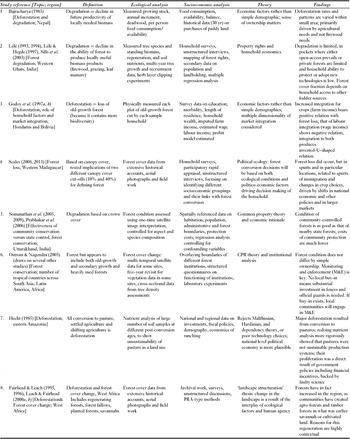
Given the voluminous literature under all these different perspectives, and our focus on interdisciplinarity, we have chosen a few studies that represent some of these theoretical frameworks but are all fully interdisciplinary, i.e. they have collected primary data on the outcome variable (changes in forest condition, Fig. 1), the human actions (human interventions in the forest, Fig. 1) and the socioeconomic drivers (social structures and processes, Fig. 1), at least at the household level or village level In the following subsections, we discuss how these sample studies (outlined in Table 4) and some of the wider literature have established the links between forest values, human actions and social factors (links 1B and 1A, Fig. 1), and what challenges remain.
Fully interdisciplinary analyses of forest loss/degradation.

Clarifying values and choosing the right outcome variables
What kind of forest cover change should be classified as degradation and what land uses should be termed non-forest land uses is always a value judgement. The ultimate variables of interest are really the multiple values attached to these different land uses. Lack of attention to this issue means forest cover figures may include monoculture plantations when the focus is really on biodiversity-rich forests, or degradation may actually represent shifts from (say) biodiversity-maximizing forests to timber-maximizing or firewood-maximizing or carbon-maximizing forests. This issue becomes even more important when studying forest conservation or reforestation, because these processes will lead to increases in some values but not others. That there can be ‘bad’ reforestation, not just because it is coercive in its method but also, for instance, destructive of local benefits from forests (Peluso Reference Peluso1992), is something that researchers must always remain sensitive to.
ID studies that use secondary data have to perforce compromise on this issue. Regional or local studies that collect their own primary data are able to choose more relevant variables, such as the right canopy cover cut-off (Study 4, Table 4), the right measure of growing stock (Study 1, Table 4), separate estimates of treeland, savannah and grassland area (Study 2, Table 4) or clearing in old-growth forests alone (Study 3, Table 4). Similarly, Study 5 (Table 4) on forest conservation by village councils compared crown cover separately for pine and oak forests, knowing the different social values attached to them. In other exceptional studies, researchers have actually measured the impact variable, such as mammal density (Laurance et al. Reference Laurance, Croes, Tchignoumba, Lahm, Alonso, Lee, Campbell and Ondzeano2006) or soil erosion (Moench Reference Moench1991), rather than just forest cover. In all these cases, the variables were identified after spending significant time in the field understanding forest use and dynamics.
Adapting ecological models to link human actions to forest outcomes
Having chosen the variable of interest, the challenge then is to link human actions to that variable through some ecological model (link 1B, Fig. 1). But, as mentioned earlier, just because ecologists have been studying forests, it is not necessary that they have the right models for link 1B, as human-impacted systems have not been considered worthy of study by most ecologists. Foresters may have the wrong models too, as they have focused on timber rather than (say) NTFP ecology. ID work has therefore forced interrogation and sometimes rebuilding of ecological models linking human actions to forest condition.
One example has been the firewood collection-deforestation link. In the simplest cases, researchers (usually social scientists) have taken harvest itself as a proxy for degradation (Nadkarni et al. Reference Nadkarni, Pasha and Prabhakar1989). More typically, natural scientists have estimated production as a fixed percentage of growing stock and compared it with total firewood collection to estimate degrading pressure. Economists have used the standard logistic growth function (supplied by foresters) to relate productivity with stock. However, Study 1 (Table 4) highlighted the need to separate greenwood from deadwood, whole tree felling from branch cutting, and private woodlots from public forests. Similarly, he pointed out that total availability of fuelwood was timber increment plus deadwood. Consequently, whereas comparison between aggregate consumption and annual timber increment suggested a shortfall (and hence degradation), a comparison within each category showed sustainable use. Study 2 (Table 4) extended this approach by estimating timber increment under lopping. Both studies generated much higher estimates of availability than conventional methods had done, and therefore found that firewood-induced degradation was not as widespread as previously believed.
Similarly, in estimating deforestation, ID researchers have begun to re-examine and rebuild estimates of forest cover change and its impacts. Study 8 (Table 4) questioned the estimates of forest loss for western Africa that were being circulated by natural scientists and, using aerial photographs, archival data and vegetation studies, found that in many locations dense forests had actually regrown over earlier savannahs, grasslands or even agriculture. Study 5 (Table 4) also built estimates of forest condition from remote sensing, controlling for aspect and vegetation type. Study 7 (Table 4) actually remeasured soil quality and nutrient status in a large sample of sites to test the claims of agronomists that pastures created by converting Amazonian forests could sustain their fertility, and found this was not the case.
Another important contribution of ID research has been to draw attention to variables other than harvest in determining forest condition. Variables such as protection levels (Studies 5 and 6, Table 4), fire frequency, timing of grazing (Study 2, Table 4) and skill in honeycomb harvesting (Siddappa Setty, personal communication; Oldroyd & Nanork Reference Oldroyd and Nanork2009) influence the dynamics of the resource and the wider impacts of harvest, and are beginning to be included in models of resource dynamics.
Linking social factors to harvest or conversion decisions
The early biological or engineering models of human behaviour posited fixed coefficients of firewood use per person, grazing per animal or land cleared per household. Economists, however, showed that there was significant flexibility in consumption levels, as households respond to scarcity by reducing consumption, or switching technologies and fuel types (Amacher et al. Reference Amacher, Hyde and Kanel1999). Probably all social science disciplines would be in agreement on this point. But beyond this, the relationship between explanations emanating from different frameworks is uneasy, if not downright hostile. Neoclassical economics, political ecology, collective action theory and cultural anthropology seem to jostle for the same space.
Some ways of reconciliation may, however, be possible. First, two broad approaches to analysis need to be recognized, what we term problem-driven versus theory-driven. In the former, researchers want to get a complete picture of the different drivers of forest change. In the latter, specific hypotheses are obtained from theory or experimental work, and then tested in the field (see Studies 5 and 6, Table 4, for the influence of collective action institutions, and Godoy et al. (Reference Godoy, Groff and O'Neill1998) for the influence of education). There is no claim of a comprehensive explanation, only that one significant variable has been identified. Much of the academic social science engagement with forestry or other environmental issues today seems to be in the theory-driven category. In such studies, there is room for other variables, privileged by other theoretical perspectives, to emerge as also significant.
Second, certain models are context-specific. We found the household economics approach useful in predicting the impacts of product markets and labour markets on forest use or conversion when the forest is unlimited (Study 3, Table 4) or under clear individual control (Study 2, Table 4), or when simply investigating variations in household resource use without trying to understand its impact on the forest. If forests are communally managed, household-level models are not very useful, and village-level models are required (Study 5, Table 4). If forest conversion in the Amazon is being done primarily by (say) corporate ranchers (Study 7, Table 4), there is not much point in building household models of migrant peasants. The challenge, of course, is to recognize the applicability or otherwise of the model used. Too often these decisions are driven by what theory the individual researcher is trained in, rather than what theory is best suited to the situation at hand. Here, the event ecology approach of Vayda and Walters (Reference Vayda and Walters1999) is relevant. They advise interdisciplinarians ‘to begin research with a focus on the environmental events or changes that we want to explain and then to work backward in time and outward in space so as to enable us to construct chains of causes and effects leading to those events or changes’.
Third, some nesting of explanations is actually possible. Economic models of utility-maximizing individual decision-making may fit within collective action theory, based on the idea that cooperation has positive pay-offs (see Study 6, Table 4). Economic models of household behaviour may explain choices made under a particular price or subsidy regime, while political economy explains why the particular subsidy regime prevails (Studies 4 and 7, Table 4).
But major disagreements still exist about whether exercise of coercive power is a motive in itself, how history influences human behaviour, whether cultural symbols or affinities matter as much as material calculations, how much people care for the future and how generalizable any results are, to just name a few. The question of power is perhaps the most difficult one, as it negates the idea of independent individual decision-making, so central to rational choice models in economics and collective action theory.
Individual theories have also not fully grasped the complexities of the ecosystem process. For instance, collective action theorists have classified forests as common pool resources, namely where one person alone cannot easily exclude another from access. It follows that, unless there is a well-defined community of users that matches the resource boundary and has well-defined rights, the exclusion problem will not be solved. However, forests also have other attributes. They generate positive externalities for regional or global stakeholders (see Table 2), but collective action theory does not apply there. Collective action theory also does not provide for winners and losers within the community of users (as when tree growth shades out grass production). From this perspective, integration across multiple social science theories seems essential.
One approach to an integrated analysis often adopted in the literature, usually by natural scientists, is a multiple regression using a large number of presumably independent variables, such as population, crop choice, technology, income, trade policy or road length (see Bawa & Dayanandan Reference Bawa and Dayanandan1997; Laurance Reference Laurance1999). However, in the absence of explicit theory, it is not clear which variables should go in and why, whether some variables are directly linked to forest change or they drive other variables, and whether there is any relationship among these variables. Economists have set up the models more rigorously, explaining which variables are proxy for what phenomenon (Allen & Barnes Reference Allen and Barnes1985 is one of the earliest such studies). But a comprehensive review of such models concluded that ‘deforestation tends to be greater when: forested lands are more accessible; agricultural and timber prices are higher; rural wages are lower; and there are more opportunities for long distance trade. Population and migration both affect deforestation rates, but in a complex fashion that cannot simply be reduced to saying population growth promotes deforestation. Major doubts remain regarding [other variables]. . . . Research will probably be more productive if it concentrates on household and regional-level studies, instead of national and global studies’ (Kaimowitz & Angelsen Reference Kaimowitz and Angelsen1998).
The multi-theoretical, but more structured approach of Geist and Lambin (Reference Geist and Lambin2002) and Rudel (Reference Rudel2005) seems more likely to yield some useful insights. In particular, Geist and Lambin's (Reference Geist and Lambin2002) approach emphasized chains of factors, distinguishing broadly between proximate and ultimate factors, and then grouped ultimate factors into five categories: demographic, economic, institutional, cultural and technological. Both studies are meta-analyses, and so constrained by the quality and detail in individual studies. But their meta-theoretical approach offers one way of moving beyond the somewhat monocausality of individual social science perspectives. It highlights the need to remain somewhat ‘undisciplined’ in order to avoid the limited outlook inevitably imposed by disciplinary discourses.
Lambin et al. (Reference Lambin, Geist, Rindfuss, Lambin and Geist2006) discussed the possibility of an overarching theory, and highlighted the need to include (1) structure as well as individual agency, (2) historical inertia, and (3) multiple scales (features we have not discussed here for lack of space). This provides a useful starting point. The next step might be to also include some specific theoretical positions about what patterns of individual behaviour exist, for example materialistic, power-hungry, altruistic or identity-based, and what structures encourage which kinds of patterns. But there is a long way to go before such an approach finds broad agreement.
Linking variables and scale
One of the methodological challenges in interdisciplinary environmental research is properly linking the ecological variable with the socioeconomic variable. We see two approaches in the literature, loosely paralleling the economist-anthropologist divide mentioned earlier. The anthropological approach is based on the belief that it is important to understand the linking variables (captured simplistically in Fig. 1 as human interventions), that mediate between larger socioeconomic processes and forest outcomes. This is a challenging task, because in the tropics the scale at which human actions take place is often quite small, although there is significant variation between the Amazon and other parts of the tropics and also between individual household actions and, say logging by companies. For instance, Study 3 (Table 4) invested a lot of effort to measure the area of old-growth forest cleared by each sample household. Study 4 (Table 4) estimated forest cover change for a large area, and then picked a few sites which showed high rates of deforestation in recent times and carried out socioeconomic studies in those areas. If both patterns and processes for a large area and timescale need to be established, this requires triangulating data from different methods, such as remote sensing, field inventories, household surveys, key informant interviews and stakeholder workshops, and combining data from several individual disciplinary studies (see Campbell et al. Reference Campbell, Lusch, Smucker and Wangui2005 for an excellent illustration).
For degradation-related studies, the task is even more difficult, because it is hard to detect degrading changes in a short time-frame and finding comparable undegraded benchmarks is not easy. ID researchers have often adopted a nested approach where controlled experiments are carried for a subset of sites. In our sample (Table 4), Lélé collected household survey data on use of forest products for a large sample, but physically measured forest product extraction for a much smaller sample and vegetation condition in a subset, and also carried out controlled experiments that simulated the main management practices to link ecological outcomes with household socioeconomic variables. But the resource and time requirements for this kind of research are high and it requires significant initial field work to determine the kinds of experiments that need to be conducted.
The economists approach, however, focuses on obtaining data on the dependent and independent socioeconomic variables and looking for relationships through statistical analysis, without necessarily gathering data on the intermediate process. We have discussed several instances of this approach in the previous section, including situations where results may be misleading. One limitation in the past was that data on the dependent variable (forest cover) were available largely from government sources, and were mostly unreliable and coarse-scale. The advent of remote sensing has dramatically improved researchers’ ability to generate fine-scale multi-temporal data on forest cover, albeit with some limitations as we discussed earlier. Secondary data on socioeconomic parameters such as population, livestock holdings, agricultural holdings and crops are also increasingly available at various scales from villages to countries, or can be collected with relative ease through one-time household surveys. Remote sensing or other map sources provide information on other variables such as the location of roads, some administrative boundaries or soil type. The difficult part is making the link between the smallest unit for which socioeconomic data are available (such as household or village) and the pixels that are likely to be influenced by the (hidden) interventions of actors in that unit. Natural scientists have tended to use proximity as the main criterion, but social scientists have pointed out the importance of tenure in shaping forest access, and analysts have begun to overlay maps of household or community tenure (which, in a tropical forest context, requires significant field work) and use pixels within them to produce more nuanced findings (see Studies 5 and 6, Table 4).
A large literature has emerged on the methodological issues in linking pixels and people which we cannot cover due to space constraints (see Liverman et al. Reference Liverman, Moran, Rindfuss and Stern1998; Rindfuss et al. Reference Rindfuss, Walsh, Turner, Fox and Mishra2004). But one conclusion seems inescapable: statistical analysis alone provides only limited and sometimes misleading insights, unless complemented with detailed field work to understand locally relevant vegetation categories, to ground truth the image, to understand and map tenurial categories, and so on. Perhaps the difference between the two approaches in such studies will become less sharp over time.
At another level, however, the tension between the two approaches remains. The natural scientists and economists believe in large-sample statistical analyses that seem to produce generalizable insights and prescriptions, whereas the anthropologists and perhaps natural historians believe in small sample qualitative case studies that highlight context-specificity and history, and abhor prescription (Walker Reference Walker2006). This tension may be irreconcilable, and we see merit in both methods. Perhaps the appropriateness of the method can only be judged in terms of how it contributes to solving the problem. So it is important to push the anthropologists to clarify what their research has to say for action or policy, but it is equally important to ask the natural scientists and economists whether global-scale analysis can go beyond bland generalities. Geist and Lambin's (Reference Geist and Lambin2002) meta-analysis came to the conclusion that ‘no universal policy to control deforestation can be conceived’. Kaimowitz and Angelsen's (Reference Kaimowitz and Angelsen1998) review of econometric models came to a similar conclusion and recommended more regional analyses. Much of the power to do something about deforestation lies with actors at various levels from local to national, rather than global actors. Thus, a more meso-level engagement seems to be called for.
To summarize, the strongly ID research on causes of deforestation, degradation and conservation provides many insights into how interdisciplinarity might be best achieved. It shows the need to be sensitive to problem framing and the choice of variables used to characterize forest condition. It also highlights the tension between respecting the other discipline and interrogating it. This tension is not quite symmetrical, and different sides of the divide need to respond differently. Natural scientists need to demonstrate more respect for social science experience in understanding human behaviour while social scientists need to interrogate of ecologists’ framing and models of human-nature interactions. An undisciplined but systematic investigation (to coin a potential oxymoron) into the causes of forest change can also be useful, as it pushes for a metatheory beyond the perspectives of individual social science disciplines. ID researchers have also shown the need for careful choice of linking variables between causes and consequences, and for balancing and blending well-structured large-scale analysis (increasingly made possible by remote sensing technology) with detailed understanding of the local and regional context and variables that can only be captured from the ground. Perhaps the larger question is whether and to what extent these insights are being institutionalized in the ID literature.
THE ORGANIZATION OF INTERDISCIPLINARY FOREST RESEARCH
Has ID research on forests adequately internalized the above insights? An examination of the larger ID literature suggests that this is happening, but inadequately. To take just one example: recent papers in Biomass & Bioenergy and Energy Policy on the firewood-deforestation question suffer from the same problems of equating use with degradation, erroneously estimating production, failing to disaggregate harvest or using fixed coefficients for consumption; errors that had been highlighted in the 1980s and 1990s. At another level, there is no clear commonly shared set of questions or definition of the central problems in forest research. The questions we chose to focus on may well be dismissed as not being of central interest in the political ecology literature, which seems to be focused on marginalization, environmental conflict, conservation and control, and environmental identity and social movement. These questions are of great importance, but natural scientists focused on saving tropical forests find them confusing or distracting, if not a positive nuisance. So the question becomes whether ID research on forests and on the environment in general is organized in such a way to enable both dialogue and internalization generating larger amounts of higher quality research of greater relevance?
A quick look at the trajectory of ID research on environment may be useful here. While environmental issues have been a matter of modern public discourse at least since the early 1900s, their emergence in academia has largely been led by natural scientists. Since what is deemed important co-evolves with what is studied (see Lélé & Norgaard Reference Lélé and Norgaard1996), the push to solve or address environmental change, not just as an academic exercise but as a societal problem, came from natural scientists. Natural scientists (ecologists, chemists, physicists and engineers)jumped boldly into understanding the causes of environmental degradation. This started as small and relatively homogeneous community and it interacted through new interdisciplinary journals such as Environmental Conservation or Ambio.
In the second phase, social science disciplines ‘discovered’ the environment as an issue worthy of engagement. Their initial response was to critique some of the gross oversimplifications made by the natural scientists, including their sociobiological leanings, neo-Malthusianism, or inattention to institutions and politics. For a while, they also engaged in contributing to these ID debates, by re-examining data on deforestation and degradation, and producing explanations based on household economic theory, political economy or cultural anthropology that better fitted the new data and nuance.
However, the power of disciplinary structures, the inherent centrifugal tendencies within academia and the natural scientists’ innate reluctance to ‘socialize’ the environment soon asserted themselves. Social science disciplines in particular co-opted or ‘disciplined’ the environment into a sub-discipline of their choice: environmental economics, environmental sociology, environmental policy, environmental values, environmental history, environmental politics or environmental governance, for example. Each of these sub-fields produced several journals, with their own internal debates. Consequently, the number of social scientists engaged in environmental research (especially forest research) has probably increased many-fold in the last few decades, but the number of scientists publishing in interdisciplinary journals (both broad or sectoral) has not greatly increased. Consequently, genuinely cross-disciplinary engagement is rare for questions like tropical deforestation. For instance, according to the ISI Web of Knowledge, Geist and Lambin's (Reference Geist and Lambin2002) paper is cited 229 times, but only 25 of these citations are in social science journals. Conversely, since most social scientists prefer to publish in sub-disciplinary journals rather than in interdisciplinary environmental journals (Walker Reference Walker2006), the natural scientists are not aware of their work.
In the meantime, natural scientists and engineers have continued to engage with the environmental problem in their own ways, and launched many issue-based or sector-based ID journals on climate change, land-use change, biodiversity conservation, or biomass and energy. But the inadequate cross-disciplinary engagement from both sides has meant that these journals tend to be tilted towards natural science, engineering or at best engineering-economic perspectives. For instance, a search for the terms ‘politics’ or ‘political ecology’ in article titles in the journal Forest Ecology and Management, fails to produce even a single paper in the last 25 years. The broad multidisciplinary science journals (Science, Proceedings of the National Academy of Sciences of the USA or Nature for example) display a bias towards large-sample statistical analyses in their scientistic search for universal truths, when the causes of environmental degradation and their solutions are often historically contingent and context-specific, requiring a combination of general and specific insights.
The academic ‘takeover’ of the ID space has also produced a more schizophrenic attitude towards the applied aspect of ID environmental research. Instead of celebrating the applied mandate and accepting the value-laden nature of the research, natural scientists generally prefer to retain the veneer of objectivity and the power that this gives them in society. Conservation and sustainability are represented as natural imperatives. Economists engage more openly in policy debates, but claim that economic efficiency is an objective criterion for public policy, whereas many others, especially social scientists critical of the state, seem leery of engaging with policy altogether (Walker Reference Walker2006), perhaps fearful of being co-opted.
This fragmentation, compartmentalization or voluntary ghettoization, coupled with a general explosion of journals, has consequences for rigour, relevance and reproduction in ID environmental research. First, building rigour requires the best minds of each discipline to be involved in both the publishing and the review process. But the number of disciplinary experts that ID journals can draw upon for submitting articles and for refereeing is small, and the number of such journals expanding. Consequently, the contributions to the ID literature may lack in rigour and not be aware of developments in the disciplinary literature. In the absence of a shared ID space, there is poor internalization of the insights gained from previous high quality interdisciplinary work. Mistakes identified two decades ago continue to be repeated. We hypothesize that the sectoral ID journals may not have the breadth of scholarship in their reviewer lists to catch such errors and push submissions towards greater disciplinary rigour, let alone internalize the learning from past ID work.
The second impact is on the level of integration achieved and therefore the contribution to social change. As mentioned earlier, the goals of problem-solving research differ from those of academic research. Simply put, academic studies are more likely to frame their question as ‘how does factor X (privileged by that discipline) contribute to deforestation?’, whereas to solve the problem the transdisciplinary question would be ‘why is there deforestation?’ But, given the ambivalence towards engaging with policy and action described above, only some analyses find their way into the public policy realm, leading to either faulty policy that hurts marginalized groups or a strengthening of the mistrust amongst policy-makers for academics’ ability to provide comprehensive solutions.
Third, some new programmes notwithstanding, there has been an overall weakening (or inadequate expansion) of the programmes that train students in interdisciplinary environmental research. It is well known that when students enter such programmes, they typically lack even minimal exposure in the ‘other’ disciplines, For instance, few of the young scholars entering political ecology today have extensive scientific or ecological training (Walker Reference Walker2005), and the lack of exposure to (if not the active denigration of) the social sciences and humanities in undergraduate science curricula is a global phenomenon. With academic recruitment dominated by disciplinary thinking and with sufficient disciplinary outlets for environmental work (provided they address disciplinary questions), even students in interdisciplinary programmes have little incentive or scope to continue doing strongly interdisciplinary work. As an example, Scales, whose Ph.D. dissertation on deforestation in Madagascar was jointly funded by both the natural and the social science research councils of UK (Scales Reference Scales2008), expressed a reluctance to first publish his findings in interdisciplinary environmental journals such as Environmental Conservation or Ambio because he felt they did not carry enough weight in either ecology or the social sciences. Such researchers are then forced to divide their integrated research into pieces that will meet disciplinary expectations. In the process, the core contribution, which is often an integrated understanding of the problem, is lost or de-emphasized (I. Scales, personal communication Reference Scales2011).
In short, owing to the way interdisciplinary research on the environment is currently organized, there is limited engagement in a common sphere, and therefore limited shared learning and building of common frameworks to make the research more rigorous and sensitive to societal needs. Fostering common ground, and fostering a sustained and broad-based ID dialogue on the environment, is the challenge, and addressing it will require significant changes in the way academia looks at, organizes and supports ID environmental research.
CONCLUSIONS
Crossing disciplinary divides is not easy at the best of times. Crossing the divide between the natural and social sciences while simultaneously trying to integrate multiple perspectives within the social sciences poses a major challenge to environmental researchers. The impetus for taking up these challenges comes largely from a desire to mitigate environmental problems. This urge is a double-edged sword, as it also comes with an a priori framing of what the problem is, based on what values underpin the researcher's perspective. Tropical forests are a classic example of this challenge, as they generate different valuesfor different stakeholders, from the hundreds of millions of forest-dwelling people to regional and global populations. Interdisciplinarity requires reconciling or integrating discipline-driven values, theories and methods, and ID research on forests has thrown up many ways in which researchers have achieved this by adopting a more plural and transparent normative framework, by constructively engaging with the other discipline and by using carefully interlinked research design. This has not only generated a better understanding of the forest-society relationship for policy-makers, but also contributed to individual disciplines.
What seems to be missing however is a shared interdisciplinary space, where scholars from all disciplines, as well as multidisciplinary scholars, engage in a continuous dialogue and debate, attempting both to define what constitutes a good environment and a good society and provide integrated analyses of the different strategies for achieving them. The pressure for more rigour and more integration must come from outside academia. Quality and rigour should not be defined purely internally, in terms of logical connections between theory, hypothesis and evidence, but should also be defined externally, as rigour in identifying the most pressing problems, rigour in defining them in socially relevant and normatively transparent ways, and rigour in examining individual understandings of the other discipline. Research on forests, with its long history and strong social engagement, has a lot to contribute to this process.
ACKNOWLEDGEMENTS
This paper draws upon our experience with a number of interdisciplinary research studies that have been enriched by interactions with colleagues too numerous to mention here. However, we thank Bhaskar Vira, Emma Mawdsley, Bill Adams and Peter Walker for specific suggestions that helped in the writing of this paper, and gratefully acknowledge the constructive comments received from three anonymous reviewers and an Associate Editor of this journal. We also thank Nicholas Polunin for providing the opportunity to review and learn from this extraordinarily rich literature. Sharachchandra Lele's work was partly supported by the Charles Wallace Trust Visiting Fellowship provided by the Centre for South Asian Studies at the University of Cambridge and Amit Kurien's contribution was facilitated by a fellowship from the Jamshedji Tata Trust.