The importance of the dry period in the overall maintenance of good udder health and productivity of dairy cows has long been recognized (Neave et al. Reference Neave, Dodd and Henrichs1950; Eberhart, Reference Eberhart1986) and the topic has recently been reviewed (Dingwell et al. Reference Dingwell, Kelton and Leslie2003a; Bradley & Green, Reference Bradley and Green2004). The goal is to have cows calving with healthy udders. Reaching this goal can be challenging because cows are highly susceptible to bacterial infections during the early dry period and again during colostrogenesis, and the rate of new intramammary infections (IMI) is higher during the dry period than during the lactation (Cousins et al. Reference Cousins, Higgs, Jackson, Neave and Dodd1980; Smith et al. Reference Smith, Todhunter and Schoenberger1985). Infections acquired during the dry period are commonly caused by environmental pathogens (Oliver & Mitchell, Reference Oliver and Mitchell1983; Smith et al. Reference Smith, Todhunter and Schoenberger1985; Williamson et al. Reference Williamson, Woolford and Day1995; Bradley & Green, Reference Bradley and Green2000; Dingwell et al. Reference Dingwell, Leslie, Schukken, Sargeant, Timms, Duffield, Keefe, Kelton, Lissemore and Conklin2004) and some of these infections may persist to the next lactation (Oliver & Mitchell, Reference Oliver and Mitchell1983; Bradley & Green, Reference Bradley and Green2000). More than 50% of enterobacterial mastitis occurring in the first 100 d of lactation was reported to have occurred in quarters infected during the dry period (Bradley & Green, Reference Bradley and Green2000).
The method of drying-off (abrupt or intermittent milking at the end of lactation) is associated with milk yield at dry-off and it may also influence the infection status at calving. Intermittent milking reduces milk yield, results in more rapid involution and an increase of natural protective factors in milk, such as lactoferrin (Natzke et al. Reference Natzke, Everett and Bray1975; Bushe & Oliver, Reference Bushe and Oliver1987). However, most studies evaluating different drying-off methods date back several decades (Oliver et al. Reference Oliver, Dodd and Neave1956; Natzke et al. Reference Natzke, Everett and Bray1975; Bushe & Oliver, Reference Bushe and Oliver1987; Oliver et al. Reference Oliver, Shull and Dowlen1990) and results from these studies may no longer be applicable to the high-producing, modern dairy cow. The common recommendation currently for drying cows off is abrupt cessation of milking at the end of lactation. In a high-producing dairy cow, however, this may cause substantial pressure in the mammary gland and on the teat canals, causing milk leakage and teat canals to stay open longer (Williamson et al. Reference Williamson, Woolford and Day1995; Dingwell et al. Reference Dingwell, Leslie, Schukken, Sargeant, Timms, Duffield, Keefe, Kelton, Lissemore and Conklin2004; Odensten et al. Reference Odensten, Berglund, Waller and Holtenius2007). Indeed, several recent studies have suggested that increasing milk yield at dry-off is significantly associated with increasing proportion of IMI at calving (Dingwell et al. Reference Dingwell, Duffield, Leslie, Keefe, DesCoteaux, Kelton, Lissemore, Schukken, Dick and Bagg2002; Rajala-Schultz et al. Reference Rajala-Schultz, Hogan and Smith2005; Odensten et al. Reference Odensten, Berglund, Waller and Holtenius2007). Results from our earlier study indicated that for every 5-kg/d increase in milk production at dry-off, the odds of having an IMI at calving increased by almost 80% (Odds Ratio, OR=1·77). Moreover, if infections caused by environmental pathogens only were considered, the odds of an infection at calving more than doubled (OR=2·1). In that study, nothing was done to manipulate the milk production level and the observed variability in milk yield at dry-off was all naturally occurring (Rajala-Schultz et al. Reference Rajala-Schultz, Hogan and Smith2005). The objective of the present study was to assess the influence of milk yield and infection status at dry-off on the prevalence of IMI at calving by comparing different drying-off procedures in one dairy herd. We hypothesized that cows enroled in an intermittent milking schedule for the final week of lactation would have reduced milk yield compared with herdmates milked twice daily and dried off by abrupt cessation of milking, and that cows with lower milk yields prior to dry-off would have a lower prevalence of IMI after calving.
Materials and Methods
Jersey and Holstein cows (n=127) ending their first or greater lactation at the seasonally calving Ohio State University Waterman Dairy Herd were enroled in the study between July 2006 and December 2007 if they met the following criteria: confirmed pregnant with a dry-off date at least 2 months prior to calving; not being treated with antibiotics at enrolment; and not enroled in any other research trial at the time of the current study. Cows were grouped by breed, and within breed they were randomly assigned to an intermittent milking schedule or a control milking schedule 1 week prior to dry-off (pre-dry). Intermittently milked cows (treatment group) were milked once in the morning for the first 4 d, skipped one full day of milking, milked the following morning, skipped another full day of milking, and then milked in the morning on the day of dry-off. Cows in the control group were milked twice daily as usual until the day of dry-off, when they were milked once in the morning. All quarters of all cows were infused with an antibiotic dry-cow product containing cephapirin benzathine following the final milking (Cefa-Dri®, Fort Dodge Animal Health, Madison NJ, USA). During the first year of the study, control cows were housed in one large group in a free-stall barn during the final week of lactation and intermittently milked cows were transferred to tie-stalls, but they were milked in the parlour with the rest of the herd at their scheduled milking times. Owing to management changes in the herd, during the second year of the study all cows were housed in a free-stall barn. Consequently, intermittently milked cows were coded into the computer such that they entered the milking parlour at normal milking times but they were only milked on the predetermined schedule (S.A.E. AFIKIM, Kibbutz Afikim, Israel). All cows were fed the same ration prior to dry-off and housing and management of the cows were the same after dry-off.
Sample collection and microbiological procedures
Duplicate quarter milk samples were collected aseptically according to National Mastitis Council (NMC) guidelines (Oliver et al. Reference Oliver, Gonzalez, Hogan, Jayarao and Owens2004) prior to milking from each cow on the day of enrolment (pre-dry), on the day of dry-off, and within 3 d of calving. Milk samples were transported to the laboratory in a cooled container immediately after milking and were frozen for a minimum of 24 h. Thawed, vortexed samples were plated on tryptic soy agar (TSA) with 5% sheep's blood and MacConkey agar plates (Remel Inc., Lenexa KS, USA) using sterile 0·01-ml loops. Plates were incubated at 37°C and checked at 24 h and 48 h for bacterial growth. Identification of isolates was in accordance with NMC guidelines (Oliver et al. Reference Oliver, Gonzalez, Hogan, Jayarao and Owens2004). Colonies on blood agar with similar morphology were counted and recorded as colony-forming units (cfu)/ml of milk. The quarter infection status was determined using a single milk sample, applying the criteria proposed by Torres et al. (Reference Torres, Rajala-Schultz and DeGraves2009). Briefly, if a sample contained at least 100 cfu/ml of contagious pathogens or 1000 cfu/ml or more of any other pathogen, a quarter was considered infected. A quarter sample was considered contaminated if three or more unique colonies were identified on blood agar (Oliver et al. Reference Oliver, Gonzalez, Hogan, Jayarao and Owens2004). If the first sample was contaminated, the second sample was used instead. If both samples from a quarter were contaminated, infection status of that quarter was considered unknown.
Lactoferrin concentration in quarter milk samples at pre-dry and dry-off was also quantified for a subset of cows (40 treatment and 47 control cows) to determine the effect of intermittent milking on the levels of this natural defence factor in bovine milk (Newman et al. Reference Newman, Rajala-Schultz, Lakritz and DeGraves2009). After microbiological culture, samples were immediately frozen at −70°C and were thawed prior to dilution for lactoferrin ELISA. For lactoferrin quantification, only the first sample from each quarter was used. Lactoferrin concentration was quantified using the Bethyl Laboratories Bovine Lactoferrin Quantitiation ELISA Kit (Bethyl Laboratories Inc., Montgomery TX USA) with the following modifications: Tween 20 was not added to the sample dilutant and PBS with a pH of 7·3 was used rather than 50 mm-Tris–0·05 m-carbonate/bicarbonate (Newman et al. Reference Newman, Rajala-Schultz, Lakritz and DeGraves2009).
Milk yield and somatic cell counts
The daily milk yields for each cow were recorded for the final week of lactation using the farm's AfiFarm record keeping system (S.A.E. AFIKIM, Kibbutz Afikim, Israel). The actual milk yield on the day of dry-off was not considered comparable between the groups owing to the varying milking schedules, and thus cumulative milk yield for the final week of lactation was calculated for each cow and used in the analyses. Milk yields from the monthly Dairy Herd Improvement Association (DHIA) records were used to compare the milk yields in the study groups during the last 3 months prior to dry-off. Individual cow somatic cell count (SCC) records for 3 months prior to dry-off were also obtained from DHIA herd records. Quarter-level milk samples were collected and submitted to DHIA on the day of dry-off for determination of SCC.
Data analysis
Data analysis was performed using Statistical Analysis System, SAS v.9.1.3 (SAS Inst. Inc., Cary NC, USA). Descriptive statistics were first calculated to compare treatment and control groups prior to dry-off [mean and 95% confidence intervals (CI) or median and 10th and 90th percentiles for continuous variables and number and proportion of quarters infected at each time point]. A t test was used with continuous variables and Chi-square test with proportions to compare the study groups. A quarter was considered infected if any pathogen was isolated using the guidelines explained above [⩾100 cfu/ml for major contagious pathogens (Staphylococcus aureus, Streptococcus agalactiae) and ⩾1000 cfu/ml for all other organisms (Torres et al. Reference Torres, Rajala-Schultz and DeGraves2009)]. Number of persisting infections, new infections and cures over the dry period were also calculated. A quarter was considered persistently infected if the same organism was isolated from the quarter at dry-off and at calving. It was considered cured if a pathogen was isolated at dry-off but that same organism was not detected at calving. A new infection at calving was diagnosed if a pathogen was isolated at calving, but not at dry-off.
Generalized estimation equations (GEE) with a logit link and binomial error distribution were used to model the probability of a quarter being infected at calving (PROC GENMOD in SAS). Analyses were run considering infections by any pathogens and with environmental pathogens only. Comparison was with the uninfected quarters. Infection status at both pre-dry and dry-off was coded as uninfected or infected with major or minor pathogens and they were considered as potential explanatory variables. Major pathogen infections were defined as quarters infected with Staph. aureus, Str. spp. (Str. dysgalactiae, Str. uberis), Enterococcus spp., Gram-negative organisms (including Escherichia coli, Enterobacter spp., Citrobacter spp.), Nocardia spp., yeast and Arcanobacterium pyogenes. Quarters infected with minor pathogens were those infected with coagulase-negative staphylococci (CNS) or Corynebacterium spp. (Oliver & Mitchell, Reference Oliver and Mitchell1983; Williamson et al. Reference Williamson, Woolford and Day1995). Compound-symmetry correlation structure was used to account for the clustering of quarters within cows and lactations within cows (Littell et al. Reference Littell, Milliken, Stroup and Wolfinger1996).
Treatment group status, cumulative milk yield for the final week of lactation, breed, parity at dry-off (lactations 1, 2, 3+), season (summer, June–September inclusive and autumn, October–January inclusive), days in milk (DIM) at dry-off, and dry period length were considered for the model. For the analyses, cumulative milk yield for the final week of lactation was divided into three categories using cut-off values that roughly achieved equal-sized groups (⩾115 kg, 115–75 kg, <75 kg). Owing to management changes in the herd between the study years, the effect of year was assessed by considering year as a potential confounder in the modelling process. Also, association of lactoferrin concentration (μg/ml) and SCC on the day of dry-off with infection status at calving was tested. First, all potential explanatory variables were screened individually against the infection status at calving. Variables were included in a full model if they were associated with the outcome with a P value of <0·20. The least significant variables were removed from the full model one at a time based on Wald Chi-square test. Cumulative milk yield during the last week of lactation was forced into the model as the main variable of interest. The modelling using infection status at calving by any pathogen as the outcome was repeated following the above-described procedure also for subsets of the data based on the quarter infection status at enrolment (uninfected and infected at pre-dry).
Results
Descriptive data on the study population
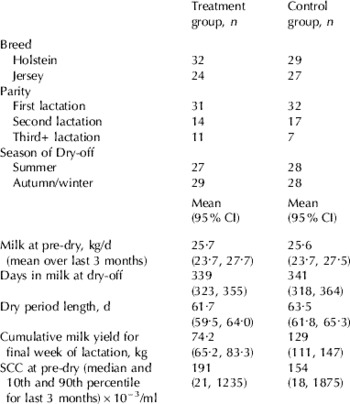
At the end of the study period, 127cows had been enroled. Losses to follow-up included late-term abortions and cows culled in the dry period (n=10). One enroled cow dried off spontaneously during the final week of lactation and was consequently excluded from the analyses. Two cows were dropped for excessive dry period lengths (>150 d). Lastly, two cows were dropped owing to lost milk yield records after a computer malfunction at the dairy. Of the final 112 dry-periods included in the study, 56 were in the control group and 56 followed an intermittent milking schedule. Twelve cows were enrolled on both years. Some cows had fewer than 4 functional quarters and consequently, 212 quarters in the treatment group and 213 quarters in the control group were sampled. Descriptive statistics on the cows in the two groups showed that the groups were very comparable at the time of enrolment in the study regarding milk yield and SCC prior to dry-off, DIM at dry-off, as well as dry period length (Table 1). Also, breed and lactation number of the cows and season of dry-off were similarly distributed among the two groups. The intermittent milking schedule was successful in reducing milk yield: treatment cows produced significantly less than control cows during the final week of lactation (mean of 74 kg for treatment cows v. 129 kg for control cows, P<0·001).
Descriptive statistics on the intermittently milked cows (treatment group, n=56) and cows milked twice daily during the last week of lactation and dried off by abrupt cessation of milking (control group, n=56)

Infection status
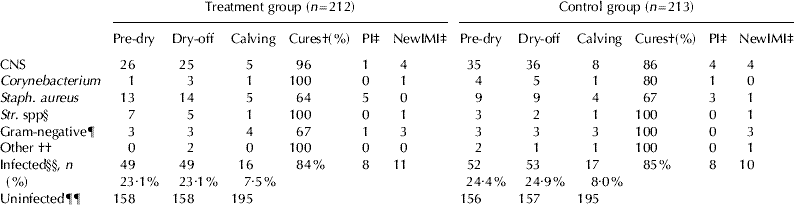
CNS were the most commonly isolated organisms at pre-dry, dry-off and at calving, and Staph. aureus was the most prevalent major pathogen (Table 2). Str. agalactiae was not isolated at all during the study. Infection status of 20 quarters (1·6%) throughout the entire study remained unknown due to contaminated samples.
Distribution (number) of different organisms isolated from quarters of cows in treatment (intermittently milked) and control (milked twice daily as usual) groups at the time of enrolment to the study (predry=one week before dry-off), at dry-off and at calving

† Percentage of cured quarters over the dry period for each organism group was calculated by dividing the number of quarters infected at dry-off minus the number persistent infections (PI) by the number of quarters infected at dry-off
‡ Number of quarters with persisting infections over the dry period (i.e., the same organism was isolated from the quarter milk sample both at dry-off and at calving). A new infection was detected when organism was isolated at calving, but not at dry-off
§ included Streptococcus dysgalactiae, Str. uberis and enterococci
¶ included Esch. coli, Citrobacter spp., Enterobacter spp.
†† included Arcanobacterium pyogenes, Nocardia spp. and yeast
§§ total number (and percentage) of quarters infected at each time point (may not add up to the number of organisms isolated because of mixed infections where two different organisms were detected in a single quarter milk sample)
¶¶ total number of uninfected quarters at each time point (the possible difference between the sum of infected and uninfected quarters and the total number of quarters is the number of contaminated samples)
The overall number and proportion of quarters infected at pre-dry and dry-off in the treatment groups were very similar (Table 2). This observation was true also when the two study years were examined separately (results not shown). Most quarters that were uninfected at pre-dry were uninfected also at dry-off (Table 2). The overall percentage of quarters infected in the treatment group both at pre-dry and at dry-off was 23·1% and in the control group the percentages were 24·4% and 24·9% at pre-dry and dry-off, respectively. At dry-off, 22 treatment quarters (10·4%) and 15 control quarters (7·0%) were infected with major pathogens (P>0·05) and 28 (13·2%) and 41 (19·2%) quarters were infected with minor pathogens (P>0·05), respectively (Table 2). One quarter at pre-dry and 3 quarters at dry-off in the treatment group had mixed infections and 4 quarters at pre-dry and 3 quarters at dry-off had mixed infections in the control group. One control quarter had a mixed infection at calving. Most of these mixed infections (9/12) had both a minor and a major pathogen isolated from the quarter, 3 quarters had two different major pathogens isolated. In the statistical analysis, all these quarters were categorized as infected with major pathogens.
Proportion of quarters infected at calving did not differ significantly between treatment and control group [16 treatment quarters (7·5%) v. 17 control quarters (8·0%) infected, P>0·05] (Table 2). In the treatment group, 84% of all the infections present at dry-off cured over the dry period and 85% of existing IMI cured in the control group. The lowest cure rate (ranging from 64 to 67%) was observed for Staph. aureus. There were no major differences in the number of new or persisting infections between the groups (Table 2).
In the logistic regression analysis, neither cumulative milk yield during the final week of lactation nor drying-off method was significantly associated with the probability of IMI at calving when modelling data from both infected and uninfected quarters at pre-dry together. Also, parity, breed, season, year of the study or lactoferrin concentration at dry-off were not significantly associated with infection status at calving. Average SCC over 3 months prior to dry-off (from DHIA records), quarter level SCC at dry-off and infection status at pre-dry and dry-off were significantly associated with infection status at calving in the univariate screening and were included in the multivariate model. Only infection status at dry-off remained significant, with cumulative milk yield prior to dry-off forced into the model as the main variable of interest (Table 3). Infections at dry-off caused by major pathogens were highly significantly associated with infection status at calving (P<0·0001), with infected quarters at dry-off having 7·6-times higher odds of being infected also at calving compared with uninfected quarters (95% CI for OR, ranging from 2·8 to 21). Quarters infected with minor pathogens at dry-off had 3·3-times higher odds of being infected also at calving than uninfected quarters at dry-off (P=0·028, 95% CI for OR: 1·1, 9·5). Quarters of cows producing more than 115 kg or between 75 and 115 kg during the final week of lactation had slightly higher odds of having an IMI at calving than quarters of cows producing less than 75 kg (Table 3); however, differences were not significant (P>0·6).
Results from the final logistic regression model for the probability of intramammary infection at calving for all quarters based on their infections status at dry-off and the milk production level of the cow during the final week of lactation

† Cumulative milk yield for the final week of lactation was divided into three groups: greater or equal to 115 kg, between 75 and 115 kg and less than 75 kg (the reference group)
When modelling the probability of infection status at calving only for quarters uninfected at pre-dry, cumulative milk yield during the last week of lactation was significantly associated with the post-partum infection status when adjusted for the treatment group (Table 4). Uninfected quarters of cows that milked over 115 kg during the last week of lactation (on average 16·4 kg/d) had 7·1-times higher odds of being infected at calving than uninfected quarters of cows that produced less than 75 kg (P=0·008, 95% CI: 1·7, 30·0). Quarters in cows producing between 75 and 115 kg during the last week of lactation also had slightly increased odds of IMI at calving compared with cows producing less than 75 kg. While the association between treatment group and infection status was not significant (P>0·05) in the initial screening, when in the model with milk yield, treatment group became significant and the results suggested that the intermittently milked cows were 4·2-times more likely to be infected at calving than control cows (P=0·0098, OR=4·2, 95% CI: 1·4, 12·3). When considering only infections caused by environmental pathogens at calving, no variables were significantly associated with IMI at calving, most likely because of the small sample size (only 9 quarters were infected either with environmental streptococci or Gram-negative organisms at calving).
Results from the final logistic regression model for the probability of intramammary infection at calving for quarters that were uninfected one week before dry-off

† Cumulative milk yield for the final week of lactation was divided into three groups: greater or equal to 115 kg, between 75 and 115 kg and less than 75 kg (the reference group)
‡ Intermittently milked cows followed an intermittent schedule for the final week of lactation. The comparison was to cows that were milked twice a day until the end of lactation and were dried off abruptly
Discussion
Intermittent milking during the last week of lactation significantly reduced milk yield prior to dry-off in the present study. Our findings were similar to those of Oliver et al. (Reference Oliver, Shull and Dowlen1990) who reported that milking cows once daily during the final week of lactation was an effective method of reducing milk production prior to dry-off. In older studies, intermittent milking has been associated with fewer IMI at calving compared with abrupt cessation of milking (Oliver et al. Reference Oliver, Dodd and Neave1956; Natzke et al. Reference Natzke, Everett and Bray1975; Bushe & Oliver, Reference Bushe and Oliver1987). This can be explained by the facts that milk accumulation in the udder after dry-off influences the rate of teat closure (Natzke et al. Reference Natzke, Everett and Bray1975; Williamson et al. Reference Williamson, Woolford and Day1995; Dingwell et al. Reference Dingwell, Leslie, Schukken, Sargeant, Timms, Duffield, Keefe, Kelton, Lissemore and Conklin2004; Odensten et al. Reference Odensten, Berglund, Waller and Holtenius2007) and that intermittent milking results in decreased milk yield, more rapid involution and an increase of natural protective factors in milk, such as lactoferrin (Bushe & Oliver, Reference Bushe and Oliver1987; Newman et al. Reference Newman, Rajala-Schultz, Lakritz and DeGraves2009). In a recent Swedish study, the proportion of cows with IMI was significantly lower after calving among cows producing 5·0–11·4 kg of milk/d during the last week of lactation than among cows producing more than that (Odensten et al. Reference Odensten, Berglund, Waller and Holtenius2007). In that study, at 2 and 3 weeks after dry-off, significantly fewer cows in the low producing group (5·0–11·4 kg/d) had open teat canals compared with the high and medium producing groups. Similarly, Green et al. (Reference Green, Bradley, Medley and Browne2008) reported that milk yield less than 10 kg at the test-day 0–30 d before dry-off was associated with reduced SCC in the first 30 d of lactation. Our earlier study also indicated that milk yield at dry-off was significantly associated with infection status at calving, with higher-yielding cows freshening with more IMI (Rajala-Schultz et al. Reference Rajala-Schultz, Hogan and Smith2005). Therefore, it was hypothesized that intermittent milking would result in reduced milk yield and in fewer infections at calving. However, in the current study, when both infected and uninfected quarters before dry-off were included in the analysis, neither drying-off method nor milk yield at the end of lactation was significantly associated with IMI at calving.
The present study did, however, find a significant association between increasing milk yield at dry-off and infection status at calving among cows that had uninfected quarters prior to dry-off. This agrees with the results of Dingwell et al. (Reference Dingwell, Duffield, Leslie, Keefe, DesCoteaux, Kelton, Lissemore, Schukken, Dick and Bagg2002) who reported that development of new IMI during the dry period increased with higher milk production before dry-off. Our results would suggest that the protective effect of reduced milk yield at dry-off is lost for cows that are already infected. Lower milk yield at dry-off expedites formation of the keratin plug and earlier closure of the teat canal (Williamson et al. Reference Williamson, Woolford and Day1995; Dingwell et al. Reference Dingwell, Leslie, Schukken, Sargeant, Timms, Duffield, Keefe, Kelton, Lissemore and Conklin2004; Odensten et al. Reference Odensten, Berglund, Waller and Holtenius2007) and thus, reduces exposure to and possible entry into the mammary gland by environmental pathogens. This is corroborated by the observation that reduced stocking density during the dry period is associated with reduced SCC after calving (Green et al. Reference Green, Bradley, Medley and Browne2008). Therefore, appropriate environmental management of dry cows (providing the non-lactating cows a clean, dry environment with adequate space, i.e. reducing the exposure to environmental pathogens) cannot be emphasized enough in maintaining good udder health.
Management of the treatment groups changed and differed between the two study years; however, year was not a significant determinant of IMI at calving and the treatment groups did not differ significantly regarding infection prevalence during the two study years, whether at pre-dry, dry-off or calving. The fact that intermittently milked cows entered the milking parlour during the second year probably caused milk let-down and leakage of milk at the time and may have caused additional exposure to environmental pathogens. Uninfected quarters that were intermittently milked had significantly higher odds of being infected at calving than uninfected control quarters when adjusted for milk yield at the end of lactation. Intermittent milking appeared to have two opposing effects: while it reduced milk yield prior to dry-off and provided a protective effect through lowered production, it also appeared to increase the risk of IMI at calving. Additionally, it was a strong confounder in the association between milk yield and infection status at calving and the protective effect of decreasing milk yield became more pronounced after adjusting for it. The current study was limited to a single herd and management style. The study results, however, confirm observations from numerous earlier studies that high milk yield at dry-off is a risk factor for early-lactation IMI. This and our earlier study demonstrated that reduction in milk yield prior to dry-off, both due to natural variation and direct intervention, decreased the risk of IMI at calving.
High quarter-level SCC at dry-off as well as high test-day SCC before dry-off were significant risk factors for IMI after calving in the initial screening, but did not stay in the final model when infection status based on microbiological culture was included in the model. Quarter infection status at dry-off was a significant determinant of infection status at calving in the current study. This is interesting to note, because all quarters of all cows enroled in the study were treated with an antibiotic dry-cow product and overall, the cure rate was relatively high (84–85%). The lowest cure rates were observed for Staph. aureus, ranging from 64 to 67%, which is very similar to cure rates reported by Dingwell et al. (Reference Dingwell, Leslie, Duffield, Schukken, DesCoteaux, Keefe, Kelton, Lissemore, Shewfelt, Dick and Bagg2003b). To maximize the benefit from dry-cow therapy and to minimize treatments that are likely to be ineffective, it is important to try to carefully identify cows that have the highest probability for cure with antibiotic dry-cow products (Østerås et al. Reference Østerås, Edge and Martin1999a,b). It has been suggested that, for example, old cows with high SCC, history of clinical mastitis and chronic infections with Staph. aureus should be considered for culling rather than for repeated antibiotic treatments (Østerås et al. Reference Østerås, Edge and Martin1999a; Barkema et al. Reference Barkema, Schukken and Zadoks2006).
Østerås et al. (Reference Østerås, Edge and Martin1999a) and Green et al. (Reference Green, Green, Medley, Schukken and Bradley2002) also report that cows are more likely to have clinical mastitis and infections caused by major pathogens after calving, if quarters are infected at dry-off. While lactoferrin concentrations at dry-off were significantly higher in the intermittently milked group than in the control group dried off by abrupt cessation of milking as outlined in our previous report (Newman et al. Reference Newman, Rajala-Schultz, Lakritz and DeGraves2009), lactoferrin at dry-off was not significantly associated with IMI at calving and did not appear to significantly impact the rate of cure of existing infections or development of new infections. The proportion of quarters that cured or acquired new IMI over the dry period were very similar between the treatment groups in this study. It is also important to note that quarters that were classified as persistently infected could have been cures and reinfections, as no genotyping of the bacterial isolates from the two time-points was performed. Additionally, CNS were not identified at species level in the current study. So, for example, the five quarters infected with CNS both at dry-off and at calving may not have been infected with the same species of CNS even though the quarters were counted as persistently infected. Regardless, infections at dry-off, whether caused by major or minor pathogens, were a significant risk factor for IMI at calving: quarters infected with major pathogens at dry-off had 7·6-times higher odds and quarters infected with minor pathogens had 3·3-times higher odds of being infected at calving than uninfected quarters at dry-off.
Conclusions
Reduced milk yield at dry-off was significantly associated with a decreased risk of IMI during the early post-partum period for quarters uninfected before dry-off. Although intermittent milking during the final week of lactation effectively reduced milk yield, it was not associated with a reduction in IMI at calving in itself. Infections with major and minor pathogens at dry-off significantly increased the likelihood of IMI after calving, despite dry-cow treatment of all quarters with antibiotics. Reduction of milk yield prior to dry-off can be used as a management strategy to reduce IMI at calving.
This study was supported by USDA Animal Health Formula Funds through the Council for Research at OSU College of Veterinary Medicine. The authors are grateful for the help provided during the study by Reagan Buel and John Lemmermen, managers at the Waterman Dairy.