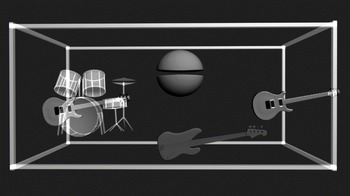
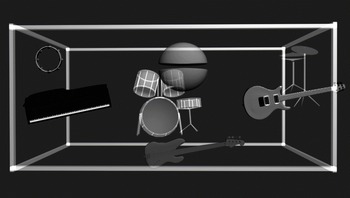
In recent years music analysis has begun to shift its focus from the score to performance. One notable outcome of this change of perspective has been a rise in the study of recordings, illustrated in the work of the CHARM project in the United Kingdom.Footnote 1 In popular musicology, the recording has long been recognized as a more important source of musical information than any visual representation, though the actual information scholars have extracted from it has, in the main, been exactly what is obtainable from a visual representation, namely information about lyrics, melody, instrumentation, harmony, and rhythm. It has frequently seemed as if the artefact itself, to which so many listeners give their primary attention, has become transparent, merely a means of transmission for these hallowed categories of information. This article emanates from a twelve-month project funded by the UK Arts and Humanities Research Council (AHRC). One of the project's aims was to develop a degree of precision in musicological discussion of the recorded artefact, particularly that aspect identified by the ‘sound-box’,Footnote 2 to begin to enable this aspect of recorded song to be discussed with the same degree of analytical engagement normally reserved for those other domains. The project was an exercise in the empirical music analysis of a large range of material, searching for similarities and differences. The heuristic model we employed, that of the sound-box, assumes that sound sources are perceived in four dimensions: laterality, register, prominence, and temporal continuity. By late 1972 producers working across a range of styles and in different geographical locations had adopted a normative positioning of sound sources across these dimensions. In 1965 no such norm existed. The key purpose of this article is to investigate and, as far as possible, explain the process by which this norm was consolidated.
Although the sound-box has not been a central issue for popular musicology, other writers have addressed it in various ways. Both Theodore Gracyk and Albin Zak discuss the laterality and prominence dimensions of the sound-box (i.e. stereo placement and degree of foregrounding) from an aesthetic stance.Footnote 3 Zak looks in some detail at spatial elements and the stereophonic aspect of tracks, making a key distinction between tracks that present a static stereo image and tracks whose image changes over their duration. He refers to the ‘conventional stereo mix of a rock band’ as being the re-creation of the live set-up, namely the visual image created in front of a live audience, an issue we address below.Footnote 4 Much as this rock mix convention might seem a natural corollary of the transition to stereo mixing, Zak's assumption that such a mix – an attempted replication of the live set-up – enjoyed normative status is hard to support, since it accounts neither for early mixes nor for the process by which such a norm might have been adopted across a range of genres. Gracyk, on the other hand, emphasizes the concept of the ‘virtual performance’ and observes that the sounds exist as they do only in recorded form.Footnote 5 Rock tracks in particular are viewed no longer as ‘records’ of a live performance, but rather as a specific shaping of ‘sonic events, mixed to produce an experience’.Footnote 6 Both Zak and Gracyk confirm that records ultimately go beyond the portrayal of realism and must be considered distinctive artefacts with, as Mark Katz comments, ‘a musical space unique to the work, one with no physical counterpart’.Footnote 7 Doyle develops the concept of such a space at some length but, because of his historical focus, does not consider stereo placement.Footnote 8 The notion that early stereo mixes (in particular those triangular in configuration) are representative of a ‘live’ performance set-up is arbitrary, as we shall argue below. Although records have historically been considered ‘byproducts of performances’,Footnote 9 performances tended to develop – to be constructed and perfected – in the studio rather than on the stage. Paradoxically, whereas stereo was initially ‘linked to notions of “realism”’Footnote 10 in terms of musical reproduction, popular music records have used the stereo illusion and imaging to create surreal performances, performances that exist only on the record.
For Richard Middleton, the sound-box is the space within which gestures – by which he means ‘kinetic patterns, cognitive maps and affective moments’ – occur.Footnote 11 This perceived space created by modern recording techniques can have a dramatic effect on the way in which a listener participates in the overall experience of the recorded, virtual performance. The significance of the sound-box in terms of the sense of physical placement has ‘enormous potential on the power and types of gestural resonance’; Middleton refers to the listener's involvement as that of ‘a gestural subject, who is assimilated into the textural space, as a participating actor’. This notion could be further applied to the act of listening over headphones as opposed to loudspeakers, in that the former offer the ‘blended textural space for assimilation, or mastery, by the detached listener-subject’.Footnote 12 Comparison of the two means of playback is significant, and will be addressed below: ‘Headphone listening […] isolat[es] the listener in a private acoustic space’,Footnote 13 a space within which various types of textural spaces can occur.Footnote 14
Other writers on the aesthetics of popular song recordings focus on the collaborative approach taken to production and mixing. The period from 1966 to 1972 witnessed not just a technological change, but a change in social processes and approaches, a development of the collaborative aspect of production in which the roles of musicians, producers, and engineers began to become more flexible.Footnote 15 It is clear that the collaborative nature of the recording process influenced the creative practice of recording and mixing, changing previous conventions of popular song recording and production. These ‘auteurs of the phonographic arts’Footnote 16 greatly influenced the change of situation whereby the recorded artefact could no longer be assumed to be a reproduction of a live performance, but became something that captured a virtual performance. The historical development of the recorded paradigm as the primary work, as in the case of rock and pop, where there is ‘no comparable space where the music originates’,Footnote 17 is an issue subject to increasing exploration. Although the literature provides some evidence regarding shifting recording practices, the reasons behind decisions concerning sonic placement, and the eventual adoption of a normative mix, remain little explored; writing that focuses on the positioning of sound sources within individual tracks is more prevalent.Footnote 18
There is, of course, much literature that addresses the sonic stage from an audio engineering perspective. One example is William Moylan's discussion of stereo imaging, which describes the space created within the sound-box as ‘the perception of the spatial characteristics of a sound’. This in turn creates the perception ‘of the physical location of a sound source in an environment’.Footnote 19 Although the perceived location of a sound on the vertical plane (i.e. determined by the frequency of the fundamental) is briefly touched upon as one of the ways in which a listener can perceive the spatial relationships of sound reproduction, vertical placement is one component of stereo imaging that does not receive as much attention in such literature as considerations of depth (‘prominence’) and lateral placement. Indeed, aspects of the perceived performance environment and issues of the perception of ‘space within space’ are also considered with reference to the ‘artistic elements […] shaped for artistic purposes and used to create musical ideas’.Footnote 20 The majority of the technical literature that deals with specific aspects of sound production and stereo imaging necessarily maintains an engineer's or sound recordist's perspective on stereo mixing. In this discipline, as Moylan's writing implies, the arrangement of sound is based on three components: lateral placement (controlled by panning devices), depth or prominence (the way in which volume and reverb can control the perceived distance of sounds in relation to other sounds and from the listener), and time. ‘Vertical’ placement is generally not considered, particularly in audio engineering terms, since lateral placement is measurable (controlled by pan pots), whereas vertical placement is not. However, producers and engineers do accept that sounds may be perceived to occupy space on a vertical plane. Beatles' producer George Martin mentions the vertical aspect of mixing, describing the panning of instruments as sounding ‘as though it were travelling up, and overhead. It was like listening to a rainbow of music arching over me.’Footnote 21 Robin Millar alluded to the vertical placement of sounds when he commented on his production of Sade's ‘Sweetest Taboo’, describing the overall mix as ‘feeling high’, referring to the frequency content of the sounds, in particular of the percussion, and the fact that these sounds perceptually occupy the upper zones of the sound-box.Footnote 22 David Gibson's The Art of Mixing provides not only a producer's perspective on various stereo mixes (differentiated according to genre, style, etc.), but also visual demonstrations of the sonic layout of generically typical recordings.Footnote 23 While Gibson is one of few producers who explicitly refer to the perceived vertical placement of a sound, production norms are his main focus and there is no reference to the establishment of a normative layout. As in so much technical literature, it is regarded simply as a given.
While technical literature and recording manuals deal with the conventions of producing ‘good’ mixes, journalistic literature focuses on topics such as the type of equipment employed by producers and engineers, how they set up microphones, and how much (and what types of) reverb they add.Footnote 24 As with the rest of the literature surveyed here, the development of a normative mix and reasons for its adoption are simply not an issue.
Methodology
The study that provided the data for this article did not adopt the highly scientific approach of audio engineers with regard to sound localization and perception. A large sample of 1000 tracks was selected for analysis. Fourteen per cent of these were chosen from the UK and US singles charts, using a method of random sampling, in order to gather ten tracks from the same month of the year in each year from 1966 to 1972. The remaining tracks were drawn from singles and albums of both popular and cult status, together with a small number of other European tracks and a limited number of songs produced in 1965.Footnote 25 Our sample contained no purely instrumental tracks, since the position of the lead voice within the sound-box is crucial to our understanding. Consideration in this article is restricted to tracks understood generically as rock, i.e. to music whose aesthetic is conditioned by the audience's desired assumption of authorial control vested in the performer(s). Where possible, the original stereo vinyl version was used, though gaining access to an original stereo vinyl of all tracks proved impossible. Therefore, because a primary aim was to analyse a very large sample of material, digitized recordings of the vinyl and CD reissues of the original stereo vinyl were used where necessary.Footnote 26 Given that the focus of this study was on the apparent location of sound sources within recorded song, aural analysis of the tracks was necessarily the analytical method chosen. Because our work was undertaken in conditions that comply with recommended audio engineering set-up guidelines, which detail the degree of angle of the loudspeaker and other factors in relation to the listener,Footnote 27 the analysis took place over headphones and over loudspeakers.
Twenty-five per cent of tracks (randomly chosen) from the years 1966–72 were subjected to both loudspeaker and headphone analysis, while the remaining tracks were analysed only over headphones. Our loudspeaker set-ups had different configurations, relating to both contemporary and historical set-ups. Whilst the two methods – loudspeakers and headphones – provided subtly different results, headphone analysis was chosen as the main method of analysis for three reasons. First, the perception of both the location of sources and the overall image width of tracks is subject to change in different listening conditions as a result of the physical attributes of the playback environment. As Moylan points out, ‘the loudspeakers themselves are placed in, and interact with, a playback environment – such as a living room’ and, more importantly, ‘the playback environment is nearly always quite unrelated to the spaces on the recording’.Footnote 28 The perceived spatial placement of sounds can change significantly according to the listening set-up, with loudspeakers often producing a centralized stereo image during playback with blended (as opposed to localized) sounds. Headphones remove the environmental influence on the spatial characteristics of sounds during playback, and provide greater consistency in listening conditions. Second, the stereo image created over headphones appears to be clearer in terms of directing a listener's ‘attention to different zones of interior space’,Footnote 29 rendering sound localization and the transcription of sonic placement more precise during aural analysis. Finally, the ‘in-the-head’ effect produced during headphone listening is very different from the image created in front of the listener during playback over loudspeakers. Steve Jones comments that ‘with headphones, the feeling is one of immediate intimacy, of music from inside one's head’, and this is particularly appropriate when considering the sonic motion, or panning, in songs from artists such as Pink Floyd, Jimi Hendrix, and the Beatles.Footnote 30 As artists such as these themselves began experiencing their music through headphones during recording sessions, effects such as panning are perhaps most usefully experienced through this medium, resulting in what Jones calls ‘headphone music’.Footnote 31
Although it is important to acknowledge the listening conditions of the mid to late 1960s, it was beyond the scope of this research to attempt to speculate on the significance of stereo placement at the time. Rather, we considered its significance for ways in which listeners experience the sound-box today, and its consequences for recent and future sound-box usage. The methodology reflects ways of experiencing music that have arisen more recently; hence it acknowledges the contemporary importance of listening over headphones using portable digital devices, such as mp3 players and iPods. Back in the late 1960s listening conditions varied from cabinet-style record players to stereo system separates, the latter owned predominantly by audiophiles.Footnote 32 In many instances stereo effects were lost on all but the best quality playback equipment (particularly if a stereo record was played using a mono pick-up). The real impact of the stereophonic effects could be experienced only when listening over headphones.
The aural analysis of a track, the recorded artefact, is fundamental to the investigation of the sound-box. As with all analysis, its communication is facilitated by a form of notation. Taking into consideration the fact that aural analysis draws upon the link between auditory and visual perception, we developed a template that visually represented the heuristic sound-box, enabling the consistent and economical transcription of sound-source placement in each track. As this is an analytical investigation, the template allows for consistency in terms of the graphic representation of sound-source placement, and provides a standard sound-box within which the varying degrees of stereo width can be measured relative to each other (as will be found in the figures below). In certain instances, the stereo image of some songs will appear to go beyond the fixed sound-box template, an observation illustrated by the placement of instruments beyond the visual boundaries.
The visual framework of the sound-box allows the various sound sources to be plotted, showing their positioning in relation both to other sound sources and to the entire stereo field, and facilitating comparisons of different sound-box configurations. Although the layout of the mix might alter significantly during the course of an individual song, we decided, rather than create multiple transcriptions that show these changes, to produce a cumulative visual representation of the sonic events occurring throughout the song's duration.Footnote 33 This would, of course, be unsatisfactory for the discussion of subtle details of individual tracks, but it is adequate to our purpose here, allowing us to develop a taxonomy of different types of mix. Our visual approach can be regarded as a variation on the visual guide used by Gibson, as opposed to the illustrations used by Moylan, for example, which deal only with depth and lateral placement.Footnote 34 Gibson's sound-box visuals consist of simple circular shapes that plot the perceived placement of the sound source. Each circle in his diagrams represents the point source of a sound, ‘a phantom image that occupies a focused, precise point in the sound stage’.Footnote 35 Where sounds are difficult to locate accurately, larger circles are used to indicate spread images – ‘a phantom image that […] has a […] size that extends between two audible boundaries’.Footnote 36 While we also adopted this general method for the initial transcriptions of our aural analyses, the final visuals employ simplified representations of the specific sound source. These transcriptions of the sonic placement, and their subsequent three-dimensional rendering, can best be considered a way of guiding the ear in much the same way as conventional chord notation. Neither is definitive or completely accurate, but both reveal key analytical detail which informs subsequent commentary. The main aim of the transcriptions is to demonstrate the development of the normative mix from an aesthetic point of view, and in terms of the technological changes concurrent with trends in sound-source stereo placement.
Two further points warrant attention before we address the details of individual tracks. Our decision to privilege headphone listening places us, as listeners, within the virtual space set up by a recording, analogous to being placed at the ‘sweet spot’ within a loudspeaker array. This is thus an idealized position, in that, when actually situated in front of loudspeakers, one can change one's listening position at will. However, such an idealized position is necessary in order for comparisons to be made. The same consistency could have been achieved by, for example, assuming a listening position in front of the right speaker, but since we are interested in ‘the properties of that to which listeners give attention’, it is surely preferable to choose the optimal stereophonic perspective. In addition, the template for our diagrammatic representation treats the space occupied by each track as being of the same size as all the others. What we have represented here is the relative positions of sound sources, again in order to enable comparisons within and between sound-boxes. The actual width of the stereo field, and the spread of registers employed, differs from track to track. With the exception of general observations – of the order of ‘triangular’ mixes tending to operate with a wide stereo field and ‘cluster’Footnote 37 mixes operating with a narrow field – we have not explored this level of difference.
The three spatial dimensions of the sound-box are conventionally understood to operate asymmetrically, and our approach to these dimensions does require comment. Human binaurality affords perception of the lateral dimension, a dimension which thus takes on the appearance of being ‘natural’, of being readily experienced in the world beyond listening to music. As David Huron notes: ‘the perception of auditory location [is influenced by] […] the relative time difference between pressure fluctuations in the left and right ears [and] […] the relative difference in magnitude or amplitude of these signals’.Footnote 38 The prominence dimension is a factor of both relative dynamic level and degree of distortion. The commonest component of such distortion is the degree of reverberation employed. However, our perception of prominence is less ‘natural’ than that of laterality. Whereas sounds are objectively present in the output from one speaker or another, they are not objectively more (or less) distant than each other: they originate in the same plane, and we make inferences as to their distance by interpreting the dynamic level and degree of distortion. This dimension, then, requires a degree of interpretation not necessary for laterality. When we come to the third dimension, it operates differently again. In Huron's words, ‘azimuth perception appears to be innate, whereas elevation perception appears to be learned’.Footnote 39 This latter position has been questioned by very recent research which argues that ‘our cognitive system maps pitch onto a mental representation of space’,Footnote 40 and that this is more than simply a cultural analogy that can be found in a variety of languages. The experiments reported by Rusconi and her colleagues dealt with the apparent misdirection of decades of earlier studies, where respondents had generally been asked to estimate the spatial height of pitches, thereby prejudging the conclusion.Footnote 41 Peter Doyle is typical of writers who state that ‘to call shorter wavelength, higher frequency sounds “high” is mostly convention’.Footnote 42 It appears that simple convention may play less of a part than we hitherto supposed. But in any case, for the purpose of this article, it seems that the differences in the ways these three dimensions are perceived are not of particular importance since, on the evidence of both our own work and that of Gibson,Footnote 43 it is clear that they can be perceived: the resultant details are available to all listeners familiar with recorded listening practices.
Taxonomy of Mixes
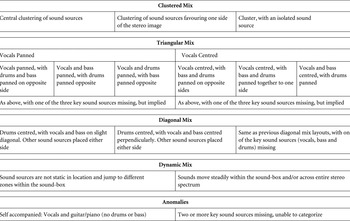
The transcriptions resulting from our aural analyses highlight several well-defined sound-box configurations. These categories and sub-categories can be found in Table 1. The taxonomy comprises four main mix types: triangular, clustered, diagonal, and dynamic. Each specific mix is constructed in terms of the relative placement of three key elements: lead vocals, bass guitar, and drum kit (most specifically the snare, because of its timbral and metrical prominence). Each section of the table shows the main mix type together with its subdivisions, which detail the range of sound-source arrangements according to the three key elements. The triangular mix, for example, utilizes either centred or panned vocals, in addition to the various drum and bass placements identified in the following row of the table. One possibility indicated in the table is therefore that of a triangular mix comprising centred vocals (right half of table) with the bass and drums panned on opposite sides (leftmost column, under ‘Vocals centred’). The clustered mix is shown to have three subdivisions: the first two describe the clustering of sound sources within the sound-box as either centred or off-centre, while the third identifies tracks in which an isolated sound source, such as the lead vocals, is set off from a main cluster.
Taxonomy of mixes

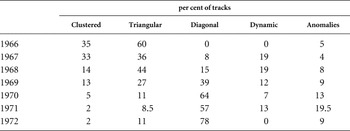
Table 2 summarizes data that demonstrate the gradual adoption of one of these categories, the ‘diagonal mix’, over the course of our period. As Table 2 shows, the early tracks were predominantly triangular in configuration, accounting for sixty per cent of our 1966 sample. As Table 1 notes, the triangular relationship between the vocals, snare, and bass can be observed in a variety of configurations creating a number of triangular subcategories, ranging from panned vocals to centrally placed vocals with panned drums. The early triangular configurations from 1966 and 1967 demonstrate extreme panning of the three key elements and, in many cases, clear separation between left and right channels creating a sparse central zone. Although this article is concerned with exemplifying these mixes by rock examples, similar points arise with other styles and genres in our sample.
Frequency percentages of mixes in the years 1966–72

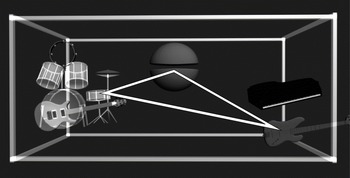
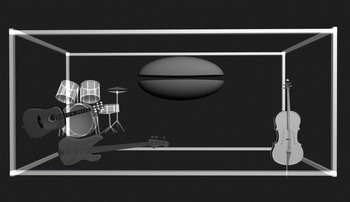
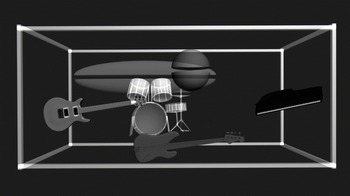
The example in Figure 1 shows the triangular configuration of the bass, snare, and vocals in the Lovin' Spoonful's ‘Summer in the City’. The drums and bass are clearly panned in opposite channels, with the vocals placed centrally. Additional sound sources, such as an acoustic guitar and backing vocals, can also be heard in the right channel with the organ and bass, but have been omitted from the diagram for clarity.
Lovin' Spoonful, ‘Summer in the City’: triangular mix.

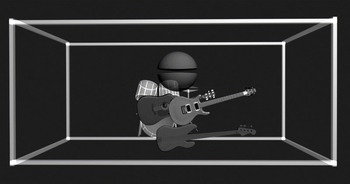
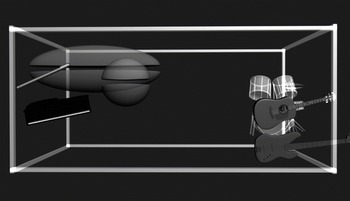
Mixes where elements are largely separated, with extreme panning of the sound sources, create a wide stereo image. In contrast, the clustered mix describes a narrow stereo image created by the central placement of sound sources within the sound-box. The example in Figure 2 shows the clustered configuration of the sound sources in Creedence Clearwater Revival's ‘Bad Moon Rising’.
Creedence Clearwater Revival, ‘Bad Moon Rising’: clustered mix.

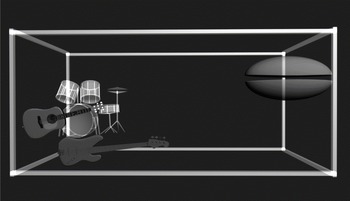
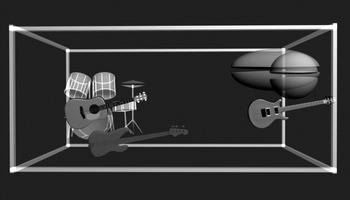
The main difference between clustered and triangular mixes can be explained in terms of the overall width of the group or ‘ensemble’ of sound sources, the ‘macro scene element’.Footnote 44 The macro width, a term used by audio engineers to describe spatial attributes of a virtual image, or reproduced ‘scene’, differs from the overall dimensions of the perceived environment within which it is contained. Therefore, if we consider the overall sound-box to be a constant, fixed framework, then the varying widths of the scene element from track to track become apparent. The individual source widths, or ‘micro attributes’, tend to be more localized in triangular mixes, and occupy more space in the sound-box, creating a wider macro scene element. The term ‘clustered mix’ describes the centralized clustering of the instruments, which results in a narrow stereo width within the sound-box. Variations and subcategories of the clustered mix include those where the cluster appears to favour a particular side, for example in Donovan's ‘Mellow Yellow’ (see Figure 3). In this example, it is likely that the off-centre placement of the cluster was not a conscious aesthetic decision, but is simply the result of the level of the signal being higher in the left channel than in the right. This creates an off-centre image favouring the left side. A similar off-centre result can be heard in the stereo mix of Manfred Mann's ‘Mighty Quinn’. To differentiate itself from the mono version, the stereo mix presents a wider image, with the main cluster of instruments placed on the right-hand side of the sound-box. The left-hand side is sparse, creating an unbalanced stereo image within the sound-box. In some cases, it is difficult to distinguish a mono track from a two-channel track where the producer has placed the sonic elements in the centre of the sound-box. Nevertheless, a central mix does not indicate a mono production, but rather one where the producer has concentrated on providing a balanced stereo image, placing the aesthetic focus on the blending of sounds, as opposed to the separation that had been favoured by many of the early stereo mixes.
Donovan, ‘Mellow Yellow’: off-centre clustered mix.

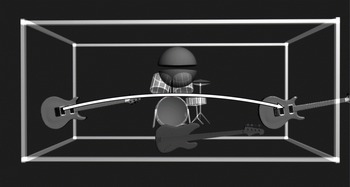
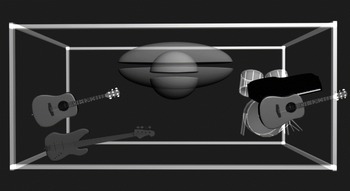
The ‘dynamic mix’ describes tracks where there is some level of movement within the sound-box. These include sounds that are repositioned at points in a track (at this early stage in stereo's history there would usually be only one such repositioning in the course of a track) and sound sources that move laterally and/or gain or lose prominence. Dynamic mixes reinforce the notion of the virtual performance space. Certainly, the in-the-head effect achieved through headphone listening enhances sonic movement to the point where sounds appear to move through the listener. Taking the example of Led Zeppelin's ‘Whole Lotta Love’, the repeated guitar glissando, first heard at 0′37″, and the movement of Robert Plant's vocal line from 4′58″ to the end of the track demonstrate the manipulation of sound sources within the sound-box. This is exemplified in Figure 4, the arrow signifying the movement of the guitar across the sound-box.
Led Zeppelin, ‘Whole Lotta Love’: dynamic mix.

The dynamic movement in The Hollies' ‘King Midas in Reverse’ is slightly different, in that the vocals, from being panned fully right in the first verse at 0′11″ (Figure 5) move to a central position at 1′09″ (Figure 6). Later in the track, at 1′50″, the backing vocals can be heard panned fully left. Both these examples illustrate the unique status of the recorded paradigm and capture the ways in which technological capabilities can function in a creative role to enhance the meanings of songs.
The Hollies, ‘King Midas in Reverse’ (at 0′11″).

The Hollies, ‘King Midas in Reverse’ (at 1′09″).

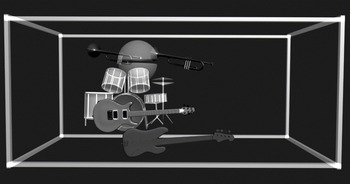
The final mix in our taxonomy is the ‘diagonal’ mix, which becomes the normative layout, or paradigm, for subsequent record production. This mix depicts the arrangement of the vocals, bass, and drums (in particular the snare) on a very slightly inclined diagonal line, with other instruments placed to either side. The example of Uriah Heep's ‘Easy Livin'’ sound-box arrangement in Figure 7 shows this normative configuration, with the vocals and bass creating a slight diagonal; neither of these key sound sources is placed exactly at the centre, an effect far more noticeable through headphones than over loudspeakers.
Uriah Heep, ‘Easy Livin'’: diagonal mix.

Other tracks display mixes where the vocals and bass appear to be centralized, creating a perpendicular rather than a diagonal alignment between vocals, snare, and bass. Examples of this configuration include Neil Young's ‘Alabama’, the Rolling Stones' ‘Brown Sugar’, and Led Zeppelin's ‘Rock and Roll’. Studio recording handbooks frequently specify this layout as one in which ‘typically the bass, snare, kick drum, and vocals go to centre; keyboards and guitars can be panned left and right’.Footnote 45 This ‘accepted wisdom’ of stereo mixing is detailed in publications such as Sound on Sound,Footnote 46 though it is not referred to in terms such as ‘diagonal’ or ‘normative’. Whether the normative mix reveals a predominantly diagonal or perpendicular alignment between the vocals, snare, and bass, the overall result is one of balance. The producer creates a stereo image that is balanced across the sound-box, with the main components in the centre and the remaining sound sources balanced either side of the snare.
Chronological changes
From the sound-box transcriptions a clear pattern emerges across the years of our survey, showing a growing tendency for producers to mix tracks according to the normative (diagonal) configuration. The decline of the earlier, markedly separated mixes can arguably be linked to the development of studio technology.
The predominant sound-box configurations in 1966 are the triangular and clustered mixes, in particular triangular mixes that emphasize the difference between left and right channels. The triangular and clustered mixes account for respectively sixty per cent and thirty-five per cent of the tracks from 1966. Variations of sound placement within the triangular configuration are notable, signifying uncertainty in stereo's early years and a lack of convention in the practice of stereo mixing. The diversity of sonic placement may seem confusing, yet the majority of tracks from 1966 and 1967 consist of triangular mixes, with off-centre vocals either panned independently or together with other sound sources. The Hollies' ‘Bus Stop’ comprises vocals panned right with drums and bass panned left. A similar configuration, albeit in reverse, with vocals (and other sound sources) panned left and the drums and bass panned right, is exemplified in ‘Pretty Flamingo’ by Manfred Mann (Figure 8). The specific placement of sound sources differentiates both between the left and right channels and between the vocals and backing instruments, revealing areas of sparseness. Whilst the effect of a stereo image is made more obvious by the panning of the acoustic guitar to the far right and the panning of the backing vocals to the far left, the centre-right area remains sparse. The vocals are nevertheless fairly prominent, despite the off-centre placement.
Manfred Mann, ‘Pretty Flamingo’.

For most people working in the industry until well into the late 1960s, stereo mixes of albums were considered to be a minor addition to the established and popular mono version. Mono was considered to be the only significant format, a notion supported by the fact that most pop music was played back on mono equipment in the home. Moreover, ‘radio was the desired outlet for any popular music of the day’, and therefore a substantial amount of music was experienced in mono. The mono transmission influenced many producers who ‘feared the resulting changes in sound if a stereo record were played on a mono station’.Footnote 47 Despite this, producers adapted to the gradual importance of stereo, an adaption which can be examined through the various sound-box configurations. Kehew and Ryan's Recording the Beatles offers a comprehensive insight into the recording process of the Beatles' albums, providing key details such as the instrument/track allocation and the placement of tracks in the stereo field. For the Beatles, stereo mixing was certainly treated as an afterthought, with no active participation from the musicians. Producer George Martin and engineer Geoff Emerick took responsibility for producing the stereo versions without the input of the band.Footnote 48 Sound-box transcriptions of the Beatles, especially of the albums from 1966 and 1967, have nevertheless revealed certain distinctive patterns of sonic placement. The sonic arrangement in the tracks ‘I'm Only Sleeping’, ‘Yellow Submarine’, ‘I Want to Tell You’, ‘And Your Bird Can Sing’, and ‘Doctor Robert’ display similar sound-box configurations: drums are panned left with vocals panned right. Although the bass is often placed with the vocals, the example in Figure 9 shows the bass and drums panned left, with the vocals panned right. The resulting mixes on Revolver can, to some extent, be explained by the mixing conventions established by Emerick, which developed from the repeated use of a particular panning configuration. Tracks 1 and 2, containing the drums (and in many cases the bass), ‘were pulled not quite to the centre of the spread, while tracks 3 and 4 (which held vocals and other instruments) were panned hard right’.Footnote 49 Exceptions to this sonic arrangement include ‘Tomorrow Never Knows’, where the drums and bass appear to be centrally placed along with right-panned vocals, and ‘Eleanor Rigby’, an anomaly resulting from the absence of drums and bass.
The Beatles, ‘I'm only Sleeping’.

Martin's approach to stereo placement considered the effect known as ‘centre build-up’, which occurred when two channels were combined to form a mono output, namely when stereo records were played on mono equipment.Footnote 50 ‘My attempts on Rubber Soul were to find a decent mono result from a stereo record. As you know, if you put something in the center, it comes up 4dB louder in mono than it does in stereo’.Footnote 51 This effect is reiterated in many recording technique manuals, particularly when discussing centre build-up: ‘When you monitor the mix in mono, you'll likely hear center channel build-up. Instruments in the center of the stereo stage will sound louder in mono than they did in stereo, so the mix balance will change in mono’.Footnote 52 The off-centre placement of sound sources to counteract the build-up – and the fact that ‘the majority of record players were built into kind of sideboards, where the speakers were about three feet apart and the stereo picture was a very near mono one anyway’ – influenced the stereo placement of many mid-1960s tracks.Footnote 53
The sound-box transcriptions from 1966 display a diversity of vocal placements, including fully panned, off-centre, and centred. By 1968 the practice of placing vocals centrally was established, and the majority of subsequent tracks display centrally placed vocals, regardless of the panning and separation of other key sound sources, such as drums and bass. The centralized vocals are mixed with either the drums and bass panned together or the two panned in opposite channels: whichever variation of this triangular configuration is adopted creates sparse central zones below the vocals, or a dense central zone in which other instruments are placed centrally along with the vocals. This variation in triangular configurations is exemplified in tracks such as Jack Bruce's ‘Rope Ladder to the Moon’ and Simon and Garfunkel's ‘Homeward Bound’. Figure 10 illustrates the mix comprising centralized vocals with drums and bass panned in opposite channels. Another important variation on the triangular mix is that of centralized vocals with bass and drums panned in the same channel. Examples of this type of configuration include the tracks ‘In the Wilderness’ by Genesis, ‘Lazy Sunday’ by Small Faces, ‘Born to be Wild’ by Steppenwolf, and ‘This Will Be Our Year’ by the Zombies. Although they demonstrate the triangular mix, the absence of additional sound sources below the vocals (see Figure 10) reveals a sparse central zone, emphasizing the vocals.
Simon and Garfunkel, ‘Homeward Bound’.

By 1969 the process of moving the bass to the centre is also largely complete, and the configuration of bass and lead vocal in the centre, with the drums off centre forms the primary triangular mix from the late 60s to the early 70s, as in Figure 11. Examples of this kind of triangular mix include The Monkees' ‘Valleri’, The Band's ‘This Wheel's on Fire’, David Bowie's ‘Man Who Sold the World’, Neil Young's ‘Heart of Gold’, the Rolling Stones' ‘Street Fighting Man’, and Grand Funk Railroad's ‘Please Don't Worry’. As with the previous variation in triangular mixes, there is a sparse central zone evident in around fifty per cent of the tracks employing this type of triangular mix.
Giles, Giles and Fripp, ‘Erudite Eyes’.

Zak puts the central placement of the bass down to its sonic function ‘as anchor of both groove and chord changes’.Footnote 54 However, it is clear that this was not always the case. As early rock tracks demonstrate, the bass could often be heard panned to one side either with, or opposite, the drums: thus its function was not initially the primary determinant of its placing. Indeed, the level of the bass guitar on stereo records has implications for the way a track is cut to vinyl. It was important to ensure that the bass was not too prominent in a mix, as its presence resulted in excessive movement of the stylus up and down, potentially causing it to jump. ‘With stereo grooves, the signals are frequently asymmetrical, that is there is a vertical component reaching a maximum in pure vertical motion of the stylus, representing equal anti-phase signals’.Footnote 55 Several measures and approaches to recording were taken to avoid this problem. First, balancing the off-centre bass with the placement of other instruments in the opposite channel reduced the likelihood of the stylus leaving the grooves; this approach is more common in tracks before 1970. Second, the bass was placed centrally in the mix so that it did not disrupt the grooves imprinted onto vinyl, and maintained everything in phase. It seems likely that the central placement of the bass, along with the kick and snare drums, was as much a result of technical factors as of aesthetic or creative judgement.
The formation of the diagonal or normative mix is signposted by the eventual central placement of the drums. Early variations of this mix include the centrally placed drums and bass, with two lead vocals panned to either side. Additionally, certain early clustered mixes could be viewed as an early intimation of the diagonal mix, spreading in width to utilize more of the sound-box. ‘Proud Mary’ by Creedence Clearwater Revival and ‘Gimme Shelter’ by the Rolling Stones, both from 1969, are early examples. Although there are some instances of the full diagonal mix dating from 1967–8, only by 1970 had it emerged as the predominant mix. Argent's 1972 track ‘Hold Your Head Up’ (Figure 12) suitably represents it. The key elements (bass, snare, and vocals) are aligned on a slight diagonal in the centre of the sound-box, with additional sound sources placed on either side. The electric guitar is panned right, balanced by the organ, panned left. The tambourine occupies the upper-left part of the sound-box and is equally balanced and mirrored by the cymbals, which appear in the upper-right zone of the sound-box. The sound fills the entire sound-box, and each sound source is clearly identifiable and distinguishable.
Argent, ‘Hold Your Head Up’: diagonal mix.

An insight into the extent to which the use of the sound-box is determined by technological limitations on the one hand and aesthetic decisions on the other can be achieved by comparing the way different producers mix and treat the same song, particularly when it involves an established normative mix at this point in the development of stereo placement. A good example is the Beatles' ‘Let It Be’, which was mixed by both George Martin and Phil Spector. The bass on Martin's version is slightly off-centre and Harrison's guitar solo is panned right, whereas both are placed centrally in Spector's version. Spector's well-documented preference for mono mixes is evident, even in his stereo versions, from the central placement and blending of sound sources. One of the main advantages of stereo mixing is the opportunity to demarcate important sound sources. The detachment of sounds from the main cluster of instruments guides the listener to focus on particular events in the track, the overall effect being the emphasis on musical meaning and intent through the experience of the performance.
The notion that early stereo mixes (in particular those triangular in configuration) are representative of a ‘live’ performance set-up is arbitrary. In many cases the live performance set-up does not reflect the track's sonic arrangement, as can be seen in the Rolling Stones' live performance of ‘Honky Tonk Women’,Footnote 56 where the drums are positioned off centre (to the right of the stage, from the viewer's perspective) and in front of the main performers. In the original recording the drums are centralized, and Keith Richards' guitar can be heard to the centre-right zone of the sound-box, as opposed to the left placement shown in the television version. Another example can be seen in Deep Purple's televised performance of ‘Highway Star’.Footnote 57 This version features a set-up that includes the keyboards panned to the far left, centralized vocals, guitar panned to the far right, and bass placed centre-left in front of the centralized drums. This triangular mix of the live set-up contrasts with the recorded diagonal mix, which features centralized vocals, bass, and drums, with the guitar panned to the far left and keyboards to the far right. Television performances often involve a liveFootnote 58 set-up that has been affected by constraints such as lighting and studio/stage dimensions, aspects that may affect the arrangement of the performers on stage. However, these set-ups are valid and worthy of consideration, as television performances were usually the means by which viewers were able to associate the ‘live’ version with the original studio track recording. Comparisons made between studio/television performances and live concert performances of the same track also show differences between the set-ups. The spatial arrangement of the performers in ‘Hey Joe’ by the Jimi Hendrix Experience at the Monterey Festival in 1967 differs from that of another live version of the same song on the BBC programme A Happening for Lulu. Both these set-ups differ from the original recording,Footnote 59 further substantiating the arbitrariness of the relationship between the recording and the live set-up.
Conclusion
In this article we have endeavoured to develop a taxonomy of mix types through the crucial period 1966–72. We have also proposed some possible answers to the question of why one particular configuration had achieved dominance by the end of the period. It is, however, in the nature of such exploratory work to be inconclusive. Proper ethnographic work would be required to support, or to contradict, our tentative conclusions.Footnote 60 It remains to be seen whether recording practices outside the USA and the UK followed the same trajectory and, if they did, whether or not it was over the same time-span. Anecdotal evidence suggests that the triangular mix, particularly with the drum-kit in the right channel, remains an option sometimes taken today, but as yet the significance of this is undecided. Indeed, the precise significance of the different mix types we have unearthed here remains to be demonstrated. That question underpins the follow-up research project, currently under way.