INTRODUCTION
Schizophrenia is closely linked to a wide range of cognitive dysfunctions. One of the most pronounced concerns episodic memory (Aleman et al., Reference Aleman, Hijman, de Haan and Kahn1999; Heinrichs & Zakzanis, Reference Heinrichs and Zakzanis1998; Pelletier et al., Reference Pelletier, Achim, Montoya, Lal and Lepage2005; Saykin et al., Reference Saykin, Gur, Gur, Mozley, Mozley, Resnik, Kester and Stafiniak1991). Episodic memory is assumed to refer to the capacity to recollect individual events (Tulving, Reference Tulving1983), which include perceptive dimensions of physical objects as well as their source (i.e., the time and the place where they occurred). However, information is not retained separately in memory but is stored as a coherent whole (Johnson, Reference Johnson1992; Johnson & Chalfonte, Reference Johnson, Chalfonte, Schacter and Tulving1994; Luck & Vogel, Reference Luck and Vogel1997). This type of associative process is termed “memory binding” (Johnson & Chalfonte, Reference Johnson, Chalfonte, Schacter and Tulving1994). Several studies have described impairments of these associative processes in patients with schizophrenia (Danion et al., Reference Danion, Rizzo and Bruant1999; Lepage et al., Reference Lepage, Montoya, Pelletier, Achim, Menear and Lal2006; Rizzo et al., Reference Rizzo, Danion, Van der Linden and Grang1996; Waters et al., Reference Waters, Maybery, Badcock and Michie2004), which may result from inefficient binding processes in working memory (WM) as suggested by Danion et al. (Reference Danion, Rizzo and Bruant1999).
WM is defined as a limited capacity system devoted to temporary storage and online manipulation of information (Baddeley, Reference Baddeley1986; Goldman-Rakic, Reference Goldman-Rakic1996). Baddeley (Reference Baddeley2000, Reference Baddeley2003) recently added a new component, the episodic buffer, to this tripartite WM model. This component represents a storage system that integrates temporary representations that enter or are retrieved from episodic memory. Attentional resources are assumed to play an important role in the maintenance of binding information in WM (Allen et al., Reference Allen, Baddeley and Hitch2006; Treisman & Gelade, Reference Treisman and Gelade1980; Wheeler & Treisman, Reference Wheeler and Treisman2002), and anything that competes for attentional resources can interfere with binding maintenance and induce the loss of associations (Wheeler & Treisman, Reference Wheeler and Treisman2002). Although deficits in WM have been widely documented in schizophrenia (Keefe, Reference Keefe, Sharma and Harvey2000; Lee & Park, Reference Lee and Park2005), little is known about the maintenance of bound information. Recent investigations of this issue have produced discrepant results. For instance, Gold et al. (Reference Gold, Wilk, McMahon, Buchanan and Luck2003) examined short-term maintenance for simultaneously colored and oriented bars. Patients with schizophrenia showed no greater impairment for recognizing both features (i.e., the binding condition) than for recognizing one feature (i.e., single-feature conditions). The authors concluded that patients with schizophrenia were able to bind information into integrated representations. Similarly, Luck et al. (Reference Luck, Foucher, Offerlin-Meyer, Lepage and Danion2008) used a procedure in which letters in spatial locations were simultaneously presented as either bound or separate. In each condition, the target display consisted of four letters and four spatial locations. In the bound condition, letters were included within the locations, whereas in the separate condition, letters were centered and separated from locations. In both conditions, probes consisted of one letter displayed onto a spatial location. Targets were previously seen cues. Thus, in the bound condition, probes could be congruent with the display if the same letter was presented in the same location or incongruent if a letter was presented in a location occupied by another letter. Lures were equally balanced between letters, locations, or both, and none of these belonged to the display. The authors found that both groups (i.e., patients and healthy controls) showed better performance for bound than for separate features and for congruent than for incongruent positive probes. Taken together, these results suggest that binding for letters/locations is not impaired in schizophrenia. By contrast, Burglen et al. (Reference Burglen, Marczewski, Mitchell, Van Der, Johnson, Danion and Salamé2004) and Salamé et al. (Reference Salamé, Burglen and Danion2006) presented successively three object drawings in various spatial locations. In different blocks of trials, participants had to memorize objects or locations or their combination. Results revealed that in patients, the rate of combination errors exceeded that of feature errors, whereas in controls, error rates were equal. The authors thus argued that the results may highlight a binding deficit for WM storage in patients with schizophrenia.
Examination of the methodologies used in these studies leads to two main considerations. The first concerns the way in which binding processes were assessed. For instance, in our previous study, participants attempted to evaluate verbal and spatial features regardless of their initial combination (i.e., congruent or incongruent trials) in the bound condition (Luck et al., Reference Luck, Foucher, Offerlin-Meyer, Lepage and Danion2008). Although we observed better performance for congruent trials than for incongruent trials, we noted that participants could perform the task by examining the familiarity of features only and not their associations. To overcome this limitation, binding should be evaluated in a more constraining manner. Typically, binding is assessed by asking participants to discriminate between combinations of studied features and novel feature combinations. Thus, accurately rejecting novel combinations (i.e., lures) requires explicit knowledge for features as well as for their association. The second consideration is that target stimuli were presented simultaneously in Luck et al. (Reference Luck, Foucher, Offerlin-Meyer, Lepage and Danion2008), whereas Salamé and his Colleagues (2004, Reference Salamé, Burglen and Danion2006) presented targets sequentially. This is of great importance as the ability to bind and remember different aspects of an experience as a coherent representation is critical in memory. In particular, it is essential to remember information occurring at the same time and dissociate it from that occurring at a different time. Several authors have suggested that in schizophrenia, aspects of temporal processing are disturbed, in particular the ability to identify temporal occurrence of stimuli (Elvevag et al., Reference Elvevag, Brown, McCormack, Vousden and Goldberg2004; Foucher et al., Reference Foucher, Lacambre, Pham, Giersch and Elliott2007; Giersch et al., Reference Giersch, Lalanne, Corves, Seubert, Zhuanghua, Foucher and Elliott2008).
The aims of the present study were twofold. The first aim was to study binding recognition for which participants had to correctly reject recombinations of familiar features. Consistent with the binding deficit hypothesis in schizophrenia, we anticipated that patients would perform poorly on recombinations relative to (a) new (unstudied) features and (b) healthy controls, leading to a significant Group × Type of Lures interaction. Our second aim was to evaluate participants’ ability to dissociate temporally concurrent features from temporally separate features. Therefore, recombinations were composed of features belonging to the same target display (intradisplay) or different target displays (interdisplays). In agreement with the literature, we expected that patients would show a pronounced deficit for interdisplay recombinations but not for intradisplay recombinations.
MATERIALS AND METHODS
Subjects
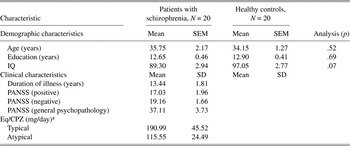
Demographic and clinical data are summarized in Table 1. Twenty outpatients (16 males and 4 females) participated in the study. All met Diagnostic and Statistical Manual, 4th Edition criteria for schizophrenia (American Psychiatric Association, 1994) as determined by consensus of the current treating psychiatrist and senior psychiatrists belonging to the research team (disorganized, N = 3; paranoid, N = 15; and residual, N = 2). Symptom severity was assessed using the Positive and Negative Syndrome Scale for schizophrenia. Patients were clinically stabilized for at least 1 month at the time of testing. Nine patients were receiving typical antipsychotics (cyamemazine, haloperidol, levomepromazine, pimozide, and zuclopenthixol), 10 were receiving atypical antipsychotics (amisulpride, aripiprazole, olanzapine, and risperidone), and 1 patient was unmedicated.
Demographic and clinical descriptions of the sample

Note
PANSS, Positive and Negative Syndrome Scale.
a Antipsychotics medication reported as chlorpromazine equivalent dosage in mg (Eq/CPZ) (Calanca et al., Reference Calanca, Bryois and Buclin2002; Woods, Reference Woods2003).
Twenty healthy subjects were recruited through local advertisements. Controls were excluded if they confirmed past or present psychiatric disorder or if a first-degree relative had sought psychiatric diagnosis or treatment. The two groups did not differ in age or years of education (t 38 < 1 for both), or in intelligence quotient (IQ), as measured with a short form of the Wechsler Adult Intelligence Scale-Revised (Crawford et al., Reference Crawford, Allan and Jack1992) (t 38 = 1.87; p = .07). All participants were free of a history of traumatic brain injury, epilepsy, alcoholism or substance abuse, other diagnosable neurological conditions, or organic mental disorder, and none were being treated with antidepressants, benzodiazepines, or lithium.
The Strasbourg Consultative Committee for the Protection of Human Subjects in Biomedical Research approved the study. All participants gave written informed consent prior to the test session and received financial compensation for their participation.
Procedure
The experiment began with a practice session that included a detailed description of the task and instructions associated with each condition (the binding condition and the two single-feature conditions). In each condition, black stimuli were displayed against a gray background on a 17″ LCD screen of a PC running E-Prime software (v. 1.1; Psychology Software Tools Inc., Pittsburgh, PA). The target display consisted of two letters and/or two spatial locations according to the experimental condition. Letters were consonants (“W” excluded) presented in uppercase in 36-point Times New Roman font. Spatial locations were defined by white lines of a grid, which created 12 different locations displayed on a centered square of three cases by side. During the probe, letters were presented in lowercase to control for a possible priming effect.
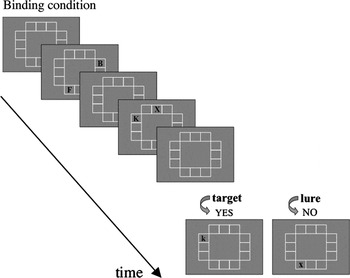
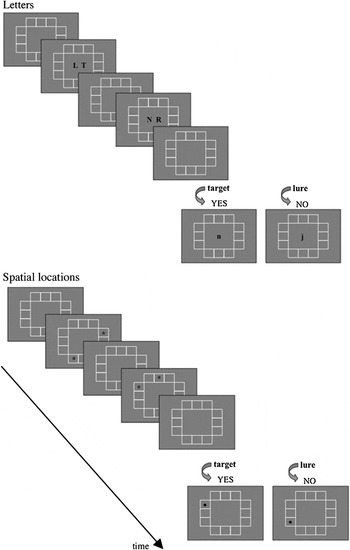
The WM task assessed participants’ ability to remember four letters (letters condition), four spatial locations (spatial locations condition), or four letters together with their locations (binding condition). In the binding condition (see Figure 1 for a graphical representation), for each trial, the grid was first presented (1000 ms), followed by two target displays (2000 ms each) separated by a blank screen delay (200 ms). Each target display consisted of two letters presented in two different cells. Following the offset of the second display, participants were required to maintain letters over a retention interval (5000 ms) during which time only the grid remained on the screen. The gray background turned to green 500 ms before the probe appeared. The probe was always a single letter presented in one cell. Each condition comprised an equal number of targets and lures in a pseudorandom order. A target corresponded to a studied letter shown in the same spatial location (i.e., identical to the target display). Two different kinds of lures were used. In half of lure trials, new (never studied) features were presented. In this case, lures were composed of a new letter in a familiar location or a familiar letter in a new location or a new letter in a new location. On the other half of lure trials, features were recombinations of studied letters and locations. A recombination consisted of a letter presented in a location occupied by another letter. Two types of recombinations were presented: intradisplay recombinations, for which the recombined letter and location belonged to the same display, and interdisplay recombinations, for which the letter and location belonged to different displays. Participants were instructed to answer “old” to targets and “new” to lures. Participants made their responses via press to an appropriate preassigned button, which varied according to their handedness. Participants had 3000 ms to answer and were instructed to respond as quickly as possible without sacrificing accuracy. After an unfilled delay of 2000 ms, a new trial began. Additionally, two single-feature conditions (see Figure 2 for a graphical representation) were added to assess the capacity to process isolated verbal and spatial features. In the letters condition, participants had to decide whether the single probe letter belonged to the four studied letters previously presented or not. The spatial locations condition was identical to letters condition, with the exception that locations were shown instead of letters. Target locations were indicated by asterisks in cells, and probe location was indicated by a point, and this change was expected to control for a possible priming effect. All conditions comprised an equal number of targets and lures in a pseudorandom order.
Procedure for the binding condition.

Procedure for the single-feature conditions.

After the participant had indicated that they understood the instructions, a short training session was provided to allow them to become familiar with the experimental task. The three conditions were pseudorandomized, and training started with one of the two single-feature conditions. Similarly, the experimental session started with one of the two single-feature conditions, each consisting of 30 trials. The binding condition consisted of 150 trials arranged in three consecutive blocks of 50 trials. Participants were invited to take a rest between blocks in order to minimize effects of fatigue. At the end of the experiment, participants were invited to comment and/or ask questions about the task and were then debriefed. The total duration of the test session (i.e., instructions, training, and experimental task) was approximately 90 min.
Data Analysis
Test data were analyzed using Statistica 6.0 (Statsoft Inc., Tulsa, Ok). Accuracy scores and response times were used as dependent variables. Analyses were conducted in two steps.
Analysis of variance (ANOVA) was conducted to measure overall performance, with group (controls vs. patients) entered as a between-group factor and conditions (binding vs. letters vs. spatial locations) as within-group factors. Accuracy was assessed according to the Two-High Threshold Model (Snodgrass & Corwin, Reference Snodgrass and Corwin1988). Accuracy was estimated with the unbiased index Pr (H − FA), with H and FA representing hits and false alarms, respectively. The Pr index reflects the participant’s ability to discriminate between old and new stimuli, and higher values correspond to better memory performance. Response biases were estimated with the Br index (FA/[1 − (H − FA)]), which reflects the tendency to consider a stimulus as new or old. To facilitate the reading of the Br, 0.5 was subtracted from scores, and with this modification, Br equal to 0 indicates an absence of a bias, a value lower than 0 indicates a conservative bias (i.e., a tendency to respond “new”), and a value greater than 0 indicates a liberal bias (i.e., a tendency to respond “old”). Student’s t tests with comparison to a standard (i.e., 0) were performed in each group for Br scores for all three conditions (i.e., letters, spatial locations, and bound information). Within-group comparisons were then conducted in each condition. Importantly, the Pr and the Br indexes are regarded as independent measures (Snodgrass & Corwin, Reference Snodgrass and Corwin1988).
In addition, two omnibus ANOVAs were performed to measure the respective effects of lure type (recombinations vs. new features) and type of recombinations (interdisplays vs. intradisplay), with group (controls vs. patients) entered as a between-group factor. These analyses relied on correct rejections in the binding condition specifically.
Tukey’s honestly significantly different (HSD) test comparisons were performed for post hoc analyses when appropriate. In all analyses, the alpha level was set at .05.
RESULTS
There were neither a primacy effect (i.e., for probe features that were presented in the first target display) nor a recency effect (i.e., for probe features that were presented in the second target display) (t < 1 in all cases). Thus, data were pooled.
Overall Performance
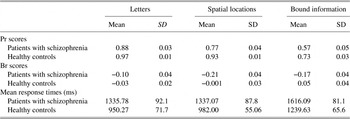
Performance (Pr and Br scores and response times) for the three conditions (letters, spatial locations, and bound information) is summarized in Table 2.
Mean PrFootnote a scores, BrFootnote b scores, and response times (SEM) as a function of letters, spatial locations, and bound information in patients with schizophrenia and healthy controls

a Discrimination index.
b Bias index.
With respect to Pr scores, both groups performed above chance in all conditions (all ps < .02). The Group × Conditions ANOVA revealed a significant effect of group (F 1,38 = 14.73; p < .001), reflecting lower overall score in patients relative to controls. A significant effect of condition was observed (F 2,76 = 73.90; p < .001). The subsequent HSD test revealed that overall scores were lower for spatial locations than those for letters (p < .005), and both scores were significantly higher compared to bound information (p < .001 in all cases). The Group × Conditions interaction failed to reach significance (F 2,76 = 1.95; p = .15).
Analyses of Br scores indicated that controls did not show a response bias for letters (t 20 = −1.45; p = .16), spatial locations (t 20 = −0.03; p = .98), or bound information (t 20 = −1.30; p = .21). Patients with schizophrenia exhibited a conservative response bias for letters (t 20 = −2.41; p = .03), spatial locations (t 20 = −5.50; p < .001), and bound information (t 20 = −4.80; p < .001). Between-group comparisons revealed that patients and controls did not differ for letters (t 38 = 1.43; p = .16) but significantly differed for spatial locations (t 38 = 4.15; p < .001) and bound information (t 38 = 2.35; p = .02).
The analysis of response times showed a significant group effect (F 1,38 = 15.45; p < .001), reflecting greater response times in patients relative to controls. A significant effect of condition was observed (F 2,76 = 24.70; p < .001). The subsequent HSD analysis revealed that the letters and locations conditions differed significantly from the binding condition (p < .001) but did not differ from each other (p = .93). The Group × Conditions interaction was not significant (F 2,76 = 0.06; p = .94).
Effects on Correct Rejections
Type of lures
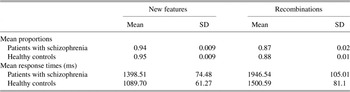
Mean proportions and response times are summarized in Table 3. When analyzing response rates, the group effect was not significant (F 1,38 = 0.51; p < .48). A significant effect of lure type was observed (F 1,38 = 38.95; p < .001), reflecting higher overall performance for novelties than for recombinations. The Group × Type of Lures interaction was not significant (F 1,38 = 0.002; p = .96). With respect to response times, patients globally took more time to respond than controls (F 1,38 = 11.30; p = .002). Both groups were faster to identify new features than recombinations (F 1,38 = 196.10; p < .001). There was a trend toward a significant interaction (F 1,38 = 3.40; p = .08). An exploratory post hoc analysis revealed that both groups responded faster for new features than for recombinations (p < .001). The two groups did not differ for new features (p = .22); however, patients were significantly slower than controls for recombinations (p = .04).
Mean proportions and response times (SEM) for correct rejections as a function of lure type (new features and recombinations) in patients with schizophrenia and healthy controls

Type of recombinations
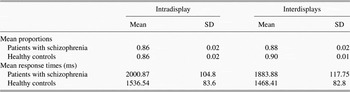
Mean proportions and response times are summarized in Table 4. The ANOVA based on proportions of correct rejections showed a significant effect of type of recombinations (F 1,38 = 4.09; p = .05), reflecting a higher proportion for interdisplay recombinations relative to intradisplay recombinations. The group effect was not significant (F 1,38 = 0.25; p = .62). The Group × Type of Recombinations interaction was not significant (F 1,38 = 0.24; p = .63).
Mean proportions and response times (SEM) for correct rejections as a function of type of recombinations (intradisplay and interdisplays) in patients with schizophrenia and healthy controls

With respect to response times, the ANOVA showed a significant effect of group (F 1,38 = 10.71; p = .002), reflecting slower responses in patients relative to controls. The analysis indicated a significant effect of the type of recombinations (F 1,38 = 5.25; p = .03), reflecting slower response times for intradisplay recombinations compared to interdisplay recombinations. The Group × Type of Recombinations interaction was not significant (F 1,38 = 0.35; p = .56).
DISCUSSION
The present study examined whether schizophrenia is associated with a deficit in binding information and whether this deficit may be modulated by the nature of the information that is assessed (combination vs. feature) and/or the way in which this information is presented (simultaneously vs. sequentially).
When comparing the binding condition to the single-feature conditions, the analyses indicated overall lower performance in patients with schizophrenia relative to controls. However, our results did not implicate a specific deficit for bound information in patients with schizophrenia, as revealed by the absence of a significant Group × Conditions interaction. This global impairment may not be attributable to a general deficit in intellectual capacity as patients and healthy controls did not differ on IQ.
In order to evaluate the effects of the nature of the assessed information and the way in which it is presented, the second set of analyses focused on correct rejections in the binding condition. Accurately rejecting recombinations requires not only memory for the features but also memory for their original combination. Here, participants were more accurate and responded faster for new features than for new combinations, replicating the results of previous studies (Mitchell et al., Reference Mitchell, Johnson, Raye, Mather and D’Esposito2000; Wheeler & Treisman, Reference Wheeler and Treisman2002). This difference reflects the fact that maintenance of binding information poses a greater demand on resources than maintenance of features (Treisman & Gelade, Reference Treisman and Gelade1980; Wheeler & Treisman, Reference Wheeler and Treisman2002). According to the latter authors, the maintenance of binding information depends on attentional processes and is susceptible to interference. In this way, the binding information is quite fragile, even more so than feature information. In addition, the current analyses showed that participants better rejected recombinations composed of temporally separate features than those composed of temporally concurrent features. Several authors have suggested that the simultaneous presentation of features may divide attention across multiple features, leading to decreased performance during encoding and retrieval (Craik et al., Reference Craik, Govoni, Naveh-Benjamin and Anderson1996; Fernandes & Moscovitch, Reference Fernandes and Moscovitch2000). Thus, dividing attention could increase the sensitivity to interference, which in turn could affect the maintenance of binding information.
Consistent with the binding deficit hypothesis of schizophrenia, we hypothesized that patients would have greater difficulty recognizing novel combinations of familiar features than novel features. More specifically, for the former, we expected lower performance for combinations involving two temporally separate (inter-) displays relative to those involving the same (intra-) display. On the contrary, the analyses of accuracy failed to reveal a specific deficit for combinations in patients, thus extending previous results in perception (Carr et al. Reference Carr, Dewis and Lewin1998a, Reference Carr, Dewis and Lewin1998b) and WM (Gold et al., Reference Gold, Wilk, McMahon, Buchanan and Luck2003; Luck et al., Reference Luck, Foucher, Offerlin-Meyer, Lepage and Danion2008). However, patients tended to require more time to recognize combinations than features, which may be interpreted as a small and/or inconsistent sign of a binding deficit. The exploratory post hoc analyses revealed significantly longer response times in patients relative to controls for recognition of combinations but not for features recognition. However, this specific group dissociation for combinations should be considered with caution, and further investigations should be conducted before straightforward conclusions can be drawn. Finally, analyses of accuracy and response times revealed no specific deficit in patients with schizophrenia for either inter- or intradisplay recombinations, suggesting that patients were able to retain in WM the temporal occurrence for a small set of bound information. The discrepancies in other studies (Dreher et al., Reference Dreher, Banquet, Allilaire, Paillère-Martinot, Dubois and Burnod2001; Fraser et al., Reference Fraser, Park, Clark, Yohanna and Houk2004) may have resulted from the use of a smaller set of information to retain and/or from a shorter retention delay. For instance, Dreher et al. (Reference Dreher, Banquet, Allilaire, Paillère-Martinot, Dubois and Burnod2001) observed that WM impairments in temporal order recall in patients increase with longer strings of features and with a longer retention delay, arguing for a difficulty effect compatible with Manoach’s (Reference Manoach2003) capacity model.
There are a few limitations when interpreting these results. The first limitation is that we excluded patients with substance abuse history in order to homogenize our sample and avoid deleterious consequences of substance abuse from influencing our results. This exclusion criterion led us to select a particular subset of patients who may not be representative of a larger population and who might demonstrate different response patterns. The second limitation is that the analysis of Br scores revealed that patients exhibited conservative response biases in all conditions, specifically for spatial and bound information. In other words, patients considered familiar (i.e., studied) features as “new” (i.e., never studied). Thus, when examining correct rejections in patients with schizophrenia, it remains possible that response biases overshadowed subtle alterations of binding processes. It would have been possible to exclude patients exhibiting a response bias to overcome this limitation. Unfortunately, in the current work, the number of participants was too low to allow such an analysis. A larger sample size will be an essential prerequisite in future studies. However, the response bias would not affect response time and therefore does not affect interpretation of results. A third limitation is that attentional processes may be related to antipsychotic regimen. Antipsychotic agents have been reported both to improve and to worsen performance in attention (King, Reference King1990, Reference King1994; Mishara & Goldberg, Reference Mishira and Goldberg2004), with a dissociation between typical and atypical antipsychotic medications. Thus, atypical antipsychotics may provide greater cognitive enhancement to patients with schizophrenia than typical antipsychotics (Harvey & Keefe, Reference Harvey and Keefe2001; Keefe et al., Reference Keefe, Silva, Perkins and Lieberman1999; Woodward et al., Reference Woodward, Purdon, Meltzer and Zald2005). To investigate the potential effects of antipsychotics on attentional processes, patients were separated according to treatment (typical vs. atypical), and analyses were repeated. None of the analyses showed a significant effect of group (t < 1 in all cases), indicating that treatment had a none-to-insignificant effect on attentional processes involved in the creation and maintenance of bound information. The fourth limitation is that this study did not address the question about the dissociation between encoding and maintenance processing. This question is of great interest in schizophrenia and is still in debate. On one hand, the overall WM deficit could occur at encoding. Some authors considered that perceptual/encoding but not necessarily retention impairments are the feature core of deficit in WM (Hartman et al., Reference Hartman, Steketee, Silva, Lanning and McCann2002; Javitt et al., Reference Javitt, Rabinowicz, Silipo and Dias2007; Tek et al., Reference Tek, Gold, Blaxton, Wilk, McMahon and Buchanan2002; see Lee & Park, Reference Lee and Park2005, for a meta-analysis). For instance, Hartman et al. (Reference Hartman, Steketee, Silva, Lanning and McCann2002) showed that patients require a fivefold increase in encoding time to reach similar performance in WM than controls. After equating for differences in encoding time, patients did not exhibit a deficit during delay condition. On the other hand, Tek et al. (Reference Tek, Gold, Blaxton, Wilk, McMahon and Buchanan2002) showed that a WM impairment was observed even when between-group differences in perceptual processing were controlled, suggesting a deficit in the retention of information.
In concert, patients with schizophrenia did not exhibit a greater deficit for bound information relative to isolated verbal and spatial information, suggesting that binding processes are not specifically altered in patients with schizophrenia. When considering bound information exclusively, patients correctly identified combinations of features as well as features per se. With respect to the former, patients were able to correctly locate information in both time and space. Together, these results suggest spared binding processes in schizophrenia, arguing against a homogenous deficit.
ACKNOWLEDGMENTS
This study was supported by operating grants from the Ministère de la Recherche et des Nouvelles Technologies. D.L. was supported by a salary award from the Fondation pour la Recherche Médicale. We thank the CAT Route nouvelle staff and the Pr. Pierre Vidailhet for help with recruitment and clinical assessments.