Silent Histories: Deafness in Early Modern England is a new perspective on a familiar period of history. It is a history of deafness and hearing which recovers the untold stories of deaf and deafened people in early modern England; and in doing so it challenges some of our ideas about English society between 1500 and 1750. While exploring the impact of deafness in a largely oral society, this book addresses some deep-rooted assumptions about what it meant to be human in early modern England.
Deaf people were a considerable minority in this period, and deafness was experienced by all types of people. Deafness did not discriminate by sex, wealth, or status. The stories in this book include men and women; young children and the elderly; the very poor and the very rich. Deafness came in many forms, and the word ‘deafness’ covered many different experiences. At one end of the spectrum were those who were born deaf or deafened in childhood, often before learning to speak – they were prelingually deaf. These deaf people often used a form of sign language to communicate and were called ‘deaf and dumb’ or ‘mute’ by contemporaries – terminology we don’t use today.
While prelingual or congenital deafness may have been rare, hearing loss was widespread. Common illnesses, including scarlet fever and measles, often caused permanent deafness, while many other infections could lead to temporary or partial hearing loss. Accidents were another frequent source of deafness: injuries to the head often damaged hearing, while guns and cannons used in warfare meant that many veterans experienced permanent hearing loss. But perhaps the most common cause of deafness was old age, particularly among people like blacksmiths and millers who had noisy working environments. The nature of this type of adventitious deafness varied from person to person (see the following section), but a common thread in the letters and diaries of those affected was a sense of isolation as the deafened person increasingly withdrew from friends, family and Church. Since these types of hearing loss were the most common experiences of deafness, they framed popular perceptions of what it meant to be prelingually deaf. This explains in part why deafness was thought of primarily in terms of deficit: the absence of sound, struggling to communicate, and the loss of independence. As we shall see, this was not, however, the experience for many prelingually deaf people.
Early modern England was a primarily oral culture, and so deafness and hearing loss appeared to be particularly devasting. It raised questions about the ability of deaf men and women to understand the world around them, never mind the challenges involved in communicating their thoughts. As a result, deafness, both prelingual and adventitious, occupied the minds of many writers, theologians, lawyers and philosophers in the period. Practical concerns about including deaf people in Church services or in legal cases reflected broader contemporary debates about knowledge and consent. And the influence of these debates were felt by everyone: deaf and hearing. Deliberations about how to include prelingually deaf people in daily worship, for example, prompted a larger discussion about the role that the senses played in salvation in the post-reformation Protestant Church. Nor were these deliberations confined to England or even to the newly formed Protestant Churches which prized the experience of listening to sermons. Instead, these were part of Europe-wide discussions about language, thought and what it meant to be human, shaping philosophical debates at the heart of the Enlightenment. The history of deafness in this period is not, therefore, just about people who experienced hearing loss; it is concerned with beliefs about hearing and listening, knowledge and rationality, that shaped early modern society. Widespread, sometimes deeply embedded, ideas about religious salvation, charitable provision, and legal capacity were thrown into sharp relief when the Church or state encountered prelingually deaf people, many of whom used sign language.
The experiences of those deaf and deafened people are at the heart of this book. Silent Histories tells previously unknown stories from the archives, illuminating the lives of men, women and children who have been left out of early modern history. Writing deaf history, however, poses a particular problem for the historian: namely how to uncover the ‘voices’ of deaf people, most of whom used sign language. As Roy Porter noted: ‘many communication systems, not only signing, leave not a rack behind in the archives’, and suggested that because we ‘have not the slightest permanent record of the billions of conversations conducted between signers in the past … maybe we know less about the mentalités of profoundly deaf Victorians than we do of Friulian millers in the age of the Counter-Reformation’.Footnote 1 While my research has uncovered some detailed records of signing in the archives, even those accounts tend to be relayed by an interpreter. However, throughout the period, there was a growing awareness that those signs used by deaf people should be considered as another language. These were not gestures or mimes which could be understood by anyone, but invariably required someone familiar with the deaf person to translate their conversation into English. Writing in the late seventeenth century, the teacher George Dalgarno noted that the signs used by prelingually deaf people ‘have no affinity to the language by which they that are about him do converse’.Footnote 2 But, since the sources historians rely on tend to be written, how then, to capture the mentalités of a group of people who communicated in a language that is, by its very nature, transitory and impermanent? Throughout this book, I have tried to foreground the experiences of deaf men, women and children. Sometimes, this has been through the filters of the contemporaries who described their signs, translated for deaf people, or summarised their conversations. Sometimes, though, this has been in their own words: by the seventeenth century, deaf children from wealthier families, were learning to read and write in English. The most thrilling of these accounts come from a series of diaries and letters written by deaf children and young people in eighteenth-century England, which I discovered as part of this project. Unstudied, these are some of the earliest self-authored writings by prelingually deaf people, and they offer a compelling and unique insight into the lives, thoughts and experiences – the mentalités – of prelingually deaf children in early modern England.
These diaries are scattered throughout the notes of the natural philosopher and speech therapist, Henry Baker (1698–1774). Between 1720 and 1760, Henry Baker taught somewhere between fifteen and twenty prelingually deaf young people to read, write and, eventually, to speak in English. Diary entries were sometimes written by students themselves (see fig. 8.6) sometimes they were dictated to Henry Baker in signs and he transcribed them. Students might copy these out again and use them to practice their pronunciation of English words. These entries (and the letters which students later wrote) are an unparalleled glimpse into the minds of young deaf people, and they reveal some surprising insights into deaf experiences in this period. Most of Baker’s students came from rich families (it cost a great deal to be taught by Baker) and it is notable that deaf students were expected to conform to the social norms of their class, despite any problems communicating. When John White, one of Baker’s first deaf students, moved to Salisbury he reported back that he had found ‘a great deal of good company’, there including the ‘Duke and Duchess of Queensberry, and several other people of quality’. White was learning to play backgammon, and his neighbours had invited him to join a ‘club’ they arranged at ‘one another’s houses every Monday night’.Footnote 3 Deaf students were expected master skills which might seem at odds with their hearing loss. George Lewis Erskine, son of the 9th Earl of Buchan, for example, had regular lessons with a dancing master. Another pupil, John Gildart, who was from a wealthy merchant family in Liverpool and described as being ‘deaf, dumb and a dwarf’, attended a dancing school and had lessons roughly twice a week while he was in London. And so, incidental details emerge of lives fully integrated into the communities around them, regardless of the largely oral nature of contemporary society. Erskine, for example, attended a concert while he lived with Baker, and paid for entrance for an Assembly – an evening of dancing, cards, and polite conversation. While William Gwillym, a motherless boy from Hereford, went to see a play at a playhouse in London while he was studying with Henry Baker.Footnote 4
Their letters and diaries are full of gems about what it was like to be a deaf child or young person in Georgian London. Sometimes these experiences reflected their deafness. For example, William Gwillym recorded what it was like to be surprised by his teacher whom he could not hear coming into a room. One time William was reading his bible and so he could not see Baker approach: his teacher ‘came behind me softly, and he touched my hand’, and William recalled that: ‘I started, and was afraid’. Elsewhere William noted that ‘I read a song about a dinner’ but ‘I cannot sing, because I am deaf’. More usual, however, in the diary entries and letters of these students, were the mundane concerns that might consume any young person of their social class in Georgian England. Complaints about illness; local interest stories (a fire, for example); details of pets; and records of meals eaten tend to feature, they were interested in the day-to-day stuff of life that had little to do with deafness. William Gwillym longed for Hereford and his family there, and remembered that when he was a child he had hunted for birds’ nests, watched his older brother shoot a gun, and had been riding with his family (he fell off his horse). Another student, Sarah Earle, only daughter of Goodenough Earle from Somerset, loved playing with her cat – often to be found in the kitchens – and had a goldfinch in a cage, which ‘sings’. When she was ill, she ate ‘some broth and some boiled veal’ which, she wrote, was ‘very good for the pain in my stomach’.Footnote 5 As we shall see, in Chapter 8, many of Baker’s students could already read and write in English when they went to study with him, and Baker used these diaries as a way to teach his pupils to speak vocally and to lip-read (a form of deaf education known today as ‘oralism’).
My emphasis on archival stories is an attempt to foreground the deaf person and their family, writing a new sort of history of deafness and disability. All too often in histories of deafness, the focus has been on cultural and legal descriptions of deafness as a category, in part due to the nature of the printed sources. Deaf historian Jennifer Nelson has pointed out, however, the ‘severe limitations on historical research on deaf people’ in premodern Europe, ‘as the way they lived is very difficult to determine other than through slight references, such as legal references to heirs disinherited’. To counter this, I have used prosopographical techniques to identify and trace numerous life journeys of different deaf men, women, and children across the period. This has helped to reveal the unexceptional cases: the stories of those prelingually deaf men, women and children who learned a profession, married and raised families, and who appeared to be fully integrated into their local communities. Yet, legal references still have a place in this history. Deaf histories have argued that deaf people were ‘denied a legal personhood’, and that this contributed to their marginalisation and exclusion. I have tested this, and found it largely to be untrue, by studying numerous property transactions and legal cases as well as more mundane examples of deaf wills.
Where possible in this account I have highlighted the ‘voice’ and experience of the deaf person: trying to answer Jennifer Nelson’s question: ‘where is your average deaf person in this period?’Footnote 6 One way of doing this is to focus on a few characters with particularly rich archival presences. Several figures reappear throughout the book, as we learn about their stories and experiences in greater depth. These include Thomas Speller, a blacksmith from a large family of deaf siblings in Jacobean Essex, and John Dight, a bookseller in 1630s Exeter. Wealthy families feature too, with the accounts of deaf heirs and heiresses including Catherine Osbaldeston, Anne Darcy, John Gaudy and Edward Gostwick. Those accounts are set alongside the details of men, women and children who came from many different walks of life, but all of whom lived at some point between 1500 and 1750. Sometimes their stories can be told in their own words, but often their thoughts and actions are recorded by others: particularly when they relied on sign language to communicate. I have chosen, however, to focus on those people whose stories exemplify a wider element of deaf history, and which illustrate both the changes and continuity in deaf experiences across the period. It will become apparent too that wealth and social position, gender and age all played a considerable part in determining the impact of prelingual deafness.
Some of these sources have been studied before; many have not. Some are familiar figures in deaf history, most are unknown. We will see the early days of the Royal Society through accounts of deaf children who were taught to speak vocally, and we will learn about less prominent men and women too, for example, John Dight, the bookbinder from pre-civil war Exeter who was desperate to take the Eucharist at his local church. There are stories which demonstrate how far prelingually deaf people were integrated into early modern life, as well as those which will highlight the difficulties and prejudice they could face. In Chapter 4, for example, we will explore the struggles of Thomas Speller, whose desire to marry his boss’s daughter caused family feuds and violence in Jacobean Essex. His experience is contrasted with the marriages of many other deaf men and women throughout the period, whose weddings passed without incident. As well as illustrating the historical experiences of deaf people, these stories are, above all, about human lives, fears and hopes. In Restoration London, Anne Darcy (a prelingually deaf heiress) pushed a nosey maid to the ground so she could escape to spend the night with her beau. And in the 1730s, another deaf teenager, William Gwillym, recorded his time in London being ‘taught to speak’, while longing for home and his family in Herefordshire. By telling the stories of these unknown figures, Silent Histories contributes to a D/deaf history of the British Isles. But it is also history of Early Modern England seen through the lenses of deafness and hearing loss. Foregrounding deafness offers a fresh perspective on the past, providing a powerful insight into religious, social and legal assumptions about it meant to be ‘normal’.Footnote 7
I.1 What Is D/deafness?
This book focuses on prelingually deaf people. Alongside their stories, I include accounts of hearing loss, including the effects of old age, since these more common types of deafness informed perceptions of congenital deafness. However, at first glance there appeared to be a clear legal distinction between prelingual deafness and later onset hearing loss. We can understand the stress on deaf people’s inability to communicate vocally (seen in the phrase ‘deaf and dumb’) as a way of distinguishing between the two groups. Those who lost their hearing later in life could often still speak vocally, they may have had some residual hearing and might be able to lip read. This group were not subject to any of the apparent legal restrictions facing prelingually deaf people, restrictions based on an ancient tradition that speechlessness reflected intellectual incapacity. However, closer examination shows that the boundary between prelingually deaf people and those with impaired hearing was not as rigid as legal texts might suggest. Instead, many people in the early modern period conceived deafness as a continuum with ‘perfect’ hearing at one end and ‘total’ deafness at the other: a concept that was supported by humoral ideas about the body.Footnote 8 This meant that congenital deafness (and sign language use) was often discussed alongside hearing loss, and we will explore that now in a little more detail to provide some context for the discussions and experiences of deaf and deafened people further on in this book.
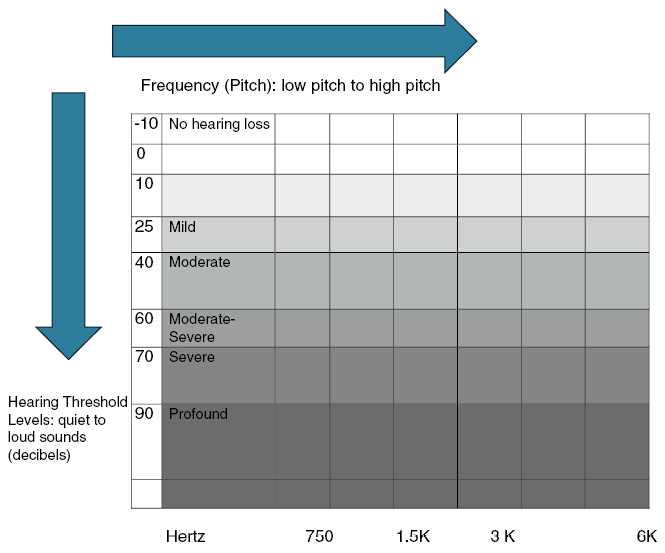
Hearing and deafness exist on a spectrum, one which we might expect to move along as we get older. Hearing loss and deafness are measured on two scales: volume (measured in decibels) and frequency (measured in Hertz). People with ‘normal’ hearing can expect to hear very quiet sounds like a whisper (c. 25 decibels) across all frequencies Severe deafness or hearing loss is now categorised as not being able to hear anything quieter than 70 decibels (a vacuum cleaner) while profound deafness is when hearing starts at 90 decibels or above, (the sounds of a power tool, a blender or hair dryer). Very few people, even those who are classed as ‘profoundly deaf’ cannot hear any noise at all (Figure I.1).Footnote 9
Audiogram showing thresholds of mild to profound hearing loss. Rosamund Oates.
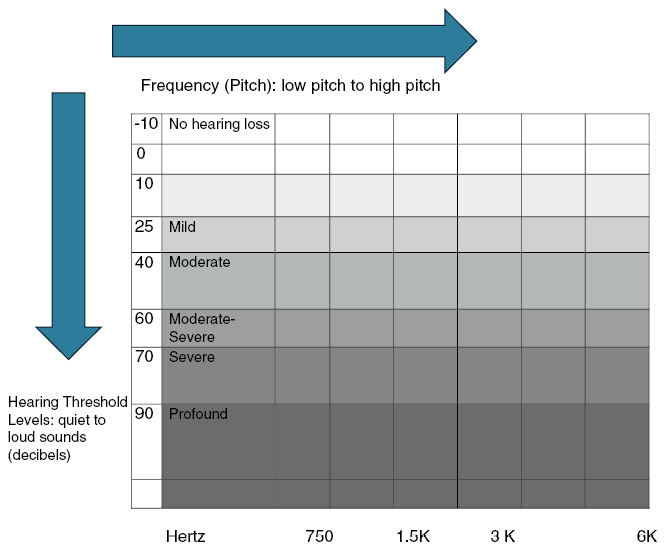
There are two things to note about the implications of these classifications of deafness for our discussion of early modern Europe. The first is that the experience of debilitating hearing loss may have been more common in the past since there were few sounds above 70 decibels in the early modern period (church bells, forges and warfare were exceptions to this, and regarded by contemporaries as unusually loud).Footnote 10 So, instead of failing to hear a hairdryer, most people may have experienced disabling hearing loss when they could not hear a normal conversation, which falls around 50 decibels. This means that the threshold for deafness was lower, suggesting that experiences of deafness may have been more frequent. This was further exacerbated by patterns of speech, which meant that some phonemes (the sounds that make up a word) were harder to hear than others, and so a person with what we would consider to be only mild hearing loss might still struggle to follow a conversation.
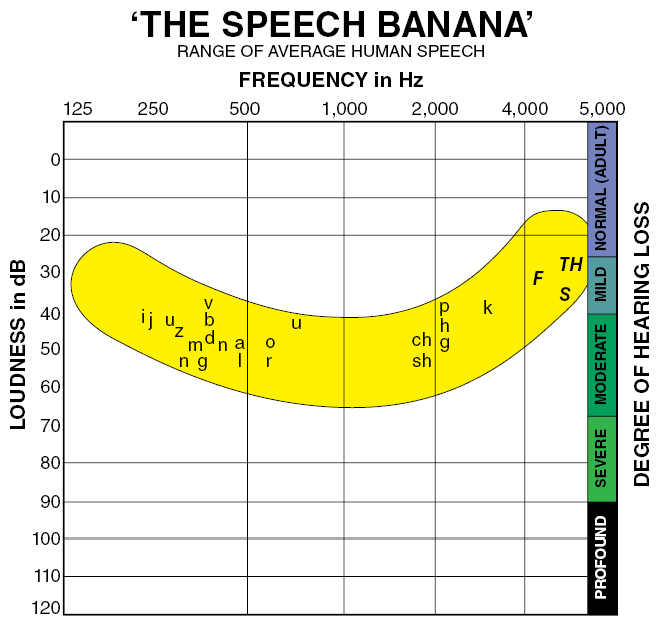
This brings us on to the second point, which is that the experience of hearing loss or deafness was not uniform, but often patchy: people could hear some words, in some circumstances, and not others. In part this was because different phonemes sat at different frequencies (demonstrated by the ‘speech banana’ later). As men and women age, they struggle to hear the sounds at the highest frequency first, meaning they miss some sounds and words, but not others. So, hearing loss is an uneven, and sometimes unpredictable, process and some situations were much harder to hear in than others.Footnote 11 Diaries from the period show how sermons, lectures and sometimes even a busy dinner table were particularly difficult for men and women who were starting to lose their hearing. This type of hearing loss, most apparent in the elderly, was often referred to as being ‘thick’ or ‘dull’ of hearing. It meant that even moderate hearing loss could lead to a sense of isolation, since, as the seventeenth-century writer Edmund Bohun complained, hearing only odd snippets of a conversation could be as bad as hearing nothing at all (Figure I.2).Footnote 12
DiegoSLP, ‘English Speech Banana Chart’ CC-BY-SA-4.0.
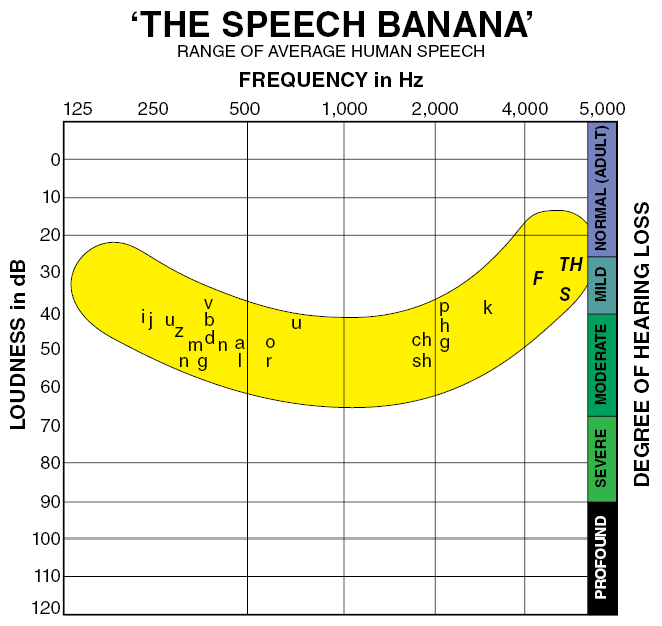
A further consequence of the ‘speech banana’ for our discussion, is that children born with some hearing loss may be able to ‘hear’, and therefore reproduce, some phonemes but not others. This meant that impaired speech was often the first sign of hearing loss and deafness in the early modern period. Over the course of his career in seventeenth-century Buckinghamshire, the physician Richard Napier saw several children who struggled to speak and who, as it later transpired, could only partially hear. This may also explain some of apparent ‘successes’ of men like John Wallis, who claimed to have taught two deaf boys to speak vocally. In some cases, boys described as being ‘deaf from birth’ may have had some residual hearing. At least one of Wallis’ students, Daniel Whalley, had actually lost his hearing after learning to speak, and had gradually stopped talking after he became deaf.
How many deaf people were there in early modern England? How many people experienced ‘severe’ or ‘profound’ hearing loss in the past? It is an almost impossible question to answer, but I can suggest some rough outlines based on current figures. In 2024, there were estimated to be around 54,000 deaf children in the UK: of whom, roughly half were born deaf, the others become deaf during childhood.Footnote 13 A US government survey from 2019 reported that around 1.7 children out of every 1000 babies were born deaf, while an earlier National Health Interview Survey found that about 4.5% of children in the U.S. struggled to hear without a hearing aid. The authors of this report suggested that around 50% of this hearing loss was caused by environmental factors. This figure increases as children grow up, with childhood illness like meningitis and measles causing further deafness. This was particularly apparent in a 2021 report by the WHO, which recorded that around 20% of the global population experienced moderate to complete hearing loss, with the vast majority (80%) of cases in low to middle income countries.Footnote 14
So, what does this mean for our discussion of early modern England? While age-related deafness may have been less common (few people experienced the high levels of deafness reported to the WHO by ninety-year-olds), many of the infections that caused deafness are now treatable or prevented through immunisation campaigns. It seems likely, then, that in early modern England levels of moderate to profound hearing loss may have been in line with the prevalence of deafness in low-income countries today (which is greater than the rates of deafness in the UK or USA). A systematic global review of 2011, for example, suggested that around 15.7% of people over fifteen years old in Sub-Saharan Africa experienced moderate to profound hearing loss, and this figure rose to 17% in South Asia. Milder forms of deafness, including temporary deafness, were of course much more widespread, but we could use these figures of c. 15–17% as a guide to how many people experienced moderate to profound hearing loss in the early modern period, including the smaller subset of people who were prelingually deaf.Footnote 15 In addition, as the earlier discussions suggest, there were many who struggled to hear in different situations and with different people.
I.2 D/deafness and Sign Language
You may have noticed that I have used the terms ‘deaf’, ‘Deaf’, and ‘d/Deaf’. This reflects a tradition that has emerged out of Deaf Pride – a movement that celebrates the richness of Deaf culture, language and identity rather than seeing ‘deafness’ as a disability that needs to be fixed. Deaf, with a capital D, signals a positive identification with the Deaf community and this person is often (though not always) a sign language user.Footnote 16 In contrast ‘deaf’ describes those people for whom ‘deafness is primarily an audiological experience’. In the twenty-first century, it is often used to refer to people who lose their hearing later in life or are reluctant to use sign language. D/deaf refers to both. In the context of my work, I have chosen to use ‘deaf’ with a lower case ‘d’ in line with other academic studies, since the emergence of a ‘Deaf’ identity can only be positively identified from the 1970s onwards.Footnote 17 This is not to suggest, of course, that deaf people in the early modern period saw themselves as deficient, or disabled, or were reluctant to use sign language: the opposite was often true. In addition, the fact that the same word ‘deaf’ covered such a broad range of experiences – from prelingual deafness to age-related hearing loss (presbycusis) – explains some of the negative stereotypes of deafness in this period. When people imagined what it was like to ‘be deaf’ they tended to draw on their own experiences of hearing loss, which, as I shall demonstrate tended to be cast in terms of deficit.
Another potentially contentious term that I use throughout the book is ‘sign language’. Language is a ‘slippery term’ for historians, and ‘sign language’ is a particularly loaded phrase, bearing the weight of decades of discrimination.Footnote 18 I use the term ‘sign language’ to stress that deaf signs were not merely mime but meaningful communication, but I am not suggesting that early modern signs had the linguistic complexity of modern sign languages. Securing the recognition that deaf sign languages are languages has been a long struggle at the heart of campaigns for Deaf equality. It was only in 1960 that the American linguist, William Stokoe, proved that American Sign Language (ASL) had the linguistic features of a language and should be recognised as such. It was decades, however, before his insights were widely accepted.Footnote 19 As the British linguists Bencie Woll and Rachel Sutton-Spence could still observe in 1998: ‘the popular view of sign languages is that they are merely some sort of limited pantomime or gesture system’. To counter this, Woll, Sutton-Spence, and others have followed Stokoe in demonstrating that British Sign Language, or BSL, is a language with a grammar, lexicon and syntax.Footnote 20 In England this was not acknowledged legally until 2022, when the UK parliament passed the British Sign Language (BSL) Act, recognising BSL as an official language in England and Wales.Footnote 21 Decades of dismissing sign languages as ‘pantomime’ prevented their use in Deaf schools in the twentieth century, with devastating effects on the education and emotional well-being of d/Deaf students. So, the classification of BSL as a ‘language’ has important social and political ramifications in the twenty-first century and it is at the heart of the Deaf struggle for equality. It is a fight which continues in demands for access to interpreters and BSL education, campaigns spearheaded in the UK by the British Deaf Association.Footnote 22
When I use the terms ‘sign language’ and ‘signs’ to describe deaf communication in the past, I am not trying to imply that a fully developed sign language existed in early modern England. Nor am I suggesting that BSL, ASL and other sign languages are equivalent to the signing of scattered deaf men, women, and children throughout the British Isles in this period. Many of the signing described by contemporaries – for example, the ‘very effectual signs’ used by the deaf Cornishman, Edward Bone – were what might be described as ‘home sign’ today. This is an ad hoc, and often unique, form of signing which developed in small groups, usually among family and friends of a deaf person. Writing as Lois Bragg, Edna Edith Sayers argued strenuously that early modern ‘sign systems’ fell far short of meeting the linguistic criteria of a language, claiming instead that they should be seen as ‘sublinguistic’ or ‘protolinguistic’.Footnote 23 Indeed, some academics argue that it was necessary to have a concentration of deaf people in one place for a period of time for the development of sign language, pointing to the example of the deaf schools founded in the late eighteenth century.Footnote 24 Other linguists, however, have seen more of a connection between historical sign systems and modern sign languages. Woll and Sutton-Spence, for example, have shown how many of the signs in John Bulwer’s Chirologia (1644) may be seen in BSL today. For ease, I use the term ‘sign language’ to refer to all the visual-kinetic movements that deaf people and their friends and families used to communicate, but this is not to imply that signing in early modern England had the complexity or morphology of modern sign languages like BSL.Footnote 25
Additionally, my research, suggests that deaf signing may have been more sophisticated than previously thought. Some recorded details of signs suggest similarities with modern sign languages. As well as the signs recorded in his books the Chirologia and Chironomia (both published in 1644), Bulwer included descriptions of signs in an unpublished guide to teaching deaf children. Some of these would be familiar to BSL users today, for example, Bulwer wrote that events in the future were expressed by ‘making an arched action’ of the hand and gesturing forward, and that a deaf signer referred to the ‘day past by throwing his hand backward once over his shoulder’. Furthermore, there appear to have been groups of deaf signers (and with it the development of a language) before the founding of the deaf schools in the second half of the eighteenth century. Silent Histories demonstrates that there was a community of deaf signers in London in the early eighteenth century, meaning that the development of linguistically complex sign language may have been earlier than originally thought. And in this book, I also show that contemporaries – particularly teachers of deaf people – considered deaf signs to have many of the features of a language and were certainly more complex than miming. As early as the 1630s, deaf and hearing people relied on expert interpreters to translate deaf signs into English (and vice versa). By the middle of the seventeenth century, the mathematician and medic, Anton Deusing, could claim that that deaf signs ‘proceed not from nature, but from their own institution, no more than our speech’. By 1698, the mathematician, cryptographer and linguist, John Wallis was using the term language (albeit hesitantly) to describe the signing of deaf people, telling a correspondent ‘we must endeavour to learn their language (if I may so call it) in order to teach them ours’.Footnote 26 My use of the term ‘sign language’, therefore, is not to argue for the historicity of BSL or to make any linguistic claims about the status of deaf signs in the period, but rather to emphasise the eloquence and expressiveness of deaf signing as a form of communication.
I.3 Disability History
The history of disability provides a new perspective on the past (I should note here that while many modern Deaf people do not consider themselves disabled, Silent Histories draws on the scholarship of disability historians). Disability history is a relatively new discipline. It aims to recover the histories of a large part of society who were previously ignored. As Douglas Baynton argued in 2001, ‘disability is everywhere once you start looking for it but conspicuously absent in the histories we write’.Footnote 27 Most significantly, perhaps, is the extent to which histories of disability have implications for everyone’s history. As academic Lennard J. Davis pointed out: ‘just as the conceptualisation of race, class and gender shapes the lives of those who are not black, poor or female, the concept of disability regulates the bodies of those who are “normal”’.Footnote 28 In a provocative article from 2003, Catherine J. Kudlick argued that if historians used disability to analyse the past in the same way that they used gender or race, it would ‘reshape our scholarly landscape’ and change our perceptions of social hierarchies, and historical ideas of progress. In short, studying disability provides a new perspective on the question of ‘what does it mean to be human’?Footnote 29
The other side of this question is: ‘what did it mean to be disabled’ in this period? Among the variety of different bodies which existed in early modern Europe, which ones were seen as ‘disabled’, which were considered to be ‘acceptable’, and how was this manifested? Historians have argued that this process of definition, often combined with segregation, was a feature of social control. This concept was explored most fully by Michel Foucault, who pointed to the ‘great confinement’ – the development of institutions for mental health patients from the seventeenth century onwards – to show how definitions of bodily incapacity could be a form of control. Other scholars have stressed how this process of defining disability could be ‘othering’. As Tobin Siebers argued: disability ‘represents a diacritical marker that secures inferior, marginal or minority status’. In the early modern period this was articulated most clearly on the stage, where – as in the case of Shakespeare’s Richard III, disability stood in as a ‘narrative prosthetic’, a shorthand for marginalisation explained by his moral failings.Footnote 30 However, definitions of disability and incapacity were not always a top-down process. For example, the early modern petitions for poor relief (discussed in Chapter 6) which Brodie Waddell argues drove the expansion of the state, reveal the extent to which concepts of impairment and disability emerged out of a dialogue between state, local officials and parishioners.Footnote 31 Furthermore, there could often be a gap between ‘representation’ and the realities of living with deafness.
So, there are two ways to explore deafness in early modern England. The first is to examine what deafness represented: how contemporaries used the idea of speechlessness and hearing loss in discussions about spirituality, intellect and sociability. The second approach is to explore what it meant to be deaf in this period: what degree of deafness or hearing loss – if any – was disabling in early modern England? The two cannot, of course, be separated: theological ideas of sensory loss, for example, impacted the experience of daily worship for many deaf men and women. Yet, while historical accounts have tended focus on the representation of deafness in print: this book asks how far those ideas about deafness shaped, and indeed were shaped by, the experience of living with hearing loss and deafness.
I.4 Models of Disability
This brings us on to the significance of the ‘social model of disability’, an approach used by successive historians to argue that disability is the product of social and cultural developments. Academics have borrowed this concept from the Disability Rights Movement.Footnote 32 From the 1970s onwards, protesters argued that it was how society treated people with impairments that was disabling, rather than any physical or cognitive impairments which those people might have. So, if everywhere had lifts, ramps, accessible toilets, and wide doors then wheelchair users would not be ‘disabled’ since they would have a similar ability to get around as an able-bodied person. In this analysis, what constitutes a disability is socially constructed, since the wheelchair user is not disabled by their impairment (in this instance, limited mobility), but the inaccessibility of buildings that can’t be navigated in a wheelchair. Activists stress that ‘disability’, therefore, arises from a set of beliefs and an environment that makes an impairment a problem. And, significantly for historians, those beliefs and social environments change over time, making disability a historically situated experience.Footnote 33 This social model of disability developed in contrast to the ‘medical model’, which focused on ‘curing’ or ‘fixing’ a disabled person and tends to cast disabled people as objects of pity and charity. In this analysis, disability was a problem to be resolved – usually through medical intervention – which many campaigners objected to.Footnote 34 The social model of disability also meant that histories of disability become part of disability rights campaigning. Douglas Baynton argued that history showed that ‘disability is culturally constructed, rather than natural and timeless’, which of course had implications for how modern societies treat people with impairments. As the activist and academic Paul K. Longmore argued in his essay collection, Why I Burned My Book, ‘the reconstruction of a usable past can contribute to the building of an accessible future’.Footnote 35
The social model of disability is not without its critics, but it has provided a useful framework for historians as well as activists.Footnote 36 It highlights how the body, in all its forms, is as much of a cultural and social construct, as it is a biological reality. So, the social model of disability has been the starting point for many historians. Academics have demonstrated the complex interplay of different factors in both the definition and the experience of disability in the past. Medieval historians have emphasised the importance of theology and religious practices in shaping disability. For example, Irina Metzler’s study, Disability in Medieval Europe combined insights from religious texts, medical works, and devotional practices to paint a nuanced picture of disability and impairment in the period. In his study of medieval blindness, Edward Wheatley referred to this approach as a ‘religious model’ of disability, and it has been embraced by historians like Jenni Kuuliala who have demonstrated the centrality of medieval Catholicism to ideas about illness, cure, and disability.Footnote 37 Academics have started to apply some of these same frameworks to their analysis of early modern Europe. Particularly fruitful have been discussions of artwork produced for churches or charitable foundations, highlighting the importance of Christian ideas about the body for renaissance ideas of disability. Barbara A. Kaminska analysed a wide range of religious artwork to explore ideas of disability in Images of Miraculous Healing in the Early Modern Netherlands. In Italy, Zuleika Murat is running large interdisciplinary projects to explore depictions and experiences of disabled people through the material culture of European Christianity from 1200–1500: all of which show the centrality of the Church to contemporary ideas of disability.Footnote 38
The ‘cultural model’ of disability has been another particularly influential approach in early modern disability studies, exploring representations of disability on ‘stage and page’. This approach (also known as Critical Disability Studies) examines discourses of disability, often with the aim of combining ‘medical’ and ‘social’ models of disability.Footnote 39 This has been a particularly productive approach for historians, as seen in the multivolume Cultural History of Disability, which traced representations of various ‘impairments’ from antiquity to the long nineteenth century. Beyond the borders of European history, Sara Scalenghe has used a similar approach for her rich and nuanced history: Disability in the Ottoman and Arab World: 1500–1800.Footnote 40 Most significantly, it has provided a powerful new template to analyse printed texts, including plays and poems, and so English Literature scholars have led the way in early modern disability studies. Elizabeth Bearden, Allison P. Hobgood and Jason Farr, for example, have explored representations of several different disabilities in this period, drawing on a range of printed material circulating in renaissance Europe.Footnote 41 Plays – particularly those by Shakespeare – have provided a rich seam for analysis, with a special edition of Disability Studies Quarterly in 2009 dedicated to ‘Disabled Shakespeares’.Footnote 42 Scholars have studied poetry, fiction, and sometimes even legal texts to demonstrate the diverse ways in which disability and physical or mental differences were depicted in printed texts and plays between 1500 and 1750.Footnote 43 This is important work: depictions on stage and page affected the lives of ‘ordinary’ disabled people. As Henri-Jacques Stiker argued in his groundbreaking history of disability, Corps Infirmes et Sociétés: ‘representations of a phenomenon are as much part of reality as “what happens”’.Footnote 44
As I have found, however, representation and reality do not always match up. In an article published in Past and Present in 2022, I argued that prelingually deaf people had ‘few legal rights’ and were often denied a legal ‘personhood’.Footnote 45 Based on years of reading legal texts and contemporary works, I was confident in my assertion. But I was wrong. After the article was written, I was able to spend eighteen months in various archives throughout the British Isles, researching the legal experiences of deaf people. What I found, repeatedly, was that far from being denied a legal ‘personhood’, prelingually deaf people were getting married, going to court, raising mortgages, writing wills, and generally engaging with the law in many different ways. This demonstrates the possible limitations of a methodology – like the cultural model of disability – which prioritises one aspect of the disabling process. In this instance, the printed texts only told one part of the story.
This book combines several different approaches to writing disability history, drawing on insights from all the different models of disability: social, cultural, religious and medical, to explore contemporary ideas of deafness. It is, however, archival sources which are the heart of this book, and with them the different stories of deaf men, women and children from across the period 1500–1750. With this approach, I am reflecting some of the more recent critiques of the rigidity of different models of disability. The disability activists and scholars, Tom Shakespeare and Alison Kafer, are just two of those who argue that any discussion of disability needs to include individual experiences of impairment as well as looking at structural or theoretical patterns of disablement.Footnote 46 And so, my account of deafness in early modern England draws on archival sources to foreground the experiences – as well as the perceptions – of deaf people. Legal, medical, theological and literary texts provide the context for much of my discussion, but the emphasis is on the experiences of the deaf people themselves, adding detail and nuance to the existing accounts of deafness and disability in the period. These sources, and the stories they tell, run throughout Silent Histories, and they show that while deaf people were often more integrated than the printed sources suggest, prejudice could sometimes prevent inclusion. My discoveries, however, raised another question which I will address later: namely if deaf people were not systematically excluded or marginalised in early modern society, why did so many historians think they were?
I.5 The History of Deafness in Early Modern Europe
Silent Histories is the first historical monograph on deafness or disability in England from 1500 to 1750, but it stands on foundations laid by others. Deaf history is an important part of Deaf culture, demonstrating that Deaf sign language users are operating in a rich and complex tradition with a cultural history that includes poetry and performance. Deaf activists and scholars – many attached to Gallaudet University in America – have turned to the past to argue that Deaf people are not disabled but ‘possessors and protectors of a great cultural heritage, a beautiful language, numerous art forms and an eloquent history’.Footnote 47 In Britain, there are a number of Deaf scholars who have been particularly important in the development of Deaf history including Peter Brown of City Lit College in London and Peter Jackson, CEO of the British Deaf History Society (BDHS). Both have been generous with their time and support for this project, and Peter Jackson’s work in particular has been groundbreaking in demonstrating that it is possible to write histories of deaf people from the seventeenth century. He has published a number of historical studies with the BDHS, and of particular interest are his study of a notebook used to teach the deaf man Alexander Popham (c. 1660s) and the experiences of the Gaudy family of Norfolk (c. 1640–1710). I would also strongly encourage anyone interested in d/Deaf or disabled history to visit the excellent Deaf Museum and Archives in Manchester, run by the British Deaf Association.Footnote 48 More recently, academics have started to explore some of the wider meanings and experiences of deafness in this period. Art historians Angelo Lo Conte and Barbara Kaminska have shown how many deaf artists were working during the renaissance period, while Ruben Verwaal has demonstrated the humoural understanding of deafness – and alerted us to the importance of hearing aids.Footnote 49 David Cram and Jaap Maat have used their considerable expertise in linguistics to examine the role that deaf people played in debates about universal languages, while Josef Fulka, Sabine Arnaud and Jonathan Rée have explored the philosophical implications of deafness in Enlightenment Europe.Footnote 50 I have drawn on all this work and more besides – Emily Cockayne’s 2003 article on deafness is a particularly useful introduction – to show the breadth of experiences of deafness in this period, and what those who weren’t deaf thought about those who were.Footnote 51 As will become clear, alongside the narrative of integration, there is another story of continuing prejudice and deep-rooted assumptions about the incapacity of deaf people.
One of these deep-rooted assumptions was that prelingually deaf people were unable to understand the world around them. Historians have argued that deafness was treated like an intellectual disability in the medieval and early modern period. Because prelingually deaf people could not hear or speak vocally, doubts were raised about their mental capacity – particularly when it came to the transfer of property or making legal contracts. This is an important thread through any history of deafness, but as we shall see there was often a discrepancy between legal guides and practice in the early modern period. Many contemporaries believed that language was essential to intellectual development, and so it appeared to follow that prelingually deaf people lacked the capacity for rational thought. Throughout the period (and well into the twenty-first century) Aristotle was routinely misquoted as claiming that prelingually deaf people lacked reason, and so they could not be educated. At the time of writing, for example, a website about deaf history created by a consortium of European universities attributes the belief that ‘Deaf people can not be educated’ to Aristotle.Footnote 52 Similar claims were being made about Aristotle in the early modern period. The Spanish humanist, Juan Luis Vives (1492–1540) dismissed Rudolf Agricola’s accounts of teaching a prelingually deaf boy by asserting that Aristotle argued that hearing was essential for intellectual development.Footnote 53 It was a persistent idea. In seventeenth-century England, the Protestant minister, Elnathan Parr argued that since ‘hearing was a sense of learning’, deaf people could only have a limited understanding of the world. ‘We have seen blind men learned’, he wrote, ‘but never deaf men so borne’.Footnote 54 As I shall show, however, it was not an idea that was universally accepted.
Historians have also stressed that speechlessness was a problem for deaf people. As Susan Anderson argues, in early modern England ‘the ability to speak’ was closely related to ‘the mental capacity to make judgement’.Footnote 55 There appeared to be an assumption that non-verbal people were, in some way, mentally incapacitated. Wendy Turner has argued that during the medieval period, deaf people were considered ‘fundamentally incommunicative and hence by implication akin to the mentally disabled’. The distinction between deafness and intellectual (or learning) disabilities sometimes appeared blurred. Historians have argued that emerging ideas of intellectual disability during the early modern period were often ‘attached to a sensory impairment’, in particular to blindness or deafness.Footnote 56 C. F. Goodey has shown that in debates about who could access the Eucharist in mid-seventeenth century England, deaf people were presented alongside ‘fools’ as an example of people who might attend, but not understand, Church services.Footnote 57 This appeared to have legal consequences, with doubts raised about the ability of deaf men and women to manage their own affairs. As Cockayne argued, in early modern England, ‘most prelingually deaf people would have been categorised’ as a ‘fool natural’ by the legal system. Natural fools were not, generally, expected to manage their own affairs.Footnote 58 As we shall see in Chapters 4 and 5, the situation was more nuanced than this, but speechlessness did consistently cause deaf people a problem when they faced a legal tradition that was overwhelmingly oral.
The phrase ‘deaf and dumb’, which was peculiar to England, reflected some of this prejudice about speech and rationality. While the word ‘dumb’ was used almost exclusively in the early modern period to mean ‘mute’, it carried connotations of a lack of rationality. Philosophers suggested that it was the ability to speak vocally that set humans apart from animals in the divine scheme of creation (explored further in Chapter 3). Animals were frequently described as ‘dumb’, with their speechlessness evidence that they lacked the capacity for rational thought. The popular fourteenth-century poem, The Pricke of Conscience, described animals as: ‘these dumb creatures … that reasonable wit has lost’ and who were ‘without reason’.Footnote 59 And this could extend to humans too. Irina Metzler argued that in medieval Europe the ‘primacy of language ensured the relegation of the deaf and mute to a dubious status, ambiguously sharing qualities of both rational man and the dumb beasts’. She has further shown etymological connections between the words for ‘deaf’ and ‘senseless’ and ‘dumb’, arguing that ‘the loss of a sensory perception – deafness – and lack of mental powers are thus linguistically linked’.Footnote 60 By the mid-seventeenth century, when John Bulwer (1606–1656) wrote a programme for deaf education, the Philocophus, he pointed to the legal and social ramifications of this connection. Bulwer wrote that since deaf people were ‘wanting speech, [they] are reckoned little better than dumb animals’ lacking the basic legal rights most people received.Footnote 61 Bulwer’s argument seemed to be supported by legal guides from the period: the jurist, Matthew Hale (1609–1767), for example, wrote that deaf people were ‘in presumption of the law an idiot’ and should be treated as such (although he also offered a significant caveat to this position).Footnote 62 Histories of deafness have used these legal texts to demonstrate the marginalisation and exclusion of deaf people. One historian claimed that in this period prelingually deaf people were considered ‘uneducated and ineducable, and outside the privileges and obligations of the law’.Footnote 63 Another historian argued that in the early modern period deaf people were ‘unable to inherit land, or own property, receive an education, or acquire the salvation of the Church’.Footnote 64
However, as I show, the reality was very different. Although some legal codes did attempt to restrict the activities of prelingually deaf people, it was more nuanced than the earlier accounts suggest. Furthermore, the Catholic Church (and later Protestant Churches) went to some lengths to explain how, and why, prelingually deaf people could be saved, including them in sacraments of confession, conversion and the Eucharist (see Chapter 1). Successive academics have tried to challenge some of these older popular perceptions of deafness and damnation. Leslie A. King’s work on Augustine’s texts, for example, has disproved the widespread claim that Augustine dismissed deaf people as being beyond salvation. Writing about the sixteenth and seventeenth centuries, Anna Kvicalova has shown that Calvinist consistories in Geneva and France attempted to include prelingually deaf people in the Eucharistic service. Previously, I have demonstrated that Lutheran, Catholic and Protestant churches across Reformation Europe and the Americas were concerned with the same issues, working hard to include deaf people in worship. Throughout the period, theologians and clerics tried to accommodate prelingually deaf people in their churches and expected them to be part of the heavenly afterlife.Footnote 65 Speechlessness or deafness, it seems, was not such a problem when deaf people were allowed to communicate in signs.
Another significant trend in the history of deafness has been to focus on developments in deaf education. Popular deaf histories have suggested that beliefs about the limited mental capacity of deaf people only changed when people started educating deaf children. In this version of the past, these teachers have been held responsible for demonstrating that deaf people were intelligent and should be treated as such. The well-trodden path of this history starts with early efforts at deaf education in sixteenth-century Spain and culminates in the efforts of in the Abbé de l’Épée in eighteenth-century France, via seventeenth-century Oxford. It is a version of history which begins with the Spanish monk Pedro Ponce de Léon (1520–1584), based at the Benedictine San Salvador monastery in Oña. He taught the deaf sons of Spanish aristocrats to communicate orally (by lip reading and speaking vocally), thereby allowing deaf children to demonstrate their intellectual capabilities. De Léon’s influence was long lasting, and widespread. His work in Spain was later taken up by Manuel Ramírez de Carrión (1579–1652) and Juan Pablo Bonet (c. 1573–166), who wrote a book outlining how to teach deaf children: Reducción de las letras y arte para enseñar a hablar a los mudos, (Reduction of Letters, and the art of teaching the deaf to speak) published in 1620.Footnote 66 News of ‘speaking deaf children’ travelled to England via a seventeenth-century courtier of Charles I, Kenelm Digby, who had encountered two of the deaf men taught by de Carrión in Spain. Back in England, Digby wrote a lurid (and slightly fanciful) account of this meeting in Treatises of Two Natural Bodies (1644). His report so interested another seventeenth-century Englishman, John Bulwer, that Bulwer developed a proposal for educating deaf children through a mixture of fingerspelling, signs and oral speech. At the same time, Oxford scholars, including John Wallis (1616–1703) experimented with teaching deaf children to speak vocally. Nor were they alone. Figures across Enlightenment Europe, including Swiss physician Johann Konrad Ammam (1669–1724) and French philosopher Denis Diderot (1713–1784), became interested in deaf education, the linguistic nature of sign language, and the intellectual capacity of deaf people.Footnote 67
This narrative arc feeds neatly into the ‘foundation myth’ of many d/Deaf studies, which have identified c. 1760 as a key moment in deaf history. This was when the Abbé Charles-Michel de l’Épée (1712–1789) established a school for deaf children in Paris. Under the guidance of de L’Épée and his successors, the sign language being used by deaf Parisians was adapted and used in teaching. At the same time in the British Isles, Thomas Braidwood started teaching deaf children in Edinburgh, also using a form of sign language to communicate with his students – although his aim was to teach his pupils to lipread and to speak vocally. By 1780 Braidwood had twenty pupils, moving his school to London in 1783. The influence of these two schools soon extended far beyond Edinburgh, London and Paris as several pupils opened their own schools, including in America.Footnote 68 These were important developments for the future d/Deaf community. The deaf schools and colleges established in Europe and the USA (most notably Gallaudet University – the bilingual Deaf American university) have been integral to the development of Deaf culture and communities. But as Deaf activist Paddy Ladd points out, this is a narrative of deaf history that casts those deaf communities as the ‘end product’ of innovations in education, noting: ‘the history of Deaf education … stood in for the true Deaf history’.Footnote 69
The history of Deaf education, however, also helps to explain why historians have seen such widespread evidence of discrimination against deaf people, despite the archives telling a more nuanced story. When I claimed in 2022, that deaf people who did not speak vocally had no legal ‘personhood’ in early modern England, I was drawing on the work of the author John Bulwer who, himself, was taking a very selective view of the legal status of deaf people. John Bulwer’s Philocophus (1648) dwelt at length on the limiting effects of deafness, particularly the lack of speech. And there seems to have been a reason for his suggestion that deaf people were ‘looked upon as misprisons in nature, wanting speech’: namely, he had plans to establish ‘a new academy’ which would teach prelingually deaf people to read, write and speak in English. The details of his teaching methods were outlined another, unpublished work, the ‘Deaf and Dumb Man’s Academy’. The purpose of the Philocophus was to prove the viability of his project to those ‘rational men’ who had previously refused ‘to credit such an undertaking’, perhaps even to raise funds for his project. With this aim in mind, presenting a particularly bleak view of the status of deaf people only confirmed the importance of his proposed school.Footnote 70 It was an approach that was to be repeated over the following centuries by teachers of deaf people who were trying to drum up trade or raise funds for their schools. In the early eighteenth century, another deaf educator, Henry Baker claimed that by teaching his deaf students to speak, he was ‘affording Happiness to those whom nature has made miserable, and from the Degree of Brutes advancing them to the Condition of Human Beings’.Footnote 71 As we shall see in Chapter 3, the Abbé de l’Épée presented an equally gloomy view of the condition of his deaf pupils when seeking support for his school in Paris: his incorrect claim that St Augustine said deaf people were damned would be repeated in deaf histories well into the twenty-first century. But, of course, these requests for help only worked because they tapped into existing assumptions about deafness and incapacity. It may not be surprising that in a largely oral world, it was hard for many people to imagine learning anything without hearing. Furthermore, the widespread experience of deafness was one of hearing loss, and with that often came a sense of social isolation. This may explain the statements of those like Bulwer and Baker, which have dominated historical accounts of deafness.
Without denying the importance of these educational developments, Silent Histories: Deafness in Early Modern England adds nuance to this account, shifting the historical gaze to deaf men, women and children in this period – rather than their hearing teachers. When, discussing teachers of deaf people, as in the case of John Wallis and his colleagues (Chapter 3) or Henry Baker, (Chapter 8) I have tried to foreground the experiences of the deaf students. In this book, I have also deliberately chosen to focus on the period before 1760, to shift our attention away from the history of education in order to tell the unknown stories of deaf people in early modern England. Using prosopographical research, I traced myriad deaf lives through the archives: from the prelingually deaf boy apprenticed to a tailor in Devon to the court limner in Edinburgh, and all sorts of people in between. This produced unexpected and illuminating stories and showed the limitations of a history focused on printed texts or legal advice. The result is an account of deaf history that is much richer and more diverse than traditional accounts, showing that deaf people were more integrated within their communities than previously thought. Of course, prejudice still existed: the experience of the bookseller John Dight, refused the Eucharist by numerous vicars in Exeter, shows that (Chapter 1). Deaf people could be vulnerable to exploitation, as in the case of the young heiress, Catherine Osbaldeston (Chapter 5). Family members were sometimes to blame, as with Evan Shaw, an elderly prelingually deaf labourer in Lancashire (Chapter 6). But deaf people also had jobs and careers; took themselves to law courts to argue their case (in sign language, with interpreters); and married against their families’ will. In many ways, their lives were not dissimilar from many others in early modern England.
I.6 Book Outline
I.6.1 Part I
The first part of this book explores early modern concepts of deafness, examining how developments in theology, medicine and philosophy affected perceptions of deafness, speech and hearing loss. Chapter 1 explores spiritual ideas of deafness, asking if bodily impairment was considered to be the result of sin in this period. Using sermons, theological texts, and ecclesiastical court cases, I assess the impact of the Protestant emphasis on preaching, and address beliefs about sensory knowledge in worship. Chapter 2 explores medical explanations for the causes and cures of deafness and speechlessness, including developments in anatomy as well as popular cures recorded in household recipe books. Chapter 3 locates these discussions about deafness in a wider philosophical interest in speech and rationality which emerged in the seventeenth century, and shaped Enlightenment debates about humanity.
I.6.2 Part II
Part II looks at experiences of deafness in a range of legal settings. Historians have claimed that deaf people were denied a legal personhood because of the oral nature of the law, and I explore this in more detail. Chapter 4 examines the importance of speech in legal settings, particularly in inheritance cases, using a wide range of court cases from the courts of Common Pleas, Chancery, the King’s Bench, Quarter Sessions, and local manorial courts. These are contrasted with legal guides from the medieval period onwards, to illustrate change and continuity. Chapter 5 examines this in greater detail, using several marriage and inheritance cases to explore the legal validity of sign language and the difficulties around deaf property management. It also includes several cases of deaf people marrying against the wishes of their families, including an account of an heiress who eloped to marry a ‘well known rake’.
I.6.3 Part III
The final section attempts to answer the question posed by Deaf historian, Jennifer Nelson, namely: ‘where is your average deaf person in this time period?’Footnote 72. Using diverse archival sources, I explore the lives of deaf men, women and children from across the social spectrum. Chapter 6 explores the experiences of some of the more marginal members of society, using petitions to the Quarter Sessions, accounts of Parish Constables, petitions for relief to the Admiralty, and apprenticeship indentures to examine charitable provision for prelingually deaf people and for people deafened through war and old age. Chapter 7 examines the range of employment options open to deaf people in this period, from servant to tailor, printer to ropemaker. This chapter particularly focuses on deaf artists at work in the British Isles in the period. Chapter 8 examines deaf education before 1750, focusing on the work of Henry Baker, a naturalist, a member of the Royal Society, and a speech therapist. I draw heavily on his notes detailing his methods and experiences with prelingually deaf children; they have not previously been studied and include some of the earliest self-authored accounts by a deaf person.
Silent Histories: Deafness in Early Modern England provides a new perspective on a familiar historical landscape by foregrounding the history of hearing, deafness, and speech. Deaf men, women, and children are at the centre of this account, demonstrating the experiences of deafness across all social classes, and throughout the period 1500–1750. The result is a rich and nuanced account, which throws wider discussions about speech, knowledge, and the meaning of bodily difference into sharper relief. As a result, Silent Histories sheds new light on what it meant to be human in early modern England.