Introduction
Ophiuroidea or brittle stars are common inhabitants of marine zoobenthos and are widespread in the world's oceans (Piepenburg, Reference Pearson and Gage2000; Stöhr et al., Reference Squires and Dawe2012). It is known that ophiuroids often can locally determine the abundance and biomass of the entire benthic community (Dahm, Reference Dahm1993; Piepenburg & Schmid, Reference Piepenburg, Barnes, Gibson and Barnes1996; Piepenburg, Reference Pearson and Gage2000; Ravelo et al., Reference Quiroga and Sellanes2017). In general, however, the role of brittle stars in marine ecosystems is still under-studied. It is possible that many are important detritivores, consuming particulate organic matter (Pearson & Gage, Reference Napakazov and Chuchukalo1984). On the other hand, large concentrations of brittle stars also provide a permanent food resource for demersal fish. For example, in many studies on the nutrition of bottom-living fish, authors have noted the presence of different amounts of ophiuroids in the general composition of the stomach contents (Komarova, Reference Kazuki, Kosuke, Kota, Hiroki, Mitsuhiro and Tetsuya1939; Templeman, Reference Taylor1982, Reference Templeman1985; Zamarro, Reference Tjørve and Tjørve1992; Napakazov & Chucukalo, Reference Kuznetsov and Palenichko2002; Pushchina, Reference Piepenburg and Schmid2005). They can also be an important item of diet for crabs, including commercial species (Hebard & McLaughlin, Reference Gorzula1961; Squires & Dawe, Reference Sparre and Venema2003; Zhivoglyadova, Reference Zamarro2005; Chuchukalo et al., Reference Chuchukalo, Nadtochy, Koblikov and Borilko2011).
Despite the availability of such information, an accurate assessment of ophiuroid bioresources is complicated, since the selectivity of consumption of these animals by fish and crabs is still unknown. To assess the importance of Ophiuroidea as a food item for commercial marine organisms we need to study their production capabilities, but at present we lack sufficient information about their growth to be able to make the relevant calculations.
We know elements of the echinoderm skeleton, including that of brittle stars, consist of a stereom, a solid microporous material (calcite with an admixture of magnesium carbonate) (Smith, Reference Shorygin1990). The pores make up the bulk of the volume of the stereom (up to 50% or even more) and are filled with living tissue (stroma). The pore size of the vertebral ossicle structure ranges on average from 3–9 μm. According to observations in the North Sea (Dahm, Reference Dahm1993), large pores in the ophiuroid's vertebral ossicle stereom are formed when microalgae sink in large amounts to the bottom (at the beginning of summer). The formation of more and more fine-meshed layers in the structure of the stereom begins when the arrival of phytodetritus on the seabed decreases (in winter and early spring). The regularity of differently pored layer formation in the vertebral structure enables us to confidently regard these layers as annual growth marks (Gage, Reference Froese and Binohlan1990a; Dahm, Reference Dahm1993).
Nowadays, the method of determining growth marks, which are formed in the structure of the vertebral ossicle, is widely and efficiently applied by many authors on species inhabiting different areas of the world's oceans (Gorzula, Reference Gage1977; Gage, Reference Froese and Binohlan1990a, Reference Gage1990b; Dahm, Reference Dahm1993; Dahm & Brey, Reference Dahm and Brey1998; Dahm, Reference Dahm1999; Anisimova, Reference Anisimova and Matoshov2000; Quiroga & Sellanes, Reference Pushchina2009; Ravelo et al., Reference Quiroga and Sellanes2017; Kazuki et al., Reference Hebard and McLaughlin2019), but there is still very little material on the growth of ophiuroids in the Arctic region.
Stegophiura nodosa Lütken, 1855 is a Pacific boreal-Arctic circumpolar species. In the Arctic, it is widely distributed from the Chukchi Sea toward Spitsbergen, its western border. The species is also recorded in the Arctic waters of the north-east coast of North America and the western shores of Greenland (Shorygin, Reference Ricklefs1928; D'jakonov, Reference Dahm1954; Anisimova, Reference Anisimova and Matoshov2000). This publication presents the results of estimates of the growth and lifespan of the Arctic brittle star S. nodosa in the Pechora Sea (SE Barents Sea).
Materials and methods
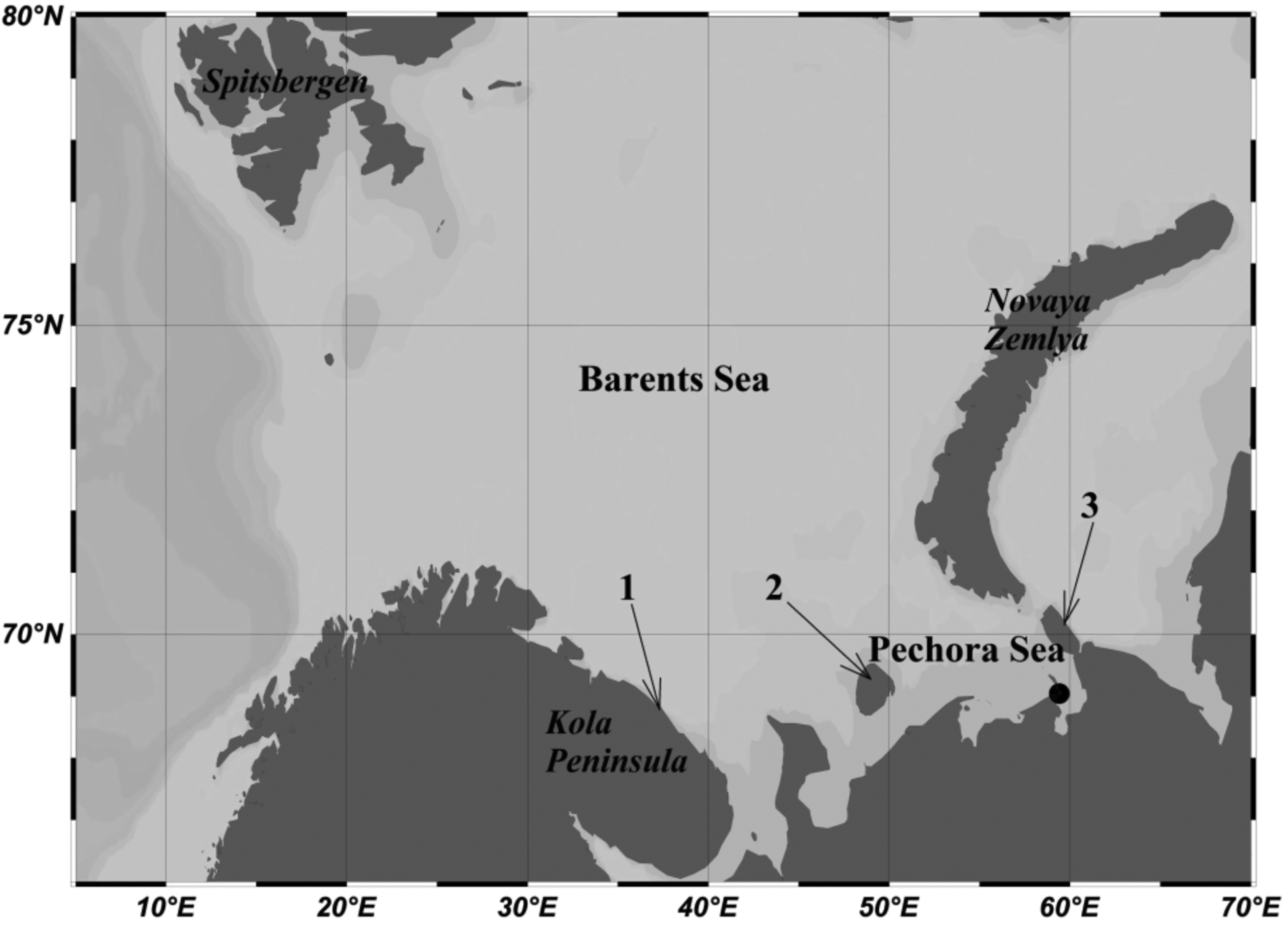
The material was collected during the summer expedition (3–15 August 2017) on the RV ‘Professor V. V. Kuznetsov’ to the Pechora Sea (at location 69°02.8´N 59°24.4´E). The specimens were sampled by a Sigsby trawl with a working opening of 1 m (Figure 1).
Location of Stegophiura nodosa Lütken, 1855 sampling in the Pechora Sea (black dot). (1) Ivanovskaya Inlet, (2) Kolguev Island, (3) Vaygach Island.

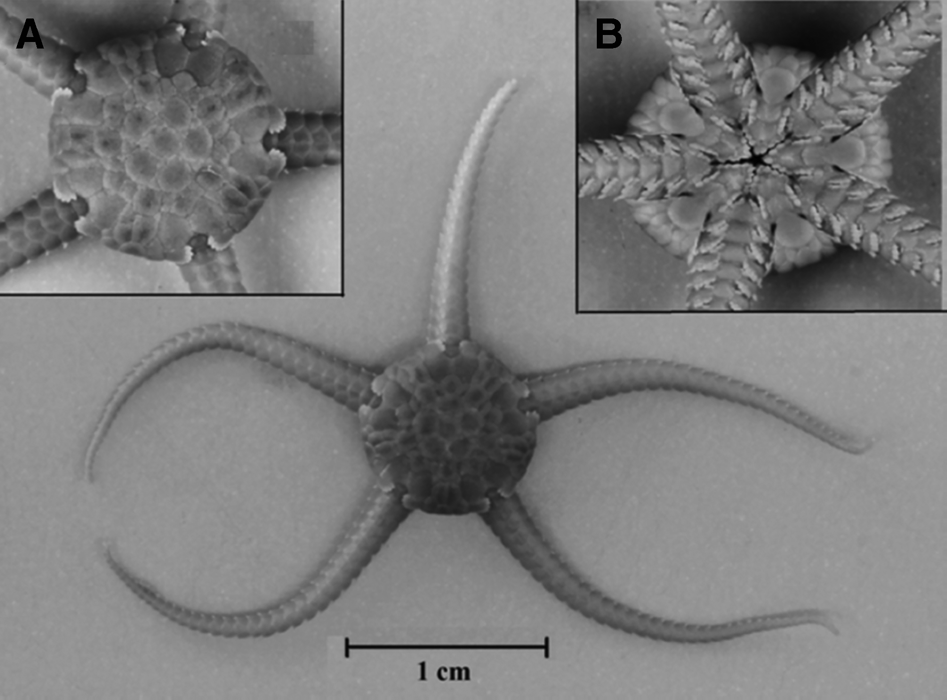
The depth of sampling was 14.5 m on a silty-sand bottom. Specimens were washed through a sieve with 1 mm mesh size immediately after collection. Taxonomically S. nodosa (Figure 2) were identified according to D'jakonov key-book (1954). Selected specimens of S. nodosa were preserved in 75% alcohol.
Photo of Stegophiura nodosa Lütken, 1855 (A – dorsal view; B – ventral view).

The weight of specimens was measured in the laboratory by electronic scales with an accuracy of 0.001 g. The measuring of disc diameter (oblique diameter) was carried out using a binocular microscope (Leica MZ 9.5, Germany); measurements were made from the edge of the disc at the base of each ray to the base of the opposite interradius (Gage, Reference Gage1990b), after that the real diameter (D) was calculated from the mean values (Am) via the simple geometric formula:
 $$D = A_m/\sin \lpar {360^\circ /5} \rpar \comma \;$$
Altogether 228 specimens of S. nodosa were collected. For individual growth analysis 53 specimens were randomly selected in 1 mm body size increments (from 1.7–9.4 mm).
Individual ages were determined by counting the growth marks on the ossicles by a method described in detail previously (Gage, Reference Froese and Binohlan1990a, Reference Gage1990b; Dahm, Reference Dahm1993; Dahm & Brey, Reference Dahm and Brey1998; Dahm, Reference Dahm1999). The first vertebral ossicles (located inside the disc) of each individual were separated from each of the five rays and cleared of organic material with bleach solvent (sodium hypochlorite NaClO). The cleaned ossicles were dried and prepared for examination with a scanning electron microscope (Quanta-250, FEI Company, the Netherlands).
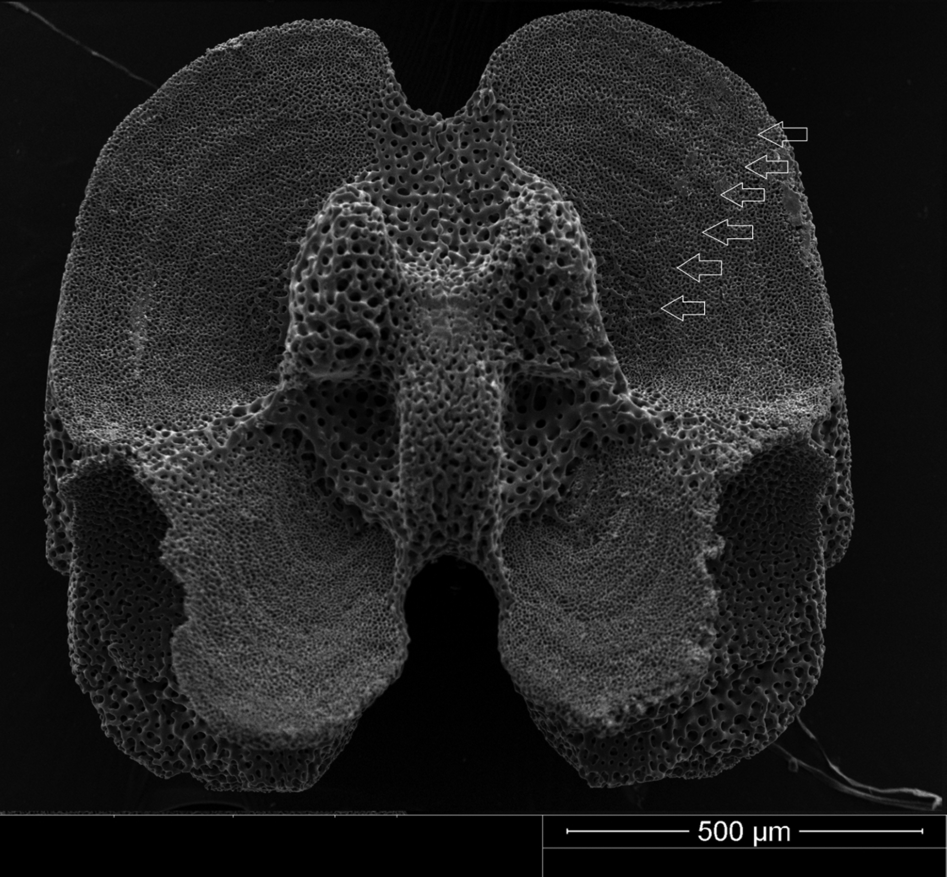
We measured the width of the ring-shaped growth marks on the SEM micrographs to calculate the growth parameters for the von Bertalanffy and Gompertz equations (Figure 3).
SEM image of the Stegophiura nodosa Lütken, 1855 vertebral ossicle with visible growth marks. Disc diameter of the specimen is 7.4 mm.

The von Bertalanffy equation was applied in the following form:
 $$R_t = R_\infty \;\ast\; \lpar {1-\;e^{-k\lpar {t-t}_0 \rpar }} \rpar \comma \;$$
where Rt is the distance (μm) from the centre of the arm (vertebral ossicle) to the age mark (ring) at a particular time t (years), t 0 – age of the beginning of growth in accordance with this equation, R ∞ – theoretical limit of vertebral ossicle radius, e – base of the natural logarithm, k – growth constant.
The equation parameters were evaluated by the Ford–Walford method for the recurrence relations of Rt+1 and Rt and by the von Bertalanffy method for the relations of ln(1−Rt/R ∞) and t.
The Gompertz equation was employed in the following form:
 $$R_t = R_\infty \cdot \hbox{e}^{\ln \lpar {R_0{\rm /}R_\infty } \rpar \cdot e^{-gt}}\comma \;$$
where Rt is the distance (μm) from the centre of the arm (vertebral ossicle) to the age mark (ring) at a given time t (years), R 0 – radius of the vertebral ossicle at t = 0, R ∞ – theoretical limit of vertebral ossicle radius, g – speed of exponential deceleration of the specific growth rate. All the parameters were found by analysing the relation of ln(Rt+1) and ln(Rt) by analogy with the Ford–Walford method (Sparre & Venema, Reference Smith and Carter1998). The final value of R 0 was adjusted by optimizing the target function in Microsoft Excel using SOLVER.XLAM.
The age correction of each exemplar for the von Bertalanffy equation was carried out by fitting the actual marked sizes of the ossicle's radii relative to the calculated values of t 0. For the Gompertz equation we used the final value of R 0 for each individual growth curve and after that fitted to them the actual marked sizes of the ossicle's radii.
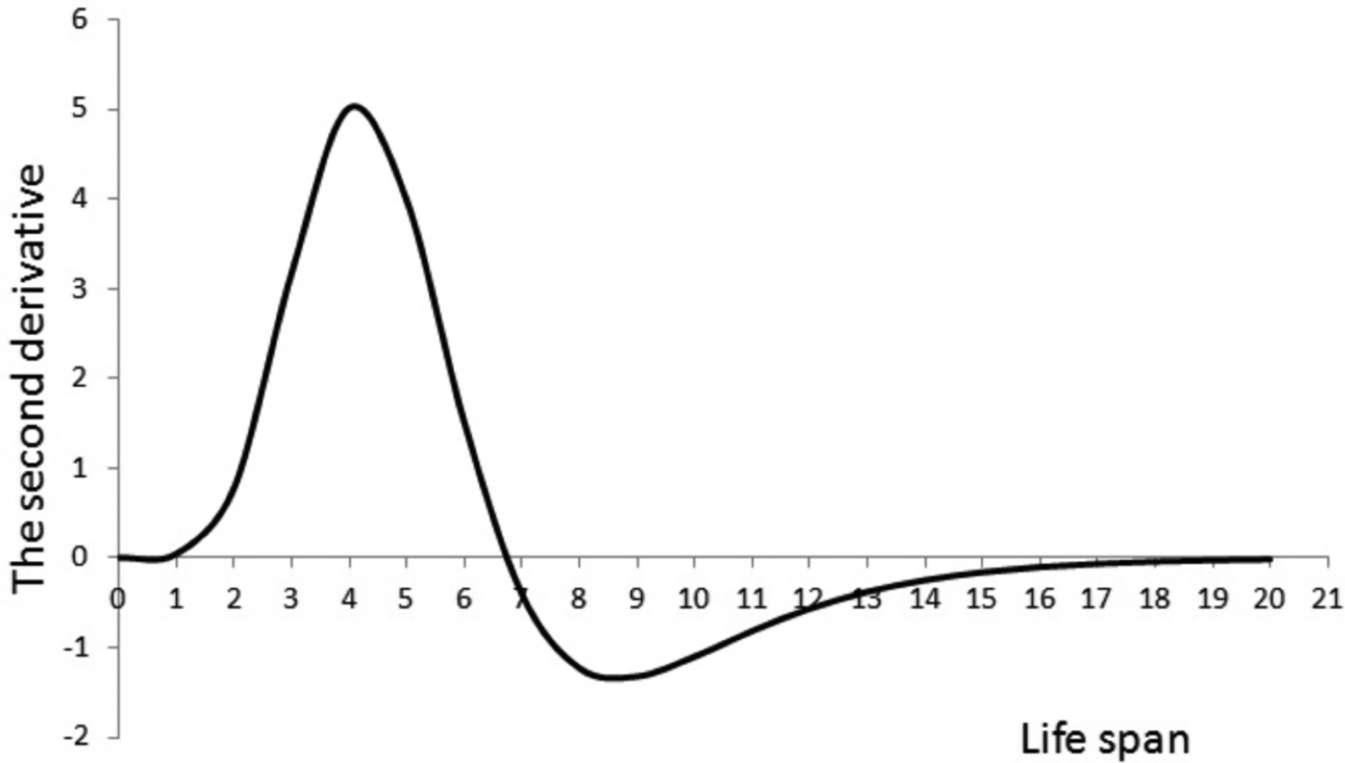
The maximum lifespan expectation was calculated from the minimum value of the second derivative for the growth equations, in accordance with the proposal of Alimov & Kazantseva (Reference Alimov and Kazantseva2004).
Results
The disc diameters of the collected Stegophiura nodosa individuals (228 specimens) ranged from 1.7–9.4 mm, while the individual mass ranged from 0.001–0.252 g.
For the approximation of the relationship of the mass of individual brittle stars to their dimensions in the sampled population, the following equation of a power function was obtained:
 $$W = 0.0006 \pm 0.00009\;\ast\; D^{2.723 \pm 0.0576} \;$$
where W is the individual mass in grams, and D is the disc diameter in millimetres.
The analysis and determination of individual age by counting growth marks on the vertebral ossicles of brittle stars showed that on the SEM images the number of visible growth rings (assumed by us and other authors (Gage, Reference Froese and Binohlan1990a, Reference Gage1990b; Dahm, Reference Dahm1993) to be ‘annual’) in the sample (53 individuals) ranged from 3–10, with an average of 6. The maximum number of rings (10) was observed on specimen with an 8.4 mm disc diameter and the minimum (3) on a specimen measuring 1.7 mm.
The application of the von Bertalanffy equation as a mathematical model of S. nodosa growth allowed us to find the parameters only for 45 specimens. In eight cases, the calculations indicated inadequate values (the slope of the Ford–Waldford regression line exceeded 45°), and therefore these values could not be used in further analysis. Similar calculations performed for the Gompertz equation gave adequate results for the entire sample (53 specimens).
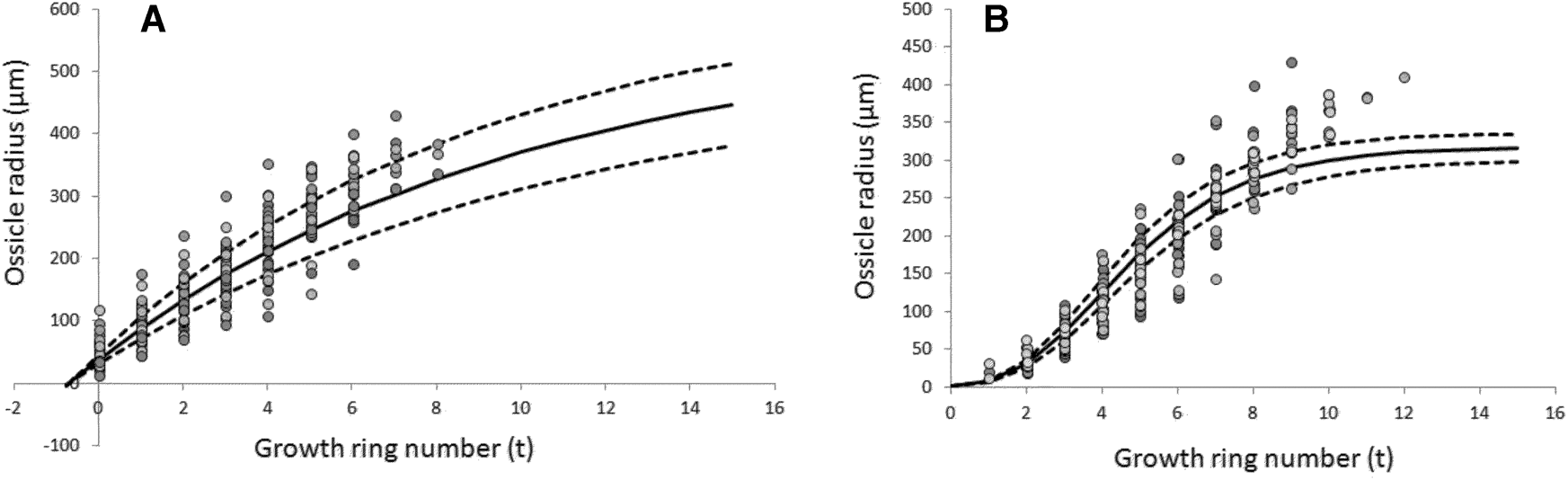
The common growth curves (von Bertalanffy and Gompertz) were built using averaged growth parameters and in both cases the values of visual distinguished growth mark radii were plotted on the curves after age correction (Figure 4).
Growth curves of sampled individuals (A) for von Bertalanffy and (B) for Gompertz models after the age correction (the dotted lines indicate 95% confidence intervals).

The von Bertalanffy theoretical radius limit of the vertebral ossicle (R ∞) averaged 565 ± 59 μm, the growth constant (k) = 0.09 ± 0.01, and t 0 = –0.69 ± 0.05. The Gompertz average parameters were as follows: R ∞ = 318 ± 18 μm, g = 0.46 ± 0.02. As a result of age correction we found that the coefficient of determination in the relation between body size and amount of growth rings was higher in the case of application of the Gompertz equation (R 2 = 0.73) than the von Bertalanffy (R 2 = 0.60).
We assume that the Gompertz equation gave more valid results for the analysed samples and therefore the parameters of the Gompertz equation were used for further calculations of the maximum lifespan of S. nodosa. The calculations were performed using the parameters R ∞ and g averaged for the studied sample. The results of the analysis led us to conclude that the individuals from the studied population of S. nodosa in the Pechora Sea can live up to 9–10 years (Figure 5).
The curve of the second derivative for the common Gompertz growth equation.

Discussion
According to Shorygin (Reference Ricklefs1928) and Anisimova (Reference Anisimova and Matoshov2000), the dimensions of the S. nodosa disc in the Barents Sea may reach 14–15 mm. In the analysed material, no individuals with a diameter greater than 10 mm were observed. About 47% of the total analysed sample was represented by individuals with disc diameters from 5.8–8.4 mm.
The ratios for the size and mass of individuals of the ophiurid (Equation 4) are close to the results performed by Anisimova (Reference Anisimova and Matoshov2000) for individuals of this species from the Ivanovskaya Inlet (NE coast of the Kola Peninsula) (W = 0.0008 • D 2.782), but differ from values for the population inhabiting waters near Kolguev Island (Figure 1) in the southern part of the Barents Sea (W = 0.0006 • D 3.112). The values of power index in these equations allow different interpretations of the growth allometry of the studied ophiuroids to be made. According to the first equation, the disc of brittle stars will become more flattened as they grow (the coefficient is substantially less than 3), but in the last equation, a tendency to its thickening is presented (the coefficient is more than 3).
Counting the growth marks in 53 individuals of our sample showed that the lifespan of S. nodosa (disc diameter from 1.7–9.4 mm) averages six years. Anisimova (Reference Anisimova and Matoshov2000) suggested that S. nodosa with a disc diameter of less than 5 mm are no more than one year old, since there are no gonads in their bursae. At the same time, she concluded that the reproductive period of S. nodosa in the Pechora Sea, in general, coincides with that in the south-western Barents Sea, where Kuznetsov (Reference Komarova1963) observed the reproduction of S. nodosa in the spring, and the exit of the fry from the bursae, in the autumn. While we did not dissect the bursae, our count of growth marks on the vertebral ossicle showed that in brittle stars with a disc size of 1.7–5.0 mm, the number of ring-shaped marks in the vertebral structure ranges from three to seven. Thus, individuals with a disc diameter up to 5 mm cannot be assigned to the one-year-old age group as previously presumed (Anisimova, Reference Anisimova and Matoshov2000), if we assume each visible ring is an annual increment of growth. Therefore, the only condition where our results do not contradict the Anisimova data, would be if there were formation of two growth rings annually, but for this we would require supplementary evidence.
At the same time, many authors, in particular Dahm & Brey (Reference Dahm and Brey1998), note that, in connection with the peculiarity of structure and formation of the ophiuroid vertebrae, the structure of the vertebral ossicle changes during development of the organism, and obvious compaction occurs in the zone of articulation (the central part of the vertebra). Compaction leads to overgrowth of the initial growth zone and, as a result, the analysis of growth markers leads to underestimation of the true age of the animal. Taking this into account, we performed an additional mathematical analysis of individual growth curves (the age correction). This method is based on the fact that the actual marked radii measurements of the ossicle are plotted on the growth curve after their fitting relative to t 0 (for von Bertalanffy equations) and R 0 (for Gompertz equations) for each sample separately. Application of this analysis showed that the radii of the initially distinguishable marks on the vertebrae correspond to an age on average of 0.7 (von Bertalanffy) and 2 (Gompertz) years. We assume that results of age correction seem to be more realistic in the Gompertz equation, since they agree with the results of other studies (Gage, Reference Gage1990b; Dahm, Reference Dahm1993; Dahm & Brey, Reference Dahm and Brey1998) and have coefficient of determination in relation to body size and amount of growth rings of more than 0.7. Maximum amount of invisible growth marks (3) was observed in specimens from 6.8–9.2 mm in disc diameter, the corrected age of these brittle stars varied from 7–12 years.
In the course of the mathematical analysis, we found that von Bertalanffy's equation, which is often used to describe the growth of animals, does not quite accurately match the growth in our case. Difficulties in applying this equation appear already at the stage of estimation of individual growth parameters, as only 45 of 53 individuals were able to be used to construct growth curves. Further calculations showed that the visible marks plotted on the growth curve don't give us any real information about initial stage of growth (Figure 4).
The attempt to build a growth model for S. nodosa was more successful with the Gompertz equation, because it worked correctly for the entire sample of 53 specimens. The individual growth curves were plotted after selection of the optimized value of the vertebral ossicle's radius at t = 0. Applying this algorithm allowed us to find the numbers of invisible marks separately for each specimen and determine the correct age.
Taking into account all the above-mentioned discussion, we used only the Gompertz's growth equation parameters to calculate the maximum lifespan of S. nodosa. In general, our results are close to those of similar studies of representatives of the Stegophiura in the Pacific region, where maximum lifespan was estimated to be 15 years (Quiroga & Sellanes, Reference Pushchina2009). Moreover, lifespan values of S. nodosa are close enough to those in the Arctic region for Ophiura sarsii (10 years) inhabiting the southern part of the Barents Sea (Anisimova, Reference Anisimova and Matoshov2000) and for Ophiacantha bidentata (14–15 years) from the south-western part of the Laptev Sea (Denisenko & Stratanenko, Reference Denisenko, Stratanenko, Sinev and Stanyukovich2017), and to results obtained by Dahm (Reference Dahm1993) for Ophiura albida and O. ophiura from the North Atlantic (maximum age for both species is 9 years).
In summary, our studies of the growth of S. nodosa revealed that the maximum lifespan of S. nodosa in the Pechora Sea may be as much as 9–10 years. In addition to the calculation of the second derivative, the proof of this statement can be obtained by estimating maximum lifespan through the growth constant of the Bertalanffy equation (Taylor, Reference Stöhr, O'Hara and Thuy1958; Froese & Binohlan, Reference D'jakonov2000) as t max = 3/k. Since we cannot accept the approximation of S. nodosa growth by this equation as satisfactory, we used the necessary transformations to recalculate the growth constant from the Gompertz equation into the growth constant of a hypothetical von Bertalanffy equation (Ricklefs, Reference Ravelo, Konar, Bluhm and Iken1973; Tjørve & Tjørve, Reference Templeman2017a, Reference Tjørve and Tjørve2017b). In the result, we obtain t max = – ln (1–0.95)/[(g/e) • 0.828 • 9/4] = 9.5, which almost completely agrees with the estimates that were made via the second derivative. It is also interesting that the results obtained by estimating the maximum lifespan using the empirical equation proposed for fish (Froese & Binohlan, Reference D'jakonov2000) exceeded 2–3 years (5.5 years). The last equation links the initial age of sexual maturation (in our case 1.5 years (Anisimova, Reference Anisimova and Matoshov2000)) with the maximum lifespan.
Acknowledgements
Scanning electron microscopy was performed at the ‘Taxon’ Research Resource Centre (Zoological Institute RAS) (http://www.ckp-rf.ru/ckp/3038/).
Financial support
This work was supported by the Russian Foundation for Basic Research (Grant 18-05-60157) and by the budget funding (project АААА-А17-117030310207-3) of the Russian Academy of Sciences.