Introduction
Temperature often underlies the performance of invertebrate species in terrestrial (Deutsch et al., Reference Deutsch, Tewksbury, Huey, Sheldon, Ghalambor, Haak and Martin2008; Saska et al., Reference Saska, Martinkova and Honek2010) and aquatic (Sanford, Reference Sanford2002; Hale et al., Reference Hale, Calosi, McNeill, Mieszkowska and Widdicombe2011) environments. This includes temperature variation at the seasonal scale (Wagner et al., Reference Wagner, Hulsmann, Horn, Schiller, Schulze, Volkmann and Benndorf2013), over very fine spatial scales (Lathlean et al., Reference Lathlean, Ayre and Minchinton2013), and at critical periods of time during the day (Laws & Belovsky, Reference Laws and Belovsky2010; Vangansbeke et al., Reference Vangansbeke, Nguyen, Audenaert, Verhoeven, Gobin, Tirry and De Clercq2015). While temperature can influence invertebrate performance through a variety of mechanisms, discussions of the effects of temperature on invertebrates focus primarily on physiological performance such as overall metabolism, the initiation and rate of feeding, digestion rates, etc. However, temperature may also affect an organism's performance by altering species interactions (Van der Putten et al., Reference Van der Putten, Macel and Visser2010; Walther, Reference Walther2010; Barton & Ives, Reference Barton and Ives2014). Predator–prey interactions in particular can vary with temperature (e.g., Kruse et al., Reference Kruse, Toft and Sunderland2008; Manca & DeMott, Reference Manca and DeMott2009; Wagner et al., Reference Wagner, Hulsmann, Horn, Schiller, Schulze, Volkmann and Benndorf2013; Costa & Kishida, Reference Costa and Kishida2015; Sentis et al., Reference Sentis, Morisson and Boukal2015), often with consequences for community structure and function, including the occurrence of trophic cascades (Barton et al., Reference Barton, Beckerman and Schmitz2009; Laws & Joern, Reference Laws and Joern2013). Here, we assess the nature of temperature-dependent expressions of arthropod predator–prey interactions (grasshoppers and wolf spiders) in a grassland food chain.
Spiders are important predators of grasshoppers that limit grasshopper populations in a size-dependent fashion (Belovsky & Joern, Reference Belovsky, Joern, Cappuccino and Price1995; Oedekoven & Joern, Reference Oedekoven and Joern1998), and alter individual foraging and microhabitat selection (Schmitz et al., Reference Schmitz, Beckerman and O'Brien1997; Schmitz, Reference Schmitz1998; Danner & Joern, Reference Danner and Joern2003). One must consider the influence of temperature in such interactions as it can be an important abiotic constraint affecting the strength of predator–prey interactions between grasshoppers and wolf spiders (Logan et al., Reference Logan, Wolesensky and Joern2006, Reference Logan, Wolesensky and Joern2007a ). Grasshoppers prefer warmer temperatures and are active throughout the day, while wolf spiders prefer slightly cooler temperatures and are active at dawn and dusk (Li & Jackson, Reference Li and Jackson1996; Joern et al., Reference Joern, Danner, Logan and Wolesensky2006; Logan et al., Reference Logan, Wolesensky and Joern2007a ). By modifying morning temperatures, one can influence predator–prey interactions between grasshoppers and wolf spiders (Laws & Joern, Reference Laws and Joern2013). Reducing morning temperatures increases the potential risk of predation to grasshoppers by extending the amount of time in the morning that both wolf spiders and grasshoppers are active; increasing morning temperatures reduces the time that wolf spiders are co-active with grasshoppers (Logan et al., Reference Logan, Wolesensky and Joern2007b ), thus minimizing predator effects on grasshopper performance.
Changes in species interactions with temperature may also affect community and ecosystem dynamics. Trophic cascades are characteristic of consumer-controlled, top-down processes that may result when predators reduce herbivore densities or alter herbivore traits, indirectly increasing plant biomass (Schmitz, Reference Schmitz2008). Trophic cascades in plant – grasshopper – spider food chains are observed in some grassland ecosystems (Schmitz, Reference Schmitz1997, Reference Schmitz1998; Schmitz et al., Reference Schmitz, Beckerman and O'Brien1997; Ritchie, Reference Ritchie2000; Laws & Joern, Reference Laws and Joern2013), but not others (Belovsky & Slade, Reference Belovsky and Slade1993, Reference Belovsky and Slade1995; Schmitz, Reference Schmitz1993; Chase, Reference Chase1996; Laws & Joern, Reference Laws and Joern2013). Variation in the strength of predator–prey interactions from factors affecting either predators or prey determines whether or not trophic cascades occur (Ovadia & Schmitz, Reference Ovadia and Schmitz2004). In our system, trophic cascades may be stronger in cooled conditions if cooler morning temperatures enhance predator–prey interactions. In contrast, warmed morning conditions that decouple predator–prey interactions would be expected to weaken the expression of trophic cascades.
Population density also has the potential to influence grasshopper responses to temperature and predation. Increased metabolic rates at higher temperatures may increase the potential for food limitation if metabolic demands outpace increases in feeding and digestion rates (Laws & Belovsky, Reference Laws and Belovsky2010). This would be especially important if food quality is low or if grasshopper densities are high, which reduces per capita resource availability. Plant quality for herbivores, including nitrogen content and C:N may also vary with temperature, but this is not typically observed at ambient CO2 concentrations (Zvereva & Kozlov, Reference Zvereva and Kozlov2006).
In tallgrass mesic grassland at Konza Prairie Biological Station (Kansas, USA), previous experimental work examined how temperature affects the outcome of spider–grasshopper predator–prey interactions for a small grass-feeding grasshopper (Laws & Joern, Reference Laws and Joern2013) and for a large mixed-feeding grasshopper species (Laws & Joern, Reference Laws and Joern2015). Here, we examine how temperature and density affect grasshopper performance and predator–prey interactions using Phoetaliotes nebrascensis, a medium sized, grass-feeding species. We hypothesized that: (1) predator–prey interactions will be stronger in reduced temperature treatments and weaker in warmed temperature treatments; (2) the effects of temperature on grasshopper performance will differ between grasshopper density treatments, and, (3) that context-dependent differences in predator–prey interactions lead to variation in community structure and function, measured as shifts in the occurrence of trophic cascades. This would be observed as an increase in plant biomass when spiders are present, compared with treatments without spiders. We then compare density-dependent responses by the grasshopper P. nebrascensis to spider predation to a range of similar experiments performed with different species studied under a range of abiotic conditions. Understanding how species interactions and community dynamics vary with temperature, as well as how the wider biotic and abiotic context affect those responses, will provide insight into ecosystem responses to temperature change.
Methods
Study site and species
Konza Prairie Biological Station (near Manhattan, KS, USA; 39°05′N, 96°35′W) is a protected tallgrass prairie research site located in a region with a highly variable US continental climate consisting of wet summers and dry, cold winters (Knapp et al., Reference Knapp, Briggs, Hartnett and Collins1998). Mean annual precipitation is 835 mm, most of which occurs during the summer growing season (May–August). Konza Prairie maintains long-term, watershed-level burning and grazing (bison and cattle) treatments (Knapp et al., Reference Knapp, Briggs, Hartnett and Collins1998). The flora biomass is dominated by warm season tallgrass, but forbs comprise ~75% of the species found in prairie habitats (Towne, Reference Towne2002). Our study was performed in an upland site in an annually burned, ungrazed watershed (K1B) during the summer of 2010.
Grasshoppers and spiders are dominant arthropod herbivores and predators in grasslands worldwide (Kajak et al., Reference Kajak, Breymeyer and Petal1971; Hewitt & Onsager, Reference Hewitt and Onsager1983; Onsager, Reference Onsager2000), including Konza Prairie. We performed field experiments to study responses by the grasshopper species Phoetaliotes nebrascensis (Thomas), a common grass-feeding species at Konza Prairie (Joern, Reference Joern2005; Jonas & Joern, Reference Jonas and Joern2007). Phoetaliotes nebrascensis is a medium-sized grasshopper species [averaging 0.53 g ± 0.07 (females; n = 39); 0.29 g ± 0.04 (males; n = 50); live weight]. This species exhibits a late season phenology where nymphs hatch in mid- to late- summer and become adults later in the growing season than is observed for most other coexisting grasshopper taxa. The wolf spider Rabidosa rabida (Walkenaer) is the most abundant wolf spider species at Konza Prairie and is a common predator of grasshopper nymphs.
Field experiments
In 2010, experiments were conducted in field cages (0.25 m2 basal area) constructed of insect screen and pvc frames placed securely over natural vegetation. Insects and spiders could not enter or escape and cages were checked twice for other insects or spiders, which were removed, before initiating the experiment. Treatments were initiated using third instar grasshopper nymphs and adult wolf spiders. Consumers were added selectively to the enclosures to create 1-level (plants only), 2-level (plants – grasshoppers) and 3-level (plants – grasshoppers – spiders) food chains. Grasshoppers were stocked at either four nymphs per cage (16 m−2) or eight nymphs per cage (32 m−2); spiders were added at one individual per cage (4 m−2). Densities of grasshoppers and spiders were within the high end of natural densities. Treatments were randomly assigned to the cages and we used six replicates of each treatment. Grasshopper survival was measured through weekly censuses of all grasshoppers in each cage. A spider was added to a cage if no spider was observed for 2 weeks in a row. The experiment ran for 8 weeks.
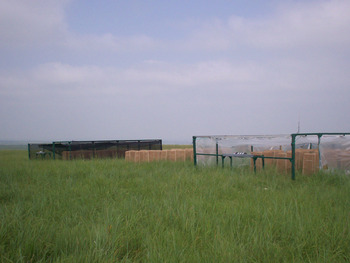
Temperature was manipulated with the use of large field chambers (7.1 × 4.8 × 1.5 m3) that surrounded experimental cages (fig. 1). The chambers were covered on three sides either with plastic sheeting (used in greenhouses) or with 50% mesh shade cloth to increase or decrease temperatures, respectively, relative to ambient conditions (no field chamber). Movable chamber roofs made of either plastic sheeting or 50% shade cloth could be opened and closed to control temperature inside the chambers. The chamber roofs covered the enclosures every morning for ~6 h from dawn (~0530 h) to ~1130 h. The cages were not covered by the roofs for the majority of the day and chambers were left open when raining. Temperature was measured every 15 min in each cage using copper-constantan thermocouples attached to a Campbell CR1000x programmable datalogger. Plastic sheeting increased cage temperatures by ~3°C and shade cloth decreased cage temperature by ~2°C relative to ambient levels (Laws & Joern, Reference Laws and Joern2013). Wind speed may have been affected by the temperature chambers, as the plastic sheeting on the warmed chambers would have slowed wind.
Field cages and temperature chambers used in this experiment. Chambers surrounded the cages on three sides, with movable tops that could be opened and closed. ‘Cooled’ temperature chambers were covered with shade cloth, ‘warmed’ temperature chambers were covered with plastic sheeting.

The primary effect of the chamber (temperature treatment) was to extend or decrease the proportion of the day that grasshoppers and spiders interacted actively. Our temperature manipulation design allows temperature to track natural daily variation relative to control conditions, rather than exposing our study system to a constant temperature as in most laboratory studies. Because grasshoppers thermoregulate with precision (Willott, Reference Willott1997), our temperature treatments alter the length of daily periods with suitable conditions rather than directly control grasshopper body temperatures within narrow ranges. Our experimental approach allows us to identify mechanisms driving grasshopper performance and tritrophic interactions in response to temperature manipulations, and to facilitate understanding about how changes in temperature are likely to affect species interactions among arthropods.
To identify trophic cascades, all vegetation remaining in each cage at the end of the experiment was clipped at ground level and removed. Vegetation was sorted between grasses and forbs, dried for 48 h at 60°C, and weighed. Grass samples were lost for one cage (high density, shaded treatment). Higher biomass in cages with spiders compared with cages with grasshoppers only would indicate a trophic cascade. Foliar C:N was measured on ground vegetation samples using a Carla Erba autoanalyzer to detect differences in plant quality among temperature treatments (Costsech Analytical Technologies Inc., Valencia, CA, USA).
Statistical analyses
Analyses were performed with R v. 2.10.1 (R Development Core Borcard et al., Reference Borcard, Gillet and Legendre2011). To assess whether grasshopper mortality varied with experimental treatments, we analyzed survivorship results with a generalized linear model and survivorship analysis. We used parametric survival models with a Weibul distribution and right-censored data (Blair et al., Reference Blair, Johnson, Knapp, Masters and Galley2007) to test the effects of temperature and predation treatments on survival (Kistner & Belovsky, Reference Kistner and Belovsky2014). We were interested in testing whether large populations responded differently to temperature and predation treatments than low populations. Therefore, we tested high and low density treatments separately and used a Bonferroni correction, setting α = 0.025.
We tested the effects of temperature treatments on plant biomass and plant C:N content using analysis of variance (ANOVA). These analyses were only performed on the plant-only treatments to remove the effects of herbivory, and which may be temperature dependent. To examine for the presence of trophic cascades, we used an ANOVA to assess differences in grass biomass across trophic levels for all temperature treatment and density treatments.
Results
Plant quality and biomass
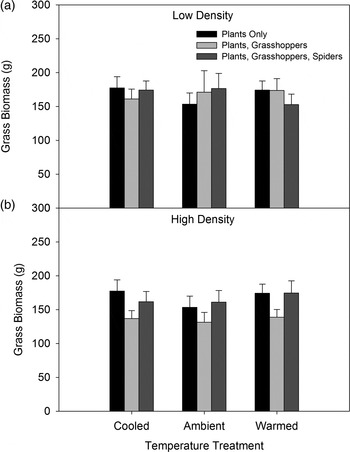
The temperature treatment had no effect on grass foliar C:N (F 2,15 = 2.23, P = 0.14) or on total grass biomass (F 2,15 = 0.70, P = 0.51) at the end of the summer. To identify whether trophic cascades were operating, we compared grass biomass in one-, two- and three- trophic level cages at the end of the experiment. Trophic cascades were not observed in any temperature treatments when grasshoppers were stocked at low densities (Temperature: F 2,47 = 0.30, P = 0.74; Trophic Level: F 1,47 = 0.25, P = 0.62; Temperature × Trophic Level: F 2,47 = 0.28, P = 0.76; fig. 2a) or at high densities (Temperature: F 2,48 = 0.51, P = 0.60; Trophic Level: F 1,48 = 0.04, P = 0.85; Temperature × Trophic Level: F 2,48 = 0.28, P = 0.76; fig. 2b).
Average biomass of grasses in each cage at the end of the experiment is plotted against temperature treatment for cages with 1-level (plants only), 2-level (plants and grasshoppers) or 3-level (plants, grasshoppers, spiders) food chains. Data are shown for grasshoppers stocked at low densities (a) and high densities (b) separately. No significant differences in grass biomass with temperature treatment or number of trophic levels were found. Bars are SE.

Grasshopper performance
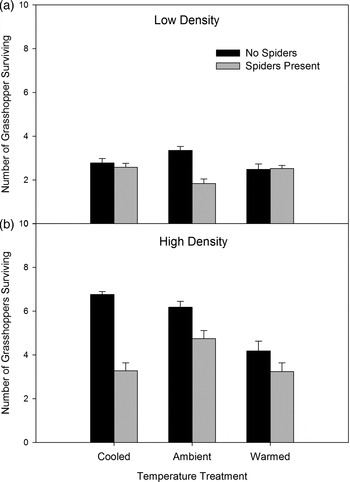
The effect of the predator and temperature treatments varied with grasshopper stocking density. When grasshoppers were stocked at low densities, there was no significant effect of spider presence on grasshopper survival (X 2 = 3.72, df = 1, P = 0.05; fig. 3a). Temperature treatment and the interaction between temperature and predators was also not significant (Temperature: X 2 = 0.74, df = 1, P = 0.39; Temperature × Predator: X 2 = 0.19, df = 1, P = 0.66; fig. 3a). At high densities, grasshopper survival was significantly affected by spider presence, temperature, and the spider × temperature interaction (Predator: X 2 = 27.92, df = 1, P < 0.001; Temperature: X 2 = 7.52, df = 1, P = 0.006; Temperature × Predator: X 2 = 9.35, df = 1, P = 0.002). When spiders were absent, grasshopper survival declined with increasing temperature, being highest in the cooled treatment, and lowest in the warmed treatment (fig. 3b). Spiders reduced grasshopper survival relative to treatments with no spiders. In the treatments with spiders, survival was highest in the ambient treatment and similar in the cooled and warmed treatments.
The number of grasshoppers surviving over time is plotted for each of the temperature and predator treatments for grasshoppers stocked at low densities (a) and high densities (b). Bars are SE. Significant responses to predator and temperature treatments were only observed at high grasshopper densities.

Discussion
Temperature, grasshopper density, and predation risk are spatially and temporally variable in grassland ecosystems. Understanding how these factors combine to affect predator–prey interactions and ecosystem functioning is a relevant, if difficult challenge. Our study finds that population density can be important to mediating the effects of temperature and predation on performance of an insect herbivore.
Because temperature affects food acquisition and nutritional requirements, (Yang & Joern, Reference Yang and Joern1994; Logan et al., Reference Logan, Joern and Wolesensky2002, Reference Logan, Wolesensky and Joern2007a ; Chown & Nicolson, Reference Chown and Nicolson2004; Harrison et al., Reference Harrison, Woods and Roberts2012), it has not surprisingly been shown to correlate with grasshopper population dynamics (Ritchie, Reference Ritchie, Floyd, Sheppard and De Barro1996, Reference Ritchie2000; Kohler et al., Reference Kohler, Perner and Schumacher1999; Jonas & Joern, Reference Jonas and Joern2007). Increased temperatures, such as those associated with climate change, are generally expected to increase insect herbivore survival, particularly in the absence of predators or parasites (Cammell & Knight, Reference Cammell and Knight1992; Bale et al., Reference Bale, Masters, Hodkinson, Awmack, Bezemer, Brown, Butterfield, Buse, Coulson, Farrar, Good, Harrington, Hartley, Jones, Lindroth, Press, Symrnioudis, Watt and Whittaker2002). However, we observed no effect of temperature treatments on grasshopper survival when grasshoppers were stocked at low densities, and decreased survival in warmed treatments when grasshoppers were stocked at high densities with no spiders. Insect survival might decrease with increased temperature if metabolic demands increase enough to cause food limitation, which would be exacerbated at high densities where per capita resources are lower. This could explain why increased temperature reduced grasshopper survival at high densities but not low densities. A similar pattern was observed in an experiment in an old field using Camnula pellucida (Scudder) (Laws & Belovsky, Reference Laws and Belovsky2010). At low densities, C. pellucida survival increased with warming, but at high densities, grasshopper survival peaked at ambient temperatures and declined in warmed treatments, likely due to increased food limitation (Laws & Belovsky, Reference Laws and Belovsky2010). Our results are consistent with other studies that find grasshopper survival decreases with warming (Barton & Schmitz, Reference Barton and Schmitz2009), or that warming has no effect on grasshopper survival (Barton et al., Reference Barton, Beckerman and Schmitz2009; Guo et al., Reference Guo, Hao, Sun and Kang2009; Barton, Reference Barton2010; Laws & Joern, Reference Laws and Joern2013, Reference Laws and Joern2015). These studies have collectively examined eight grasshopper species from a variety of grassland types. In most cases warming does not affect grasshopper survival, and in the few cases where multiple densities were examined, responses to temperature were density dependent.
We predicted that predator effects would be strongest in the cooled temperature treatment and weakest in the warmed temperature treatment because wolf spiders are more active at cooler temperatures. Support for this hypothesis was density dependent. At high grasshopper densities, reductions in grasshopper survival in response to spider presence were highest in the cooled treatment as predicted. However, at low densities predators had no effect on grasshopper survival. These density dependent responses may result from trait mediated responses to predators (Werner & Peacor, Reference Werner and Peacor2003). Grasshoppers have shown decreased activity and overall feeding rates in response to predation risk from spiders (Schmitz et al., Reference Schmitz, Beckerman and O'Brien1997; Schmitz & Suttle, Reference Schmitz and Suttle2001), which could reduce performance, especially if resources are scarce. This effect would be stronger under cooled conditions where predation risk is high, leading to strong behavioral responses, and because grasshopper feeding and digestion would be reduced in cooled conditions. These effects should be exacerbated at high densities, where per capita resources are lower, possibly explaining why predator effects were only observed at high densities.
Our findings are in line with other studies that consistently document temperature-dependent predator–prey interactions between grasshoppers and spiders (e.g., Chase, Reference Chase1996; Rothley & Dutton, Reference Rothley and Dutton2006; Barton et al., Reference Barton, Beckerman and Schmitz2009; Barton & Schmitz, Reference Barton and Schmitz2009; Laws & Joern, Reference Laws and Joern2013, Reference Laws and Joern2015). Thus, temperature can indirectly affect grasshopper survival by mediating predator–prey interactions, even when temperature does not directly affect survival (Laws & Joern, Reference Laws and Joern2013, Reference Laws and Joern2015). However, increased temperatures do not consistently lead to decreased predator effects in field experiments with grasshoppers. Studies using nursery web spiders and mixed feeding grasshopper species found that habitat overlap between the species increased with temperature, enhancing predator effects in warmed treatments compared with ambient treatments (Barton et al., Reference Barton, Beckerman and Schmitz2009; Barton & Schmitz, Reference Barton and Schmitz2009; Barton, Reference Barton2011). Studies with Orphulella speciosa (Scudder) and wolf spiders uncovered temporal variation in the outcome of species interactions, where predator effects were enhanced in cooled treatments in some years, but not others (Laws & Joern, Reference Laws and Joern2013).
Despite reductions in grasshopper survival in response to spider predation at high densities, we did not observe trophic cascades. The study was conducted in a productive tallgrass prairie with high aboveground net primary productivity (Knapp et al., Reference Knapp, Briggs, Hartnett and Collins1998), and plants may compensate for grasshopper herbivory when grasshopper densities are moderate. Shifts in the expression of trophic cascades with increased and/or decreased temperature have been observed in a variety of ecosystems including aquatic systems (Kishi et al., Reference Kishi, Murakami, Nakano and Maekawa2005), aquatic microbes (Petchey, Reference Petchey2000) as well as grassland invertebrates (Chase, Reference Chase1996; Barton et al., Reference Barton, Beckerman and Schmitz2009; Barton & Schmitz, Reference Barton and Schmitz2009; Laws & Joern, Reference Laws and Joern2013). While we did not observe trophic cascades in our study, variation in the expression of trophic cascades with temperature manipulations at our site have been observed in previous experiments using other grasshopper species (Laws & Joern, Reference Laws and Joern2013, Reference Laws and Joern2015).
Changes in plant C:N are not commonly observed in response to temperature manipulations (Zvereva & Kozlov, Reference Zvereva and Kozlov2006), and we did not see an effect of temperature treatment on plant C:N. Vegetation samples were pooled by functional group (grass, forbs), masking any potential species specific responses of plants to temperature treatments. We also did not measure grasshopper foraging choices, which may vary as host plants respond to temperature manipulations and herbivory. Differences in plant composition and relative abundance also may have resulted among temperature and predator treatments, and further studies should examine this dynamic. A more complete understanding of how food web interactions will vary with temperature change will require an understanding of feedbacks between temperature, herbivory, and plant quality and how these relationships affect plant biomass and community composition.
Conclusion
Examining species performance in response to single environmental factors provides valuable insights for identifying mechanisms controlling species dynamics. Because context-dependent responses are so prevalent in natural systems it becomes especially important to incorporate complexity into experiments that assess interactions among multiple biotic and abiotic factors simultaneously (Agrawal et al., Reference Agrawal, Ackerly, Adler, Arnold, Caceres, Doak, Post, Hudson, Maron, Mooney, Power, Schemske, Stachowicz, Strauss, Turner and Werner2007), particularly if outcomes result from quantitative contributions that are not readily predicted from single-factor qualitative predictions. Here, we assessed how grasshopper–spider interactions respond to several key environmental variables identified from numerous experiments examining these interactions in response to one or two environmental variables. In general, population density was important to determining how grasshoppers responded to predation and temperature manipulations. While it is often logistically difficult to conduct experiments at multiple densities, our study shows that density can be important to determining how insect herbivores respond to the biotic and abiotic environment. Moreover, our results demonstrate the potential breadth of context-dependent performance responses by grasshoppers as key environmental factors vary over space and time.
Acknowledgements
The authors are grateful to E. Welti, A. Rippe, E. Laws, A. Tatarko, W. Scribner, P. O'Neal, and J. Taylor for field and laboratory assistance. This manuscript was greatly improved by thoughtful feedback from two anonymous reviewers. Funding was provided by the NSF Kansas EPSCoR Ecological Forecasting Consortium, the Kansas State University Institute of Grassland Studies, the Konza Prairie NSF/LTER, and the Kansas State University Division of Biology. The Konza Prairie is owned by the Nature Conservancy and managed by Kansas State University Division of Biology. This is contribution 16-356-J of the Kansas Agricultural Experiment Station.