In July 2014, one year after his arrival in Libya, Ambassador Li Zhiguo 李志国 oversaw the closing of the Chinese embassy in Tripoli. As Chinese diplomats left the country, the Chinese Ministry of Foreign Affairs (MFA) issued a warning to Chinese nationals against travelling to or remaining in the North African country.Footnote 1 Henceforth, the MFA has repeatedly declared that Chinese citizens should not travel to Libya. Yet, on 27 December 2017, the MFA published an unusual message on the website of its department of consular affairs, naming and shaming a certain Mr Qiang and a certain Mr Wei (qiang mou wei mou 强某、魏某) for “pushing their own luck” (bao you jiaoxing xinli 抱有侥幸心理) and not only investing in a steel mill in Libya but also bringing dozens of workers from the Chinese provinces of Hubei, Sichuan and Hunan with them.Footnote 2
This somewhat strange message symbolizes the increasingly difficult relationship that exists between Chinese foreign policy and Chinese companies abroad, especially in unstable and risky countries. As Chinese companies explore the world looking for contracts and investment opportunities, their country's foreign policy is increasingly vulnerable to shocks caused by instability and violence in third countries.
Especially since the evacuation of some 36,000 Chinese nationals from Libya during the Arab Spring, this key issue is increasingly shaping Chinese foreign policy as it goes global and begins to include a military component to defend what John Semple Galbraith called the “turbulent frontiers,” i.e. the country's interests threatened in faraway regions of the globe.Footnote 3 Indeed, the need to defend interests overseas, including persons and assets abroad, has become a “strategic task” of the Chinese militaryFootnote 4 and one of the “fundamental goals of China's national defence in the new era.”Footnote 5 The military base that opened in Djibouti in 2015 is the most visible development originating from this new consensus.
Against this background, it is critical to find an answer to the question of whether and how the Chinese companies dispatching the country's citizens to work abroad respond to security risks and uncertainties. Indeed, the less cautious they are, the more likely it is that their assets and, most importantly, employees will be victims of instability overseas, thereby pushing Chinese policymakers to accelerate the launch of new policies. However, previous studies have mostly focused on specific cases and payed little attention to the other non-military measures taken by the Chinese government to decrease the possibility of Chinese nationals being involved in crises and incidents overseas, thereby limiting our understanding of this critical aspect of Chinese foreign policy.Footnote 6
In this study, we statistically explore this important topic, using new data and information on the Chinese human presence and diplomatic activities in the Middle East, North Africa and the Horn of Africa from 2004 to 2017. This is an increasingly important part of the world for Chinese companies but one that has experienced a high level of political instability, especially during the time period we consider. In brief, a set of fixed-effect Poisson regressions finds a significant decrease in the number of Chinese workers in response to inter- and/or intra-state violent events in host countries. However, rather unexpectedly given the strong attention of the Chinese government to the safety of Chinese nationals overseas, we do not find significant evidence that the number of Chinese workers that the country's contracting firms choose to bring to the region is responsive either to security warnings from Chinese embassies and consulates advising Chinese citizens to leave the country, or to perceptions of potential (in)stability in host countries by experts. These statistical findings are supported by anecdotal evidence which shows not only that Chinese companies tend to be rather risk acceptant but also that such an approach to economic operations in potentially risky countries has not changed significantly since the shock of the Arab Spring in 2011.
This study aims to make three contributions to the existing scholarship on Chinese foreign policy. First, we shed light on the dynamics behind the decision of Chinese policymakers to consider military solutions to protect the country's interests overseas. Scholars and analysts are often quick in connecting threats to these interests to the use of military means to protect them, especially when it comes to the study of a great power. However, the associated economic, political and diplomatic costs might be extremely high, and the military option is not chosen lightly by policymakers.
This is especially true in China's case. On the one hand, China has long embraced a “japanized” foreign policy (i.e. neither using the military nor engaging in thorny security issues), especially outside of Asia.Footnote 7 Changing such a key aspect of its approach to international issues cannot happen easily.Footnote 8 On the other hand, the Chinese military has little overseas experience and, like other armed forces, has been reluctant to engage in what Peter D. Feaver and Christopher Gelpi categorize as “interventionist” uses of force, i.e. missions not related to the traditional defence of China's sovereignty and territory.Footnote 9
These factors are likely to make reaching an agreement over the use of the military difficult. Indeed, an analysis of the difficulties of reforming China's private security industry suggests that there is no consensus over how Chinese interests overseas should be protected.Footnote 10 In these circumstances, reactive/passive diplomatic solutions that require few resources are usually preferred, until it is evident that they are not effective.Footnote 11 Our study suggests that the previous low-cost regulatory measures to attempt to shape the behaviour of Chinese companies abroad have not been effective and the likelihood that Chinese workers will become victims of violence during events of political instability remains significant. This undermines the Chinese government's attempts to find non-military solutions to security risks abroad.
Second, our study uses new data and variables to explore the behaviour of Chinese companies vis-à-vis security threats overseas. Most importantly, we analyse the number of labourers sent abroad by Chinese engineering contracting firms. While economic losses can be prevented with insurance, the political damage caused by the death of a citizen cannot. This is a crucial issue for policymakers and presumably motivates them to put pressure on engineering firms to change their behaviour. The use of this data, therefore, makes our study substantially different from others which use data on Chinese foreign direct investment (FDI) and indices of political/institutional risks to explore how Chinese investors respond to risks abroad.Footnote 12 At the same time, we have created a new dataset of warnings issued by the Chinese government to prevent its citizens from travelling to dangerous countries in the region.
Our third contribution is the adoption of a quantitative approach to the study of an issue – the nexus between economic activities overseas, security and Chinese foreign policy – that has thus far solely been analysed qualitatively. By covering a large number of countries in an unstable and important region across a time span of over a decade, our approach allows us to gain new insights into common features in the behaviour of Chinese companies across different places and moments, including before and after an impactful event like the Arab Spring. This analysis is necessary for understanding the scope of the problem that Chinese policymakers face and for generalizing beyond the single cases at the centre of other qualitative studies.
The remainder of this paper is structured as follows. The next section presents our analytical framework. We then describe our data sources and methodology. In the fourth section, we present the results and outline some tentative potential explanations. Finally, we offer some concluding remarks and suggestions for further research.
Theory and Hypotheses
Doing business abroad in potentially unsafe places entails foreseeable and unforeseeable dangers to persons and assets. In his seminal 1921 book, Risk, Uncertainty, and Profit, Frank H. Knight formalized a distinction between risk and uncertainty.Footnote 13 According to Knight, an ever-changing world brings new opportunities for businesses to make profits, but it also means we have imperfect knowledge of future events and potential threats. Risk applies to situations where one does not know the outcome of a given situation but can accurately measure the odds. Uncertainty, on the other hand, implies that one cannot know all the information needed in order to set accurate odds in the first place. While perfect measurement of the odds of a certain outcome is impossible, Knight argued that a firm will improve its information-gathering capabilities or purchase insurance in order to reduce uncertainty and turn it into quantifiable risk, which can be accounted for in the evaluation of the profitability of the firm's economic operations. The firm will, usually, pass this cost on to customers.
Yet, even risk-averse managers might not engage in those activities if they believe that the cost of doing so is higher than the expected payoff.Footnote 14 Indeed, resources devoted to information gathering may not be concentrated in those areas where uncertainty is greatest. This is because the expected payoff from gathering information is itself a function of uncertainty, and risk aversion applies to the decision to acquire information as it does to other decisions. At the same time, even when managers decide that more information is necessary, the way they use that information may depend more on accessibility than on its quality.Footnote 15
Since the approval of the National Overseas Emergency Response Plan (guojia shewai tu fa shijian yingji yu'an 国家涉外突发事件应急预案) in 2005, the Chinese government has developed an increasingly elaborate regulatory framework to ensure that Chinese firms are attentive to risks and uncertainties, especially when it comes to the safety of their employees.Footnote 16 Against this background, one should expect Chinese companies to pay attention to the management of risk and uncertainty.Footnote 17
In particular, the Chinese government has focused on two interrelated goals. The first is to clarify that managers of a company are fully responsible for the company's employees’ safety abroad. As such, various state agencies, especially the MFA and the Ministry of Commerce (MOFCOM), have published a number of “opinions” (yijian 意见), i.e. policy documents that clarify laws and regulations, which build on the principle that “[whoever] sends personnel abroad is responsible for them” (shei paichu shei fuze 谁派出,谁负责). As has been made explicit in the many warnings issued by Chinese embassies and consulates, Chinese nationals who travel to or who remain in highly dangerous places have to pay the costs associated with their protection and rescue.Footnote 18 Chinese companies are expected to follow key steps such as keeping in close contact with embassies, developing risk-assessment capabilities, teaching basic medical and self-defence skills to staff, preparing contingency plans and avoiding problems with people and authorities in host countries.
The second goal is to ensure that state institutions play an active role in supporting companies to manage security risks.Footnote 19 This has mostly happened through a system that involves the MFA and MOFCOM in Beijing. On the one hand, these state institutions are called on to evaluate the feasibility of overseas investments and assess the risks associated with tendering bids for, and eventually carrying out, projects overseas. They mostly play a regulatory role and have the power to veto certain operations in very specific cases, such as when the host country has no diplomatic relations with China or when the scope of the project/investment is exceptionally large and/or is in economic sectors that are deemed to be sensitive, like the arms industry.Footnote 20 On the other hand, these ministries have to produce risk assessment reports, manuals and regulations, as well as issue warnings about security situations. Chinese embassies and consulates abroad regularly organize meetings and training courses with members of the Chinese community in order to ensure that they are aware of the security situation and have a basic knowledge of what to do in the event of danger.Footnote 21 In order to make it easier for Chinese nationals to find updates regarding its activities, including those related to the situation in foreign countries, the MFA has created a telephone application entitled “Foreign ministry 12308” (waijiaobu 外交部 12308), a public account called “Consular protection express” (lingshi zhitongche 领事直通车) on the popular messaging application WeChat, and an account named “The voice of the consular protection system” (lingshi zhi sheng 领事之声) on the Twitter-like Chinese social media platform Weibo.
The focus of Chinese policymakers on avoiding the political, economic and diplomatic costs associated with crises abroad when Chinese nationals are involved suggests that they have tried to create a regulatory framework that makes the acceptance of uncertainty more costly, pushes firms to seek information and, at the same time, produces information for Chinese companies abroad. Therefore, we should expect to see changes in firms’ behaviour when there is information available about the worsening security conditions in the countries in which they operate. Specifically, we should expect Chinese companies implementing contracts in (potentially) dangerous places to decrease the number of Chinese labourers that they employ, all other things being equal. Otherwise, it would imply that either Chinese companies seek information but do not change their behaviour and may be risk acceptant, or that they do not seek information and may be comfortable with uncertainty. In either case, it would also mean that Chinese government policy has not substantially reduced the vulnerability of its foreign policy to shocks caused by threats to its nationals overseas.
Hence, we propose the following hypotheses:
H1 Chinese companies will significantly reduce the relative number of Chinese workers when the Chinese MFA issues a warning against travelling to and/or remaining in a given host country, all other things being equal.
H1 is meant to test directly whether or not Chinese companies use and/or react to the information provided by the MFA regarding serious threats in host countries. As is explained in the following section, this information is not nuanced or detailed but is easily accessible to Chinese firms.
H2 Chinese companies will significantly decrease the relative number of Chinese workers when the perceived stability of the host country decreases, all other things being equal.
H2 is meant to test whether or not Chinese companies use and/or react to expert information about the decreasing stability of the host country. As we explain below, experts’ perception of instability reflects a form of information that is more nuanced and specialized but less easily accessible to Chinese firms.
H3 Chinese companies will significantly reduce the relative number of Chinese workers when the magnitude of violence experienced in the host country increases, all other things being equal.
H3 is meant to assess the behaviour of Chinese companies when the security situation of a country actually worsens in practice, regardless of the accessibility and quality of the information on potential risks.
Data and Methodology
Geographical and temporal scope
To empirically test the hypotheses outlined above, we analyse a panel dataset of 26 host countries from 2004 to 2017. Geographically, we look at the Middle East (Bahrain, Iran, Iraq, Israel, Jordan, Kuwait, Lebanon, Oman, Qatar, Saudi Arabia, Syria, Turkey, the United Arab Emirates and Yemen), North Africa (Algeria, Morocco, Egypt, Sudan and Tunisia), East Africa (Djibouti, Ethiopia, Somalia, South Sudan and Eritrea) and, to a limited extent, West Africa (Mali).
There are two reasons for this scope. First, we make use of an existing dataset on the number of Chinese contract workers dispatched to the Middle East, North Africa and the Horn of Africa, which has been constructed by the ChinaMed Project from Chinese official data found in China's statistical yearbooks.Footnote 22 This dataset has been highly underutilized in the literature on China's foreign economic presence and yet offers a reliable picture of the presence of Chinese contract workers across this region.
Second, as argued by Enrico Fardella, political instability, extremism and economic dislocation across this part of the world intersect with one of the most consequential macro-trends of this century: the transition of China from the periphery to the centre of the international system.Footnote 23 The launch of the Belt and Road Initiative in 2013, with its focus on building logistics infrastructure, and the opening of the first Chinese overseas military base in Djibouti in 2015, which embodies the fusion of China's economic and security strategy in the region, are the two most recent and symbolic signs of this.Footnote 24 Analysing Chinese engagement with these countries thus offers important insights into the evolution of Chinese policy towards one of the most important geopolitical and geo-economic hubs in the world.
Chinese workers – dependent variable
Our dependent variable is the number of Chinese contract workers per country-year. The ChinaMed Project gathered data from the China Trade and External Economic Statistical Yearbooks on the number of Chinese contract workers present per country-year from 2004 to 2017, alongside some data on the total value of Chinese contracts in each host country.Footnote 25 These volumes classify the contracts and workers into three categories: engineering contracts, labour service contracts, and contracts for design and consulting services.Footnote 26 We limit our analysis to workers employed in engineering projects because data on the value of labour service contracts (a key control variable) are missing from 2010 onwards, while all data for design and consulting service workers are missing from 2007 onwards. Engineering projects comprise the vast majority of Chinese contracts abroad and include the construction of the types of infrastructure projects that lie at the heart of China's Belt and Road Initiative, such as bridges, roads, railways, ports, and any other infrastructure a Chinese company can be contracted to build. The mean number of these workers per country-year is 4,004, with a minimum of zero and a maximum of 59,888 (Algeria in 2015).Footnote 27 From a financing source point of view, the data include workers on projects funded by all kinds of finance, from Chinese to foreign and host country capital, including both grant aid and loans. These projects are distinct from FDI in that they are typically handed over to the host government after completion; however, many of the companies involved are also substantial foreign direct investors.
Although the statistical yearbooks do not specify the source of the data, we have two fairly solid reasons to assume that it comprises workers mostly employed by large Chinese state-owned companies (SOEs). First, from a bureaucratic point of view, the flow of information between the National Bureau of Statistics (NBS) and SOEs is likely stronger and more efficient than that between the NBS and private companies, and large SOEs are much more compliant with regulations issued by the MFA and MOFCOM than smaller private companies. Second, while there are many Chinese private entrepreneurs in the region, they tend to be small in scale and most companies engaged in major engineering construction contracts are state owned.Footnote 28 In Africa, this pattern is evident. For example, of the World Bank-funded Chinese contracting projects in Africa studied by Jamie Farrel, 77 per cent were implemented by just seven large-scale SOEs.Footnote 29 Likewise, Chuan Chen, Andrea Goldstein and Ryan Orr's survey of major Chinese contractors in the African market found that all 35 firms surveyed were state owned.Footnote 30 Since SOEs are the main Chinese economic actors in the developing world, this analysis contributes important knowledge on the impact of security trends in host countries on Chinese foreign policy.
Information, instability and violence in the host country – independent variables
In order to test H1, we assembled new data from Chinese embassy websites to create a dummy variable which records the warnings issued by the Chinese MFA and embassies and consulates in the countries in our panel.Footnote 31 We focus only on warnings that urge Chinese nationals not to travel and/or leave the host country because of serious violent events such as terrorist attacks, wars, civil wars and large-scale protests, as the MFA usually makes clear that those who do not follow these warnings will bear all the costs associated with their own protection/rescue, meaning that in the case of an emergency, the managers of Chinese companies in the host country will be held responsible. These warnings are found in the consular services section of the websites of Chinese embassies and consulates as well as on the website of the MFA's department of consular affairs’ Centre for Consular Assistance and Protection.Footnote 32 In total, Chinese embassies issued such warnings for 28 country-years in our panel. We code the absence of such warnings as 0, and one or more of such warnings as 1. Although this information contains only brief descriptions of the situation, it is easily available and usable for Chinese companies, and embassies and consulates proactively send these warnings to companies they are aware of in the host country.
As for H2, we use the “Political stability and absence of violence/terrorism” index from the World Bank's Worldwide Governance Indicators. The index reflects the opinion of analysts from international institutions, non-governmental organizations and commercial business information providers on the likelihood of political instability and politically motivated violence, including terrorism, in host countries.Footnote 33 It is a numerical representation of information and is more detailed but more difficult and expensive to access than the warnings issued by the Chinese government. Indeed, Chinese state-owned insurance company Sinosure uses similar, if not the same, sources for its yearly The Handbook of Country Risk (Guojia fengxian fenxi baogao 国家风险分析报告).Footnote 34 The index is expressed in units of a standard normal distribution, with a higher score indicating higher stability.
Finally, we draw on the “Major episodes of political violence” dataset compiled by the Center for Systemic Peace to test H3. This dataset includes an index measuring incidences of major episodes of political violence by organized groups which result in at least 500 directly related deaths over the course of the episode.Footnote 35 The index includes all episodes of international, civil, ethnic, communal and genocidal violence and warfare.Footnote 36
We also control for various other factors that may affect the number of workers from home that Chinese contractors choose to bring. These include the total financial value of Chinese engineering contracts per country-year (as more and higher value contracts will naturally lead to more Chinese workers); factors that could influence how open a host country is to foreign workers, including regime type, an index of the general global openness of the host country and local unemployment; factors that could influence the calculation on whether or not it makes sense to import workers from China, including population and GDP per capita; and – on the assumption that rentier host economies will face less domestic pressure to protect jobs for locals – the level of reliance of the host country on natural resource rents. A more detailed description of the rationale, definition and data sources for all variables is available in Table A1 in the online Appendix A. For key variables, summary statistics are listed in Table A2 in the same appendix.
Model
Our dependent variable is a count variable, and our data comprise a panel dataset of 26 host countries from 2004 to 2017. Accordingly, we use a fixed-effect Poisson model with robust standard errors clustered by country as our baseline.Footnote 37 Country fixed effects account for unobserved time-invariant factors, while the Poisson model accounts for the fact that count data may not be normally distributed. Alternative approaches for analysis of count data include the negative binomial model and the zero-inflated model. As there is no theoretical reason to expect that any different factors drive the observations, which have a zero value, we do not use the zero-inflated model. Following the guidance of McKinley Blackburn, we opt for the more mainstream Poisson model over the negative binomial model as our baseline.Footnote 38
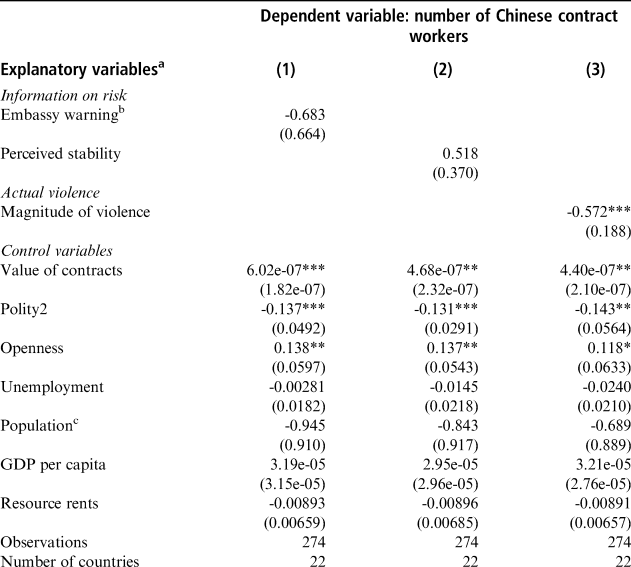
As some countries in our sample have limited statistical capacity, data for certain variables are unavailable for some country-years. For our baseline regressions, the number of observations is 274 and the number of countries is 22.
Results and Discussion
Our baseline results are presented in Table 1. Model 1 tests hypothesis 1, model 2 tests hypothesis 2, while model 3 tests hypothesis 3. Unexpectedly, we find no statistically significant relationship between the number of Chinese engineering contract workers and warnings issued by the Chinese embassy against travel to/in the host country, all other things being equal (model 1). In other words, we find no significant evidence that Chinese contractors completing projects in the region respond to warnings from the Chinese embassy to leave the country by reducing the number of workers they bring over from China. Although the coefficient is negative, it could be owing to chance. Likewise, and also unexpectedly, we find no significant evidence in favour of hypothesis 2, i.e. that Chinese companies decrease the number of workers they send to countries which are perceived as less stable and more likely to experience violent incidents.
Baseline Regressions (Panel Poisson Model with Country Fixed-effects)

Source:
Authors.
Notes:
aAll variables except embassy warning and magnitude of violence lagged by 1 year; b base = 0 (embassy has not issued a warning to leave the country); c natural logarithm. Robust standard errors in parentheses. *** p<0.01, ** p<0.05, * p<0.1.
However, as expected, the coefficient for magnitude of violence in model 3 is positive and statistically significant at the 0.01 per cent level, supporting hypothesis 3 and providing strong evidence that Chinese contractors bring significantly fewer workers (or remove existing workers) when actual violent incidents are experienced in host countries. These results are substantively as well as statistically significant: the incidence rate ratio (IRR) of the magnitude of violence in model 3 is 0.56, indicating that the expected number of Chinese workers would be expected to decrease by a factor of 0.56 (i.e. 44 per cent) in response to a one-unit increase in magnitude of violence, holding other variables constant.Footnote 39
To account for the potential effects of the Arab Spring of 2011, which, following the mass evacuation of Chinese citizens from Libya, further galvanized stronger government efforts to encourage Chinese companies to pay attention to security risks and uncertainties, we also re-ran the baseline regressions including a dummy variable which controls for the pre- and post-Arab Spring periods. The results are reported in Table B1 in the online Appendix B. They indicate no substantive change in the signs or directions of the results.
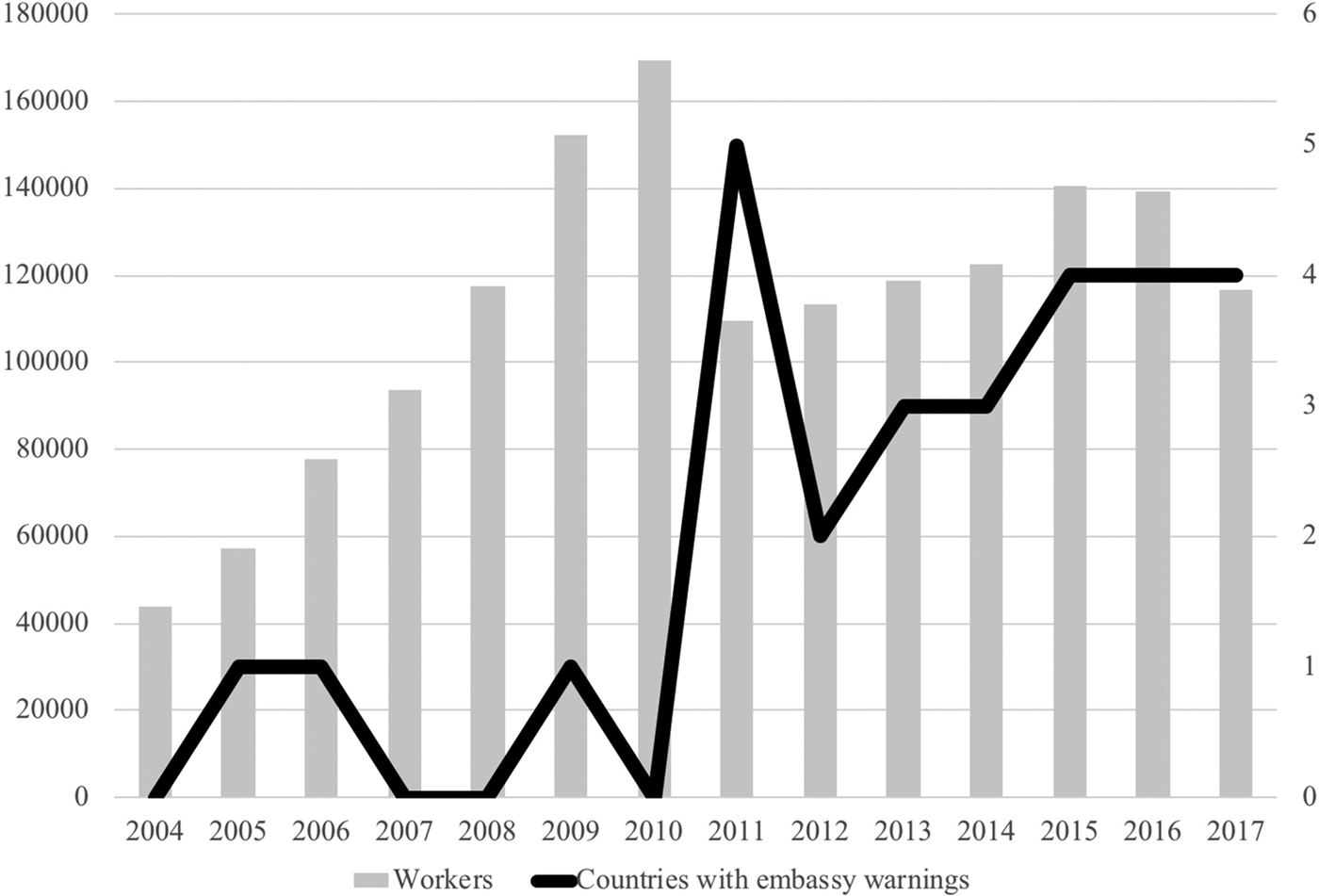
Figure 1, which plots the number of Chinese workers and the number of countries with embassy warnings per year in the region, suggests these patterns occur regionally as well as by country. Although the number of workers declines with the violence of the Arab Spring, it continues to rise after 2012, even as the number of host states facing warnings across the region rises.
Countries with Embassy Warnings and Number of Workers across the Region
Source:
Authors; worker data from ChinaMed.

Results for other control variables and robustness checks
The results for the other control variables are either insignificant or as expected. Contract values and host openness have a positive and significant impact on the number of Chinese workers, as anticipated. Less democratic countries also appear to have more Chinese workers, suggesting that more authoritarian states are more willing to tolerate foreign workers.
We also carried out several robustness checks. First, to make sure that the results are not driven by the extreme case of Libya, we re-ran the baseline regressions dropping Libya from the panel. Second, we re-ran the regressions with a number of alternative or additional control variables. Third, we re-ran the regressions with several alternative statistical models. The results are, with a few exceptions, robust to these alternative specifications. A detailed summary of the rationale, data sources and results of each of the robustness checks is available in the online Appendix C.
Summary of findings
Overall, we do not find significant evidence that Chinese companies respond to embassy warnings or expert perceptions of host stability. Instead, they appear to respond only to violent incidents in host countries by bringing substantially fewer workers from home. The results for H1 and H2, combined with the qualitative evidence offered below, point to the interpretation that Chinese contractors may be failing, at least to some extent, to comply with the Chinese government's prescriptions to take responsibility for the security of their workers overseas. Essentially, they may be either willing to tolerate or incapable of identifying security risks unless significant violent events actually occur.
Anecdotal evidence supports this interpretation of the statistical analysis. For example, according to a study published by the Academy of Macroeconomic Research, the main think tank inside China's National Development and Reform Commission, 99 per cent of Chinese companies active abroad had never purchased export credit insurance before the Arab Spring of 2011.Footnote 40 As lamented by a Chinese security consultant in 2015, “the [Chinese] companies that care the most about security invest less than 1 per cent of their overseas investment budget in it.”Footnote 41 Some exceptions, such as the energy giant China National Petroleum Corporation (CNPC), spend much more and have developed their own risk-assessment and risk-management units.Footnote 42 Yet, the results of the analysis suggest that those exceptions may be few.
Moreover, there is qualitative evidence that Chinese companies are rather unresponsive to warnings from diplomats working in the countries in which they operate who have a better understanding of the situation on the ground. Indeed, immediately after the evacuation from Libya of some 36,000 Chinese nationals, a number of Chinese ambassadors with experience in the Middle East and North Africa told Southern News Network journalists that the extreme unpreparedness of Chinese companies to deal with political risks was far from abnormal.Footnote 43 According to Qin Hongguo 秦鸿国, former ambassador to Kuwait, this problem “has existed for more than 20 years” because Chinese companies are deaf to the warnings of the MFA. Highlighting the same problem, a former Chinese ambassador to an African country told Lucy Corkin that “it is only when problems occur that the Chinese companies contact me; otherwise, they do not see me at all.”Footnote 44 The fact that, on average, for country-years with embassy warnings in our dataset, 1,514 Chinese contract workers remain in the country at the end of the calendar year further suggests that, at least in some cases, embassy warnings are not effective in persuading Chinese contractors to keep workers at home.
Hence, it appears that relying solely on companies to solve the problem of protecting China's citizens abroad may not be a very effective solution and, as a result, Chinese foreign policy may remain vulnerable to shocks caused by instability abroad. Given the significant focus of the Belt and Road Initiative on developing countries, some of which were not included in the ChinaMed dataset but yet present similar dangers, the approach of Chinese companies to the risks of operating abroad and bringing Chinese workers with them may continue to contribute to the emergence of a more securitized Chinese foreign policy. This is a process that to date has happened in a tortuous but steady way.Footnote 45 Our findings may potentially suggest that this process could speed up in the future because of the growing awareness of the Chinese government that past policies have not significantly changed the behaviour of Chinese companies overseas.
Potential explanations
This study does not empirically investigate why we find no concrete evidence that Chinese contractors seek or use information that could help them to manage risk and uncertainty; however, drawing on the existing literature, we suggest some tentative explanations.
First, the literature on Chinese foreign direct investment suggests that Chinese firms with close ties to the state may be more tolerant of uncertainty as a result of a moral hazard problem. SOE managers may assume that further support from the state will be available in unexpected adverse circumstances.Footnote 46 Moreover, SOEs tend to scale down their operations, not to shut them down, in cases of instability in the host country, especially if their activities are meant to achieve a strategic goal set by their government owner.Footnote 47
Second, several studies, most notably that by William Norris, suggest that the Chinese government faces a principal-agent problem when attempting to ensure that Chinese companies act in accordance with the government's wishes abroad.Footnote 48 In the context of the diverging interests of the principal (the government, primarily concerned with citizen safety) and the agents (the companies, concerned first and foremost with profit), the government may lack sufficient information, monitoring and enforcement capabilities to ensure that firms are responsive to warnings about security.
Other research offers additional, complementary explanations. For example, in some cases, managers might overlook risk because they trust in their own experience accumulated in foreign countries.Footnote 49 Chinese companies might also overestimate the resilience of the government of the host country vis-à-vis political instability based on their experience at home.Footnote 50 Private entrepreneurs might make similar calculations, as they expect the members of their social networks to support them in case of trouble.Footnote 51
Yet, it is important to highlight that at least in the case of state-owned and/or large companies, there are also dynamics that should make Chinese managers more risk and uncertainty adverse. For example, James Ohlson finds that wealthier companies seek and use more information than poorer ones.Footnote 52 Moreover, being more reliant on the government of their home country for financial and political support, SOEs tend to comply with the directives issued by their government, although the degree of compliance might be lower in the case of non-central SOEs.Footnote 53 Likewise, Pippa Morgan finds that the principal-agent problem for the Chinese government is least severe for large-scale and state-owned firms operating abroad. Footnote 54 These factors may explain the case of the CNPC mentioned above; however, our analysis suggests that the considerations that make managers more risk and uncertainty acceptant may prevail in many cases, at least until violent events actually occur.
Conclusion
The decision to use the military to protect the country's interests overseas is not an easy one to take. The political, diplomatic and economic costs can be significant. It is the failure of other more conservative policies that is likely to push policymakers to reach a new consensus on the necessity to “move up a gear” and start preparing for the use of the military as an instrument overseas. We argue that this is a likely explanation for some of the recent developments in Chinese foreign policy, including the establishment of China's first military base overseas in Djibouti.
Since the mid-2000s, the Chinese government has implemented a policy aimed at making Chinese companies less risk- and uncertainty-acceptant by threatening punishment for those who disobey, and pushing MOFCOM and, especially, the MFA to provide training and timely information for Chinese companies abroad. However, our statistical analysis of data (that have so far been scarcely or never used) on the Chinese human presence in North Africa, the Middle East and the Horn of Africa strongly suggests that this policy has failed.
While we find strong evidence that Chinese companies reduce the relative number of Chinese workers in the host country when large scale violent events take place, we find no significant indication that they seek and/or use information from either embassies or experts that could help them to avoid these last-minute evacuations or, worse, having their employees caught in the middle of wars or terrorist attacks. Supported by anecdotal evidence, the quantitative approach we use allows us to move beyond previous studies, which focus on specific cases, and demonstrates that this is a well-established pattern among the Chinese companies operating in a part of the world which is increasingly important for Chinese diplomacy but which is also highly unstable. The fact that no significant change in the behaviour of Chinese companies can be observed after the Arab Spring is particularly telling.
Hence, as China's foreign policy remains vulnerable to instability in third countries, the future expansion of its security presence overseas cannot be ruled out. Although the government in Beijing is likely to prefer avoiding the use of expensive military tools, this process might accelerate as actors such as the Chinese navy or top managers of SOEs may try to seize the opportunity to push for more decisive policies in that direction.Footnote 55 This is an important topic for future research. Finally, while we have also discussed a number of potential explanations revolving around the relationship between companies and government as well as cultural factors, statistical analysis alone cannot shed light on why Chinese companies remain highly risk- and uncertainty-acceptant. This is another research-worthy issue for scholars and analysts.
Biographical notes
Andrea GHISELLI is an assistant professor at the School of International Relations and Public Affairs of Fudan University. He is also Research Fellow and Project Manager at the TOChina Hub's ChinaMed Project. His research interests include Chinese foreign policymaking and China's relations with the Middle East and North Africa.
Pippa MORGAN is a lecturer in political science at Duke Kunshan University. Her areas of interest include international and comparative political economy, international relations, Chinese foreign policy, China's foreign aid and foreign direct investment, and China–Africa relations.
Conflicts of interest
None.
Supplementary material
Supplementary material is available online at https://doi.org/10.1017/S0305741020001216.