INTRODUCTION
Insect pests and plant diseases are the most important and difficult problems to solve in organic agriculture production in China (Yang & Song Reference Yang and Song2006). In organic agriculture, the occurrence of insect pests and plant diseases is frequent and serious. However, farmers lack efficient control methods, resulting in yield loss and even crop failure (Wu et al. Reference Wu, Li and Liu2007). At present, bio-pesticides are the most common form of pest control used in organic agriculture (Liu & Liu Reference Liu and Liu2003); however, their cost is often several times higher than chemical pesticides, which makes it difficult for farmers to choose the bio-pesticides alternative, especially those farmers living in more remote areas (Zhu et al. Reference Zhu, Mao and Liu2005). Hence, many farmers dare not develop organic farming simply because of its high input and high risk, which further restrains development of China's organic agriculture.
China has a 5000 year history of agricultural cultivation. Ancient farmers bequeathed valuable treasures to agricultural production practice, including natural methods of pest control (Anonymous 1959). The sources of these natural pesticides are indigenous animals or plants and, therefore, may be renewable and sustainable. A bio-pesticide must be environmentally friendly, protect human health, be easy to produce, convenient to use and of low cost and must not include any synthetic chemical component or promote pest resistance (Zhang et al. Reference Zhang, Wang and Xu2002). Communication between farmers over a long period of time has resulted in the establishment of practical techniques, but these techniques and their implementation are not consistent. There is also a lack of scientific and systematic examination, in contrast to modern technologies (Zhou Reference Zhou1996; Deng Reference Deng2002; Zhang & Li Reference Zhang and Li2002). Studies of effectiveness and mechanisms of action have resulted in patented pesticides, such as azadirachtin and matrine. However, the literature seldom evaluates the potential effect of bio-pesticide use on ecology, economy and the society.
The present study examined a method from Tuanjie, a town near Kunming in Yunnan province. Some of the local farmers in Tuanjie use pumpkin leaf juice to control aphids and caterpillars on vegetables. The present paper investigated the prescription or formula that the farmers were using and their extraction methods (usually similar to those used in the extraction of herbal medicines) and compared them with other control methods to validate the possibility of its adoption (Weltzien Reference Weltzien and Casida1990; Trankner Reference Trankner, Tjamos, Papavizas and Cook1992; Udayagiri et al. Reference Udayagiri, Norton and Welter2000; Zhang et al. Reference Zhang, Yang, Chen, Li and Xie2006). The feeding restraint effect and anti-feeding effect of pumpkin leaf acetone extract (PLAE) on caterpillars were tested and the effect of control was investigated in the field. Further, the economic value of PLAE was estimated.
MATERIALS AND METHODS
Sample preparation
All the insects and pumpkin leaves came from Haobaoqing, an organic vegetable farm 30 km from Kunming.
Fresh, young leaves of Cucurbita ficifolia (pumpkin) (275 g), selected from near the meristem of the tendrils, were immersed in 500 ml acetone and the mixture treated with ultrasound radiation (250 W) for 20 min. The acetone extract was vacuum-filtered, the clear solution was evaporated under vacuum at <55°C and freeze-dried into powder. The weight of dry extract was 23·2 g. When the laboratory examination and field experiments were conducted, 2·8 g dry extract was dissolved in water and made into a 1 litre constant volume emulsion. Because of flocculation and sedimentation on standing, this concentrated emulsion was well shaken prior to use.
Caterpillars of the small cabbage butterfly Pieris rapae Linnaeus (Lepidoptera: pieridae) were reared in Brassica oleracea var. botrytis (cauliflower) fields. Fourth instar caterpillars of identical size and apparent health were selected and starved for 4 h prior to experimentation.
Experimental design, treatments and husbandry
When caterpillars are sprayed with diluted solutions and fed with sprayed leaves, their feeding capability may be restrained. These conditions were simulated and measured in the present research. Reduced feeding by caterpillars was termed a feeding restraint effect and the refusal to eat leaves sprayed with solution was termed an anti-feeding effect. Anti-feeding effect can be measured as either an absolute or a relative effect: the absolute anti-feeding effect compares consumption of PLAE-treated food with consumption of untreated food, whereas the relative anti-feeding effect compares consumption of PLAE-treated food with consumption of food treated with distilled water.
The laboratory bioassay method adopted was modified from that of Mu (Reference Mu1994) and Akhtar & Isman (Reference Akhtar and Isman2004). The field experiment method was modified from that of Ruppel (Reference Ruppel1983) and Stark et al. (Reference Stark, Jepson and Mayer1995).
Feeding restraint effect
Thirty caterpillars were placed into a gauze box and sealed. The concentrated (2·8 g/l) PLAE prepared as described above was diluted into working solutions of 1·40, 0·70, 0·35 and 0·18 g/l. Distilled water was used as a control treatment. All the selected experimental caterpillars were treated by spraying the diluted solutions on the gauze boxes with a hand sprayer until the filter paper underneath the gauze box became wet. After 4 h, all surviving caterpillars were moved to humid Petri dishes containing filter paper, one caterpillar per Petri dish.
Using a punch, leaf discs of 20 mm diameter were prepared and five discs placed into each Petri dish with one caterpillar per disc. Every solution concentration had ten replicates. The area eaten on each disc was determined using a leaf area meter (CI-202).
Absolute anti-feeding effect
It was determined that a 700 mg/l PLAE solution would not kill the caterpillars. Leaf discs (20 mm diameter) were dipped into this solution for 3 s and five discs placed in each Petri dish (diameter 90 mm) after air drying. Finally, one live caterpillar was placed in each Petri dish, with ten replicate dishes. Distilled water was used as a control treatment. Data on area eaten were recorded at respective times using a leaf area meter. Under the given condition, the caterpillar's feeding effect is indicated by absolute anti-feeding effect (defined above as a comparison of PLAE-treated food consumption with that of untreated food).
Relative anti-feeding effect
Six leaf discs were placed in each Petri dish, three of which were treated with 700 mg/l PLAE solution as described above. The remaining three were treated with distilled water and dried to form a control treatment. The experiment then proceeded as in the absolute anti-feeding effect experiment. Under the given condition, the caterpillar's feeding effect is indicated by relative anti-feeding effect (defined above as a comparison of PLAE-treated food consumption with that of food treated with distilled water).
Field experiment
The field study was carried out at the Haobaoqing organic vegetable farm (25°0′ N, 102°7′E, 2030 m asl). The soil type in this farm is red-yellow silty clay loam, rich in iron and alumina. Soil fertility was estimated as moderately sufficient. Biogas fermentation residue was the only soil amendment and the crops planted were alternated every year since 2002. B. oleracea var. botrytis (cauliflower) was sown between 8 February and 10 February 2007 and fertilized twice with biogas fermentation residue (composition not measured), once before sowing and another application after seedlings emerged and were over 100 mm long. Irrigation was applied every day. A sticky yellow card was used to entrap aphids. There were a total of eight blocks (1000 m2 per block) for the experiment: four treated with 700 mg/l PLAE solution, while the remainder formed the control group treated with distilled water. All the experimental fields were sprayed, whether with distilled water or PLAE solution, with a knapsack-type fog machine (SX-16). In accordance with the principle of double blind studies, the spray person was a farmer invited from a nearby village, who then chose blocks to spray. The investigation team were not aware of which block had received distilled water or PLAE solution.
The number of all instars of small cabbage caterpillars and leaf damage levels were recorded before spraying and on day 2, day 5 and day 7 after spraying, using a five-point sampling method, with three cauliflowers being investigated at each point.
Economic evaluation
To examine the practical use of natural pesticides such as pumpkin leaf extract (PLE) solution, economic benefits were also evaluated by comparing the profits from different pest management methods. In order to be practical, convenient to use and of low cost to farmers in poor regions, an aqueous extract of pumpkin leaf was used directly after being crushed and diluted with water. The different pest management methods therefore were: (i) PLE solution, (ii) a commercialized biological pesticide (an aqueous compound of 0·20 Azadirachtin and 0·10 Matrine, trade name Chong Jin), (iii) chemical pesticides and (iv) zero pest management (control). Evaluations were carried out through field investigations and discussions with local farmers who grow crops and use chemical pesticides, while data on PLAE solution, biological pesticides and zero pest control management were collected from Haobaoqing organic farm. The only crop investigated was cauliflower. The numbers of groups investigated in each pest management method ranged from 8 to 23. Investigation content included the yield of cauliflower, the cost of pesticide use and the increase in profit per hectare.
Type and rate of fertilizer application, irrigation characteristics and other characteristics of the fields were held constant. C. ficifolia is widely distributed in the study area and even grows wild. During the investigation, the only other pests present were aphids; since aphids do not seriously harm cauliflower, no pest management treatment was carried out on the crop. The relative economics were evaluated by comparing the profit increase to the lowest profit field. The costs of growing and harvesting were not determined in this research.
Calculations and statistical analysis
The purpose of the present study was to estimate the feeding restraint proportion of small cabbage caterpillars with different exposure approaches to natural pesticide residues. A separate logistic regression was carried out, in which PLE concentration was the independent variable and feeding restraint rate was the dependent variable. Using the regression formula, 0·95 feeding restraint concentration (FC95) and 0·50 feeding restraint concentration (FC50) can be obtained.
For the feeding restraint test and the anti-feeding effect test, the following formats were used:


Here, S c and S t are the areas of the control group and the treatment group, respectively.
The cauliflower leaf protection effect and cabbage worm control effect in field experiments were calculated with the following format (Wang & Huang Reference Wang and Huang1999):

The level of leaf damage was classified into six levels (Li et al. Reference Li, Hao, Wang and Wei2005): 0: intact leaf; I: leaf area eaten was less than or equal to 0·2 of the whole leaf area; II: eaten area 0·2–0·4; III: 0·4–0·6; IV: 0·6–0·8; and V: more than 0·8 of the leaf area was destroyed. When calculating the index of damaged leaves, all these levels were introduced into the formats.
When calculating the insect pest index, caterpillar instars were assigned different damage coefficients, viz. c 1–3 is the damage coefficient for 1–3 instar caterpillars, and c 4 and c 5 are the damage coefficients for 4 and 5 instar caterpillars, respectively (Wang & Huang Reference Wang and Huang1999).
RESULTS
Feeding restraint effect
At 4 h, proportional mortality rates in the 1·40 and 0·35 g/l groups were 0·05 and 0·15, respectively.
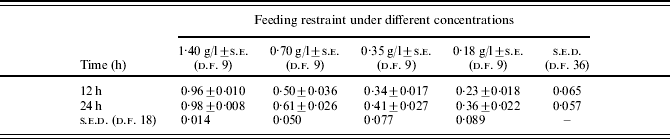
Bioassay results (Table 1) showed that the application of PLAE solution had a restraining effect on the feeding activity of caterpillars. The FC95 at 12 h was 1·34 g/l and at 24 h was 1·28 g/l, while the FC50 at 12 h was 0·63 g/l and at 24 h was 0·46 g/l. The FC95 calculated during 12 and 24 h periods did not show any significant difference, but the FC95 is obviously two to three times higher than FC50.
Feeding restraint effect examination of pumpkin leaf on small cabbage caterpillars
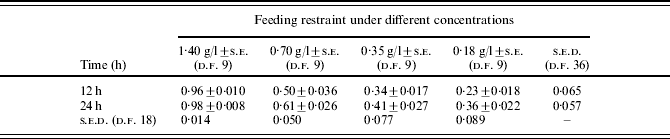
s.e.=standard error; d.f.=degree of freedom; s.e.d.=standard error of difference.
Anti-feeding activity
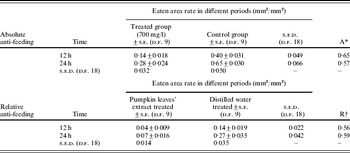
The anti-feeding experiment results (Table 2) showed that the cauliflower leaves processed with 700 mg/l PLAE solution showed a good anti-feeding effect: in both the relative anti-feeding experiment and the absolute anti-feeding experiment, the eaten areas on different processed cauliflower leaves had obvious differences at 12 and 24 h.
Anti-feeding effect examination of PLE on small cabbage caterpillars
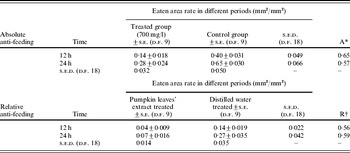
* A=Absolute anti-feeding.
† R=Relative anti-feeding.
Field experiment
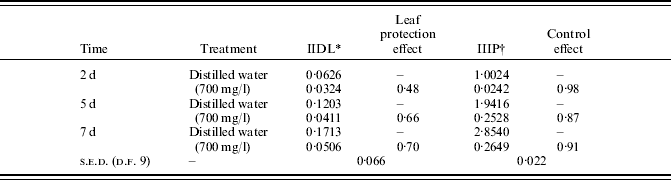
In the field experiment, leaf protection effect was used to determine the damaged leaf reduction after the use of PLAE and control effect was used to determine the pest reduction after the use of PLAE. As is shown in Table 3, the damage to the treated group was significantly less than that to the control group, evidenced by an incremental index decrease in both leaf damage and numbers of caterpillars. On days 2, 5 and 7, the leaf protection effect continued to increase, suggesting a gradual development of the control effect of PLE on caterpillars.
Field management of 700 mg/l PLE on small cabbage caterpillars
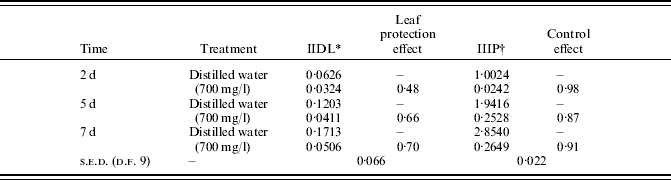
* IIDL=Index increment of damaged leaves.
† IIIP=Index increment of insect pest.
Economic analysis
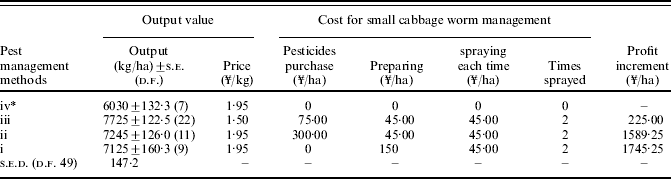
It is shown in Table 4 that the lowest profit came from the group without control for serious pests; although the price of the product was high, the highest profit came from the management with the PLE solution, which was 1747 Yuan/ha higher than the group with zero pest control. Although the cost of commercial biological pesticides was very high, because of higher yield and price, the profit increment from this biological control was also higher than zero pest control at 1589 Yuan/ha. The cost for chemical pesticide use was very low and also brought higher yield, but products without chemical pesticides are preferred by wholesalers and consumers, thus offsetting the high yield and low cost. Therefore, the chemical pesticides control method could only increase profit by 225·00 Yuan/ha compared with the control.
Cost analysis of different pest management methods for small cabbage caterpillar in cauliflower fields
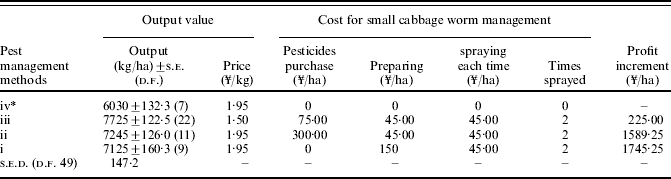
* i=PLE solution; ii=commercialized biological pesticide; iii=chemical pesticides; iv=zero pest management (control).
It is especially worth noting that in the market, the price of organic food is at least twice that of food treated with chemicals. Products produced without chemical pesticides will sell for 30% more to merchants. Even when the profit increments were compared, the products of the other groups, apart from that with no pest control, all made higher profits than the chemical pesticides control group.
DISCUSSION
From the experiments on the feeding restraint effect and anti-feeding effect, it can be concluded that the main mechanisms of PLAE solution of small cabbage caterpillars are feeding restraint and avoidance response, instead of contact kill. Only a small number of the individuals died, even when exposed to high-concentration solutions, and most of the caterpillars exhibited feeding restraint and moved to leaf discs which were without extract. However, both the feeding restraint and anti-feeding activity experiments reflected that the PLAE solution provided effective control of caterpillars and the observed data at 12 and 24 h showed no significant difference. A previous experiment by the present authors also found that PLAE solution provided good control of the instars of Prodenia litura (Fabricius) (tobacco caterpillar) and Plutella xylostella (Linnaeus) (diamond-back moth) through anti-feeding and feeding restraint effects.
When considering both control effect and economic profit, the 700 mg/l concentration can be applied to control small cabbage caterpillars. PLAE solution can only restrain caterpillar feeding activity or force avoidance, instead of killing them directly. Thus the leaves of any new plant growth, which are untainted with PLE, may still be eaten by the remaining caterpillars. Higher concentrations of the extract may modify the adhesion, wetness and spreading of the solution and might improve its control effect (Hu & Hu Reference Hu and Hu1996), making PLE solution more efficient for caterpillar control and giving the potential for widespread practical application.
After completion of the formal anti-feeding experiment, small cabbage caterpillars continued to be fed with cauliflower leaves dipped in PLAE solution until pupation. Although a few individual caterpillars died, most became normal pupae. However, the time of pupation was delayed, and the lengths and weights of the pupae were lower than that of the control group. Although the experiment was rather crude, the implication is that PLAE solution has an effect on the caterpillars' transition to pupae.
For convenience and because of its wide availability, PLE solution could be used as an alternative to chemical pesticides, at least in part, and could significantly benefit farmers. Additionally, pumpkin leaf is a safe material for humans and animals: the tendrils and leaves are often eaten as vegetables by the inhabitants in Yunnan, it is environmentally friendly, can be widely used in organic agriculture for pest control and has good prospects for application and extension of use.
The feeding restraint research method, the anti-feeding activity research method and the field experiment method used in the present study are all mature technologies. There have been many studies about anti-feeding effect of plant extracts on pests, including caterpillars (Matsumoto & Sei Reference Matsumoto and Sei1987; Klocke et al. Reference Klocke, Hu, Chiu and Kubo1991; Wang et al. Reference Wang, Zhu, Yu, Chen and Lu2002), but research on pumpkin leaf as a pest control method has not been found in the literature. Although some farmers in rural China use PLE for the control of aphids, there has been no systematic research on its usage. The products of some pest management plants have been commercialized, such as ryamodol (Gonzalez-Coloma et al. Reference Gonzalez-Coloma, Cabrera, Monzon and Fraga1993) which can be extracted from Persea indica and extracts from the genus Aglaia (Satasook et al. Reference Satasook, Isman, Ishibashi, Medbury, Wiriyachitra and Towers1994) and from Azadirachta indica (neem) (Jarvis et al. Reference Jarvis, Johnson and Morgan1998). However, the price of all those bio-pesticides is very high, at least in China. Many companies also produce pesticides with components similar to those in natural plants through chemical synthesis.
Many other developing countries, such as Cuba (Rosset & Moore Reference Rosset and Moore1997) and Cameroon (Sonwa et al. Reference Sonwa, Coulibaly, Adesina, Weise and Tchatat2002), are using indigenous bio-pesticides to control pests. Without the support of extension services, growers have developed traditional integrated control methods based on the use of plant extracts mixed with conventional pesticides and obtained good control effects.
In conclusion, the pest control characteristics of applied PLAE solution were demonstrated by feeding restraint and anti-feeding research in the laboratory. When the solution concentration of the extract surpasses 700 mg/l, the influence from those higher solution concentrations was not significant. Field experimental results further demonstrated the control effect of PLAE solution on small cabbage caterpillars and even caterpillars of other species. Use of indigenous pesticides, at least for PLE, currently shows economic benefits compared with other pest control methods.
We thank the Yunnan Provincial Science and Technology Bureau for their financial support to perform this study and we acknowledge the support and cooperation of Haobaoqing organic farm. Gratitude is extended to Professor Gary Shook for editing early versions of this paper. Critical comments by two anonymous reviewers significantly improved this paper.