

Research commonly finds that citizens are loss averse: they dislike losses far more than similarly sized gains (Kahneman and Tversky Reference Kahneman and Tversky1984). One implication is that, while political arguments framed in terms of losses to be avoided or gains to be enjoyed can both be persuasive, the former typically have a larger impact on policy attitudes (Arceneaux Reference Arceneaux2012; Cobb and Kuklinski Reference Cobb and Kuklinski1997; Jerit Reference Jerit2009; Quattrone and Tversky Reference Quattrone and Tversky1988). Although several scholars have studied the impact of these frames on public opinion, we know far less about how they affect policy activism.Footnote 1 This is a critical omission because, although politics is sometimes responsive to public opinion, that link is not automatic (Bartels Reference Bartels2008; Gilens Reference Gilens2012). Instead, responsiveness is most likely to occur when both public opinion and activism exert pressure in support of particular goals. As Han (Reference Han2016) notes, policy activists “play multiple important roles in the functioning of our democracy…[and have] policy impacts disproportionate to their size.”
Using field- and survey-based experiments, here we examine the impact of gain- and loss-framed arguments on political activism. Intuitively, we might expect that loss aversion would motivate political action when an individual is reminded of something they stand to lose. Yet here we argue that when people consider taking action, certain contextual features are also salient that, in some cases, can reverse the advantage of loss-framed arguments.
Our expectations are based on three premises. First, decisions to engage in activism prompt thoughts about opportunity costs (Green and Cowden Reference Green and Cowden1992; Verba et al. Reference Verba, Schlozman and Brady1995). Even if people care about an issue, the question of “Can I afford it?” becomes salient and affects whether they perceive that they can spend scarce resources of attention, time, and/or money on activism. Second, these subjective perceptions of affordability are context dependent and can vary apart from objective resources. They depend upon whatever other resource demands are salient at that moment (Shah et al. Reference Shah, Mullainathan and Shafir2012; Thaler Reference Thaler1999). Third, political arguments often make other demands salient by reminding people about existing resource constraints they face. A common example is when arguments in favor of policy change cite threats to material well-being (Chong et al. Reference Chong, Citrin and Conley2001). These arguments remind people about existing material constraints that they may not otherwise be thinking about. For instance, Levine (Reference Levine2015) finds that, among people without health insurance, large medical bills are not automatically salient whenever they are asked to contribute money to a political cause. However, solicitations that reference the high cost of health care remind them about this financial constraint, which diminishes their willingness to donate.
The foregoing considerations lead to our expectations. Critically, the kinds of losses featured in loss-framed arguments are often about material resources. For instance, they may warn that policy change is needed because of threats to financial well-being or health. For those who are already facing financial or health hardships in their own lives, these arguments serve as a reminder about them, which lowers perceptions that they can afford to spend scarce resources on political activism. We expect that, among people already facing related material constraints, loss-framed arguments will therefore reduce policy activism.Footnote 2 Among those not facing related material constraints, we expect that loss-framed arguments will motivate activism. Lastly, because gain-framed arguments typically do not reference material constraints as a potential benefit of policy change, we expect that they will generally be mobilizing.
We examine these expectations with respect to climate change. A key barrier to activism in support of climate-friendly policy is that most people do not see how climate change will affect their daily life (Egan and Mullin Reference Egan and Mullin2012). In response, some have suggested framing the issue in terms of its impact on public health (e.g. Maibach et al. Reference Maibach, Nisbet, Baldwin, Akerlof and Diao2010). Two possibilities focus on how new policies could reduce health risks due to climate change (a loss frame) or how they could achieve certain health benefits (a gain frame; eg. Stokes and Warshaw Reference Stokes and Warshaw2017). Because health is an important resource for political participation (Gollust and Rahn Reference Gollust and Rahn2015; Pacheco and Fletcher Reference Pacheco and Fletcher2015), we expect that framing climate-friendly policies in terms of losses to be avoided (i.e. threats to health that will occur if climate change continues unabated) will remind at least some people of an existing health-related material constraint they face. By “health-related material constraint,” we mean the cognitive and time resources consumed when attending to poor health.Footnote 3 We expect that this frame will demobilize those facing such a constraint.
In what follows, we describe two experiments. One is a large-scale field experiment in which we partnered with an environmental organization to investigate the impact of loss and gain frames on a common form of activism. The second experiment is embedded in an online survey, which will allow us to specifically compare the effect of loss- and gain-framed arguments on those who are and are not facing an existing health constraint.
Experiment 1: loss- and gain-framed arguments in the field
During May 2016, we partnered with an environmental organization to conduct a field experiment. Together we purchased email addresses from Care2, which characterizes its member list as the world’s largest online community for good (see appendix in Supplementary Material for more details). We targeted women on this list, as it meant that we were focusing on a group that our partner believed would be most responsive (c.f. Miller and Krosnick Reference Miller and Krosnick2004).
Ideally, we would have liked to target list members that we knew had experienced health problems in the recent past (and thus were most likely to be reminded of a health-related material constraint). Unfortunately, however, that information was unavailable, and in fact the only other demographic information available was age (and even in this case it was only available for a small, yet random, fraction of the entire list).Footnote 4 In light of this limitation, yet still wanting to narrow our set of respondents as much as possible, we decided to exclude the youngest cohort (those aged 18–25), given that people are more likely to have health problems as they get olderFootnote 5 and also given that those over the age of 25 are more likely to live with children and/or elderly parents that have health emergencies that arise.Footnote 6 That said, we certainly do not expect that loss-framed arguments referring to health will remind everyone in our sample of an existing health-related material constraint, and so that is one reason why a follow-up study with a more precise measure of this individual attribute will be important.
In total, we purchased 100,708 email addresses and randomly assigned respondents to receive one of three messages. The control group received a message that advocated for clean energy policies. It was modeled after language our partner organization already used that first diagnoses the problem (“climate change is real”) and then transitions to a prognosis (“[policies] that promote clean energy the most will have the biggest benefit”). The losses group received the same diagnostic message and prognosis as the control group along with additional information diagnosing the nature of the situation – the harms to public health that would be reduced if we took action. This risk reduction language was modeled after the current “dominant justification” for carbon reduction policies (Bernauer and McGrath Reference Bernauer and McGrath2016) and also followed a similar structure to previous public opinion-based studies of loss aversion (e.g. problem 7 in Quattrone and Tversky (Reference Quattrone and Tversky1988)). Lastly, a gains group received the same diagnostic message and prognosis as the control group along with additional information diagnosing the nature of the situation – the health-related benefits that would occur if we took action. In all cases, we avoided overly catastrophic language and ensured that our treatments were similar in structure and length (see Appendix 1 in Supplementary Material for precise wording).
In total, 33,565 people received the control message, 33,589 received the losses frame, and 33,554 received the gains frame. The emails contained links to an online petition, and respondents were encouraged to sign the petition (and, in doing so, join the partner organization). Cold emails like ours are commonly used to expand organizations’ active bases of support and are thus an important prompt for issue activism (Han Reference Han2016; Karpf Reference Karpf2012). Our measure of activism is the number of people that signed. At first blush, signing a petition and joining an online organization may not seem like they would demand much in the way of scarce resources, yet past work finds that responding to requests like this prompts people to consider opportunity costs and reflect upon if they can “afford it” (Levine Reference Levine2015).
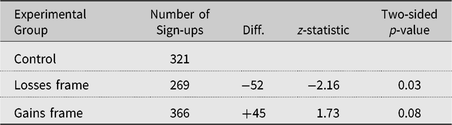
As shown in Table 1, we found that fewer people took action after receiving the losses argument relative to the control. In contrast, significantly more people did after receiving the gains argument relative to the control. These results certainly show how loss-framed arguments can be demobilizing, yet at the same time they are theoretically ambiguous as we did not have a more precise way of measuring whether people were reminded of a health-related material constraint. With that limitation in mind, we designed a second experiment.
Activism in Experiment 1 in Response to Loss and Gain Frames
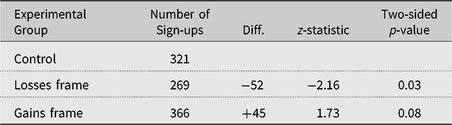
Note: The difference is an estimate of the intent-to-treat effect. z-statistics are based on a comparison of sign-up rates (thus acknowledging slight differences in the number of recipients across experimental groups). Although we stated clear directional expectations, all of our statistical tests are two sided because our partner organization hypothesized effects in the opposite direction (c.f. McClendon Reference McClendon2013).
Experiment 2: further test of loss- and gain-framed arguments
For our second study, we examined loss- and gain-framed arguments in an experiment embedded in a survey. While this context sacrifices some of the realism associated with the field, it enables us to collect more precise information about our respondents so that we can compare responses among people facing health-related material constraints and those who are not. It thus sacrifices realism for greater theoretical precision.
Although surveys often feature nationally representative samples, in our case we wanted one that would approximate the Care2 list in the sense of being relatively liberal and politically engaged, yet also have greater variation in people’s recent health experiences. One kind of convenience sample that satisfies these criteria is Amazon’s Mechanical Turk (AMT) (Berinsky et al. Reference Berinsky, Huber and Lenz2012). While AMT samples are often criticized for their non-representativeness, in the context of our study this is a strength rather than a deficiency.
We recruited 526 people to take our study during November 2016. Subjects were again randomly assigned to receive one of three messages – control, losses, and gains. The text was very similar to the field experiment, though with slight modifications given that these were not tied to our earlier partner organization (see Appendix 2 in Supplementary Material for treatment text, question wordings, and summary statistics).Footnote 7 Afterwards, subjects were asked to join the listserv of 350.org (an environmental organization) in order to gain the opportunity to contact elected officials as well as take other actions.
We also included two questions that measured whether respondents had recently experienced a health-related material constraint. We asked if either they or a family member had experienced a health emergency in the past year. 41.1% indicated yes to at least one question. We label them as having a “health hardship” (see Appendix 2 in Supplementary Material for evidence that this attribute was not systematically related to treatment assignment). Given our argument that loss frames can make pre-existing material constraints salient, we asked about emergencies because the very definition of an emergency implies an event that demands scarce time and attention toward personal matters. Moreover, given the salience of emergencies, we decided it was reasonable to ask about an entire year, as opposed to a much shorter time period in which it is likely that far fewer respondents would answer yes.
Before presenting the results, we briefly describe a pre-test using a separate AMT sample conducted in November 2016. The purpose of this pre-test was to ensure that our gain- and loss-framed arguments satisfied a basic condition of loss aversion: that people viewed them as strong arguments (Chong and Druckman Reference Chong and Druckman2007) and that compared to the control group people viewed the loss-framed argument as making a stronger case for clean energy policy than the gain-framed argument. In this pre-test (N = 309), respondents were randomly assigned to receive either the control, losses, or gains message and then asked: “In your opinion, how strong or weak is this argument for immediately passing clean energy policy?” with seven response options ranging from “extremely strong” to “extremely weak.” In each case average opinions were above the halfway mark, indicating that each argument was viewed as strong as opposed to weak. Yet the difference between the losses frame and the control was larger than the difference between the gains frame and the control. On a 0–1 scale, average opinions in the control, losses, and gains frames were 0.60, 0.72, and 0.67. The two-sided p-value was 0.04 for the comparison between control and loss, and 0.09 for the comparison between control and gain. We found no differences in opinions between those who had and had not experience a health hardship (based on our definition used above).
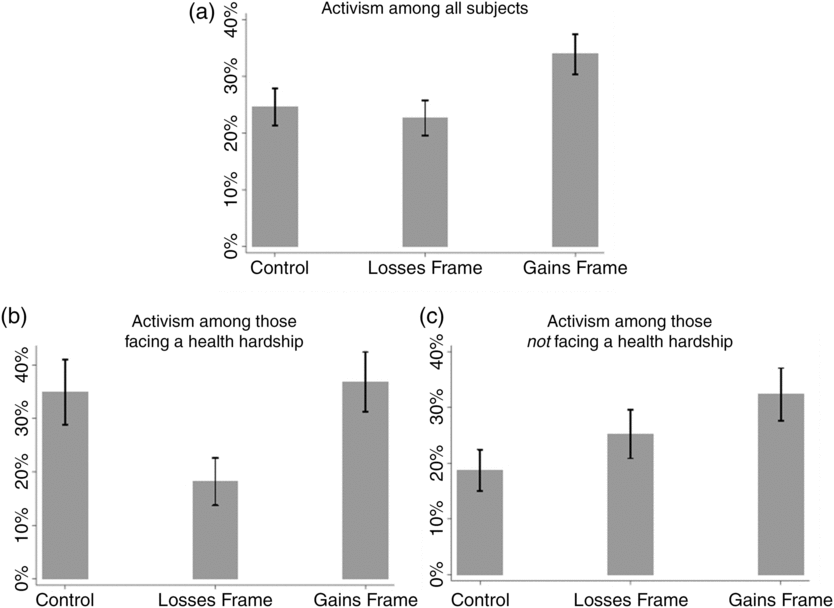
Turning now to the results of the main survey experiment, first we examine behavior among the entire sample (see Figure 1a). As expected, the gains frame was mobilizing – respondents were significantly more likely to sign up relative to the control (33.9% versus 24.6%, z = 1.94, p = 0.05). That pattern did not arise with the losses group: the direction of the effect was negative, yet it was not statistically significant (22.7% versus 24.6%, z = −0.43, p = 0.67).Footnote 8
Activism in experiment 2 in response to loss and gain frames, for all subjects (panel A; N = 526), only subjects who have recently experienced a health hardship (panel B; N = 216), and only subjects who have not recently experienced a health hardship (panel C; N = 310). Y-axis depicts percentage of respondents signing petition/joining organization. Bars represent plus/minus one standard error.
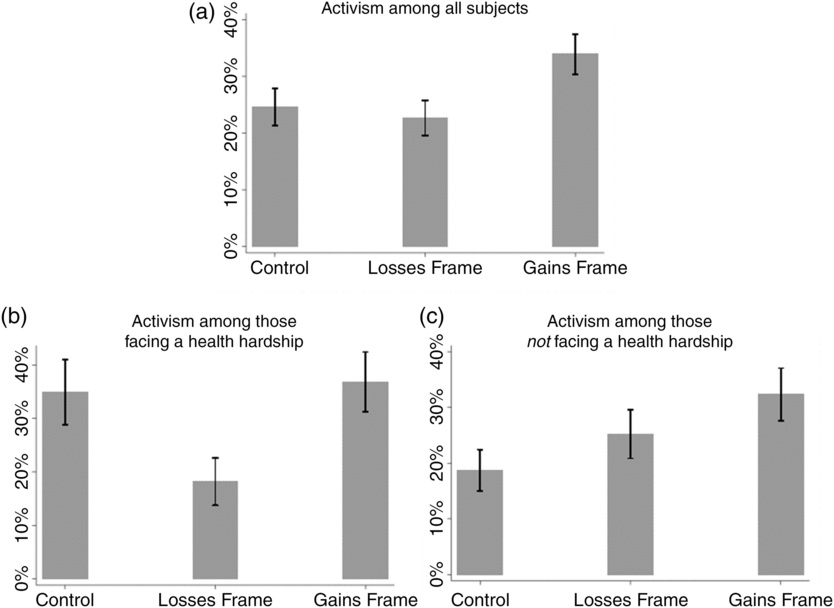
Next, we examine behavior separately for those who have (Figure 1b) and have not (Figure 1c) recently experienced a health hardship. Among those facing a health hardship, the loss-framed argument reduced activism just like in the field experiment (18.2% versus 34.9%, z = −2.38, p = 0.02). The pattern was altogether different among those who received the gains frame, in which the direction of the effect was positive though not statistically significant (36.8% versus 34.9%, z = 0.23, p = 0.82). However, among people not facing a health hardship, we do not observe any evidence of demobilization. In both cases, among those who received either the losses or gains frame, the direction of the effect was positive (comparing losses versus control: 25.2% versus 18.8%, z = 1.12, p = 0.26; comparing gains versus control: 32.3% versus 18.8%, z = 2.20, p = 0.03).
The patterns in Figure 1 raise several other considerations worth discussing. For instance, in the control group those with health hardships were more likely to sign up than those without, which initially may seem unexpected. Given that this attribute is not randomly assigned and we lack a representative sample, we are cautious about drawing firm conclusions. Nevertheless, taking this pattern at face value underscores two critical aspects about activism. First, as mentioned earlier, subjective perceptions about whether one can afford to spend scarce resources on activism vary apart from objective resources. We have argued that the demobilization arising in response to loss frames occurs because people are already experiencing health-related material constraints in their own lives and the loss frames make those constraints salient. Yet in the absence of such salience (like in the control group), we should not necessarily expect people experiencing health-related material constraints to be less active. Second, our results underscore the importance of recruitment. Participants in our experiments all received requests to participate, and past research on activism finds that expected relationships between individual attributes and activism can disappear when looking only at those who are recruited. For example, whereas income and education strongly explain activism across a random sample of the population, Brady et al. (Reference Brady, Schlozman and Verba1999) find that among those who are recruited these two factors do not explain it.
In addition, at first blush, one might be tempted to attribute one of our core results – diminished activism among people facing health hardships in response to the losses frame (see Figure 1b) – to the relatively high level of activism among people facing health hardships who received the control message. Yet note that we did not observe a similar decrease among those who received the gains frame. Thus, the core result is directly attributable to the losses frame itself.
Finally, in Appendix 3 in Supplementary Material, we present results from a second, follow-up MTurk study in which we did not measure action, but we did measure several post-treatment attitudinal measures to provide further evidence of our proposed mechanism. Specifically, we find that the same types of people that were demobilized in our MTurk study (those who received the losses frame and had experienced a health hardship) were also more likely to say that the information they received reminded them about how their health limited their ability to do things they want to do. This was not the case among people who had not experienced a health hardship, nor was it the case among those who received the gains frame. In Appendix 3 in Supplementary Material, we also report results from another attitudinal measure that helps rule out an alternative explanation, as well as a third question that verifies that the loss-framed argument actually reminded people of something they could lose.
Discussion
These findings enhance our understanding of political activism by showing how an otherwise strong argument for getting involved may be demobilizing. As applied to climate politics, our results suggest that the “dominant justification” for carbon reduction policies (Bernauer and McGrath Reference Bernauer and McGrath2016) may unintentionally make policy change less likely.
From a theoretical perspective, they build on previous work showing that people become more active when organizations employ frames that resonate with personal goals such as staying healthy (Han Reference Han2009; Levine Reference Levine2015; Miller and Peterson Reference Miller and Peterson2004). Our results corroborate this key finding with one important exception – this strategy can backfire when the reason an issue resonates with personal goals also reminds people about constraints on the resources they would use for activism. People’s perceptions of whether they can “afford” activism are context dependent, and political rhetoric can affect those perceptions. It is important to recognize this possibility when studying organizational efforts to build political will for policy change.
That said, in this paper we have only analyzed activism with two convenience samples that were largely sympathetic to the issue (see Appendix 2 in Supplementary Material for further evidence of this). Future work should expand the range of respondents and types of activism, perhaps including people specifically chosen for greater ideological diversity. Given the popularity of loss-framed arguments it would also be valuable to study whether other examples from other issue areas remind people about constraints on their money, time, and/or health, thus potentially undermining activism. Finally, because loss-framed arguments, especially related to climate politics, tend to bundle together notions of experiencing loss, reducing risk, and facing material constraints, further research may also seek to unpack the individual effect of each piece.
Supplementary material
To view supplementary material for this article, please visit https://doi.org/10.1017/XPS.2018.28.