Introduction
Auditory verbal hallucinations (AVH) in childhood are common (Jardri et al. Reference Jardri, Bartels-Velthuis, Debbane, Jenner, Kelleher, Dauvilliers, Plazzi, Demeulemeester, David, Rapoport, Dobbelaere, Escher and Fernyhough2014), mostly transitory (Bartels-Velthuis et al. Reference Bartels-Velthuis, van de Willige, Jenner, van Os and Wiersma2011b ) and usually associated with minimal distress or impairment in daily life (Bartels-Velthuis et al. Reference Bartels-Velthuis, Jenner, van de Willige, van Os and Wiersma2010) and only a subgroup of children with AVH experience these as part of a psychotic disorder (Rubio et al. Reference Rubio, Sanjuan, Florez-Salamanca and Cuesta2012). Persistent AVH, however, are associated with psychopathology and cognitive alterations (Bartels-Velthuis et al. Reference Bartels-Velthuis, Blijd-Hoogewys and van Os2011a ).
The aetiology of hallucinations remains largely unknown, but several cognitive mechanisms behind hallucinations have been suggested, including failure in self-monitoring with misattribution of internal cognitive events as originating externally (Waters et al. Reference Waters, Woodward, Allen, Aleman and Sommer2012), and intrusive cognitions in the form of thoughts, memories and auditory imagery (Badcock & Hugdahl, Reference Badcock and Hugdahl2012). Perceptions can be viewed as internal productions made up of both (a) bottom-up sensory input under strong influence of (b) top-down information processing originating from cognitive expectations, based on previous experiences and knowledge (Behrendt, Reference Behrendt1998; Aleman et al. Reference Aleman, Bocker, Hijman, de Haan and Kahn2003; Daalman et al. Reference Daalman, Verkooijen, Derks, Aleman and Sommer2012). Hallucinations have been suggested to arise as a result of errors in top-down information processing of sensory input, with excessive influence of perceptual expectations (Aleman et al. Reference Aleman, Bocker, Hijman, de Haan and Kahn2003). In a recent study, test persons were exposed to unfinished sentences using the ‘semantic expectations (top-down processing) task’, measuring which individuals heard words (top-down errors) at the end of the unfinished sentences in random noise (Daalman et al. Reference Daalman, Verkooijen, Derks, Aleman and Sommer2012). Individuals with non-clinical AVH were influenced more strongly by top-down processing compared to healthy controls. The study by Daalman et al. (Reference Daalman, Verkooijen, Derks, Aleman and Sommer2012) could not demonstrate a significant role for top-down processing in the formation of AVH in individuals with psychotic disorders, but other studies have shown stronger top-down processing in psychotic patients with AVH compared to psychotic individuals who did not experience hallucinations (Aleman et al. Reference Aleman, Bocker, Hijman, de Haan and Kahn2003; Vercammen et al. Reference Vercammen, de Haan and Aleman2008).
AVH are associated with the formation of explanatory delusional ideation in adults (Freeman et al. Reference Freeman, Pugh, Vorontsova, Antley and Slater2010) and it has been suggested that aberrant attribution of salience to normal perceptual input may play a role in the formation of delusions (Kapur, Reference Kapur2003; Holt et al. Reference Holt, Titone, Long, Goff, Cather, Rauch, Judge and Kuperberg2006). Psychotic experiences (PE), including AVH, can be viewed on a continuum model of psychosis (Johns & van Os, Reference Johns and van Os2001), and an extended psychosis phenotype ranging from mentally healthy individuals to individuals with diagnosable psychotic disorders has been suggested (Kaymaz & van Os, Reference Kaymaz and van Os2010). In the general population of children, PE include hallucinatory experiences, delusional ideas and subjective thought disorders (thought withdrawal, broadcasting and insertion). PE may mark vulnerability to psychotic disorder (van Os et al. Reference van Os, Linscott, Myin-Germeys, Delespaul and Krabbendam2009; Kelleher & Cannon, Reference Kelleher and Cannon2011; Jeppesen et al. Reference Jeppesen, Clemmensen, Munkholm, Rimvall, Rask, Jorgensen, Larsen, Petersen, van and Skovgaard2015a ).
Differences in the characteristics and correlates of PE may exist over the continuum that may give rise to hypotheses of distinct mechanisms (Badcock & Hugdahl, Reference Badcock and Hugdahl2012). Just as in research on delusional ideation (Peters et al. Reference Peters, Day, McKenna and Orbach1999), a recent study showed that both similarities and differences exist in comparing AVH in psychotic and otherwise healthy individuals (Daalman et al. Reference Daalman, Boks, Diederen, de Weijer, Blom, Kahn and Sommer2011). Later age of onset, higher frequency and less controllability of AVH were characteristics found in individuals with clinically significant psychosis. Perhaps most crucially, Daalman et al. (Reference Daalman, Boks, Diederen, de Weijer, Blom, Kahn and Sommer2011) also found that AVH in psychotic individuals more often had negative emotional valence compared to AVH in otherwise healthy individuals.
Psychosis often manifests itself in the context of depression (van Rossum et al. Reference van Rossum, Dominguez, Lieb, Wittchen and van Os2011; Chiappelli et al. Reference Chiappelli, Kochunov, DeRiso, Thangavelu, Sampath, Muellerklein, Nugent, Postolache, Carpenter and Hong2014), and depressive symptoms have been shown to be associated with more severe and persistent AVH, causing more distress in patients with psychotic disorders (Smith et al. Reference Smith, Fowler, Freeman, Bebbington, Bashforth, Garety, Dunn and Kuipers2006). An affective pathway to psychosis has been suggested (Myin-Germeys & van Os, Reference Myin-Germeys and van Os2007), and momentary assessment studies of subjective stress and affect have provided evidence of increased emotional reactivity in persons prone to psychosis (Myin-Germeys et al. Reference Myin-Germeys, Peeters, Havermans, Nicolson, DeVries, Delespaul and van Os2003; Oorschot et al. Reference Oorschot, Kwapil, Delespaul and Myin-Germeys2009).
Other pathways to PE and psychosis may involve alterations in Theory of Mind (ToM) – the ability to attribute mental states to others. Specifically, excessive ToM explanations in the context of overall poor ToM (hyper-ToM) have been associated with PE, and paranoid ideation in particular (Clemmensen et al. Reference Clemmensen, van Os, Drukker, Munkholm, Rimvall, Væver, Rask, Bartels-Velthuis, Skovgaard and Jeppesen2016), and Bartels-Velthuis et al. (Reference Bartels-Velthuis, Blijd-Hoogewys and van Os2011a ) showed that better ToM functioning reduced the risk of formation of delusional ideas in children with AVH.
The White Noise (WN) task was introduced in a study in adults as an experimental paradigm for studying top-down processing in individuals with psychotic disorders (Galdos et al. Reference Galdos, Simons, Fernandez-Rivas, Wichers, Peralta, Lataster, Amer, Myin-Germeys, Allardyce, Gonzalez-Torres and van Os2011). Top-down processing was studied by identifying individuals who experienced hearing voices in random noise in the absence of actual speech, referred to as ‘speech illusions’ for the remainder of this article. In that study, speech illusions provoked by the WN task occurred significantly more often in patients with psychotic disorders than in non-clinical controls, and speech illusions were described more often as affectively salient by patients. These results were replicated in adults by Catalan et al. (Reference Catalan, Simons, Bustamante, Drukker, Madrazo, de Artaza, Gorostiza, van Os and Gonzalez-Torres2014). However, there is inconsistency to what degree subclinical expression of psychosis in non-clinical control-groups are associated with speech illusions induced by WN (Galdos et al. Reference Galdos, Simons, Fernandez-Rivas, Wichers, Peralta, Lataster, Amer, Myin-Germeys, Allardyce, Gonzalez-Torres and van Os2011; Catalan et al. Reference Catalan, Simons, Bustamante, Drukker, Madrazo, de Artaza, Gorostiza, van Os and Gonzalez-Torres2014). Furthermore, this association has only been studied in adults.
The current study is, to the best of our knowledge, the first to examine whether the formation of speech illusions during the WN task is associated with markers of vulnerability for psychosis in a large, general-population cohort of pre-adolescent children, and the first study to examine associations between speech illusions and ToM and negative affect in any age group.
We specifically aimed to determine:
-
• The rate of speech illusions in the experimental WN task paradigm in pre-adolescence.
-
• The association between speech illusions and psychosis vulnerability as marked by (1) the presence of PE in pre-adolescence, or (2) a family history of any mental disorder or mental disorder with psychosis.
-
• The association of negative affect with formation of speech illusions.
-
• The association of hyper-ToM with formation of speech illusions.
We hypothesized that speech illusions during the WN task would be associated with increased vulnerability for psychosis as measured by one or several of the following: PE, family liability to psychosis, negative affect and hyper-ToM. Second, we hypothesized that any associations would be stronger for speech illusions with affective content as described in adults (Galdos et al. Reference Galdos, Simons, Fernandez-Rivas, Wichers, Peralta, Lataster, Amer, Myin-Germeys, Allardyce, Gonzalez-Torres and van Os2011; Catalan et al. Reference Catalan, Simons, Bustamante, Drukker, Madrazo, de Artaza, Gorostiza, van Os and Gonzalez-Torres2014).
Method
Study population
The Copenhagen Child Cohort 2000 (CCC2000) comprises all 6090 children born in the year 2000 in 16 municipalities in the county of Copenhagen, Denmark, and is representative for children born in Denmark that year regarding key perinatal characteristics (Skovgaard et al. Reference Skovgaard, Olsen, Houmann, Christiansen, Samberg, Lichtenberg and Jorgensen2005). In the period 2011–2012, a total of 4847 children were eligible for follow-up; 19 had died, 217 had emigrated, 14 were untraceable, and 993 had claimed ‘research protection’ (an option that allows a citizen to avoid inquiries from research and consumer surveys). The parents were contacted up to four times by letter and/or telephone and invited to sign their child up for an interview and assessment, and the study was promoted in local news media. The children received a schoolbag as a gift, and participants participated in monthly lotteries for a gift card of about €700.
Measures
Children participating in face-to-face examinations were invited to undergo semi-structured psychopathology interviews and cognitive tests conducted by trained professionals (three PhD students, one post-doctoral and one psychologist) as well as and two students with special training. The following four parts of the examinations were utilized for the current study on speech illusions.
The WN task
The children wore headphones and were presented with a total of 36 stimuli in completely random order; 12 with WN only, 12 with WN and clearly audible neutral speech, and 12 with WN and barely audible neutral speech. All stimuli were responded to by pressing a number in the range 1–5 using a computer keyboard: 1 = ‘hearing positive voice’, 2 = ‘hearing negative voice’, 3 = ‘hearing neutral voice’, 4 = ‘no speech heard’ and 5 = ‘uncertain’. Hearing any voice in WN only was the variable of interest, and was considered a speech illusion. The 24 stimuli with speech were included to create a level of expectation thereby facilitating increased levels of top-down processing (Galdos et al. Reference Galdos, Simons, Fernandez-Rivas, Wichers, Peralta, Lataster, Amer, Myin-Germeys, Allardyce, Gonzalez-Torres and van Os2011; Catalan et al. Reference Catalan, Simons, Bustamante, Drukker, Madrazo, de Artaza, Gorostiza, van Os and Gonzalez-Torres2014).
Each child with ⩾2 speech illusions was considered exposed according to the WN paradigm. If they only experienced one speech illusion they were considered not exposed, thus minimizing the number of potentially false-positive results (Catalan et al. Reference Catalan, Simons, Bustamante, Drukker, Madrazo, de Artaza, Gorostiza, van Os and Gonzalez-Torres2014). For the analyses, speech illusions were divided into ‘any speech illusions’ (with/without affective content) and ‘speech illusions with affective content’, if at least one of the speech illusions had affective content (was rated positive or negative by the child). We removed children from the analyses who likely misunderstood the task and consistently reported similar speech illusions. Hence, if a child reported 11 or 12 of the same type of speech illusion (out of maximal 12 possible reports of illusions), he/she was excluded. A maximum of two missing responses was accepted (pressing another button than 1–5 resulted in a missing value).
The WN task was conducted last in the test battery, and hence the results of the task were unknown to the interviewers while conducting the interviews with the children. The 3 × 12 tests were randomly applied using E-prime 1.1 (Psychology Software Tools, USA). For the present study, in which the task was part of a larger assessment battery, a short version including only 36 stimuli was used instead of the original 75 stimuli (Galdos et al. Reference Galdos, Simons, Fernandez-Rivas, Wichers, Peralta, Lataster, Amer, Myin-Germeys, Allardyce, Gonzalez-Torres and van Os2011). Hence, the strain on the children was minimized, with the length of the task restricted to 5–10 min. The short version has not been used previously.
PE and affective symptoms
To determine PE and negative affect, the Kiddie-Schedule for Affective Disorders and Schizophrenia – Present and Lifetime Version (K-SADS-PL) sections on psychotic and affective symptoms were utilized (Kaufman et al. Reference Kaufman, Birmaher, Brent, Rao, Flynn, Moreci, Williamson and Ryan1997). Symptoms were scored as ‘not present’ v. ‘likely/definitely present’ during the last month and/or lifetime before. For the analyses, we formed two variables for both PE and negative affect: last month and lifetime (ever).
The measures of any hallucinations and any delusions were assessed by a semi-structured interview with clinical probing and cross-examination of 22 types of PE, using the 22 items from the K-SADS-PL covering nine types of hallucinations and 13 types of delusions.
In accordance with the K-SADS-PL instructions, PE were rated ‘not present’ if the child only heard someone calling their name, if the experience was described as hypothetical, or if the belief was culturally accepted or plausible such as ‘my best friend reads my thoughts’ or solely as part of religious beliefs. In addition, symptoms were rated ‘not present’ if occurring only in relation to sleep, fever, somatic illness, or use of alcohol or medicine.
Any hallucination was rated present when at least one of the nine items of hallucinatory experiences covering all five sensory modalities were scored ‘likely/definitely present’, and likewise any delusion was rated present when at least one of the 13 items of delusional experiences were scored ‘likely/definitely’ present. The history of combined hallucinations and delusions was a priori chosen as index of increased severity and clinical significance of PE (Smeets et al. Reference Smeets, Lataster, Dominguez, Hommes, Lieb, Wittchen and van Os2012, Reference Smeets, Lataster, Van Winkel, de Graaf, Ten and van Os2013; Jeppesen et al. Reference Jeppesen, Clemmensen, Munkholm, Rimvall, Rask, Jorgensen, Larsen, Petersen, van and Skovgaard2015a ).
Negative affect was defined as a rating of ‘depressed mood’, ‘irritability’ and/or ‘anhedonia’, when at least one of these depressive symptoms were likely/definitely present in the period.
Joint ratings of videotaped interviews were held approximately bimonthly throughout the data collection period, and 75 videotaped interviews were independently assessed by four raters, who assessed most children, to determine inter-rater reliability. The agreement was very good for any PE (κ = 0.94) and for any hallucination (κ = 0.91) and moderate for any delusion (κ = 0.64), as reported previously (Jeppesen et al. Reference Jeppesen, Clemmensen, Munkholm, Rimvall, Rask, Jorgensen, Larsen, Petersen, van and Skovgaard2015a ).
For negative affect the inter-rater agreement was also very good: ‘Depressed mood’ (κ = 1), ‘irritability’ (κ = 0.92), ‘anhedonia’ (κ = 0.94), and any depressive symptom (κ = 0.99).
ToM Storybook Frederik
The ToM Storybook Frederik was used to assess ToM. ToM Frederik is the Danish version of the Dutch ToM Storybook Frank (Blijd-Hoogewys & Bartels-Velthuis, Reference Blijd-Hoogewys and Bartels-Velthuis2007) and is aimed at 10- to 14-year-old children in order to test the understanding of second-order false beliefs, white lie, irony, double bluff and ‘faux pas’ (a socially awkward or tactless act). The children are asked a total of 24 questions while being presented with 16 pictures and listening to the storybook read aloud.
The 24 questions consist of 16 ‘test’ and eight ‘justification’ questions. The test answers are scored 0–1; 1 is given for a correct understanding of the situation (range 0–16). The eight justification answers are classified according to 23 predefined categories. Based on these categories, the answers were scored (‘0’, ‘1’, ‘2’, and for some items ‘3’) (range 0–20). Scores on the justification items depend on the level and quality of references made to the thoughts, beliefs, feelings or intentions of the story characters or the child itself (see Clemmensen et al. Reference Clemmensen, van Os, Skovgaard, Vaever, Blijd-Hoogewys, Bartels-Velthuis and Jeppesen2014 for details). The two scales were summed in order to form the total scale score of ToM abilities (range 0–36). The eight justification answers were also scored on a dichotomous scale as a non-mentalizing (‘0’) or mentalizing (‘1’) type of answer, regardless of the classification of the answer as formally right or wrong in the context, resulting in a mentalizing scale score (range 0–8).
Hyper-ToM was defined on the basis of (i) total ToM score below the median combined with (ii) number of mentalizing answers above the median for all children of the cohort who completed the test. A categorical variable was constructed, incorporating both measures to capture children that had a low level of overall ToM abilities while making frequent mental attributions: children who were among the top 50% with regard to number of mentalizing answers, while at the same time among the lowest 50% with regard to overall ToM abilities measured by the total scale score. These children showed a tendency towards exaggerated and aberrant mentalizing explanations, labelled hyper-ToM. Based on 50 children, the inter-rater reliability was good for categorizing children as hyper-ToM (κ = 0.81) (Clemmensen et al. Reference Clemmensen, van Os, Drukker, Munkholm, Rimvall, Væver, Rask, Bartels-Velthuis, Skovgaard and Jeppesen2016).
General cognitive abilities
To examine intelligence as a potential confounder of the associations between speech illusions and psychosis vulnerability, the Block Design (BD) subtest of the Wechsler Intelligence Scale for Children – III (WISC-III) was used as a proxy measure of general cognitive ability. The BD subtest is highly correlated with full-scale IQ in the Wechsler intelligence test (Wechsler, Reference Wechsler2003).
Register data
In order to identify a family history of mental disorders, information regarding diagnosed mental health disorders at psychiatric hospitals or centres in Denmark in any first-degree relative (including father, mother and siblings) was retrieved from the Danish Psychiatric Central Register. We included any registered diagnosis from the date of birth of the parent, or from April 1969 (whichever came last) and until the birth of the CCC2000 index child. For siblings, diagnoses were included until December 2010. A hierarchical exposure variable was constructed with three levels indicating ‘any mental disorder with psychosis’, ‘any other mental disorder’, and ‘no registered psychiatric contacts’ for first-degree relatives. Except for siblings, only diagnoses prior to birth of the index child were included, in order to avoid reverse causation. (For details on the variable and included ICD-8 and ICD-10 diagnoses see Jeppesen et al. Reference Jeppesen, Larsen, Clemmensen, Munkholm, Rimvall, Rask, van, Petersen and Skovgaard2015b .)
Data from the Medical Birth Register and the Integrated Database for Labour Market Research were linked through the Danish Civil Registration System using the personal identification numbers of the CCC2000 children in order to describe their socio-demographic and perinatal characteristics.
Statistics
Background characteristics were compared using χ2 analyses for participants v. non-participants and for participating children with/without speech illusions.
Associations between (affectively salient) speech illusions and PE, family history of mental disorder, negative affect and hyper-ToM were tested using logistic regression analyses, yielding odds ratios (OR) and 95% confidence intervals (CI).
In addition, we tested to what degree (affectively salient) speech illusions were associated with cognitive ability (BD score as proxy for general cognitive ability), sex and age. The multivariable analyses of the independent effects of correlates of speech illusions were adjusted for BD score and sex. Stepwise forward conditional logistic regression was performed.
Inter-rater reliability of the K-SADS-PL was calculated using Cohen's κ.
All analyses were two-sided with a significance level of 5% and performed in SPSS v. 19 (IBM Corp., USA) and Stata v. 13 (StataCorp., USA).
Ethics
The study was approved by the Danish Data Protection Agency (J.nr. 2010-41-4438) and by the Capital Region of Denmark (J.nr. 2007-58-0015). The National Committee on Health Research Ethics was consulted (J.nr. H-C-FSP-2010) in accordance with national guidelines. Participation was voluntary and data were kept confidential. The parents signed up their children for participation in the study and no further consent was required.
Results
Study population
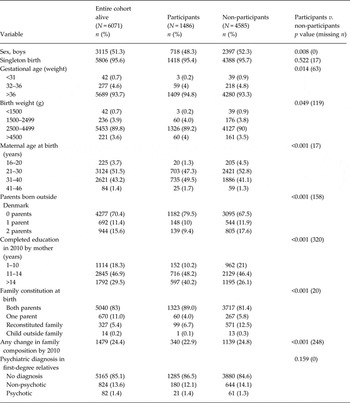
We had complete WN task data on 1490 children (mean age 11.6 years, 51.7% girls). Four children likely misunderstood the task (i.e. reported >10 of the same type of speech illusion), and were removed from all analyses, in line with the exclusion criteria. One child had missing data on hyper-ToM and BD, and was therefore not included in analyses including these variables. The 1486 children (30.7% of eligible children) were compared to the remaining 4585 children in the cohort (Table 1). Non-participants differed slightly, although significantly, in the distribution of male sex, low birthweight, low gestational age, low maternal age, low level of maternal education, not living with both parents at birth and experiencing more changes in family composition.
χ2 analysis comparing participants and non-participants on key perinatal and socioeconomic variables

Prevalence of speech illusions
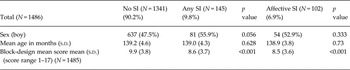
A total of 145 (9.8%) children experienced at least two speech illusions during the WN task. Slightly more boys than girls experienced speech illusions (11.3% boys v. 8.3% girls, p = 0.056). The comparison of children with and without speech illusions with regard to all the sociodemographic and familial background characteristics showed only one significant difference: mothers of children with speech illusions had slightly lower level of education (see Supplementary Table S1). Out of the 145 children with speech illusions, 102 (6.9% of all children) experienced at least one speech illusion with affective content (7.5% boys v. 6.3% girls, p = 0.333). Children who experienced speech illusions had significantly lower BD scores (p<0.001, Table 2). Of the children who were categorized as having speech illusions, 100 (69%) experienced between two and four speech illusions.
Distribution of speech illusions (SI) provoked by the White Noise task across sex, age and IQ estimate

χ2 analysis.
Associated psychosis vulnerability
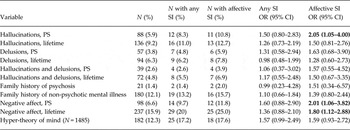
Table 3 depicts univariate analyses describing associations between speech illusions and each of the following variables, lifetime and last month: any hallucinations (regardless of presence of delusions), any delusions (regardless of presence of hallucinations), combined hallucinations and delusions, and negative affect. Furthermore, hyper-ToM and family history of non-psychotic mental disorder and family history of psychotic disorder in first-degree relatives (prior to birth of index child for parents, until age 10 of proband for siblings), are shown. The analyses showed that hallucinations during the last month predicted speech illusions with affective content during the WN test (OR 2.05, 95% CI 1.05–4.00), whereas delusions did not predict speech illusions. Last-month negative affect (OR 2.01, 95% CI 1.06–3.82) and lifetime negative affect (OR 1.80, 95% CI 1.12–2.88) were also significantly associated with affectively salient speech illusions. Associations between speech illusions and hyper-ToM and family history of mental disorders were not significant. Effect sizes were slightly larger for affective speech illusions than for any speech illusion for all variables, and in all cases non-significant for ‘any speech illusion’.
Associations between risk factors of psychosis and speech illusions (SI) during the White Noise task

OR, Odds ratio; CI, confidence interval; PS, present state.
Logistic regression analyses performed for all 1486 included children.
Family history refers only to first-degree relatives.
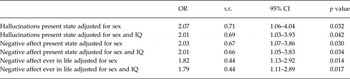
Last month and lifetime negative affect as well as last month hallucinations were adjusted individually for sex and estimated general cognitive ability, defined as the proportion scoring in the lowest 20% on the BD test. All three variables held significance (Table 4).
Adjusted associations between speech illusions and hallucinations and negative affect, respectively

OR, Odds ratio; CI, confidence interval; s.e., standard error.
Multivariate analyses adjusting for sex and low IQ estimate (defined as the estimated 20% lowest scorers on the Block Design test). Analyses conducted on 1485 children.
Discussion
The current study is the first to utilize the WN task in children, and to examine speech illusions in the WN task in relation to emotional dysregulation. We showed that 9.8% of children from the general population experienced at least two speech illusions during the WN task. Experiencing speech illusions was associated with hallucinations during the last month and negative affect both during the last month and lifetime, particularly and significantly for affectively salient speech illusions, also after controlling for sex and estimated general cognitive ability.
The WN studies previously conducted in adults (Galdos et al. Reference Galdos, Simons, Fernandez-Rivas, Wichers, Peralta, Lataster, Amer, Myin-Germeys, Allardyce, Gonzalez-Torres and van Os2011; Catalan et al. Reference Catalan, Simons, Bustamante, Drukker, Madrazo, de Artaza, Gorostiza, van Os and Gonzalez-Torres2014) showed that approximately 9% of controls experienced speech illusions, similar to the number of children in the general population in this study. However, only approximately 1–3% of the adults experienced speech illusions with affective content, whereas this was the case for almost 7% of children in the current study, indicating that children, to a greater degree than adults, may attribute affective salience to speech illusions. The current study used a shorter version of the WN task (36 stimuli) than in previous studies in adults (75 stimuli), and it is possible that the rate of children with speech illusions would have been higher, had the full test been utilized.
The WN task was designed to ‘provoke’ speech illusions in order to study alterations in top-down processing of sensory information and attribution of affective salience, which may mediate psychotic symptoms (Galdos et al. Reference Galdos, Simons, Fernandez-Rivas, Wichers, Peralta, Lataster, Amer, Myin-Germeys, Allardyce, Gonzalez-Torres and van Os2011). The results of this study suggest that such alterations do occur often in apparently normally developing children, to approximately the same extent as previously shown in adults. However, children presenting with negative affect and hallucinations more often experience speech illusions than children without these adversities, suggesting that the children who present with altered top-down processing might be a group of children with an increased vulnerability for psychosis.
Affectively salient speech illusions provoked during the WN task were significantly associated with subjectively experienced and rater verified hallucinations during the last month, using the K-SADS-PL. However, neutral speech illusions were not significantly associated with hallucinations. This finding provides some support to the theory that expressing aberant attribution of salience to one's experiences is associated with PE (Holt et al. Reference Holt, Titone, Long, Goff, Cather, Rauch, Judge and Kuperberg2006).
Pathways from negative cognition and depressed mood towards psychosis have been suggested (Fowler et al. Reference Fowler, Hodgekins, Garety, Freeman, Kuipers, Dunn, Smith and Bebbington2012), mediated by altered affective response to stress (stress sensitivity) (Myin-Germeys & van Os, Reference Myin-Germeys and van Os2007). Experience sampling method studies, in which participants reported emotional states across different contexts related to every-day situations, show that persons prone to psychosis had elevated emotional reactivity to stress (Oorschot et al. Reference Oorschot, Kwapil, Delespaul and Myin-Germeys2009). In support of these theories, the current study has shown that the tendency to experience speech illusions measured by the WN task is associated with observer-based ratings of negative affect. Depressive symptoms have been shown to increase severity and maintainance of AVH (Smith et al. Reference Smith, Fowler, Freeman, Bebbington, Bashforth, Garety, Dunn and Kuipers2006). Daalman et al. (Reference Daalman, Boks, Diederen, de Weijer, Blom, Kahn and Sommer2011) showed that psychotic individuals more often experienced unpleasant AVH compared to non-clinical voice-hearers who rarely experienced voices with emotional valence. Future studies that will re-evaluate the children of the CCC2000 sample in adolescense, will examine if children who experienced speech illusions with affective content show more persistence of hallucinations. The association between speech illusions during the WN task and symptoms of negative affect have not been investigated before, and the current findings should be replicated in other age groups.
Furthermore, psychotic disorders in first-degree relatives were previously shown to be associated with PE in this cohort (Jeppesen et al. Reference Jeppesen, Larsen, Clemmensen, Munkholm, Rimvall, Rask, van, Petersen and Skovgaard2015b ). The association between family history of psychosis and affective speech illusions was suggestive but not statistically significant, indicating that PE as a phenomenon are more directly linked to family history of psychotic disorder compared to the speech illusions detected in the WN paradigm.
The tendency to excessively attribute intentions or self-referential meaning to others (hyper-ToM) has been found to correlate significantly with PE and paranoid ideation in particular in the present sample (Clemmensen et al. Reference Clemmensen, van Os, Skovgaard, Vaever, Blijd-Hoogewys, Bartels-Velthuis and Jeppesen2014). Therefore, the tendency of excessive attribution across social situations measured as hyper-ToM could be expected to also correlate with the excessive attribution of salience and affective salience in relation to WN task. However, in spite of a positive trend, we found no significant association between hyper-ToM and speech illusions, which concurs with the finding that no significant association was found between speech illusions and delusions. This suggests that different mechanisms may underly these different expressions of psychosis vulnerability. However there is evidence that delusions can arise as an attempt to explain anomlous (sensory) experiences (Krabbendam et al. Reference Krabbendam, Myin-Germeys, Hanssen, Bijl, de Graaf, Vollebergh, Bak and van Os2004; Smeets et al. Reference Smeets, Lataster, Dominguez, Hommes, Lieb, Wittchen and van Os2012, Reference Smeets, Lataster, Van Winkel, de Graaf, Ten and van Os2013), and depressive and anxiety symptoms have been suggested to contribute to delusional experiences (Freeman et al. Reference Freeman, Dunn, Fowler, Bebbington, Kuipers, Emsley, Jolley and Garety2013). It will be interesting to follow the children who experienced speech illusions and negative affect in the current study, with regard to if they experience delusions in future CCC2000 studies.
The main strength of the current study lies in the large study sample, allowing demonstration of association in low-power conditions. Data on subclinical psychopathology were obtained using in-depth and comprehensive interviews, and register data were utilized in order to describe the cohort and supplement the study with family history of mental disorder. It would have been of interest to examine if higher levels of speech illusions in the current WN task are progressively more strongly associated with measures of putative risk factors for psychosis (dose-response relationships). This was not possible because the WN data were highly skewed, with only few children experiencing higher levels of speech illusions.
Limitations include the use of a shortened version of the WN task in this study, which precludes direct comparison with the results of WN studies in adults. Moreover, it cannot be ruled out that some children did not correctly understand the WN task, thereby potentially attenuating the results of the study. However, we did control for general cognitive ability, in order to try to accommodate this potential problem. Weaknesses also include the cross-sectional design, limiting the possibility to examine temporal trends. The risk of selection bias should also be mentioned, due to sizeable none-participation rate with some evidence for selection depending on socio-economic and perinatal characteristics of participants. This selection may have restricted the range of clinical characteristics, thereby attenuating the presented associations and possibly biasing the findings towards the null. However, PE were previously shown to be overall non-differential with regard to attrition in the cohort (10.5% prevalence crude, 10.9% prevalence adjusted) (Jeppesen et al. Reference Jeppesen, Clemmensen, Munkholm, Rimvall, Rask, Jorgensen, Larsen, Petersen, van and Skovgaard2015a ), and we have no reason to believe that this is not also the case for speech illusions in the WN task.
Conclusions
Speech illusions with and without affectively salient content were commonly observed when using the WN task in children from the general population. Observer-rated hallucinations (including AVH) according to the K-SADS-PL were detected more often in children who experienced speech illusions with affective content, supporting the expected link between observer-based rating of subjectively experienced hallucinations and experimental speech illusions using the WN task. The WN task thus allows investigation of developmental hypotheses regarding the expression of hallucinations in children and associated psychosis vulnerability. Affectively salient speech illusions were associated with negative affect in children, supporting the theory of an affective pathway to psychosis involving an increased risk to experience hallucinations. Although speech illusions in the WN task were mostly an isolated phenomenon, the associations with negative affect and hallucinations indicate that such experiences are not always necessarily benign. Children with PE more often have a concurrent non-psychotic mental disorder and/or a poorer level of functioning than children without PE (Jeppesen et al. Reference Jeppesen, Clemmensen, Munkholm, Rimvall, Rask, Jorgensen, Larsen, Petersen, van and Skovgaard2015a ; Kelleher et al. Reference Kelleher, Wigman, Harley, O'Hanlon, Coughlan, Rawdon, Murphy, Power, Higgins and Cannon2015), and PE and related distress and impairment should be evaluated as part of the clinical assessment of mental health problems in children and young people.
Supplementary material
For supplementary material accompanying this paper visit http://dx.doi.org/10.1017/S0033291716001112.
Acknowledgements
Grants from the Danish Foundation TrygFonden (J. nr. 7-10-0189 and 7-11-0341); the Lundbeckfonden (J. nr. R54-A5843). The following individuals contributed to the recruitment and assessment of children: Anne Dorothee Müller M.Sc.Psych., Maja Gregersen, M.Sc.Psych. and Nina Ramskov Siegismund M.Sc.
Declaration of Interest
None.