

Introduction
Canada’s healthcare system is frequently described as universal in nature; however, for residents with precarious immigration status, eligibility is conditional on a range of factors, often including province/territory of residence, length of permit and university enrolment or employment (Chen, Reference Chen2017). Assemblage theory of noncitizenship speaks to the ways in which both residency and access to rights and resources, like healthcare, are conditionally assembled through shifting relations of power negotiated via policies, institutions, actors and discourses (Goldring et al., Reference Goldring, Berinstein and Bernhard2009; Landolt and Goldring, Reference Landolt and Goldring2015). An examination of noncitizenship, both as a set of legal categories and as a lived experience, requires “[capturing] the formal and substantive logics of conditionality and frames of deservingness that are woven together” (Landolt and Goldring, Reference Landolt and Goldring2015: 861). Within this context, diverging discourses surrounding healthcare eligibility and accessibility, often following ideas of “deserving” and “undeserving,” have proliferated. For example, refugee claimants have been framed both as deserving of healthcare coverage by mobilizing discourses of vulnerability and human rights, and undeservingly of healthcare coverage through the mobilization of fraud, criminalization and resource scarcity discourses (Villegas and Blower, Reference Villegas and Blower2019). Entitlements for migrant workers have been politicized in different ways—for example, with economic contributions and labour market participation often seen as the basis of deservingness but positioned as undeserving if/when the immigration process renders them without legal status (Hennebry et al., Reference Hennebry, McLaughlin and Preibisch2016; Tungohan and Careless, Reference Tungohan and Careless2023). Among precarious status residents, international students are the fastest growing group in Canada (IRCC, 2024d) and their presence is increasingly politicized (Brunner, Reference Brunner2025; Chatterjee et al., Reference Chatterjee, Gupta, Marom and Su2023). Public healthcare coverage for international students varies considerably across provinces, ranging from no coverage, coverage for certain groups or under specific conditions, to full coverage with a study permit (Glynn, Reference Glynn2026). Given this, where do international students fit within the discursive landscape of healthcare access?
In spring 2018, international students in the province of Manitoba, Canada were stunned to learn that their access to public health insurance was ending and confused as to what this would mean for them in the coming semester. Just six years after public healthcare insurance was extended to include international students studying in Manitoba in 2012, it was rescinded, leaving students to contend with the private system. Using Critical Frame Analysis, this article examines Manitoba Hansard, government documents and media from 2007 to 2023 (39th to 42nd Legislatures) to understand how healthcare access for international students in Manitoba was framed by policymakers and how these discourses differ from those used by other actors. Findings indicate three distinct frames: (1) healthcare provision is positioned as a means of attracting international students as an economic or Market Incentive to immigrate; (2) healthcare provision is framed as a Friendly Gesture of Inclusion, wherein inclusive discourses of wanting to be “welcoming” and “fair” are coupled with recognition of economic and social contribution; and (3) healthcare provision is framed as a Human Right, or a moral imperative that all people deserve in virtue of their humanity. Examining shifts in healthcare eligibility policy for international students in Manitoba provides an instructive illustration of the ways in which frames of deservingness construct and uphold conditionality in the context of noncitizenship. This article demonstrates how adopting a government’s framing of the issue, and the logics of conditionality therein, may lead to strategic gains; however, these same frames may also contribute to conditionality of access rather than concretely securing rights.
International Students as Precarious Migrants in Canada
International student migration can be understood through the assemblage theory of noncitizenship (Landolt and Goldring, Reference Landolt and Goldring2015). Categories of noncitizenship have expanded significantly since the early 2000s in Canada, including different categories of workers and students, and their families, visitor visa holders and people in need of protection. These have been described as precarious legal categories of immigration characterized predominately by (1) conditionality of presence and (2) conditionality of access (Goldring et al., Reference Goldring, Berinstein and Bernhard2009). That is, across all precarious immigration categories, a person’s legal presence within the country and their ability to access the services and resources needed to live are conditional upon a set of criteria established via immigration policies, but also healthcare agencies and hospitals, employers, family members, universities and other administrative bodies. Furthermore, these conditions can be context-specific and are subject to change. As such, this conceptual framework establishes noncitizenship as constituted by “multi-scalar, dynamic, contingent, institutional arrangements involving configurations of disparate elements, including variously situated social actors, relations of power, institutions, regulations, policies, organizations, etc., that come together in patterned but changing ways” (Landolt and Goldring, Reference Landolt and Goldring2015: 856).
In 2023, there was an all-time high of 682,240 international students from over 180 countries granted permits to live and study in Canada—a number that has more than doubled over the last ten years (IRCC, 2024d). This aligns broadly with the general increase in migration to Canada within the 2000s but is also the result of a concerted nation-building recruitment effort to make Canada an attractive place to study (Brunner, Reference Brunner2023b; Kim and Kwak, Reference Kim, Kwak, Kim and Kwak2019; McCartney, Reference McCartney2021; Trilokekar and El Masri, Reference Trilokekar, El Masri, Kim and Kwak2019; Wang-Dufil and Hari, Reference Wang-Dufil and Hari2023). Conditional residency is predicated on a student being accepted into a designated post-secondary institution, demonstrating ties to their home country, being able pay student fees and support dependents. Many students continue to work in Canada on Post-Graduation Work Permits after completing their studies and apply for permanent residency. Student migration has generally been seen as beneficial to Canada not only because of tuition fees but also because of the skill of those who choose to settle in the country permanently (Doyle et al., Reference Doyle, Loveridge and Faamanatu-Eteuati2016). This was amplified during the COVID-19 pandemic and post-pandemic recovery, when many students were allowed to work unlimited hours amid broad labour market shortages (Brunner, Reference Brunner2023b, Reference Brunner2025; Coustere et al., Reference Coustere, Brunner, Shokirova, Karki and Valizadeh2024). Wang-Dufil and Hari (Reference Wang-Dufil and Hari2023) note that Canada’s rationale for attracting international students is characteristic of neoliberalism, prioritizing economic convenience without investment in health and social systems to support migrant student well-being.
International students face numerous challenges transitioning to life in Canada, often impacted by financial insecurity and housing affordability issues (Calder et al., Reference Calder, Richter, Mao, Burns, Mogale and Danko2016). Although international students are permitted to work, they face barriers to labour market access, are often underpaid for their qualifications and subjected to limited working hours (Calder et al., Reference Calder, Richter, Mao, Burns, Mogale and Danko2016; Raghuram, Reference Raghuram2013; Wang-Dufil and Hari, Reference Wang-Dufil and Hari2023). Employment challenges can continue post-graduation—for example, many Post-Graduate Work Permit holders are underemployed and face challenges meeting the requirements for permanent residency (Sweetman and Warman, Reference Sweetman and Warman2013, Reference Sweetman and Warman2014; Vosko, Reference Vosko2020; Wang-Dufil and Hari, Reference Wang-Dufil and Hari2023). Balkaran et al. (Reference Balkaran, Lucchese, Terebessy, Cunningham, Bhangu, Siddiqi, Banerjee, Thakore, Thakore, Guttmann and Wanigaratne2026) found that international students struggle with the constant uncertainty surrounding their financial and immigration status, but are unlikely to reach out for support, making them more vulnerable to mental health challenges (see also: Le et al., Reference Le, Tran-Mai and Tran2025; Moissac et al., Reference Moissac, Graham, Prada, Gueye and Rocque2020).
Research also suggests that international students in Canada are twice as likely to face difficulties in accessing healthcare compared to Canadian citizens (Aboelzahab et al., Reference Aboelzahab, Pinto, McCarthy and Dolovich2024). Access to public social and health services for international students (as well as their family members) are limited, and dependent on maintaining their study permit and overall academic standing (Doyle et al., Reference Doyle, Loveridge and Faamanatu-Eteuati2016; Johnstone and Lee, Reference Johnstone and Lee2014; Kim and Kwak, Reference Kim, Kwak, Kim and Kwak2019). Many international students in Canada do not have access to public health insurance and must utilize private insurance options and/or pay out of pocket (Balkaran et al., Reference Balkaran, Lucchese, Terebessy, Cunningham, Bhangu, Siddiqi, Banerjee, Thakore, Thakore, Guttmann and Wanigaratne2026; Larios et al., Reference Larios, Larsen, Olanubi and Oviosun2023; Omilabu and Neiterman, Reference Omilabu and Neiterman2026; Sarr et al., Reference Sarr, Camara, Adoun and Lapierre2026). For international students with private health insurance, a lack of proper information and support on how to use their coverage prevents them from seeking out and utilizing healthcare when needed (Omilabu and Neiterman, Reference Omilabu and Neiterman2026). More generally, Lee and Guirguis (Reference Lee and Guirguis2021) found that international students experience challenges navigating the Canadian healthcare system, accessing specialists, finding the Canadian equivalent of their previous medications and coping with the costs of medications and treatments. Social, economic and psychological vulnerabilities were further exacerbated for international students during the COVID-19 pandemic (Hari et al., Reference Hari, Nardon and Zhang2021; Zhao and Bhuyan, Reference Zhao and Bhuyan2024).
Since 2024, the presence of international students has been increasingly politicized. Brunner (Reference Brunner2025) cautions that despite economic contributions, students are only welcomed “until [they become] a political liability” (Reference Brunner2025: 17). Amid a growing housing crisis and increased concerns regarding scarcity of public resources across Canada, the steady increase in temporary residents like international students became an issue of political debate and focus (Chatterjee et al., Reference Chatterjee, Gupta, Marom and Su2023; IRCC, 2024a; Passifiume, Reference Passifiume2023). Subsequently, Immigration, Refugees and Citizenship Canada (IRCC) placed an annual cap on study permit issuance as part of the larger plan to reduce the temporary resident population to 5 per cent of the total Canadian population to ease pressure on infrastructure and social services (IRCC, 2025). Other restrictions related to international student migration were also implemented, like additional administrative steps, increasing the financial requirement for student permit applicants (IRCC, 2023), re-imposing caps on the number of hours a student may work (IRCC, 2024c) and only providing work permits for spouses of students enrolled in graduate or certain professional programs (IRCC, 2024b).
Migration for the purposes of study is frequently understood as an act of voluntary mobility that requires a considerable amount of relative privilege (Brunner et al., Reference Brunner, Karki, Valizadeh, Shokirova and Coustere2024, Reference Brunner, Streitwieser and Bhandari2026; Sidhu and Dall’Alba, Reference Sidhu and Dall’Alba2012; Waters, Reference Waters2012). International students must demonstrate they have financial resources (suggesting financial stability), have generally been permitted to work and migrate with their families, their children may attend public schools, and in some provinces, they may access other public services like healthcare. However, these features of the study permit program obscure the ways in which international students, especially those who are racialized, are made precarious through transnational education migration, and the othering and surveillance processes built into these programs (Brunner, Reference Brunner2023a; Vosko, Reference Vosko2020). As Kim and Kwak note, international students are frequently framed as “ideal immigrants” while at the same time “viewed as foreigners less deserving of the same rights and entitlements as permanent residents and citizens, including access to social and health services” (Reference Kim, Kwak, Kim and Kwak2019: 12; see also: McCartney, Reference McCartney2021). This literature has demonstrated the fundamental precariousness of international student migration that speaks to the conditionality of precarious noncitizenship, both in terms of residency opportunities and access to rights and resources within the host country (Goldring et al., Reference Goldring, Berinstein and Bernhard2009; Landolt and Goldring, Reference Landolt and Goldring2015). This sense of precarity and shifting patterns of inclusion and exclusion aligns with Brunner et al.’s articulation of the international student experience, as characterized by “Unfamiliarities, Uncertainties, and Ambivalent Long-Term Intentions” (Reference Brunner, Karki, Valizadeh, Shokirova and Coustere2024: 973) in a context of shifting policies and perceptions.
Healthcare Eligibility for International Students in Manitoba: Case Overview
International student access to public healthcare insurance varies across provinces, educational institutions and individual health statuses. There is wide variation between provinces/territories across Canada with respect to provincial-level health insurance policies (see Figure 1). This includes full access to public health insurance for study permit holders with one-year visas living in Alberta, Saskatchewan, Newfoundland and Labrador, New Brunswick, Prince Edward Island, the Northwest Territories and Nunavut—approximately 11 per cent of the incoming international student population nationally in 2023 (IRCC, 2024d). Other provinces have conditional or partial access to public health insurance for international students—roughly 32 per cent of incoming students in 2023 (IRCC, 2024d). In British Columbia, study permit holders attending postsecondary institutions can access coverage under the provincial insurance plan by paying a monthly premium of $75. In Nova Scotia, study permit holders can access the provincial insurance plan after their first year of studies. In Quebec, international students from the European countries of Belgium, Denmark, Finland, France, Greece, Luxembourg, Norway, Portugal, Romania, Serbia and Sweden can access provincial health insurance under a Social Security Agreement, while all other study permit holders are ineligible. In 2023, 56 per cent of incoming international students were not eligible at all for provincial public health insurance because they resided in Manitoba, Ontario and Yukon (IRCC, 2024d).Footnote 1
Public Healthcare Eligibility for International Students by Province.

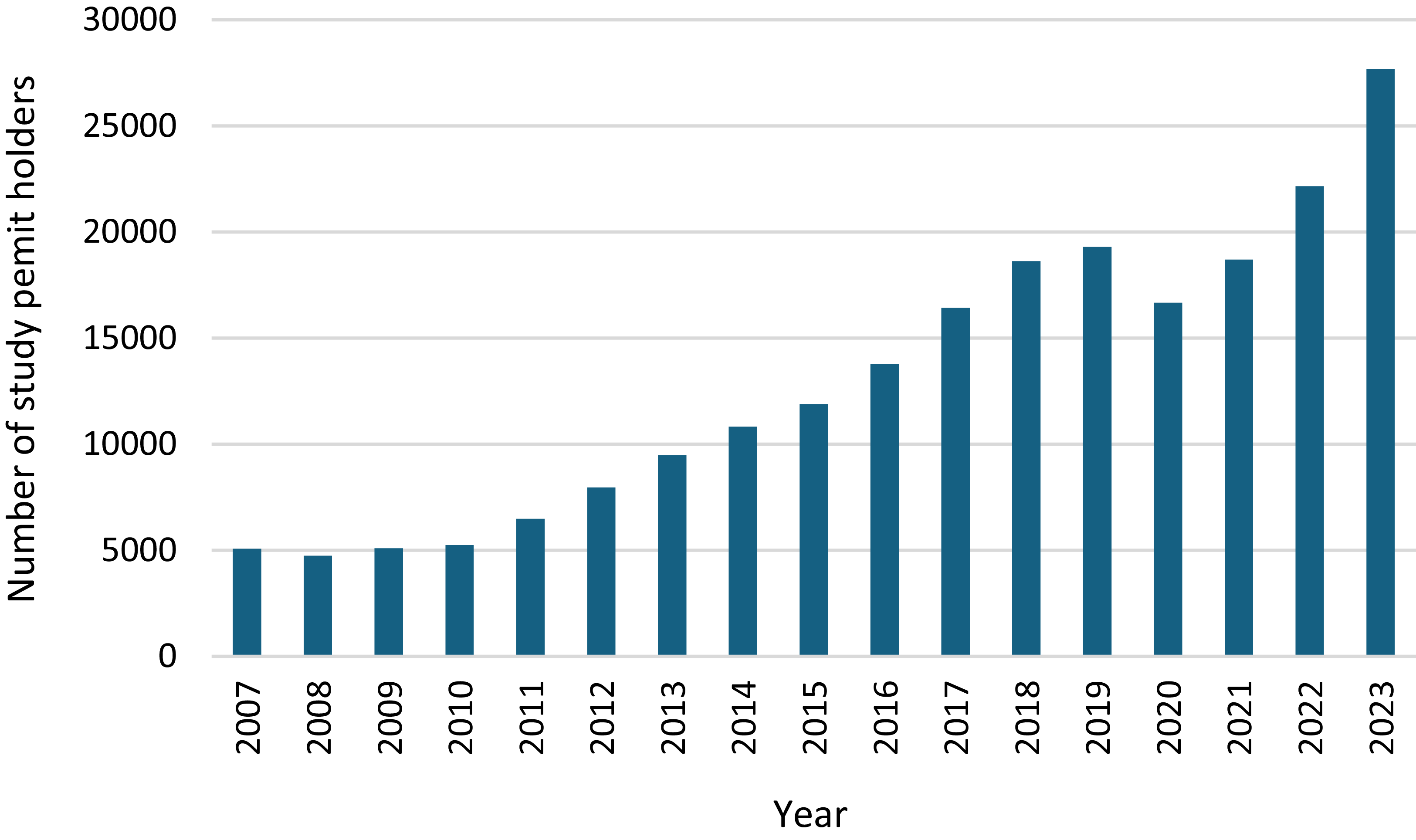
These eligibility conditions are subject to change—for example, Manitoba first opened access to health insurance for study permit holders and their families in 2012 and then removed access in 2018. The 2012 expansion took the form of a change in the Residency & Registration Regulation of the Health Services Insurance Act to include valid study permit holders with permit lengths of over 6 months to be included as residents for the purpose of health insurance. Section 8(1)(a.1) of the regulations was repealed in 2018, with the Health Minister at the time claiming this would save $3.1 million in budgetary spending (CBC News, 2018a). This change left about 18,630 students and their families potentially uninsured and looking to the private insurance system (IRCC, 2024b), and universities scrambling to implement a plan (CBC News, 2018b). In 2020 during the COVID-19 pandemic, the Manitoba government temporarily made commitments to cover screening, testing or treatment associated with COVID-19 regardless of the insurance status of the patient. Community members and advocates have raised concerns as to whether this policy was meaningfully implemented and international students faced considerable healthcare challenges during the pandemic (Larios et al., Reference Larios, Larsen, Olanubi and Oviosun2023; Wichers, Reference Wichers2021). At the time of analysis, in 2023, 27,674 international students were present in Manitoba (IRCC, 2024e). International students represent the largest publicly uninsured group in the province (see Figure 2).
International Students in Manitoba as of December 31 Per Year (IRCC, 2024e).

Students without public insurance are expected to purchase private coverage, often through their institutions. The University of Manitoba, University of Winnipeg and Brandon University participate in the Manitoba International Student Health Plan (MISHP) which is administered by Blue Cross and offers relatively comprehensive coverage for about $1,200 annually (Studentcare, 2026; University of Manitoba, 2026). Students at other post-secondary institutions cannot access MISHP and must purchase other private, often less comprehensive, insurance plans.
University and college plans vary considerably, ranging from quite comprehensive to only covering basic emergency services. Furthermore, depending on the plan and healthcare facility, private insurance plans often still require the costs of care be paid upfront and reimbursed later and may not provide comprehensive coverage for pre-existing conditions or certain types of care, like prenatal and obstetric care, for example (Larios et al., Reference Larios, Patricia Ahonon, Elias and Halldorson2025). While having to rely on private insurance may not be a barrier to students with stable financial resources, who are able-bodied, who do not have partners and children with them and who are not or may not become pregnant, it creates significant challenges for those managing these other considerations. Gaps in coverage can also occur when students experience processing delays in their immigration paperwork (for example, when transitioning between institutions, renewing an expired study permit, or transitioning from a study to a work permit) or when their medical needs mean they cannot maintain full-time student status (Larios et al., Reference Larios, Larsen, Olanubi and Oviosun2023). These challenges can lead to people putting off accessing essential care and accumulating large medical bills (for example, Caulford and Vali, Reference Caulford and Vali2006; Hynie et al., Reference Hynie, Ardern and Robertson2016; Ridde et al., Reference Ridde, Aho and Ndao2020).
Framing Deservingness and Conditionality: Critical Frame Analysis
Assemblage theory of noncitizenship directs attention to the conditionality of residency in a given territory and of access to rights and resources while residing there (Goldring et al., Reference Goldring, Berinstein and Bernhard2009). Assemblages of noncitizen conditionality are dynamic and multi-scalar, including “evolving patterns of formal and substantive claims-making … contoured by shifting policies, configurations of entitlements, and frames of deservingness” (Landolt & Goldring, Reference Landolt and Goldring2015: 856). Such frames of deservingness play a role in the negotiating work of conditional access. Immigration scholars have frequently analyzed the discursive framing of precarious status migrants in Canada to uncover underlying assumptions and logics of conditional residence and access, mapping the discursive contours of deservingness and inclusion. For example, Tungohan and Careless map how migrant workers in Canada have at various times been “tolerated, threatening and celebrated” (Reference Tungohan and Careless2023: 120) and the ways in which these frames have shifted in response to key events (like the COVID-19 pandemic) with direct implications for conditional inclusion. Gaucher (Reference Gaucher2014) uses a discursive frame analysis of media and Hansard to uncover historically embedded assumptions about whose claims to family and citizenship are deemed legitimate and how these shape the conditions of residency and inclusion within the national body. Other research has used framing and discursive analysis to specifically interrogate the contours of healthcare deservingness for noncitizens in Canada. Analyzing shifts in access to healthcare for refugee claimants, Villegas and Blower document how politicians and advocates “framed deservingness and undeservingness to support or contest the [Interim Federal Health Program] cuts” (Reference Villegas and Blower2019: 69), which provided comprehensive, no cost healthcare insurance to claimants while their refugee status is being determined (see also: Huot et al., Reference Huot, Bobadilla, Bailliard and Laliberte Rudman2016). Likewise, M. D. Gagnon et al. (Reference Gagnon, Bhuyan, Gastaldo and Forman2026) analyze how racialized pregnant noncitizens and their citizen children are discursively constructed as “undeserving” through various dimensions of the “birth tourism” frame, where deservingness is often assessed with respect to moral character and economic contribution. This analytic approach offers rich analysis of the ways in which frames of deservingness and inclusion are mobilized and contested as features of the assemblage of noncitizen conditionality.
The role of discourse and framing emerged as a focal point in the study of policymaking following the argumentative turn (Dekker, Reference Dekker2017; Fischer & Forester, Reference Fischer and Forester1993), when attention turned to the ways in which issues are discursively framed as particular types of problems with particular types of solutions fit for the policy agenda. Stone argued that issues become recognized as policy problems when political actors deliberately portray them as such, discursively framing issues to “[attribute] cause, blame, and responsibility” (Reference Stone1989: 282). Rien and Schön elaborated:
Policy frames and their underlying appreciative systems are revealed through the stories participants are disposed to tell about policy situations. These problem-setting stories, frequently based on generative metaphors, link causal accounts of policy problems to particular proposals for action and facilitate the normative leap from “is” to “ought” (Rein & Schön, Reference Rein, Schön and Weiss1977). Because the reality of any policy situation is always richer and more complex than can be grasped through any particular story, policy controversies are inherently subject to multiperspectival accounts. They always carry the potential for interpretation in terms of multiple, conflicting frames where there are no such commonly accepted frameworks for resolution. (Reference Rein and Schön1993: 148)
Rien and Schön further noted that frames themselves are not static, but may shift, extend and blend in response to shifts in political context (Reference Rein and Schön1996: 101); further shaping the political context in the process (Reference Rein and Schön1993: 155).
Critical Frame Analysis (CFA) builds on this body of policy theory, as well discourse analysis, social movement theory and feminist theory to attune researchers to the role of power relations within policy framing processes (Verloo, Reference Verloo2005). Verloo and Lombardo define policy frame as “an organizing principle that transforms fragmentary or incidental information in a structured and meaningful problem, in which a solution is implicitly or explicitly included” (Reference Verloo, Lombardo and Verloo2007: 32). Similar to other policy frame analysis, CFA begins with “the general assumption that a policy (proposal) will always contain an implicit or explicit representation of a diagnosis, connected to an implicit or explicit prognosis and a call for action” (Verloo, Reference Verloo2005: 22). A series of sensitizing questions ground this approach, prompting attention to Voice—who is speaking, from what perspective, using what kinds of concepts and knowledge; Diagnosis—how is the problem represented, what causal stories are being told, who is involved, and what roles are the attributed; Prognosis—what should be done, by who, and how; Normativity—what norms can be identified in the diagnosis and prognosis?; Balance—What dimension or elements are emphasised? What frictions exist? (30–31). Through this approach, CFA uniquely calls attention to “who has voice in defining the problem and who has voice in suggesting suitable courses of action to resolve the problem, […] as well as specific focus on the attribution of responsibilities (for causing the problem or for solving the problem)” (22).
While frame analysis has been used by a wide range of scholars, for example, examining the dynamics of Canadian immigration with respect to focusing events and media framing over time (Lawlor, Reference Lawlor2015; Wallace, Reference Wallace2018) and the politicization of immigration and integration at the federal and subnational levels (Fiřtová, Reference Fiřtová2021; Gagnon & Larios, Reference Gagnon and Larios2021), the explicit attention to voice and power relations is key for examining conditionality of access. As such, this article employs CFA to examine frames of deservingness with respect to the conditionality of healthcare access for international students.
Methods & Analysis
To examine what kinds of frames emerged around the issue of international students and access to healthcare and the different voices present within discussions around international student eligibility, we examined debates within the legislature, media coverage, press releases and other statements released by various organizations in Manitoba. We selected data from 2007 to 2023 to analyze how student migration was framed generally and, specifically, to capture discourses before and after (1) the expansion of healthcare to international students in 2012; (2) the retraction of healthcare coverage in 2018; and (3) the health crisis of the COVID-19 pandemic.
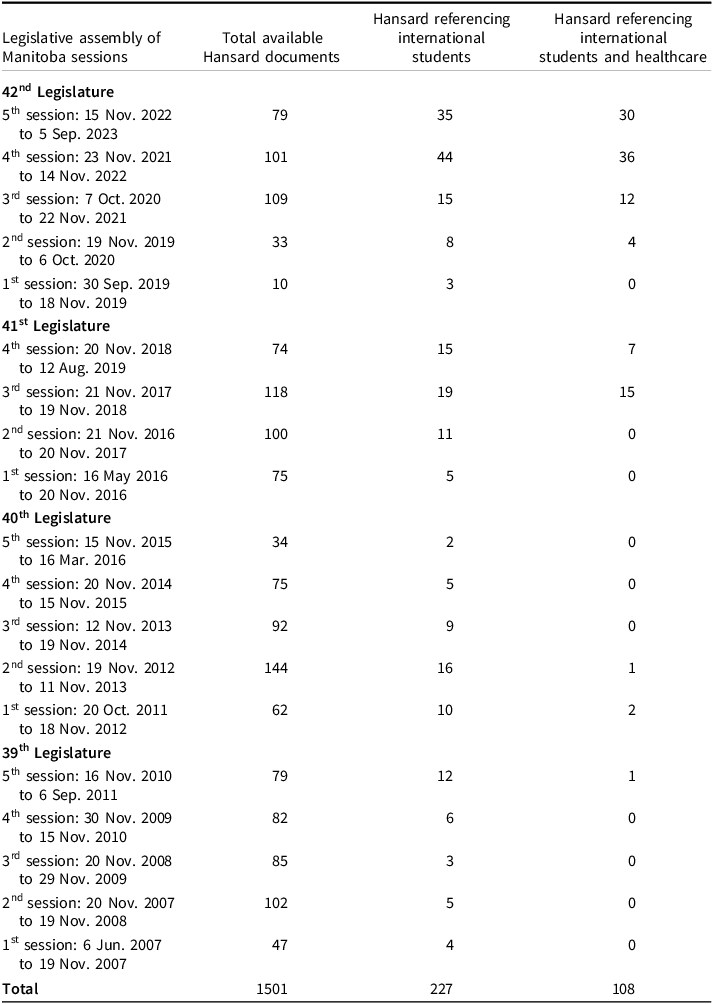
To capture legislative debate, we conducted a search of transcripts of House Debates from the 39th, 40th, 41st and 42nd Manitoba Legislative Assembly, from 6 June 2007 to 5 September 2023. In total, 227 transcriptsFootnote 2 were selected as relevant to the topic of international students and, of those, 108 referred to international student access to healthcare (see Table 1). Additionally, we identified media coverage related to international students and healthcare experiences. Articles were identified within mainstream Manitoba media outlets for coverage using the Eureka media database following the same timeframe as the 39th, 40th, 41st and 42nd Legislatures. This included CTV News Winnipeg, Winnipeg Free Press, Brandon Sun, CBC Manitoba and ICI Radio-Canada Manitoba, resulting in 40 media articles concentrated primarily between 2018 and 2023.
Summary of Hansard Document Data

Table 1. Long description
A table summarizing Hansard document data from the Manitoba Legislative Assembly sessions, detailing references to international students and healthcare. The table has 42 rows and 4 columns. The columns are labeled Total available Hansard documents, Hansard referencing international students, and Hansard referencing international students and healthcare. The rows are labeled with the legislative assembly session, including the legislature number and session dates. Row 1: 42nd Legislature, 5th session: 15 Nov. 2022 to 5 Sep. 2023, 79, 35, 30. Row 2: 42nd Legislature, 4th session: 23 Nov. 2021 to 14 Nov. 2022, 101, 44, 36. Row 3: 42nd Legislature, 3rd session: 7 Oct. 2020 to 22 Nov. 2021, 109, 15, 12. Row 4: 42nd Legislature, 2nd session: 19 Nov. 2019 to 6 Oct. 2020, 33, 8, 4. Row 5: 42nd Legislature, 1st session: 30 Sep. 2019 to 18 Nov. 2019, 10, 3, 0. Row 6: 41st Legislature, 4th session: 20 Nov. 2018 to 12 Aug. 2019, 74, 15, 7. Row 7: 41st Legislature, 3rd session: 21 Nov. 2017 to 19 Nov. 2018, 118, 19, 15. Row 8: 41st Legislature, 2nd session: 21 Nov. 2016 to 20 Nov. 2017, 100, 11, 0. Row 9: 41st Legislature, 1st session: 16 May 2016 to 20 Nov. 2016, 75, 5, 0. Row 10: 40th Legislature, 5th session: 15 Nov. 2015 to 16 Mar. 2016, 34, 2, 0. Row 11: 40th Legislature, 4th session: 20 Nov. 2014 to 15 Nov. 2015, 75, 5, 0. Row 12: 40th Legislature, 3rd session: 12 Nov. 2013 to 19 Nov. 2014, 92, 9, 0. Row 13: 40th Legislature, 2nd session: 19 Nov. 2012 to 11 Nov. 2013, 144, 16, 1. Row 14: 40th Legislature, 1st session: 20 Oct. 2011 to 18 Nov. 2012, 62, 10, 2. Row 15: 39th Legislature, 5th session: 16 Nov. 2010 to 6 Sep. 2011, 79, 12, 1. Row 16: 39th Legislature, 4th session: 30 Nov. 2009 to 15 Nov. 2010, 82, 6, 0. Row 17: 39th Legislature, 3rd session: 20 Nov. 2008 to 29 Nov. 2009, 85, 3, 0. Row 18: 39th Legislature, 2nd session: 20 Nov. 2007 to 19 Nov. 2008, 102, 5, 0. Row 19: 39th Legislature, 1st session: 6 Jun. 2007 to 19 Nov. 2007, 47, 4, 0. Row 20: Total, 1501, 227, 108.
To analyze these documents, we employed a Critical Frame Analysis (CFA) to identify the primary discourses and resulting frames used to discuss and shape understanding of this issue such that dramatic policy shifts were possible (Rein and Schön, Reference Rein and Schön1993; Verloo, Reference Verloo2005; Verloo and Lombardo, Reference Verloo, Lombardo and Verloo2007). Based on our research objectives and themes emerging from the literature, we established a preliminary coding tree in order to do a broad discourse analysis of all collected documents discussing international students. This allowed us to map how student migration and related issues were being debated more broadly and the different voices raising concerns. Based on this overview, we identified passages relevant to healthcare access, seeking to identify and code specifically what was problematized within these passages (diagnosis), what goals and policy responses were being brought forward (prognosis), and by who (voice). Within each diagnosis/prognosis passage, we coded for conditions of deservingness, for example, in relation to economic (via work or tuition) and demographic contributions, and expressions of fairness, inclusion and human rights. Documents were initially coded independently by individual researchers using the coding tree. The research team met regularly to ensure alignment across coders and to discuss the codes, emerging themes and underlying norms and systems (normativity). Finally, we analyzed connections across diagnosis/prognosis and deservingness discourse to establish three key policy frames:
-
1. Healthcare as a Market Incentive
Manitoba’s desire to recruit international students to study and live in the province in the key problem identified in this frame. The provision of public health insurance is framed as a factor that, when provided, may attract international students to come to Manitoba (or, alternatively, motivate them to look elsewhere if not provided). The prognosis is then a matter of market calculus where the economic costs associated with the provision of public health insurance are weighed against the potential economic contributions of international students. It is associated with broader discussion of Manitoba’s “attractiveness” and “competitiveness” to international students and immigrants. International student deservingness of healthcare is conditional upon being strategically advantageous to labour/immigration priorities and when weighed against other types of incentives (e.g., an accessible Provincial Nominee Program, costs of tuition).
-
2. Healthcare as a Friendly Gesture of Inclusion
The provision of public health insurance is framed as a gesture of inclusion which brings together discourses of making Manitoba “welcoming” for international students and other immigrants, such that they will come and want to stay because their role and contributions to the province are acknowledged. Under this frame, this gesture of inclusion is linked to current and future contributions of international students to Manitoba’s economy, communities and multicultural fabric. To the extent that discourses of “fairness” are connected to these contributions—e.g., international students contribute to the community and therefore it is only fair to treat them as community members by providing healthcare—they are included in the gesture of inclusion frame. Importantly, a gesture of inclusion is not a moral mandate, but a gift, voluntarily offered out of good will. Although a different framing of the issue, the key problem at the centre of this frame is still the desire to attract international students, with provision of healthcare as part of the solution. This frame, however, moves away from a purely instrumental assessment of deservingness, highlighting instead values of fairness and inclusion.
-
3. Healthcare as a Human Right
The provision of public health insurance is framed as an important piece of recognizing healthcare as a human right and necessity of life. In this frame we see provision of healthcare positioned as a moral imperative that all people deserve in virtue of their humanity, regardless of immigration or citizenship status. In this frame, the key problem is the existence of barriers to healthcare for international students, including lack of insurance coverage and extreme hospital bills, described as “inhumane” and “unfair.” Provision of public health insurance is put forward as the prescribed policy response, with the view all people are deserving of accessible healthcare in virtue of their humanity.
The following sections trace the emergence of these frames and how they dialogue across three key timepoints: the 2012 expansion of public healthcare insurance to international students, the 2018 removal of healthcare insurance, and healthcare access concerns during the pandemic. In doing so, we trace the shifting discursive landscape of the conditionality of healthcare provision and deservingness in the context of noncitizenship.
Expansion of Public Health Insurance
The subject of immigration in Manitoba is significantly shaped by the “province-building” goals of economic development, meeting labour demands and addressing the need for population (Carter et al., Reference Carter, Morrish and Amoyaw2008; Labman and Zell, Reference Labman, Zell and Dauvergne2021; Paquet, Reference Paquet2014, Reference Paquet2019a; Silvius and Annis, Reference Silvius and Annis2007). The central policy problem that runs through all discussion of international students in the Legislative Assembly is the need to attract international students to Manitoba’s educational institutions and have them settle permanently as immigrants. As a result, questions surrounding access to healthcare for international students generally map onto that goal. This aligns with the broader politics of immigration developing in Canada throughout the early 2000s, focusing on mobilizing a series of temporary residency programs to bolster the Canadian economy (Paquet and Larios, Reference Paquet and Larios2018; Silvius and Annis, Reference Silvius and Annis2007; Sweetman and Warman, Reference Sweetman and Warman2014). Notably, Manitoba was the first province to include post-secondary graduates as eligible under the Provincial Nominee Program, greatly facilitating opportunities for permanent residency for international students in Manitoba (Carter et al., Reference Carter, Morrish and Amoyaw2008). These established norms of connecting temporary migration programmes to economic contributions (normativity) provide a backdrop for the emerging frames related to international students and healthcare access.
In October 2011, Greg Selinger, the leader of the New Democratic Party of Manitoba (NDP), was elected for a fourth consecutive term (beginning in 1999 until 2016). During this mandate, we see a concerted effort to implement policies aimed at making Manitoba a more attractive option for international students and establish provisions to incentivize student migration and settlement (Carter et al., Reference Carter, Morrish and Amoyaw2008)—or “a friendly place to come and learn” (Erin Selby in Legislative Assembly of Manitoba 2013c: 1251). For the government of Manitoba (voice), healthcare provision for international students emerges as a solution (prognosis) to the problem (diagnosis) of failing to attract international students such that Manitoba is missing out on the benefits of student migration for the “educational, social, cultural and economic fabric of our society” (Bidhu Jha in Legislative Assembly of Manitoba 2013c: 1251). From this discussion emerges the Market Incentive frame, wherein the costs of providing of healthcare insurance are economically weighted against the benefits of recruiting students to the province. This framing is further informed by key policy discussions that lay the foundation for the Market Incentive frame including, for example, extensive recruitment efforts (Legislative Assembly of Manitoba 2011a, 2011b, 2012a, 2013f), best practices and protections for students (Legislative Assembly of Manitoba 2013b, 2013c, 2013d), affordable tuition (Legislative Assembly of Manitoba 2011c, 2012d, 2012e) and expanding opportunities for permanent settlement via the Manitoba Provincial Nominee Program (MPNP) (Legislative Assembly of Manitoba 2012b, 2013a, 2016). The provision of public health insurance emerges in early 2011 as one of a suite of programs meant to enhance the attractiveness of Manitoba to international students. Under the Market Incentive frame, being deserving of public healthcare insurance is conditional on international students being an in-demand commodity in the broader market of post-secondary education.
Student voices are largely absent from this discussion. However, John Gerrard (Liberal MLA) and Minister of Health Theresa Oswald (NDP MLA) both reference meetings with the Canadian Federation of Students (CFS)—a student organization representing student unions across the country (Legislative Assembly of Manitoba, 2011d). Gerrard refers to student concerns stating:
International students wishing to see a doctor must endure the stresses of an American-style, insure-yourself or pay-for-it-yourself health-care system under this NDP government. After graduation, we’d like these students to make a home in Manitoba, and, as such, they should be afforded access to the universal health care like any other Manitobans. (Legislative Assembly of Manitoba, 2011d: 1297; emphasis added)
The first line gestures toward the stresses international students faced accessing healthcare at the time. Rather than speaking of these stresses as a potential disincentive to attracting international students, Gerrard frames provision of healthcare insurance as a Gesture of Inclusion—public health insurance is not strictly about an economic calculus but creates a welcoming environment where students are treated fairly. International students are positioned as future Manitobans, evoking a sense of deservingness equivalent to current Manitobans; however, within this frame deservingness is still conditional on making specific contributions to Manitoban society and an intention to reside long-term in the province.
In response, the government, represented by Oswald, expresses agreement and makes a commitment to extend healthcare coverage for international students in Manitoba. This is announced a year later by Erin Selby, then NDP Minister of Advanced Education and Literacy:
Manitoba remains an innovative leader in the international education. In addition to offering domestic and international students quality programs with affordable tuition, Manitoba was the first jurisdiction in Canada to implement the off-campus work program, the first to offer the tuition tax rebate program, and the first to dedicate an international student stream to the Provincial Nominee Program. This year we now extend provincial health care coverage to international students, growing Manitoba’s reputation as a destination choice for thousands of students from around the world. (Legislative Assembly of Manitoba, 2012c: 1379; emphasis added)
Having the Education Minister make this announcement (voice) signals this issue is meant to be seen as an education issue rather than a health issue. Consistent with the Market Incentive frame, public health insurance is listed as a part of a robust package of initiatives meant to draw international students to the province for their education, as well as long-term residency after they graduate. As of September 2012, the NDP provincial government under Selinger expanded public healthcare eligibility to include international students.
After implementation, discussions in the Manitoba legislature regarding international students’ healthcare access are consistently framed with an eye to the impact of health coverage on the competitiveness of Manitoba in attracting international students, such that the Market Incentive frame remains the dominant discourse—for example:
[W]hen we talk about what Manitoba can offer to students, when we tell them that you’ll have an experience in Manitoba that you can’t get anywhere else, it’s not a difficult sell. […] Certainly, in Manitoba we have a very affordable, accessible post-secondary education system, even for international students where our rates are still amongst the lowest in Canada and we have advantages of things such as free health care for students when they’re here in Manitoba. And we know that many of those students decide to stay once they see Manitoba and what we have to offer and, of course, our famous friendliness that everyone is aware of. (Selby in Legislative Assembly of Manitoba, 2013e: 2843; emphasis added)
The provision of public healthcare insurance to international students is an example of expanded conditional access within noncitizenship assemblage. However, throughout this debate, provision of health insurance is consistently framed as a response to an economic need within the province. Under the dominant Market Incentive frame, deservingness or conditions of access hinge on international students being an in-demand economic commodity that Manitoba aims to attract. Under the Gesture of Inclusion frame, there is some consideration of the lived experiences of international students, but provision of health insurance is framed as fair treatment for contributions, and therefore still conditional. Overall, inclusion in the public health insurance system is framed as conditional on perceived economic and other contributions, and becomes vulnerable when these contributions are no longer perceived as in-demand or are seen to be fairly compensated in other ways.
Withdrawal of Public Health Insurance
On 19 April 2016, Brian Pallister (Progressive Conservative Party of Manitoba, PCP) was elected Premier of Manitoba and would go on to be re-elected on 10 September 2019. During his tenure, the conversation around international education remained focused on the economy, attracting international students to Manitoban institutions and enticing them to stay permanently. On 14 March 2018, we see the renewed debate on healthcare and international students in the legislature (Legislative Assembly of Manitoba, 2018a). This discussion emerged at a time when Government was implementing broad cuts to healthcare, climate action, restorative justice and addictions programming, public service wages and workforce, housing and social supports and education (Hajer et al., Reference Hajer, Hudson and Keith2025; Wilt, Reference Wilt2019). It was estimated that cutting healthcare insurance for international students would decrease Government spending by approximately $3.1 million, in addition to cuts to post-secondary funding announced in the 2018 provincial budget (CBC News 2018a). Both the Government (PCP) and the Opposition (NDP) continue to frame the provision of healthcare to international students using the Market Incentive frame, with the debate centring on whether provision of public insurance has an impact on attracting students. Gesture of Inclusion emerges also as a secondary frame mobilized by the non-governing parties. However, with healthcare access under threat, international students themselves and allied community organizations also began vocalizing a new frame—Healthcare as a Human Right—with provision of healthcare being positioned as a right and part of respecting the basic humanity of people regardless of status or specific contributions.
In talking about this policy change, the Government continued to solely mobilize the Market Incentive frame. In a written statement to the media, the then-Education Minister stated, “We do not have evidence to demonstrate that health coverage is a determining factor in [an international student’s] decision to study here” (Glowacki, Reference Glowacki2018). This justification is further explained within the legislative debates, for example, Premier Pallister stated:
Foreign students come to this province not solely because there’s a health-care program but largely because there’s an educational opportunity and they will stay because there’s an economic opportunity. (Legislative Assembly of Manitoba, 2018a: 631; emphasis added)
In particular, they highlighted an economic and immigration calculus that factors in Manitoba’s low tuition, costs of living and immigration opportunities via the MPNP (Legislative Assembly of Manitoba, 2018a, 2018g). As Pallister continued:
The tuition costs in Manitoba will remain the lowest in western Canada, […] I think maybe international students are capable, with their math skills—and I’m confident they are—to understand the real savings they’ll derive by being in a province that has growth opportunities for a change. (Legislative Assembly of Manitoba, 2018a: 632; emphasis added)
While there are sentiments and intentions attributed to international students within these discussions, there is no evidence of consultation with students themselves (voice). The Opposition used the Market Incentive frame to restate the causal story from 2012. They argued that removing access to public health insurance will increase costs for students and make Manitoba less attractive as a destination for international education, noting that “Providing health care for international students has been a key tool for promoting Manitoba around the world” (Flor Marcelino in Legislative Assembly of Manitoba, 2018a: 632; see also: 2018h, 2018g). They argued that this is damaging economically to post-secondary education in Manitoba, as well as future immigration prospects. Wab Kinew, in his role as Leader of the Opposition, stated:
[International students] contribute millions to our economy each year. Now, we do want many of these students who want to put down roots here to contribute to our economy in the long term. However, they won’t be able to put down those roots if they don’t come to the post-secondary institutions in Manitoba in the first place. By cancelling the health coverage, they will be forced to look to other provinces (Legislative Assembly of Manitoba, 2018a: 632; emphasis added).
The Opposition also raised economic concerns for domestic students, warning that decreases in international student enrolment means decrease international tuition (which educational institutions often rely on), and there are risks that the tuition burden will be passed on to domestic students (Legislative Assembly of Manitoba, 2018b). This concern is raised, for example by NDP MLA Amanda Lathlin, within the context of broader cuts to post-secondary funding in the province, and ultimately reinforces the instrumentalization of international students and their needs—“How are we going to ensure that tuition for domestic students does not go up by removing healthcare coverage for international students and making Manitoba less appealing for international students coming to study here in Canada?” (Legislative Assembly of Manitoba, 2018d: 1287; emphasis added).
Distinct from the Government, however, the Opposition couples this Market Incentive frame with the Gesture of Inclusion frame, as seen in the statement below by Kinew, with reference to both competitiveness and fairness.
Now, 7 of 10 provinces cover health insurance for international students, but in Ontario cost of insurance is up to $1,100, right, which could potentially make our institutions less competitive, but it also strikes to an issue of fairness. So why is this government making it harder to attract and retain international students? (Legislative Assembly of Manitoba, 2018a: 631; emphasis added)
Rather than purely instrumental, the Gesture of Inclusion frame couples notions of “fairness” to references of economic and social contribution and intended future membership. Throughout this 2018 debate, we see an invocation of “fairness” and being “welcoming” and “inviting;” importantly this discourse is often linked to ideas of showing “appreciation” and international student contributions as students but also as future Manitobans (Legislative Assembly of Manitoba, 2018c, 2018e, 2018f). This invocation of fairness is consistently paired with concerns around whether treating students “unfairly” will ultimately impact their desire to come and stay in Manitoba. This is characteristic of the Gesture of Inclusion frame, where fairness is about being friendly and inclusive, but ultimately a voluntary action—for example, Marcelino, a vocal NDP MLA on this issue stated, “We are known as a welcoming society, as friendly Manitoba. International students have helped the affordability of our universities and increased the diversity of our post-secondary institutions, but now it’s at risk” (Legislative Assembly of Manitoba, 2018a: 632; emphasis added). This is echoed by Liberal MLA and vocal advocate Gerrard:
…there is an opportunity to welcome these students instead of to say, oh, we’re just going to make you pay more if you come here. I think there would have been a much better way, a much better understanding of the importance that these students are playing in research and innovation, if they’re grad students, bringing ideas and bringing their knowledge and their expertise from around the world to contribute here in Manitoba. And this is a government which is saying, no, no, we’re not so interested in you. We’re just going to cut back on the support for your health care while you’re here. It’s sending the wrong message. (Legislative Assembly of Manitoba, 2018d: 1294; emphasis added)
The Government responses to this frame also indicated key features of framing Healthcare as a Friendly Gesture of Inclusion. For example, Minister Wishart’s statements below take up the language of “welcoming” and inclusivity but suggest there are other ways, aside from healthcare coverage, to be “welcoming” and protect against vulnerability. As the then-Minister of Education and Training stated:
We’re certainly pleased to be an open and inclusive province and very attractive to international students, not only because of our cost-effective tuition, but also because of the welcoming atmosphere in this province. We are working with the stakeholders to make sure that coverage will be available for all international students so that no one is left in a vulnerable position as not having health-care coverage. (Legislative Assembly of Manitoba, 2018b: 725; emphasis added)
This framing continues to ground itself in established norms of recognizing the economic contributions of temporary migration, while also pulling in provincial narratives of Manitoba as a friendly and welcoming province (DeParle, Reference DeParle2010; Sanders, Reference Sanders2012) and a federal immigration politics emphasising Canada as a welcoming place for immigrants (Paquet, Reference Paquet, Birch and François2019b; Trebilcock, Reference Trebilcock2019) (normativity).
The Government at the time challenged this argument. As stated by Kelvin Goertzen, then-Minister of Health, Seniors and Active Living, “I’ve great compassion there, but the Canadian health-care system is not a gift to the world. It is not a gift to the entire totality of our globe” (Legislative Assembly of Manitoba, 2018f: 1465; emphasis added). Here we see the provision of healthcare to non-Canadians (including international students) being framed as a potential “gift,” as opposed to a right or as necessary in virtue of one’s humanity. Gifts are given voluntarily, not out of obligation, but as Gestures of friendship and community. The Government responses here reveal the limits of the framing Healthcare as a Friendly Gesture of Inclusion, which constitutes healthcare provision as a voluntary gesture conditional on the needs and priorities of the Government. Furthermore, it allows for consideration other types of gestures (such as low tuition or accessible permanent residency programs) that can also suggest inclusion and a welcoming environment.
This Gesture of Inclusion frame contrasts with student and community uses of “fairness,” which are connected to healthcare as a Human Right that people are deserving of in virtue of their humanity. For example, former international student and then-chair of the Canadian Federation of Students for Manitoba, Dele Ojewole referred to the policy change as “inhumane” and healthcare access as a “right” (Glowacki, Reference Glowacki2018). Within the framing of the issue by students themselves (voice), conditional and therefore inequitable healthcare access is itself the problem (diagnosis). The policy response (prognosis) advocated for by students was to maintain public health insurance eligibility as a matter of human rights, alongside concerns of fairness and inclusion.
On 27 March 2018, the Government announced that international students, their spouses, and their dependents would no longer be eligible for provincial health insurance as of 1 September 2018. In describing the cut to health insurance, along with a range of other public programmes, Education Minister Ian Wishart stated: “we look for value for money” (as quoted in CBC News, 2018a)—firmly grounding this decision in the Market Incentive frame.
Pandemic Impact and New Possibilities
The spectre of the COVID-19 pandemic renewed debate around access to healthcare coverage in 2020 and the Healthcare as a Human Right frame, positioning healthcare access as a moral imperative that all people deserve in virtue of their humanity, became much more prominent. For example, the Opposition Health Critic at the time, Uzoma Asagwara, argued, “It is all of our responsibilities to make sure that every single Manitoban has equitable access to health care in this province, and that includes our international students” (Legislative Assembly of Manitoba, 2020b: 852; emphasis added). When asked directly as to whether the Government would cover healthcare for international students, the Premier at the time responded that the Opposition was merely engaging in pandemic-related “fear mongering” (2020b: 824). As the pandemic worsened, the Opposition continue to call for international students to be included under public health coverage—for example, Asagwara stated:
The Throne Speech purports to be laying out the path forward and protecting Manitobans, but which Manitobans, Madam Speaker? Which Manitobans is this government purporting to be protecting? I wonder if it’s international students. Is it those folks? Is it the international students who had their health care removed? Is it the international students who are paying exorbitant amounts of money for private insurance and who are now actively discriminated against in our health-care system? Which, maybe, some folks aren’t aware of. I am aware of because I’ve sat down and had conversations with international students who have had nearly catastrophic outcomes trying to access health care in Manitoba and have been denied equitable access because that health care was removed by this government. So you can’t say that you’re putting forward a plan and laying a path to protect Manitobans and not specifically identify which Manitobans you refuse to protect. (Legislative Assembly of Manitoba, 2020a: 129; emphasis added)
This general framing is consistent with shifting norms emphasizing public health and equity across the country in the context of the COVID-19 pandemic (normativity) (Forman and Jackson, Reference Forman and Jackson2023; Machado and Goldenberg, Reference Machado and Goldenberg2021). For example, from 2020 to 2023, Ontario extended public health coverage to all residents of Ontario regardless of status (HNUC, 2020). As the health crisis progressed, the Government of Manitoba agreed to provide COVID-19 vaccinations and cover related healthcare costs for all residing in the province regardless of health insurance status (CBC News, 2021).
Student and community activism is also much more visible in the media and in the legislature (voice)—for example, petitions signed by Manitobans calling for an expansion of public healthcare to international students and others, mobilized by the Healthcare for All Manitoba Coalition, were read aloud in the Manitoba Legislature 23 times by eight different members of the Legislative Assembly across 2021 and 2022 (2021a, 2021b, 2021c, Legislative Assembly of Manitoba, 2021d, 2021e, 2021f, 2022a, 2022b, 2022c, 2022d, 2022e, 2022f, 2022g, 2022h, 2022i, 2022j, 2022k, 2022l, 2022m).Footnote 3 Several international students went to the media to share their stories of trying to access healthcare during the pandemic—all mobilizing and making visible the Human Rights framing—frequently characterized their treatment as inhumane (Larios et al., Reference Larios, Larsen, Olanubi and Oviosun2023; see also: Hari et al., Reference Hari, Nardon and Zhang2021; Zhao and Bhuyan, Reference Zhao and Bhuyan2024). Calvin Lugalambi shared his story of becoming uninsured when transferring between two post-secondary programs causing a gap in his private insurance at a time when he required emergency surgery (Lilley, Reference Lilley2021). While at the hospital, he also caught COVID-19, extending his stay and resulting in over $120,000 in hospital bills. Another student, Ella, experienced a mental health crisis during the pandemic resulting in her missing classes and losing her full-time student status, and her private coverage along with it. When she sought medical support, she was involuntary hospitalized, charged a bill of $38,000 when released, and reported to border authorities when she could not pay (Favaro, Reference Favaro2022). She described the experience as traumatizing and furthering her depression. At a rally at the legislature calling for the province to reinstate public health coverage, one student described the impact of not having comprehensive health coverage, stating, “I’m in a potentially life-threatening situation and I’m thinking of hospital bills and money, and my parents going broke” (as quoted in McKillop, Reference McKillop2022).
Within the petitions signed by constituents, the Opposition’s discourse and the international student experiences shared in the media, the Human Rights frame becomes clear—healthcare is not simply a matter of being welcoming, but of equity, life and death and basic human rights. Treating public healthcare insurance as conditional becomes the problem (diagnosis) as voiced by students and their allies (in government and in community), and the solution (prognosis) is the extension of healthcare insurance as a human right that international students deserve in virtue of their humanity.
During the most recent provincial election in October 2023, the NDP Government spoke to expanded health coverage for international students during their campaign. Upon winning the election on 3 October 2023, NDP Premier Wab Kinew included expanded healthcare coverage in the Mandate letter of the Minister for Higher Education (Kinew, Reference Kinew2023), signaling continued connection of healthcare provision to immigrant recruitment and retention. Students and advocates had hoped to see this implemented by the new academic year in September 2024 (Macintosh, Reference Macintosh2024; MacLean, Reference MacLean2024). However, this promise was not present in the budget in 2024, 2025 and 2026 and the timeline for implementation remains uncertain. At the same time, the politics around international student migration shifted with the federal government voicing criticism towards the reliance on international students (normativity), implementing new caps and limitations on student migration (Chatterjee et al., Reference Chatterjee, Gupta, Marom and Su2023; IRCC, 2025; Passifiume, Reference Passifiume2023). Given the history of connecting healthcare provision to student economic contributions, this new politics troubles the causal story that has been told about international students under the Market Incentive and Gesture of Inclusion frames. Although the Manitoba Government has not reneged its commitment, it is possible that this shift in problem (prognosis) will impact the solution put forward, providing another potential example of the ways in which politics and discourse feature within the precarious nature of noncitizenship assemblage and conditional access.
Conclusion
International student eligibility for public health insurance in Manitoba has both expanded and retracted within the last decade and a half providing a conceptually interesting example of the conditionality of access and the frames of deservingness that discursively constituted noncitizen assemblage for migrant students (Landolt and Goldring, Reference Landolt and Goldring2015). The case demonstrates how immigration and economic context, and the dominant stories and institutional priorities available, can significantly shape the way in which healthcare deservingness is constituted. In a province like Manitoba, recruiting skilled immigrants to address both the labour market and broader demographic needs has been a significant priority shaping all immigration-related concerns. Debate pertaining to international student healthcare eligibility in Manitoba has been dominated by a Market Incentive discourse that frames healthcare provision as a part of generating market appeal for Manitoba with respect to international education migration. Appeals to fairness are also frequent, as evidenced by the Gesture of Inclusion frame, but ultimately do not challenge the underlying diagnosis/prognosis present in the Healthcare as Market Incentive discourse. In both frames, social and economic contributions of international students to the province are a condition to accessing public healthcare, with the offer of healthcare featuring either as a market incentive or part of a fair exchange of benefits. The power to determine which social and economic contributions are prioritized and factored into this calculus remains with the state.
The discussion and debate around healthcare insurance eligibility for international students was framed as an immigration marketing issue, not as fulfilling a basic human right. By extension, if healthcare eligibility no longer contributes to making a program attractive, the market incentive to provide it disappears. This ultimately keeps healthcare access precarious (even when international students were included), as individual provincial governments can decide that health insurance is not needed to make Manitoba an attractive destination for international students or can claim it is focusing on other ways to make the province attractive (e.g., immigration opportunities). Most recently international students and allied community advocates mobilized the frame Healthcare as a Human Right. This frame holds a fundamentally different premise—problematizing the lack of accessible healthcare itself rather than positioning public insurance as a policy solution to an immigration, labour and demography problem. Although activism around healthcare access during the COVID-19 pandemic contributed greatly to the visibility of the Human Right frame, it is unclear whether or how this may shape expanded access within the province.
In 2023, the Manitoba Government made a commitment to reestablish access to public health insurance for international students, positioning this commitment alongside commitments to recruit skilled immigrants. This suggests a continued influence of Market Incentive and Gesture of Inclusion frames, although there has been very little discursive engagement from the Government. At time of writing, this commitment has been reaffirmed but has yet to be implemented. Student and community advocates seeking reestablished access should be mindful of the way this issue continues to be framed, and the logics of conditionality employed therein. Our analysis echoes concerns raised by Brunner et al., who “support strategic calls for more coordinated, cross-sectoral efforts to improve the lived experiences of student-migrants, [but] caution against justifying these calls based on neoliberal, econometric, or (neo)colonial rationales” (Reference Brunner, Karki, Valizadeh, Shokirova and Coustere2024: 973). We suggest that relying on frames that link entitlement to economic contribution can be advantageous and open up opportunities for more substantive rights within a migration and labour context such as Manitoba’s, where temporary migration programs are deeply entangled with economic and province- or nation-building priorities (Carter et al., Reference Carter, Morrish and Amoyaw2008, Reference Carter, Pandey and Townsend2010; Paquet, Reference Paquet2014). However, if the underlying power relations do not also shift, these rights remain conditional. While the expansion of healthcare access to international students and their families in 2012 may seem to indicate that Manitoba is a friendlier province for immigrants, we suggest that this policy shift may be better characterized as a province responding to demographic and economic province-building priorities rather than a secure expansion of migrant rights.


 Open access

