INTRODUCTION
Patients with advanced cancer experience a number of devastating physical and psychosocial symptoms (Paice, Reference Paice2004; Walsh et al., Reference Walsh, Donnelly and Rybicki2000). These debilitating symptoms as well as the diagnosis of an advanced disease impact patient-reported overall health, especially with respect to quality of life (QoL) and well-being. Well-being is a multidimensional state of being that indicates how well one is dealing with life (Cassell, Reference Cassell2013). It can also be defined as the sum total of the cognitive and emotional reactions that patients have when they compare what they actually have and do in life with their aspirations, needs, and other expectations (Calman, Reference Calman1984). Patients with optimal well-being usually have better self-awareness, effective ways of coping with and adjusting to stress, satisfying relationships and a sense of connectedness with others, a sense of faith, a sense of empowerment and confidence, and a belief that they are living with meaning and hope (Lin & Bauer-Wu, Reference Lin and Bauer-Wu2003). Assessment and improvement of feelings of well-being are among the most important goals of cancer care (Cassell, Reference Cassell2013). Patient self-reports of a feeling of well-being as assessed by the Edmonton Symptom Assessment Scale (ESAS) Feeling of Well-Being (FWB) item has been significantly associated with QoL scores (Bush et al., Reference Bush, Parsons and Palmer2010). Cancer-related symptoms and QoL scores have also been found to be associated with overall survival in advanced cancer (Braun et al., Reference Braun, Gupta and Staren2011; Brown et al., Reference Brown, Brodsky and Cataldo2013; Ganz et al., Reference Ganz, Lee and Siau1991; Schonwetter et al., Reference Schonwetter, Robinson and Ramirez1994; Ballatori et al., Reference Ballatori, Roila, Ruggeri, Preedy and Watson2010; Qi et al., Reference Qi, Schild and Mandrekar2009; Rummans et al., Reference Rummans, Clark and Sloan2006; Sloan et al., Reference Sloan, Loprinzi and Kuross1998; Wang et al., Reference Wang, Shi and Lu2010; Derogatis et al., Reference Derogatis, Abeloff and Melisaratos1979; Vodermaier et al., Reference Vodermaier, Linden and Rnic2014). The tools utilized to assess symptoms and quality of life are not often used in daily patient care. The ESAS is regularly used for assessment and management of symptoms in patients with advanced cancer (Pereira et al., Reference Pereira, Green and Molloy2014). Regular monitoring of sense of well-being by the ESAS could be a very useful target for palliative care interventions purposed to improve quality of life. To the best of our knowledge, there have not been any studies aimed at determining the main predictors of ESAS well-being or at evaluating the association between well-being and survival.
The primary objective of our study was to determine the factors associated with feelings of well-being using the Edmonton Symptom Assessment Scale–Feeling of Well-Being item (ESAS–FWB; 0 = best, 10 = worst) in patients with advanced non-small-cell lung or non-colonic gastrointestinal (GI) cancer who had been referred to an outpatient supportive care clinic (OSCC). We also examined the association of ESAS–FWB score with overall survival (OS). We included only subjects with advanced non-small-cell lung and non-colonic gastrointestinal cancer because these patients have a predictable trajectory of illness as well as a well-defined prognosis. In addition, they also receive well-defined homogenous therapy. Furthermore, they were the most frequently referred patients to palliative care with moderate to severe symptoms (Yennurajalingam et al., Reference Yennurajalingam, Urbauer and Casper2011).
METHODS
We received approval from the University of Texas MD Anderson Cancer Center Institutional Review Board to conduct our study. Due diligence was taken to protect patient confidentiality.
In this retrospective study, we reviewed the electronic medical records of 826 consecutive advanced cancer patients at the time of first consultation at the OSCC of a comprehensive cancer center from 1 January 2008 to 31 December 2013. To be eligible for inclusion, patients had to (1) have advanced non-small-cell lung or non-colonic GI cancer (where advanced cancer was defined as metastatic, locally advanced, or recurrent incurable cancer), and (2) be seen as an initial consult in the OSCC between 1 January 2008 and 31 December 2013.
All data retrieved from patients' electronic medical records and analyzed were gathered as part of routine clinical care.
Outcome Measures
The outcome variables for our study included patient demographics (age, sex, cancer diagnosis, primary tumor site, cancer stage); symptoms as assessed by the Edmonton Symptom Assessment Scale (ESAS); performance status as measured by the Zubrod scale (Zubrod et al., Reference Zubrod, Schneiderman and Frei1960); overall survival; Memorial Delirium Assessment Scale (MDAS) score (Breitbart et al., Reference Breitbart, Rosenfeld and Roth1997); weight changes (per month and at 6 months); CAGE Questionnaire (cut down, annoyed, guilty, eye opener) score; weight loss; hemoglobin; electrolytes; neutrophil–lymphocyte ratio (NLR); morphine equivalent daily dose (MEDD); and serum albumin levels. The ESAS, MDAS, and CAGE are patient self-report measures that were routinely evaluated in all patients presenting to the OSCC during the study period. Primary caregiver distress was routinely evaluated as a part of the standard assessment procedure during an OSCC visit. This was initially evaluated by the clinic nurse at the initial consult or at follow-up visits. The clinic nurse evaluated the patient alone or with a family caregiver (when both were present) to determine the structure and function of the family, including identification of the primary family caregiver (PFC) and the presence of PFC distress. This information was then discussed with the treating physician, who further evaluated the severity of the primary caregiver distress and developed a management plan along with the palliative care team. This may have included consideration of referral to a counselor or conducting split family visits. During a split family visit, one of the healthcare professional (physician, nurse, or counselor) stayed with the patient, and another healthcare professional independently provided counsel to the PFC. This information was later documented in the medical records by the physician. It can be readily seen that PFC distress is an interdisciplinary diagnosis that results from evaluation by a nurse and a physician during a clinic visit.
ESAS
We previously designed the ESAS to determine the severity of 10 symptoms commonly experienced by cancer patients during the previous 24 hours. These included pain, fatigue, nausea, depression, anxiety, drowsiness, dyspnea, anorexia, other symptoms (sleep disturbance), and feelings of well-being (Bruera et al., Reference Bruera, Kuehn and Miller1991). The severity of each symptom is rated on a numerical scale of 0 to 10 (0 = no symptoms, 10 = worst possible symptom severity). The ESAS is both valid and reliable in assessing the intensity of symptoms in cancer patients (Carvajal et al., Reference Carvajal, Centeno and Watson2011; Chang et al., Reference Chang, Hwang and Feuerman2000). Symptom distress score is defined as a composite of all of the symptoms listed in the ESAS (Cheung et al., Reference Cheung, Barmala and Zarinehbaf2009).
We also categorized the ESAS symptoms as follows:
-
■ ESAS physical: sum of pain, shortness of breath, appetite, nausea, fatigue, and drowsiness scores.
-
■ ESAS psychological: sum of anxiety, and depression scores.
— (see Selby et al., Reference Selby, Chakraborty and Myers2011)
CAGE
The CAGE Questionnaire is a simple and valid tool that assesses for alcoholism (Ewing, Reference Ewing1984). It consists of four items:
-
(1) Have you ever felt you should cut down on your drinking?
-
(2) Have people annoyed you by criticizing your drinking?
-
(3) Have you ever felt bad or guilty about your drinking?
-
(4) Have you ever had a drink first thing in the morning to steady your nerves or to get rid of a hangover (eye opener)?
Prior studies by our team and others suggest that the presence of alcoholism in advanced cancer patients receiving palliative care is associated with poor symptom control, including pain (Parsons et al., Reference Parsons, Delgado-Guay and El Osta2008).
Statistical Considerations
Summary statistics were performed for all variables. Stepwise logistic regression analysis was performed using demographic characteristics, Eastern Cooperative Oncology Group (ECOG) performance status, MEDD, percent weight loss, family caregiver distress, ESAS symptom score (including ESAS distress), CAGE score, and objective measures (serum albumin, white blood cell count, NLR, hemoglobin levels). The univariate predictors of baseline severity of ESAS–FWB scores that were significant at the 20% level were included in a multivariate model. We then analyzed the association between ESAS–FWB scores and OS using Spearman's rank correlation coefficient. Univariate and multivariate regression analyses were performed to evaluate the associations among the known major clinical prognostic factors, ESAS–FWB score, and OS.
All statistical analyses were performed using SPSS (v. 15.0 for Windows, SPSS Inc., Chicago, Illinois, USA) or SAS (SAS Institute, Cary, North Carolina, USA).
RESULTS
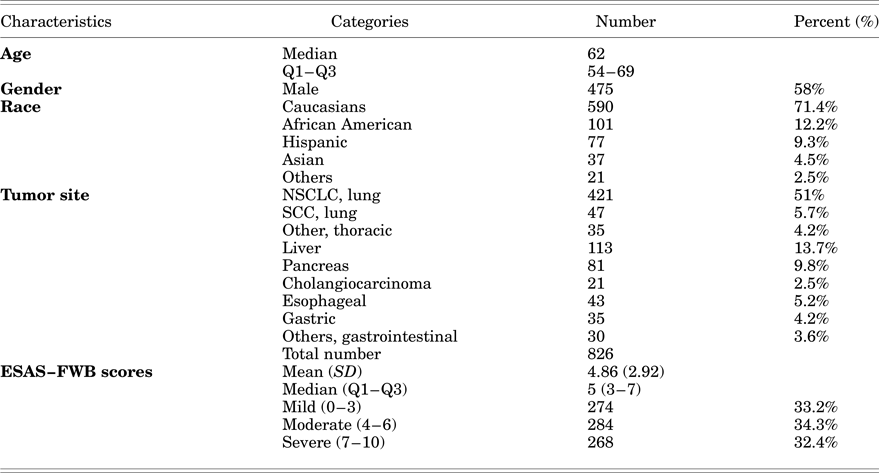
A total of 826 evaluable patients were analyzed (median age = 62 years, 58% male). Table 1 shows that the median ESAS–FWB score was 5, and that the interquartile range (IQR) was 3–7 at the initial visit.
Patient characteristics

ESAS = Edmonton Symptom Assessment Scale; FWB = feeling of well-being; NSCLC = non-small-cell lung cancer; SCC = small-cell lung cancer; SD = standard deviation.
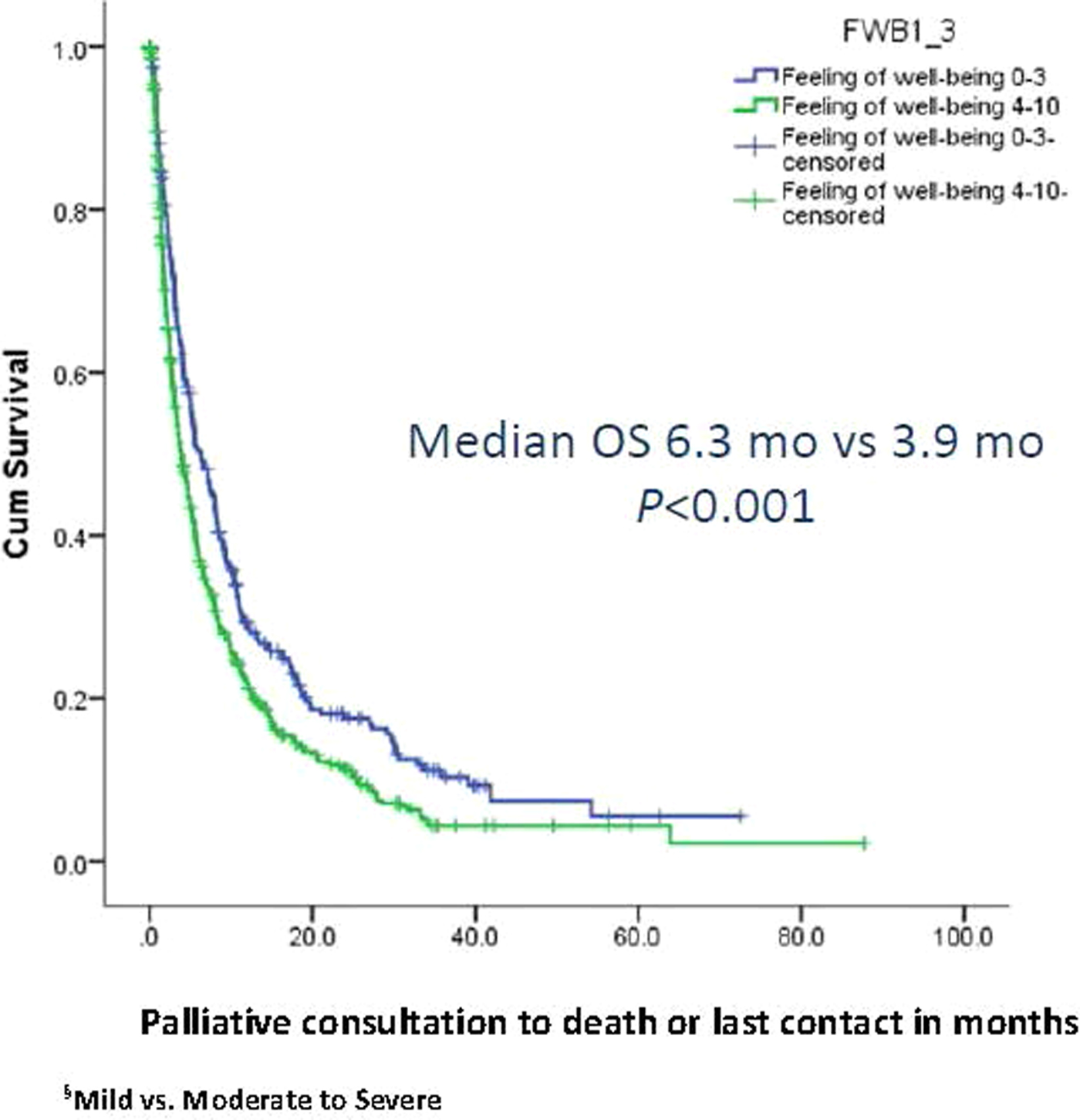
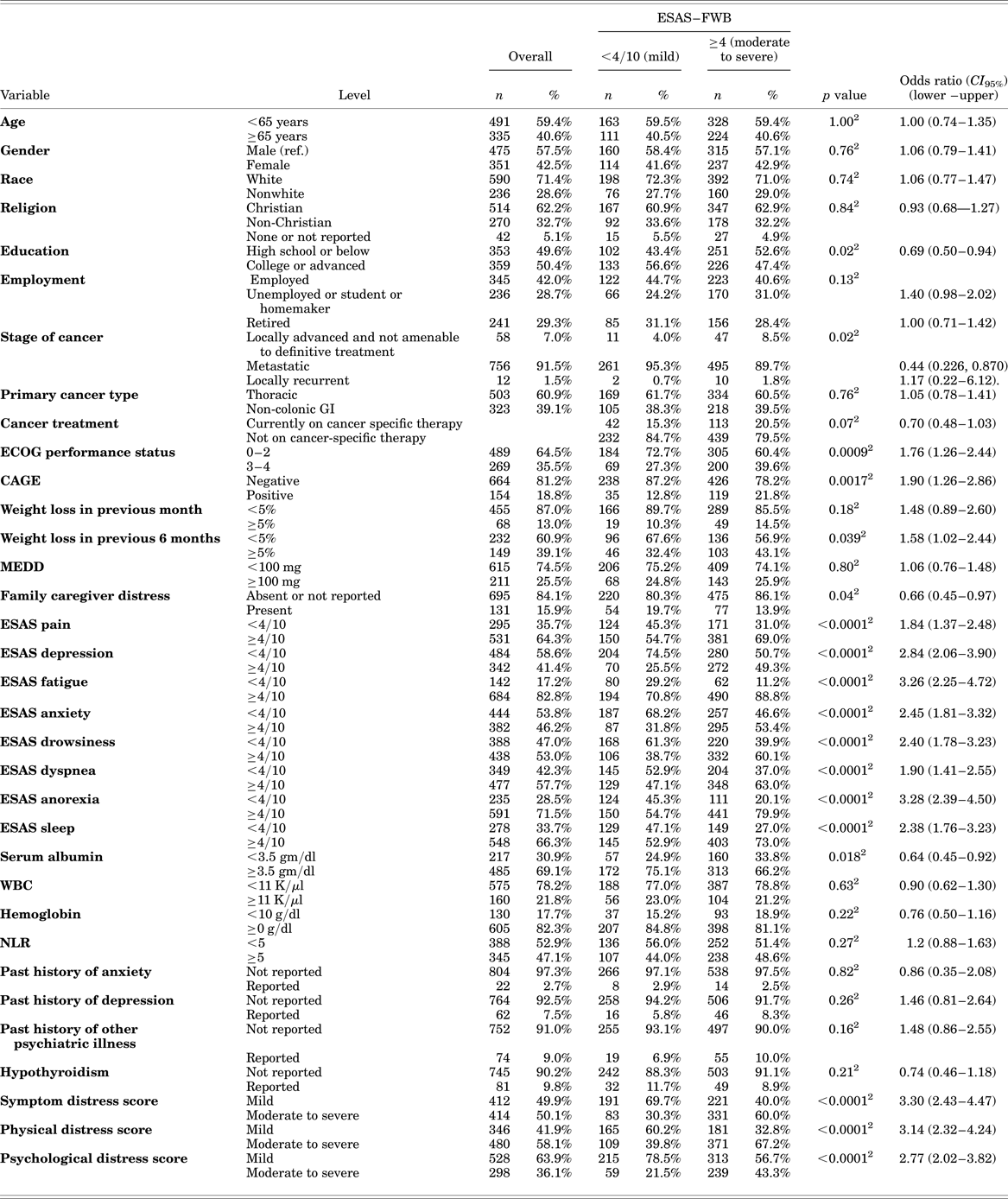
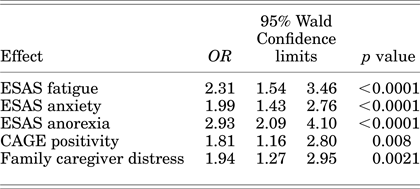
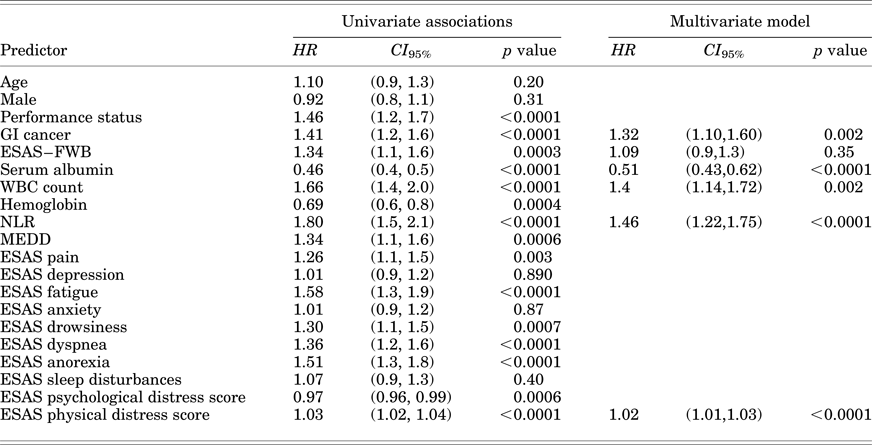
Table 2 presents the univariate associations of the factors associated with ESAS–FWB score. Multivariate regression analysis to determine the factors associated with ESAS–FWB score showed a significant association with ESAS fatigue (OR = 2.31, p < 0.001); anxiety (OR = 1.98, p < 0.001); anorexia (OR = 2.31, p < 0.001); CAGE positivity for alcoholism (HR = 1.80, p = 0.008); and family caregiver distress (HR = 1.93, p = 0.002) (see Table 3). A worse ESAS–FWB score was significantly associated with OS (months) (r = –0.18, p < 0.001), and a moderate to severe ESAS–FWB score was significantly more highly associated with OS than mild scores (<4 out of 10) (Figure 1). Table 4 presents the results of the multivariate regression analysis to determine the associations among ESAS–FWB score, known prognostic factors, and OS in our patient population. The final model of the stepwise regression analysis, which included all the known major clinical prognostic factors, suggested that GI cancer (HR = 1.32, p = 0.002), low serum albumin (HR = 0.51, p < 0.0001), a high white blood cell (WBC) count (HR = 1.4, p = 0.002), NLR (HR = 1.46, p < 0.001), and a high ESAS physical distress score (HR = 1.02, p < 0.001) were the variables independently associated with OS. The ESAS–FWB score was not found to be independently associated with OS in the final model (p = 0.35).
Association between a feeling of well-being and median overall survival.

Predictors of severity of baseline Edmonton Symptom Assessment Scale–Sense of Well-Being item (ESAS–FWB)

CAGE = (cut down, annoyed, guilty, eye opener; screening for alcoholism); ECOG = Eastern Cooperative Oncology Group; ESAS = Edmonton Symptom Assessment Scale; FWB = Feeling of Well-Being item of the ESAS; MEDD = morphine equivalent daily dose; NLR = neutrophil–lymphocyte ratio; WBC = white blood cell.
1 Wald chi-square test (contingency table).
2 Fisher's exact test (contingency table).
3 Wald chi-square test (logistic regression).
Predictors of severity of baseline ESAS–FWB item: Multivariate model

CAGE = cut down, annoyed, guilty, eye opener; ESAS = Edmonton Symptom Assessment Scale.
Factors associated with overall survival in advanced non-small-cell lung and non-colonic gastrointestinal cancer

CI 95% = 95% confidence interval; ESAS = Edmonton Symptom Assessment Scale; FWB = Feeling of Well-Being item; GI cancer = non-colonic GI cancer; HR = hazard ratio; MEDD = morphine equivalent daily dose; NLR = neutrophil–lymphocyte ratio; WBC = white blood cell.
DISCUSSION
In our study, we found that patients with advanced cancer frequently present with moderate to severely poor feelings of well-being at the outpatient palliative care clinic. We also found that the severity of ESAS–FWB scores is significantly associated with such common cancer-related symptoms as fatigue, anxiety, anorexia, a history of alcoholism, and family distress as diagnosed by a physician.
Prior studies have suggested that the primary sources of distress in patients who have advanced cancer with a limited prognosis are an inability to achieve goals due to impaired function, physical or psychosocial symptoms, and a decreased sense of well-being (Cassell, Reference Cassell2013). One of the primary goals of palliative care teams is to restore patients' well-being (Cassell, Reference Cassell2013). The findings of associations with ESAS–FWB scores in this cohort of advanced cancer patients with a limited prognosis suggest that ESAS–FWB scores are associated with a patient's physical and psychosocial symptoms as well as with the level of family caregiver distress (Parsons et al., Reference Parsons, Delgado-Guay and El Osta2008; Yennurajalingam et al., Reference Yennurajalingam, Urbauer and Casper2011).
We have identified a number of variables—such as patient-reported fatigue, anxiety, anorexia, a history of alcoholism, and patients' experience of family caregiver distress—that are significantly associated with ESAS–FWB scores (see Tables 2 and 3). Fatigue, anxiety, anorexia, and family distress have been found to be burdensome in prior studies in a palliative care population (Barbera et al., Reference Barbera, Seow and Howell2010; Ryan et al., Reference Ryan, Ingleton and Gardiner2013; Selby et al., Reference Selby, Chakraborty and Myers2011; Yennurajalingam et al., Reference Yennurajalingam, Urbauer and Casper2011). Future studies should evaluate interventions (Derogatis et al., Reference Derogatis, Abeloff and Melisaratos1979; Vodermaier et al., Reference Vodermaier, Linden and Rnic2014) that specifically target these symptoms and evaluate their effect on ESAS–FWB scores.
We found that patients with moderate to severe poor ESAS–FWB scores had a significantly worse OS than those reporting mild ESAS–FWB scores (Figure 1). However, in the final logistic regression model, ESAS–FWB score was not independently associated with OS. These findings suggest that the association between FWB and OS is due to some of the other clinical factors that impact a feeling of well-being. Patient-reported ESAS–FWB scores may constitute a marker of cachexia, worse performance status, symptom distress, and psychosocial distress. Previous studies have suggested that the severity of symptoms (especially depression and poor psychological coping skills) are also associated with poor survival (Wang et al., Reference Wang, Shi and Lu2010; Derogatis et al., Reference Derogatis, Abeloff and Melisaratos1979; Vodermaier et al., Reference Vodermaier, Linden and Rnic2014).
Improving patient well-being is one of the fundamental goals of clinical cancer care (Cassell, Reference Cassell2013). One of the advantages of the ESAS is that it is one of the most commonly used tools for the assessment of cancer-related symptoms during routine clinical care of patients with advanced cancer (Pereira et al., Reference Pereira, Green and Molloy2014). The findings of our study regarding symptom severity and its association with ESAS–FWB scores can be helpful for the clinical teams who plan interventions to enhance well-being in cancer patients. Some authors have described more comprehensive tools that investigate components of well-being—for example, hedonic well-being, where the emphasis is on increasing pleasure and limiting pain, and eudaemonic well-being, which focuses on self-actualization and autonomy (Eid & Larson, Reference Eid and Larsen2008). Future research should investigate the associations of ESAS–FWB scores with more comprehensive tools that investigate all three main components of a feeling of well-being: evaluative well-being, hedonic well-being, and eudaemonic well-being.
LIMITATIONS OF THE STUDY
Our study has several noteworthy limitations. The most important is the retrospective nature of data collection from patients' electronic health records. In addition, study evaluation was conducted on a select group of palliative care patients (non-small-cell lung and non-colonic GI cancers) rather the whole group of patients in the palliative trajectory with such diseases. There is also the concern that our routine assessment of primary caregiver distress at the supportive care clinic may have been incomplete or may have led to misdiagnosis in some cases. We thus suggest that it is important to routinely conduct a formal assessment of PFC distress, perhaps using such validated instruments such as Zarit's Caregiver Burden Scale (Tanco et al., Reference Tanco, Park and Cerana2017).
CONCLUSIONS
Worse ESAS–FWB scores are associated with high scores on ESAS fatigue, anorexia, anxiety, CAGE positivity for alcoholism, and family distress. The ESAS–FWB is an indirect measure of other known factors related to overall survival (e.g., cachexia and frailty). More research is required in order to understand how palliative care interventions that are capable of improving ESAS fatigue, anorexia, anxiety, CAGE positivity, and family caregiver distress could contribute to significantly improving patient performance on the ESAS–FWB.
ACKNOWLEDGMENTS
Preparation of this manuscript was supported in part by the American Cancer Society (RSG-11-170-01-PCSM) (S.Y.).