Orthostatic intoleranceReference Stewart 1 stands for a series of symptoms induced by upright posture and relieved when returning to supine, which includes headache, nausea, abdominal pain, dizziness, diminished concentration, tremulousness, syncope, and so on. Vasovagal syncope, postural orthostatic tachycardia syndrome, and orthostatic hypotension are important haemodynamic patterns of orthostatic intolerance in children.Reference Brignole and Hamdan 2 Children with orthostatic intolerance usually suffer from debilitating and stigmatising effects on their lives at home and in the school, which in turn may cause excessive parental anxiety. Vasovagal syncope is characterised by loss of consciousness, the pathogenesis of which is reduced arterial pressure and blood supply to the brain, mediated through neural mechanisms rather than primary cardiac dysfunction.Reference Kinsella and Tuckey 3 – Reference Jardine 5 Postural orthostatic tachycardia syndrome is presently defined as the development of orthostatic intolerance symptoms accompanied by a heart rate increase of at least 30 beats/minutes, or a rate that exceeds 120 beats/minutes, which occurs within the first 10 minutes of standing or head-up tilt test.Reference Abed, Ball and Wang 6 , Reference Jarjour 7 Vasovagal syncope and postural orthostatic tachycardia syndrome have similarities in clinical manifestations. For example, children with vasovagal syncope or postural orthostatic tachycardia syndrome always have dizziness, pallor and other orthostatic intolerance symptoms. The pathogenesis of the two diseases is different, and thus the treatment algorithms are divergent. Hence, differentiating them in clinical practice would play an important role in selecting suitable therapeutic regimens.
At present, the haemodynamic differential diagnosis between vasovagal syncope and postural orthostatic tachycardia syndrome is based mainly on the head-up tilt table test.Reference Kapoor, Smith and Miller 8 , Reference Lai, Chen, Lin and Hwang 9 The head-up tilt table test can be sometimes risky for patients, if syncope is provoked. Thus, it is important to find safe diagnostic methods for addressing the diagnosis of the underlying haemodynamic patterns of orthostatic intolerance. In 2009, Stewart et alReference Stewart 10 showed that vasovagal syncope and postural orthostatic tachycardia syndrome could be differentiated, by analysing the clinical presentations of patients. For children with vasovagal syncope, fainting episodes usually occur sporadically, separated by fairly long intervals during which the patient is entirely well. On the other hand, almost all young patients with postural orthostatic tachycardia syndrome are chronically ill and uncommonly have fainting as part of the syndrome. Children with vasovagal syncope or postural orthostatic tachycardia syndrome may have different pathophysiologic features and clinical presentations, and should be given different treatment, but presently there is no objective method or discriminant analysis technique to differentiate between them. Therefore, the present study was undertaken to analyse the association between the clinical presentations and haemodynamic patterns of orthostatic intolerance cases in clinical practice.
Materials and methods
Patients
In all, 629 children (284 boys and 345 girls) aged 3–18 years (mean 12.2 ± 2.9 years) with vasovagal syncope or postural orthostatic tachycardia syndrome were consecutively recruited in the Multi-center Network for Childhood Syncope in Beijing, Hunan Province, Hubei province, and Shanghai, China. All patients underwent a standardised evaluation including a complete history, a physical and neurological examination, a baseline laboratory evaluation, a 12-lead electrocardiogram, an echocardiogram, an electroencephalogram, 24-hour ambulatory electrocardiography monitoring, and 24-hour blood pressure monitoring. Then, a baseline head-up tilt table test or sublingual nitroglycerin head-up tilt table test was performed. The study protocol conforms to the ethical guidelines of the 1975 Declaration of Helsinki as reflected in a priori approval by the institution's human research committee, and it was approved by the Ethics Committee of Peking University First Hospital.
Clinical diagnostic protocolReference Brignole, Alboni and Benditt 11 – Reference Zhang, Du, Wang, Du, Wang and Tang 14
Initially, all patients underwent a screening evaluation, consisting of careful history and a detailed physical examination, including orthostatic and supine heart rate with blood pressure measurements, and a standard electrocardiogram. Some additional examinations were indicated when necessary, including echocardiogram, 24-hour ambulatory electrocardiography monitoring, electroencephalogram, cranial or cervical computed tomography, cardiac catheterisation, or cardiac electrophysiology examination. For those whose diagnosis was still unclear, the head-up tilt table test was performed to diagnose the haemodynamic patterns in vasovagal syncope, postural orthostatic tachycardia syndrome, orthostatic hypotension, etc.
Baseline head-up tilt test
Baseline recordings of heart rate, electrocardiogram and blood pressure with a Dash 2000 Multileads Physiological Monitor (GE Medical Systems, Milwaukee, Wisconsin, United States of America), in the supine position, were obtained near the end of a 10-minute rest period. Then the patient was tilted to 60° on a tilt table. The monitoring of the variation of electrocardiogram, heart rate and blood pressure was carried out along with clinical monitoring of symptoms. The baseline head-up tilt table test was continued for 45 minutes or until a positive response appeared. If a positive response was elicited, the test was aborted by a rapid lowering of the tilt table.
Sublingual nitroglycerin head-up tilt test
Sublingual nitroglycerin head-up tilt table test was conducted in patients with negative response in baseline head-up tilt table test using nitroglycerin (4–6 μg/kg, the maximum dose ≤300 μg). The Dash 2000 Multileads Physiological Monitor was used to record the electrocardiogram, heart rate and blood pressure, along with clinical monitoring of symptoms. The tests continued for 20 minutes or until positive responses appeared.
Informed consent was obtained from each child or his/her parents, and the study protocol was approved by the Ethics Committee of the Peking University First Hospital.
Haemodynamic diagnostic criteria
Vasovagal syncope
The positive standard of head-up tilt table test for vasovagal syncope was that patients had syncope or presyncope, in association with one of the following changes during the head-up tilt table test: decreased blood pressure; decreased heart rate; sinus arrest appeared; and second- or third-degree atrioventricular block with asystole for 3 or more seconds.Reference Kapoor, Smith and Miller 8 , Reference Kapoor, Smith and Miller 15
Postural orthostatic tachycardia syndrome
When heart rate increased ≥30 bpm or a maximum heart rate ≥120 bpm occurred during the first 10 minutes of the head-up tilt table test, it was defined as postural orthostatic tachycardia syndrome, and it was often accompanied by dizziness, chest distress, headache, palpitation, pale, etc.Reference Mathias, Low, Iodice, Owens, Kirbis and Grahame 16
Statistical analysis
Results with normal distributions are expressed as mean ± standard deviation. We used the diagnoses of vasovagal syncope or postural orthostatic tachycardia syndrome as dependent variables, and used sex, symptoms, symptom onset, symptom prodrome, the posture following symptom onset, complicated symptoms during the episode and symptoms after the episode, all as independent variables, to complete the discriminant analysis. In adopting a step-by-step method for screening variables and the criteria for screening variables, Wilks’ λ was used. We also used empirical validation and cross-validation, in order to evaluate the variables’ discriminating power. The assignment methods for upper variables were as follows: assigned a 1 for symptoms’ appearance, and when symptoms did not appear we assigned a 0. Assignment for sex: 1 was male and 0 was female. Assignment for diagnosis: 1 was vasovagal syncope, and 2 was postural orthostatic tachycardia syndrome. A p-value <0.05 was considered statistically significant.
Results
The baseline characteristics of children
Among the 629 patients aged from 3 to 18 years (mean 12.2 ± 2.9 years), 284 (45.2%) were male and 345 (54.8%) were female. In all, 299 (47.5%) had vasovagal syncope and 330 (52.5%) had postural orthostatic tachycardia syndrome. In children with vasovagal syncope aged from 5 to 18 years (mean 12.7 ± 2.9 years), 136 (45.5%) were male and 163 (54.5%) were female. In 330 patients with postural orthostatic tachycardia syndrome, aged from 3 to 18 years (mean 11.7 ± 2.7 years), 148 (44.8%) were male and 182 (55.2%) were female.
Of the 629 patients, 506 (80.4%) came from Beijing, 41 (6.5%) came from Hunan Province, 67 (10.7%) came from Hubei Province, and 15 (2.4%) came from Shanghai. In patients who came from Beijing aged from 3 to 18 years (mean 12.0 ± 2.8 years), 221 (43.7%) were male and 285 (56.3%) were female. In patients who came from Hunan Province aged from 8 to 18 years (mean 12.7 ± 2.6 years), 24 (58.5%) were male and 17 (41.5%) were female. In patients who came from Hubei Province aged from 7 to 18 years (mean 12.7 ± 3.2 years), 32 (47.8%) were male and 35 (52.2%) were female. In patients who came from Shanghai aged from 6 to 15 years (mean 11.5 ± 2.2 years), seven (46.7%) were male and eight (53.3%) were female.
The age and sex of patients did not have significant differences among different districts, respectively (F = 1.963, p > 0.05; χ2 = 3.609, p > 0.05).
The outcome of discriminant analysis
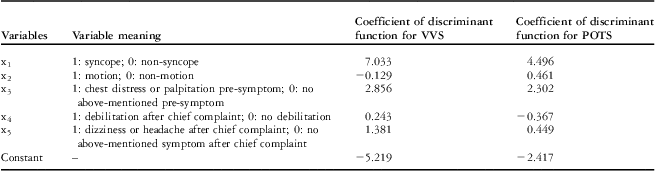
We used step-by-step discriminant analysis for the assembled variables – sex; syncope; prolonged upright posture, agitation, hot weather and motion as inducing factors; dizziness and headache, chest distress and palpitation, stomach ache and nausea as prodrome; sitting position and decubitus position before attack; pale and chest distress during attack; temporal debilitation, dizziness and headache, nausea, vomiting, and stomach ache after attack – doing two kinds of discriminations for children with vasovagal syncope or postural orthostatic tachycardia syndrome. At last, the variables selected into the model were x1 (syncope), x2 (motion), x3 (chest distress and palpitation), x4 (temporal debilitation), x5 (dizziness and headache) (Table 1). The discriminant function aimed at vasovagal syncope and postural orthostatic tachycardia syndrome were as follows:
 $$no{ \!\!\!\!\!\!{\rm{Vasovagal}}\,{\rm{syncope\!\!:}}\,\cr \quad {\rm{F1}}\, = \,{\rm{7}}{\rm{.033}}\cdot \,{{{\rm{x}}}_{\rm{1}}}\,{\rm{ - }}\,{\rm{0}}{\rm{.129}}\cdot \,{{{\rm{x}}}_{\rm{2}}}\, + \,{\rm{2}}{\rm{.856}}\cdot \,{{{\rm{x}}}_{\rm{3}}}\, \cr \quad+ \,{\rm{0}}{\rm{.243}}\cdot \,{{{\rm{x}}}_{\rm{4}}}\, + \,{\rm{1}}{\rm{.381}}\cdot \,{{{\rm{x}}}_{\rm{5}}}\,{\rm{ - }}\,{\rm{5}}{\rm{.219}} $$
The discrimination outcome of VVS and POTS in children.

POTS = postural orthostatic tachycardia syndrome; VVS = vasovagal syncope
where F1 stands for vasovagal syncope.
 $$no{\quad \!\!\!\!\!\!{\rm{Postural}}\,{\rm{orthostatic}}\,{\rm{tachycardia}}\,{\rm{syndrome\!\!:}}\, \cr {\rm{F2}}\, = \,{\rm{4}}{\rm{.496}}\cdot \,{{{\rm{x}}}_{\rm{1}}}\, + \,{\rm{0}}{\rm{.461}}\cdot \,{{{\rm{x}}}_{\rm{2}}}\, + \,{\rm{2}}{\rm{.302}}\cdot \,{{{\rm{x}}}_{\rm{3}}}\, \cr \quad{\rm{ - }}\,{\rm{0}}{\rm{.367}}\cdot \,{{{\rm{x}}}_{\rm{4}}}\, + \,{\rm{0}}{\rm{.449}}\cdot \,{{{\rm{x}}}_{\rm{5}}}\,{\rm{ - }}\,{\rm{2}}{\rm{.417}}$$
where F2 stands for postural orthostatic tachycardia syndrome.
The method, using the discriminant function, was that we inserted the five variables (x1, x2, x3, x4 and x5) into the two above-mentioned functions, and compared the two function values yielded. Finally, we assigned to each patient the haemodynamic pattern with the larger yielded value.
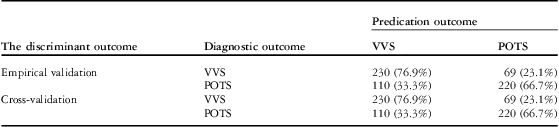
The results of the discriminant analysis in our study supported the correct rates of empirical validation and cross-validation. The total discriminant diagnostic accuracy was 71.5%, and the number of the patients, which were judged correctly, in the vasovagal syncope group was 230 (76.9%) and in the postural orthostatic tachycardia syndrome group was 220 (66.7%) (Table 2).
The diagnostic and predictive outcome of VVS and POTS in children.

POTS = postural orthostatic tachycardia syndrome; VVS = vasovagal syncope
Discussion
At present, the incidence of orthostatic intolerance is on an upward trend.Reference Brignole and Hamdan 17 – Reference Guzman, Armaganijan and Morillo 19 In children with orthostatic intolerance, vasovagal syncope and postural orthostatic tachycardia syndrome were the most common haemodynamic patterns. Vasovagal syncope and postural orthostatic tachycardia syndrome have many similarities. Meanwhile, owing to the difference of pathogenesis between vasovagal syncope and postural orthostatic tachycardia syndrome, the treatment modalities for them are different. The treatment modality mainly depends on the haemodynamic patterns.
Therefore, it is imperative to explore how to correctly distinguish them in clinical practice. Previously, the haemodynamic diagnosis was based on the head-up tilt table test. However, the head-up tilt table test has some risks in certain situations, which limits its use clinically.
In 2009, Stewart et alReference Stewart 10 showed that postural orthostatic tachycardia syndrome and vasovagal syncope could be differentiated mainly through patients’ clinical presentations. Postural orthostatic tachycardia syndrome is a chronic day-to-day form of orthostatic intolerance, and vasovagal syncope is most often episodic and is associated with long periods of “wellness”.Reference Stewart 10 Although some previous studies revealed that there was no association between head-up tilt table test and the frequency of syncope attacks,Reference Wang, He and Li 20 we found that the frequency of syncope in children with postural orthostatic tachycardia syndrome was noticeably lower than the frequency of syncope in children with vasovagal syncope.Reference Zhang, Du, Li and Chen 21 The baseline heart rate of children with postural orthostatic tachycardia syndrome was faster than that in children with vasovagal syncope or in children with normal haemodynamics.Reference Zhang, Du and Li 22 In 2006, in a multi-centre study,Reference Chen, Yang and Wang 23 we found that children with the vasovagal syncope–vasoinhibitory pattern were apt to fall to the ground after prolonged standing, and that they also had many presyncopal episodes. However, many children with postural orthostatic tachycardia syndrome presented with dizziness, but only patients with severe underlying problems had syncope.Reference Skerk, Pintarić, Delić-Brkljacić, Popović and Hećimović 24 , Reference Kavi 25 Some studies have reported that the incidence of postural orthostatic tachycardia syndrome in females was higher, by a 4:1 ratio.Reference Skerk, Pintarić, Delić-Brkljacić, Popović and Hećimović 24
In children with orthostatic intolerance, their different haemodynamic patterns yield different clinical manifestations. However, there are few studies in this issue predicting haemodynamic patterns based upon the clinical manifestation of the patients.Reference Stewart 10
In our study, through a stepwise discriminate analysis aimed at clinical manifestation and haemodynamic patterns in 629 children with vasovagal syncope or postural orthostatic tachycardia syndrome, we established discriminate functions and found that syncope after motion with a prodrome of chest distress or palpitations and the concomitant symptom(s) after a syncopal attack, with debilitation, dizziness or headache, were the most important variables in correctly diagnosing vasovagal syncope. Through our study, we found that the overall rate of correctly diagnosing vasovagal syncope and postural orthostatic tachycardia syndrome was 71.5%, particularly.
However, our study still has some limitations. For example, in the study the number of included patients is relatively small, and the symptom description was impacted by subjective factors. In spite of the limitations of the results of the present study, we might be able to predict vasovagal syncope, a haemodynamic pattern of orthostatic intolerance cases, initially, when the child has the above-mentioned clinical manifestations in the clinic setting. For increasing the predictive value of our conclusions, we need conduct a larger multi-centre study and add some objective indicators in the future.
Acknowledgements
This work was supported by a grant from National Twelfth Five-Year Plan for Science & Technology Support (2012BAI03B03), Capital Medical Development Scientific Project (2007-2003) and Beijing Science and Technology Program (D10100050010059). Thanks to Dr. Hong Tian and Hongwei Wang for their case collection.