

Candidates the world over have managed to get into power by harnessing momentum from voters’ resentment and disillusionment against mainstream politics and elites. Parallels with populism and the resurgence of the concept in political analysis are not mere coincidence. Candidates have appealed directly to voters using new social media, disparaging political parties, invoking a rhetoric of “us against them”—the poor and vulnerable against the elites, especially the progres urban elites—and positioning themselves as outsiders, distant from the traditional political machinery. On the right, the discourse is nationalistic: decrying immigration as a serious threat to national security and the economy, or based on a cultural backlash against progressive value change. On the left, an expropriating, racist, and predatory political elite is the enemy of the people, exploiting the poor and deepening inequality. This phenomenon has manifested itself in contemporary Latin America, a historically populist hotbed, but also in Europe and elsewhere, including the United States.
A particularity of recent developments is the shift from left- to right-wing populism. We have also seen a conservative turn in many other countries, albeit not necessarily of a populist nature: Argentina, Canada, Chile, Colombia, Paraguay, and Peru. Therefore, it has become increasingly important to investigate this right-wing shift—populist or not—around the world. Two questions worth asking are, what are the ideological underpinnings of the right-wing vote? And is it a consequence of resentment against some common enemy, or is it based on issue positions?
For instance, some have linked the 2016 victory of President Donald Trump in the United States to a generalized feeling of resentment against progressive elites, based on traditionalist cultural values (Manza and Crowley Reference Manza and Crowley2017; Mutz Reference Mutz2018; Morgan Reference Morgan2018; Cramer Reference Cramer2016). In Europe, the right-wing extremist vote is based on the support of those marginalized by globalization and is, to a great extent, a reaction to immigration (Gidron and Mijs Reference Gidron and Mijs2019). The debate about the affective roots of polarization—based on feelings and group identity, not on issue positions (Iyengar et al. Reference Iyengar, Sood and Lelkes2012, Reference Iyengar, Lelke, Levendusky, Malhotra and Westwood2019; Mason Reference Mason2018)—also points in this direction.
On the other hand, Inglehart and Norris (Reference Inglehart and Norris2016, Reference Inglehart and Norris2017) argue that the rise of right-wing extremism in Europe is based on a cultural backlash toward progressive value change in recent decades. Thus, values and issue positions, and not just resentment, would be at the root of right-wing support in Europe.
In contemporary Latin America, very little is known about the cultural and ideological profile of voters who back right-wing candidates. Given the significant institutional, historical, economic, and social differences in relation to the United States and Europe, it is important to theoretically construct—and test—an explanation for the electoral success of conservatism south of the Rio Grande.
This study takes a step in this direction by exploring the determinants of the vote for Jair Bolsonaro in the Brazilian 2018 presidential elections. Bolsonaro may have won for various reasons: a deeply rooted feeling of antipetismo (resentment against the PT, Workers’ Party), which flourished with Dilma Rousseff’s failed presidency; and a strong antisystem feeling of disenchantment with political institutions and with democracy itself, deepened by corruption scandals involving traditional right-wing parties, such as the PSDB (which governed Brazil before Lula and the PT) and the MDB (the party of Michel Temer, Dilma’s vice president and successor, who came to office accused of orchestrating a coup against the PT).Footnote 1
But there could be more to the story. Did issue positions affect vote for Bolsonaro? As documented for the first time with public opinion survey research from the electorate, the 2018 elections mark an extensive alignment of various right-wing issue positions and vote choice for an openly conservative candidate in Brazil. The so-called contradiction between populist political arrangements and “quasi-charismatic political figures,” on one hand, and “positional issue voting” on another, as pointed out by Baker and Greene (Reference Baker, Greene, Carlin, Singer and Zechmeister2015, 173), may not have happened in Brazil’s 2018 elections. There might have been issue voting for an allegedly populist politician. As we will see, Bolsonaro’s political platform matches his voters’ policy preferences.
This article analyzes voting behavior in Brazil using the 2018 Brazilian Electoral Panel Study (BEPS). During the course of the campaign, voters were interviewed in March, September, and October. Thus we have a baseline measure before the campaign formally started, a second measure after the official candidate nomination process but before political ads and TV and radio debates, and a third after the first round, in which Bolsonaro and Fernando Haddad of the PT moved to the second round of the election. In addition to vote intention, it is important to highlight the numerous survey items that capture issue positions at distinct moments of the campaign, allowing for a detailed account of how issue positions affected vote choice in 2018.
Focusing on vote choice, the analysis distinguishes between the Bolsonaro voter and those who voted for other candidates, but also between core Bolsonaro supporters—those who consistently declared their intention of voting for Bolsonaro in all three waves—and the rest. Thus, we focus on the mechanisms of reinforcement generated by the electoral campaign (Finkel Reference Finkel1993; Greene Reference Greene2011) and on the possible heterogeneity among voters who support extreme right-wing candidates. Furthermore, we explore attitude toward other Bolsonaro supporters, our measure of Bolsonarismo, using a feeling thermometer. Respondents were asked to state how closely they identified with people who supported Bolsonaro, on a scale of 1 to 10. The more general and diffuse sentiment toward Bolsonaristas aids in further defining the attributes of conservatism in Brazil. These alternative measures of support for a right-wing candidate provide a richer picture of the conservative vote in Brazil.
The next section of this article focuses on the content of conservatism in Latin America, drawing on literature on right-wing extremism and populism. The article proceeds to detail the historic Brazilian election of 2018 and how issues affected vote choice in previous electoral episodes. The data and results are presented, and the study concludes with remarks about future elections in Brazil and how the Bolsonaro phenomenon compares to other Latin American cases.
The Content of Conservatism
Recent developments in the literature on populism and extremism help to identify the content of contemporary right-wing ideology (Muis and Immerzeel Reference Muis and Immerzeel2017; Akkerman et al. Reference Akkerman, Zaslove and Spruyt2017; Norris Reference Norris2005; Rovira Kaltwasser 2011; Mudde Reference Mudde2004). There is a growing consensus that some issues have become increasingly relevant to distinguish conservative voters from the others. These include positions on law and order and reactions to progressive cultural change.
Conservatism today reflects a nationalist, nativist position. Immigration, foreigners, and those who support globalization, regional integration, and the opening of borders are to blame for economic downfall and crime. Economic crises, according to conservative perspectives, mobilize voters to protect national frontiers; hostility and hatred toward foreigners and immigrants are a consequence (Gandesha Reference Gandesha and Morelock2018; Mudde Reference Mudde2004). Hence, conservatism is based on a reactionary posture of “making the nation great again,” longing for a past of greatness long gone due to globalism advanced by left-wing, progressive governments. Immigration is associated with crime and terror, and to combat both, harsh punishment is necessary. Reviving the glorious past requires the elimination of criminals and marginais (outlaws). Law and order are central to this perspective.
Recent literature has called attention to a cultural dimension of conservatism (Hopkins and Hainmuller 2014; Inglehart and Norris Reference Inglehart and Norris2016, Reference Inglehart and Norris2017; Gidron and Hall Reference Gidron and Hall2017). A generational difference in support for right-wing radicalism has emerged: those with traditional views about society are older and white, as opposed to citizens with multicultural and postmaterial values and a more diverse background. According to Inglehart and Norris, developed societies witnessed significant value changes after the 1960s, characterized by “post-materialist values, such as cosmopolitanism and multiculturalism, generating rising support for left-libertarian parties, such as the Greens and other progressive movements advocating environmental protection, human rights, and gender equality” (2016, 3). New forms of conservativism have emerged across the globe as a reaction to these values, which are closely intertwined with the politics of identity, human rights, and recognition.
Clearly, conservatism is a multidimensional concept (Luna and Rovira Kaltwasser Reference Luna and Rovira Kaltwasser2014b). It entails “multiple programmatic rights,” involving economic, social, and authoritarian dimensions (Power and Rodrigues-Silveira Reference Power, Rodrigues-Silveira and Ames2019).
In addition to those issue positions, research in Latin America has pointed to other traits of conservatism. Grievances about inequality are particularly important: the right espouses a view that inequalities are “natural and outside the purview of the state” (Luna and Rovira Kaltwasser Reference Luna and Rovira Kaltwasser2014a, 4). Hence, social policies are unattractive to conservative voters. Furthermore, Doyle and Wiesehomeier (Reference Doyle and Wiesehomeier2014) conclude that right-wing voters, identified through self-placement scales on an ideological continuum from right to left, prefer less government intervention, opt for conservative positions on moral issues, and show authoritarian inclinations (Doyle and Wiesehomeier 67, Reference Doyle and Wiesehomeier2014). In addition, they are especially distinguishable for their mano dura approach to combating crime, favoring repressive measures. The authors’ characterization of conservative voters clearly resonates with the conceptualization proposed here.
In sum, conservatism is a multipronged concept, comprising (at least) the following elements: harsh views on the punishments for crime and violence; a disregard for human rights; a strong reaction to progressive value change, marked by intolerance of gay rights, feminist agendas, and secular interpretations of the family; and a consequent resentment of those who support such views—that is, mostly left-wing parties. Inequality and the role of the state are also key economic cleavages in distinguishing the right from the left.
This view of conservatism reopens the voting behavior agenda to the importance of issue voting. Right-wing voters, in their more recent manifestations, are not without values and ideological positions; they are not simply prone to clientelism (Montero Reference Montero2014) or resentful of others. Hence, issues become a central aspect for understanding elections in contemporary Latin America, especially given the increasing divide between left and right.
Earlier studies have shown that issue positions matter in Brazilian and Latin American elections (Ames et al. Reference Ames, Baker, Rennó, Timothy and Peter2008; Rennó and Ames Reference Rennó and Ames2014; Baker and Greene Reference Baker, Greene, Carlin, Singer and Zechmeister2015). In the past, abortion (Rennó and Ames Reference Rennó and Ames2014) and privatization (Ames et al. Reference Ames, Baker, Rennó, Timothy and Peter2008) have affected vote choice in Brazil. Baker and Greene (Reference Baker, Greene, Carlin, Singer and Zechmeister2015) show that there was economic positional issue voting on questions about privatization, free trade, foreign investment, core capitalist values, and the role of the state in the economy in 14 of 18 Latin American countries, Brazil included.
But in 2018, given the saliency of different topics during the election and the radicalization of positions, especially on cultural factors, a larger variety of issues were discussed and may have been decisive in defining vote choice. The Bolsonaro vote was not merely a rejection of the PT; it was oriented on an alignment of right-wing ideological positions unknown in recent Brazilian history. We should focus now on the case of the 2018 elections, in order to show that Bolsonaro had a clear conservative political platform.
The Conservative Turn in the Brazilian 2018 Elections
According to this conceptual framework, Jair Bolsonaro is a classic right-wing conservative. Still, the 2018 election introduces particularities that must be considered when exploring which issues induced voters to support a right-wing candidate.
The Brazilian 2018 election has many unique traits that set it apart from previous elections in the country and elsewhere. Significant electoral reform was implemented on the eve of the election, with major changes in rules and serious implications for how campaigns were conducted. Institutional changes included the prohibition of campaign donations by firms and the expansion of public funding, the reduction of the official campaign period from 90 to 45 days, the setting of ceilings for campaign expenditures by office, and the gradual adoption of an electoral threshold for political parties. In addition, party membership laws were made flexible, allowing politicians to change parties in specific windows of time before the election.Footnote 2
The motivations behind these changes were dubious. They came on the heels of the Lava-Jato operation, which arrested politicians, including former president Lula da Silva, and businessmen (they were mostly, if not all, men). Hence, the mood was favorable toward the adoption of proposals that reduced the impact of money on campaigns, seen as a major cause of corruption in Brazil. This was the manifest reason for the reforms and how they were publicly justified.
Political reform has been closely associated with the economic and political context in Brazil in recent years. After waves of protest in 2013, Brazil fell into challenging and deep-rooted economic and political crises. The culmination of this process was Dilma Rousseff’s impeachment, which occurred in 2015. Subsequently, the PT suffered significant losses in the 2016 municipal elections. Developments connected with the Lava-Jato operation also affected Michel Temer from the MDB and Aécio Neves, the PSDB president and presidential candidate in 2014. Graphic images and sound bites about bribes being solicited and paid by JBS, a food industry giant in Brazil, to both Temer and Neves were decisive in sealing the fate of their parties in the 2018 elections. PSDB and MDB had terrible vote returns in the presidential elections.
Temer faced two consecutive votes in Congress in the second half of 2017 to temporarily remove him from office while investigations were being conducted, completely killing his intention to introduce reforms, such as pension reform, and extremely weakening his administration. Neves faded away and was elected by only a small margin as federal deputy for Minas Gerais, a state he had governed twice and had represented as a senator until 2018. Thus, the reputations of the PT, PSDB, and MDB, the three major players in Brazilian politics since 1994, were damaged by corruption scandals, creating the opportunity for outsiders to become hopeful contenders in the presidential race.
On the political front, another major factor was Lula’s imprisonment and the PT’s insistence on continuing to back him as a candidate. In our panel study, data from March 2018 have two electoral scenarios: one with Lula and the other without a PT candidate, then the only two possibilities. There was no discussion of an alternative candidate in the PT at that moment. While in prison, Lula commanded the electoral process. He led the race from jail, something unheard of in Brazilian history—and perhaps even the world—until he was officially declared ineligible to run for office by the Electoral Superior Court and prohibited from running, just one month before the first round. Fernando Haddad, former minister of education and former mayor of São Paulo, the PT vice presidential candidate, replaced Lula. The question was if Lula would be able to transfer his electoral capital to Haddad, who was unknown in most of the country, in that short, one-month period.
On the economic front, Brazil faced one of its harshest crises. Although it is beyond the scope of this article to provide a critical analysis of the roots of the crisis, indications point to policies adopted by the Dilma administration related to the lax control of public expenditure, as well as generous subsidies and fiscal exemptions and a disregard for inflation. The turbulent international economic environment and the fall in commodities prices are also frequently mentioned villains. It is likely that a combination of these factors resulted in two consecutive years of negative GDP variation (2015 and 2016) and significant rises in unemployment.
Additionally, recovery has been slow, directly affecting the MDB and the PSDB, which assumed government after the impeachment. The economic crises, attributed to the PT government but also damaging those other two major players in the system, made for a negative mood in the country.
This combination of crises and institutional change set the 2018 elections apart. The unquestionable novelty in the election was the Bolsonaro candidacy. Bolsonaro put forward his name as a presidential candidate in 2015. Considered an eccentric, pro—military dictatorship politician who had been a military man himself before entering politics, Bolsonaro became a serious competitor only much later on. His innovative and clever use of social media to spread his conservative and anti-PT rhetoric—especially the diffusion of memes over WhatsApp and through tweets— and continuous campaigning for more than four years were decisive in increasing his popularity across the country.
But more than that, his message and style resonated with the moment. In his rhetoric, Bolsonaro adopted an “us against them” attitude at a time of institutional frailty of the major political players and significant questioning of traditional political institutions. Bolsonaro emerged as a charismatic leader with a messianic proposal for saving the country from the incompetence and corruption of traditional elites, mostly the left-wing PT.
Bolsonaro is deeply critical of the left and how it represents the re-emergence of a loosely defined communist threat and the perversion of traditional family values. A significant part of the Bolsonaro rhetoric rails against progressive views regarding gender politics in general and the feminist movement in particular. Bolsonaro has become known for his antigay position and restrictive concept of the family, based on religious beliefs. Bolsonaro clearly embodies the cultural backlash that Inglehart and Norris point out (Reference Inglehart and Norris2016; see also Caleiro Reference Caleiro2018). Except that in Brazil, Bolsonaro mobilized young conservative Brazilians.
Moreover, a cornerstone of Bolsonaro’s rhetoric advocates the use of harsh methods to combat crime and corruption. Bolsonaro favors relaxing regulations on gun control and arming citizens to fight crime. He also supports harsh punishment of crime. His proposals resonate both with citizens who live in the sprawling poor suburban areas of large Brazilian cities, who are exposed to violence on a daily basis, and with elites, who are scared of the crimes they see on television.
In addition to positions on crime and cultural backlash, some factors are specific to the Brazilian case and might be applicable to other Latin American cases. First, it is essential to keep in mind that corruption scandals have become an integral part of Brazilian elections (Rennó Reference Rennó2007, 2011; Pimentel Junior 2010; Corrêa Reference Corrêa2015). Since the 2006 elections, on the eve of the Mensalao scandal, research has shown that perceptions of corruption as a national problem have consistently undermined the image of the Workers’ Party. The Lava-Jato operation exposed the soft underbelly of corruption in Brazil as never before. It tarnished the parties that had held the presidential office since 1995. Bolsonaro relied heavily on accusations of corruption in his negative campaigning against the Workers’ Party. In 2018, this factor may have been especially important to conservative voters, especially core Bolsonaro supporters.
Furthermore, early in the campaign, Bolsonaro named Paulo Guedes, a well-known liberal, as his proposed minister of economics, thereby capturing the potential support of those in favor of privatization and the opening of markets. Bolsonaro adopted a position of reducing state intervention in the economy. The protectionist, antiglobalization banner of other conservative leaders in the world was not present in Brazil. Right-wing voters in Latin America have traditionally been against state intervention in the economy.
Consequently, there might have been an alignment of social and moral conservatism, economic liberalism, and vote choice, something new in Brazil.
Bolsonaro thus became the spokesperson for the significant portion of the Brazilian population that was fed up with crime, corruption, economic turmoil, apparent administrative incompetence, and the social-moral liberalism of the left, especially the PT. He proposed a clear policy agenda and political platform. He became the quintessential anti-PT candidate, something the PSDB had masterfully embodied until 2014. Antipetismo has become an important theme in the study of Brazilian elections (Paiva et al. Reference Paiva, Krause and Paz Lameirão2016; Borges and Vidigal 2016; Ribeiro et al. Reference Ribeiro, Carreirão and Borba2016; Samuels and Zucco Reference Samuels and Zucco2018). The election of 2018 tends to confirm that the PSDB was not the sole and perpetual recipient of this feeling, as Borges and Vidigal point out for the 2014 election (2016).
Therefore, it is undeniable that resentment against a specific party, the Workers’ Party, also played a role in explaining the conservative vote in Brazil. This resentment was not vaguely directed at progressive, urban elites; it had a clear target, personified by the PT. Resentment in Brazil has a partisan basis—the rejection of a specific party (Carreirão and Kinzo 2004).
Last but not least, right-wing positions in Latin America are also linked to views on inequality, excusing the state from responsibility for reducing the problem through social policies (Luna and Rovira Kaltwasser 2014). Here it is important to distinguish between distinct social policies and their impact on the vote. Being a beneficiary of the Bolsa Família decisively affected vote choice in previous Brazilian elections. Hence, Bolsonaro was ambivalent toward it (Aragão Reference Aragão2018). But he was more vocal against affirmative action policies based on racial quotas (G1 2018). Therefore, this specific variation in social policies that combat inequality may also be associated with the right-wing vote. Given the PT’s dominance over the Bolsa Família, those favorable to it might be less inclined to support Bolsonaro. On the other hand, positions against racial quotas should definitely lead to voting for Bolsonaro.
Hypotheses
Considering all these factors, what are the determinants of support for Bolsonaro? Based on the literature and the case of the 2018 Brazilian election, one would have expected his voters to be motivated by
1. A cultural backlash against social and moral issues related to abortion, gay rights, and the defense of a more significant influence of religious values on public affairs.
2. Attitudes favorable to harsh punishment for crime.
3. A strong rejection of corruption and the perception that it is an important national problem.
4. A liberal economic perspective, favorable to privatizations.
5. A strong rejection of and resentment toward a specific political party, the Workers’ Party.
6. Strong opposition to social policies, especially racial quotas.
Data and Variables
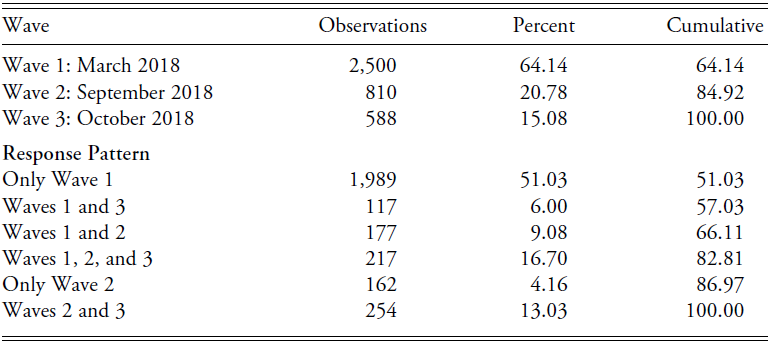
Data for this study come from the 2018 round of the Brazilian Electoral Panel Study (BEPS). The BEPS was conducted in the 2010 and 2014 elections, using repeated waves of interviews with the same respondents in each electoral episode.Footnote 3 In 2018, the BEPS was part of the Cara da Democracia project by the federally funded Instituto da Democracia, a partnership between several Brazilian universities: UFMG, IESP, Unicamp, and UnB.Footnote 4 As previously noted, the panel is based on three waves of interviews: one before the campaign formally started, a second after the nomination of candidates but before the airing of political ads on TV and radio, and a third immediately following the first round of the election, in October. The response patterns and sample sizes are presented in table 1, providing ample variation to test the hypotheses proposed, albeit with relatively smaller sample sizes than previous editions of the BEPS.
Waves and Response Pattern for the 2018 Brazilian Electoral Panel Study
Source: BEPS 2018
A clear advantage of this dataset, in addition to the repeated interviews, is the unique questionnaire design, providing numerous measures of issue positions, including abortion, gay rights, gun control, and religious instruction in schools—several related to the cultural backlash hypothesis. Conservatives around the world seem to have united around flags of intolerance to differences and so-called minorities, harsher punishment of crime and terrorism, support for gun ownership, and a religious interpretation of the family. This dataset allows measures of conservative attitudinal stability during the course of the campaign, and its effect on vote choice and support for an undisputed conservative candidate: Jair Bolsonaro, now the 38 th president of Brazil.
In particular, a battery of questions asks voters to position themselves in favor of or against several policy issues. Table 2 presents these results, indicating the predominant conservative views of Brazilian citizens across the many topics analyzed and their aggregate stability over the course of the campaign. Issue positions are linked to each hypothesis as indicators of the distinct dimensions of conservatism delineated above. Given the prevalence of several conservative attitudes and their short-term stability, it is expected that Bolsonaro would capture a significant portion of voters holding such positions. If we consider wave 1 as an indication of voters’ previous beliefs and attitudes, it is clear that the 2018 elections were set in an atmosphere likely to favor the success of radical right-wing candidates.Footnote 5
Issue Positions in the Brazilian 2018 Elections (percent)

Source: BEPS 2018
These views were quite stable during the campaign, both at the aggregate level, as shown in table 2, and at the individual level. A mean of 82 percent of respondents maintained their positions between waves 2 and 3 on all the items. There was more instability between waves 1 and 2, with a mean of 66 percent of the citizens maintaining their positions. Thus, from the beginning of the campaign to the end, a majority of respondents did not shift their positions in dyads of subsequent waves. There was some initial accommodation, before the campaign actually picked up, followed by stability. If we consider the instability of vote intentions between waves 2 and 3 (67 percent of voters shifted their positions), it is clear that adjustment of issue positions anticipated final vote choices. More voters shifted their vote intention than their issue positions in the latter part of the campaign, reducing the possibility of the endogeneity of issues in relation to the vote.
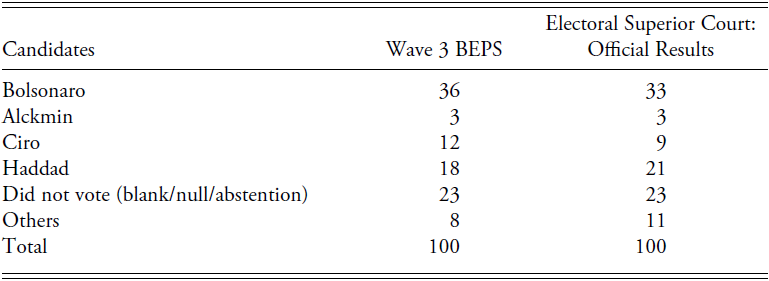
We find that voters are predominantly conservative, particularly on questions regarding abortion, gun ownership, and religious instruction in schools. Bolsonaro tapped into the mood of the population. Other right-wing candidates and their expensive marketing teams failed terribly to perceive the depth of conservatism in Brazil. Table 3 shows election results in the first round and the declared vote intentions in wave 3. It indicates Bolsonaro’s exceptional performance in the election, almost winning in the first round. It also shows that a significant number of voters did not vote in 2018 (blank, null, abstention), making this category important in understanding vote choice.
Official Election Results and Declared Vote in Wave 3 (percent)
Source: BEPS 2018; Electoral Supreme Court
Issue positions are the key independent variables in the analysis. We measured conservative and progressive views using these items and tested how they correlated with vote choice in the first round of the election, with stable support for Bolsonaro across the three waves of the panel, and with support for Bolsonarismo on the basis of responses to a feeling thermometer for Bolsonaro supporters. We explored the effects of the issues one by one to evaluate each individual impact on vote and support for a right-wing politician. The central claim is that Bolsonaro supporters will be consistently distinct from all others, as they are more conservative on social and moral issues, in favor of harsher punishment toward crime, economic liberals—defending privatization, very concerned about corruption, and ambivalent toward social policies.
We focus on wave 3, which occurred after the first round. The model includes all the issue position variables presented in table 2. Given the significant stability on issue preferences, we include only wave 3 responses to maximize sample size.
In addition to the battery of questions about being favorable to issues, we included a measure of support for harsh punishment by distinguishing those who agreed with the statement, “a good criminal is a dead criminal.” Those who agree with this statement should be more likely to support Bolsonaro.
The Workers’ Party is an anchor of vote choice in Brazil, mobilizing allies and foes. The model contemplates this partisan aspect of elections in Brazil. We expect that PT supporters will be strongly against Bolsonaro.
More important, however, antipetismo (resentment of the PT) is a central factor in explaining support for Bolsonaro. It is measured by those who dislike the Workers’ Party. Anti-PT voters should be strongly in favor of Bolsonaro. However, the inclusion of the antipetismo variable should not erode the effect of issue positions on support for Bolsonaro. There are ideological underpinnings to Bolsonaro support; it is not just about resentment.
The model also captures the effect of corruption by including a variable that indicates if the respondent thinks corruption is the worst national problem. We argue that these voters will be more likely to support Bolsonaro, as his antisystem positions were strongly based on the idea that the traditional parties were corrupt. Corruption has been a significant influential factor in Brazilian elections since 2006 (Rennó Reference Rennó2007, 2011; Pimentel Junior 2010; Corrêa Reference Corrêa2015) and should not be excluded from models that explain vote choice, although it risks specification error.
Two variables measure positions toward social policies. Being a Bolsa Família beneficiary is another important, long-term explanation for vote choice in Brazil. Instead of testing the traditional measure of being a Bolsa Família recipient (Licio et al. Reference Licio, Rennó and de Castro2009; Peixoto and Rennó Reference Peixoto and Rennó2011; Nicolau Reference Nicolau2014; Bohn Reference Bohn2011; Zucco and Power Reference Zucco and Power2013; Zucco Reference Zucco2015), we preferred to include the issue position of being in favor of Bolsa Família, which captures a broader audience. Results show that 92 percent of the Bolsa Família beneficiaries—the questionnaire included the traditional measure—were in favor of the program. The two measures are practically identical, but the one we used is more encompassing when considered as an issue position. The expectation is that being in favor of the program should induce stronger support for the PT candidate, Fernando Haddad.
In addition to the Bolsa Família variable, we analyzed positions toward racial quotas, a potentially more divisive issue. We expect that Bolsonaro supporters will be against social policies, viewing them in a negative light, following the idea that individuals are responsible for their own economic success (Luna and Rovira Kaltwasser 2014).
The model also controls for the usual suspects: age, educational level, income, gender, and whether the person attends religious services or mass. Following Inglehart and Norris Reference Inglehart and Norris2016, it is possible that older, less-educated men will be more conservative and more likely to support Bolsonaro. In Brazil, however, Bolsonaro appealed directly to younger and poorer voters, so what is true for Europe may not be for Brazil. We also controlled for being a replacement in wave 2, to check for panel conditioning.Footnote 6 Furthermore, the usage of social media as a dichotomous variable, indicating those who used Facebook, Twitter, WhatsApp, and other programs to comment about politics, was also included in the model.
A last set of controls comprises variables associated with the conditions for a populist vote that could increase the likelihood of support for Bolsonaro. Satisfaction with democracy captures the population’s overall feeling toward the political system, whereas evaluations of President Temer and of senators and deputies capture more specific dimensions of regime legitimacy. These variables focus on a possible antisystem perspective favorable to the outsider Bolsonaro. Those dissatisfied with the regime, institutions, and political actors should be more likely to support Bolsonaro. We also included a measure of perceptions of the honesty of elections, a direct measure of trust in a pivotal democratic institution that Bolsonaro criticized intensely during the campaign. His claim was that the electronic ballot is not impervious to hacking and that it does not allow a vote recount. It could, then, be bugged (Rosa Reference Rosa2018). Therefore, his voters could have adhered to such an idea and should be mistrustful of elections in Brazil.Footnote 7
Analysis
We focus first on vote choice, as declared in wave 3, to distinguish Bolsonaro voters from all others. Next we analyze the heterogeneity among Bolsonaro supporters by differentiating between core supporters—those who declared their intention to vote for Bolsonaro in all three waves—and all other voters, including those who migrated to Bolsonaro during the campaign. The core supporters can be seen as “true believers,” those who consistently backed Bolsonaro throughout the campaign—the core Bolsonaristas. Finally, we test this same model with a third dependent variable based on responses to a feeling thermometer toward Bolsonaro supporters, in which 0 indicates no affection toward them and 10 indicates maximum affection. In this way we capture a more granulated attachment to Bolsonarismo, independent of having voted for him. This is also a way to analyze variation within Bolsonarismo, keeping an eye on causal or correlational heterogeneity.
First, it is important to state that all hypotheses hold, albeit not uniformly across dependent variables. Only views favorable to privatizations affect vote for Bolsonaro, being a core Bolsonarista, and Bolsonarismo. Perceptions of corruption as a national problem affect being a core Bolsonaro supporter and Bolsonarismo. Therefore, it is interesting to investigate the model’s specific effect on each dependent variable. The impact of the theoretical model varies across distinct manifestations of support for Bolsonaro.
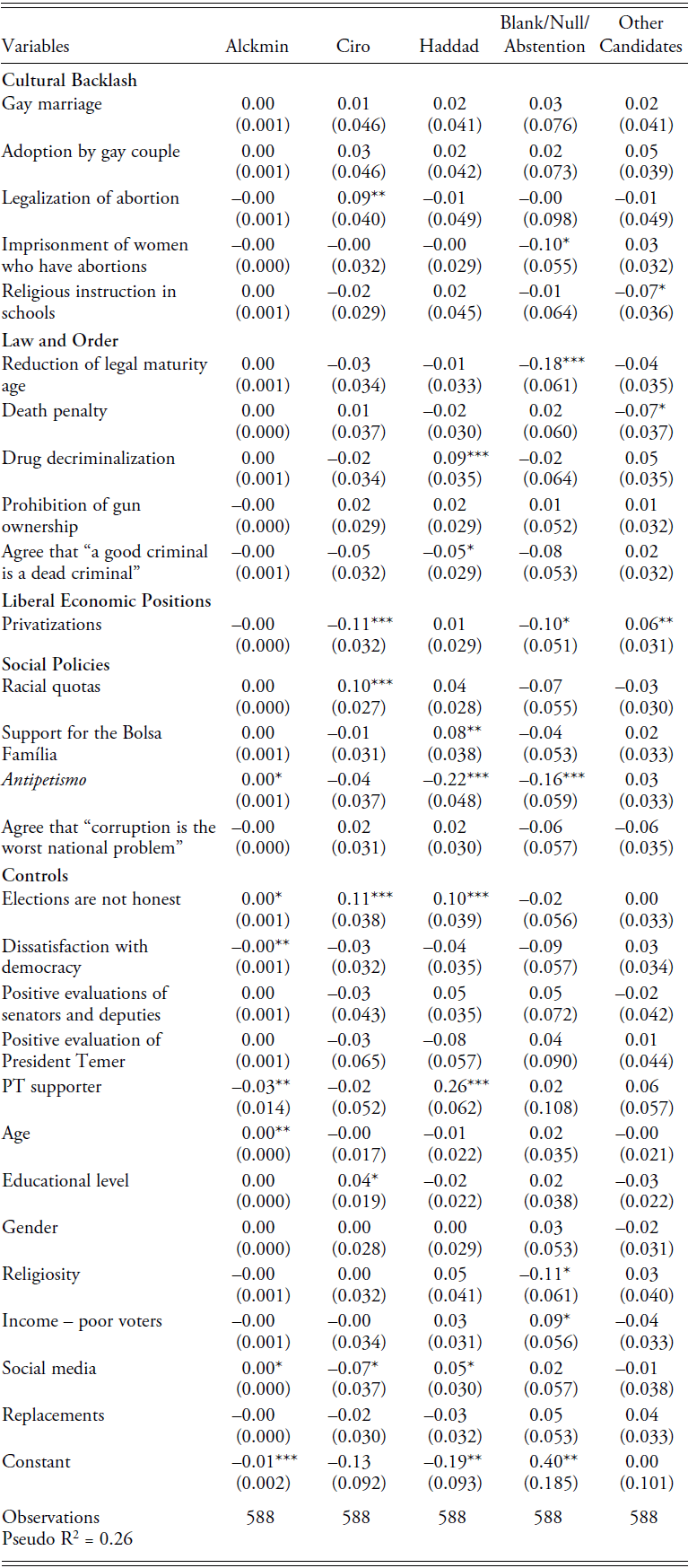
Focusing first on table 4, we see that Bolsonaro voters differ from other voters in many dimensions. Among the cultural backlash indicators, those who are against abortion and in favor of incarcerating women who get abortions, as well as those who favor religious education in schools, tend to support Bolsonaro. Those who espouse a harsher view on law and order, including lowering the age of legal maturity (civil and penal responsibility); who favor the death penalty; oppose the decriminalization of drugs; and agree that “a good criminal is a dead criminal” also have a greater probability of voting for Bolsonaro. Bolsonaro voters oppose social policies, especially when compared to voters for Ciro Gomes of the PDT and Haddad of the PT. Bolsonaro voters are younger than voters for Geraldo Alckmin of the PSDB (but with a small probability), more dissatisfied with democracy, less educated than Ciro voters, and more religious than those who did not vote. Having used social media has mixed effects: it increases the probability of voting for Alckmin and Haddad in relation to Bolsonaro, but of voting for Bolsonaro in relation to Ciro. This certainly requires further investigation, given popular expectations that Bolsonaro benefited from campaigning using fake news in new forms of communication and information technologies.
Marginal Effects from Multinomial Regression on Vote for Bolsonaro
***p < 0.01, **p < 0.05, *p < 0.1
Standard errors in parentheses
Table 4 presents marginal effects for incremental changes from the mean for all the dummy variables included in the model, as provided by dmlogit2 command in Stata. All variables are held constant at their means. The size of the coefficients indicates a substantial impact of some variables on vote choice. These include views on reducing the age of legal maturity and antipetismo. Age and educational level are measured as trichotomies, so the interpretation is slightly distinct, focusing on the impact of a one-unit change in the independent variable. Educated voters have a larger probability of voting for Ciro. The fact that demographic and socioeconomic controls are not so relevant indicates the cross-cutting nature of Bolsonaro’s support, across age, education, income, gender, and even religiosity. More important, all statistically significant coefficients are in the expected direction, pointing to a consistent, multidimensional alignment of conservative issue positions and vote for a right-wing candidate. The differences are especially true in relation to the left-wing candidates Ciro Gomes and Fernando Haddad.
Table 5 analyzes variations among Bolsonaro supporters by looking at stable Bolsonaro voters—core Bolsonaristas—and exploring the variations of affection toward Bolsonaro supporters, our measure of Bolsonarismo. Stable Bolsonaro support is a dichotomous variable, so we present the marginal effects of each independent variable holding all others at their mean, identically to table 4. Bolsonarismo is a discrete, continuous variable that we logged in order to normalize its distribution and facilitate the use of OLS regression.
Marginal Effects from Logit for Stable Bolsonaro Support and Regression Coefficients for Bolsonarismo (logged)

***p < 0.01, **p < 0.05, *p < 0.1
Standard errors in parentheses
Stable Bolsonaro voters favor privatizations, view corruption as a national problem, and have lower income levels. Therefore, these voters are not necessarily more conservative on cultural values and opinions on law and order than all other voters, including those who switched to Bolsonaro during the campaign. The core Bolsonaro supporter is economically liberal and strongly influenced by views that the country is plagued by corruption. If we consider the results from table 4, core Bolsonaristas are no different from other voters who voted for Bolsonaro but oscillated during the campaign in his favor. Core Bolsonaristas are not more conservative than the voters who converted during the election.
A broader range of variables influence affection toward Bolsonaro supporters, the third dependent variable. Variables related to the cultural backlash positions are important. These include opposition to homosexuals’ adopting children and to the legalization of abortion. Positions favorable to drug decriminalization decrease affection toward Bolsonarismo. Agreement with the idea that a good criminal is a dead criminal increases the appeal of Bolsonarismo. Hence, both cultural and law-and-order factors again increase the probability of becoming more favorable to Bolsonarismo. Rejection of racial quotas is another factor that distinguishes Bolsonaristas. Furthermore, rejection of the PT increases the chances of liking Bolsonaro supporters, and petistas clearly dislike Bolsonaro.
In all equations, issues are important to distinguish Bolsonaro voters from others. It is not just resentment against the PT that motivates the allegiance with Bolsonaro, even though this is a very important aspect of the story. Issue positions as indicators of conservatism in relation to social and moral questions and views on law and order, the economy, and social policies are fundamental explanations and indicate an alignment of multidimensional conservative policy preferences with the vote for a candidate who defends a clear conservative political platform.
Conclusions
The 2018 Brazilian elections saw the rise to power of yet another right-wing politician. Jair Bolsonaro took Brazil by storm, devastating his adversaries to the right, leading the race comfortably, and almost winning in the first round. He was able to mobilize anti-PT voters who, in other elections, had backed the more moderate PSDB, relying on a radical conservative discourse very much in tune with a worldwide wave of increased reaction to progressive cultural change and the reassertion of religious orientations in politics. Bolsonaro epitomized this reactionary movement in Brazil.
Critical of gay rights, women’s rights, Bolsa Família, and racial quotas, Bolsonaro supporters challenge the predominant view that social inclusion is consensual in Brazil (Alston et al. Reference Alston, Melo, Mueller and Pereira2016). Conservative voters in Brazil are clearly against identity and redistributive politics and policies that favor so-called minorities.
In the 2018 elections, the ideological divide among right- and left-wing voters in Brazil appears more pervasive regarding the range of issues it now mobilizes and, consequently, more relevant than what was documented previously (Singer 1990, Reference Singer2000, Reference Singer2009). The ideological distance between voters who support left- or right- wing candidates is marked by several different issue positions in distinct dimensions: cultural, economic, crime, social policies. However, the new factor is an alignment in the right, not in the left, as Singer previously argued.
Bolsonaro voters adopted positions that were consistently in line with their candidate’s rhetoric and position taking. Future studies can test for the internal coherence of these ideological traits and their dimensionalities. This article has taken a first step toward documenting the effect of issues on vote choice, showing that there is a right-wing voter in Brazil with consistent issue preferences. Issues mattered. Now we can move ahead to identify the specifics of how issues articulate to compose a consistent ideological framework.
Furthermore, are these divides particular to the specific Brazilian context? Issues must be taken into consideration in future studies about voting behavior in the region (Baker and Greene Reference Baker, Greene, Carlin, Singer and Zechmeister2015; Doyle and Wiesehomeier Reference Doyle and Wiesehomeier2014). We should now focus on how the new conservative turn in the region is based on positional issue voting. This article also has taken a first step in this direction.
In 2018, many more issues assumed a central role in explaining vote choice, especially those associated with social and moral questions. Hence, positional issue voting now must contemplate a broader dimension of topics in Latin America. It would be interesting to explore a similar theoretical approach in elections elsewhere in the region where the right has once again emerged as a force to be reckoned with.
Finally, conservative vote and support for Bolsonaro cuts across demographic and socioeconomic boundaries, but it has special resonance with poorer, less educated, and younger Brazilians. The conservative movement that gained momentum in the 2018 elections seems to be here for the long haul.
Appendix: Survey questions
The following table presents the original battery of items in Portuguese, exactly as they were asked of respondents in the original language.
Original Survey Item to Measure Issue Positions
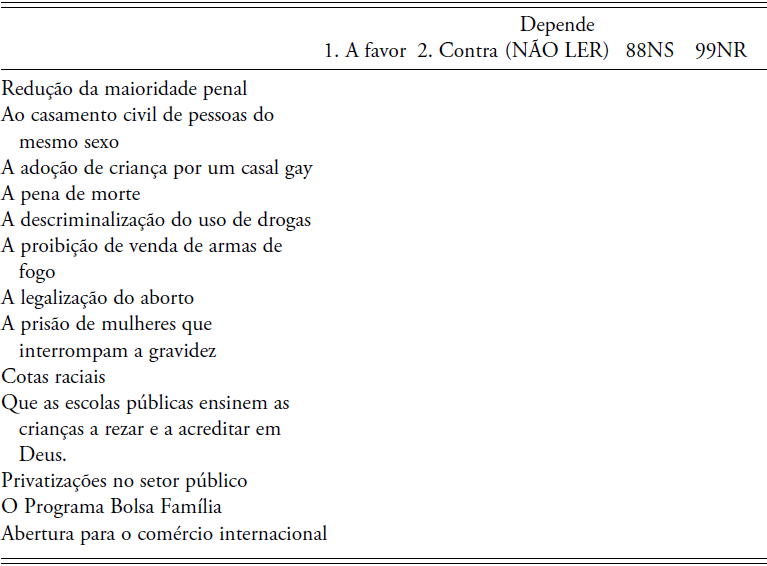
Question: Agora vou enumerar uma série de temas debatidos na sociedade brasileira. Gostaria de saber se o Sr.(a) é a favor ou contra.
The independent variables were measured with the following questions:
P23b. Falando de alguns grupos de pessoas, poderia informar o quanto gosta ou desgosta dos listados abaixo. Usaremos agora uma escala de 1 a 10, na qual 1 significa “desgosto muito” e 10 significa “gosto muito”. Pessoas que apoiam o Bolsonaro [People who support Bolsonaro, author’s translation]
P51. Em outubro haverá eleições para presidente. Se a eleição fosse hoje, e se estes fossem os candidatos, em quem o(a) Sr.(a) votaria [Ler as opções]?
1. Haddad
2. Alckmin
3. Ciro Gomes
4. Marina Silva
5. Bolsonaro
6. Henrique Meirelles
7. Álvaro Dias
8. Guilherme Boulos
9. Outro
12. (NÃO LER) Anularia o voto/votaria em branco
13. (NÃO LER) Não iria votar
88. NS
99. NR



