1 Introduction
This article is about the interaction of the two frameworks of language change known as grammaticalisation and lexicalisation. We ask the questions: what happens if grammaticalisation and lexicalisation processes co-occur? Using the construction take prisoner, we discuss how particular semantic and syntactic changes conventionally associated with grammaticalisation and lexicalisation affect the construction and what this tells us about the interaction of the two frameworks.Footnote 1
The construction take prisoner has two formal constituents, a verb and a noun phrase (NP) functioning as a predicative complement.Footnote 2 In semantic terms, predicative complements are non-referential, that is, the complement does not refer to any specific referent in the discourse but to the subject or object of the sentence (see e.g. Huddleston & Pullum et al. Reference Huddleston and Pullum2002: 217, 252–4; Berlage Reference Berlage2010). This applies to the case of take prisoners in (1) and (2), where the complement prisoners either relates back to the object NP of an active sentence as in (1) or to the subject NP of a passive construction as in (2).
(1) They've taken us prisoners and are keeping us, . . . (COHA, 1912)Footnote 3
(2) All of the ex-ministers have been taken prisoners and are in the Fortress of St Peter, they say. (COHA, 1917)
While example (2) illustrates the passive use of the construction, the active construction is realised in terms of two different variants: the discontinuous placement of take and prisoners as in (1), where an intervening object NP separates verb and complement, and the continuous word order as in (3), where verb and complement occur in immediate syntactic adjacency. The two variants in the active construction can be compared to the situation that we find with verb-particle constructions of the type put the fire out vs put out the fire.
(3) Congo forces have helped the British in every possible manner to conquer Ethiopia, taking prisoner many thousands of Italian troops and some Italian generals. (COHA 1942)
The construction has been chosen for closer analysis because it involves the verb take, which can be classified as a light verb in English. In the Cambridge Grammar of the English Language, light verbs are defined as
semantically ‘light’ in the sense that their contribution to the meaning of the predication is relatively small in comparison with that of their complements. . . The main semantic content is located not in the light verb but in the noun functioning as the head of the direct object. (Huddleston & Pullum et al. Reference Huddleston and Pullum2002: 290)
That this definition fits the present construction is obvious from the meaning of the verb. In the context of take prisoner, take cannot simply be substituted by the verbs seize, grasp, capture or catch, which correspond to its original meaning (see section 4).
Typical light verb constructions are introduced by make, give, do, have or take (see e.g. Huddleston & Pullum et al. Reference Huddleston and Pullum2002: 290–1). Classical examples include give a kiss, take a rest and have a look. While take prisoner is certainly a less prototypical construction than e.g. take a rest in the sense that it involves neither a deverbal noun nor an article, it clearly falls under the semantic definition provided above.Footnote 4
The outline of this article is as follows: section 2 familiarises the reader with the hypotheses and mechanisms of change underlying the empirical investigations presented here, before section 3 summarises the methodology. All the empirical findings are presented in sections 4–6. While section 4 is concerned with the (partial) grammaticalisation of take, section 5 deals with three mechanisms associated with the lexicalisation of the construction take prisoner. In section 6, we see how the speed of lexicalisation is influenced by the word order of the constituents. The findings presented will be shown to be in line with an array of typological findings on agreement relations in languages as diverse as the Romance family, Classical Arabic and Old English.
2 Mechanisms of change
This article investigates two general hypotheses:
1. The construction take prisoner has been subjected to two different types of language change in the course of time: grammaticalisation and lexicalisation processes. While the verb take has become partially grammaticalised, the construction take prisoner has gone down the path of lexicalisation.
2. The speed of lexicalisation of the construction is considerably affected by the relative word order of the constituents (the complement prisoner(s) and the NP functioning as the object or subject of the clause).
While the second hypothesis will be explored in detail in section 6, we will here be concerned with the first hypothesis and its manifestations. We will ask which core mechanisms of grammaticalisation and lexicalisation are involved in the changes associated with take prisoner and show that these can be isolated and subjected to empirical analysis.
The claim that the verb take has become partially grammaticalised will be based on the fact that it has become semantically bleached, and, concomitantly, entered a productive pattern of the type take + NP (+ prep.). Semantic bleaching is a core mechanism of grammaticalisation. This has been attested ample times in the literature (see e.g. Hopper & Traugott Reference Hopper and Traugott1993; Haspelmath Reference Haspelmath1998; Heine & Kuteva Reference Heine and Kuteva2002; Lehmann Reference Lehmann2002). The meaning associated with an item that undergoes grammaticalisation typically becomes less lexical, therefore more general and abstract.
The construction take prisoner, on the other hand, has been subjected to a process of lexicalisation. This can be attested on the basis of two core mechanisms. These are: (i) a restriction in terms of co-occurrence patterns and (ii) the decategorialisation of the original NP prisoner.
While extension of usage is a mechanism that has been clearly assigned to the process of grammaticalisation (Heine & Kuteva Reference Heine and Kuteva2002), lexicalisation often involves a decrease in a construction's range of application. This article will show that, initially, prisoner combines freely with the verbs take and make but, in the course of time, the construction make prisoner falls out of use.
The picture is not quite as straightforward in the case of decategorialisation. Decategorialisation, which can be defined as the loss of morphosyntactic properties typical of a particular lexical category, may on the one hand be interpreted as being central to the process of grammaticalisation. In Heine & Kuteva (Reference Heine and Kuteva2002), for example, decategorialisation is listed as one of the key mechanisms of grammaticalisation, next to desemanticisation (semantic bleaching), extension (use in new contexts) and erosion (phonetic reduction). A case in point is the noun while, which has turned into a conjunction in the course of time. In its functional shift from a noun to a conjunction (which we refer to as grammaticalisation), it has given up features typical of an NP, which are only preserved in the (rare) use of while as a noun, as in this takes a while (Hopper & Traugott Reference Hopper and Traugott1993: 104). It seems characteristic of decategorialisation in the context of grammaticalisation that an item not only loses formal properties associated with a lexical word class, but also adopts properties of the grammatical word class it enters. In the example above, the conjunction while ‘gains’ the ability to link clauses and indicate temporal relationships in discourse in a way that did not exist before (Hopper & Traugott Reference Hopper and Traugott1993: 104).
On the other hand, decategorialisation may also be interpreted as a mechanism of lexicalisation, an interpretation which is likewise attested in the literature (see e.g. Traugott Reference Traugott, Brinton and Akimoto1999; Brinton & Traugott Reference Brinton and Closs Traugott2005: 131; Brinton Reference Brinton, Seoane and López-Couso2008; Berlage Reference Berlage2010). In this context, the loss of morphosyntactic features typically associated with lexical categories does not seem to be compensated for by the adoption of features of another category. This has to do with the fact that the items are not changing from a lexical into a grammatical word class but are lexical to start off with and, as they combine with other elements, begin to form a new lexical entry. A showcase example is the idiomatic expression bread-and-butter as in This is my only bread-and-butter (my only source of income). The construction has become decategorialised in the sense that the phrase can no longer take internal modification as in *This is my bread-and-creamy-butter. Considering now the two different directions of change that we find in lexicalisation and grammaticalisation, we can clearly say that the construction take prisoner is moving in the same direction as bread-and-butter, i.e. decategorialisation will be interpreted as a mechanism involved in the process of lexicalisation.
Previous research on composite predicates by Brinton & Traugott (Reference Brinton and Closs Traugott2005) and Brinton (Reference Brinton, Seoane and López-Couso2008) has claimed that we have to distinguish between two different types of composite predicates: those that involve non-productive verbs such as lose in lose sight of and those that contain a light verb such as take in take a look at or take control over. Brinton & Traugott (Reference Brinton and Closs Traugott2005) and Brinton (Reference Brinton, Seoane and López-Couso2008) claim that constructions of the lose sight of type have become lexicalised, while those of the take a look at type have become grammaticalised. Their argumentation runs in terms of the productivity of the verb. While non-productive lose is basically restricted to the construction lose sight of, productive take enters numerous other constructions (with or without prepositions following), such as take advantage of, take care of or take a rest. This clearly contrasts with the claim put forward in this article: the construction take prisoner involves both grammaticalisation and lexicalisation processes.
3 The methodology
The majority of the analyses presented in this article are based on the Corpus of Historical American English (COHA), an electronic corpus that extends to over 400 million words and contains fictional and non-fictional American texts published between 1810 and 2009. The corpus is balanced by genre across the decades, with fictional texts representing about half of the data available.Footnote 5
Surveying the more specific construction take prisoner of war in present-day British and American English (BrE and AmE), the study draws on a set of British and American newspapers published between 1990 and 2005. For BrE, these are the Daily Mail (DM) 1993–2000, Daily Telegraph (DT) 1991–2000 and 2002/2004, Guardian (G) 1990–2005, Independent (I) 1993–4 and 2002–5 and The Times (T) 1990–2004. The American newspapers selected are the Detroit Free Press (DFP) 1992–5, Los Angeles Times (LAT) 1992–9, New York Times (NYT) 2001 and Washington Times (WT) 1990–2. The choice of corpora can be explained in the sense that we need a very large set of (homogeneous) data in order to account for such a low-frequency construction as take prisoner of war.
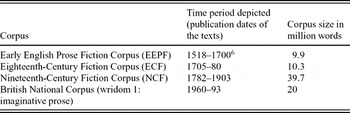
For a comparison of the constructions take prisoner and make prisoner from the sixteenth to the twentieth century, the analysis draws on a set of fictional historical texts representing BrE.Footnote 7Table 1 provides a detailed account of the corpora in use, their sizes and the publication dates of the texts contained therein.
Corpora used for the comparison of normalised frequencies associated with take prisoner and make prisoner

In section 6, where we compare the relative speed of lexicalisation in relation to the word order of the constituents, the database consists of a series of American newspapers, which are the Chicago Daily Tribune, Christian Science Monitor, Los Angeles Times, New York Times, Wall Street Journal and Washington Post. Only those texts are included that were published between 1845 and 1940.Footnote 8 The choice of corpus and time span can be accounted for by the fact that, firstly, we want to observe changes in what will be shown to be the ‘critical time span’ for the demise of plural marking in prisoner(s) (see section 5) and, secondly, by the fact that the newspaper genre is known to be particularly sensitive to changes occurring in the language (see e.g. Mair Reference Mair2006: 183–93).
4 The semantic bleaching of take
This section provides evidence for the partial grammaticalisation of the verb take, which is manifested in semantic bleaching. In claiming that the verb take has undergone a process of grammaticalisation, the article follows Brinton & Traugott (Reference Brinton and Closs Traugott2005) and Brinton (Reference Brinton, Seoane and López-Couso2008). Three points of evidence will be adduced for this claim:
(a) evidence from the OED pointing to the original meaning of the verb take
(b) evidence from the parallel construction make prisoner
(c) evidence provided by the productivity of the pattern take + NP (+ prep.)
In the OED (3rd edition, online version), the original meaning of transitive take is specified as ‘to seize, grasp, capture, catch’. An example of take occurring in the meaning of ‘capture’ is provided in example (4) below.
(4) He is your brothers prisoner. That in the wars of Mantoa was took. (A. Cokayne Trappolin I. i, in Small Poems 425, 1658)
This clearly contrasts with the earliest occurrences of the construction take prisoner proper, where take cannot simply be equated with ‘capture’. Two examples of the construction are given below. Both of them originate from around 1500.
(5) Nor no man to be so bolde As to take Any of theym prisoners, soo that they be not Armed or in warres ayenst vs, pryuy or perte. (J. Blount tr. N. Upton Essent. Portions De Studio Militari (1931) 35, c. 1500)
(6) He had rather they had bene taken prisoners. (Ld. Berners tr. J. Froissart Cronycles I. 157, 1523)
The examples show clearly that the meaning of take is not ‘capture’. Rather, semantic bleaching of take has set in, resulting in a much more abstract meaning of the verb take.
Further evidence for the semantic bleaching of take comes from the parallel construction make prisoner. Make prisoner not only shows the same syntactic pattern (with make another light verb), but it can also be replaced with take prisoner without a change in meaning. Look at the evidence provided in (7) below.
(7) The Captain who had receiv'd direction to make Artabbanes his Prisoner, being a Parthian, and consequently reverencing the high bloud of the Arsacides, came even in tears to do his dutie, . . . (EEPF, 1655)
Since make is, in general, not a synonym of take (cf. e.g. make money vs take money), such replacement is only possible if the meaning of take has already become sufficiently abstract.
A third factor supporting the hypothesis that take has become partially grammaticalised is its productivity in verb–noun combinations such as take care, take notice, take advantage etc. (Kytö Reference Kytö, Brinton and Akimoto1999). Such productivity is only possible if the meaning of take has become considerably more abstract.
Three different types of evidence have been adduced for the semantic bleaching of take and, therefore, for the partial grammaticalisation of the verb. While take has become semantically bleached and, concomitantly, considerably extended its range of application (extension), it has not undergone further mechanisms typical of grammaticalisation like erosion (loss of phonetic substance) or decategorialisation. In line with the grammaticalisation cline predicting that the direction of change of an item is from ‘content item > grammatical word > clitic > inflectional affix’ (Hopper & Traugott Reference Hopper and Traugott1993: 7), a process of complete grammaticalisation would imply that take finally develops into a grammatical affix (Brinton & Traugott Reference Brinton and Closs Traugott2005: 131–2). Clearly, this is far from what is attested in the data and it remains an open question whether take will ever reach a stage of complete grammaticalisation.Footnote 9
If we assume that take has adopted a grammatical function, then the question arises what this function is. We claim that it is the grammatical function of take to make the NP prisoner part of a verbal construction. This in turn promotes the process of lexicalisation affecting the construction take prisoner.
5 The lexicalisation of the construction
This section will shed some light on the lexicalisation of the construction take prisoner. Empirical evidence for the lexicalisation process comes from the two different mechanisms outlined in section 2. We will start by looking at the increase of co-occurrence restrictions associated with the original NP prisoner.
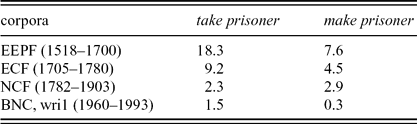
As we have seen in example (7) from the seventeenth century, prisoner combines not only with the verb take but also with the verb make. An overview of take prisoner and make prisoner in fictional historical texts dating from the sixteenth to the twentieth century is provided in table 2. The fictional texts selected come from the Early English Prose Fiction Corpus (EEPF), the Eighteenth-Century Fiction Corpus (ECF), the Nineteenth-Century Fiction Corpus and the fictional section of the British National Corpus (BNC, wridom 1) (for further information, see section 3). Table 2 provides the normalised frequencies of these constructions from the sixteenth to the twentieth century. The analysis includes singular NPs (with both singular and plural reference) and plural NPs as well as cases in which the constructions contain determiners, premodifiers or both. Both active and passive variants are considered. An example in which prisoner is preceded both by a premodifier and a determiner is provided in (8).
(8) By the Verdict of these, euery thought, word, and deed of man, is either freed or made a lawfull prisoner. (EEPF, 1627)
Take prisoner and make prisoner: frequencies of occurrence in four corpora representing British English
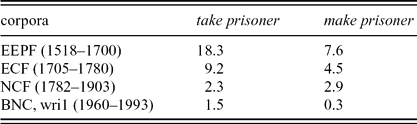
Table 2 reveals that the collocations take prisoner and make prisoner show a very similar development: their normalised frequencies continuously decrease, with the construction make prisoner leading the decline.Footnote 10 The fact that make prisoner is practically absent from Present-day English attests to a decrease in the external distribution of prisoner. This is the reverse of what we see in the development of take, which has significantly extended its use of application (see section 4). These results can certainly be read as evidence for the (partial) lexicalisation of the construction take prisoner.
While the co-occurrence restrictions outlined above can be interpreted as changes in the external distribution of prisoner, there are also considerable changes in terms of the internal distribution of the complement. Morphosyntactic changes related to the NP prisoner inside the construction take prisoner can be detected on different levels. This is obvious from examples (9), (10) and (11), which come from the seventeenth century and which represent occurrences of the construction no longer found in Present-day English. In (9) and (10), prisoner is preceded by a determiner, in (11) it is inflected for plurality.
(9) . . . that they took the Queen a Prisoner (EEPF 1656)
(10) . . . and took him my Prisoner (EEPF 1669)
(11) . . . Many Noble men of Scotland were taken prisoners at this battell and many more slaine . . . (EEPF, 1626)Footnote 11
The examples illustrate that the construction was a lot more flexible in Early Modern English than it is today, where prisoner cannot be preceded by a determiner or take plural s-inflection.Footnote 12 While both the use of a determiner and the occurrence of plural -s inflection are characteristic of typical NPs (and their head nouns) in English, the present article is restricted to the more frequent feature of the two, which is plural marking. Plural -s attached to the complement prisoner marks agreement between the complement and its corresponding object (in the active construction) or subject NP (in the passive).
If the use of plural s-inflection in the complement is indicative of its nominal status, then the decategorialisation of prisoner should be attested in a decrease of those cases containing plural marking (in the context of more than one referent). Increasingly, the construction should become syntactically fixed. In order to get a first idea as to how long plural prisoners is preserved, let us look at example (12), which was published in the American newspaper Christian Science Monitor in 1913. The example illustrates that plural marking still existed at the beginning of the twentieth century.
(12) It is still unknown how many Turks were taken prisoners. (1913)
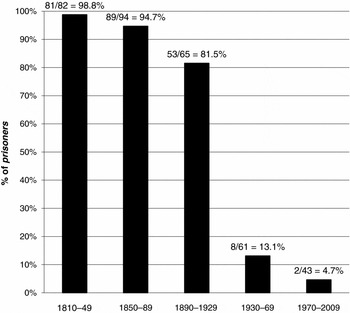
On the basis of quantitative corpus analyses focusing on AmE, we will now trace the demise of plural s-inflection in the complement prisoner.Footnote 13 To begin with, the study depicts the evolution of take prisoner from 1810 to 2009. The database is the COHA corpus (for further information, see section 3). Since the example presented in (12) has suggested a late decategorialisation of prisoner, the overview does not start prior to the nineteenth century.Footnote 14
The analysis presented in figure 1 includes active and passive instances of the construction.Footnote 15 Since we are interested in the demise of plural agreement, only those uses in which take prisoner has more than one referent are included in the analysis. The columns presented in figure 1 show the percentages of plural marking, with the uninflected form prisoner accounting for what is missing to complete the 100 per cent level. The absolute figures accompanying the columns give the total occurrences of the inflected variant prisoners and the sum of the inflected and uninflected variants, respectively. The data are arranged according to time periods of thirty-nine years each.
The demise of plural marking in the case of take prisoner(s) from 1810 to 2009 in the COHA corpus

With respect to the early to late nineteenth century, the results illustrate a fairly stable situation. During a period of approximately eighty years the inflected form prisoners accounts for 94.7 to 98.8 per cent of all cases. It is only in the late nineteenth and early twentieth centuries (1890–1929) that the uninflected form gradually gains ground and is used in 18.5 per cent of all cases. This results in a highly significant contrast compared to the previous time span (with p < 0.01).Footnote 16 An even stronger decline of plural agreement is attested for the time period 1930–69. Here, plural marking decreases so drastically that it is used in no more than 13.1 per cent of all cases.Footnote 17 Towards the second half of the twentieth century, plural marking continues to drop further, resulting in an overall ratio of 4.7 per cent of plural inflection for the period 1970–2009. Overall, figure 1 reveals that major changes in plural inflection take place between the beginning and middle of the twentieth century.
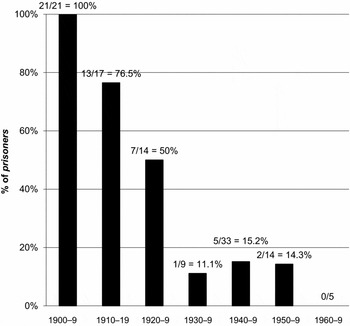
Figure 2, which relies on the same syntactic restrictions and the same database, depicts the evolution of the complement prisoner(s) between 1900 and 1969. In order to see exactly when major changes occurred, the data are arranged by decades.
The demise of plural marking in the case of take prisoner(s) between 1900 and 1969 in the COHA corpus

Figure 2 shows a major decrease of plural marking between 1900 and 1939. Although the absolute figures are too small to yield statistically significant contrasts, they clearly suggest that the peak of change was between 1920 and 1939. After 1939, plural marking is used in less than 16 per cent of all cases before it is entirely given up in the 1960s.
Today, the last vestige of variable plural marking involving the complement prisoner(s) is found in the context of the collocation take prisoner of war. The rivalry between plural inflection and zero marking (the omission of plural -s) is demonstrated in examples (13) and (14).
(13) This is particularly affecting those taken prisoner of war in Japan, . . . (G93)
(14) We were not told we were taken prisoners of war, . . . (G95)
Large-scale analyses of present-day British and American newspaper texts reveal that plural marking in the case of take prisoner of war is only slightly less frequent than zero marking (40 as opposed to 60 per cent).Footnote 18 Compare the evidence in table 3.
Plural s-inflection involving the collocation be taken prisoner(s) of war in a set of present-day British and American newspapers

(DM93–00, DT91–00/02/04, G90–05; I93/94/02–05, T90–04, DFP92–95, LAT92–99, NYT01, WT90–92)
The fact that plural inflection has survived in the modified construction take prisoner of war seems unsurprising: in contrast to its status in the unmodified variant take prisoner, the complement prisoner(s) can be considered more nominal in the case of take prisoner of war. This is because the ability to take a postmodifier is associated with free syntactic NPs and not with nouns that have become decategorialised (see e.g. Huddleston & Pullum et al. Reference Huddleston and Pullum2002: 326; Hoffmann Reference Hoffmann, Lindquist and Mair2004: 180).Footnote 19 What might be more surprising is the fact that the collocation take prisoner of war dispenses with plural marking in as many as 60 per cent of all cases. Possibly, analogical pressures are at work. If so, the demise of plural marking associated with take prisoner of war can be accounted for by assimilation pressures emanating from the standard phrase.Footnote 20
To summarise, evidence from two different areas has been presented to support the claim that the construction take prisoner has become partially lexicalised. Not only has the original NP prisoner seen a decrease in terms of its external distribution (the pattern make prisoner has fallen out of use), it has also become decategorialised, with the construction take prisoner of war being the last threshold of plural -s inflection. As in the case of the grammaticalisation of take, however, the lexicalisation of take prisoner is not yet completed. Take and prisoner have not become syntactically fused but still exist as individual words. At this stage it is not clear to what extent the construction will be further lexicalised.
While both manifestations of lexicalisation would merit further research, the remainder of this article concentrates on the decategorialisation of prisoner. It isolates one factor that impinges on the speed of plural s-deletion and asks if and how different types of word order associated with the predicative complement construction affect the morphosyntactic change involved.
6 Word order and agreement
This article claims that the word order of verb (take) and complement (prisoner(s)) relative to each other considerably affects the speed of plural s-deletion. While word order is certainly not responsible for the actuation of the change involved, it will be shown to promote or retard the loss of plural agreement.
On the basis of the explanations suggested below, it is argued that plural marking in the complement prisoner(s) is preserved better in those contexts where the plural NP precedes prisoner(s) than in those environments where it follows. If this is the case, the three types of word order (one passive and two active variants) should behave as follows: plural -s should be lost earlier in the construction take + prisoner(s) + NP than in discontinuous active uses of the kind take + NP + prisoner(s) and in the passive construction NP + be taken prisoner(s). The hypothesis is illustrated below.

There is a vast body of typological evidence corroborating the hypothesis that agreement (defined as a formal relationship between elements, whereby ‘the form of one syntactic element is modified so as to match properties of another’ (Corbett Reference Corbett1979: 204)) depends on the placement of the elements relative to each other. Items I-III outline a number of agreement relations in languages as diverse as the Romance family, Classical Arabic (partly paralleled by the Germanic languages) and Old English. In all of these languages, agreement is favoured by or restricted to those cases where the NP that triggers agreement in the item that may carry inflection occurs before it.
I The Romance languages, in particular Present-day French, Italian and Catalan
All the examples presented in (15)–(20) focus on the relation between an object NP and the past participle (of the have-perfect) associated with it. As predicted, (gender and/or number) inflection may occur where the NP precedes the participle it is related to as in examples (16), (18) and (20). By contrast, it is absent in those cases where the NP follows, as in (15), (17) and (19). Overall, the examples from Present-day French, Italian and Catalan combine to corroborate the effect of word order on agreement.
Let us have a closer look at the individual examples from French, Italian and Catalan. We start off with the examples from French given in (15) and (16), both of which involve a question word (combien) (see e.g. Belletti Reference Belletti2001: 8–9).
(15)

(16)
Let us now turn to the examples from Italian in (17) and (18), where the direct object is either represented by a full lexical NP (as in (17)) or by a personal pronoun (as in (18)).
(17)
(18)
Last of all, let us look at examples (19) and (20) from Catalan. In these cases, the NP is represented by determiner + noun. Determiner and noun function as the direct object of the verb in (19) and as the direct object of the relative clause in (20).
(19)
(20)
While variation does not occur in (19), where the direct object follows the participle, it variably occurs in (20), where the direct object precedes the participle (see e.g. Fischer Reference Fischer2002: 160–3).
Quantitative evidence for the fact that plural agreement depends on the relative ordering of subject and predicate comes from spoken Brazilian Portuguese. Naro (Reference Naro1981) finds that lower-class speakers tend to leave out plural inflection (of the predicate) much more often in those cases where the predicate precedes the subject than in those environments where it follows.
II Classical Arabic
In Classical Arabic, a plural subject that precedes its predicate as in (21) triggers both gender and number inflection of the predicate (here: masculine plural), while a postpositional subject as in (22) activates gender marking (here: masculine) only (see e.g. Fischer Reference Fischer and Bright1992: 97; Hudson Reference Hudson1999: 186).Footnote 21
(21)
(22)
III Old English
As in the case of the Romance languages, we are concerned with the relation between the direct object NP and the past participle of the have-perfect. As (23) illustrates, the participle may either be inflected or uninflected where it follows the NP (see e.g. Harrison Reference Harrison1887: 134–5; Caro Reference Caro1896: 404–6; Visser Reference Visser1973: 2189; Harris Reference Harris1984: 321; Mitchell Reference Mitchell1985: 283–5; Denison Reference Denison1993: 346–8; Brinton Reference Brinton, Stein and Tieken-Boon van Ostade1994: 138–40).
(23) Fela Godes wundra we habbað gehyred and eac geseweneFootnote 23
‘a-lot God's wonders (gen pl) we have heard and also seen’ (ÆC Hom I 38.578.24; example and translation quoted from Denison Reference Denison1993: 347)
We might wish to account for the difference in marking by reference to the Complexity Principle (Rohdenburg Reference Rohdenburg1996), which predicts the choice of more explicit grammatical forms in variation contexts involving an increased processing load. While the relation between object and participle is still easily accessible with respect to the first participle (gehyred), the greater distance between object and participle in the second case is very likely to add to the processing load of the hearer/reader. If, however, the second participle carries inflection, which makes its connection to the preceding object NP more transparent, parsing should be considerably facilitated.Footnote 25 A second, phonological explanation accounts for the missing inflection in the case of the first participle by means of an avoidance strategy (see Schlüter Reference Schlüter2005). According to this approach, the speaker may leave out inflection to avoid the pronunciation of two successive vowels as in gehyrede and.

While (most of) the typological evidence provided so far comes from individual text samples, large-scale empirical confirmation for the hypothesis that word order determines agreement is found in Caro's empirical study of the relation between participial inflection and word order in Old English. As early as 1896, Caro compares the two word-order patterns plural object NP + participle and participle + plural object NP in terms of their ratios of plural agreement. The difference between them is statistically significant, with p<0.05 (*):
Caro's findings corroborate the trend represented by the examples above. The occurrence of plural inflection positively correlates with the word-order pattern NP + inflectional item.
Caro (Reference Caro1896) states that, from a psychological point of view, the speaker is less aware of a plural entity that is pronounced after the element it is related to than of one that is articulated in advance. If we assume that the concept of plurality is much more salient where the NP precedes the complement than in those cases where it follows, the complement prisoner(s) is more likely to be explicitly marked in the first than in the second case.Footnote 26 Unfortunately, there is as yet no empirical evidence supporting this motivation, so that a psychological explanation – plausible as it might be – remains speculative for the time being.
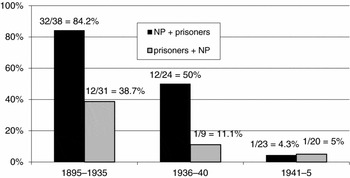
It is against the background of typological evidence provided above that we will now focus on the distribution of the competing word-order variants in the case of take prisoner. Figure 3 illustrates the extent to which the distribution of plural and zero marking is influenced by the two word-order patterns prisoner(s) + NP and NP + prisoner(s). To this end, the study analyses all the plural NPs that occur in combination with the two constructions took prisoner(s) + NP and NP + were taken prisoner(s) in the American historical newspapers specified in section 3.
Plural agreement between the complement prisoner(s) and its related plural NP in the context of the two word-order variants NP + were taken prisoner(s) and took prisoner(s) + NP in a set of American newspapers from 1895 to 1945

As far as the active–passive distinction is concerned, the present study concedes that passive examples differ from their active counterparts in various ways. Due to the limited amount of data,Footnote 27 the study cannot restrict the search to the two active variants take + NP + prisoner(s), where the object NP precedes the complement, and take prisoner(s) + NP, where the object NP follows the complement. In order to get a sufficient number of examples in which the NP precedes the complement, the analysis has to rely on passive occurrences. There is no doubt that the distinction between active and passive occurrences should be pursued further at a future stage.
With respect to the composition of figure 3, the black columns indicate the percentages of the word-order variant NP + prisoners and the grey ones provide the corresponding ratios in the context prisoners + NP for the three time periods 1895–1935, 1936–40 and 1941–5. As in figures 1–2, the absolute figures on top of each column represent the total occurrences of prisoners and the sum of the inflected and uninflected variants, respectively.
Figure 3 clearly confirms our hypothesis. Number agreement is preserved much better in those cases where the NP precedes the complement prisoner(s) than in those contexts where it follows. This contrast is particularly pronounced in the earliest period, spanning the years 1895 to 1935. Here, plural marking occurs in 84.2 per cent of all cases that have the NP preceding prisoner(s) but in only 38.7 per cent of those contexts that involve the pattern prisoner(s) + NP. This difference is very highly significant (p < 0.001). The contrast between the two types of word order is best illustrated in a newspaper article from 1917 which contains both the inflected and the uninflected complement depending on the relative placement of the direct object NP.
(24) The Teutons took prisoner 556 men and captured two machine guns . . . (Los Angeles Times, 22 January 1917)
(25) . . ., bayoneting a number of them and taking others prisoners . . . (Los Angeles Times, 22 January 1917)
Between 1936 and 1940, word order still affects the choice of variant. Although the contrast is slightly lower than the one found in the previous time span, it is still statistically significant (p < 0.05). Accordingly, it is only in the 1940s, when the omission of plural marking is so widely established that it affects nearly every context, that differences due to word order become neutralised.
To summarise, the data reveal that plural marking is preserved better in those contexts where the plural NP precedes the complement than in those cases where it follows. While the active variant took prisoner(s) + NP has already dispensed with plural agreement in 61.3 per cent of all cases between 1895 and 1935 (12 out of a total of 18 occurrences have given up plural marking between 1914 and 1918, alone), the passive construction NP + were taken prisoner(s), in which the plural NP precedes the complement, is subject to major changes as late as the mid 1930s. This finding is perfectly in line with typological evidence from the Romance languages, Classical Arabic and Old English. Here, as there, agreement is preferred in (or even confined to) those cases where the NP precedes the item it is related to. Overall, this finding confirms word order as a major factor affecting the speed with which prisoner becomes decategorialised and the construction increasingly lexicalised.
7 Conclusion
This article has discussed the interface of grammaticalisation and lexicalisation on the basis of the predicative complement construction take prisoner. Qualitative and quantitative corpus studies have provided evidence in support of the two general hypotheses presented in section 2:
1. The construction take prisoner has been subjected to two different types of language change in the course of time: grammaticalisation and lexicalisation processes. While the verb take has become partially grammaticalised, the construction take prisoner has gone down the path of lexicalisation.
2. The speed of lexicalisation of the construction is considerably affected by the relative word order of the constituents (the complement prisoner(s) and the NP functioning as the object or subject of the clause).
The two types of change predicted in hypothesis 1 were investigated using specific mechanisms typical of grammaticalisation and lexicalisation. The partial grammaticalisation of take is thus obvious from semantic bleaching affecting the verb in its earliest co-occurrences with prisoner and from the associated productivity of the pattern take + NP. While the argumentation in terms of pattern productivity is fully in line with Brinton & Traugott (Reference Brinton and Closs Traugott2005) and Brinton (Reference Brinton, Seoane and López-Couso2008), the observations related to the process of lexicalisation clearly extend their approach.
As for the lexicalisation of take prisoner, the data have attested to, firstly, a decrease in the external distribution of prisoner, apparent from the fact that the pattern make prisoner falls out of use. Secondly, there has been a decrease in the internal distribution of prisoner, manifested in the decline of plural s-deletion, which has its peak in the early to mid twentieth century.
All of these mechanisms support the hypothesis that one and the same construction has undergone two different types of language change, with grammaticalisation being restricted to the verb take, and lexicalisation pertaining to the overall construction. The article has thus revealed that studying the individual mechanisms involved gives us more profound insights into the process of language change than could have been obtained from the global notions of grammaticalisation and lexicalisation.
The second part of this article has shown that the speed of decategorialisation (one manifestation of lexicalisation) is determined by the word order of the elements relative to each other (hypothesis 2). While word order is certainly not the initiator of the grammatical change affecting the construction, it helps to predict which contexts are first and last affected by the lexicalisation process. In line with typological evidence from languages as diverse as the Romance family, Old English or Classical Arabic, large-scale analyses show plural agreement to be preserved better in those cases where the plural NP precedes the complement than in those cases where it follows.
While we have isolated one factor affecting the loss of number agreement, it is of course possible that there may be other factors impinging on the speed of the lexicalisation process. It is, for instance, very likely that the distinction between personal pronouns and other NPs functioning as direct objects of take prisoner in the active construction (e.g. take the people prisoner vs take them prisoner) or subjects in the corresponding passive voice (the people are taken prisoner vs. they are taken prisoner) affects the speed of lexicalisation. Preliminary studies confirm this trend. Yet, more data are necessary to turn this tendency into a statistically sound determinant of the speed of lexicalisation.