INTRODUCTION
The ichthyofauna of the Arabian Gulf and Omani waters has been described extensively, from the early works of Boulenger (Reference Boulenger1888, Reference Boulenger1889) to more recent studies (White & Barwani, Reference White and Barwani1971; Kuronuma & Abe, Reference Kuronuma and Abe1972; Fischer & Bianchi, Reference Fischer and Bianchi1984; Al-Abdessalaam, Reference Al-Abdessalaam1995; Randall, Reference Randall1995; Jawad & Al-Mamry, Reference Jawad and Al-Mamry2009; Jawad et al., Reference Jawad, Louisy and Al-Mamry2010a, Reference Jawad, Al-Mamry and Al-Kharusib, Reference Jawad, Al-Kharusi and Al-Mamry2011a, Reference Jawad, Al-Mamry and Al-Mamaryb). Recently, the survey of RV ‘Al-Mustaqila 1’ in the territorial waters and exclusive economic zone of the Sultanate of Oman between Ra's Al Hadd and the Oman–Yemen border (McKoy et al., Reference McKoy, Bagley, Gauthier and Devine2009) has provided the most comprehensive ichthyolofaunal survey of Omani waters since the previous surveys of RV ‘Dr Fridtjof Nansen’ (Kesteven et al., Reference Kesteven, Nakken and Stromme1976; Saetersdal et al., Reference Saetersdal, Stromme, Bakken and Piekutowsk1982, Reference Saetersdal, Bianchi and Stromme1999; Stromme, Reference Stromme1986) and FRV ‘Rastrelliger’ (Johannesson, Reference Johannesson1990).
In the present paper, we confirm the presence of the peacock wrasse Iniistius pavo (Valenciennes, 1840) in the Sea of Oman.
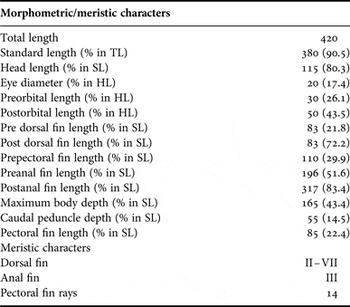
The specimen is deposited in the ichthyological collection of the Marine Science and Fisheries Centre, Oman (OMMSFC). Standard length, measured from tip of snout to base of caudal fin, was used for proportional measurements, and total length (TL) for the maximum length of specimen. The specimen was fixed in 10% formalin and stored in 70% ethanol. Measurements were made with dial calipers to the nearest 0.1 mm following the methods of Fischer & Bianchi (Reference Fischer and Bianchi1984), Eschmeyer (Reference Eschmyer2014) and Fricke (Reference Fricke2014) (Table 1).
Morphometric and meristic characters of Iniistius pavo collected from the Sea of Oman (TL, total length; HL, head length; SL standard length).

LABRIDAE
Iniistius pavo (Valenciennes, 1840)
MATERIAL EXAMINED
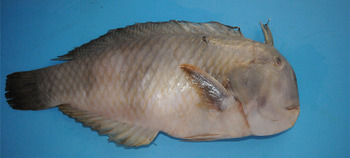
OMMSFC 1199, 1: 420 mm TL, coast of Muscat City, Sea of Oman, 23°39′01.61″N 58°30′47.87″E, gill net, 12 m depth, 20 January 2014 (Figure 1).
Iniistius pavo, 420 mm total length.

DESCRIPTION
Body is deep with compressed dorsal side of head, the extreme convex curve is above lower eyes. Dorsal fin with first 2 spines long and connected to each other by a membrane and separated from the rest of the fin. No scales on the head in front of dorsal fin. Lower jaw with no scales. Body with 3 or 4 poorly defined broad, green vertical bars on sides; a prominent black spot above lateral line and below sixth dorsal fin spine; dorsal and anal fins bluish.
REMARKS
The total length of the present specimen (420 mm) is larger than the previously reported length for this species (90 and 179 mm, Randall & Earle (Reference Randall and Earle2002); 410 mm, Lieske & Myers (Reference Lieske and Myers2004)). Therefore, the size given in this study is a new maximum size recorded for this species. The description of the present specimen agrees with the description given by Allen & Erdmann (Reference Allen and Erdmann2012).
Iniistius pavo, which also has a range of junior synonyms, has not been listed in the Omani ichthyofauna before (White & Barwani, Reference White and Barwani1971; Al-Abdessalaam, Reference Al-Abdessalaam1995; Randall, Reference Randall1995; Al-Jufaili et al., Reference Al-Jufaili, Hermosa, Al-Shually and Al-Mujaini2010). Fischer & Bianchi (Reference Fischer and Bianchi1984) indicated that this species would occur on the Arabian Sea coasts of Oman and the Sea of Oman, but, there was no mention of this species in subsequent publications about Omani waters (Randall, Reference Randall1995; Manilo & Bogorodsky, Reference Manilo and Bogorodsky2003). The nearest locality to the Sea of Oman where this species has been recorded from is the Somali coast (Froese & Pauly, Reference Froese and Pauly2014). This is the first documented occurrence in the Sea of Oman and Omani waters in particular, indicating a range extension of its previously known distribution. The importance of the present record of I. pavo comes as a result of extensive ichthyological collections in the area and the absence of any previous record of these members from the Omani waters.
ACKNOWLEDGEMENTS
We thank the Ministry of Agriculture and Fisheries Wealth, Marine Science and Fisheries Centre, Ministry of Fisheries Wealth and the Directorate of Agriculture and Fisheries Developmental Fund for giving us the opportunity to work on the fish samples within the qualitative and quantitative distribution of marine organisms in the Sultanate of Oman and for providing the appropriate financial support. Our sincere thanks are also due to Sergey Bogorodsky of Station of Naturalists, Omsk, Russia and Ronald Fricke of Staatliches Museum für Naturkunde, Rosenstein, Germany for the confirmation of the identification of the species.