

Prologue
In the transcript of R v Hickey, a murder trial in the Australian state of New South Wales, sits forty seconds of silence.Footnote 1
[Pause for forty seconds]
That silence could be sustained for a full forty seconds during trial struck me in reading this portion of the trial transcript. The transcript does not pause; its text carries on. Yet this pause was present in the live performance. I have invited you to recreate that courtroom experience so that you could feel it and practice it for yourself. We cannot know what that silence felt like; we only read it and recreate it ex post facto. Silences of varying lengths are always present in live performance, legal or otherwise; their shape and contours incapable of being captured in the (tran)script beyond that of a textual direction like that above.
Perhaps the most famous silence in performance is John Cage’s 4’33”, wherein the performer enters the stage but does not play their instrument for four minutes and thirty-three seconds.Footnote 2 In this work, Cage invites the audience to listen to and in silence. Whilst Cage is regarded as a musical composer, he was a true interdisciplinarian, influenced by artist Robert Rauschenberg whose work White Paintings (Figure 1), a series of canvases in solid white, formed the background to one of Cage’s first “happenings” or performance art events, Theatre Piece.Footnote 3 Rauschenberg’s work may be regarded as a pictorial representation of the sound of silence. Within the work, Rauschenberg reverses positive and negative space so that the negative space becomes the central content, finding presence in absence, which is what Cage sought to do in his work. There have been many words written about Cage’s silent work, but most salient is composer Kyle Gann’s conclusion that 4’33” requires “a new approach to listening.”Footnote 4 For listening demands that we hear silences, not simply voices;Footnote 5 that we attune ourselves to the gaps in speech, the background noises and the silence in the court.
Robert Rauschenberg, White Painting, 1951; Oil on canvas; 48 x 48 inches (121.9 x 121.9 cm); Robert Rauschenberg Foundation; © Robert Rauschenberg Foundation.

Juxtaposing a legal case to an artistic performance hints at the interdisciplinary approach that informs this paper. Despite calls at the turn of this century for law to be reconceptualized as a performing art,Footnote 6 law and performance is still an emerging field of scholarship. The “performative turn” has been apparent in social sciences and humanities since midway through the last century as “performance theorists recognize the ubiquity of cultural performances, and encourage the analysis of performances in many diverse fields and disciplines.”Footnote 7 Richard Schechner, a pioneering scholar of performance studies, argues that “theatre is but one of a complex of performance activities, which also includes rituals, sports and trials (duels, ritual combats, courtroom trials),”Footnote 8 situating trials within the performative spectrum as theatre and ritual.Footnote 9 As Kate Leader writes, “the metaphor of trial as theatre and performance is pervasive.”Footnote 10 However, the relation between law and performance has not always been comfortable. As Julie Peters explains, “law’s history is marked by an oscillation between the antinomies of theatricality and antitheatricality, in a relationship of attraction–revulsion—a kind of fort-da.”Footnote 11 Rejecting the parenthetical divide between performance and law, I try to give space for the two disciplines—legal and performance studies—to speak to each other and, in doing so, offer new insight into legal performance and, in this instance, how silence plays in the court. “Legal performance” is a term I borrow from Nicole Rogers and Julie Peters to describe the idea of court proceedings as performance.Footnote 12 As Peters describes it, configuring law as performance is “an alternative way of studying the law, more attentive to the material, affective and aesthetic textures of legal process.”Footnote 13
The article explores the different interpretations of silence in legal performance and silence’s impact on the legal audience. I start with silence as a listening device accompanied by a discussion of what happens when the listening audience breach the silence. This leads to an exploration of silence in legal speech and, in particular, how pauses in speech can have meaning. This is followed by a move away from silence in language to silence in the environment of legal performance, exploring relatively unchartered territory away from the existing scholarship that considers silence mostly as an absence of speech. An exploration of dead and noisy silence, to use the lexicon of sound recording analysis, tests assumptions around whether silence is the right condition for legal performance. I conclude that silence is used and experienced in a similar way in legal and theatrical performance, namely as a means of attunement.
Listening to Silence
Silence is a recurring element in legal performance. There is a right to silence (which is ironically often exercised by stating it in words). There is silence in the court. Silence affects and, in particular, attunes the audience to the legal performance. Thus it deserves listening to; both listening “causally” to obtain information about its context and “semantically” to obtain information about its meaning.Footnote 14 Distilling the nature of silence is difficult. In his seminal work, Acoustic Jurisprudence, legal scholar James Parker argues that to do so “depends on quite a refined sense of legal oratory, one that is as sensitive to its rhythms and ellipses as its content.”Footnote 15 Silence is much more open to interpretation than words, and yet this article cannot but reduce the phenomenon to words.Footnote 16 As sociolinguist Adam Jaworski writes, “paradoxically… its study is only possible when it is broken.”Footnote 17
Despite the many words written on the right to silence, silence as a political act or right,Footnote 18 silence as a virtue, and silence as a spiritual zen,Footnote 19 few scholars consider courtroom silence in its aesthetic sense. In searching for an understanding of the aesthetic dimension of silence in legal performance, we can here turn to performance scholars. As actors well know, silence can be filled with action and unspoken dialogue as much as words or noise can.Footnote 20 Indeed, as legal scholar Gary Watt comments, “silence is so much more eloquent than words very often”Footnote 21 and, as Bret Rappaport suggests, “can be more persuasive than the speech that surrounds it.”Footnote 22 Watt goes on to suggest that in deploying silence in legal performance, lawyers need the knowledge and awareness of theatrical actors.Footnote 23 I propose to adopt this view by suggesting that legal performers can learn from theatrical performers in this respect.
In legal studies, unlike in theatre and performance studies, we seldom exercise our conscious capacity to attune ourselves to the various ways in which silence can be meaningful. To riff off Simon and Garfunkel, comprehending the sound of silence requires a deep listening that goes beyond hearing, and yet, ironically, hearing is the word used to describe many legal proceedings.Footnote 24 Understanding the significance of silence to legal performance is an ongoing projectFootnote 25 and one that requires us to listen. Really listen. In so doing, it requires those within legal performances to develop attunement practices and a mode of embodied listening, which may be foreign to practitioners of the law.Footnote 26
Embodied Attunement
In Justice as Attunement, legal scholar Richard Dawson argues that attunement is at the heart of doing justice.Footnote 27 Though Dawson does not provide a strict definition, attunement in legal performance may mean orienting oneself or paying close attention to meaning.Footnote 28 Similarly, fellow legal scholar Sara Ramshaw in her work on justice and improvisation argues that attunement to what is beyond the determinate is necessary for law’s operation,Footnote 29 and that the act of listening in law and performance “demands attunement.”Footnote 30 Attunement entails an “intense form of commitment and responsibility to—as well as interaction with—all that surrounds: people, environments, nature and the sounds of daily life.”Footnote 31 This kind of spatial attunement is well captured in anthropologist Kathleen Stewart’s notion of “atmospheric attunement,” which she describes as “an intimate, compositional process of dwelling in spaces.”Footnote 32 Stewart describes attunement as “absorption, a serial immersion in little worlds… attending to what might be happening”Footnote 33 and a mode of engagement through bodies in space.Footnote 34 The legal and broader scholarly engagement with the notion of attunement suggests that it entails both a self-focused orientation or attention and an outwardly-focused orientation to that which surrounds.
The attunement process of silence, I wager, thus has two stages to it. First, the silence creates focus or attention; then, it disperses that attention to the background noise. Seth Kim-Cohen captures this well in his account of Pauline Oliveros’s notion of “deep listening” or attuning to the sound-in-itself in contradistinction to his notion of “surface listening” or attuning “to encompass adjacent concerns and influences.”Footnote 35 However, these listening practices need not be distinct or strictly sequential. As actor trainer Phillip Zarrilli describes, attunement is the ability to both “inhabit one’s body-mind and remain sensorially and perceptually alert” to “the performance environment.”Footnote 36 In the moment of attunement created by silence, one is thus both inwardly focused and also publicly aware of or alert to the surrounding environment.Footnote 37 Zarrilli goes on to argue that attunement creates “a state of fuller attentiveness,” in which one is alert to one’s surroundings and prepared to react to stimuli.Footnote 38 In attunement, one is present and alive to stimulation. The other senses become elevated and responsive to the surrounding environment.Footnote 39 One can drop out of attunement when one’s attention is diverted.Footnote 40 Conversely, attunement can return in a snap moment of arrest or “habitual pause in a tempo,”Footnote 41 like the silence that breaks voice or noise. Zarrilli, who is famous for his psychophysical actor training method draws in part from philosopher Shigenori Nagatomo,Footnote 42 whose work Attunement Through the Body advances the idea that attunement is a “somatic knowing between the personal body and its living ambience.”Footnote 43 Attunement is thus an embodied practice, not an experience purely of the mind. Zarrilli’s notion of the “body-mind” captures this anti-dualism. Breathing and emotion can give rise to a heightened sense of attunement;Footnote 44 as can stillness, which theatre-maker Anne Bogart suggests creates spatial awareness and attention to others within space.Footnote 45
I recall a time being locked in an anechoic hearing test chamber, striving to hear, trying to tune into sound in a space of silence. As author Meghan O’Rourke writes, “to hear ourselves, we sometimes have to flee ourselves, diving into silence until we’re comfortably alone with the noise within.”Footnote 46 Silence provides a moment to hear oneself.Footnote 47 In the chamber, I attuned in to my body, not only the noise within but how silence felt (slight goose bumps on my skin) and tasted (slight metallic taste in my mouth).Footnote 48 These sensory manifestations are linked to anxiety and may express the fear that I felt in being in this dark, quiet, claustrophobic space.Footnote 49 In moments of silence, other senses beyond the hearing are elevated. There is a truly multi-sensory experience to silence. Author George Prochnik suggests that “silence is for bumping into yourself.”Footnote 50 In silence, I reacquainted myself with my body. The absence of voice calls attention to the body—its facial configurations, sweat, movement, etc.—and invites the audience to read the body. For example, a pause in testimony at the recent defamation trial concerning the actor Geoffrey Rush called attention to the testifier’s head turn.Footnote 51 From tuning in to my body, I then tuned out to the sounds in the space around me, minute as they may be.Footnote 52 The quietness enhanced my perception and enabled me to hear more acutely.Footnote 53 I was more connected to my acoustic surroundings; even the most innocuous of noises became something of interest.Footnote 54 Silence attunes one both internally (to the body) and externally (to the space).
Verbal Silence
In almost all legal performances, there is silence as a speaker—I shall refer to them as an actor, as they are not always speaking—speaks. It is worth noting audience is not a static concept in legal performance. There are many legal actors who play the role of audience at some point. The common law judge is audience during most proceedings but then a powerful actor at their end, as is the jury. The lawyers oscillate between acting and spectating. The testifier is the archetypal “poor player that struts and frets his hour on the stage and then is heard no more” receding, if they please, to the gallery.Footnote 55 The public gallery is certainly an audience to the proceedings, but at times acts within them as they stand to welcome the judge.
This form of silence between actor and audience may be referred to as conversational or floor-sharing silence, where the actor speaks and the audience are silent except for certain non-verbal reactions such as laughing, clapping, and mmhmm-ing that let the actor know they have been heard. A particularly amusing example of this is in the proceedings of Eight Mile Style v New Zealand National Party, a copyright infringement case where the entire court sits in silence to listen to Eminem’s Lose Yourself.Footnote 56 In watching the video footage of this moment of trial, one can see the discomfort and perhaps even bemusement in the audience—the intrusion of song into the legal soundscape is foreignFootnote 57—but nonetheless the convention of conversational silence is maintained, albeit the actor’s words are pre-recorded music coming through a laptop.
Legal linguist Dennis Kurzon argues that there is here a contract between speaker and listener, that one is silent while the other speaks.Footnote 58 For a listener to break silence while another is speaking is to breach that contract, and the possibility of breach lends a powerful potency to the performance. This is well depicted in the proceedings of R v Johnson, where, during the trial, the accused interrupted the speaker by variously breaking out in bird and animal noises and a rendition of Tag Team’s Whoomp! (There It Is).Footnote 59 The disruption of the convention of conversational silence is an act of violent defiance and arguably leads the performance into catastrophe. What is significant in this moment is that the audience are breaking the “fourth wall,” the invisible barrier that separates the audience from the actors, which is (for the most part) firmly entrenched in legal and theatrical performance spaces. The accused are both breaking the fourth wall and breaking the contract of conversational silence.
Just as there is audience silence, there is also the silence of the actor in legal performance; in particular, meaningful silence, where something is being thought but not heard.Footnote 60 This might occur where a witness pauses to consider an answer or where a judge pauses to contemplate documents or when the court pauses to look at images in evidence or when a lawyer pauses to allow their words to sink in.Footnote 61 Theatre critic Lyn Gardner observes that, in moments of silence in the theatre, “the audience holds its breath”Footnote 62 and it feels like time slows. Silence slows time or, rather, time in silence feels longer. In this moment, the actor’s—and audience’s—sensations are heightened. The actor can feel the gaze of their audience, and the audience hold their breath with a palpable feeling of anticipation for what is to come next.
To apply this theatrical understanding of pause to the legal performance, let’s examine the sabotage trial of Nelson Mandela wherein the defendant made his now famous “I Am Prepared to Die” speech from the dock. Reflecting on the finale of his speech, Mandela observed:
I had been reading my speech, and at this point I placed my papers on the defence table, and turned to face the judge. The courtroom became extremely quiet. I did not take my eyes off Justice de Wet as I spoke from memory the final words… The silence in the courtroom was now complete. At the end of the address, I simply sat down. I did not turn to face the gallery, though I felt all their eyes on me. The silence seemed to stretch for many minutes. But in fact it probably lasted no more than thirty seconds.Footnote 63
Here the actor, Mandela, commands the stage and, perhaps more importantly, commands the silence. His gestures—placing papers on a table, turning to face the judge—demand a silence in the courtroom, a silence that is completed through his act of ending speech and sitting. Meanwhile, his audience sit in silence, taking a moment to attune to what has been said and its impact in the court space. In this moment, “silence uses the listener as a tool of the orator instead of just as a passive audience member… [The] silence is powerful because it penetrates the listener’s mind by giving meaning to what was already heard.”Footnote 64 The audience become participant in the shared silence, lending it even greater power.
The silence is then broken, as Mandela describes:
Then from the gallery I heard what sounded like a great sigh, a deep collective “ummmmm,” followed by the cries of women… Justice de Wet, as soon as there was order in the courtroom, asked for the next witness. He was determined to lessen the impact of my statement.Footnote 65
Here the actor’s silence is broken by three sounds—the audience’s hum, cries, and another actor’s words. The cries can be read as an emotional reaction to the actor’s words and are a significant non-verbal act in their own right, but the hum and judge’s words interest me more. I suggest that both are ways of processing this silence. The hum may be read as a release of tension that has built up during the silence but also an attempt to bring noise back to the courtroom where words could not suffice to respond to this powerful silence. Justice de Wet’s words, on the other hand, are a means of cutting through the impact of the defendant’s statement, but also cutting the impact of the silence that follows. The question can be asked: “Did Justice de Wet seek to use the next witness to silence either Mandela’s words or the silence just after them?”Footnote 66 I suggest here that Justice de Wet’s interruption sought to do both. Ironically, the judge used words to silence the silence, silencing through noise. The noise of the audience and, in particular, the judge thus served to make the moment of silence all the more powerful, in turn raising questions of what is more powerful or disruptive—holding or breaking silence.Footnote 67
Of course, not all silence in legal performance has the power or intentionality of Mandela’s. There is also “the anxious silence you get when an actor forgets his or her lines”Footnote 68 and goes searching for wordsFootnote 69 or stumbles crudely over a line or is delayed in acting due to technical problems such as a jarring video-link. An example of this kind of silence is Lord Neuberger’s delivery of the Brexit judgment wherein His Honour said, “The issue in these proceedings have [sic] nothing to do, ah, with whether the UK should exit from the EU,” pausing after “proceedings” and briefly at the “ah” perhaps realising he has misused “issue” in the place of “issues” (and thus “have” in the place of “has”) but unable to correct what has been spoken without further embarrassment. The break in speech is ostensibly to allow the actor to pause, collect himself and attune back into what he is to say. The interruption of sound—temporally much sharper than a pause for effect—also shocks the audience back into sensation. Sontag argues noise perforates silence, but in this instance silence perforates noise.Footnote 70 There is also silence for effect, the separation out of words or actions for emphasis,Footnote 71 thus “furnishing or aiding speech to obtain its maximum integrity or seriousness.”Footnote 72 An actor will know that an intelligent use of pause lends greater presence. To quote Mladen Dolar, “silence works as the efficient support which endows the few chosen words with their proper weight.”Footnote 73 Pauses are common in phrasing and used to effect by skilled rhetoricians.Footnote 74 It allows the audience a short space to comprehend what has been said and to ascribe meaning to it.
Silence creates tension as noise is momentarily suspended, but it also allows the audience to break and reattune,Footnote 75 what is said to sink in, and the actor to test their reception.Footnote 76 Actor and storyteller Felix Nobis says:
I think [silence] can speak, it can recalibrate the listener, it can give the listener opportunity to find themselves within the story… It’s a matter of timing, tuning in to the audience and then finding a moment to… break the tension… There’s an element of orchestrating that suspension of tension and then pulling it back.Footnote 77
It is interesting, in this passage, that Nobis deploys musical metaphors to discuss the actor’s control over silence. The actor is “tuning” into the audience and “orchestrating” the deployment of silence. There is a level of artistry to what the legal performer does (and this is certainly evident in Mandela’s performance discussed above). It is, as Nobis describes, “a matter of timing.” However, against the discussion of Mandela’s silence as a moment of tension that is broken by the hum of the audience and words of the judge, Nobis inverts this idea to suggest that it is the words of performance that create tension in the audience and the silence of the actor that operates as a circuit-breaker, a space for “the audience to move or to cough if they’ve been holding that in for that long.”Footnote 78 Silence in performance operates in a dimorphic sense: it can both create and ease tension in the audience and the actor. Thus silence has a beneficial effect on the legal audience and offers them an opportunity to connect to what is being said, particularly so given the complexity of legal language.
Here it might be useful to distinguish between silence and pause in performance as a way to explore this dimorphism. A pause is a temporary hold or break; silence has a degree of permanence.Footnote 79 It is the temporality or timing that differentiates the two. Dashes, ellipses, full stops and commas are all means of capturing pauses—or breaks—in theatrical and legal scripts (transcripts, judgments, etc.), whereas silences are usually indicated by a separate stage direction. An actor will typically count out the length of a pause or silence in beats, and there will be a noticeable difference in the number of beats between the two. Beats separate silence from pause; it is the length that creates discomfort.Footnote 80 The difference between pause and silence in theatre is that “the pause punctuates the speech, or sets the pace; the silence operates as a theme, or a shift between themes.”Footnote 81 A pause suggests action will continue; a silence holds no such promise but perhaps a change in the direction of the action.Footnote 82 In the performance at Mandela’s trial, the audience sit in silence for thirty seconds—which, as experienced in the pause at the commencement of this paper, is quite a long time—but then, perhaps uncertain of when or whether this silence could end, break into noise as the tension induced by such long silence could not possibly be sustained. A similar reaction occurred during performance artist Laurie Anderson’s performance of Violin Solo where, during a pause of fourteen seconds, some of the audience laughed nervously and clapped, seemingly uncertain whether the piece had finished.Footnote 83 If poorly executed, it is possible to experience tedious silence, where the pause lapses into longueur.Footnote 84 In such moments, silence drags time and the audience’s impatience manifests as restlessness. Indeed, much of the legal performance is spent in this kind of silence—long breaks in proceedings, pauses to read, waiting for equipment to be set up. In this sense, it might be said that silence is the condition de jure.
Environmental Silence
The discussion so far has focused principally on voice. Silence in legal performance is not merely the absence of speech; there are other types of silence outside the rhetorical. Thus it is fitting to branch out to focus on other sounds in the courtroom and into the spatialization of silence. In Acoustic Jurisprudence, Parker refers to the International Criminal Tribunal for Rwanda’s Audio-Visual Redaction Manual, which lists different types of silence to determine which should be redacted from audio transcripts of tribunal proceedings. The first of these is dead silence, where there is no noise or sound.Footnote 85 An example of this may be where a tape was recording while the audio was not on in the courtroom. Musician Mike Batt’s work A One Minute Silence, which is a recorded minute of silence and is distinguishable from Cage’s 4’33” as no background noise can be heard in the recording, may be another example. However, whether one can truly experience dead silence is debatable, as discussed further below.
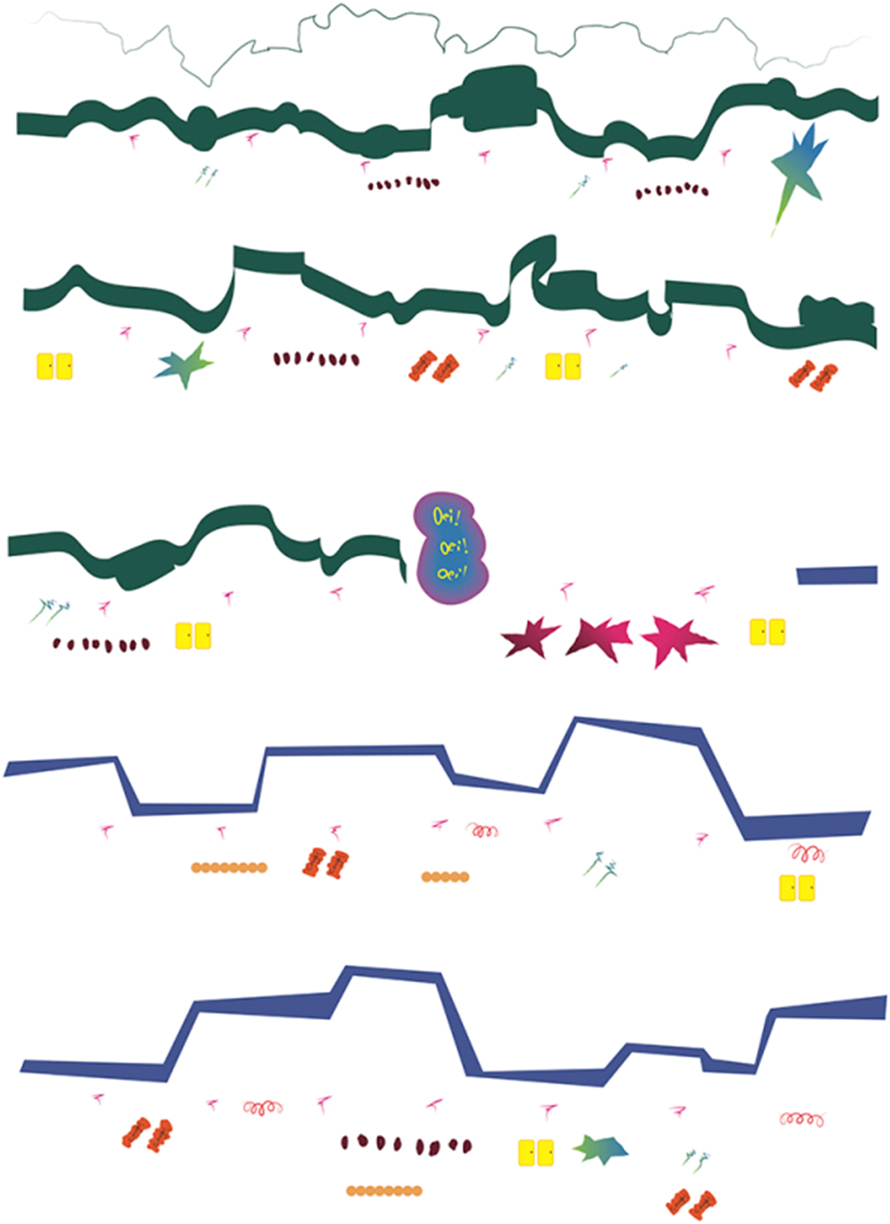
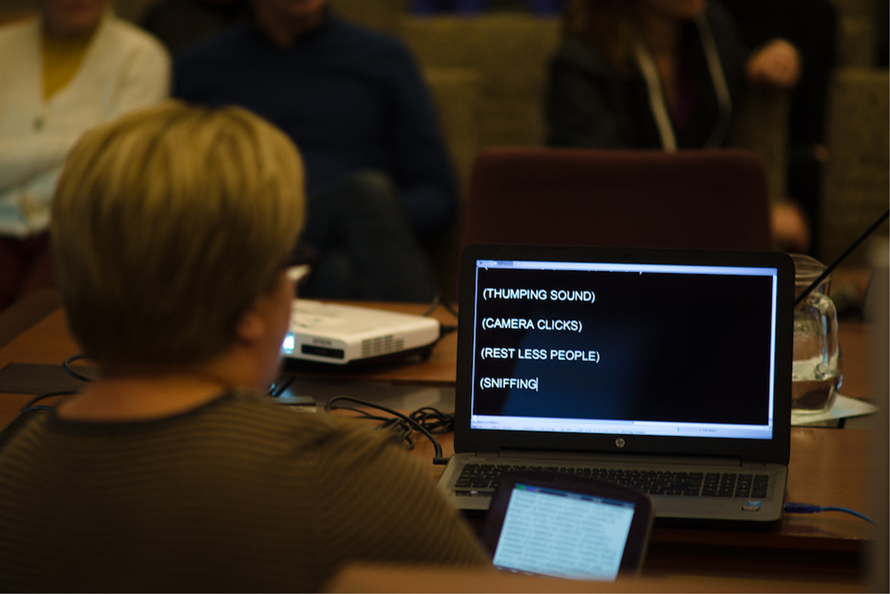
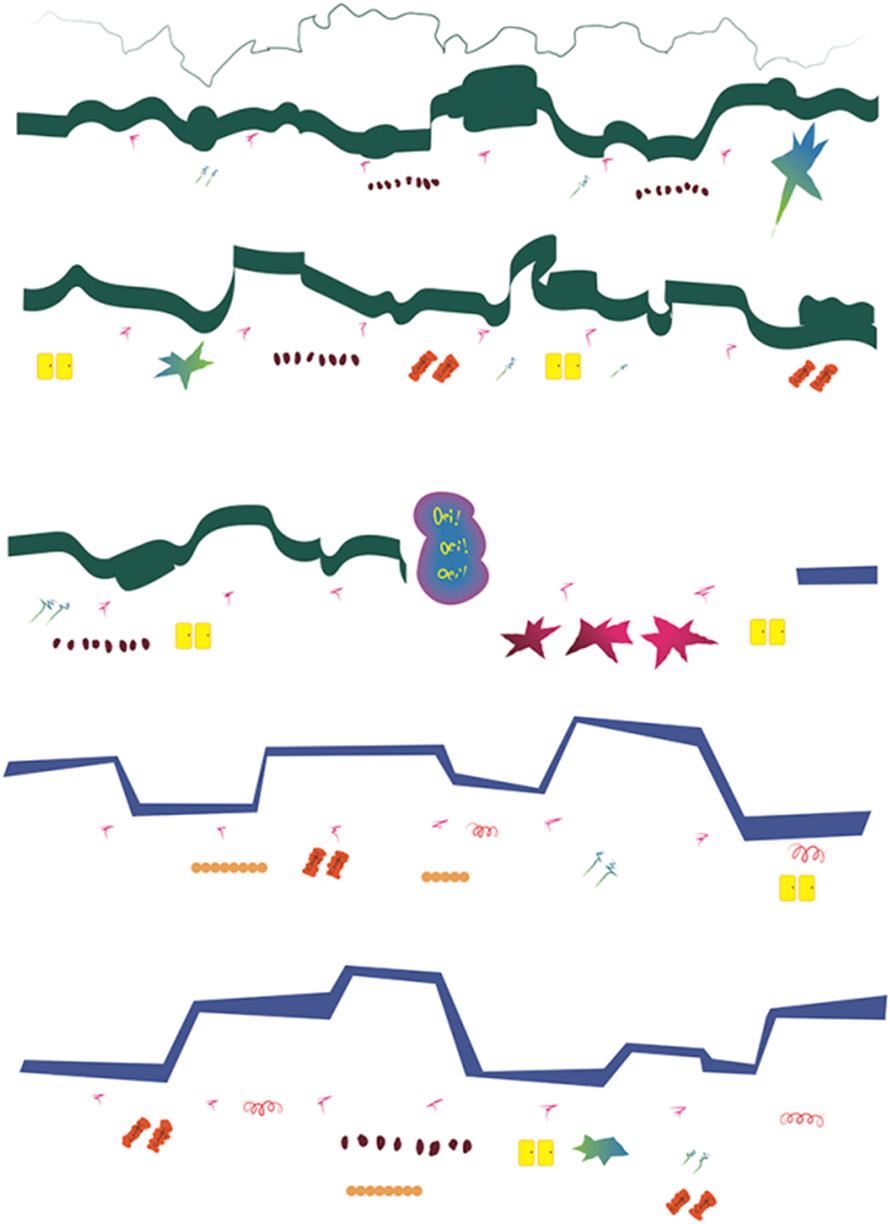
There is also noisy silence—a seeming contradiction in terms—where background noises can be heard whilst nothing is said.Footnote 86 Silence and noise are seemingly antithetical, but silence can often expose noise. This is explored in lawyer-turned-artist Jack Tan’s work Waiting for Hearing to Begin (Figure 2), the title of which plays on the notion of hearing as both a legal process and an auditory experience. The work is a printed textile score and choral recording that “demonstrates the sounds heard in a courtroom prior to the entry of the judge. General chatter, footsteps, doors creaking, pens dropping, bangs and other background noises.” In Acoustic Justice, a series of performances, presentations and experiments curated by James Parker and artist Joel Stern (Figure 3), a stenographer captures this noisy silence in words—“coughing,” “restlessness,” etc. Parker describes how “the constant hum of strip-lighting, air-conditioning units, and computer fans… [anchor the audience in] a very particular kind of institutional space and mode of life.”Footnote 87 It is interesting that these “noisy silences” are rarely transcribed in the records of legal proceedings, though the video recording and transmission of legal proceedings allows us to attune to these different noises.
Jack Tan, Hearings (Waiting for hearing to begin), 2016.
Sean Dockray, Acoustic Justice, Liquid Architecture, 2017; Federal Court of Australia, Melbourne. Photo: Keelin O’Hehir.

In the courtroom, noise is inescapable. To quote Cage, “there is no such thing as silence. Something is always happening that makes a sound.”Footnote 88 Cage invites his reader to listen to “the sounds that happen to be in the environment” for “there is always something to see, something to hear” in any space.Footnote 89 There is always the background noise in space which, when given attention, is transformed from the mundane to the extraordinary, from the background to the fore.Footnote 90 Indeed, “in any present moment there is always something to attune to.”Footnote 91 Even when listening to a blank recording, such as Batt’s A One Minute Silence, or when waiting for a legal performance to begin, one can still hear noises in the listening environment. A blank canvas or an empty space is still filled with meaning.Footnote 92 A performance “space is never empty… [but] filled with invisible tensions.”Footnote 93
Retired Australian High Court Justice Michael Kirby describes a space of silence as “the right situation” for court proceedings.Footnote 94 While most courts try to block out environmental noise and create a condition of silence through architectural devices such as glazed windows or insulation, others are re-embracing environmental noise, which was always present in historical and indigenous courts. The Neighbourhood Justice Centre in Collingwood, Australia, for example, is deliberately designed to allow people in court to hear the sounds of children playing in the nearby schoolyard.Footnote 95 In an article on the Centre’s website, a visitor during a court tour describes, “While some might say that you shouldn’t be able to hear outside noise, that it’s distracting, the sound of normal life is a reminder that the court is part of, not separate to, the life of the community.” Moments of silence in legal performance at the Neighbourhood Justice Centre allow the audience to attune to the outside and recognize the connection of law to its community. Of course, such sound bleed can also distract from the legal proceedings and, further, undermine the court’s solemnity.Footnote 96 Environmental noises outside the court offer a provocative challenge to the authority of the court, whereas other environmental noises within the court such as computer fans and strip lighting instantiate the court’s position within the bureaucratic sphere of the state.
Through his work, Cage makes environmental noise an object of art. Gann describes 4’33” as “an act of framing, of enclosing environmental and unintended sounds in a moment of attention.”Footnote 97 Silence frames sound and sound frames silence.Footnote 98 Cage’s silence is thus a tool for the creation of a “listening space”—a space for concentration and attunement.Footnote 99 The act of listening demands attunement to background noises of the civic soundscape in which the legal performance is situated.Footnote 100 Whilst knowledge, culture and context affect listening, legal performance participants are often called to forget their background under the pretence that justice is best served blind.Footnote 101 As I have argued elsewhere, blinding—or, in this case, deafening—oneself to context “only serves to hide the human consequences of detached legal(istic) judgment.”Footnote 102 Blocking out or ignoring background noise can deafen the audience to a contextualized appreciation of the legal performance and its connection to the broader civic community. Through attuning oneself to the background noise in legal performance and listening, one can instead begin to connect to oneself and others in the space around.Footnote 103
Conclusions
Conversational silence allows the audience to attune to what the other is saying; silence for effect attunes—Nobis says it recalibrates—the audience to the story; in moments of anxious silence when the words are lost, the audience attune to the speaker, willing them to speak; and in noisy silence, the audience attune to the background noises and appreciate law’s location within the civic and bureaucratic space. Silence in legal performance thus operates to attune the audience to the proceedings in the same way as it brings the audience in when used in theatrical performance. This is not to say that silence is the only means of attunement in legal performance. The motion of rising when a judge enters the court is another powerful call to attention as is the rap of the gavel on the bench.Footnote 104 Notably, however, these moments are aimed at inducing silence—the gavel quite directly operates as a silencer and the call to rise is in part an act to create a listening space for the legal performance. The legal audience’s vocal response to both moments is one of silence.
In Listening, Thinking, Being: Towards an Ethics of Attunement, communications scholar Lisbeth Lipari sketches out what I take to be four effects of attunement.Footnote 105 Firstly, there is the relational, the way in which attunement connects us to our bodies, space, and the other bodies in space. Secondly, there is the patience and, I would expand on this, the responsibility that attunement entails. Silence creates the possibility of responsible listening, and engaging deeply with the other voices and sounds within and around a legal performance space. Thirdly, there is the invention, the possibility of change and transformation that attunement provides. Silence forces one to face an abyss without voice or sound and, as James Boyd White suggests, invent something anew and, in doing so, transform our listening: “the moment of silence [is] where transformation and invention can take place.”Footnote 106 I have previously suggested that silence creates a listening space, but here I venture further to suggest that this space holds potential for change and transformation. Silence changes the state of the audience and transforms them into attentive listeners attuned to the performance and its surrounding environment. Finally, Lipari reminds her reader that attunement is impermanent. One is always switching in and out of listening, drifting in and out of concentration, letting things come and go. One drops in and out of listening; it cannot be sustained for long.
An exploration of silence in legal performance leads to the conclusion that silence creates a space of listening or attunement and enables participants in the legal proceeding to pay attention to meaning and the surrounding environment.Footnote 107 It also “provides the condition to build understanding.”Footnote 108 It is an opportunity to let the words and noises sink in and, in so doing, to comprehend their meaning. It entails a form of responsible listening, attuned to all that surrounds,Footnote 109 and requires those within the legal performance to “be actively engaged in listening to others”Footnote 110—both voices and sounds. It is impossible to decisively conclude what went on in the testifier’s mind in the forty seconds of silence in the proceedings for R v Hickey or how those within the proceedings responded to this silence, whether they sat in concentration or drifted in and out. The practice of attunement may nonetheless offer a way of understanding silence and noise within legal performance and its surrounds. Here I hope to have pointed out some directions to understanding the power of silence in the court and invited you to listen and attune yourself to silence in legal performance.