Introduction
Anti-N-methyl-D-aspartate receptor (NMDAR) encephalitis is a recently described autoimmune disease associated with NMDAR antibodies and a multi-stage neuropsychiatric syndrome (Dalmau et al., Reference Dalmau, Gleichman, Hughes, Rossi, Peng, Lai and Lynch2008; Dalmau, Lancaster, Martinez-Hernandez, Rosenfeld, & Balice-Gordon, Reference Dalmau, Lancaster, Martinez-Hernandez, Rosenfeld and Balice-Gordon2011; Dalmau et al., Reference Dalmau, Tuzun, Wu, Masjuan, Rossi, Voloschin and Lynch2007). Early symptoms are predominantly psychiatric, however, the syndrome progresses to include cognitive deficits, seizures, movement disorders, autonomic instability, and coma (Dalmau et al., Reference Dalmau, Lancaster, Martinez-Hernandez, Rosenfeld and Balice-Gordon2011; Irani et al., Reference Irani, Bera, Waters, Zuliani, Maxwell, Zandi and Vincent2010). Patients are typically females of reproductive age, although male, pediatric, and older adult patients have been reported (Dalmau & Rosenfeld, Reference Dalmau and Rosenfeld2014). Anti-NMDAR encephalitis is paraneoplastic in approximately half of cases, although tumor detection varies by age, gender, and ethnicity (Dalmau et al., Reference Dalmau, Lancaster, Martinez-Hernandez, Rosenfeld and Balice-Gordon2011; Dalmau & Rosenfeld, Reference Dalmau and Rosenfeld2014).
Compelling evidence suggests an antibody-mediated disease pathogenesis. Antibodies reduce receptor density from synaptic sites, leading to characteristic physiological, behavioral, and cognitive disturbance (Hughes et al., Reference Hughes, Peng, Gleichman, Lai, Zhou, Tsou and Balice-Gordon2010; Moscato et al., Reference Moscato, Jain, Peng, Hughes, Dalmau and Balice-Gordon2010, Reference Moscato, Peng, Jain, Parsons, Dalmau and Balice-Gordon2013). Congruent with genetic and pharmacological models, the loss of synaptic NMDAR functions accounts for symptom presentation and course, given the roles of this system in excitatory neurotransmission, and synaptic modification (Dalmau et al., Reference Dalmau, Lancaster, Martinez-Hernandez, Rosenfeld and Balice-Gordon2011; Waxman & Lynch, Reference Waxman and Lynch2005). Increases and decreases in synaptic efficacy associated with NMDAR-facilitated induction of long-term potentiation and depression are the likely cellular correlates of learning and memory (Bliss & Collingridge, Reference Bliss and Collingridge1993; Hunt & Castillo, Reference Hunt and Castillo2012).
Antibody effects are reversible with treatment (Moscato et al., Reference Moscato, Jain, Peng, Hughes, Dalmau and Balice-Gordon2010), and positive outcomes are seen in approximately 81% of patients (Titulaer et al., Reference Titulaer, McCracken, Gabilondo, Armangue, Glaser, Iizuka and Dalmau2013). Declining antibody titers correlate with symptom improvements (Dalmau et al., Reference Dalmau, Gleichman, Hughes, Rossi, Peng, Lai and Lynch2008, Reference Dalmau, Lancaster, Martinez-Hernandez, Rosenfeld and Balice-Gordon2011). However, the condition is life threatening in the acute stages and relapses represent a 12% risk within 2 years (Dalmau et al., Reference Dalmau, Lancaster, Martinez-Hernandez, Rosenfeld and Balice-Gordon2011; Titulaer et al., Reference Titulaer, McCracken, Gabilondo, Armangue, Glaser, Iizuka and Dalmau2013). Early immunotherapy and tumor resection are considered favorable prognostic factors (Titulaer et al., Reference Titulaer, McCracken, Gabilondo, Armangue, Glaser, Iizuka and Dalmau2013). Paraneoplastic anti-NMDAR encephalitis is thought to be particularly treatment-responsive (Dalmau et al., Reference Dalmau, Gleichman, Hughes, Rossi, Peng, Lai and Lynch2008, Reference Dalmau, Lancaster, Martinez-Hernandez, Rosenfeld and Balice-Gordon2011; Florance et al., Reference Florance, Davis, Lam, Szperka, Zhou, Ahmad and Dalmau2009), but this is not always the case (Irani et al., Reference Irani, Bera, Waters, Zuliani, Maxwell, Zandi and Vincent2010; Titulaer et al., Reference Titulaer, McCracken, Gabilondo, Armangue, Glaser, Iizuka and Dalmau2013).
Acute-phase cognitive deficits typically involve short-term memory dysfunction, and language disintegration (Dalmau et al., Reference Dalmau, Lancaster, Martinez-Hernandez, Rosenfeld and Balice-Gordon2011; Florance et al., Reference Florance, Davis, Lam, Szperka, Zhou, Ahmad and Dalmau2009; Irani et al., Reference Irani, Bera, Waters, Zuliani, Maxwell, Zandi and Vincent2010). Deficits in memory and executive functioning have also been shown to represent a major long-term morbidity of anti-NMDAR encephalitis (Finke et al., 2012). However, additional high-quality neuropsychological studies with this population are necessary to clarify the nature of cognitive deficits, particularly with respect to sub-processes within major cognitive domains such as memory and executive functioning.
Social cognition following anti-NMDAR encephalitis has only been investigated in one study of two patients (Bach, Reference Bach2014). Social cognition “difficulties” were reported, however, the extent of deficits was unclear. Anecdotal reports that social functions recover late and that children can develop a phenotype resembling autism suggests more comprehensive evaluation of these abilities is warranted (Creten et al., Reference Creten, van der Zwaan, Blankespoor, Maatkamp, Nicolai, van Os and Schieveld2011; Dalmau et al., Reference Dalmau, Lancaster, Martinez-Hernandez, Rosenfeld and Balice-Gordon2011). This exploratory study aims to investigate patterns of cognitive functioning (including social cognition) in patients treated for anti-NMDAR encephalitis.
Materials And Methods
Participants and Procedure
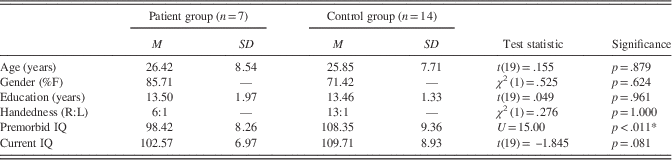
Seven treated anti-NMDAR encephalitis patients (six females) aged 16–37 years (M=26.42; SD=8.54) were recruited via Queensland-based physicians. Patient performance was compared to a sample of 14 control participants (10 females) aged between 16 and 38 years (M=25.85; SD=7.71) without significant psychiatric or neurological histories. Control participants were carefully selected to match the patient group on the basis of age, gender and education level. All were assessed by a Clinical Neuropsychologist trainee (G.M.) under supervision (G.R. and D.S.). Clinical variables were sourced from medical records, with additional detail provided by patients or physicians.
This study received ethical clearance from the Human Research Ethics Committees at both the Royal Brisbane and Women’s Hospital and The University of Queensland. All participants provided informed written consent.
Clinical and Functional Variables
Clinical variables included: (1) demographics (age, gender); (2) time elapsed between acute treatment and neuropsychological testing; (3) nature of treatment; (4) history of relapses; (5) disease etiology; (6) history of psychiatric admissions; and (7) serum/cerebrospinal fluid (CSF) antibody testing results at diagnosis and most recent follow-up.
Functional outcomes were evaluated at the time of neuropsychological testing using the modified Rankin Scale (mRS; Patel et al., Reference Patel, Rao, Heilman-Espinoza, Lai, Quesada and Flint2012). Previous anti-NMDAR encephalitis research has used ordinal mRS bands to classify outcomes (Dalmau et al., Reference Dalmau, Gleichman, Hughes, Rossi, Peng, Lai and Lynch2008; Titulaer et al., Reference Titulaer, McCracken, Gabilondo, Armangue, Glaser, Iizuka and Dalmau2013), which were adopted by the present study (“good”=0 – 2; “poor”>2). The Hospital Anxiety and Depression Scale (Snaith & Zigmond, Reference Snaith and Zigmond1994) is a 14-item self-report measure that was administered to evaluate the severity of symptoms of anxiety and depression. Scores of ≥8 and ≥11 are considered suggestive of possible and probable caseness, respectively (Snaith & Zigmond, Reference Snaith and Zigmond1994). Patients also subjectively rated their recovery on a scale from 1 (worst) to 10 (best).
Neuropsychological Assessment
Participants underwent comprehensive neuropsychological testing, which included standardized measures of intellectual functioning (premorbid - Test of Premorbid Functioning; Wechsler, Reference Wechsler2009; current - Wechsler Abbreviated Scale of Intelligence, 2nd Edition; Wechsler & Zhou, Reference Wechsler and Zhou2011), episodic memory (visual - Rey Complex Figure Test; Meyers & Meyers, Reference Meyers and Meyers1996; verbal - selected Wechsler Memory Scale, 4th Edition subtests [Logical Memory and Verbal Paired Associates tasks]; Wechsler, Holdnack, & Whipple Drozdick, Reference Wechsler, Holdnack and Whipple Drozdick2009), semantic memory (Pyramids and Palm Trees Test; Howard & Patterson, Reference Howard and Patterson1992), language (spontaneous speech - Cookie Theft Scene; Goodglass, Kaplan, & Barresi, Reference Goodglass, Kaplan and Barresi2000; nominal functions - Graded Naming Test; Warrington, Reference Warrington1997), auditory short-term and working memory (Wechsler Adult Intelligence Scale, 4th edition [WAIS-IV], Digit Span subtest; Wechsler, Coalson, & Engi Raiford, Reference Wechsler, Coalson and Engi Raiford2008), attention and processing speed (selected Delis-Kaplan Executive Function System [D-KEFS; Motor Speed, Visual Scanning, Number Sequencing, and Letter Sequencing trials of the Trail Making Test, and Colour Naming and Word Reading trials of the Colour-Word Interference Test] and WAIS-IV subtests; [Digit Span] Delis, Kaplan, & Kramer, Reference Delis, Kaplan and Kramer2001; Wechsler et al., Reference Wechsler, Coalson and Engi Raiford2008), and executive functioning (Hayling Sentence Completion Test and selected D-KEFS measures of initiation, response inhibition, cognitive flexibility, planning, problem solving, verbal fluency, abstraction and rule learning, including the Trail Making, Tower, Proverbs, Verbal Fluency, and Colour Word Interference tests; Burgess & Shallice, Reference Burgess and Shallice1997; Delis et al., Reference Delis, Kaplan and Kramer2001).
The Hayling Sentence Completion Test (Burgess & Shallice, Reference Burgess and Shallice1997) was designed to assess verbal initiation and inhibition in the same task. A sentence with the last word omitted (e.g., The captain stayed with the sinking…) is orally presented and individuals are asked to complete it either meaningfully (…ship), measuring initiation, or with an unconnected word (e.g., …elephant), measuring inhibition of a prepotent response. Four scores are derived based on the response time (RT) to produce a connected word (Initiation RT) or an unconnected word (Suppression RT), the errors produced instead of an unrelated word (Suppression Errors), and a combination of RTs and Errors (Overall Score). All four scores are sensitive to frontal lobe damage (Robinson et al., Reference Robinson, Cipolotti, Walker, Biggs, Bozzali and Shallice2015).
Experimental Attention Battery
The Sustained Attention to Response Task (SART; Robertson, Manly, Andrade, Baddeley, & Yiend, Reference Robertson, Manly, Andrade, Baddeley and Yiend1997) is a theoretically based measure of sustained attention and cognitive control. Two-hundred twenty-five digits from 1 to 9 (25 of each number) were visually presented to participants over 4.3-min. Numbers were displayed for 250 ms, and were followed by a 900-ms mask (an “X”). Participants pressed the space bar to each digit, except when a target number specified at the start of the task was randomly displayed, which signaled responses should be withheld. Participants were instructed to allocate equal priority to accuracy and speed. Before the task, participants completed a practice trial consisting of 18 digit presentations, two of which were targets. Errors of commission (responses on no-go trials) and omission (non-response on go-trials) were used as measures of failures in response inhibition (commission errors only) and sustained attention. Reaction times of all key presses were collected to investigate variability in response latencies indicative of lapsing attention.
Participants completed a psychological refractory period (PRP; Pashler, Reference Pashler1994) paradigm to investigate dual task performance. This task required participants to complete two serially presented tasks as quickly and accurately as possible. The two tasks were separated by a variable time interval, known as the stimulus onset asynchrony (SOA), which was either short (200 ms) or long (1000 ms). Task 1 required responses (rapid key presses) to one of two letters (e.g., H vs. S) using one of two keys. This was immediately followed by task 2, which required a response to one of two colored circles (e.g., red vs. blue) using one of two keys. Three blocks comprised of 60 individual trials each were completed, with the stimuli changing between blocks (Block 1: “H” and “S,” red and blue; Block 2: “E” and “D,” green and yellow; Block 3: “J” and “K”, purple and orange). Practice blocks preceded each condition, where participants were provided with feedback regarding accuracy. Outcome measures included average reaction time and overall accuracy across short SOA and long SOA trials.
Social Cognition Assessment
Four measures investigated aspects of social cognition, including: (1) mental state decoding, also known as theory of mind (ToM); (2) emotion recognition; and (3) processing behavioral appropriateness across social contexts. Three tasks (advanced ToM, emotion attribution and social situation tasks) were developed and used with adults with neurological conditions (Baird et al., Reference Baird, Dewar, Critchley, Dolan, Shallice and Cipolotti2006; Blair & Cipolotti, Reference Blair and Cipolotti2000; Heims, Critchley, Dolan, Mathias, & Cipolotti, Reference Heims, Critchley, Dolan, Mathias and Cipolotti2004; van Harskamp, Rudge, & Cipolotti, Reference van Harskamp, Rudge and Cipolotti2005) and acquired psychopathy (Blair & Cipolotti, Reference Blair and Cipolotti2000). Full details and examples of these three tasks are given in the original studies; however, we provide brief details below.
Advanced ToM Task
In this task participants read 15 stories depicting social scenarios, and answer questions requiring interpretation and justification of the protagonist’s behavior. Three scores index situation comprehension, and the use of mental state and physical information during interpretation. An example story is as follows: “Daniel and Ian see Mrs. Thompson coming out of the hairdressers one day. She looks a bit funny because the hairdresser has cut her hair too short. Daniel says to Ian: “She must have been in a fight with a lawnmower!” After reading each story, participants are asked a “comprehension question” where they are required to demonstrate whether or not they understood important subtleties within the story (e.g., “is it true what Daniel said?”). Participants are then asked to justify in their own words why the protagonist may have behaved in that way or made such a statement (e.g., “why does he say this?”). These responses are then evaluated with respect to whether the participant included mental state information in their justification (e.g., “Daniel thinks her hair looks funny and he is making a joke about how bad she looks”), or relied upon physical material in their explanation (e.g., “because her hair is too short.”).
Emotion Attribution Task
Participants read 75 short stories describing emotional situations. Their task is to specify an emotion describing how the character might feel in that scenario. Stories were designed to elicit attributions of happiness, sadness, anger, fear, and embarrassment, with 15 items for each emotion. For example “Cathy has received some exam results; she has done very well” is designed to elicit happiness.
Social Situations Task
Participants read 39 short stories involving behaviors that can be classified as conventional or social violations in the narrative context. They allocate a score from “A” (fairly normal behavior) to “D” (shocking behavior). Seventeen normative behaviors (“A”=correct) and 20 violations (“B”–“D”=correct) were presented. Three scores were derived. The first two scores were the number of normative situations and violations correctly identified, with higher scores indicating greater accuracy. For each violation correctly identified, responses were then numerically scored to reflect the extent to which they perceived the behavior to be inappropriate (e.g., B=1, C=2, D=3). These were summed to calculate the third score, which was an overall violation severity score. Higher scores on this measure indicated that the person perceived the social violations to be more shocking.
Reading the Mind in the Eyes Task
Originally developed to assess adult ToM competence (Baron-Cohen, Jolliffe, Mortimore, & Robertson, Reference Baron-Cohen, Jolliffe, Mortimore and Robertson1997), this task involves viewing 36 photographs of the eye regions of people acting out psychological states. Participants decide which of four emotions of the same valence best represents what the person is thinking or feeling. Performance differentiates non-clinical samples from various groups with known social functioning deficits including people with schizophrenia (Craig, Hatton, Craig, & Bentall, Reference Craig, Hatton, Craig and Bentall2004; Kettle, O’Brien-Simpson, & Allen, Reference Kettle, O’Brien-Simpson and Allen2008; Murphy, Reference Murphy2006), and autism spectrum disorders (Baron-Cohen et al., Reference Baron-Cohen, Jolliffe, Mortimore and Robertson1997; Baron-Cohen, Wheelwright, Hill, Raste, & Plumb, Reference Baron-Cohen, Wheelwright, Hill, Raste and Plumb2001).
Statistical Analyses
Due to the exploratory nature of the current study, no correction for multiple comparisons was made during statistical analyses.
Group Analyses
To compare the patient and control samples on potentially confounding demographic variables, a series of chi-square and independent t tests were conducted. Independent t tests and non-parametric Mann-Whitney U tests examined differences between groups with respect to testing scores. Non-parametric tests were used where test assumptions were violated. An alpha value of .05 was consistently adopted as the significance threshold (two-tailed).
Case Series Analyses
To characterize each patient’s cognitive profile, analyses were also conducted on individual scores. Deficits were recorded on standardized measures where performance fell at or below the 10th percentile. To account for problems associated with small sample size, modified t test analyses compared individual patient and control group scores on measures without normative data (Crawford & Garthwaite, Reference Crawford and Garthwaite2002; Crawford & Howell, Reference Crawford and Howell1998).
Results
Patient Characteristics
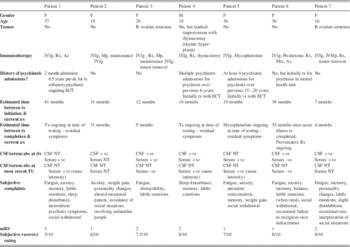
Patient and control group demographics are summarized in Table 1. Patient clinical information is summarized in Table 2. Neurocognitive and social function was assessed in all patients outside the acute disease phase. No patient exhibited abnormal cerebral MRI findings (Siemens, 1.5 Tesla) before the initiation of immunotherapy. No abnormalities were detected on T1, T2, fluid attenuated inversion recovery (FLAIR) or diffusion weighted imaging (DWI) sequences. Electroencephalogram was abnormal in six cases (all except P1) with findings suggesting diffuse disorders of cortical function. Two patients who were CSF positive at diagnosis did not require further testing following dramatic clinical response (P2, P7). Persistent serum antibodies unchanged in intensity from first testing were reported in three patients (P1, P4, P5).
Summary of demographic variables for patients and control participants
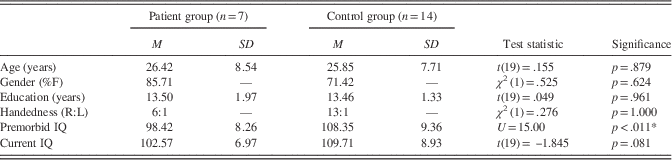
Note. F=female, IQ=intellectual quotient; L=left; M=male; R=right.
* p < .05.
Patient clinical and demographic information

Notes. +ve=positive; -ve=negative; ADLS=activities of daily living; ax=assessment; Az=azathioprine; CSF=cerebrospinal fluid; dx = diagnosis; ECT=electro-convulsive therapy; F=female; IVIg=intravenous immunoglobulin; M=male; Mp=methylprednisolone; mRS=modified Rankin Scale; Mtx=methotrexate; NT=not tested; pre-dx=pre-diagnosis; R=right; Rx=rituximab; tx=treat/ed/ment.
Paraneoplastic etiologies were identified in two patients (P3, P7) following pelvic examination and either pelvic MRI or ultrasound (or both). Another patient (P4) underwent thymectomy. Four patients (P2, P3, P6, P7) received treatment within a month of symptom onset, and had not relapsed. The remaining three patients (P1, P4, P5) had lengthy psychiatric histories and comparatively poorer response to immunotherapy. Two of these cases (P1 and P5) presented with historical symptoms potentially indicative of neurological disturbance before the characterization of anti-NMDAR encephalitis (e.g., significant catatonia, seizure activity, multi-system organ dysfunction). Nonetheless, without access to serum or CSF samples for retrospective antibody analysis we could not definitively conclude that these patients were presenting with anti-NMDAR encephalitis before the characterization of the disease. It was challenging to reliably estimate the duration of untreated illness in these cases.
Problems with memory, fatigue, anxiety, emotional lability, and personality changes were the most commonly reported everyday difficulties. Most described changes in their social functioning, such as withdrawal, disinhibition, misinterpreting interpersonal signals, or failing to recognize their own indiscretions.
Neuropsychological Assessment Results
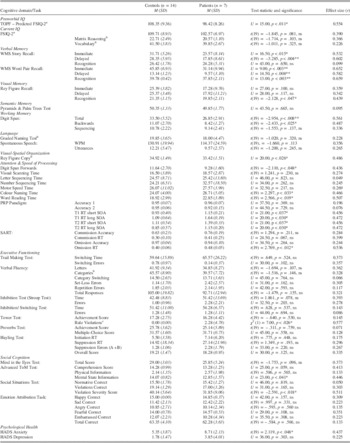
At the group-level (see Table 3), patient sample performance fell significantly below that of the control group in the domains of verbal and visual episodic memory (logical memory and verbal paired associates tasks, Rey complex figure test), sustained attention (SART), divided attention (PRP), information processing speed (color naming and word reading tasks), verbal short-term and working memory (digit span forward and backward), and executive functioning (visual-spatial planning/organization and problem solving, as assessed by the copy trial of the Rey complex figure test and the Tower Test). Medium-to-large effect sizes were identified.
Summary of performance on cognitive measures and questionnaire responses for anti-NMDAR encephalitis patient and control groups

Notes. HADS=Hospital Anxiety and Depression Scale; FSIQ-2=Full Scale Intelligence Quotient, 2 subtest version; M=mean; n.s.=not significant; PRP=Psychological Refractory Period; RT=Reaction Time; SART=Sustained Attention to Response Task; SD=standard deviation; SOA=Stimulus Onset Asynchrony; T1=Target 1; T2=Target 2; ToM=Theory of Mind; TOPF=Test of Premorbid Functioning; WMS=Wechsler Memory Scale; WPM=words per minute.
*p<.05, **p<.01, two-tailed.
a Standardized score (all other analyses conducted on raw data).
b Measure taps multiple domains.
c Analyzed as dichotomous variable through Chi-Square (errors vs. no errors).
Performance on tests of overall intellectual functioning (FSIQ), perceptual reasoning (matrix reasoning), semantic memory (vocabulary, Pyramids and Palm Trees Test, semantic verbal fluency), language (vocabulary, Graded Naming Test, spontaneous speech, verbal fluency), basic psychomotor speed (motor speed, visual scanning and letter/ number sequencing tasks), and aspects of executive functioning (abstraction, response inhibition, flexibility, and verbal fluency, as assessed by the Trail Making Test, Hayling Test, and the color-word interference, verbal fluency, and proverbs tasks) were comparable between groups. Estimated premorbid intellect was significantly higher in the control sample, however, two patients reported longstanding academic difficulties. Scores on a test of vocabulary, which is less reliant on reading skills suggested performance equivalence between groups with respect to premorbid intellect. The patient sample reported significantly higher levels of anxiety relative to controls. Individually, greater variability in neuropsychological functioning was evident (see Supplementary Material, which is available online).
Social Cognition Assessment Results
On the advanced ToM task, the groups were equivalent in their understanding of social encounters and use of physical information in their interpretations of these situations. However, controls made a significantly higher number of references to mental state information (medium effect size). Mental state interpretation capacity as assessed by the Reading the Mind in the Eyes test did not differ significantly between groups. The patient and control groups accurately identified social situations as normative and violations at comparable rates. Relative to controls, the patient group rated social violations as significantly less severe (large effect size). Once again, there was considerable individual variability in performance across tests of social cognition (see online supplementary material).
Functional Outcomes
A range of functional levels were evident (see Table 2). “Good” functional outcomes were recorded in six patients. None achieved “full recovery,” with scores between 1 and 2 indicating “mild deficits.” “Poor” outcomes were recorded for P1. All believed recovery was occurring gradually, and that assistance from family, friends, and employers/ educators was facilitating this process. Progress barriers included fear of relapse, loss of confidence and ongoing problems with cognition and mental health.
Discussion
To our knowledge, this is the first exploratory investigation of social cognition and the most comprehensive neuropsychological evaluation of anti-NMDAR encephalitis patients conducted to date. We sought to support the work of Finke et al. (Reference Finke, Kopp, Pruss, Dalmau, Wandinger and Ploner2012), and also aimed to validate preliminary evidence that anti-NMDAR encephalitis adversely affects social cognition (Bach, Reference Bach2014). Given the small sample size and large number of statistical comparisons that were applied in the context of this preliminary investigation, results must be interpreted cautiously.
Social Cognition
This study is the first to document anti-NMDAR encephalitis patient performance decrements on tests of social cognition. Noteworthy differences in performance from controls related to judging the severity of interpersonal violations, and using mental state information to make sense of social situations. Basic emotion attribution skills were relatively preserved, as was capacity for recognizing normative and unconventional social behavior, and accurately decoding mental state information through facial features.
These findings are in keeping with reports of disturbed interpersonal functioning during recovery from anti-NMDAR encephalitis (Bach, Reference Bach2014; Dalmau et al., Reference Dalmau, Lancaster, Martinez-Hernandez, Rosenfeld and Balice-Gordon2011). Results extend those described by Bach (Reference Bach2014). Specifically, the current study reports subjective social dysfunction experienced by patients can occur in conjunction with objectively aberrant responses on measures of social cognition. Results suggested that anti-NMDAR encephalitis may adversely affect the ability to decode and adaptively use mental state information.
Neuropsychological Outcomes
Consistent with previous research in adult (Finke et al., Reference Finke, Kopp, Pruss, Dalmau, Wandinger and Ploner2012) and pediatric samples (Matricardi et al., Reference Matricardi, Patrini, Freri, Ragona, Zibordi, Andreetta and Granata2016), neuropsychological deficits were identified in most patients despite substantial clinical/ functional recovery, and protracted treatment duration. Patient group performance was affected in the domains of verbal and visual episodic memory, working memory, attention, information processing speed, and executive functioning. Episodic memory and aspects of executive functioning represented the most severely affected abilities at the individual level; however, profiles ranged from within normal limits to extensive dysfunction.
By contrast, psychomotor speed, semantic memory, perceptual reasoning, language, and general intellectual functions were relatively preserved. It has recently been reported that structural hippocampal damage and associated memory deficits represent long-term sequelae of anti-NMDAR encephalitis (Finke et al., Reference Finke, Kopp, Pajkert, Behrens, Leypoldt, Wuefel and Paul2015). This is interesting in view of our finding that patient performance on tests of episodic and semantic memory suggested that episodic memory ability was preferentially affected over semantic memory ability during recovery from anti-NMDAR encephalitis. With respect to executive functioning, results highlighted that patients varied quite substantially with respect to their performance in this domain, and that component skills’ weaknesses need to be evaluated on a case-by-case basis.
Our findings are congruent with the distribution and roles of the NMDAR system, and underlying pathogenic mechanisms whereby antibodies diminish NMDAR-mediated synaptic function (Hughes et al., Reference Hughes, Peng, Gleichman, Lai, Zhou, Tsou and Balice-Gordon2010; Moscato et al., Reference Moscato, Jain, Peng, Hughes, Dalmau and Balice-Gordon2010, Reference Moscato, Peng, Jain, Parsons, Dalmau and Balice-Gordon2013). Nonetheless, the spectrum of individual profiles and absence of abnormal MRI findings is in keeping with disorder complexity, and evidence that neurological sequelae are best considered from a functional perspective (Dalmau et al., Reference Dalmau, Lancaster, Martinez-Hernandez, Rosenfeld and Balice-Gordon2011; Finke et al., Reference Finke, Kopp, Scheel, Pech, Soemmer, Schlichting and Paul2013; Iizuka et al., Reference Iizuka, Yoshii, Kan, Hamada, Dalmau, Sakai and Mochizuki2010).
Mental Health and General Functioning
Our results suggested that anti-NMDAR encephalitis patients often experience anxiety and depression during recovery. Nonetheless, most were making excellent progress toward baseline functional status, despite mild deficits. However, loss of confidence had prompted several patients to re-evaluate employment and educational pathways. This was potentially unnecessary in at least two cases, highlighting that recovering patients may benefit from psychological interventions.
Research and Clinical Implications
There is now accumulating evidence that anti-NMDAR encephalitis patients require formal assessment for residual cognitive dysfunction, with individually tailored rehabilitation interventions developed where indicated. Resolution of gross neurological and psychotic symptoms is not an adequate treatment goal. Clinicians are advised not to underestimate difficulties in social and vocational functioning, and psychological health. This seems particularly important given the young age of many patients.
Additional research is required to support the novel claim that anti-NMDAR encephalitis patients demonstrate impairment on tests of social cognition. These deficits potentially account for the observation that social behavior is slow to improve (Dalmau et al., Reference Dalmau, Lancaster, Martinez-Hernandez, Rosenfeld and Balice-Gordon2011; Tham & Kong, Reference Tham and Kong2012). The neurological mechanisms associated with memory dysfunction in this population have been investigated in recent research (Finke et al., Reference Finke, Kopp, Scheel, Pech, Soemmer, Schlichting and Paul2013, Reference Finke, Kopp, Pajkert, Behrens, Leypoldt, Wuefel and Paul2015). Additional studies of this nature could elucidate the functional neurological correlates of other neuropsychological deficits, including social cognition. Intervention trials aimed at improving ToM such as Social Cognition and Interaction Training (Lahera et al., Reference Lahera, Benito, Montes, Fernandez-Liria, Olbert and Penn2013; Penn, Roberts, Combs, & Sterne, Reference Penn, Roberts, Combs and Sterne2007; Roberts & Penn, Reference Roberts and Penn2009) could determine if these deficits are reversible. Addressing this aspect of patient care seems important given the possibility that disease mechanisms may interrupt social skills development.
This study suggests recovery occurs gradually, although not necessarily in a linear fashion. Neuropsychological deficits were observed up to several years following the initiation (and in some cases completion) of adequate treatment, indicating the course of cognitive dysfunction can be protracted. Our results also suggest that cognitive impairments in treated anti-NMDAR encephalitis patients may occur as a consequence of ongoing residual disease activity in combination with more chronic illness sequelae. Small sample size and low power prevented meaningful analysis of clinical variables associated with neuropsychological outcomes. However, previous research (Finke et al., Reference Finke, Kopp, Pruss, Dalmau, Wandinger and Ploner2012; Matricardi et al., Reference Matricardi, Patrini, Freri, Ragona, Zibordi, Andreetta and Granata2016) has suggested that early and aggressive immunotherapy may be relevant to more favorable cognitive outcomes in this population.
This study identified heterogeneity in neuropsychological performance in this sample, with profiles ranging from pervasive impairments to normal functioning across all domains assessed. Findings indicate the utility of comprehensive baseline assessments, with particular focus on episodic memory, executive functioning, attention, information processing speed, and working memory. Within domains multiple measures are recommended to accurately characterize deficits. Serial neuropsychological testing may have utility for monitoring disease activity, as has been suggested by previous research (Finke et al., Reference Finke, Kopp, Pruss, Dalmau, Wandinger and Ploner2012).
Summary And Conclusions
Despite small patient numbers inevitable in a rare and recently characterized disorder, this study demonstrated that cognitive deficits and impairments of social cognition associated with anti-NMDAR encephalitis can persist for many years following the initiation of adequate treatment. The spectrum of neuropsychological functioning ranged from an absence of deficits to more extensive dysfunction. Performance decrements were identified in several cognitive domains, including episodic memory, executive functioning, working memory, attention, and information processing speed. This study is the first to corroborate anecdotal reports that social cognition may function abnormally during recovery from anti-NMDAR encephalitis. It is recommended that future studies involving larger samples and longitudinal assessments are conducted. Such research could contribute greater clarity regarding the course of cognitive dysfunction in anti-NMDAR encephalitis, and factors related to neuropsychological outcomes in this population.
Acknowledgments
We thank Associate Professor Paul Dux and Dr. Kelly Garner from the University of Queensland for generously providing the SART and PRP paradigm. Funding: This study was supported by funding from philanthropic donations. G.R. is the recipient of an Australian Research Council DECRA fellowship (DE1211119). J.G.S. is the recipient of a National Health and Medical Research Council Practitioner Fellowship Grant (#1105807). Conflicts of Interest: The authors declare no conflicts of interest.
Supplementary Material
To view supplementary material for this article, please visit http://dx.doi.org/10.1017/S1355617716000679