INTRODUCTION
Investigations on hydroids in the vast Indo-Pacific region have been carried out since the 18th Century, and the fauna is at least moderately well-known. By comparison, those of India are much less studied (Nagale & Apte, Reference Nagale and Apte2013a), with species of the south-west and south-east coasts having received the most attention (Mammen, Reference Mammen1963, Reference Mammen1965a, Reference Mammenb). The earliest records of these cnidarians from the State of Gujarat, north-west India, are based on collections in 1905–1906 by James Hornell, described by Thornely (Reference Thornely and Hornell1916). She reported 17 species from locations including Dwarka, Adatra and Poshitra. Otherwise, little is known about the hydroid fauna of the State of Gujarat.
The objective of this study was to more fully investigate intertidal hydroids found in the Gulf of Kutch, Gujarat.
MATERIALS AND METHODS
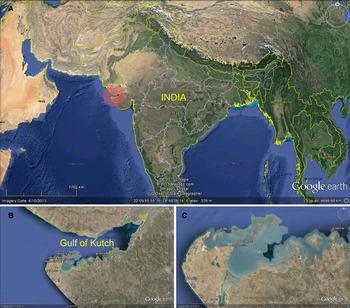
Hydroids were collected from various rocky substrates at Dwarka (22°14′28,90″N68°57′23,38″E), Bet Dwarka (22°28′37, 96″ N 69°08′15, 45″E), Poshitra (22°24′05,22″N 69°12′29, 32″E), Adasaba reef (22°23′58, 58″N 69°12′53, 56″E), Boriya reef (22°25′12, 65″N 69°13′15, 24″E), and Narara (22°28′43, 32″N 69°43′02, 80″E), all situated in the Gulf of Kutch, Arabian Sea, India (Figure 1). Each location offered diverse habitats for hydroids. The coast at Dwarka is a flat intertidal rocky shore, with deep to shallow tide pools and with large boulders at the high tide level. Bet Dwarka is an island having a rocky shore with cobbles and pebbles, and with tide pools of shallow to medium depth. Poshitra is a rich coral reef area, having varied habitats such as shallow tide pools and sandy–muddy bottoms. Poshitra is predominantly a relatively pristine coral reef flat. Adasaba reef and Boriya reef are offshore submerged reefs with a mix of corals and sandy–muddy habitats. Narara is a flat intertidal degraded coral reef habitat composed of dead coral rubble, cobbles, pebbles and sand.
Study area: (A) Gulf of Kutch, India; circled in red colour; (B, C) various collection sites in the Gulf of Kutch.

Hydroids were collected manually at each sampling site during low tide, and preserved in 4% formalin in seawater. Specimens were deposited in collections at the Bombay Natural History Society. Identifications were based on characters including colony form, hydrothecal morphology, and gonophore type (Bouillon et al., Reference Bouillon, Gravili, Pagès, Gili and Boero2006), and on nematocyst complement (Östman, Reference Östman2000), using a Leica EZ4 D stereoscope and a Leica DM750 compound microscope.
RESULTS
SYSTEMATICS
Family SPHAEROCORYNIDAE Prévot, 1959
Genus Sphaerocoryne Pictet, Reference Pictet1893
Sphaerocoryne bedoti Pictet, Reference Pictet1893
SUBSTRATE
Sponge.
SIZE
5–9 mm.
COLLECTION SITES
Dwarka and Poshitra.
DESCRIPTION
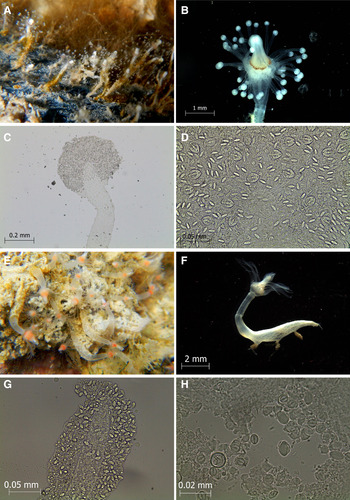
Hydroid erect, unbranched, translucent white (Figure 2A). Hydrorhiza embedded in sponge. Hydranth pear-shaped with elongated hypostome, 30–40 capitate tentacles present below the hypostome (Figure 2B, C). Gonophores absent.
Sphaerocoryne bedoti: (A) hydroids growing on sponge; (B) hydranth; (C) single capitate tentacle with nematocyst accumulation; (D) nematocysts; Zyzzyzus warreni: (E) hydroids growing on sponge; (F) solitary hydroid showing anchoring tubers; (G) arrangement of nematocysts in aboral tentacle; (H) nematocysts. Scale bars: B, 1 mm; C, 0.2 mm; D & G, 0.05 mm; F, 2 mm; H, 0.02 mm.

Nematocysts: large stenoteles (19.3–23.5 × 14–18.3 µm), small stenoteles (9.5–10.8 × 7.3–7.98 µm) and desmonemes (11.4–13 × 4.0–5.4 µm) (on tentacles) (Figure 2D).
REMARKS
This species is recorded for the first time from Gujarat.
GLOBAL DISTRIBUTION
Circumglobal in warm waters; Indian Ocean (Mammen, Reference Mammen1963; Millard & Bouillon, Reference Millard and Bouillon1974), type specimen from Ambon, Maluku, Indonesia.
DISTRIBUTION IN INDIA
Kerala (Mammen, Reference Mammen1963).
Family PENNARIIDAE McCrady, 1859
Genus Pennaria Goldfuss, 1820
Pennaria disticha Goldfuss, 1820
SUBSTRATES
Sponge, rock.
SIZE
3–10 cm.
COLLECTION SITES
Dwarka, Bet Dwarka and Poshitra.
DESCRIPTION
As in Nagale & Apte (Reference Nagale and Apte2013b).
REMARKS
Pennaria disticha was found almost at all collection sites. However, it was more common at Poshitra reef than on Narara and Dwarka reefs. Aeolids including Facelina lineata, Sakuraeolis gujaratica and Cratena sp. were observed feeding on P. disticha at Poshitra reef.
GLOBAL DISTRIBUTION
Circumglobal in tropical and warm temperate waters (Calder, Reference Calder2010).
DISTRIBUTION IN INDIA
Pamban and Neendakara (Mammen, Reference Mammen1963), Mumbai (Gazetteer of Maharashtra), Ratnagiri, Rajapur and Vijaydurg (Nagale & Apte, Reference Nagale and Apte2013b).
Family TUBULARIIDAE Fleming, 1828
Genus Ectopleura L. Agassiz, 1862
Ectopleura viridis (Pictet, Reference Pictet1893)
SUBSTRATE
Sponge.
SIZE
8–30 mm.
COLLECTION SITE
Poshitra.
DESCRIPTION
As in Nagale & Apte (Reference Nagale and Apte2013b). Gonophores absent.
REMARKS
This species has previously been reported from India, as Ectopleura pacifica, by Gravely (Reference Gravely1927) and Mammen (Reference Mammen1963).
GLOBAL DISTRIBUTION
Central Indo-Pacific. The type locality is the Port of Ambon, Indonesia.
DISTRIBUTION IN INDIA
Neendakara, Thankassery and Madras harbour (Mammen, Reference Mammen1963), Pamban (Gravely, Reference Gravely1927) and Ratnagiri (Nagale & Apte, Reference Nagale and Apte2013b).
Genus Zyzzyzus Stechow, 1921
Zyzzyzus warreni Calder, Reference Calder1988
SUBSTRATES
Rock, sponge.
SIZE
8–20 mm.
COLLECTION SITE
Poshitra.
DESCRIPTION
Hydroid solitary, embedded in sponge (Figure 2E), anchored basally by tubers (Figure 2F); polyps transparent white with reddish-pink colour at base of hypostome. Hydranth vasiform; showing demarcation from hydrocaulus. Tentacles filiform, in two whorls; oral tentacles 12–14, in one whorl, 0.8–1 mm long; aboral tentacles 19–25, in one whorl, 1–3 mm long. Gonophores present on few hydroids.
Nematocysts: desmonemes, stenoteles, euryteles and isorhizas. Oral tentacles: large stenoteles (9–11.2 × 8.8–10.6 µm) and small stenoteles (4.24–5.2 × 3.5–4.2 µm), isorhizas. Aboral tentacles: small stenoteles (4.2–6.7 × 4.1–6 µm) and large stenoteles (9.51–10.8 × 8.4–9 µm), microbasic euryteles (8.79–10.9 × 5.6–6.4 µm) concentrated at tip (Figure 2G, H). Gonophores: small stenoteles (5.15–6.77 µm) and large stenoteles (10–12.7 × 10.2–11.6 µm), desmonemes (9.48–10.4 × 5.6–7.5 µm).
REMARKS
Zyzzyzus warreni was previously recorded from the Indian Ocean by Millard (Reference Millard1975) as Zyzzyzus solitarius (Warren, 1906). The name of the species was replaced by Calder (Reference Calder1988) to Zyzzyzus warreni.
GLOBAL DISTRIBUTION
Circumequatorial in distribution (Millard, Reference Millard1975; Calder, Reference Calder1988; Campos et al., Reference Campos, Marques and Migotto2007).
DISTRIBUTION IN INDIA
The genus Zyzzyzus and species Z. warreni are recorded for the first time from India.
Family CLADOCORYNIDAE Allman, 1872
Genus Cladocoryne Rotch, Reference Rotch1871
Cladocoryne floccosa Rotch, Reference Rotch1871
SUBSTRATES
Eunicid tubes and green algae.
SIZE
1–2 mm.
COLLECTION SITE
Dwarka
DESCRIPTION
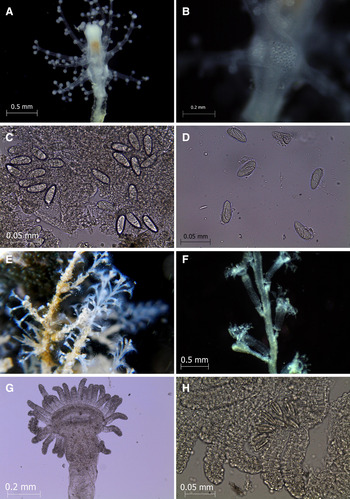
Hydroid solitary, erect, unbranched; arising from creeping hydrorhiza, adhering to algae and tubes of eunicid worms. Hydrocaulus slightly corrugated, with distinct annulations at base. Hydranth club-shaped, with large hypostome; oral tentacles 4–8, short, capitate, in a single whorl; aboral tentacles long, branched, capitate, transparent, in 2–3 indistinct whorls; branches of aboral tentacles stubby, terminating in capitula (Figure 3A). Nematocyst patches occurring between oral tentacles and lowest aboral tentacles. Spherical nematocyst cluster present at the terminal portion of branched capitate tentacles (Figure 3B). Gonophores not observed.
Cladocoryne floccosa: (A) hydranth; (B) nematocyst patch on hydranth base; (C, D) nematocysts; Nemalecium lighti: (A) colony; (B) arrangement of hydranths; (C) hydranth with nematodactyl; (D) nematocysts. Scale bars: A & F, 0.5 mm; B & G, 0.02 mm; C, D & H, 0.05 mm.

Nematocysts: large and small stenoteles and macrobasic euryteles (33.6–41.1 × 13.2–17.1 µm) clustered between tentacles on hydranth (Figure 3C, D).
REMARKS
Genus Cladocoryne Rotch, Reference Rotch1871 is distinguished by a combination of distinctive characters including ramified capitate tentacles and nematocyst patches on the hydranth. Gonophores were absent in our specimens, but their morphological features were sufficient for identification.
Lees (Reference Lees1968) stated that Cladocoryne floccosa had been reported from Pamban, India, by Mammen (Reference Mammen1963). However, no such record is found in Mammen (Reference Mammen1963) and we list the species here as a new record for the region.
Mammen (Reference Mammen1963) recorded new species in two new genera (Cladocorynopsis and Lobocoryne) from India, both of them later accepted as genus Cladocoryne (Bouillon et al., Reference Bouillon, Boero and Seghers1987; Schuchert, Reference Schuchert2006). Cladocoryne travancorensis and Cladocoryne littoralis are the two species known from India. Jäderholm (Reference Jäderholm1903) recorded Cladocoryne haddoni from Pamban, India, but without a detailed description of the species.
GLOBAL DISTRIBUTION
Circumglobal in tropical and subtropical waters, extending into temperate waters (Millard, Reference Millard1975). English Channel (Rotch, Reference Rotch1871), Indian Ocean (Millard & Bouillon, Reference Millard and Bouillon1974), Western Pacific Ocean (Hirohito, Reference Hirohito1988; Schuchert, Reference Schuchert1996) and eastern Pacific (Lees, Reference Lees1968; Calder et al., Reference Calder, Mallinson, Collins and Hickman2003). Type locality of species is Herm, near Guernsey.
DISTRIBUTION IN INDIA
Cladocoryne floccosa is recorded for the first time from India.
Family AGLAOPHENIIDAE Marktanner-Turneretscher, 1890
Genus Macrorhynchia Kirchenpauer, 1872
Macrorhynchia philippina Kirchenpauer, 1872
SUBSTRATE
Rock.
SIZE
3–7 cm.
COLLECTION SITES
Poshitra, Adasaba reef and Boriya reef.
DESCRIPTION
As in Nagale & Apte (Reference Nagale and Apte2013b).
REMARKS
The aeolid Cuthona yamasui was found feeding on Macrorhynchia philippina.
GLOBAL DISTRIBUTION
Circumsubtropical (Pictet, Reference Pictet1893; Mammen, Reference Mammen1965b; Millard & Bouillon, 1973; Millard, Reference Millard1975; Schuchert, Reference Schuchert2003). Type locality of the species is Manila, Philippines.
DISTRIBUTION IN INDIA
Pamban (Mammen, Reference Mammen1965b), Andaman (Gravely, Reference Gravely1927), Adatra (Thornely, Reference Thornely and Hornell1916), Ratnagiri, Rajapur and Vijaydurg (Nagale & Apte, Reference Nagale and Apte2013b).
Family HALECIIDAE Hincks, 1868
Genus Nemalecium Bouillon, Reference Bouillon1986
Nemalecium lighti (Hargitt, Reference Hargitt1924)
SUBSTRATE
Live hard coral.
SIZE
4–10 mm.
COLLECTION SITE
Poshitra.
DESCRIPTION
Colonies erect, branched or unbranched; small colonies unfascicled, larger colonies fascicled (Figure 3E). Hydrocaulus with thick perisarc, bearing hydrothecae; hydrothecae sessile, arranged alternately; hydrotheca cup- or saucer-shaped; polyps large and elongated, with single whorl of 25–29 filiform tentacles; tentacles armed with nematocysts (Figure 3F, G). Hydranths usually with a pair of nematodactyls, a few with a single nematodactyl (Figure 3G); nematodactyls characteristically different from other tentacles: stout, finger-like, curved inwards.
Nematocysts: microbasic mastigophores (5–7 × 1–2 µm), large pseudostenoteles (33–37 × 13–15 µm) on nematodactyls (Figure 3H).
REMARKS
Among hydroids of the family Haleciidae, Halecium tenellum and Hydrodendron mirabile have been reported from south India (Mammen, Reference Mammen1965a). The genus Nemalecium is previously unrecorded from India.
GLOBAL DISTRIBUTION
Indian Ocean (Gravier-Bonnet, Reference Gravier-Bonnet, Bouillon, Boero, Cicogna and Cornelius1987), western Pacific (Bouillon, Reference Bouillon1986), Bermuda (Calder, Reference Calder1991), Brazil (Migotto, Reference Migotto1996; Migotto et al., Reference Migotto, Marques, Morandini and da Silveira2002) and Caribbean Sea (Galea, Reference Galea2008). Type locality of species is Port Galera Bay, Mindoro, Philippines.
DISTRIBUTION IN INDIA
The genus Nemalecium and species N. lighti are recorded for the first time from India.
Family SERTULARIIDAE Lamouroux, 1812
Genus Diphasia Agassiz, 1862
Diphasia digitalis (Busk, 1852)
SUBSTRATE
Rock.
SIZE
2–6 cm.
COLLECTION SITE
Poshitra.
DESCRIPTION
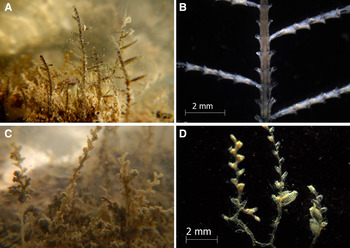
Colony erect (Figure 4A), with a stolonal hydrorhiza. Hydrocladia alternate; length of hydrocladia becoming shorter towards distal end of hydrocaulus. Hydrothecae on hydrocaulus and hydrocladia; in two longitudinal rows; oppositely arranged on both hydrocaulus and hydrocladia (Figure 4B). Each internode with 2 pairs of hydrothecae. Hydrocladial hydrothecae differing in shape from those on hydrocaulus. Hydrotheca without marginal cusps; operculum comprising a single abcauline circular flap. Gonotheca absent.
Diphasia digitalis: (A) colonies; (B) arrangement of hydrocladia and hydrotheca; Sertularella striata: (C) hydroids; (D) arrangement of hydrotheca and gonophores. Scale bars: B & D, 2 mm.

REMARKS
Mammen (Reference Mammen1965a) recorded this species, as Nigellastrum digitale, from Kerala. His material, bearing gonophores, was collected by dredging at a depth of 20–27 m. Venugopalan & Wagh (Reference Venugopalan and Wagh1986, Reference Venugopalan and Wagh1990) reported this hydroid from offshore waters of Mumbai but gave no detailed description of the species. At Poshitra, the hydroid was collected from an intertidal area. An aeolid, Eubranchus sp., was observed feeding on the colony.
GLOBAL DISTRIBUTION
Circumglobal in tropical and subtropical waters; type locality of species is Torres Strait (Australia).
DISTRIBUTION IN INDIA
Pamban (Gravely, Reference Gravely1927; Leloup, Reference Leloup1932); Trivandrum, Kerala (Mammen, Reference Mammen1965a); Mumbai, Maharashtra (Venugopalan & Wagh, Reference Venugopalan and Wagh1986, Reference Venugopalan and Wagh1990). Diphasia digitalis is recorded here for the first time from the coast of Gujarat.
Genus Dynamena Lamouroux, 1812
Dynamena crisioides Lamouroux, 1824
SUBSTRATES
Rock, sometimes on yellow and orange sponge.
SIZE
2–6 cm.
COLLECTION SITE
Poshitra, Adasaba reef, Boriya reef and Narara.
DESCRIPTION
As in Nagale & Apte (Reference Nagale and Apte2013b).
REMARKS
Dynamena crisioides, a well-known species of the intertidal zone across the tropics and subtropics, was more abundant along the Poshitra reef than at Narara and Boriya.
GLOBAL DISTRIBUTION
Tropical and subtropical waters; type locality of species is Moluccas, Indonesia. Indian Ocean (Mammen, Reference Mammen1965a; Millard & Bouillon, Reference Millard and Bouillon1974; Millard, Reference Millard1975; Rees & Vervoort, Reference Rees and Vervoort1987; Schuchert, Reference Schuchert2003) and Bermuda (Calder, Reference Calder1991).
DISTRIBUTION IN INDIA
Kovilam, Kerala (Mammen, Reference Mammen1965a), Mumbai harbour (Venugopalan & Wagh, Reference Venugopalan and Wagh1986, Reference Venugopalan and Wagh1990), Ratnagiri, Rajapur and Vijaydurg (Nagale & Apte, Reference Nagale and Apte2013b).
Genus Dynamena Lamouroux, 1812
Dynamena quadridentata (Ellis & Solander, 1786)
SUBSTRATE
Algae.
SIZE
1–4 cm.
COLLECTION SITE
Poshitra and Boriya reef.
DESCRIPTION
As in Nagale & Apte (Reference Nagale and Apte2013b).
GLOBAL DISTRIBUTION
Circumglobal in tropical and warm temperate waters (Migotto, Reference Migotto1996; Migotto et al., Reference Migotto, Marques, Morandini and da Silveira2002); type locality of species is west coast of Africa.
DISTRIBUTION IN INDIA
Tamilnadu, Kerala (Mammen, Reference Mammen1965a), Ratnagiri and Rajapur (Nagale & Apte, Reference Nagale and Apte2013b).
Genus Idiellana Cotton & Godfrey, 1942
Idiellana pristis (Lamouroux, 1816)
SUBSTRATE
Algae.
SIZE
3–6 cm.
COLLECTION SITE
Poshitra, Adasaba reef, Boriya reef and Narara.
DESCRIPTION
As in (Nagale & Apte, Reference Nagale and Apte2013b).
GLOBAL DISTRIBUTION
Circumsubtropical (Allman, Reference Allman1888; Mammen, Reference Mammen1965a; Migotto et al., Reference Migotto, Marques, Morandini and da Silveira2002; Schuchert, Reference Schuchert2003), type locality of species is New Holland, Australasia.
DISTRIBUTION IN INDIA
Gulf of Mannar (Mammen, Reference Mammen1965a), Dwarka, Poshitra, Adatra (Thornely, Reference Thornely and Hornell1916), Ratnagiri and Rajapur (Nagale & Apte, Reference Nagale and Apte2013b).
Genus Sertularella Gray, 1848
Sertularella striata Stechow, 1923
SUBSTRATES
Sponge, rock.
SIZE
5–20 mm.
COLLECTION SITE
Poshitra.
DESCRIPTION
Colony erect, unbranched (Figure 4C). Hydrorhiza creeping, embedded in sponge. Hydrothecae alternate; tilted on abcauline side; large and thick with annulations over entire length; mouth quadrangular with 4 marginal cusps; operculum with 4 valves. Gonothecae spindle-shaped with annulations over entire surface (Figure 4D).
GLOBAL DISTRIBUTION
Circumglobal. South Africa (Millard, Reference Millard1975), south-western Atlantic Ocean (Genzano et al., Reference Genzano, Giberto, Schejter, Bremec and Meretta2009).
DISTRIBUTION IN INDIA
Sertularella striata is recorded for the first time from India.
DISCUSSION
Scant information is previously available on hydroids of the Gulf of Kutch. The oldest record dates back about 98 years ago (Thornely, Reference Thornely and Hornell1916). That work was nevertheless of value in our exploration of the hydroid fauna from the area. We report here on 12 species of intertidal hydroids from coral reefs at Dwarka, Bet Dwarka, Poshitra, Adasaba reef, Boriya reef and Narara, all in the Gulf of Kutch region. Four of the species are new to Indian waters, namely Zyzzyzus warreni, Cladocoryne floccosa, Nemalecium lighti and Sertularella striata. These four, plus six others (Sphaerocoryne bedoti, Pennaria disticha, Ectopleura viridis, Diphasia digitalis, Dynamena crisioides and Dynamena quadridentata) are new to the State of Gujarat. The genera Zyzzyzus Stechow, 1921 and Nemalecium Bouillon, Reference Bouillon1986 are reported for the first time from India.
As with previous studies on relationships between aeolids and hydroids (Clark, Reference Clark1975), nudibranchs are common predators on hydroid colonies. Three hydroid species were observed being preyed upon by aeolids: Pennaria disticha, Macrorhynchia philippina and Diphasia digitalis were used as prey by Facelina lineata, Sakuraeolis gujaratica, Cratena sp., Cuthona yamasui and Eubranchus sp.
Predominant substrates of hydroid species observed here were rocks and sponges, with six species found on each. Other substrates included algae, eunicid polychaetes and live coral. Although seven of the 12 species in this study were collected from a single substrate, many hydroids tend to be opportunistic substrate generalists.
CONCLUSION
All of the species recorded here are known previously from the Indo-Pacific region, and are of frequent occurrence there. Herein we document their occurrence intertidally in the Gulf of Kutch, India, in the northern Arabian Sea. With additional study, we believe additions to the local fauna are likely. Moreover, ecological studies are needed to establish relationships between the hydroids and their substrates, as well as their interactions with aeolid nudibranchs. In terms of conservation, knowledge about hydroid prey is paramount in understanding the life cycles of their aeolid predators.
ACKNOWLEDGEMENTS
The authors are grateful to the Ministry of Environment and Forests (MoEF), Government of India, for providing financial support under the AICOPTAX-Mollusca project. We are thankful to the Department of Forest and Environment, Government of Gujarat, and especially Mr Kamboj, IFS CCF, for providing necessary permissions to visit the Marine National Park. We thank Dr J.R. Bhatt of the MoEF for his continued support. The authors thank the Director of the Bombay Natural History Society for his unstinting support for the studies. We acknowledge Ms Amruta Prasade, Ms Reshma Pitale, Mr Bhavik Patel and Mr Rajesh Parmar for their contributions during field expeditions. We also thank Dr Dale Calder for valuable guidance in identification of species and language editing.