ʿAJŪBA
On Hall Road, a street in the Pakistani city of Lahore famous for its role in the informal distribution of films in copy, Adeel, a DVD storeowner fondly casts his mind's eye back to his family village in Sindh. It wounds him slightly when he admits it has been three decades since his last visit, but his countenance brightens when he recalls the topic in question. His uncle had dragged him to an outdoor cinema, a sight that inspired in him a sense of ʿajūba, of being in the presence of a one-off, a sublime novelty, or sight of great wonder:
When we went inside, we saw some people sitting on the floor. Someone had put up a ṭākī [cloth] and the film was being projected on it. They had built a raised section with wooden planks you could climb onto up a wooden ladder. It was like a kaččī gallery and the ticket price was Rs2 or 3 more. We sat down and watched the film all night; once you have paid the money there was no stopping you watching it again and again. However much strength you have, you can keep sitting there. Some people were sleeping and whoever woke up would rub their eyes and start watching the film. Remember, I had come from Lahore to visit that village. I had seen established cinemas and well-dressed cinemas with good furniture and equipment. To see the open-air cinema in that village was quite astonishing.… When I spoke to my family recently, they told me that the cinema still exists, but they have added a pakkā roof made of bamboo. They have started to keep pedestal fans in the cinemas and the cinema is open twenty-four hours, from morning to night.
The cinema had, in his absence, transformed from a kaččī ṭākī (traveling cinema) to a pakkī ṭākī (permanent cinema). In Urdu and Punjabi, this amalgamates the English word, “talkie” (from touring talkie, a name for a temporary or mobile cinema, as opposed to a built one) and ṭākī, the cloth used as a projector screen. The encounter with the viewing apparatus, and its naming, are formed in the fixedness or mobility of the surface of the screen or the furniture, as well as the addition of fans and shelter from occasional sandstorms. Despite having described Adeel's one-man DVD store—in which he retrieves, records, and duplicates rare Pakistani films in the absence of a national film archive—as informal, I became aware that my interlocutors in Lahore were not familiar with such a distinction. Informality as a concept developed in adherence to urban planning and, fittingly, the closest approximate binary I found in my field site was that between the kaččā and the pakkā, roughly defined as the temporary and the fixed, and often used to describe built structures. Kaččā is most frequently heard with reference to kaččī ābādī—slum housing or areas of slum housing—and it can also refer to temporary bridges over torn-up streets awaiting resurfacing, or a makeshift road demarcated by a collective decision to drive over a section of undeveloped land. Although to be kaččā is to be rough and ramshackle, to be kaččā can also be communal and unplanned. To address the state of being kaččā requires a process of transformation and approval to turn it into pakkā.Footnote 1 Despite his not having returned for so long, some of Adeel's most frequent customers are the patrons of that very open-air cinema who, since the decline of celluloid film production, now order from him discs of long-lost Punjabi-language Pakistani films to play on their new digital projectors. He fears that a return visit to see such atmospheric and technological adornments may vanquish the ʿajūba with which the kaččī ṭākī, and the phenomenological transience of film experience, struck him.
I chose this vignette from a year of ethnographic fieldwork in Lahore between 2017 and 2018 for the ways in which it underlines the transformative and mutable exhibition of film. Evidently, within film experience there are palpable thresholds materialized and sensitized by the ambient qualities of its exhibition. This essay returns to archival and historic accounts of film exhibition to understand some of the ways in which colonial authorities and foreign powers attempted to gage, express, and utilize the event of mobile, usually outdoor, film exhibition. I approach this material as a prehistory to my research on the morality and mediation of film in contemporary Pakistan. Consequently, I focus on the sentiments, tastes, and desires that prefigured the creation of the Islamic polity in 1947 following the Partition of the Indian subcontinent. In what follows, I discuss the ways in which the performance of film—its image and its atmosphere—was rehearsed and tested in colonial India and the extent to which these regimes of contact were abandoned by Pakistan after Partition. This will be instantiated in studies that attempted to situate audiences and their reaction to film exhibition, including that of the wide-ranging Indian Cinematograph Committee of 1927–1928 (hereafter ICC), and of the mission of anthropologist John J. Honigmann in West Pakistan in 1952.
In a shorter report that followed the ICC, “The Problem of Films in Native Markets,” the India Office, a British government department that administered much of the Indian subcontinent, noted the importance of understanding and responding to the inevitability that, “the native population of the Empire is bound to want to become ‘cinema-minded’ in the near future.”Footnote 2 Talk of preparing for the change in cinema-mindedness quickly gave way to widely entrenched and active attempts to inculcate and expedite the process. Wielding the promise of transformative and lasting change, colonial film exhibition and its compulsion to forge cinema-minded subjects operated in ways not dissimilar from Pentecostal and Islamist strategies of religious conversion that have become the subject of recent scholarship on rupture and cultural transformation (Larkin and Meyer Reference Larkin, Meyer and Akyeampong2006; Robbins Reference Robbins2010). Behind this ongoing narrative of religious reformism and rupture is a long history of religious thought defined by oppositional stances and pious narratives of breaking with the past, so as to constitute an Other that lags behind (Larkin Reference Larkin, Hackett and Soares2015: 65). I will centralize this progressivist and modernizing imperative to explore the production of rupture, not just within, but projected upon the Muslims of pre-Partition north India and post-Partition Pakistan, and some of the challenges these discourses faced.
Much of the thinking that guided the adoption of mobile film exhibition by colonial authorities and foreign powers neglected to take into consideration the ways that inculcating “cinema-minded” subjects would also train their minds to understand and undermine the ʿajūba of the elicited film event. This essay concludes by considering the first British mobile film exhibitions in Pakistan organized by the British Information Services agency (hereafter BIS)Footnote 3 across rural areas using film vans fitted with mobile projectors and screens for outdoor exhibition. These tours, which departed from Karachi and Lahore immediately following Partition and the creation of West and East Pakistan, were forced to reconcile the cumbersome materiality of the cinematic apparatuses with the use to which they were to be put, namely the circulation of a kaččā phenomenology across authorized channels in authorized forms. While these exhibitions tried to indigenize the apparatus, film's affective dimensions were continually wielded in an attempt to homogenize its subjects and their perceived needs, to situate them as Muslim viewers, rural viewers, or female viewers. At times, these attempts to elicit a response from colonized peoples, as mediated by the sights, sounds, and sensations of film exhibition, were met with strategies that disrupted the development of programmatic approaches to such events and their future deployment.
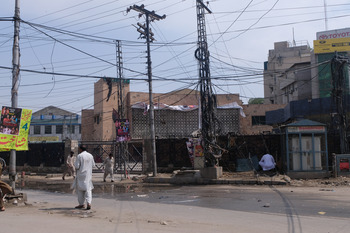
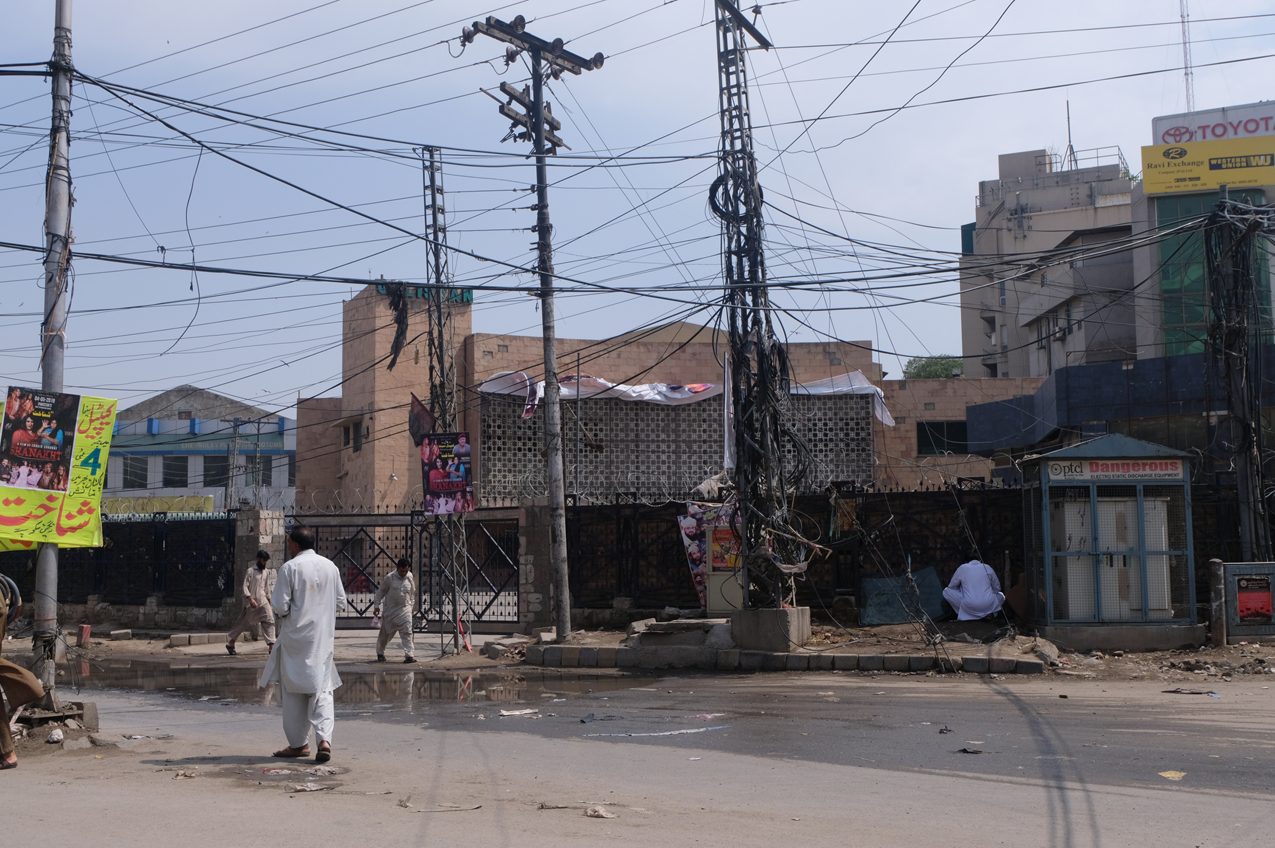
A short distance from Adeel's store many analogue cinemas on Lahore's historic film street, Abbott Road, struggle to attract cinemagoers due to the intermittent power supply and the cost of converting to digital projection (author's photo, May 2018).
APPARATUS AND EVENT
What sort of an event is a film screening, or the exhibition of the moving image? The journey that this essay takes through fragmented time frames, sites, and modes of exhibition attempts to arrive at a general picture of some of the ingredients that challenged a long experiment in wielding the film event, and the afterlife of these elements in the particular conditions of film experience in Pakistan today. In this context, I take up Iftikhar Dadi's call for further study of the “complex relay between screen imagination, modernization, and political authoritarianism” (Reference Dadi2010: 13) in the history of film experience in Pakistan. I also take Brian Larkin's work as the foundation upon which to explore the conflation of the event of film exhibition, film as an object of colonial knowledge, and its relationship with Muslim audiences. In view of the bureaucratic and political labor evident from attempts to utilize, manage, and reproduce the event of film contact, film was a significant aesthetic infrastructure honed and deployed by colonial authorities. I refer to film infrastructures as conceptual objects and modes of address (Larkin Reference Larkin2008: 245), the aesthetics of which work by rearranging hierarchies of function so that the phenomenological dimension rather than the technical dimension of infrastructure remains dominant.
The most recognizable of the phenomenological and aesthetic infrastructures of film experience are the apparatus and the interface of its exhibition. In the 1970s, film theorists combined a growing incorporation of Marxist analysis with the popularity of psychoanalysis to explore the ideological mechanics of the cinematic apparatus that, rather than inculcating ideology through content, actively masked the ideological effects which their operation and application provoked. Jean-Louis Baudry described the impactful experience of film as a “work,” which he clarified as “a process of transformation” (Reference Baudry1974–1975: 40) that operates when the work is concealed. His apparatus theory explored how spectatorial contact was coded into the cinematic process and material encounter, but this view lost influence when researchers showed that there were multiple origins and epistemologies coded into cinematic experiences across the world. Scholarship on early film in South Asia has been particularly adept at showing how film circulates as an unfinished object. Film was moving across colonial South Asia in all sorts of ways by the late 1920s, by which time India had already established an indigenous film culture cross-fertilized by print culture, architecture, lithography, and calendar art, and later, song. It is often noted that the forces of film experience extend across a much wider sphere than the immediate event of film exhibitions (Bhaumik Reference Bhaumik2011). In South Asia, film converged with other forms of address, such as popular music and sound technology that forged an event that was both reproducible and itself an assemblage of sights, sounds, and sensations, and their mediation and remediation (Hughes Reference Hughes2007: 4). This might, with a nod to Alfred Gell, be called film's distributed objecthood, incorporating the advertising material, the architecture of cinema halls, film's urban exchanges and flows, and the circulation of fame and rumor. For Gell, distribution was not just the spread of artifacts or individuals, but also the notion that “images of something (a prototype) are parts of that thing (as a distributed object)” (Reference Gell1998: 223). In contrast to the spatial-temporal spread of persons, an object can be distributed by prior design, comprised of constituent parts with their own networks and life histories, or as part of an art tradition that speaks to other objects across platforms.
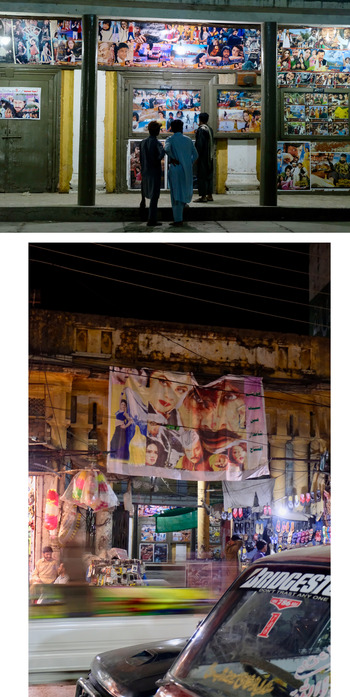
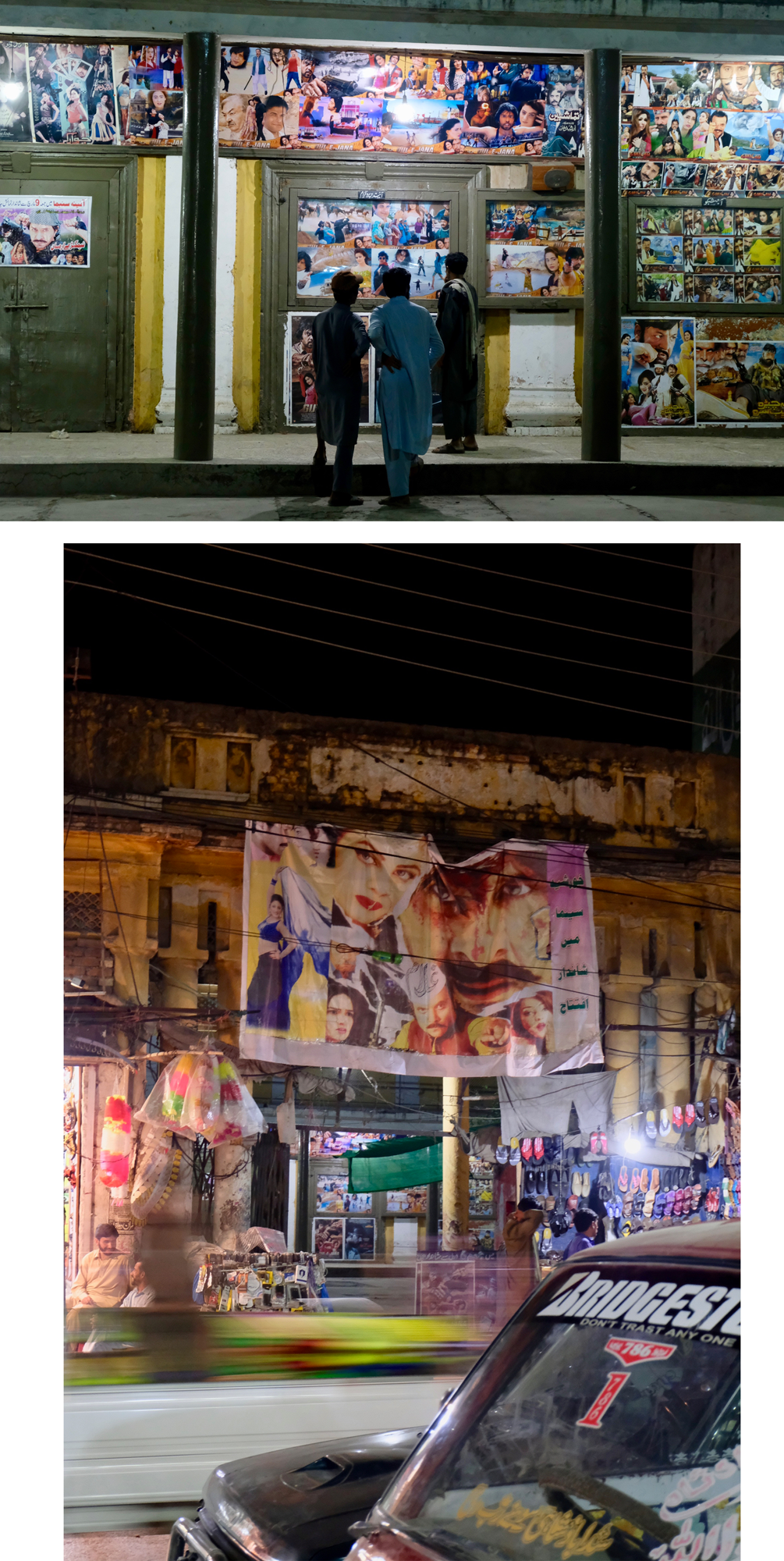
One of the longest-lasting pakkī ṭākī (permanent cinemas), the Khurshid Cinema in Rawalpindi plays only Pashto language films on a portable digital projector. Built long before Partition, the cinema includes both an internal courtyard separate from the adjoining street and a rectangular, flat-roofed projection hall (author's photos, April 2018).
A recent revival of interest in the ideology of the cinematic apparatus (Elsaesser Reference Elsaesser2011; Szczepaniak-Gillece Reference Szczepaniak-Gillece2016) resonates with a substantial body of literature in visual anthropology on the event of techno-material contact. In The Coming of Photography in India (Reference Larkin2008), Christopher Pinney charts the historic development of photography into an improvisational and experimental zone in which the photograph rapidly emerged as an agent of transformation and disturbance. In his monograph on media urbanism in Nigeria, Larkin compares first contact with the moving image, and its ability to inspire awe, with other forms of mass infrastructure such as roads, bridges, and railways. The elicitation of what he calls a “colonial sublime” (Reference Pinney2008: 11) was wielded in an attempt to modernize subjects and train their senses so as to bolster indirect rule.
Larkin observes that religious scholars use a narrative of rupture similar to that of media studies (Reference Larkin, Hackett and Soares2015: 77). In scholarship on early cinematic exhibition, the “coming” of film, or of sound recording or photography, presupposes a moment of rupture. Evidently this zeitgeist was palpably felt to be a potentially useful object of colonial power. The “binary logics” (ibid.: 65) of religious narratives of rupture, which manufacture a before and an after, are also palpable in film experiences when film is instrumentalized in ways akin to religious conversion. Those colonial authorities who produced and circulated these films evidently saw the event itself as a moment of illumination and change, following which the film-going or “cinema-minded” subject might be moralized, tamed, and subjectivized. For example, after a film screening organized for rural viewers by the French Service General de l'Information in Morocco, “the majority of the audience help to dismantle the apparatus and screen with great interest” (Film Centre Reference Film Centre1949: 74). The compilers of an extensive booklet produced by UNESCO on examples of film elicitation around the world subsequently advised that each screened film should address such fascination with the apparatus with an, “introduction to the image” (ibid.: 75) to familiarize the audience with the screen and with the cinematic effect, which many in the audience were expected to be experiencing for the first time. The frequency of such reports compiled and published by governmental and non-governmental development agencies, and colonial authorities, evinces a faith in the efficacy of the film event to mediate contact with disparate subjects whose distance and differences might be usefully collapsed by the meeting of apparatus and event. Apparent at the heart of this thinking was the idea that if a film could, subject to the vagaries of its apparatus, unfold its canned duration in a near-identical fashion night after night, then the event of its reception could be similarly replicated.
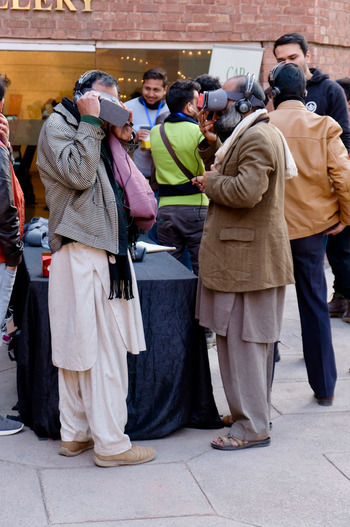
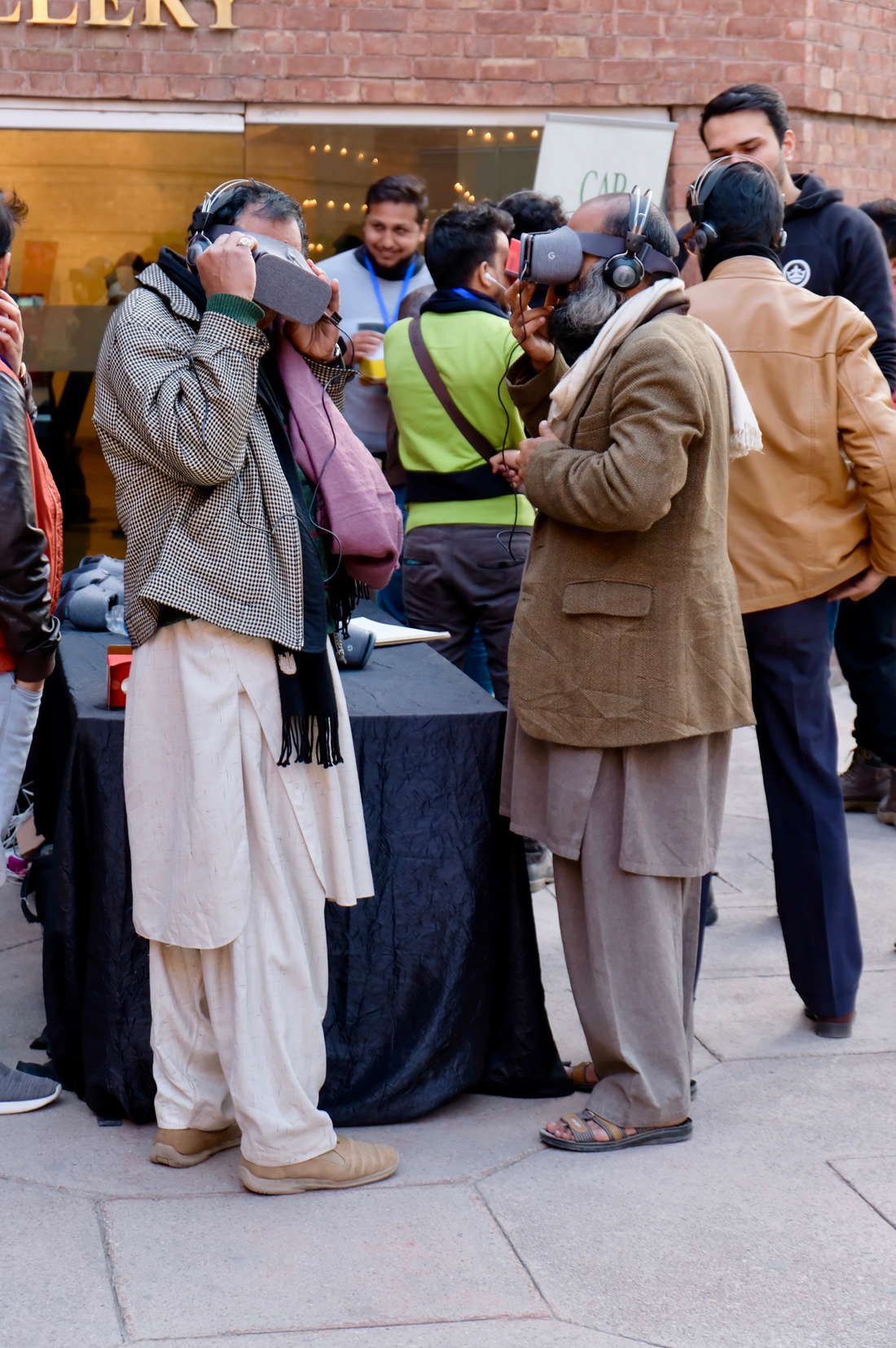
The event and ajuba of viewing. Participants at a music festival in Lahore enjoy another element of Sharmeen Obaid's “Look but with Love” project—a Virtual Reality (VR) documentary (author's photo, January 2018).
While I explore the mediation and procedure of film exhibition in British India and Pakistan through archival documents and reports, I hope to rekindle something that speaks to the exertion and commandment of the event itself. What does the event do when it is wielded as a “ritual of rupture,” the kind of discursive break that Joel Robbins (Reference Robbins2003: 224) associates with Pentecostal Christian attitudes to conversion that define and delimit tools of real, efficacious change. In recent Francophone philosophy Alain Badiou's Being and Event defines the event as that which emerges from the edge of the void, a rupture in the everyday and of being, an act of honing the present and becoming (Reference Badiou2005: 175). While Badiou argues that something can only be known as an event in retrospect and if it is a product of sites of exclusion, in this paper I argue that something different was at work with regard to the elicitation of film in British India and by foreign powers in Pakistan following Partition. Instead, I follow Marilyn Strathern in studying the event of contact, through her short essay on an indigenous peoples’ response to Western elicitation of communication. What Strathern calls indigenous practices of “decomposing” the event constitutes the “taking apart of an image,” thereby imbuing in themselves “power as witnesses to their own efforts of elucidation” (Reference Strathern1992: 245). I trace this tension between elucidation and elicitation through the phenomenology of kaččā and pakkā film exhibition, in which the former emerged as the communal product of spontaneous consensus, and the latter as the result of power and order imposed upon it. The sense of ʿajūba felt by Adeel is synonymous with this rupture that fuses a moment of radical becoming with the negative pleasure of the sublime. With the incitement of ʿajūba, and the recalibration of thought that was expected to follow, the elicitation of film contact was designed to manufacture rupture, for the purpose of knowing South Asian subjects at the threshold of their greatest vulnerability.
DENIALS
In 1952, the Anthropologist John J. Honigmann conducted a research project to what was then the western wing of the Dominion of Pakistan, under contract to the International Motion Picture Service of the U.S. Department of State. This study, possibly unique in the history of anthropology,Footnote 4 took Honigmann to interior Sindh (Chiho), Khyber Pakhtunkhwa (Tordher), and Punjab (Chak41) to study the impact of U.S. Information Services (USIS) Films. The USIS was ostensibly a propaganda unit whose goal was to project a favorable image of the United States, largely to counter similar initiatives operated by the Soviet Union and Great Britain. The report's mode of analysis was structured to test the pedagogic effectiveness of the films, and the viewer's ability to apply the lessons learned to their own situation, particularly those relating to hygiene and agriculture. The USIS were under the impression that the target audience were well-versed in Urdu, a language that was being promoted as the national language across the new nation. Chief among the report's concerns was whether the films, delivered in English and occasionally supplemented with live Urdu narration, were being understood by speakers of other languages.
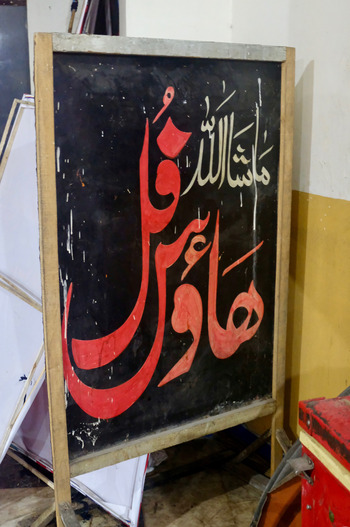
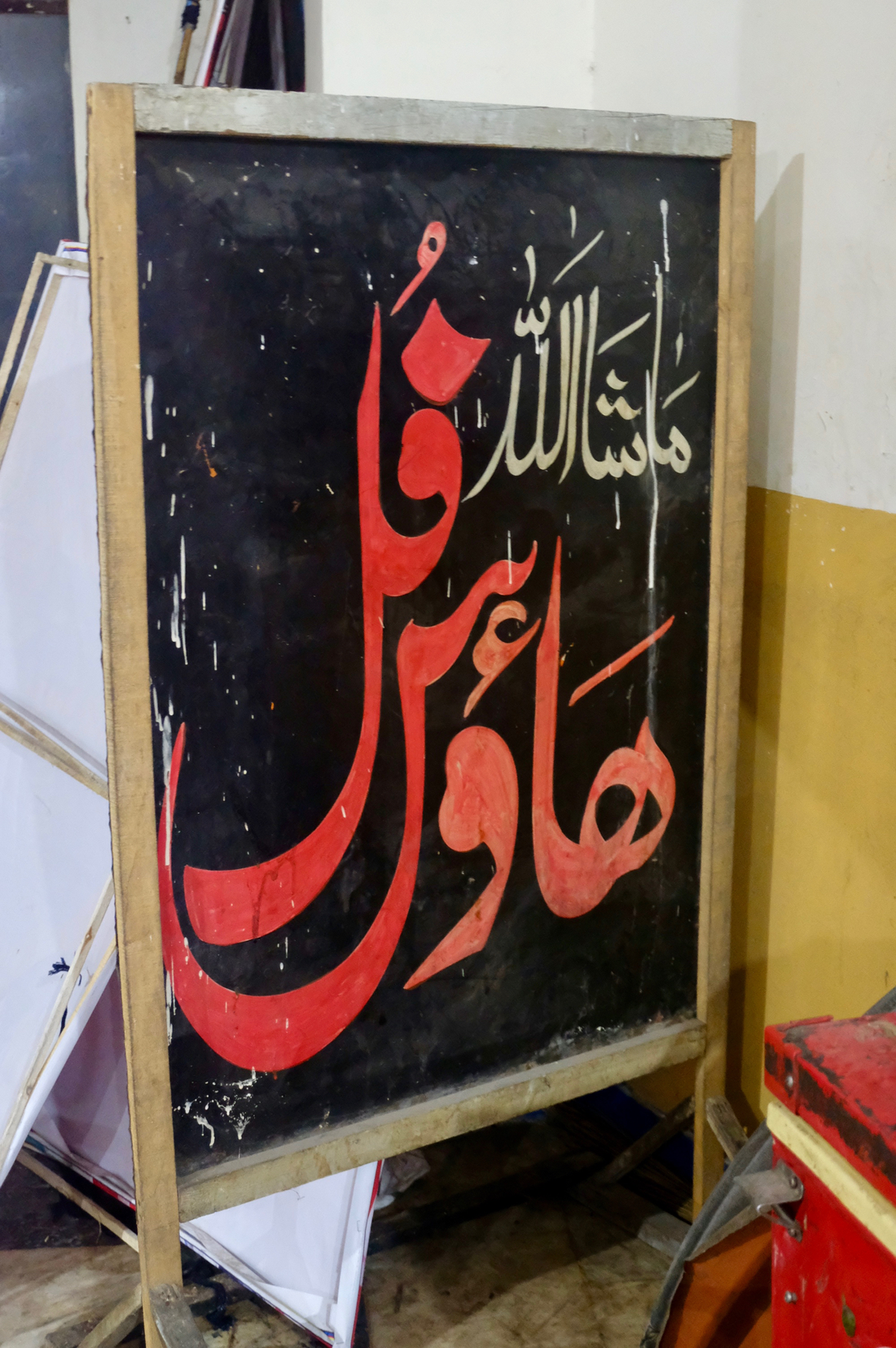
A backroom sign in one of Lahore's cinemas serves as a reminder of better times. Reading “Mashallah [Allah wills it] House-Full,” the sign would have often been placed outside on the main street to indicate a sell-out show (author's photo, October 2018).
Honigmann's study was to provide ethnographic context to the exhibition of the U.S. films so that the administrator of a film program might “visualize the audience he reaches” (Reference Honigmann1953: xi). Chiho, Tordher, and Chak41 were purposefully chosen for their distance from urban centers, with larger towns avoided to guarantee greater distance from Urdu speakers and influence. The first village, Chiho, for example, a majority Sindhi village with some Balochi and Hindu households, was largely unaffected by the horrors of Partition and harbored little enthusiasm for the movement to adopt Urdu as the national language. Only 40 percent of the villagers had ever seen a film and none of the women had (ibid.: 13). There was no cinema within 50 miles of Chiho, but before Partition the North Western State Railway would occasionally send a cinema car to the nearest town where some of the villagers had their own experience of film. The materiality of exhibition and viewing was not subject to study, but Honigmann's holistic report provided much of the minutiae of the experience of the USIS mobile film exhibitions. In practice, he not only concealed that he was commissioned by the USIS but maintained an illusion of disconnect between his party and the exhibition of the mobile film unit, arriving at the villages a few days before and participating in the surprise among the villagers once the unit appeared to show up out of nowhere.
Recounting a time roughly contemporaneous with Honigmann's study, Arthur Goodfriend (Reference Goodfriend1963) showed the challenges faced by USIS public relations programs on the other side of the India-Pakistan border. Goodfriend documented his time with the Delhi office sending film tours around Rajasthan, and their attempts to counter the spread of Soviet propaganda that wrought a so-called “twisted image” of the United States while presenting an image of themselves that boasted of the diversity of its blocs. He explained,
The Communist cultural offensive seemed more sensitively attuned to India's nature. India was a multilingual, multiracial, multicultured country in which each ethnic group feared for the future of its cultural tradition. Soviet exports carefully cultivated the idea that, under communism, folk cultures had nothing to fear. Uzbeks, Ukrainians, Georgians, Azerbaijans danced, sang, and played in costumes not unlike Indian tribal raiment in color and cut … they identified Soviet folk-art with India's own in a common defense against Western “mongrelization” (ibid.: 213).
The incursions that film vans made into the rhythms of the everyday were documented by Goodfriend, who wrote of the village of Safar, home to close to eight hundred people. In the evening a bus would roll in from Udaipur depositing mail, newspapers, and occasionally a passenger. Sometimes it was a menial bureaucrat or an agricultural official advocating changes to land cultivation. Goodfriend continued, “Sometimes it was a holy man who seized the citizens’ imaginations for a fortnight with a religious preachment, turning their superstition to his own advantage until sanity was restored. Sometimes it was a cinema.… For weeks afterward, villagers compared the customs of the outside world as revealed by these celluloid self-images” (ibid.: 164).
These early film audiences living along the North Western State Railway, and global encounters and frictions so often described in studies like that of the ICC, can help us think beyond the scholarly fiction of national cinemas (Jaikumar Reference Jaikumar2003; Chatterjee Reference Chatterjee and Christie2012). Such a frontier cosmopolitanism is exactly what Goodfriend reported and what the USIS expected to read about in Honigmann's report, for this ethnographic frontier was supposed to reveal where the fault-lines lay in the early Cold War struggle for influence. Yet what Honigmann observed after the elicitation of film contact was not an appetite for such global encounters—in the sense that they were recognized by his subjects—but quite the opposite. His found his respondents disinterested in the films about matters relating to international affairs, something he attributed partly to the lack of radios and newspapers in the area. In Tordher, an area the anthropologist remarked was only 280 miles from Soviet-occupied Tajikistan (Honigmann Reference Honigmann1953: 177), there was little interest in the international bifurcation of power that constituted the nearby geopolitical fault-line, and some men were unaware of where or even what Russia was. In one of the target films of the study, In Defense of Peace, an action-packed propaganda short for which audience reception data was most eagerly sought, few could identify the countries depicted or knew the protagonists or antagonists of the global power game. One viewer, a cultivator, responded succinctly, “If someone bombs me here, I will be in danger; otherwise not” (ibid.: 46). The idea that mobile cinemas would foster the desired kind of local-global thinking was beginning to look vulnerable. The films had been selected in too haphazard a way, and those that villagers understood were about matters they knew they could have had no influence on, such as irrigation works. To be effective in the way their producers hoped, mobile film screenings needed to be about far more than comprehension; they needed to wield the event of contact itself.
Among the taxonomies of response Honigmann presented in his report, an unexpected category presented itself, one that would have been hard to reconcile with the picture Goodfriend painted of his experience in India. Following a boisterous, often chaotic screening of several short films ranging from medical and hygiene awareness documentaries to newsreels, and glimpses of everyday life in Europe, America, and beyond, some audience members denied seeing anything at all. In his final report, Honigmann grouped responses under five headings: “insignificant comprehension,” “moderate comprehension,” “good comprehension,” “absent for entire evening,” and “although present for some time during the evening, subject denies seeing this film.” At one USIS-organized event Honigmann observed, 29 percent of the audience were categorized under the last category (ibid.: 38). He mused, “Denial seems to be related to the difficulty or strangeness of a film” (ibid.: 37). In certain instances, this was perhaps due to the films’ content being incomprehensible to viewers, or their anxiety about appearing to not have understood what they were supposed to in front of foreign guests (ibid.: 41). But denial can be also seen as an event in itself, variously in speakers’ insistence on their participation in, and later categorization under, the non-event, and that denial was an effective way to disappoint the USIS project. “Denials” as a category of experience subverted the USIS's expectations that the audience would respond in some way, either as co-producers of the narrative or, alternatively, as elicited global subjects moved by the depiction of associated countries, situations, or emotions.
ITINERANT CINEMAS
The ʿajūba that Adeel felt but that some of Honigmann's respondents did not is a reminder of the uneven successes associated with colonial attempts to wield first or sustained contact with the moving image. The “colonial sublime” was elicited to train the senses of colonial subjects and modernize them in order to cement direct and indirect rule. Indigenous elements such as land, topography, climate, and materiality became as important to reconcile with the apparatus as was connecting the content of the films with the audience. Such concerns were expressed in frequent, urgent memos sent around the India Office, including one from a Captain Knatchbull in 1932 that asked, “How many times can you show a film before it becomes useless?”Footnote 5 Knatchbull's desire to gain a measure of the lifespan of film material recalls the findings of the ICC regarding so-called “nomadic cinemas,” whose use of aged and decrepit films outside the circulatory radar of the authorities perplexed the Committee.
From the early twentieth century until Partition in 1947, the India Office drew on sizeable resources and manpower to gauge the use value of film media. The exhaustive investigations undertaken by the ICC in 1927–1928 produced four fascinating volumes, which included written and oral interviews with 353 “witnesses”: film producers, exhibitors, distributors, actors, film censors, newspaper editors, and educationists working in India. In the ICC, India became the site of one of the first expeditions sponsored by a state into the status of film labor and production within its polity (Shoesmith Reference Shoesmith1988; Mazzarella Reference Mazzarella, Kaur and Mazzarella2009). The ICC was established by the British Indian government to assess film censorship, audience demographics, and the advancement of an Indian film industry, and to explore the possibility of creating regulatory preferences for “Empire films” there (Chowdhry Reference Chowdhry2000; Grieveson and MacCabe Reference Grieveson and MacCabe2011). British censorship regimes, the foundations of which were to be laid down by the ICC report, responded to the perceived dangers of mass-mediation, the creation of what William Mazzarella (Reference Mazzarella2013: 2) describes as a sphere of “performative dispensation” wherein power is attained in parallel with the demarcation of an affective zone of phenomenological order.
Much of the rich and extensive literature on early cinema in South Asia has drawn on the ICC reports and interviews. The ICC has been seen less as an ongoing project to come to grips with the phenomenology of the film event, as I perceive it, and more as an attempt to infiltrate that growing assemblage to find a market for British films. Like Priya Jaikumar, I see the ICC as a response to and evidence of “rupture,” but not of the “coherence of imperial ideology” (Reference Jaikumar2003: 87) that led to the entangled trajectories of Indian and British film production (Reference Jaikumar2006). Rather, it was a rupture that presented the radical possibility of reproduction. How does film function? How does it affect cognition? In whose lifeworlds is it entangled? These are the questions that I think animated the ICC. They spoke to both the racial anxieties of the Empire and the emergence of Indian middle-class anxieties that stratified film experience amidst the emergence of an urban poor (Dass Reference Dass2009). This kind of elite discourse about film is still prevalent across both India and Pakistan.
The question of how film has been used to engage religiously diverse audiences has driven much scholarship on early cinema in South Asia. What was predominantly a commercial enterprise was driven by what Ravi Vasudevan calls a “sociology of the market” that understood audiences “in terms of their social, religious, and ethnic composition” (Reference Vasudevan2015: 29). Such marketplace knowledge was built in parallel to latent ethnographic methodologies directed at the cinema and fostered by colonial authorities. Desire and faith were conceived as a set of triggers and indices to be known, counted, and quantified to make way for a cosmopolitanism fed from above. The ICC project was conducted like an ethnographic or anthropological mission, and its members travelled 9,400 miles between mid-October 1927 and late February 1928. It staged participant observations in forty-five cinemas and noted the activities of informal projectionists. The Committee also received 320 written testimonies and interviewed 114 Europeans and 239 Indians, of whom 157 were Hindus, thirty-eight Muslims, twenty-five Parsis, sixteen Burmese, two Sikhs, and one Christian (ICC 1928a: 13–14). The importance of the study, apart from its historical value in documenting film experience in 1920s India, was that it was the first attempt by a state to identify film as an object of colonial knowledge. The goal was to understand the way film worked, and classify its audiences and the public spheres in which it operated, so as to render it intelligible for the purposes of regulation.
The Committee worked to embellish its legitimacy through claims of its practical use-value in the field of governance, steeping its project in reformist attitudes toward education, hygiene, and social progress. While the ICC was a framework for creating the boundaries for censorship, less studied have been the ways in which it surveyed existing practices that might be co-opted and events that might be brought under the remit of the state. By the early twentieth century, film began to take its place at the heart of collective cohabitation. The ICC detailed public events ripe for appropriation, namely those centered around the mela [fair], which in Peshawar included a special Friday film showing for the tribesmen who visited the city to trade (ibid.: 20).
More puzzling to the ICC's compilers was the phenomenon of nomadic cinemas, which we now recognize as predecessors of informal and pirated media networks, rendered outside of authorized channels only by the circulation of discourses intended to demarcate and own those channels. In the early years of film's exhibition in South Asia, it was defined by its performativity rather than by its static exhibition, and traveling cinemas were not the exception but the norm (Bhaumik Reference Bhaumik2011: 45; Mahadevan Reference Mahadevan2015). They “come into existence and pass away,” according to the ICC, and “generally carry with them their own tents and benches, transported on bullock-carts.… Ordinarily they exhibit old second-hand western films which can be purchased very cheaply, and according to our information these films are generally much worn and in very poor condition” (ICC 1928a: 24–25). The report refers to these caravans as “itinerant cinemas,” and seems to take a paradoxical line on their activities, wavering between advocating their appropriation as a vehicle for propagandistic cohesion within the Empire and penalizing their borderless activities for operating outside of formal licensing arrangements. In the formal sphere of film circulation, such films that had come to the end of their lifecycle were identified as “junk” (ibid.: 76), a category no doubt born out of concern over the atrophic nature of film's contingent and contagious materiality.
The ICC's concern about used-up films, as well as their anxiety over the morality of films that circulated throughout British India, were echoed by a number of Indian respondents who agreed to sit for interviews with the Committee. Yusuf Ali, the principal of Islamia College in Lahore, complained of films, “that one has seen 2 to 3 years ago in England suddenly come here and parade as new films. Many of them are worn out, so that they are not worth looking at; and … are selected for the very qualities for which they would be rejected in England, except in the lowest class of cinema houses” (ICC 1928b: 118–19). His annoyance at being forced to inhabit the lower rungs of a circuit well articulates the logic of the circuits themselves, in which the newness of a film work is reflective of hierarchies of class and taste. Yusuf Ali was a member of the Punjab Board of Film Censors, and while he may have been aggrieved by the insult to prestige of being offered less-than-new films, the unsanctioned circulation of “old and inferior films” (ibid.) by itinerant cinemas was also an affront to the very existence of the censor boards.
By safeguarding traveling cinemas, the ICC could be seen to be not only preserving the breadth of film contact in the absence of cinema theatres (ICC 1928a: 146), but also instrumentalizing the birth of media informality and overseeing its transformation into the realm of legitimacy—that is, the transformation of kaččā into pakkā. The ICC recommended that licenses be made easier to get, which would facilitate projectionists’ mobility between districts, municipalities, and provinces since they would not have to apply for a new license in each place. In this way, they identified traveling cinemas as potential distributors. Rather than curbing their activities, the Committee focused on the quality of the films in circulation. They also recommended railway fare concessions, thereby earmarking the mobility of films in various assemblages and forms for sponsorship. Such nomadic activity was a key characteristic of informal cultural transmission in British India, briefly evading the metropole and filling infrastructural gaps in more remote outposts.
THRESHOLDS, ENTANGLEMENT, AND “MUSLIM TASTES”
The “denials” which Honigmann reported on—individuals who attended showings but later denied being present—contrast with contemporary ethnographies of film exhibition in South Asia, which describe the co-production of a participatory public sphere or a film culture that suffuses public life and frames social imaginings. It also sits uncomfortably with scholarship on how film experience has been consistently vernacularized in South Asian public culture, often in opposition to the wielding of its apparatus. This can be seen variously through recent engagements with the public culture of the cinema hall (Srinivas Reference Srinivas2000; Srinivas Reference Srinivas2016) and a growing body of literature on film distribution, its discontinuities, and its surprising symmetry (Srinivas Reference Srinivas2003; Laboto Reference Laboto2007). In a recent monograph, Anand Pandian studies the creative impulses behind cinema production and undertakes a phenomenological exploration of reception and experience. He examines the ways in which film seeps into everyday life, or “what happens to life when everything begins to look and feel like film” (Reference Pandian2015). Pandian describes the ethereal, routine, banal, and delusional experience of losing track of where real life ends and cinema begins. Christian Metz described this malaise as an exhausted retreat from the dream-like stimuli of cinephilia, that “regime of illusion” (Reference Metz1982: 136) whose established pleasure relies upon an indexical relation to lived realities and possibilities for actualization. Metz interprets the resulting “cinephobia” as the product of a neurotic mind that rejects habitualized film-going experience upon finding the possibility for everyday actualization too remote. Considering this, Honigmann's “denials” seem almost like a communal warning system that monitors the threshold of absorption and rupture.
What has been called cinephobia, and the myriad ways it has been conceptualized, is worth probing further as an expression of filmic exorbitance. Like Ali Nobil Ahmad (Reference Ahmad2014), I take cinephobia in Pakistan to be a symptom of both ambivalence and animosity toward film and the resulting strategies taken by cinephiles for navigating ellipses, deterioration, and decay in filmic institutions and infrastructures (Cooper Reference Cooper2016; Reference Cooper2018). Scholarly reflection on cinephobia is almost as old as the discipline of film studies. Jean Giraud's Reference Giraud1930Lexique français du cinema cites the increasing use of terms like cinephobe or cinephobie in cinematographic trade journals between 1908 and 1912 (Cassetti Reference Casetti2018). Ricciotto Canudo mentioned it in a glossary of terms used to categorize the assets of film phenomenology in his seminal essay “The Birth of a Sixth Art” (Reference Canudo1980[1923]). The social commentators who theorized this negative labor of film experience became its first theorists (Ionita Reference Ionita2013: 21), driven by a distaste for visual excess.
While this scholarly trajectory adds a dark patina to the European “golden age” of early cinema, cinephobia in South Asia possesses its own history, one not restricted to the inspiration of awe and terror that elicits the sublime (Cassetti Reference Casetti2018: 148). Ravi Vasudevan's work on Indian film publics in the three decades preceding Partition (Reference Vasudevan1995) reveals fears that social boundaries were under threat by an incorporeal force, materialized by an audience, which together produced a third space of becoming. He argues, “Cinephobia sprang from fears that the accelerated circulation of images and ideas through the technologies of the modern public sphere might result in animosity between groups and cause civil strife” (Reference Vasudevan and Vasudevan2000: 15). While M.S.S Pandian (Reference Pandian1996: 952) noted a late flowering of cinephobia among Tamil political and literary elites in the 1940s, S. V. Srinivas (Reference Srinivas1999) argued that by the 1930s these largely bourgeois anxieties about intermingling classes had become part of popular opinion.
While the ICC noted that, particularly in North India, there were “objections to the moving picture” on religious grounds (ICC 1928a: 20), the entire basis of its investigation rested on the regime's moral and ideological anxieties that film had the power to destabilize. Abdul Qayum Malik, Bar-at-Law, in an interview he gave to the ICC on 26 November 1927, remembered, “A film depicting the Life of the Prophet shown in a Karachi Cinema some years ago led to a grave popular discontent, inasmuch as a part of the cinema was destroyed by fire and the showing of the film stopped” (ICC 1928b: 184). He seems to have been remembering a controversy in July 1914 when Muhammad Ali Jauhar—a leading figure of the Indian pan-Islamic Khilafat Movement, which grew in response to the decline of the Muslim Turkish Ottoman Empire—in his weekly periodical the Comrade decried a scene in a film he felt insulted the Prophet Muhammad (Bamford Reference Bamford1925: 115).
Kazi Muhammad Aslam Khan, Pleader in Peshawar, in his interview of 30 November 1927, noted the same pervasive anxiety over American biblical epics and their depiction of Muslim Prophets in amorous situations (ICC 1928b: 272). He noted that members of Peshawar's Muslim community widely visited the cinema despite considering it “a sacrilege.” The only exception was members or supporters of the Khalifat Movement, who refrained from cinema-going and advised others to do the same (ibid.: 280). He painted an illuminating picture of the scene: “Supposing I was talking to some of them in the street. Well, if they got a hint that I was going on to the cinema they would say, ‘Kazi Sahib, no good going there.’ They consider it from the economic point of view. They consider it a waste of money” (ibid.). That the Khilafat was a non-cooperation movement aligned with Mahatma Gandhi and the Congress Party suggests the possibility that ambivalent assessments of film, as well as anti-cinema violence, were a by-product of a wider climate of rejecting colonial commodities in favor of homegrown, swadeshi products. In Karachi in 1920 the observance of haṛtāl (closure of businesses as a cooperative protest) for “Khilafat Day,” and the death of the nationalist figure Bal Gangadhar Tilak, nearly shut down the city. Three of the city's four cinemas gave their usual evening screenings, but once word spread that they were breaking the haṛtāl, subsequent screenings provoked people to completely destroy the Imperial Cinema, while the Kohinoor Cinema was damaged by stone-throwers (Pioneer Mail 1920: 14).
Evidence of the picturization of Prophets, along with the concentration of cinemas in British-majority Cantonment areas, created in film a nemesis whose faults were both easy to explain and capable of inciting both anti-colonial dissent and pan-Islamist sentiment allied with a wider, religiously-diverse nationalist movement. That Yusuf Ali and Abdul Qayum Malik, two Muslims from Punjab, were both avid cinemagoers sits in contrast to the conclusions of the ICC report, which mourned that Muslims were uninterested in films. Listed under “certain difficulties and defects of production” were “Muslim tastes” (ICC 1928a: 83), though the report later cites these same “Muslim tastes” to explain the preference for “Western films” in Peshawar (ibid.: 169). This sensitivity to the thresholds of religious sentiment in the policing of social and moral order forms what Christopher Pinney calls “imageology,” the forms of knowledge relating to permissibility that circumambulate images in an attempt to situate them ethically or morally (Reference Pinney2015). The result is a mindset that presupposes the existence of what Larkin calls “binary Islam” (Reference Larkin, Hackett and Soares2015), a reactionary monotheism that operates on normative inversion. In the case of the ICC, they believed that data collected on audience reactions would show that Hindus were distinctly Other to Muslims in terms of their desires and tastes but would also reveal strategies for their coexistence. Film was taken seriously as an object of colonial knowledge, as a latent source for knowing of the “entanglement” (Larkin Reference Larkin2016: 634) between and within faiths and the social power they held within the polity.
Another ICC respondent was Habib Ahmad Alavi, the Assistant Master of a Shi'i Government School in Lucknow, interviewed on 6 December 1927. He believed that even the “uneducated Indian” understood Western films, because “the film prepares his mind for what is coming next” (ICC 1928b: 406). While Alavi was making a point about the facilities of narrative, his statement can be taken as expressing a broader hermeneutic reasoning trained and inculcated by film. To train the mind for the habits of narratological process appears akin to an extension of non-cooperation, exercising the faculties of refusal by disenchantment. This form of quiet resistance follows what Strathern described as the role of elucidation in reversing the power dynamics brokered by the elicitation of contact with the novel and the new. Part of gaging and applying film was to know one's subject, which in this case was a “binary Islam.” But here, I would argue, the changing individuals, collectives, and forces that colonial authorities saw as “Muslim” were seeking to elucidate film and its effects rather than reject it.
Hamid Naficy has explored in great depth the social and political dimensions of film media against the changing religious landscape of Iran across the twentieth century, and the ways in which film media's moral permissibility and social efficacy are continually contested from both above and below (Reference Naficy2012). Naficy notes that many anti-cinema tendencies prevalent in Iran before and after the 1979 revolution ideologically functioned within Louis Althusser's “hyperdermic theory” (ibid.: 5), which argued that film changes people morally, ethically, and ideologically. Yet Honigmann only found one or two individuals in each village who stayed away from film exhibitions for reasons of religious permissibility (Reference Honigmann1953: 26).Footnote 6 Referring to the vague popularity of one film screened, Honigmann argued that people understood Insects as Carriers of Disease because, “there exists at least a theory of contagion, unempirical though it may be” (ibid.: 166). Any warmth shown toward any of the films Honigmann monitored may also have been because people had not yet extended that local theory of contagion to film performance and representation.
In contemporary Pakistan, the association between film culture and its māḥaul (atmosphere or ambience) plays a complex role in the often-ambiguous relationship between political support, public piety, and personal faith.Footnote 7 Those negotiating the varying regimes of permissibility that pervade everyday life often return to film. In this discursive sphere, thresholds of permissibility are socially and materially constituted as part of a wider project of rethinking and renewing the space of media forms with which traditional orthodoxy has yet to reconcile itself. Whether it is contemporary Pakistani religious scholar Maulana Tariq Jameel taking film and stage actress Nargis on the Hajj pilgrimage to Mecca to strengthen her taubaʾ—her renunciation of the performance industry—or a recent court case brought by the Karachi Jamaat-e-Islami party decrying the repurposing of an Islamic cultural center as a cinema, the labor and contagion of film contact have often been cited as incompatible with the aspirations of Pakistan as an entity that is both religiously political and politically religious.
I began this essay with a vignette about Adeel, who runs a DVD store in Lahore. Like many people in the film business, he found his religious feelings easy to reconcile with his trade in Lahore-based “Lollywood” films productions, their covers emblazoned with buxom women towering over leering men wielding Kalashnikovs or bloody knives. Not that he could explain the bifurcation of his trade and his faith. His confidence in the hybridity of religious and entrepreneurial worlds trumped the scriptures of rational explanation. He himself defined it as a difference between maẕhabī (religiosity) and the global (using the English word); while from a religious perspective he would iterate clearly that “film should not exist,” film is able to remain an ambivalent guest in a global marketplace porous to lessons that do not threaten the world of faith.
Many of the neighboring film traders on the floor of the plaza in which Adeel works voiced more negative opinions about the māḥaul of film production and experience. Yet most saw themselves as minor mediators in a larger network of circulation and felt they played no part in the maintenance or spread of this negative atmosphere. Rather than operating within a binary logic, these merchants engaged on a daily basis with what Larkin has called “remediation” a “form of deep engagement, an intimacy with the Other that is transgressive and both thrilling and threatening” (Reference Larkin, Spyer and Steedly2013: 241). “Commensuration” (ibid.: 252) and equivalence became the key strategies of elucidation that would challenge the normalization of film as entertainment for all, ultimately frustrating colonial and residual attempts to wield film experience. Adeel summed up his trade in film copies with his frequent use of the Urdu verb sambẖalna to reference ensuring the continued accessibility of older Pakistani films. In its usage, this multifaceted verb indicates an act of safekeeping and of keeping steady, and is used, for example, if someone is about to lose their balance. This differs from maḥfūz̤ karna, which more directly refers to keeping something safe. The act of keeping steady operates on the assumption that the object in question is already in motion and is the agential and ethical responsibility of someone else. In this non-commensurate sphere of circulation, persons are ethically neutral conduits. Against these claims of neutrality, Adeel would speak of the engine of public demand and its role in making apparent what is fit for sale and what is not. The extent to which these circuits are communally felt relies on their remaining kaččā; that is, the product of communal consensus rather than authorized passage. This populist assumption of the moral character of the masses resists stratification that might impose an elitist order.
Attempts to deal with the pressures of acclimatizing film media to the environmental and logistical challenges posed by the subcontinent continued after Partition in the exegeses of Muslim scholars on the permissibility of film or radio.Footnote 8 These belong to an array of forms of everyday resistance to coercive infrastructures rather than open defiance of them. No wonder, then, that the Pakistani polity quickly discarded the debates, infrastructures, sensibilities, and priorities generated by the ICC. In their place, film-related anxiety became a kind of aesthetic sensibility or taste, but it persevered also as a form of anxiety over the protean power of potent images to catalyze change.Footnote 9
MOBILE MUSEUMS OF FUTURE INFRASTRUCTURES
The authors of the ICC report could not understand why Indian Muslims would not want to render their illustrious history in visual terms (ICC 1928a: 83). What evidently emerged from these top-down attempts to negotiate the aesthetic sensibilities and visual anxieties of a vast subcontinent of multi-religious subjects was a distinct governmental approach to “visual instruction,” which can be gleaned from a report on a project conducted in the Central Provinces and Berar in 1938. Visual education followed the concept of “visual instruction” promoted by geographer Harold Mackinder. For Mackinder, geography—the visualization of space, topography, and terrain—was a way of reaching the hearts and minds of the Empire's subjects, whom he addressed through the founding of the Colonial Office Visual Instruction Committee (COVIC). Through the medium of magic-lantern slides, the COVIC combined geographic education with attempts to acculturate subjects within the Empire (Ryan Reference Ryan1994). When the Committee added cinematographic screenings, the discourse of visual instruction was joined by the event-like quality and contingent materiality of film exhibition. The report explored the psychologically affective medium of film and its authors concluded of visual media's semiotic power, “It is instantaneous. It is deep” (Government of the Central Provinces and Berar 1938: 4).
The 1932 Ottawa Conference Report on the Use of Cinema in the Dominions and Colonies warned that Indian films were being produced as propaganda for the Congress cause of independence. The exhibitions of these films were to be challenged by “well-organized and cleverly conducted film propaganda, using open-air methods with most up to date means” (Report 1932: 4). What was it about the open air or mobile event that was considered so efficacious? Following the ICC report, it was decided that cinema vans, used by the British for propaganda during World War I, should be deployed in India to appropriate the network and phenomenology of contact already operated by indigenous itinerant projectionists. In March 1932, news of this scheme was leaked to newspapers in the United States,Footnote 10 revealing that teams of cameramen were to be sent under the auspices of a new company to display the achievements of 150 years of British influence in India while highlighting the failings of Indian indigenous technology. Film was supposed to act as a tautological tool, which first suggested superiority through contact and then reiterated the point discursively through content.
However, ten years after the ICC, the Berar report found that traveling cinemas could not be relied upon to give these shows in educational institutions due to a surfeit of domestic educational films. One way forward was suggested by an experiment that had been conducted at the same time as the ICC report was being compiled. In 1927, the Agriculture Department established a cinema van with a generator, accompanied by a “small agricultural museum” (Government of the Central Provinces and Berar 1938: 4) displaying seeds, manures, and agricultural artefacts. The authorities felt that by conjoining forms of tactile engagement with film contact they could combine material knowledge with new forms of visual education or instruction. They could thereby create a future-facing archive of infrastructural development and a kaččā experience materially conducive to the generation of pakkā infrastructure. After all, this was a period of great innovation in Indian agriculture, most notably Sir Albert Howard's Reference Howard and Wad1931 Indore process of composting and green manuring (Howard and Yeshwant Reference Howard and Wad1931).
A later report (Film Centre Reference Film Centre1949) described vans that carried not only museum objects but also professionals; a cinema van in Iraq carried a doctor, while another film van tour in India recommended carrying facilities to help people sow seeds. Mobile cinema vans became a truly convergent, multi-functional media platform. They built on ICC recommendations that the costs and functions of outreach programs be spread across departments: “According to the composition of its crew and its program, it becomes a mobile health center, a veterinary center, or a school for use in the campaigns for literacy and agricultural improvement” (ICC 1928a: 83). Rural areas not accessible by vans were to be served by the pre-cinematic technology of magic lantern shows using acetylene lamps. For urban areas, films would be provided where the apparatus was already established. To bypass the expense of subtitling, the report suggested that a presenter give live commentary on or explanations of the on-screen action. Echoing the parlance of the time, the report argued that this presenter cum interpreter would “make the people cinema-minded with respect to educational pictures” (Government of the Central Provinces and Berar 1938: 13).
This focus on the role of the mediator, the encounter with material culture, and the need to reformat cinematic apparatuses based on the gaps in infrastructure all resonate with Adeel's feelings of ʿajūba. Cinema-mindedness as a recursive agent of rupture relied on “people as infrastructure” (Simone Reference Simone2004), particularly those usually excluded from positions of power. Owing perhaps to his late middle-age and sense of nostalgia, Adeel—who re-records and retrieves Pakistani films from the past by negotiating gaps in state protection and investiture in local film—remains mesmerized by the ephemerality of film exhibition rather than its formalization into fixity. Yet in the colonial era, mobile cinema vans were neither a spontaneous response to a capacious technology nor a repurposed extant technology. The approach was a planned, systematic program of adapting the apparatus to the topography and screening films that would resonate with local lives and material cultures. As tools of mass communication, mobile film tours tapped into contemporary notions of films as embodying “felt internationalism” (Acland Reference Acland2003) or as bearers of cosmopolitanism.
A 1949 UNESCO report titled “The Use of Mobile Cinema and Radio Vans in Fundamental Education” (Film Centre Reference Film Centre1949) illustrates the wide variety of vehicles used and stresses the experimental nature of the expeditionary enterprise. Logistical challenges were inevitable, and van crews were to be aware of weight limitations on bridges and ferries and carry a suitable power supply—generators, batteries, and acetylene or pressure gas lamps. There was even an amphibious vehicle for wetlands. The rapid deterioration of the images and also of the apparatuses was expected. The kaččā screens yellowed from regular exposure to dust, and the report recommended gauging the threshold point of deterioration, the moment when the excess energy the projector had to expend illuminating its patina exceeded the cost of simply replacing the screen (ibid.: 55).
Managing the encounter with the radically familiar was a primary concern, and the goal was to render the everyday, topographies, and personalities as uncanny: “[The viewer] is thus made to realize that this new type of spectacle shows real life, exact, and that he is not to be shown something unknown to him, something that has been made for the sake of it” (ibid.: 75). As I have said, mobile cinema van operators were often sensitive to the importance of having along a skilled speaker, an intermediary to broker a connection between the apparatus, the radically familiar content, and the audience. This careful economy of use value, contact, and spectacle always calculated the best method of maximizing effort and investment, but it did not factor in the “denials” that Honigmann would face; the denial of mediation, of contact, of commensurability, of serving as human infrastructure.
The UNESCO report stated, “Mobile cinema and radio vans should be regarded as having a double purpose. They are production units as well as exhibition units. In other words, their equipment should make it possible to record and reproduce sound, and to take and print photographs so leading to the local production of slides, film strips and films” (ibid.: 32). Film and its subsequent formats for visual access can be defined by their capaciousness; celluloid holds time, light, and indices, while media such as magnetic cassettes and optical discs have strictly defined storage limits. In this way, mobile cinemas were precursors to the spread of capacious media hardware such as VHS, DVDs, and audiocassettes that transformed the landscape of media circulation in Pakistan in the late 1970s and early 1980s and subverted—for both Pakistani and Indian audiences—the 1965 cultural embargo on films from across their respective borders.
MOBILE FILM VAN TOURS IN PAKISTAN
In the months preceding Partition, commentators such as Muhammad Hasan Askari noted parallels between technological developments in film exhibition and the responsibility of individuals within the polity: “Color … will need to inhabit the film like a good, responsible citizen—one who establishes his own individuality and personality but retains a harmonious relationship with the film's overall visual aspect and makes every effort to remain within its own limits” (Reference Askari2014: 170). Just seven days after Partition in August 1947 and the creation of the Dominion of Pakistan, BIS appointed a new film officer to the nascent country.Footnote 11 In context, this was not wholly surprising. With the creation of Pakistan, the British monarch became head of state, with constitutional matters delegated to Muhammad Ali Jinnah. Pakistan inherited only 11 percent of the three thousand kaččī ṭākī and pakkkī ṭākī cinemas in British India (Anwar Reference Anwar1957: 2). So stretched were the resources left to filmmakers there that they completed films left unfinished by departed Hindu colleagues. Although not all Hindu filmmakers left immediately, a Pakistani government report of 1957 stated that in August 1947 eight pre-Partition films were in the process of completion in Lahore's studios. “Each incomplete film was more or less a heap of stray shots and all the non-Muslim artistes who had worked on those films had also left Pakistan” (ibid.: 35). The last of these unfinished films, “workable stories … knit from scattered shots and rushes of incomplete films” was released to Pakistani audiences in 1953 (ibid.).
Amid the trauma of Partition, with so many on the move, people categorized as “evacuees” lost their property. Vazira Fazila-Yacoobali Zamindar narrates the unfortunate story of an Indian Muslim cinema-owner in Bombay who, upon traveling to Pakistan to visit his son who had recently migrated, was labeled an “evacuee” by a Bombay rival who wanted his cinema declared evacuee property and assigned to himself. Even after the man died a few months later, his rival still tried to have him declared an “intended evacuee” so he could grab his property (Reference Zamindar2007: 146).
Any plans to share use of the Central Film Library in Delhi for the distribution and circulation of British informational, educational, and propaganda films were halted by the expiration of the Standstill Agreement between India and Pakistan and consequent dissolution of the customs union that existed in the months following Partition.Footnote 12 By mid-1948, a sizeable cache of films had been allocated to the Karachi office and Pakistan's first film archivist appointed. Mrs. A. M. Hills, the photographic librarian in Karachi,Footnote 13 managed a repository at Wood Street in Karachi of over seventy films on topics such as labor and industry; health, hygiene, and medicine; agriculture, farming, and forestry; engineering; and education and youth training. On 5 July, the first British film screening was held for an invited audience (including the American Information Officer), apparently in reaction to the Americans having shown 16-millimeter sound films a few months before. This July showing predated by a month the premiere of the first film produced in Pakistan, Teri Yaad. Though BIS complained that the portable screen they had to use for the July showing was vulnerable to a slight breeze, excitement at the show's success led the staff to request “any old film” that the Karachi library could obtain.Footnote 14 They did carefully note that films should be selected that presented a positive visual and audio image of Britain, including by omitting Scottish and northern English accents.
For BIS to book and acquire newly produced instructional films for static and mobile film tours, representatives had to attend “user shows.” At these were auditioned the visual economies of foreign powers during a period in which the subcontinent was undergoing transitional decolonization. Some viewers at these shows expressed reservations over films about postwar England's industrial north that gave the impression that Britain was a “pretty grubby place.”Footnote 15 Evidently, the educational, infrastructural, and propagandistic films left their mark on at least some viewers. Director of the Department of Films and Advertising in the Ministry of the Interior Arshad Hussain expressed a desire to start the equivalent of the British Film Institute (BFI) in Pakistan.Footnote 16 This goal would be disappointed a decade later when, months before the formal establishment of the National Film Archive of India,Footnote 17 the BFI Director donated two silent films, shot in India in 1898 and 1901, to Prime Minister Jawaharlal Nehru. This gesture signaled the formal hand-over of the subcontinent's colonial film heritage to India (Dharap Reference Dharap, Ramachandran and Rukmini1985: 530) rather than Pakistan, which even now has no national film archive.
In late 1948 there was a flurry of activity at BIS’ headquarters in Karachi, as organizers requested educational films on hospital teams, distillation, flax, radiation, and local government. They were wanted for a “film tour for comparatively unsophisticated audiences”Footnote 18 carried out in a film van that departed on 9 January. BIS had been especially eager to get a copy of Television Is Here Again, a film about the re-birth of BBC Television following World War II.Footnote 19 A montage of visual attractions that the BBC broadcast every afternoon, largely for ongoing testing of the medium, was an unusual choice of film for mobile cinema vans to show to Sindh villagers. Such telescoping of mediums, apparatuses, and forms of address was intended to inculcate awe at the technological and visual achievements of Britain and of the Empire in which Pakistan was a dominion territory.
In early November, the film van in Lahore was about to depart for Peshawar for three weeks to give shows to Pakistani troops.Footnote 20 Having recently visited the cantonment in Rawalpindi, a new route was planned, in consultation with the Pakistani Army, from Jhelum to Rawalpindi, Campbellpur, Nowshera, Peshawar, and Abbottabad, before its return to Lahore. In Abbottabad, an individual named Abdullah Butt was engaged to give a microphone commentary in Urdu, but assurance was given that when exhibiting to officers and officer-cadets, “the English sound-track will naturally not be interrupted by any Urdu,” assuaging concerns about overlapping linguistic hierarchies. The BIS report of this tour, like many others, highlighted the importance of having a generator, since film showings in remote villages were impossible without one. Another report prescribed “humidifying” solutions “which claim to resuscitate film which has been dried out” (Film Centre Reference Film Centre1949: 114), and concern with the verisimilitude of images was balanced with an almost medical diagnosis of the materiality of their formation. A formula was given for a humidifying solution, including distilled water, mint oil, thyme, and eucalyptus. Film tours were required to be mobile, circulatory events of mediations that operated in technologically difficult circumstances by employing local material resources. In places where the “colonial sublime” of smooth roads or electricity cables had not yet reached, the mobile van could supply a brief phenomenology of contact.
The film event does not conceal its underpinnings, how it operates, and its illusions, but rather lays them bare. Susceptible to the atrophying quality of its own system, the mobile cinema van formed an assemblage of other infrastructures and hopes for the future. The post-Partition reports of BIS in Pakistan worry more about the technomateriality of the object than the content of the films. Consequently, the event-like quality of the earliest film exhibitions in Pakistan focused on the challenges of contingency, on predicting and dealing with the problems that would naturally arise due to topography, topicality, and the technology of the medium. Film vans entered uninvited into the everyday and tried to use moving images to broker reciprocal contact. It was felt that the best results would emerge if the kaččā and the pakkā coexisted.
In the town of Hala, in Sindh, a local landlord and religious figure named Makhdum Ghulam Hyder saw the first “talkie” film of his life. While the target was not always such “first contact” with the film experience, whenever that was achieved it was eagerly noted to superiors. This instance at Hala was presented in the report as one of the tour's central achievements, and it would have circulated widely to justify future tours. Perhaps following the example of the itinerant projectionists detailed in the ICC, the mobile cinema tours created an imitative, kaččā phenomenology that they thought was suited to a colonized nation. Yet the apparatus continued to cause trouble, owing not least to what Sudhir Mahadevan describes as “the management of bodies, the construction of posture, and the regulation of movement” that undergirded the use of mobile cinema vans (Reference Mahadevan2015: 25). After the eagerly reported elicitation of first contact, the archive is silent, and no further papers report on any BIS mobile cinema tours in Pakistan. Perhaps there were no more tours because the spectacle of vast infrastructural or technological prowess of the “colonial sublime” had an inbuilt frailty and susceptibly to obsolescence. Since both the sublime and technology are subject to relational ordering, education and elucidation domesticates the ability to replicate the technological sublime, effectively destroying it. The power of the sublime is also usurped by breakdown and failure, which produce an ambiguous effect that struggles to preserve the efficacy of the apparatus and its ability to reproduce the impact of its first contact.
BETWEEN ELICITATION AND ELUCIDATION
At the start of my fieldwork, a mobile cinema van tour was making its way across Sindh, organized by Oscar-winning filmmaker and journalist Sharmeen Obaid-Chinoy and her company, SOC films. The van was emblazoned with the phrase “dekh magar pyār se” (“look, but with love”),Footnote 21 and it screened Pakistani-made animated films and documentaries. Judging from photographs circulated on Facebook, the vehicle was not installed with a regular projector, and instead the images were shown using a specially designed back-projector while the audience sat outside. The van also had a space inside for women to sit in, including a dozen or so seats for when communities required gender-segregated viewing.
With the absence of rural cinemas, the project was meant to compensate for the lack of community spaces in Pakistan. Commenters on Facebook, mostly diaspora professionals expressing their opinions in English, quickly chimed in with recommendations of what should be screened, mainly pedagogic material for adults and children on topics ranging from child marriage to feminism, waste disposal, civic duties, water conservation, and hygiene. The evident desire to educate rural, “uneducated” viewers underscores the pervasive impact and residual values associated with mobile cinema tours from the colonial era. That is to say, the tours quietly amplified a commonsensical colonial belief that if one could identify the phenomenological elements of a visual event that was ideal in its enchantment and transmission of an intended message, then that event could, like film itself, be reproduced.
For Adeel, the kaččā was something of wonder, while its transformation into pakkā erased the efficacy of enchantment. As Alfred Gell observed, technologies of enchantment are made efficacious by the terms of power that trading partners enter into (Reference Gell, Coote and Shelton1994: 43). We can see “denials” and “cinephobia” as refusals to trade in enthusiasm, pragmatic refusals of secular magic (During Reference During2002), or non-cooperation through disenchantment. I argue that cinephobia, in its different forms, manifests an element of what Ashis Nandy looked for in film culture as a workable system of subaltern agency, “an ethically sensitive and culturally rooted alternative social knowledge” (Reference Nandy1983: xvii). While Nandy used the motifs, memories, and repertoires of popular film to imagine what might be termed a “non-governmentality,” which operates independently from the residual effects of colonialism and its postcolonial continuities, many of the negative responses to the incitement of ʿajūba, from cinephobia to denials of attendance, could be described as everyday forms of resistance.
Yet these evince neither a material nor an ideological struggle. Rather, they are occurrences in which ruptures are refused, surprise is rendered banal, and the new is dismissed as inoperable, incompatible, or impermissible. I have tried to read the elicitation of film contact and its subsequent denial by employing Strathern's notion that elucidation empowers and works to negate the elicitation of contact associated with the “colonial sublime” of wonder, awe, and infrastructural aesthetics. The British government, Honigmann's mission, and the mobile van tours tried to reach what they perceived to be excluded groups, those waiting to be bought into the dominant structure, so that they could become beneficial to it. In its cultivation of “cinema-minded” subjects, the British Empire attempted to manufacture foundational events by wielding an apparatus that had the power to destabilize by its very existence. They failed to understand that this could destabilize the social order, through what Mazzarella describes as “cinema's capacity to denaturalize the naturalized mediations of colonial life” (Reference Mazzarella, Kaur and Mazzarella2009: 75).
The residual impact of mobile film tours was to combine the elicitation of contact with the elucidation of the apparatus. Such attempts were not aimed just at fighting illiteracy and providing hygiene awareness, but also at technocratic leveling and propagating development in the era of decolonization. The use of mobile cinema vans increased following the observations of the ICC, as British authorities sought to maintain the wonder of the kaččī ṭākī while transforming them into an arm of pakkā statecraft. Perhaps Adeel's sense that ʿajūba was usurped by the pakkā lies in his awareness of the dangers of being accommodated by governing regimes of visibility and permissibility. Regimes trying to subsume vehicles of potential dissent often employ informal approaches. While the ambivalence and seeming indifference that so complicated Honigmann's report—the “denials”— were by no means clear symptoms or expressions of active subaltern agency, they do point to certain everyday strategies of decolonization, namely, elucidation and discursive dissent.