Introduction
Depression in mothers during pregnancy and the postnatal period can not only substantially affect the quality of life for mothers, but also have wide-ranging adverse impacts on their offspring. Studies evidence the negative impact of perinatal depression on children and their higher risk of developing emotional, behavioural and intellectual problems (Murray & Cooper, Reference Murray and Cooper1997; Essex et al. Reference Essex, Klein, Mich and Smider2001; Hay et al. Reference Hay, Pawlby, Sharp, Asten, Mills and Kumar2001; Marchand et al. Reference Marchand, Hock and Widaman2002; Grace et al. Reference Grace, Evindar and Stewart2003; McMahon et al. Reference McMahon, Trapolini and Barnett2008; Fihrer et al. Reference Fihrer, McMahon and Taylor2009; Pawlby et al. Reference Pawlby, Hay, Sharp, Waters and O'Keane2009; Velders et al. Reference Velders, Dieleman, Henrichs, Jaddoe, Hofman, Verhulst, Hudziak and Tiemeier2011). Maternal depression, particularly during pregnancy and in the postnatal period, can contribute to intergenerational transmission of socio-economic disadvantage, making an impact on the child's quality of life and future life prospects, including in the labour market (Johnston et al. Reference Johnston, Schurer and Shields2011).
As demonstrated by a number of studies, there is a substantial economic impact associated with mental health problems starting in childhood and reaching into adulthood and possibly later life, with wide-ranging implications for society (Scott et al. Reference Scott, Knapp, Henderson and Maughan2001; Healey et al. Reference Healey, Knapp and Farrington2004; McCrone et al. Reference McCrone, Knapp and Fombonne2005; Romeo et al. Reference Romeo, Knapp and Scott2006; Knapp et al. Reference Knapp, King, Healey and Thomas2011). The purpose of this research was to explore some of the early adulthood economic consequences of adverse child development effects linked to maternal depression during pregnancy and after birth.
Method
In overview, our approach was first to apply logistic regression to data from a South London cohort in order to estimate the additional risk that children develop adverse outcomes linked to their earlier exposure to perinatal depression. We then looked for evidence streams that are concerned with the costs attached to those outcomes, including those that reach into adulthood. With simple decision-analytic modelling we then combined the risk data with the various sources of evidence. The aim was to model cost consequences in adulthood until the age of 50 years where evidence was strong enough to allow this.
Primary data source
We analysed data from the still on-going community-based South London Child Development Study (Hay et al. Reference Hay, Pawlby, Sharp, Asten, Mills and Kumar2001, Reference Hay, Pawlby, Angold, Harold and Sharp2003). In this study, 252 women were initially recruited from two antenatal clinics between January and December 1986; a 75% random selection was assessed by psychiatric interview during pregnancy and 85% of those entered the follow-up study after the first postnatal year. Our study focused on the 120 mothers and children for whom full information was available and who have been found to be representative of the group that entered the follow-up study (Hay et al. Reference Hay, Pawlby, Waters, Perra and Sharp2010). Data were available to us for a range of outcomes for the child at ages 11 and 16 years. Maternal depression was assessed and diagnosed during pregnancy and after birth using the Clinical Interview Schedule (Goldberg et al. Reference Goldberg, Cooper, Eastwood, Kedward and Shepherd1970) for an International Classification of Diseases, ninth revision (ICD-9) diagnosis. Because of the very long follow-up period, this topic-specific study offered a good platform for examining some of the long-term implications of maternal perinatal depression on children.
Statistical analysis
First, we generated the additional probabilities that children who had been exposed to perinatal depression would experience adverse child development outcomes compared with children whose mothers were not depressed during this period. For this purpose we undertook multivariate logistic regression analysis in Stata (release 10.1; StataCorp LP, USA) to test the significance of the relationship between antenatal and/or postnatal depression and child development outcomes. We considered covariates in the analysis which had previously been found by the researchers of the South London-based study to influence the relationship between either antenatal or postnatal depression and child development outcomes (Hay et al. Reference Hay, Pawlby, Sharp, Asten, Mills and Kumar2001, Reference Hay, Pawlby, Angold, Harold and Sharp2003, Reference Hay, Pawlby, Waters, Perra and Sharp2010). These included child's gender, mother's age at birth, mother's age at birth of first child, breastfeeding, maternal depression before pregnancy, relationship breakdown in the year after birth and mother's intelligence quotient (IQ). We modelled the effect of perinatal depression for child outcomes using backward elimination logistic regression. We generated predicted probabilities for the child variables with perinatal depression as the exposure factor and adjusted for the covariates. We then calculated the additional risk for each child outcome from the difference in predicted probabilities between those children exposed and not exposed to perinatal depression.
Variables
For the regression we prepared the data as follows: we created an additional binary variable for whether the mother had experienced depression at 36 weeks into pregnancy and/or at 3 months postpartum. Then, we selected variables for adverse child experiences; our choice was guided by previous findings of significant relationships in the literature and appropriateness for use in economic evaluation. Emotional and conduct problems at age 11 years were measured on the respective subscales of the teacher-rated Strengths and Difficulties Questionnaire (Goodman, Reference Goodman1997); we took a threshold of five to define cases for emotional problems and a threshold of three for conduct problems (instructions in English for scoring self-rated SDQs by hand are available from http://www.sdqinfo.com/py/sdqinfo/c0.py). Cognitive impairment, which had been measured at age 11 years, was defined as IQ score below 81 on the Wechsler Intelligence Scale for Children (WISC-III; Wechsler, Reference Wechsler1992; Petrou et al. Reference Petrou, Johnson, Wolke, Hollis, Kochhar and Marlow2010). We combined three variables to create one binary variable concerning the special educational needs (SEN) status of the child. The status had been reported by parents or teachers at 11 years for the child being ‘currently’ on the register, or having been on the register ‘ever’, and at age 16 years for ‘on the register since 11 years’. The status ‘on the register’ indicated that the child had been formally assessed for their SEN. Furthermore, a classification into five stages provided information of the level of support the child was likely to have received (under national guidance): stage one described initial action and stage five comprised a formal entitlement for additional school resources (so-called ‘statement’). The binary variable that we created summarized whether or not the child was deemed stage 1 or above on any of those variables. Because the sample size was too small to sensibly carry out statistical analysis within those subgroups, we approximated probabilities for a child being on the register for primary school, secondary school, or throughout both, and being with a statement (stage five) or without one (stages one to four) from the whole sample distribution. Finally, we created a binary variable for whether the adolescent at age 16 years left school with or without qualifications based on teacher-reported results.
Evidence assessment
We reviewed studies concerned directly or indirectly with the economic implications of adverse development outcomes during childhood and (where possible) adulthood. Our search strategies were pragmatic and we used expert advice and snowballing to identify the relevant literature. We prioritized and selected sources that reported peer-reviewed evidence from the UK of a more recent date, based on larger samples and with the appropriate study design (following the hierarchy of evidence). Datasets looked at included: surveys or studies that measured public service use by children or adults with mental health problems; employment and earnings surveys for people with mental health problems or those leaving school without qualifications; we also looked at epidemiological studies that investigated the prevalence and incidence of mental health conditions at different ages and average durations; and we searched for studies that evaluated (incremental) health utility scores associated with different development conditions in paediatric and adult populations.
Decision-analytic modelling approach
In MS EXCEL 2010 (Microsoft Corp., USA) we used decision-analytic modelling to link the additional risk data from the analyses of the South London study with data that we identified in the evidence search.
We estimated costs to the public sector by assigning unit costs to service-use data where this had not already been undertaken in the original studies. Where possible we took unit cost estimates from the 2011 version of the Personal Social Services Research Unit (PSSRU) annual compendium, a national source commonly used for economic evaluations in this area (Curtis, Reference Curtis2011). All public service costs were reported at 2010–2011 price levels. Next, still taking a government perspective, we valued payments of social security benefits at £80 per week, which was a weighted average of incapacity benefits, income support and Job Seeker's Allowance calculated from statistics on expenditure and number of claimants in those categories (Department of Work and Pensions, 2011). We did not consider loss of tax revenues.
Then, reflecting costs to the individual and society, we estimated the additional risk of reduced earnings for, and the quality of life impacts on the individual and society. We valued productivity losses at average daily wage rates for the cost of a lost workday or an average per annum wage rate for people moving from incapacity benefit into employment (Perkins et al. Reference Perkins, Farmer and Litchfield2009). We valued quality-of-life impairments for children who experienced adverse outcomes in childhood and adulthood by assigning the willingness-to-pay threshold of £20 000 for an additional year spent in best health (measured on a standardized scale). Values between £20 000 to £30 000 are used by the National Institute for Health and Care Excellence to inform decisions about the cost-effectiveness of interventions (National Institute for Health and Care Excellence, 2013). We estimated the health-related quality of life (HRQOL) loss experienced by children with adverse conditions during childhood from study findings by Petrou et al. (Reference Petrou, Johnson, Wolke, Hollis, Kochhar and Marlow2010) who evaluated incremental utility scores between children with and without each condition. Where a distinction was made in this source between health utility scores measured on two different scales (Health Utility Index mark 2 and 3; HUI2 and HUI3), and for different severities of the condition, we calculated a weighted (incremental) health utility score. We incorporated HRQOL loss in adulthood where evidence was available. All costs (public service use including payments for benefit claims, productivity losses and HRQOL impairments) were discounted back to the time of birth at a rate of 3.5% (National Institute for Health and Care Excellence, 2013). The sum of the discounted costs (i.e. present value) was then multiplied by the additional risk that a child exposed to perinatal depression would experience adverse outcomes during childhood and adulthood.
Whilst this described our general approach, we carried out the following additional steps specific to each area of child development; these were determined by the ways that outcomes had been measured and the available evidence in this field.
Modelling emotional problems
Based on findings from an earlier study in this field by Halligan et al. (Reference Halligan, Murray, Martins and Cooper2007) that child emotional disorder was rooted in childhood anxiety rather than depression, we prioritized information specific to anxiety disorder where this was possible. We estimated costs per year from data from a British cohort on the use of mental health specialist services, their frequency and duration for children with emotional problems (Meltzer et al. Reference Meltzer, Gatward, Corbin, Goodman and Ford2003; Snell et al. Reference Snell, Knapp, Healey, Guglani, Evans-Lacko, Fernandez, Meltzer and Ford2013).
We calculated treatment costs from the age of 11 to 16 years assuming the additional risk to be constant over this period and applying those cost per year estimates. We approximated treatment costs and the value of HRQOL impairments in adulthood based on assumptions drawn from the literature: we assumed an average onset of anxiety in adolescence around the age of 16 years and an average persistence of 16 years (Grant et al. Reference Grant, Hasin, Blanco, Stinson, Chou, Goldstein, Dawson, Smith, Saha and Huang2005). In addition, we assumed that the average probability that a child at age 16 years would continue having these mental health problems in adulthood would be 86%, a figure used in previous economic studies and which had been derived from data from a UK birth cohort study which measured depression and anxiety of individuals from age 13 to 56 years (Colman et al. Reference Colman, Ploubidis, Wadsworth, Jones and Croudace2007; Friedli & Parsonage, Reference Friedli and Parsonage2009). Because of the considerable overlap between the two conditions in adulthood and a treatment response that in practice was expected to be similar, we estimated treatment costs for adults based on annual cost for depression (Thomas & Morris, Reference Thomas and Morris2003).
We derived estimates for HRQOL loss in adulthood from a European study which evaluated incremental health utilities for mild, moderate and severe forms of generalized anxiety disorder in adults compared with those without the condition via the Short-Form-12 (Toghanian et al. Reference Toghanian, DiBonaventura, Järbrink and Locklear2010).
Productivity losses and costs to the public sector as a result of additional benefit claims were estimated from the additional probabilities of unemployment for children with psychological problems until the age of 50 years as provided by a study of the British National Child Development cohort (Goodman et al. Reference Goodman, Joyce and Smith2011).
Modelling behavioural problems
Studies of the economic consequences of conduct pro-blems have found that costs to the public sector and society can be very high (Bonin et al. Reference Bonin, Stevens, Beecham, Byford and Parsonage2011). In our analysis we used existing cost estimates from longitudinal studies (Scott et al. Reference Scott, Knapp, Henderson and Maughan2001; Friedli & Parsonage, Reference Friedli and Parsonage2007, Reference Friedli and Parsonage2009). Data were available to predict public service costs between ages 10 and 28 years. This included resource use for treating mental illness and substance misuse, and costs to the criminal justice and education systems. Cost estimates were provided for those with conduct problems; it was assumed that, of those, 10% were severe enough to be classed a disorder (Friedli & Parsonage, Reference Friedli and Parsonage2007, Reference Friedli and Parsonage2009). Adolescents with behavioural problems have been found to be at a higher risk of leaving school without qualifications (Colman et al. 2009). Productivity losses were taken directly from Friedli & Parsonage (Reference Friedli and Parsonage2007, Reference Friedli and Parsonage2009). HRQOL losses during childhood were estimated as described earlier. How conduct problems or disorder affect the HRQOL in adults is still uncertain, and so no cost could be calculated (see, for example, McCabe et al. Reference McCabe, Sutcliffe and Kaltenthaler2005).
Modelling intellectual problems
We estimated public sector costs for additional school expenditure associated with an increased risk that a child would be deemed stage 1, captured through our newly created variable. Because the South London study sample was too small to identify the additional risk distinguished by school periods or stages, we derived parameters for those from the distribution in the sample as a whole. If it had been reported at 11 years that the child had been on the register ‘ever’ but not ‘currently’, then we assumed that the child had been on the register for the primary school period only. Children who were reported at age 16 years to have been on the register since age 11 years were assumed to have been there for the whole secondary school period. Where responses were positive to all three questions it was assumed that the child had been on the register for their whole time during primary and secondary school. We excluded observations for which responses were contradictory, for example when it was reported that the child at 11 years was ‘currently’ on the register but at age 16 years not reported as having been on the register since 11 years. In addition, from the sample, we derived probabilities that a child would be on the register without a statement (stages 1 to 4) or with a statement (stage 5) during primary and secondary school.
Costs for school support provided to the child were applied to these probabilities. Because the only cost estimates which provided a split into costs for children with and without a statement for SEN was an older source (Boyle & Burton, Reference Boyle and Burton2004) we derived an alternative estimate from recent school budget data provided by the Department for Education. This second approach, however, did not allow a distinction to be made between costs with or without statement, and instead we took an average figure per pupil with SEN.
We used the additional risk of a child leaving school without qualifications to predict productivity losses and additional government expenditure for paying benefit claims.
First, we calculated per annum values linked to the risk of lower earnings for someone who left school without qualifications compared with someone who left with qualifications. We then estimated annual costs linked to the additional risk for someone leaving school without qualifications to be unemployed – one, in the form of productivity losses and, two, in the form of social security payments. Probability values were derived from employment rates published in labour market reports (Pigott, Reference Pigott2011); we used earning statistics for average salary information for people with different qualifications. Employment-related costs were valued for the period when a person leaves school at age 16 years until retirement age (conservatively assumed to start early when people reach their fifties). HRQOL losses due to cognitive impairment in childhood were modelled for the period age 11 to 16 years, for which we calculated a weighted mean of moderate and severe conditions based on an assumption that 10% of problems were classed a disorder.
Results
The average age of mothers at the birth of their index child was 26.7 years (s.d. = 5.0 years; range 17–44 years) and for almost half of the women (48%) this was their first child. At the time of birth 65% were married and another 28% were living with their partners; this proportion changed substantially during the study period, with only 51% of the offspring living with both biological parents by age 11 years. The vast majority (88%) of women were from a working-class background and 72% had at least basic school qualifications. Of the sample, 72% were white British. Of the women, 31% were diagnosed with depression during pregnancy and 22% with depression at 3 months postpartum. This compares with a very wide range of prevalence rates reported in the literature (from as low as 5% to more than 25%), a range explained at least in part by variations in assessment tools and methods, timing and population (Gavin et al. Reference Gavin, Gaynes, Lohr, Meltzer-Brody, Gartlehner and Swinson2005). In this study the comprehensive diagnosis process that was carried out is likely to have contributed to a more accurate identification of cases; at the same time some of the population characteristics such as a higher proportion of working-class families and families from ethnic minorities could explain a relatively high prevalence. The sample, although unlikely to differ greatly from many other urban areas in England, was not representative of the country as a whole.
Additional risk for developing adverse child outcomes
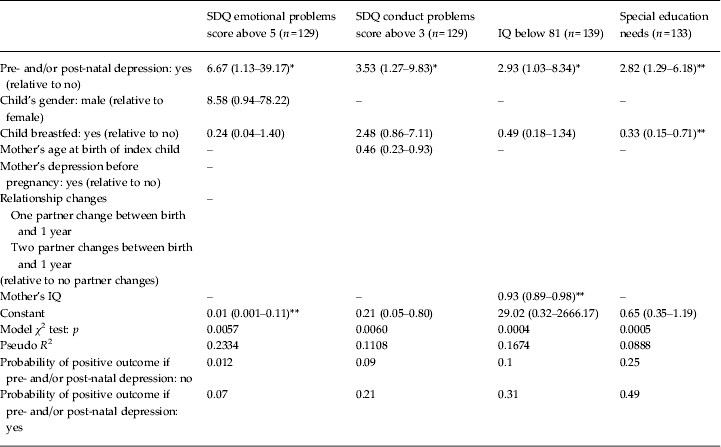
Results from the statistical analysis, including probabilities for the development of adverse child outcomes depending on whether or not the mother was depressed during and/or after pregnancy, are presented in Table 1. Perinatal depression, measured through the combined variable, was significantly associated with child emotional problems and whether a child was registered at school because of SEN. The significant effect we found on behavioural problems originated in depression during pregnancy whilst the child's cognitive impairment (measured as IQ below 81) was affected by postnatal depression. Perinatal depression in combination with breastfeeding predicted school performance. Because of the important link between mother's depression and breastfeeding we decided to reconstruct the relationship by linking the effect of perinatal depression on breastfeeding from the literature to the additional risk (from our study) of 10% that a child who had not been breastfed would leave school without qualifications. From a study by Henderson et al. (Reference Henderson, Evans, Straton, Priest and Hagan2003) we derived the additional probability of 2.5%. This was based on a reported overall risk for mothers to stop breastfeeding between the second and sixth months of 22% and a reported higher risk of 1.25 for depressed mothers compared with non-depressed mothers. Values for additional risks derived from differences in probabilities are shown in Table 2.
Results from statistical analysis using backward elimination logistic regression a

Data are given as odds ratio (95% confidence interval) unless otherwise indicated.
SDQ, Strengths and Difficulties Questionnaire; IQ, intelligence quotient.
a p value for retaining effect = 0.20, p value for addition to the model = 0.10; perinatal depression effect always retained.
* p < 0.05, ** p < 0.01.
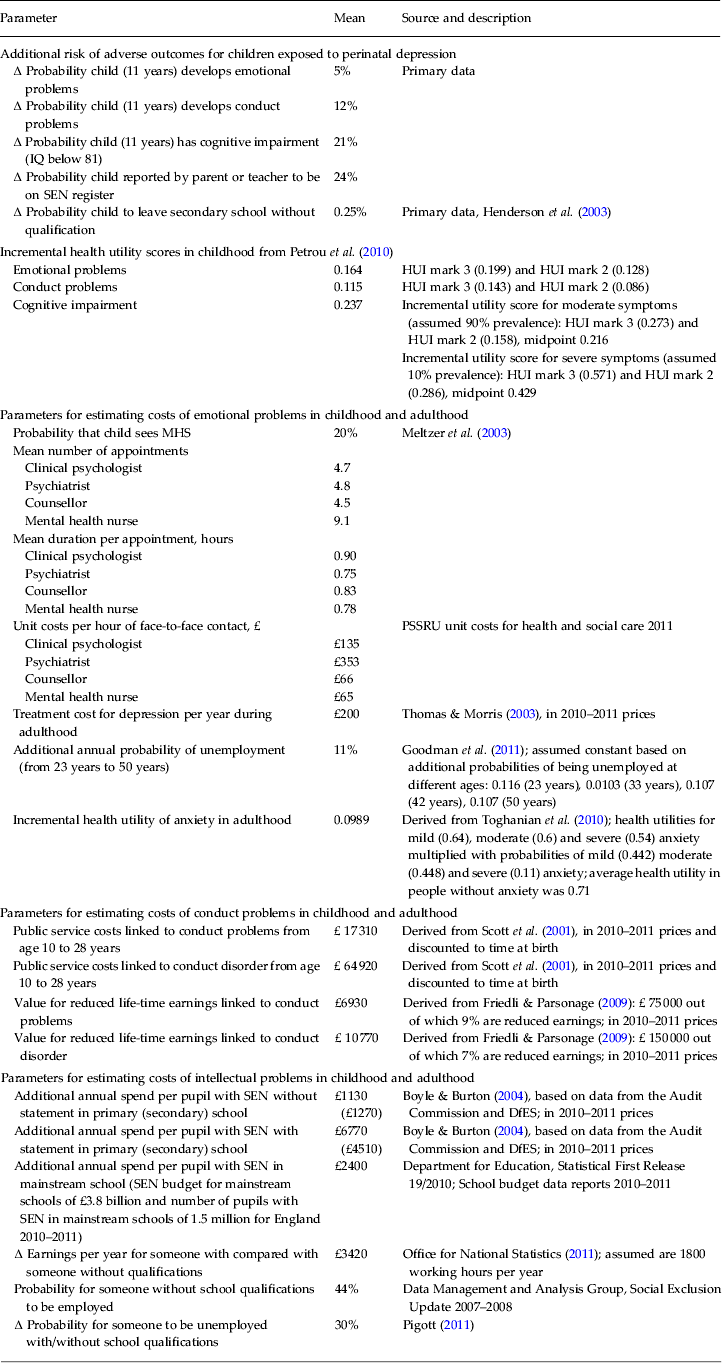
Parameters for estimating costs of emotional problems in childhood and adulthood

IQ, Intelligence quotient; SEN, special educational needs; HUI, Health Utility Index; MHS, mental health specialist; PSSRU, Personal Social Services Research Unit; DfES, Department for Education and Skills.
Costs linked to emotional problems
Parameters used for the analysis are shown in Table 2. The costs attributable to perinatal depression for treating emotional problems during adolescence and adulthood were £80 at the time of birth. The direct costs to the government for paying out-of-work benefits linked to a child's greater risk of unemployment were estimated at £180. Productivity losses linked to the additional risk of a person being unemployment were valued at £490. The value of HRQOL during childhood was estimated at £620 at the time of birth. HRQOL loss during adulthood was estimated at £630 so that the combined loss was valued at £1250.
Costs linked to behavioural problems
Parameters considered in the analysis are presented in Table 2. The public sector costs associated with the additional risk of a child developing conduct problems (including the risk of developing a disorder) were estimated at £1040. Costs from reduced earnings linked to perinatal depression were £890 at the time of birth and those from reduced HRQOL were £1040.
Costs linked to intellectual problems
For a child reported by their parents or teachers to be/have been on the SEN register (as shown by the binary variable we created) we found: the probability of being on the register during both primary and secondary school without a statement (stages 1 to 4) was 35% and the probability for the same length with a statement was 17%; the probability for being registered during primary school only and without a statement was 26% whilst it was 22% for being on the register (stages 1 to 4) during secondary school only. Children who had a statement appeared to have it for their whole school career so that there were zero probabilities for having a statement during primary or secondary school only. Costs for additional school support were estimated at £3030 if the data from Boyle & Burton (Reference Boyle and Burton2004) were applied and at £3320 when we applied school budget data. We included the lower value in the results. The productivity loss for someone leaving school without qualifications attributable to perinatal depression was £1400 and respective out-of-work payments amounted to £20 per child. HRQOL loss related to cognitive impairment during childhood was estimated at a value of £3760. The data informing these calculations are presented in Table 2.
Cost findings combined
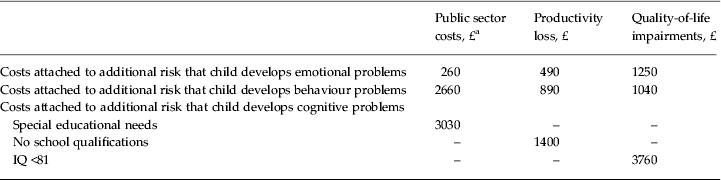
Findings on cost consequences per child exposed to perinatal depression linked to the three areas of child development are shown in Table 3. The costs for each area of child development could not be simply aggregated because some of the consequences overlapped; for example, the calculated reduced earnings for someone leaving school without qualifications overlapped with the productivity loss calculated from adverse emotional and behavioural outcomes. For each cost category (public sector, productivity, HRQOL) the highest value across the three child outcome areas can be interpreted as the cost minimum; that is, the costs that would occur if there were a complete overlap between the consequences. Following on from this, costs for public service spending were then at a minimum £3030; loss of earnings exceeded £1400 per child and quality-of-life impairments were valued at a minimum of £3760.
Costs per child exposed to perinatal depression, at 2010–2011 prices, discounted to time of birth

IQ, Intelligence quotient.
a Includes government payments for benefit claims.
Discussion
Summary
The aim of this research was to get a better understanding of the economic implications of perinatal depression through its effect on children. We used the South London Development Study to extract outcomes data for children (exposed; not exposed) at ages 11 and 16 years, and linked those to UK literature on economic consequences. We established the additional probabilities that children exposed to antenatal and/or postnatal depression develop negative outcomes in three areas of child development (emotional, behavioural and cognitive). Only considering a subset of the economic costs of adverse child development linked to mother's depression – because of data limitations – we find that the cumulative costs (discounted back to time of birth) are high, with public sector costs per case of perinatal depression of at least £3030 and a minimum economic value of £8190 if non-cashable productivity and quality-of-life losses are included.
Strengths and limitations
Our study explored some but not all of the economic consequences that are likely to be linked to perinatal depression and its effects on children. We calculated costs as they arise for the government in the form of expenditure for public services and welfare payments, and costs to the individual in the form of quality-of-life losses and productivity losses. With the exception of the welfare payments, these together are costs to society (welfare payments decrease government expenditure but increase individuals' income by the same amount, so that from a societal perspective they represent a zero-sum exchange).
These findings complement other evidence on early childhood factors and longer-term economic effects that can be potentially reduced if risk factors of perinatal depression are identified and addressed through prevention or treatment. It contributes to knowledge on the costs of a mental health condition that, although defined by a relatively short time-frame, can have particularly wide-ranging economic impacts. Decision-analytic modelling allowed us to draw on a broad range of epidemiological and economic datasets and include a wide range of economic consequences over a long time horizon.
Our study only explored a subset of economic consequences. Our approach of searching the literature for information about those was thorough, but we were not able to conduct a systematic review. We relied on data that provided information on reported emotional and behavioural problems at age 11 years, but this meant that we could not include treatment costs for earlier years, and these have been shown to be substantial for a small number of children with symptoms at the severe end of, for example, the antisocial behaviour spectrum (Romeo et al. Reference Romeo, Knapp and Scott2006). We did not include internalizing and externalizing outcome measures in our analysis because they are broader constructs that are often measured at a time when symptoms are not distinctively manifested.
A range of public sector costs and costs to individuals could not be included in the analysis because of the absence of evidence. For example, evidence from the USA indicates that by far the largest proportion (85%) of the cost of anxiety disorders is attributable to an excess use of health services (Kessler & Greenberg, Reference Kessler, Greenberg, Davis, Charney, Coyle and Nemeroff2002). Furthermore, a current lack of knowledge about disorder persistence, progression and regression of some mental illnesses into old age prevented us from projecting the economic consequences into old age. The analysis also did not include the knock-on effects and costs that accrue to other individuals (such as family members or the victims of crime).
A further limitation is that our estimates of additional probabilities were derived from a relatively small sample, with consequences for statistical significance.
Implications
Numerous studies have emphasized the need to focus on supporting mothers during the sensitive period around childbirth. Our work indicates that there could be not only health and wellbeing arguments but also economic arguments for action to prevent or treat perinatal depression. Earlier work that estimated the burden of postnatal depression on mothers themselves also demonstrated the benefits for investing in this area (Morrell et al. Reference Morrell, Warner, Slade, Dixon, Walters, Paley and Brugha2009; Bauer et al. Reference Bauer, Knapp, McDaid, Knapp, McDaid and Parsonage2011; Brugha et al. Reference Brugha, Morrell, Slade and Walters2011; Dagher et al. Reference Dagher, McGovern, Dowd and Lundberg2011). Although in this paper we do not evaluate interventions for mothers, our work is, as far as we are aware, the first to explore some of the economic consequences from a child's perspective. It provides further argument for policy makers and service providers to focus on planning an effective support infrastructure for new mothers and mothers-to-be.
Our findings only relate to higher-risk populations and further evidence is needed to understand a fuller set of economic consequences that relate to all groups of childbearing women. We know from previous research that the influence of other risk factors needs to be considered, such as whether or not children are breastfed and the nature of the mother–infant relationship, including child maltreatment or parent hostility (Danese et al. Reference Danese, Moffitt, Harrington, Milne, Polanczyk, Pariante, Poulton and Caspi2009; Barker et al. Reference Barker, Jaffee, Uher and Maughan2011; Pawlby et al. Reference Pawlby, Hay, Sharp, Waters and Pariante2011; Velders et al. Reference Velders, Dieleman, Henrichs, Jaddoe, Hofman, Verhulst, Hudziak and Tiemeier2011; Plant et al. Reference Plant, Barker, Waters, Pawlby and Pariante2013). There is an important role for studies that evaluate the (cost-)effectiveness of interventions that aim to reduce those predictors of adverse child outcomes such as perinatal depression, and for measures of long-term effects (for example, meta-analysis by Cuijpers et al. Reference Cuijpers, Brännmark and Straten van2008).
Acknowledgements
We are grateful to a number of people for comments and help over a long period, including Cheryll Adams, Jane Morrell, Madeleine Stevens, Eva Bonin, Nika Fuchkan and Pon-Hsiu Yeh. The work reported in this paper was partly supported by a National Institute of Aging grant (R01AG040640).
Declaration of Interest
None.