Introduction
The global prevalence of depression in the elderly ranges from 1.0% to 65.4% (Liu et al., Reference Liu1997; Tsai et al., Reference Tsai, Chung, Wong and Huang2005a; Reference Tsai, Yeh and Tsai2005b; Djernes, Reference Djernes2006; Fiske et al., Reference Fiske, Wetherell and Gatz2009) due to different assessment methods. However, depression is known to be a significant predictor of mortality among the elderly population (Fu et al., Reference Fu, Lee and Chen2003) and is the most important predictor of suicide among elders (Conwell and Thompson, Reference Conwell and Thompson2008). Early detection and appropriate treatment interventions for depressive symptoms in the elderly have become important issues for healthcare systems worldwide.
Depression in the elderly has been shown to be effectively treated by antidepressants, as well as psychotherapy alone and in combination with drug treatment (Lebowitz et al., Reference Lebowitz1997). Depressive symptoms in institutionalized Taiwanese elders have been relieved by light therapy (Tsai et al., Reference Tsai, Wong, Juang and Tsai2004b) and self-worth therapy (Tsai et al., Reference Tsai, Wong, Tsai and Ku2008). However, primary care doctors are still most familiar with treatments based on medication. Moreover, given the high occurrence of polypharmaceutical treatment and age-related changes in pharmacokinetics, the safety of drug therapy among the elderly remains questionable (Sumaya et al., Reference Sumaya, Rienzi, Deegan and Moss2001). Therefore, it is important to explore non-pharmacological therapies/strategies to treat depression or relieve depressive symptoms in the elderly.
One important non-pharmacological strategy is self-care, a learned behavior and a continuous action directed at meeting known needs (Orem, Reference Orem1985). According to Orem's Self-Care Theory, which is now an established nursing theory, humans are able to act deliberately to regulate life, health and well-being. When self-care demands exceed individual self-care capabilities, deficits occur and nursing interventions are needed. The ways that individuals meet self-care needs are influenced by personal and cultural elements (Orem, Reference Orem1985).
To date, self-care management strategies have been reported to decrease or relieve symptom distress among different patient populations, such as those with cancer (Borthwick et al., Reference Borthwick, Knowles, McNamara, Dea and Stroner2003), HIV/AIDS (Tsai et al., Reference Tsai, Hsiung and Holzemer2002; Eller et al., Reference Eller2005), and psychiatric illnesses (Tsai and Chen, Reference Tsai and Chen2006; Farhall et al., Reference Farhall, Greenwood and Jackson2007). Strategies to self-manage pain have been explored among elders living in institutions (Tsai et al., Reference Tsai, Tsai, Lai and Chu2004a) and the community (Tsai et al., Reference Tsai, Liu and Chung2010), as well as to self-manage depressive symptoms among institutionalized elders (Tsai, Reference Tsai2006). Because these strategies were reported by patients, they give healthcare providers a better understanding of the strategies that patients themselves have used to deal with symptoms and the effectiveness of these strategies. Such information can then be clinically verified for effectiveness and safety by healthcare providers to offer other patients more alternative self-care strategies (Tsai et al., Reference Tsai, Hsiung and Holzemer2002; Reference Tsai, Liu and Chung2010).
As in other developed countries, Taiwan's proportion of the population aged over 65 is increasing. This older population grew from 7.9% of the total population in 1994 to 10.4% at the end of 2008 (Department of Health, Executive Yuan, 2010). Unfortunately, few studies to date have focused on understanding self-care strategies to manage depressive symptoms among elders worldwide, whether institutionalized or living in the community. In addition, depression in community-dwelling Taiwanese elders has been shown to be significantly predicted by several factors such as age (Lu et al., Reference Lu, Liu and Yu1998), marital status, education level, chronic physical illness (Liu et al., Reference Liu1997), perception of poor health status, perceived income inadequacy, and respiratory disease (Tsai et al., Reference Tsai, Yeh and Tsai2005b). Among community-dwelling elders in the West, however, high risk for depressive symptoms was associated with being female, perceived income inadequacy (Miller et al., Reference Miller, Malmstrom, Joshi, Andresen, Morley and Wolinsky2004), not having a spouse (Weyerer et al., Reference Weyerer2008), poor perceived health status (Huang et al., Reference Huang, Zhang, Dong, Lu, Yue and Liu2010b), having had a stroke (Whyte et al., Reference Whyte, Mulsant, Vanderbilt, Dodge and Ganguli2004; Huang et al., Reference Huang, Dong, Lu, Yue and Liu2010a), cardiac disease, and chronic lung disease (Huang et al., Reference Huang, Dong, Lu, Yue and Liu2010a). These inconsistent results suggest that the relationships among depression, demographic characteristics, and chronic illness warrant further exploration. Therefore, the purpose of this study was to explore self-care management strategies and risk factors for depressive symptoms among elderly outpatients living in Taiwanese communities.
Methods
Sample and setting
This study was part of a larger research program that seeks to assess health-seeking behaviors among the community-dwelling elderly population in Taiwan. Participants were sampled by convenience from a medical center and a regional hospital randomly selected in northern Taiwan. Patients were recruited if they met the following inclusion criteria: (1) aged 65 years or above, (2) able to communicate, and (3) attending internal medicine clinics as outpatients at the selected hospitals. Of 1180 patients/clients who met the inclusion criteria, 125 refused to participate due to being too busy and one did not complete the questionnaire. Therefore, the final sample size was 1054. Data were collected from July to October 2008.
Measures
Depressive status was measured using the 15-item Geriatric Depression Scale-Short Form (GDS-S) (Burke et al., Reference Burke, Rocaforte and Wengel1991). Responses to items on the GDS-S can be “yes” or “no.” After revising the score for positive items, each item with a “yes” answer receives 1 point. Possible scores range from 0 to 15, with 5 as the cut-off point for a tendency to depression (Burke et al., Reference Burke, Rocaforte and Wengel1991). The Chinese version of the GDS-S has been used in different settings and has been shown to be a reliable and valid tool (Liu et al., Reference Liu1997).
Self-care management strategies for depressive symptoms were measured by self-report and semi-structured questionnaires. Participants were asked to freely describe three common self-management strategies to relieve depressive symptoms, to score each strategy's level of effectiveness on a scale from 0 (not effective) to 10 (extremely effective), and to indicate the information source of each strategy. The level of effectiveness was further categorized as not effective (score = 0), low (score = 1–3), moderate (score = 4–7), and high (score = 8–10). No suggestions or list of alternative strategies was presented to participants.
Sociodemographic information included participants’ demographic information (age, gender, education level, marital status, number of children), number of chronic diseases, perceived health status, and perceived income adequacy. Chronic diseases were obtained using a researcher-designed questionnaire. Perceived health status was rated by one question with responses from 1 (extremely bad) to 5 (extremely good). Perceived income adequacy was rated by another question with responses from 1 (extremely inadequate) to 4 (extremely adequate and can save money).
Procedures
Each selected hospital was approached individually. After the hospitals’ institutional review boards approved the study, two research assistants (RAs) approached elderly outpatients sitting in the waiting areas of internal medicine clinics. After describing the study, screening for the inclusion criteria, and obtaining written consent to participate, the RAs read the questionnaire items to each participant and recorded their answers. Both RAs were experienced nurses who had studied geriatrics for several years.
Analysis
SPSS for Windows, version 15.0 was used to analyze quantitative data. Mean, standard deviations, t-test, χ2, one-way ANOVA, Scheffe test, and logistic regression analysis were used. Content analysis (Miles and Huberman, Reference Miles and Huberman1994) was used to categorize all self-care strategies. Usage frequencies (percentage) were also computed for each strategy.
Results
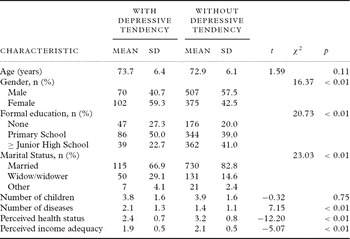
In this sample of 1054 elderly outpatients, 172 scored ≥ 5 on the GDS-S, giving a 16.3% prevalence of depressive tendency. Participants with and without depressive tendency were found to differ significantly in six demographic characteristics (Table 1). In general, more elders with a depressive tendency were female, had a low education level, were widows/widowers, had chronic diseases, perceived that their health condition was poor, and perceived that their income was inadequate.
Demographic characteristics of elderly outpatients with (n = 172) and without (n = 882) depressive tendency

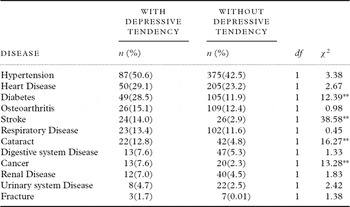
For this sample of elderly outpatients, chronic diseases are shown in Table 2. Elders with and without depressive tendencies differed significantly in the prevalence of four chronic diseases: diabetes, stroke, cataract, and cancer. The prevalence rates of these diseases were higher in elders with depressive tendency than in those without.
Diseases in elderly outpatients with (n = 172) and without (n = 882) depressive tendency

**p < 0.01, *p < 0.05.
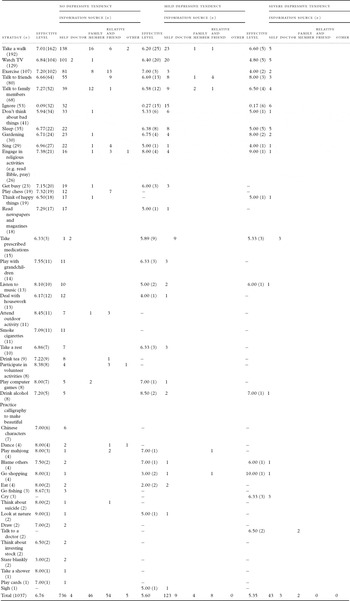
To explore differences in self-care strategies by depressive tendency, we categorized participants into three groups: no depressive tendency (GDS-S score = 0–4), mild depressive tendency (GDS-S score = 5–10), and severe depressive tendency (GDS-S score = 11–15). The self-care strategies used by participants to manage depressive symptoms and sources of this information are shown in Table 3. The majority of participants (70.1%) used self-care strategies to manage depressive symptoms and these strategies were quite varied. The specific self-care strategy most often used to relieve depressive symptoms was taking a walk. These management strategies had an average score for level of effectiveness of 6.40 (SD = 2.19), indicating moderate effectiveness. The main information source for these management strategies was the participant himself/herself.
Strategies used by elderly outpatients to self-manage depressive symptoms

Comparison of the three depressive status groups showed that they differed significantly by number of self-management strategies (F = 4.32, df = 2, p = 0.01) and average effectiveness level (F = 18.51, df = 2, p<0.01). Post hoc analysis indicated that elders with severe depressive tendency used significantly more self-management strategies (M = 1.33, SD = 0.83 vs. M = 0.96, SD = 0.83; p = 0.03) than elders with no depressive tendency. Moreover, elders with mild and severe depressive tendency reported significantly lower effectiveness levels (M = 5.60, SD = 2.51 vs. M = 6.76, SD = 1.88; p < 0.01 and M = 5.35, SD = 2.72 vs. M = 6.76, SD = 1.88; p < 0.01, respectively) for these strategies than elders with no depressive tendency.
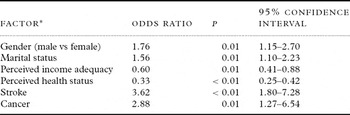
The risk factors for depressive symptoms were explored by logistic regression analysis. Results showed that depressive tendency in elderly Taiwanese outpatients was significantly predicted by gender, marital status, perceived income adequacy, perceived health condition, stroke, and cancer (Table 4).
Risk factors predictive of depressive tendency in elderly outpatients

* Independent variables were gender, formal education, marital status, number of diseases, perceived health status, perceived income adequacy, diabetes, stroke, cataract, and cancer
Discussion
This is the first study to explore self-care strategies to manage depressive symptoms in a large-scale study of elderly outpatients in Taiwan. These elders clearly used some self-management strategies (e.g. practicing calligraphy, playing mahjong) that would be different from those chosen by elders in Western cultures. Nonetheless, teaching elderly people how to self-manage depressive symptoms is an important task, especially since Taiwanese physicians are commonly concerned about drug interactions with antidepressants in elders (e.g. Lee et al., Reference Lee, Yang and Tsai2004), which may result in hesitation in prescribing antidepressants.
The prevalence of depressive symptoms in this sample of elderly outpatients (16.3%) was lower than that previously found among community-dwelling elders (26–37.7%) (Liu et al., Reference Liu1997; Tsai et al., Reference Tsai, Yeh and Tsai2005b) and elderly nursing home residents (43.3–55%) (Tsai et al., Reference Tsai, Chung, Wong and Huang2005a; Tsai, Reference Tsai2006) in Taiwan. The difference between the prevalence rates in our study and in previous studies on Taiwanese community-dwelling elders is likely to be due to the use of different sampling strategies (Tsai et al., Reference Tsai, Yeh and Tsai2005b). Another reason for the different prevalence rates might be that all of our participants were able to visit their clinic whereas other studies might have included elders who were housebound (Liu et al., Reference Liu1997; Tsai et al., Reference Tsai, Yeh and Tsai2005b). Moreover, the lower prevalence of depressive tendency in our sample of elderly outpatients compared to institutionalized elders in Taiwan is consistent with the Western literature on depressive tendency in these two elderly populations (Djernes, Reference Djernes2006).
Even though only 16.3% of our elders were identified by the GDS-S as having a depressive tendency, the majority of elders (70.1%) reported having used self-care strategies to manage depressive symptoms. Based on our clinical experience, elderly people commonly express feeling down or blue. Therefore, we asked them to share their three commonly used self-care strategies to deal with this feeling. In fact, most participants had used some self-care strategies to deal with this feeling regardless of their present depressive status. Of 43 self-care management strategies that participants identified, the most commonly used strategy was “taking a walk,” which was similar to that used by elderly Taiwanese nursing home residents in an earlier study (Tsai, Reference Tsai2006). However, those elderly nursing home residents identified only 25 self-care management strategies to manage depressive symptoms (Tsai, Reference Tsai2006). This difference might be explained by the nursing home residents having a highly structured daily schedule in the institution, which limited their ability to engage in self-chosen activities in the same way as their community-dwelling peers. Another possible explanation is that 200 elders (Tsai, Reference Tsai2006) are likely to provide fewer strategies than the 1054 elders in the current study. Further studies are needed to explore self-care strategies for depressive symptoms in these two populations.
No studies could be found on elderly adults’ self-care strategies for depressive symptoms, but one US study of people living with HIV disease found that the most frequently used self-care strategy was “practicing complementary/alternative therapies,” such as praying and meditating (Eller et al., Reference Eller2005). This strategy was reported to be “helpful” in managing depressive symptoms (Eller et al., Reference Eller2005). In our study, only 26 elders used complementary therapies to self-manage depressive symptoms but it was rated as one of the most effective strategies by elders with depressive tendency. Since few participants used this category, further studies are needed to explore the effect of complementary therapies on Taiwanese elders with depressive tendency.
About one-fifth of participants with mild (19.9%) and 5.6% with severe depressive tendency did not report any self-care strategies to deal with their depressive symptoms. Among those who used self-care strategies, elders with severe depressive tendency tended to use significantly more self-management strategies and reported a lower level of effectiveness for these strategies than elders with no depressive tendency. These data suggest that these elders had limited knowledge about self-managing their depressive symptoms. Further efforts should be directed toward screening elderly outpatients for depressive symptoms and offering educational interventions to reduce the morbidity and mortality associated with depression.
Among the 40 self-care management strategies used by elders with no depressive tendency to control depressive symptoms, those rated as highly effective (mean level ≥ 8) were those related to nature, fishing, attending outdoor activities, participating in volunteer activities, listening to music, playing computer games, dancing, playing mahjong, shopping, eating, and taking a shower. However, only “attending outdoor activities” was identified by several participants (n ≥ 10). Among the 26 self-care management strategies used by elders with mild depressive tendency to control depressive symptoms, those rated as highly effective (mean level ≥ 8) were drinking alcohol and engaging in religious activities, but both strategies were identified by fewer than five participants. Among the 19 self-care management strategies used by elders with severe depressive tendency to control depressive symptoms, those rated as highly effective (mean level ≥ 8) were shopping, engaging in religious activities, talking to friends, and gardening, but these four strategies were identified by few participants. Interestingly, the highly effective self-care strategies identified by the three groups were quite different. However, the strategies identified by the no depressive tendency group tended to require participants’ active engagement, whereas the strategies identified by the other groups seemed to be passive. Since no previous studies have explored self-care strategies by depressive status, we cannot make any comparisons and further studies are needed to explore this issue. The effectiveness and safety of this study's most effective self-care management strategies should be clinically verified in a larger sample. Based on the results, healthcare providers could then offer alternative strategies to their elderly patients for managing depressive symptoms.
The majority of the participants in this study reported that the main source of their management strategies came from self-learning. They also received advice about self-care management strategies for depressive symptoms from relatives and friends, physicians, and volunteers. These data suggest that these elders have great potential for self-care. Self-learning has also been shown to be the major source of self-care symptom-management strategies among Taiwanese patients with schizophrenia (Tsai and Chen, Reference Tsai and Chen2006), with HIV/AIDS (Tsai et al., Reference Tsai, Hsiung and Holzemer2002), in elderly patients with pain (Tsai et al., Reference Tsai, Tsai, Lai and Chu2004a; Tsai et al., Reference Tsai, Liu and Chung2010) and with depression (Tsai, Reference Tsai2006). Interestingly, few elders in our sample identified physicians and none identified nurses as the source of self-care strategies, which supports the findings of a previous study of elderly Taiwanese nursing home residents (Tsai, Reference Tsai2006). This may reflect that fact that few elderly patients in Taiwan are screened for depression and receive interventions during their internal medicine clinic visits. More studies are needed to explore this issue.
In this sample of older adults, depressive tendency was associated with gender, formal education, marital status, number of diseases, perceived health status, perceived income adequacy, diabetes, stroke, cataract and cancer, in partial agreement with the literature (Djernes, Reference Djernes2006; Fiske et al., Reference Fiske, Wetherell and Gatz2009; Huang et al., Reference Huang, Dong, Lu, Yue and Liu2010a). In our sample, depressive tendency was significantly predicted only by gender, marital status, perceived income adequacy, perceived health condition, stroke, and cancer. In the Western literature, elders at high risk for depressive tendency have been shown to be female (Miller et al., 2014), without a spouse (Weyerer et al., Reference Weyerer2008), with perceived income inadequacy (Miller et al., 2014), perceived poor health status (Huang et al., Reference Huang, Zhang, Dong, Lu, Yue and Liu2010b), and have had a stroke (Whyte et al., Reference Whyte, Mulsant, Vanderbilt, Dodge and Ganguli2004). However, our finding that having cancer predicted elders’ depressive tendency was not supported by a meta-analysis of studies on chronic diseases as risk factors for depression in old age (Huang et al., Reference Huang, Dong, Lu, Yue and Liu2010a).
The present study's findings differ in some respects from those of another large-scale study of community-dwelling elderly adults in Taiwan (Tsai et al., Reference Tsai, Yeh and Tsai2005b). That study found that depressive tendency was significantly predicted not only by perception of poor health status and income inadequacy, but also by having a respiratory disease, poor cognitive function, poor social support network, and dissatisfaction with living situation (Tsai et al., Reference Tsai, Yeh and Tsai2005b). This difference may be explained by different sampling methods (convenience sampling vs. stratified random sampling). Since both studies identified perception of poor health status and income inadequacy as risk factors, these factors should be emphasized in future interventions for community-dwelling elders with depressive tendency in Taiwan.
The currently available evidence indicates that the relationship between perceived health and depressive status is complex but important (Huang et al., Reference Huang, Zhang, Dong, Lu, Yue and Liu2010b). To decrease/prevent this risk factor for depressive tendency, healthcare providers must not only promote the physical health of elders in Taiwan, but also improve their perceived health. To decrease/prevent the perception of income inadequacy, healthcare providers need to assess the financial problems of elderly patients in clinics. Elders who need help should be referred to social workers for further assistance.
Limitations
This study did not assess participants for depressive disorders, nor was information recorded about antidepressant use. Therefore, our findings cannot be generalized to elderly outpatients diagnosed with depression. In addition, participants who were taking antidepressants might have decreased our sample's depressive tendency. Researchers who wish to replicate this study may want to consider assessing for depressive disorders and recording antidepressant use.
Conclusions
Our findings reveal that these elderly outpatients had limited knowledge about self-managing their depressive symptoms. Increasing elders’ knowledge about managing depressive symptoms is important to reduce the morbidity and mortality associated with untreated depression. In addition, the effectiveness and safety of this study's most effective self-care management strategies should be clinically verified in a larger sample. Based on the results, healthcare providers could then offer alternative strategies to their elderly patients for managing depressive symptoms. Finally, to decrease/prevent the depressive risk factor of poor perceived health status, healthcare providers could seek to promote/improve both the actual and perceived health of elderly outpatients in Taiwan. To decrease/prevent the risk factor of income inadequacy, healthcare providers could carefully assess financial problems in the clinic and provide suitable referral for further assistance.
Conflict of interest
None.
Description of authors' roles
Y-F. Tsai designed the study, supervised the data collection, performed data analyses and wrote the paper. L.L. Liu, H.H. Tsai and S.C. Chung assisted with collecting and analyzing the data, and writing the paper.