INTRODUCTION
Inflammation is associated with many of the leading causes of death, including heart disease, cancer, stroke, diabetes, and Alzheimer’s disease (Glass, Saijo, Winner, Marchetto, & Gage, Reference Glass, Saijo, Winner, Marchetto and Gage2010). Inflammation is also associated with neurocognitive dysfunction (Krabbe, Pedersen, & Bruunsgaard, Reference Krabbe, Pedersen and Bruunsgaard2004; Marsland et al., Reference Marsland, Petersen, Sathanoori, Muldoon, Neumann, Ryan and Manuck2006; Teunissen et al., Reference Teunissen, van Boxtel, Bosma, Bosmans, Delanghe, De Bruijn and de Vente2003). Novel anti-inflammatory therapies are currently being tested and used in individuals with chronic inflammatory conditions (Canvin & el-Gabalawy, Reference Canvin and el-Gabalawy1999; Gorelick, Reference Gorelick2010; Marchetti & Abbracchio, Reference Marchetti and Abbracchio2005; Raber et al., Reference Raber, Sorg, Horn, Yu, Koob, Campbell and Bloom1998). In line with this notion, researchers have begun to explore the use of marijuana in the reduction of inflammatory processes (Albayram et al., Reference Albayram, Alferink, Pitsch, Piyanova, Neitzert, Poppensieker and Bilkei-Gorzo2011; Cabral & Griffin-Thomas, Reference Cabral and Griffin-Thomas2009; Jackson, Diemel, Pryce, & Baker, Reference Jackson, Diemel, Pryce and Baker2005). One of the major outcomes for inflammation is neurocognitive performance (Glass et al., Reference Glass, Saijo, Winner, Marchetto and Gage2010; Gorelick, Reference Gorelick2010); however, no study has examined the potential effects of marijuana use on this relationship in human samples. Given the potential anti-inflammatory properties of marijuana and the fact that it is the most prevalent illicit drug used in the United States (NIDA, 2012), it is imperative to examine the concomitant effects of markers of inflammation and marijuana use on neurocognitive performance.
The relationship between inflammation and neurocognition is well documented in older individuals (Jordanova, Stewart, Davies, Sherwood, & Prince, Reference Jordanova, Stewart, Davies, Sherwood and Prince2007; Marioni et al., Reference Marioni, Deary, Murray, Lowe, Strachan, Luciano and Price2011; Rafnsson et al., Reference Rafnsson, Deary, Smith, Whiteman, Rumley, Lowe and Fowkes2007; Sartori, Vance, Slater, & Crowe, Reference Sartori, Vance, Slater and Crowe2012; Wilson, Cohen, & Pieper, Reference Wilson, Cohen and Pieper2003). One marker frequently examined in older adults is Interleukin-6 (IL-6). IL6 is a proinflammatory cytokine produced by macrophages and activated lymphocytes in the immune system; and as such, is an indicator for inflammatory processes in the nervous system (Raber et al., Reference Raber, Sorg, Horn, Yu, Koob, Campbell and Bloom1998). Higher serum IL-6 levels reflect increases in inflammatory processes, which when chronic can cause damage to various locations within the central nervous system and neurocognitive impairment. However, to our knowledge, only one other study has reported the association between IL-6 and neurocognition in middle-aged adults (Marsland et al., Reference Marsland, Petersen, Sathanoori, Muldoon, Neumann, Ryan and Manuck2006). Marsland et al. (Reference Marsland, Petersen, Sathanoori, Muldoon, Neumann, Ryan and Manuck2006) found IL-6 to be related to poorer performance on multiple measures of memory and executive function in a predominantly non-Hispanic White sample. Very few studies examining the relationship between inflammation and neurocognition present or adjust for possible racial/ethnic variation within the sample. It is critical to included minorities, such as African Americans, given that they are predisposed to high life stress and inflammation-mediated vascular disease (Black, Reference Black2003; McDade, Hawkley, & Cacioppo, Reference McDade, Hawkley and Cacioppo2006).
There is also growing literature examining the relationship between chronic marijuana use and neurocognitive performance (Block & Ghoneim, Reference Block and Ghoneim1993; Gonzalez, Reference Gonzalez2007; Grant, Gonzalez, Carey, Natarajan, & Wolfson, Reference Grant, Gonzalez, Carey, Natarajan and Wolfson2003; Grant, Chamberlain, Schreiber, & Odlaug, Reference Grant, Chamberlain, Schreiber and Odlaug2012; Pattij, Wiskerke, & Schoffelmeer, Reference Pattij, Wiskerke and Schoffelmeer2008; Weckowicz & Janssen, Reference Weckowicz and Janssen1973). This body of research has suggested that chronic marijuana use is associated with poorer neurocognitive outcomes, such as attention and concentration (Solowij, 1995) as well as executive function (Bolla, Brown, Eldreth, Tate, & Cadet, Reference Bolla, Brown, Eldreth, Tate and Cadet2002; Curran, Brignell, Fletcher, Middleton, & Henry, Reference Curran, Brignell, Fletcher, Middleton and Henry2002). Moreover, prenatal exposure to marijuana use can have a subsequent deleterious effect on learning, memory and impulsivity 10 years after exposure (Richardson, Ryan, Willford, Day, & Goldschmidt, Reference Richardson, Ryan, Willford, Day and Goldschmidt2002). Overall, long-term marijuana users exhibit poorer performance on various neuropsychological domains (Crean, Crane, & Mason, Reference Crean, Crane and Mason2011).
Chronic marijuana use induces anti-inflammatory processes, including the inhibition of macrophage function and natural killer cells (Baldwin et al., Reference Baldwin, Tashkin, Buckley, Park, Dubinett and Roth1997; Chang, Lee, & Lin, Reference Chang, Lee and Lin2001; Klein, Reference Klein2005; Klein, Friedman, & Specter, Reference Klein, Friedman and Specter1998). Given that macrophages produce proinflammatory cytokines, it is plausible that the inhibition of these cells due to chronic marijuana use decreases proinflammatory cytokines production, including IL-6. For example, as previously reported by Keen, Pereira, & Latimer (Reference Keen, Pereira and Latimer2014), participants who report lifetime marijuana use absent any other illicit drug use have significantly lower levels of IL-6 than their lifetime non-drug using counterparts. Moreover, this study found no significant difference between those who reported lifetime marijuana in addition to other illicit drugs when compared to lifetime non-drug users or when compared to lifetime marijuana only users.
Previous studies have identified a non-psychoactive constituent of marijuana, cannabidol, as an anti-inflammatory influence in humans (Durst et al., Reference Durst, Danenberg, Gallily, Mechoulam, Meir, Grad and Lotan2007). Agonists of the cannabinoid receptors, like cannabidol, induce apoptosis, suppress cell proliferation, inhibit pro-inflammatory cytokine production, increase anti-inflammatory cytokine production, and induce regulatory T-cells (Rom & Persidsky, Reference Rom and Persidsky2013). However, there seems to be some inconsistency in reported findings of cannabidol driving the anti-inflammatory influence, as some have found an upregulation of IL-6 (Monnet-Tschudi et al., Reference Monnet-Tschudi, Hazekamp, Perret, Zurich, Mangin, Giroud and Honegger2008). This inconsistency could be due to the different physiological locations from which the cells are extracted and examined, or it could be the differential effects of the two major constituents in marijuana, the psychoactive constituent of THC and the non-psychoactive cannabidiol (Kozela et al., Reference Kozela, Pietr, Juknat, Rimmerman, Levy and Vogel2010).
Researchers have begun to explore the potential therapeutic effects of marijuana (or its constituents) use in inflammation-based diseases (Baker, Pryce, Giovannoni, & Thompson, Reference Baker, Pryce, Giovannoni and Thompson2003; Greineisen & Turner, Reference Greineisen and Turner2010; Killestein, Uitdehaag, & Polman, Reference Killestein, Uitdehaag and Polman2004). However, using marijuana use as a potential mitigating factor on the relationship between inflammatory processes and neurocognitive performance has not been explored. Identifying the effects of lifetime recreational marijuana use on the relationship between markers of inflammation and neurocognitive performance may be informative to not only those who are diagnosed inflammatory based diseases, but even individuals who are middle to elderly age. This subset of individuals may not be diagnosed with an inflammatory disease, but may not be classified as healthy either. The main goal of the present study was to test whether self-reported lifetime marijuana use moderates the relationship between IL-6 and neurocognitive function. We expect inverse associations between IL-6 and neurocognitive performance. Specifically, increases in IL-6 levels will be associated with poorer neurocognitive performance. Furthermore, based on previous research examining the influence of chronic marijuana use on cytokine function, we tested the hypothesis that self-reported lifetime marijuana use would moderate the relationship between IL-6 and neurocognitive performance. Specifically, those who reported marijuana use in their lifetime will have lower serum levels of IL-6 and thus better neurocognitive performance than their non-marijuana using counterparts.
METHOD
Participants
Study participants included 161 African-American adults, 50.3% women, recruited at Minority Organ Tissue Transplant Education Program health fairs in the Washington, DC metropolitan area for the parent study entitled, “Stress and Psychoneuroimmunological Factors in Renal Health and Disease.” This study consistently received annual approval from the Howard University Institutional Review Board and was conducted in accordance with the Helsinki Declaration. Inclusion criteria for the parent study included individuals who were 18 years of age and older, with no history of traumatic brain injury or psychiatric diagnosis. A total of 212 participated in the parent study, but only those with complete data for IL-6, lifetime marijuana use, neurocognitive variables, and no self-reported pathology (e.g., hypertension, diabetes) were used in the current study.
Procedures
Study procedures entailed one study visit lasting approximately four hours. Upon entering the Howard University Hospital General Clinical Research Center, researchers obtained informed consent from the participants. After informed consent was received, a registered nurse obtained a peripheral venous blood sample and the first of three blood pressure readings. Following these collections, study participants underwent simultaneous testing of neuropsychological function and heart rate variability, provided a second blood pressure reading, completed a battery of psychological instruments, and provided a final blood pressure reading. Participation was voluntary and participants were remunerated $50 for their time.
Interleukin-6
A venous blood sample of approximately 2 mL was collected from each participant. Samples were centrifuged for 30 min, aliquoted into six vials, and stored at −70 degrees Celsius at the Howard University General Clinical Research Center until sent to Quest Diagnostics for analyses. Serum interleukin−6 (IL-6) concentrations (pg/mL) were quantified using enzyme-linked immunosorbent assay.
Lifetime Marijuana Use and Substance Dependence
As a part of the demographic and medical history questionnaire, the questions “Have you ever used an illicit drug or narcotic?” and the follow up question “Have you ever used (insert drug type here; e.g., “marijuana”)?” were used to collect illicit drug use data. Response choices were “yes” or “no” and groups were created to compare lifetime non-marijuana users and lifetime marijuana only users. The responses were then dummy coded, “yes” was coded as “1”, “no” was coded as “0”. This questionnaire also included the questions “Have you had a problem with any drug dependence?” and “Have you ever had a problem with alcohol dependence?”. Response choices were “yes” or “no” and groups were created to compare lifetime non-marijuana users and lifetime marijuana only users. It should be noted that there were missing data for the drug dependence question and five for the alcohol dependence question.
Neurocognitive Measures
Wisconsin Card Sorting Test
The Wisconsin Card Sorting Test (WCST) is a 128-item test of set shifting, a measure of executive function, during which examinees receive feedback about whether or not their responses are correct (Berg, Reference Berg1948; Grant & Berg, Reference Grant and Berg1948). The computerized version of this test (Heaton & PARStaff, Reference Heaton2003) was used in the current study. For purposes of the current study, the total number of completed categories and perseverative errors (total number of items for which the participant continued to respond to a stimulus that was incorrect) were used as measures of set shifting and conceptual ability.
Stroop Color and Word Test
The Stroop Word/Color Test (Golden, Reference Golden1978) is designed to test facets of executive function, primarily inhibition. The task has three trials. In the first trial participants are asked to read names of colors (red, green, blue, and yellow) written in black ink on a white page down each column aloud, as quickly and accurately as possible in 45 s. The second trial requires the participant to name the color of XXXXs printed in colored ink (red, green, blue, and yellow) down the column aloud as quickly and accurately as possible in the time given. In the third and final trial, the participant is asked to name the color of the ink the word is printed in, ignoring the word that is printed (ex. the word Red written in green ink) also down the column aloud as quickly and accurately as possible in 45 s. The first two trials require the participants’ use of attention. The third trial, the Color/Word portion of the task requires the participant to inhibit the response of reading the word for the more appropriate response of naming the color.
Trail Making Test
The Trail Making test, which is broken down into two parts, is a timed assessment of visuospatial tracking and cognitive flexibility (Reitan, Reference Reitan1958). Participants are instructed to connect, sequentially, a series of numbers that appear in a scattered manner on a sheet of paper. If the participant makes an error, the examiner must immediately direct the participant to back to the point of the error and instruct the participant to continue. Trail Making Test A (TMT-A) consists of encircled numbers from 1 to 25, randomly spread across a sheet of paper. The participant is to connect the numbers in ascending order as quickly as possible, without lifting their pen from the paper. Trail Making Test B (TMT-B) is more complex than A as it requires the participant to connect numbers and letters in an alternating pattern as quickly as possible, without lifting the pen from the paper (Reitan, Reference Reitan1958). Part A requires the participant to use visual tracking and planning, while Part B requires more thought processing, attention on behalf of the participant, and shifts in organization.
Symbol Digit Modalities Test
The Symbol Digit Modalities Test (SDMT; Smith, Reference Smith1982) is an assessment of psychomotor speed and attention. The SDMT is a substitution task. Using a reference key, the participant has ninety seconds to pair given numbers with a list of geometric figures. These substitutions assess the speed with which the participants scan between the key and the test to find the correct substitution (psychomotor speed) and how well they pay attention to which symbol corresponds with which number.
Assessment of Covariates
Age (in years), sex, years of education, and annual income were collected via a demographic questionnaire administered by a trained researcher. Age, and years of education were used as continuous variables. On the demographic questionnaire, Income was scaled as less than $20,000, $20,000 through $40,000, and greater than $40,000. Income levels were dummy coded with values ranging from zero to two, with zero representing the lowest value and two representing the highest value. Lastly, sex was dummy coded as zero for women and one for men.
Statistical Analyses
Data were analyzed using the Statistical Package for Social Sciences, Version 20.0 (SPSS Inc.). IL-6 levels were negatively skewed, so values were log transformed before analyses. To test the hypothesis that self-reported lifetime marijuana usage affects the strength of the association between IL-6 and neurocognitive performance we used several moderation analyses separately for each of the neurocognitive measures. We used the ModProbe computation procedures for probing interactions provided by Hayes and Matthes (Reference Hayes and Matthes2009). The ModProbe macro produces the basic regression output, as well as estimates of the effect of the focal predictor variables (i.e., IL-6) at values of the moderator variable (i.e., self-reported lifetime marijuana use). Specifically, we estimated ordinary least squares regression models with each of the neurocognitive measures as outcome variables, IL-6 as the focal predictor (F) and self-reported lifetime marijuana use as the moderator (M) and the interaction (F×M). To rule out the possibility that the associations between IL-6 and neurocognitive measures are confounded by chronological age, gender and education, we statistically adjusted for these demographic variables in all moderation analyses. All variables were standardized before using the ModProbe. All predictors and covariates were treated simultaneously in the regression models. The ModProbe calculates the squared multiple correlation coefficient for the full model that includes the interaction term and additionally the proportion of the variance in the outcome uniquely attributable to the interaction.
To visualize statistically significant interactions, the MODPROBE macro produces the conditional effects for the main predictor (i.e., IL-6) and moderator (lifetime marijuana use). The IL-6 will be dichotomized into “high” and “low” values based on values above and below the median, respectively.
RESULTS
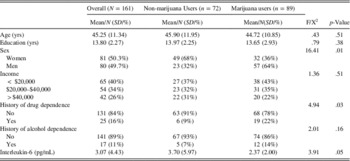
Means, standard deviations, and frequencies for all demographic, IL-6, and lifetime marijuana use variables are shown in Table 1. Comparisons between lifetime marijuana users and lifetime non-marijuana users are also presented in Table 1. The non-marijuana users were mostly women (68%), compared to the marijuana users who were mostly men (65%). Marijuana users had more individuals with a history of drug dependence (22%) than their non-using counterparts (9%). Non-marijuana users had higher levels of IL-6 (M=3.70; SD=5.97) than their marijuana using counterparts (M=2.37; SD=2.00). No other differences were found among the demographic or drug use history variables.
Subject characteristics

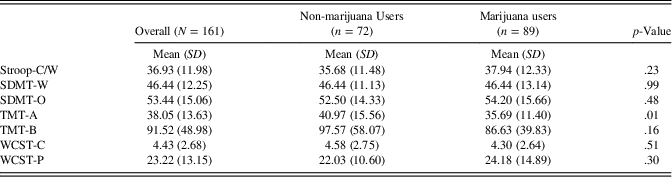
The range, mean, standard deviations for the neurocognitive tasks are presented in Table 2. When comparing lifetime marijuana users to lifetime non-marijuana users in neurocognitive performance, the two groups only differed on the TMT-A. More information on other contrasts can be seen in Table 2.
Neurocognitive task means

Note. Stroop-C/W=Stroop Color/Word Trial; SDMT-W=Symbol Digit Modalities Test Written Trial; SDMT-O=Symbol Digit Modalities Test Oral Trial; TMT-A=Trail Making Test A; TMT-B=Trail Making Test B; WCST-C=Wisconsin Card Sorting Task Number Completed Categories; WCST-P=Wisconsin Card Sorting Task Perseverative Errors.
Zero-Order Correlations Among Neurocognitive Performance, Interleukin−6 Levels, and Lifetime Marijuana Use
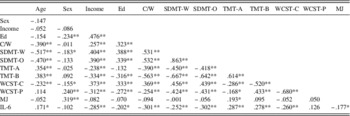
Higher IL-6 was associated with poorer performance on both Trail Making A (r=.287; p=.001) and Trail Making B (r=.278; p=.001) tests (Table 3). Moreover, higher IL-6 levels were associated with the poorer performance on the Stroop Color Word Trial (r=−.301; p=.001), Symbol Digit Modalities Test Written trial (r=−.252; p=.001), Oral trial (r=−.302; p=.001), and the total correct responses of the Wisconsin Card Sorting Task (r=−.260; p=.001). Lifetime marijuana use was associated with poorer performance on the Trail Making Test A (r=.193; p=.022) and IL-6 (r=.177; p=.046). These results can be found in Table 3.
Zero-order correlations

Note. *<.05; **<.01; Ed=years of education; C/W=Stroop Color Word Trial Raw Scores; SDMT-W=Symbol Digit Modalities Test Written Trial; SDMT-O=Symbol Digit Modalities Test Oral Trial; TMT-A=Trail Making Test Trial A; TMT-B=Trail Making Test Trial B; WCST-C=Wisconsin Card Sorting Task Categories Completed; WCST-P=Wisconsin Card Sorting Task Perseverative Errors; MJ=lifetime marijuana; IL-6=interleukin-6.
Executive Function Task Performance Regressed on Covariates, Interleukin−6, Lifetime Marijuana Use, and Interaction Term
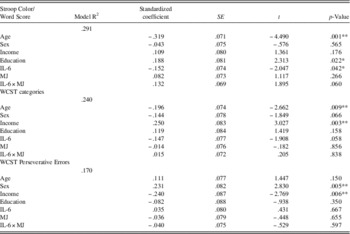
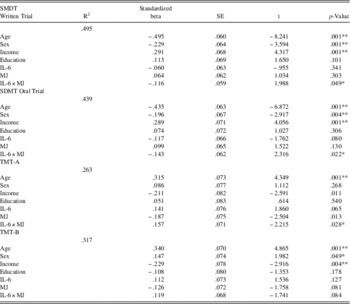
As seen in Table 4, IL-6 was only significantly associated with Stroop Color Word Trial performance (B=−.152, standard error [SE]=.074; p=.042). The interaction between IL-6 and lifetime marijuana use was not significantly associated with the Stroop Color Word score (B=.132; SE=.069; p=.060), WCST Categories (B=.015; SE=.072; p=.838), and the WCST Perseverative Errors (B=−.040; SE=.075; p=.597). The amount of variance increase accounted for by the IL-6 and lifetime marijuana use interaction term was approximately 2% for the Stroop Color Word trial (R2=.016), 0% for the WCST Categories (R2=.000), and 0% for the WCST Perseverative Errors (R2=.001).
Ordinary least squares regression: Interleukin-6 and lifetime marijuana use predicting Stroop Color/Word Trial Scores, Wisconsin Card Sorting Task Perseverative Error Scores, and Categories Completed

Note. *<.05; **<.01; Ed=years of education; C/W=Stroop Color Word Trial Raw Scores; SDMT-W=Symbol Digit Modalities Test Written Trial; SDMT-O=Symbol Digit Modalities Test Oral Trial; TMT-A=Trail Making Test Trial A; TMT-B=Trail Making Test Trial B; WCST-C=Wisconsin Card Sorting Task Categories Completed; WCST-P=Wisconsin Card Sorting Task Perseverative Errors; MJ=lifetime marijuana; IL-6=interleukin-6.
Psychomotor Performance Regressed on Covariates, Interleukin−6, Lifetime Marijuana Use, and Interaction Term
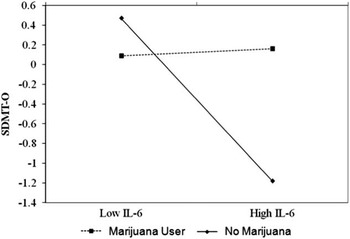
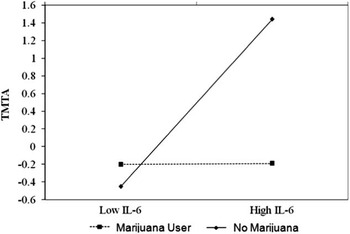
IL-6 and lifetime marijuana use interact in predicting performance on the SMDT Written trial (B=−.116; SE=.059; p=.049), SDMT Oral trial (B=−.143; SE=.062; p=.022), and the TMT A trial (B=.157; SE=.071; p=.028) (Table 5). The variance accounted by the interaction term and the psychomotor tasks were approximately 1% SDMT Written trail (R2=.013), 2% for the SDMT Oral trial (R2=.019), and 3% for the TMT-A (R2=.024). This is seen graphically in Figures 1, 2, and 3. However, the interaction was not significant associated with TMT B performance (B=−.119; SE=.068; p=.084). The variance accounted for by the interaction was approximately 1% (R2=.014). Lifetime marijuana use was an independent predictor of TMT-A performance (B=−.187; SE=.075; p=.013). Individually, IL-6 and lifetime marijuana use were not significantly related to any other psychomotor task.
Symbol Digit Modalities Test Written Trial (SDMT-W) as function of interleukin-6 (IL-6) and lifetime marijuana use. Lifetime marijuana use values are the sample mean and ± one SD from the mean. Low and high IL-6 reflect IL-6 end-points. Using the IL-6 median, values above the median are “High,” while values below the median are “Low.”

Symbol Digit Modalities Test Oral Trial (SDMT-O) as function of interleukin-6 (IL-6) and lifetime marijuana use. Lifetime marijuana use values are the sample mean and ± one SD from the mean. Low and high IL-6 reflect IL-6 end-points. Using the IL-6 median, values above the median are “High,” while values below the median are “Low.”

Trail Making Test Trial A (TMT-A) as function of interleukin-6 (IL-6) and lifetime marijuana use. Lifetime marijuana use values are the sample mean and ± one SD from the mean. Low and high IL-6 reflect IL-6 end-points. Using the IL-6 median, values above the median are “High,” while values below the median are “Low.”

Ordinary least squares regression: Interleukin-6 and lifetime marijuana use predicting Symbol Digit Modalities Test Written and Oral Trail Scores and Trail Making Test A and B Trial Scores

Note.*<.05; **<.01; Ed=years of education; C/W=Stroop Color Word Trial Raw Scores; SDMT-W=Symbol Digit Modalities Test Written Trial; SDMT-O=Symbol Digit Modalities Test Oral Trial; TMT-A=Trail Making Test Trial A; TMT-B=Trail Making Test Trial B; WCST-C=Wisconsin Card Sorting Task Categories Completed; WCST-P=Wisconsin Card Sorting Task Perseverative Errors; MJ=lifetime marijuana; IL-6=interleukin-6.
DISCUSSION
The primary goal of the present study was to test the hypothesis that self-reported lifetime marijuana use moderates the relationship between IL-6 and neurocognitive performance. The interaction between IL-6 and lifetime marijuana use predicted better performance on the SDMT written and oral trials, as well as TMTA. Specifically, those who did not use marijuana during their lifetime had higher levels of IL-6, which was associated with poorer neurocognitive performance. In contrast, there was no relationship between IL-6 levels and neurocognitive performance in self reported lifetime marijuana users. Specifically, participants with high IL-6 levels who did not report lifetime marijuana use had poorer neurocognitive performance than their marijuana using counterparts with high IL-6 levels. The current results partially support our hypothesis that those who reported marijuana use in their lifetime would have lower serum levels of IL-6 and perform better on neurocognitive tasks. Previous research suggests that higher levels of IL-6 are associated with deficits in numerous neurocognitive domains. IL-6 levels are also associated with a decrease in volume (Rubino et al., Reference Rubino, Realini, Braida, Guidi, Capurro, Vigano and Parolaro2009) and activation (Quickfall & Crockford, Reference Quickfall and Crockford2006) in various regions of the brain related to executive function, psychomotor speed and attention. Consistent with this literature, our results indicated a higher IL-6 levels were associated with poorer performance on the Stroop Color/Word, SMDT written and oral, and TMTA.
Previous literature suggests that marijuana’s effects on the brain, specifically relating to neurocognitive performances, may be minimal (Baker et al., Reference Baker, Pryce, Giovannoni and Thompson2003; Iversen, Reference Iversen2003). In fact, most research indicating neurocognitive deficits related to marijuana use have done so based on acute intoxication, with tests of long-term effects being inconsistent (Crean et al., Reference Crean, Crane and Mason2011; Gonzalez, Reference Gonzalez2007; Iversen, Reference Iversen2003). In the current study, unadjusted correlations are in line with previous research where lifetime marijuana use was related to poorer performance on the TMTA (Tapert, Granholm, Leedy, & Brown, Reference Tapert, Granholm, Leedy and Brown2002).
Given the cellular literature indicating marijuana’s anti-inflammatory processes, various studies have examined the potential therapeutic or protective role of marijuana in inflammatory-based conditions such as multiple sclerosis (Cabral & Griffin-Thomas, Reference Cabral and Griffin-Thomas2008) and Alzheimer ’s disease (Campbell & Gowran, Reference Campbell and Gowran2007; Marchalant, Brothers, & Wenk, Reference Marchalant, Brothers and Wenk2008). However, findings are still controversial (Gowran, Noonan, & Campbell, Reference Gowran, Noonan and Campbell2011; Hazekamp & Franjo, Reference Hazekamp and Franjo2010; Killestein et al., Reference Killestein, Uitdehaag and Polman2004). Our study suggests that lifetime marijuana use is associated with lower IL-6 levels, supporting previous research that posits marijuana use may have anti-inflammatory properties (Keen et al., Reference Keen, Pereira and Latimer2014).
The current results also indicated that the interaction between lifetime marijuana use and IL-6 predicted better performance on SDMT written and oral as well as TMTA. Specifically, higher levels of IL-6 and no report of lifetime marijuana use were associated with poorer performance on the SDMT and TMTA. These findings are consistent with the scant literature that suggests the immunosuppressive influence of marijuana use, which attenuates the relationship between inflammatory markers and neurocognitive function in murine models (Barichello et al., Reference Barichello, Ceretta, Generoso, Moreira, Simoes, Comim and Teixeira2012). Although the potential protective effects of marijuana use have not been fully explored, there is a clear empirical foundation for the bidirectional pathway between the immune system and the central nervous system (Wrona, Reference Wrona2006). The lower levels of serum IL-6 in lifetime marijuana users is in the current study is consistent with findings presented by Barichello et al. (Reference Barichello, Ceretta, Generoso, Moreira, Simoes, Comim and Teixeira2012) and Mukhopadhyay et al. (Reference Mukhopadhyay, Rajesh, Horvath, Batkai, Park, Tanchian and Pacher2011) who find that agents of marijuana not only have immunosuppressive effects in the central nervous system, but also in the periphery. This previously unexamined relationship among marijuana use, cytokine function, and neurocognitive performance suggests that the anti-inflammatory properties of marijuana may be protective against inflammation-related deficits in neurocognition.
There is growing literature presenting marijuana use as a therapeutic agent against inflammation processes (Baker et al., Reference Baker, Pryce, Giovannoni and Thompson2003; Greineisen & Turner, Reference Greineisen and Turner2010). However, this notion must be taken with some caution, given the lack of literature in human models and the long-term detrimental effects of marijuana use upon the immune system (Baldwin et al., Reference Baldwin, Tashkin, Buckley, Park, Dubinett and Roth1997; Ishida et al., Reference Ishida, Peters, Jin, Louie, Tan, Bacchetti and Terrault2008). Marijuana use may leave users more susceptible to infections, such as HIV (Reiss, Reference Reiss2010) and viral Hepatitis C (Hezode et al., Reference Hezode, Roudot-Thoraval, Nguyen, Grenard, Julien, Zafrani and Mallat2005). Moreover, previous research asserts that examining the long-term effects of marijuana use on neurocognitive performance lends itself to various methodological considerations that may also influence neurocognition, such as time of abstinence, severity of use, and the concomitant use of other substances (Gonzalez, Reference Gonzalez2007; Grant et al., Reference Grant, Gonzalez, Carey, Natarajan and Wolfson2003).
Using lifetime marijuana use as a moderator for the relationship between IL-6 and neurocognitive function integrates different physiological systems represented in various fields of research. In line with this notion, the moderating effect of lifetime marijuana use may act as a proxy variable for other psychosocial, or biological constructs that may influence the differences between marijuana users and non-marijuana users. One such variable is gender, as previous research reports women have higher levels of IL6 than their male counterparts (O’Connor, Motivals, Valandares, Olmstead, & Irwin, Reference O’Connor, Motivals, Valandares, Olmstead and Irwin2007). This is an interesting assertion, as men report using marijuana more often than their female counterparts (Cotto et al., Reference Cotto, Davis, Dowling, Elcano, Staton and Weiss2010). Furthermore, higher levels in particular personality domains, such as sensation seeking, openness to experience, and impulsivity may lead to substance use/abuse (Flory, Lynam, Milich, Leukefeld, & Clayton, Reference Flory, Lynam, Milich, Leukefeld and Clayton2002). Environmental stresseors may increase the potential of an individual abusing drugs, including marijuana (Sinha, Reference Sinha2001). Future research should examine the influence of other potential psychosocial and biological covariates, including but not limited to gender, depression, impulsivity, body mass index, diabetes Type II, medication usage, and perceived stress.
This study has some limitations. First, the cross-sectional design prevents authors from establishing cause in the relationships between IL-6, self-reported lifetime marijuana use and neurocognition. Moreover, given the dearth of literature exploring these three constructs and being limited by the variables available in the parent study, we prudently used reports of lifetime marijuana use. Future studies should incorporate more sensitive measures of marijuana exposure. Examining differences between infrequent marijuana users, habitual users, and a group of healthy controls will further elucidate the nature of the relationship among IL-6 and neurocognitive performance. Also, the influence of other substances, such as alcohol, nicotine, or illicit drug use was not included in the current study. Future research examining the potential intersection among these constructs with marijuana use would further inform and potentially identify the orthogonal influence of marijuana use on the relationship between cytokine function and neurocognitive performance. Lastly, given the aims of the parent study, only African Americans were recruited. This limits generalizability to other race/ethnic groups.
In summary, self-reported lifetime marijuana use moderated the relationship between interleukin−6 and psychomotor based neurocognitive performance in a sample of middle aged African Americans. Although these findings are correlational in nature, replication is necessary to determine the true nature of marijuana’s immunomodulatory influence in both those with inflammatory based diseases and pre-clinical community based samples. Given the prevalence rates of inflammatory conditions, such as obesity, metabolic syndrome and diabetes, it is imperative to elucidate the potential therapeutic nature of marijuana use.
Acknowledgments
We acknowledge the Minority Postdoctoral Fellowship Supplement (R01 DA029894), which allowed the first author time to complete this manuscript and the parent study entitled Stress and Psychoneuroimmunological Factors in Renal Health and Disease, which is supported by a grant from the National Center for Minority Health and Health Disparities (P20 MD000512). The authors reported no conflict of interest.