The role of money creation to finance governments has long been a staple in the monetary literature. One of the issues frequently addressed is how certain monetary policies have led to rapid inflation. As a result, a wide variety of studies both theoretical and empirical have been generated to assess the causes as well as consequences of inflationary finance. Given the episodes of extreme inflation over time, most of these studies have focused on the financial history of nations during the twentieth century. For example, attention has been given to such countries as Argentina, Austria, Bolivia, Germany, Greece, Hungary, Israel and Poland.
For this there is a good reason. As Forrest Capie was able to determine, there were only three episodes of very rapid inflation prior to the twentieth century.Footnote 1 Two of them occurred in American history; once during the Revolutionary War and the other was in the Confederacy during the Civil War.Footnote 2 However, studies that examine inflationary finance in the Confederacy far outnumber those for the Revolutionary War. This is unfortunate because the experience of the Revolutionary War played a pivotal role in establishing the institutional arrangement for the fundamental monetary powers of the new national government under the Constitution. The latter in turn was instrumental in the formation of an American monetary union.Footnote 3
The purpose of this article is to undertake an empirical assessment of the policy of inflationary finance pursued by the Continental Congress during the Revolutionary War. It is motivated by, and an extension of, some of the ideas in the work of Calomiris, particularly the notion of linking successes and failures on the battlefield with the depreciation of the Continental Dollar.Footnote 4 Questions addressed will include why the Continental Congress chose its policy, how events beyond congressional control influenced the outcome of monetary policy, and whether the inflation rate exceeded the revenue-maximising rate. The organisation of the article is as follows. Section I will discuss the monetary regime established by the Continental Congress and why it was used largely to finance the war. Section II will briefly look at monetary regimes outside the control of Congress that influenced the monetary environment within which congressional policy was pursued. Section III examines the early years of the Revolutionary War when inflation first developed as a result of the monetary policies of the Continental Congress. Section IV will assess how military and geopolitical events influenced the outcome of monetary policy during the middle years of the war. Section V examines the question of whether the inflation rate induced by the monetary policy of the Continental Congress went beyond the revenue-maximising rate.
I
Although it had not declared independence, the Continental Congress when it convened on 10 May 1775 began to undertake activities usually associated with a national government. It began for the first time passing measures involving national expenditures. By the end of June, it had established the Continental Army, which in effect was a national army. Congress had also appointed the first generals of this army, including George Washington as Commander-in-Chief, established a variety of army corps and made arrangements for the purchase of arms and munitions.Footnote 5 Furthermore, Congress had ordered the new army to undertake an invasion of Canada.Footnote 6
As Congress assumed national expenditure powers, it was at the same time seeking an independent source of revenue. At the time, however, the Continental Congress was confronted by severe political and economic constraints in the choice of revenue sources. Implementing a national tax system to meet the immediate expenses of the military was proving to be very difficult. First of all, the bureaucratic machinery necessary for collection and enforcement would have to be established. This required time and resources, neither of which Congress had.
More importantly, the political environment was not favourable for granting Congress the power to tax. The reason for this was the experience of ten years of protest against new British taxes. The revolutionary financer Robert Morris later pointed this out in one of his essays. ‘America having never been much taxed for a continued Length of Time … and the Contest being on the very Question of Taxation’, he observed, ‘the laying of Imposts unless from the last Necessity would have been Madness’.Footnote 7 In turn, if Congress did not have the power of taxation it would have a difficult time turning to the bond market as a viable option for government funds.
Confronted with these problems, Congress turned to a consideration of printing money. It consulted with the colonial assemblies to inform them that a national currency was being considered. After having received a favourable response from them on this proposal, Congress on 22 June 1775 authorised the first emission of the Continental Dollar. ‘Resolved, That a sum not exceeding two millions of Spanish milled dollars be emitted by the Congress in bills of Credit.’Footnote 8 Thus, the Continental Dollar as initially emitted was defined to be on par with the specie value (i.e. silver) of the Spanish Dollar. One delegate stated the logic of having a national currency in this way: ‘Do you think gentlemen, that I would consent to load my constituents with taxes, when’, he concluded, ‘we can send to our printer and get a wagon-load of money?’Footnote 9
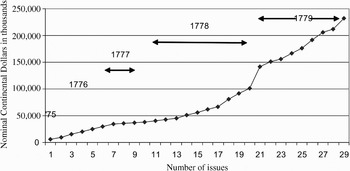
After declaring independence in 1776, Congress drafted the Articles of Confederation. Under the Articles, the Continental Congress did not get the authority to tax but rather was to be funded by voluntary contributions from the states. The effect of this was to institutionalise the free-rider problem, with the states having little incentive to make contributions. Over time, as the states failed to make any payments, Congress circumvented the free-rider problem by issuing more currency. Emissions of the Continental Dollar continued until Congress resolved in 1779 to end the emission of currency altogether. As Figure 1 indicates, by the time of the last emission, which was on 29 November, Congress had emitted over 200 million nominal Continental Dollars.
Total supply of nominal Continental Dollars (thousands)
Source: Charles Bullock, ‘The finances of the United States from 1775 to 1789’, Bulletin of the University of Wisconsin: Economic, Political Science, and History Series, 1.2 (June 1895), p. 135. The above issues per year are not the same as the number of authorisations made by the Continental Congress per year. The issues are the outcome of a two-month lag suggested by Bullock between the authorisation of an emission and the actual delivery of the printed currency.

II
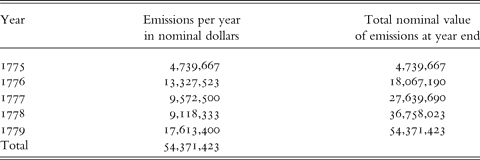
There were both positive and negative aspects associated with the decision by the Continental Congress to fund the war primarily through the emission of currency. On the positive side, currency emission did enable Congress to circumvent the free-rider problem it had institutionalised. However, on the negative side, the decision exposed Congress to an environment whereby it was not the only entity which was issuing currency. Each state, at least initially, relied primarily on its own currency emissions for revenue. With only minor exceptions, no state passed any tax legislation during 1775 and 1776.Footnote 10 Between 1775 and 1779, there was more than an eleven-fold increase in the nominal supply of state currencies (Table 1). Therefore, the individual states and the Congress competed with each other for real resources through the issuance of currency.
State emissions of paper currency during 1775–9
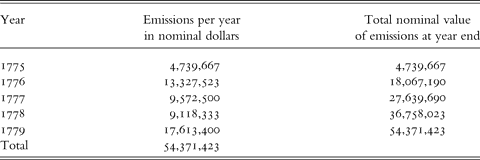
Source: Nominal dollar emissions are from Edward Forbes Robinson, ‘Continental Treasury Administration, 1775-1781: a study in the financial history of the American Revolution’, PhD dissertation, University of Wisconsin (1969), table ii, p. 327.
Relying upon currency emissions for its primary source of revenue exposed Congress to another problem. Having fought a long series of wars with the French going back to 1689, the British were well aware of the importance of financing in conducting warfare. They realised that if they could undermine the revenue policy of the Continental Congress the funding of the rebellion would collapse. As a result, early in the war the British decided to reduce the value of the Continental Dollar by counterfeiting it. Since this was a covert project, the quantity of British counterfeits is not known.
III
Throughout the years of 1776 and 1777, the Continental Congress funded its war with the British primarily through the emission of the Continental Dollar. The reason was that none of the states had made any of their expected voluntary contributions. In 1776, Congress authorised four emissions totalling 19 million dollars. During 1777 there were five emissions totalling 13 million dollars. Thus, by the end of 1777 the quantity of nominal Continental Dollars had increased over sixfold since the end of 1775. During this period, the United States experienced an inflationary episode very similar to those studied in the literature on rapid inflation. As Bental and Eckstein point out, two common features of these previously studied episodes are rising monthly inflation rates and a decline in real money balances.Footnote 11 In the case of the Revolutionary War, the four emissions by the Continental Congress in 1776 had resulted in more than a threefold increase in the nominal stock of Continental Dollars. By mid 1776, the specie value of the Continental Dollar began to depreciate and a double-digit monthly inflation rate was reached by the end of the year. However, the relative rates of increase of the nominal stock of Continental Dollars and inflation were such that the specie value of total Continental Dollars increased throughout the year. In 1777, this changed just as on previous occasions. The inflation rate overtook the rate of increase in the nominal stock of currency so that real money balances fell.
All of this occurred while the states were issuing their own currencies and the British were beginning to counterfeit the Continental Dollar. During the first year of the war, the states not having taxes tripled their emissions. In order to curb the reliance of the states upon currency finance, the Continental Congress in January 1777 requested that the states ‘raise, by taxation, in the course of the current year, and remit to the treasury, such sums of money as they shall think will be most proper in the present situation’.Footnote 12 This was the first time that Congress had requested the states to resort to taxation. During 1777, eight complied. This was the beginning of state taxation as tax laws were passed every year thereafter.Footnote 13 However, most of the revenue generated, rather than being sent to the treasury of the Continental Congress, was spent by the states. The result, shown in Table 1, was a substantial cut in state emissions during 1777 (see Table 1).
By February 1778, the financial position of the Continental Congress appeared dire. While the States, as requested by Congress, had cut the quantity of their nominal emissions of currency in 1777, they had paid very little into the congressional treasury. Meanwhile, Congress had increased its nominal money emissions over sevenfold since 1775 to circumvent the continuing free-rider problem. This had led to double-digit inflation reducing real balances to a level close to that attained in 1775. The specie value of the Continental Dollar was now only about 20 per cent of what it had been when first issued. To this point in time both the monthly inflation rates and the behaviour of real money balances continued to follow a pattern similar to that found in the studies of inflationary finance of nations in the twentieth century.
IV
An unusual turn of events occurs in the monetary data for 1778. The specie value of new Continental Dollar emissions dropped from 4 million dollars in late 1776 to 200,000 dollars by February 1778. The specie value of new emissions began a turnaround in the spring. By November, a new emission had reached a value of 2.5 million dollars (Figure 2).
Specie value of new emissions
Source: Bullock, ‘The finances of the United States’, p. 135. The above figure takes into account the two-month lag between the authorisation of an emission and actual delivery of the printed currency as discussed by Bullock.

In January 1779, the specie value of emissions then once again went into decline. This trend continued until the end of the year, marking the lowest specie value of any emission by the Continental Congress.
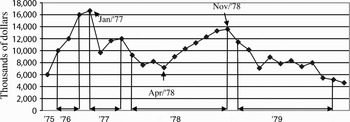
The result of this was an episode not commonly observed in studies on hyperinflation during the twentieth century. Following the onset of hyperinflation, the specie value of total Continental Dollar emissions went into a decline. This decline continued during 1777 and by April 1778 reached a level nearly that of 1775, one year before the Declaration of Independence. What is unusual is that this downward trend ended and then began to rise, reaching a level of nearly 14 million dollars by November 1778 (Figure 3). This was the third-highest level attained during the entire Revolutionary War. Then in January of the following year, the specie value of total Continental Dollars began a decline that continued throughout the rest of the war.
Specie value of total Continental Dollar emissions
Source: Bullock, ‘The finances of the United States’, p. 135. The above figure takes into account the two-month lag between the authorisation of an emission and actual delivery of the printed currency as discussed by Bullock.

What is the explanation for the resurgence of the monetary base during 1778 and its subsequent decline once again in 1779? It would seem that one possibility is offered by a relatively recent development in the literature on the inflationary finance undertaken during the American Civil War. It is based upon an idea suggested by two scholars over 100 years ago. Schwab argued that in the North, ‘The value of the greenback was much more a barometer of popular feeling as to the eventual outcome of the war than a gauge of their amount in circulation…’.Footnote 14 The same he argued was true of southern currency. Schwab then attempted to support this assertion by linking currency values both in the North and the South with the victories and defeats of both sides on the battlefields during the war. Two years later Wesley Mitchell (1903) in his A History of the Greenbacks also argued that ‘war news’ had a significant impact upon the specie value of northern currency during the war. In his words
Even more striking than the influence of financial events upon the currency was the effect of the ‘war news’. While the war continued there could be no thought of redeeming the government's notes. Hence every victory that made the end of hostilities seem nearer raised the value of the currency, and every defeat depressed it.Footnote 15
After nearly a century, a systematic effort has been undertaken by scholars to assess the link, if any, between ‘war news’ and the specie value of currency during the Civil War. Based upon a model generated to assess war finance in the Confederacy, Burdekin and Langdana asserted that
… despite the role of deficit expansion in accounting for the rates of note and debt issuance, the fiscal variables cannot satisfactorily account for the fluctuations in the Confederate price level. Rather, we find ‘war news’ to be of key importance in determining price movements …Footnote 16
Building upon Mitchell's work, McCandless set about further examining the effects of military events during the war on northern and southern prices. Based upon his analysis he concluded
During the war, the single most important indicator of future government expenditures is the process of the war itself. Because of this, it is the war news and its effects on people's expectations that move currency prices and move them much more violently than actual expenditures or actual money issues do.Footnote 17
Later, Smith and Smith in their view were to confirm the results of these studies, ‘in the sense that military and financial news events had statistically significant effects of the signs predicted by the theory’.Footnote 18
A recent trend of this literature has been to broaden ‘war news’ to include not only events on the battlefield but nonmilitary events as well. The list of things considered is quite extensive. Some examples of nonmilitary events are results of elections, financial reform measures, political news, passage of Congressional acts, issuance of the Emancipation Proclamation, as well as changes in policy makers and military leaders.Footnote 19
Although the role of ‘war news’ has emerged in the recent research on currency values during the Civil War, no systematic analysis has been made of the role it played in the determination of the specie value of the Continental Dollar during the Revolutionary War.Footnote 20 One caveat here is that when compared to those who study the Revolutionary War, scholars of the Civil War have the benefit of being able to draw upon a relatively large database. Such tools as structural break analysis and stochastic switching models all employing econometric methodology have therefore been brought to bear upon the issue of war news. Unfortunately, the financial data for the Revolutionary War is excruciatingly limited.
Furthermore, from a military point of view, the two wars differed substantially from each other. In the case of the Revolutionary War, the Americans basically fought a war of attrition as General George Washington sought to keep the Continental Army intact and not engage in a major battle that might be lost to the superior British Army. The result was a series of a large number of skirmishes and relatively small battles by European standards in the hope that eventually the British would tire of the war. The Civil War in contrast was in effect a war of annihilation fought between very large armies in a series of major battles.Footnote 21 Unlike the outcome of a relatively small skirmish in a war of attrition, the outcome of a major battle is more likely to provide the scholar with a ‘turning point’ in a war of annihilation with which to measure its impact upon the monetary sector. Nevertheless, appealing to war news in general might offer a possible explanation for the resurgence of the monetary base during 1778 and its subsequent decline once again in 1779. The reason has to do with understanding the logic of the war news argument in the Civil War literature and setting it against what was happening during this period of the Revolutionary War.
The basic premise of the argument in this literature is that war news conveyed information that affected the expectations of individuals regarding future government behaviour. Favourable war news increased the probability of a shorter war and lower future government expenditures. In the case of the Revolutionary War, with the Continental Congress dependent upon currency for revenue, this would mean an increased expectation of lower future issues of the Continental Dollar. Unfavourable war news would have just the opposite effect.
It turns out that during 1778 there was war news that for the Americans would have appeared to have dramatically raised expectations of not only a successful but also an imminent conclusion to the war. What happened was a tectonic geopolitical shift during the year. The precursor to this shift had been the Seven Years War. Following its defeat by the British, France was eager to salvage the previous tripartite balance of power with Spain and Britain. Believing the American colonies to be a fundamental source of British power, the French government thought their loss to Britain would restore the power of France. As delighted as the French were that the Americans had declared independence, the military results of the first two years of the war had not convinced them that even with their aid would the revolution be successful.
All this was to change with the outcome of one battle. During 1777, the British devised a new military strategy to defeat the Americans. Since the heart of the rebellion was in New England, it was decided that a large British army would be sent to cut New England off from the rest of the colonies. A major assault would then be made against the isolated American army. A decisive victory would not only be a major step in bringing about the end of the rebellion but also ensure that the French would not intervene. Ten thousand troops were sent from Canada to, and down along, the Hudson River to link up with the northward bound army from New York City. The plan failed, however, as the entire British army from Canada was forced to surrender to the Americans at Saratoga on 17 October.Footnote 22
Unknown to the Americans, the geopolitical shift got underway during the winter of 1778 following the American defeat of the British at the battle of Saratoga. In December, when news of the outcome of Saratoga reached Britain and France, each began to make significant changes in their policies in dealing with the Americans. The French became aware that the British were badly shaken by Saratoga and had sent an emissary to France to meet with American representatives there to discuss possible peace terms while not offering independence. Fearing the Americans might accept such a deal and thereby deprive them of an opportunity substantially to reduce the power of the British Empire, the French countered with an offer to side formally with the Americans with a treaty of commerce and one of a military alliance. The two treaties were agreed upon and signed by the French government and the American representatives on 6 February 1778.Footnote 23
After getting word of the Franco-American alliance within days after its signature, the British government, now fearing a new war with France, decided to make a comprehensive peace offer directly to the Continental Congress. In March, Parliament passed bills of conciliation listing major concessions to be taken directly to America by an appointed peace commission. The commissioners were to offer the Americans the withdrawal of all British forces and the right to have their own army. Britain would give up what it viewed as its right to tax the Americans. It would formally recognise the Continental Congress and allow the Americans to have representation in Parliament. With these as well as other concessions, the British government in effect was now willing to go well beyond what the Americans had asked for during the two years before declaring independence.
For the Americans, it seemed the war that had at best been a stalemate up to this point was now taking a turn towards not only an imminent but also a favourable conclusion. The news of the fundamental shift in both British and French policies arrived in late April 1778. Copies of the British bills of conciliation and the French treaties were delivered to the Continental Congress almost simultaneously. The members of Congress, having believed since 1776 that an alliance with France was critical for their success, voted unanimously to ratify the treaties on 4 May 1778, only days after their arrival.Footnote 24 Later, in June, the peace commissioners arrived from London and all British military forces were evacuated from Philadelphia. With the French treaties in hand, Congress rejected the offer of the British commissioners and then returned to Philadelphia in July. By the end of August, France had both declared war on Britain and landed troops in a combined operation with the Americans against the British.
It would appear that the behaviour of the specie value of total Continental Dollar emissions is consistent with the commencement of all of this war news. As we have seen in Figure 3, the specie value declined from a peak in January 1777 to April 1778, during which the war continued on at best as a stalemate. The impact of war news upon the value of the Continental Dollar did not escape the notice of American leaders. For example, during the summer of 1777 when the military situation was tenuous at best, it was widely believed that the next major move by the British would be to capture the American capital of Philadelphia. Alexander Hamilton, in a letter to Gouverneur Morris on 22 July, warned him of the impact such a development would have upon the value of the Continental Dollar.
There will, however, be many disagreeable consequences attending such an event; amongst which, the foremost is, the depreciation of our currency, which, from the importance in which Philadelphia is held, cannot fail to ensue.Footnote 25
It was late April when there was the onset of a series of favourable war news events that began with the arrival of the bills of conciliation and the proposed treaties of alliance with France. It is during the period of favourable war news that the specie value of total Continental Dollar emissions began to increase and continued to do so for the rest of the year.
Also following the battle of Saratoga, the Continental Congress, realising it had a severe financial problem, decided in November 1777 to take two new courses of action. The first was that Congress issued state requisitions for revenue to be in proportion to the value of land and generated by state taxes. Since Congress did not have the power of coercion over the states, this action did not resolve the free-rider problem. To reduce its severity, however, Congress made it explicit how much each state owed. Thus, any state which did not meet its specified requisition, would at least be clearly identified as a free rider and therefore be more likely to make a contribution to the Continental treasury.Footnote 26
The second new course of action was directed at the monetary front. At the time, Congress summarised its situation as follows:
To maintain our fleets and armies, large sums have been emitted in continental bills of credit, and the same expedient method has been adopted embraced by the respective states to answer the demands of their internal governments their internal wants. By these exertions expedients, our paper currency, notwithstanding the settled solid basis on which it is founded, is multiplied beyond the rules of good policy.Footnote 27
So the Congress resolved, ‘That it be earnestly recommended to the legislatures of the several states to refrain from further emissions of article bills of credit.’Footnote 28 In effect, the states were asked to give up emissions as a source of revenue and join a monetary union. Six states responded by not issuing currency during 1778. The net result was that total state emissions in 1778 declined from those of 1777.
After rising from April to November 1778, why then did the specie value of total Continental Dollar emissions go into a rapid decline and continue to do so throughout 1779? It turns out November 1778 marked the confluence of the execution of changes made in the military strategies of both Britain and France. The essence of these changes had to do with the allocation of military resources. The French shifted forces away from America to another front of the war while the British shifted their forces to a new front in America. The reallocation by both Britain and France began in November. For the Americans the combination of this reallocation of forces ended all hopes of an imminent conclusion to the war.
The French in their turnabout of strategy decided to withdraw troops from America and focus military forces in the Caribbean, where they thought the major battles with Britain were more likely to occur. Consequently, in November 1778, France sent its fleet from American waters to the West Indies. It would be nearly a year after this departure before French troops once again fought alongside the Americans.
For their part, the British decided to open a new front in the war with America. The previous strategy of having their army defeat the Continental Army in New England was scrapped in favour of shifting to a defensive mode and then sending some troops to the southern colonies. The British believed the military environment would be more favourable in the South and the troops would be in closer proximity to any future French offensive in the Caribbean. In November 1778, a British force embarked from New England for the coast of Georgia. This force by the end of December had captured Savannah and by the end of January 1779 had captured Augusta, the capital of Georgia.
November 1778 thus marked a turning point in the war but it was not in favour of the Americans. Rather than coming to imminent conclusion, the war was now expanding to the southern states. Concerned with this development, the French agreed for a second time to assist the Americans on the ground. In September 1779, they sent a fleet carrying troops to land and fight along with the Americans to try to capture Savannah. The effort failed, with both the French and the Americans suffering very high casualties. In turn, France once again withdrew its forces. In December 1779, Britain launched its largest offensive since 1777 by landing troops near Charleston, which was later captured.
Just as November 1778 was a turning point on the war front, so it was, as we have seen, a turning point on the monetary front. It was to be the last turning point, however. The specie value of total Continental Dollar emissions went into a decline from which it would not recover (Figure 3). By November 1779, when it reached a level lower than it had been in 1775, the Continental Congress had decided that month's emission would be the last. The specie value of the Continental Dollar continued to decline until it eventually passed from circulation as Congress financed the rest of the war with foreign loans, state requisitions and confiscation. When the war shifted to the South, both the magnitude and the locus of state emissions changed dramatically. Annual state emissions went from about 9 million dollars in 1778 to nearly 18 million dollars in 1779, 98 per cent of the increase coming from southern states.Footnote 29
Despite the surge of state emissions during 1779, it was the Continental Dollar that dominated the growth of the total nominal money supply since 1775. Over the course of the period starting from 1776, the total money supply in nominal terms had grown 26-fold.Footnote 30 By the end of 1779, the emission of Continental Dollars had made up over 80 per cent of the growth of the total nominal money supply.
Just as in the case of the Civil War, it would seem that war news had an impact upon the specie value of total Continental Dollar emissions during the Revolutionary War. If favourable events were viewed as bringing the war to an end sooner and thereby reducing future currency emissions thus lowering inflationary expectations, it would not be surprising to observe a rise in the real stock of money. A fundamental mechanism in all of this is of course the velocity of money. Inflation after all is a tax on money balances. Lowering inflationary expectations would lead to a decrease in the velocity of money. Alternatively, if unfavourable events were viewed as increasing the duration of the war and consequently increasing future currency emissions, expectations of rising prices would lead to higher velocity that would work to lower the real stock of money.
Unfortunately, there is not enough data available to measure velocity. Among other things, it is not clear what was happening to real output during the Revolutionary War.Footnote 31 One can, however, reasonably speculate as to what was happening to the general trend of velocity during the ‘good news’ and ‘bad news’ coming from the war front. From April to November 1778 when the news was favourable, the specie value of total Continental Dollar emissions rose 89 per cent. During those seven months it is unlikely that the real output of the economy grew very much, if at all, let alone by 89 per cent. Surely velocity was dropping. On the other hand, during the period of unfavourable events from November 1778 through November 1779, the specie value of total Continental Dollar emissions fell 59 per cent. During those 12 months it is not very likely that real output declined by 59 per cent. Thus, it would seem, velocity was very likely increasing. Accordingly, after having been driven down in value from its peak in January 1777 through the first four months of 1778 due to rapid inflation, the real stock of the Continental Dollar seems to track fairly well events on the war front.
V
This Currency, as we manage it, is a wonderful Machine. It performs its Office when we issue it; it pays and clothes Troops, and provides Victuals and Ammunition; and when we are obliged to issue a Quantity excessive, it pays itself off by Depreciation.
Ben FranklinFootnote 32As Ben Franklin pointed out, there was indeed a financial payoff to the depreciation of the Continental Dollar. By employing inflationary finance during the Revolutionary War, the Continental Congress was able to generate revenue from seigniorage or the inflation tax on cash balances. To what extent did its monetary policy take advantage of this revenue source to finance the war? Theoretically, this could be determined. Various contemporary models of inflationary finance have led to the generation of variations of a Laffer curve between seigniorage and inflation to sort out the revenue-maximising rates of inflation as well as the extent to which the achieved levels of inflation were above or below the revenue-maximising rate.
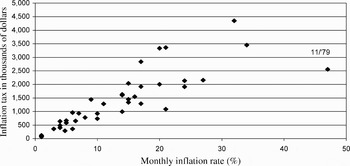
Using these models to construct a theoretical foundation, what can we say about inflation tax revenue during the Revolutionary War? Unfortunately, the paucity of data is such that the answer is very little. Using a simplistic approach to assess the data we do have, however, does shed some light on the effectiveness of the monetary policy of the Continental Congress in generating inflation tax revenue. Taking the real money base in specie at each point of emission and multiplying it by the subsequent monthly rate of inflation on that base is a rough approximation of the tax revenue generated by month. Figure 4 shows the outcome of this exercise.
Inflation tax
Source: The real money base of the specie value of Continental Dollars at each point of emission is taken from Bullock, ‘The finances of the United States’, p. 135, as depicted in Figure 3. The monthly rate of inflation is based upon a price index derived from a weighted average of commodity prices presented in Anne Bezanson, Prices and Inflation During the American Revolution (Philadelphia, 1951), table 3, p. 344.

It would seem that for almost all of the period 1776 through 1779 the inflationary finance policy of the Continental Congress managed to generate inflation rates that increased the inflation tax. The revenue-maximising inflation rate does not appear to have been exceeded except perhaps for November 1779, which was when the Continental Congress authorised its last emission of the Continental Dollar.
VI
After having declared independence, the Continental Congress was confronted with the question of how to finance an inevitable war with Britain. This was no small issue in that following its recent victory over France in the Seven Years War Britain was arguably the world's greatest superpower. For the members of Congress the imposition of taxes was politically unacceptable, as taxation of the colonies had been one of the major grievances the Americans had with the British. Confronted with this political reality, the Continental Congress decided it would rely upon voluntary contributions from the newly formed states to finance the war. Thus, the public good of independence to be provided to the states by Congress would be funded by the states. This policy, which was incorporated into the Articles of Confederation, in effect institutionalised the free-rider problem.
The institutional foundation was therefore laid to use monetary policy to finance the war. As the war got underway and with the states not making their payments, Congress increasingly resorted to printing more currency to circumvent the free-rider problem. As we have seen, this led to extreme inflation, an initial increase and later a decline of the specie value of Continental Dollar emissions. At that point, it would appear that had it not been for the intervention of favourable war news, the revolution might have come to an end. Fortuitously, the revolution got a second chance. The specie value of Continental Dollar emissions rose only to fall once again with the British invasion of the South.
Had the Continental Congress given itself the power of taxation in the Articles of Confederation, the financial story of the Revolutionary War would no doubt have played out very differently. As it was, the Continental Congress funded the entire war without the explicit power of taxation. Instead, through its monetary policy, Congress pursued the taxation of cash balances. By staying on the left side of the Laffer curve, Congress was able to continue to generate revenue over a long enough period to give the military time to wear down the British and set the stage for their ultimate defeat.