Implications
Organic farming promotes a combination of providing good-quality feedstuffs, appropriate livestock husbandry systems and correct management practices to promote animal health and welfare. Therefore, there is a need to evaluate the organic system compared with other systems on issues pertaining to animal health and product quality. This is the first study in the Spanish national context addressing this evaluation.
Introduction
The benefits of organic systems are primarily related to environmentally friendly production and to high animal welfare, whereas issues pertaining to animal health and product quality are more influenced by the specific farm management than by the production method (Sundrum, Reference Sundrum2001; Vaarst et al., Reference Vaarst, Bennedsgaard, Klaas, Nissen, Thamsborg and Ostergaard2006). For instance, overcrowding and mistakes in feeding regimes, particularly in the case of intensive practices, can lead animals into imbalances or damage their metabolic homoeostasis, and consequently can result in sub-clinical and clinical disease states (Link and Schumacher, Reference Link and Schumacher2004). Although such problems rarely occur in extensive beef production systems (Hovi et al., Reference Hovi, Sundrum and Thamsborg2003), animal health issues remain one of the main difficulties encountered by organic breeders of ruminants (Cabaret, Reference Cabaret2003).
Although there is a large body of research comparing organic and conventional farming systems, most of the studies have involved health assessment of dairy cows. Indeed, significant correlations between animal health (as measured by clinical examination) and production of milk (Sundrum et al., Reference Sundrum, Andersson and Postler1994) have been reported two decades ago. In contrast, the literature for organic beef cattle and relationships between health and production is rather scarce. It should be noticed that in the organic beef production systems, the quality of meat products is a major factor that emphasises product quality rather than quantity (Hermansen and Zervas, Reference Hermansen and Zervas2004). Thus, it is adjusted to the expectations of consumers who tend to be wary of intensive production systems that have been associated with food crises (Sundrum, Reference Sundrum2001). Farm processes and resultant food product quality are linked to (amongst other things) the health of the animal and its disease status. Thus, to improve meat quality, it is necessary to examine the whole production chain from breeding to meat processing. Therefore, slaughterhouse records can also be used to evaluate the impact that farming systems have on final beef performance (Vaarst and Hovi, Reference Vaarst and Hovi2004).
It seems that the standards associated with organic farming do not per se ensure either high levels of animal health and welfare or safe livestock food products (Vaarst et al., Reference Vaarst, Bennedsgaard, Klaas, Nissen, Thamsborg and Ostergaard2006; Fall et al., Reference Fall, Emanuelson, Martinsson and Jonsson2008). Furthermore, there is lack of uniformity of standards because countries differ in characteristics such as climate, availability of resources (feedstuffs, litter, outdoor areas), herd structures, economic conditions and disease prevalence, cultural differences in the perception of problems and expertise to deal with them (Lund and Algers, Reference Lund and Algers2003; Vaarst et al., Reference Vaarst, Bennedsgaard, Klaas, Nissen, Thamsborg and Ostergaard2006). Thus, because there are different ways of adhering to organic principles and standards, developments in organic farming practice have to be set in a national, regional and local context (Vaarst et al., Reference Vaarst, Bennedsgaard, Klaas, Nissen, Thamsborg and Ostergaard2006).
In Spain, 97% of organic cattle livestock production is for beef cattle (MAPA, 2008), and the number of beef calves slaughtered in the north-western region of Spain accounted for 61.8% of the national scale (MAPA, 2008).
To date, there has been no assessment of health status of organic and other beef cattle systems and the resultant quality of meat in Spain. The objective of this study was to analyse and compare organic beef cattle farming in Spain with intensive and conventional systems in terms of impacts on management practices and animal health and impacts on the safety and quality of cattle products.
Material and methods
Experimental design
This was an observational 1-year study that considered beef cattle of NW Spain and consisted of data analysis from the farm and from the slaughterhouse.
Farm phase analysis
The study population has been described in an earlier paper (Blanco-Penedo et al., Reference Blanco-Penedo, Shore, Miranda, Benedito and López-Alonso2009). In brief, beef cattle production systems are represented by a production cycle of 7 to 9 months of age for the calves, with a weight between 300 and 400 kg and a carcass yield of ∼60%. Beef production in this area of Spain is quite distinctive and represents 32% of the market for Spanish consumers (MAPA, 2008). Intensive farming in this region is a calf system that has highly standardised livestock practices where calves are mainly fed imported or purchased concentrates and maintained indoors. Conventional beef production comprises of indoor management for unweaned young calves, maternal suckling and complementary concentrate-based diet. However, alternative systems have been designed by including a grazing period. The calves born between the autumn and winter season are reared with their mothers on pasture and are allowed to suckle freely while they are grazing on a rotational system, receiving complementary grass silage when grass available on pasture is limited. Calves finish indoors for 8 to 10 weeks before slaughter and are offered the concentrate and the grass hay ad libitum. In recent years, however, there has been an increase in the number of organic farms in this region. These have mostly been conventional farms that have adapted to the broad standards required of organic systems (EC 889/2008).
For our study, 24 organic farms (∼47% of the target population, the organic beef farms in NW Spain) were randomly selected from the Official Certification Body (CRAEGA, Xunta de Galicia, 2008) and stratified by area (number of farms proportional to the number of organic farms in each area). Farmers from conventional farms located in the neighbourhood of the eligible organic farms were invited to participate. The included number of conventional farms (n = 26) was not representative of the total conventional beef farms in this region but was considered adequate to provide comparative data. The final number corresponded to the organic and conventional farms that actively chose to participate. Farm phase analysis was only achieved in organic and conventional management types. The rationale to exclude intensive system was that intensive farms in this region are only calf systems. In total, data for 780 cows and 306 calves from the 24 organic farms and 498 cows and 288 calves from the 26 conventional farms were collected.
During January to February 2008, farms were visited for 2 to 3 h. Farmers were interviewed face to face and responded to a complementary questionnaire that covered general information, animal nutrition and management practices in the farm. One person (first author) was assigned as the only interviewer. Information from the questionnaire was obtained by closed questions. Only open questions were used to capture farmer attitude. Data recorded on health management practices, diagnosis and treatments and beef production on the farm (animals sold to slaughter or life) for the 2007 calendar year were retrieved from the corresponding farm books. Collected data were evaluated and checked during the period of the experiment and the farmers were contacted again if necessary. Information on 26 surrounding conventional beef farms was likewise collected following the same procedure. Furthermore, a direct inspection performed by the first author was executed in order to check the fulfilment of organic legislation in the organic farms.
Slaughterhouse phase analysis
Hygiene and quality records of beef cattle slaughtered in a slaughterhouse in NW Spain were retrieved from the official 2007 yearbook. The data represented the annual work of this slaughterhouse. Calves that were born and reared in NW Spain were included in the study. A total of 5861 calves and their corresponding records were analysed comprising records of 244 calves from organic farms, 2596 calves from intensive farms and 3021 calves from conventional farms. The organic beef cattle represented the 84% of all certified organic calves slaughtered in NW Spain in 2007. The remaining 16% of certified organic calves were slaughtered at two different slaughterhouses and were not included in this study to avoid variability in hygiene control and carcass quality criteria. The mean (s.d.) age at slaughter was 295(52), 286(31) and 246(64) days for organic, intensive and conventional calves, respectively. Condemnations and pathological finding codes at the post-mortem inspection were retrieved from the Official Inspector's Veterinary Record Book. Carcass quality classification was a visual evaluation of the carcass using the SEUROP system and a visual fatness score (EC 103/2006). These assessments were carried out by graders at the slaughterhouse.
Statistical analysis
All statistical analyses were carried out using STATA Software v. 11 (Stata Corporation, College Station, TX, USA). For the farm phase analysis, the unit of study was the farm. Univariable analysis was carried out to study differences between farm types. For categorical variables, the statistical significance of differences between farming types was determined by the Fisher test. Variables that were normally distributed were analysed by Student's t test or Analysis of Variance (ANOVA). Variables that were not normally distributed, even after data transformation, or that did not meet the underlying assumptions of the ANOVA were analysed by the non-parametric Kruskal–Wallis test. On the slaughter phase analysis, multivariable, multilevel statistical models were consistently used. Management type, age, breed and sex were the frequently used predictor variables in the different statistical models with farm as a random effect. The predictor variable of main interest ‘farm type’ was forced to stay in all models. The relations between the appearance of condemnations/pathological findings and farm type were studied using logistic regression models. Weight, carcass conformation and fatness scores were studied using linear mixed models, including the appearance of pathological findings in the analysis. The rationale for including the presence of pathological findings was based on assuming that the existence of previous disease has a potential effect on beef performance. Breeds and cross of breeds were divided in two major groups according to the distribution of the observations and named as modern crosses and indigenous crosses. The unit of time for the age was month. To perform the statistical analysis, SEUROP system was scored with numbers from 1 to 18 (1: highest to 18: lowest quality). The degree of fatness, which takes into account the amount of fat on the outside of the carcass and in the thoracic cavity (1: low; 2: slight; 3: average; 4: high; 5: very high), was evaluated with the slaughterhouse's 5-point scale.
Throughout the studies, model building was done by backward stepwise elimination of main effects with P < 0.2 (F-test) as the exclusion and re-entering criterion. All possible first-order interactions were subsequently added to the model, and the backward stepwise elimination process was continued until all remaining effects had P < 0.05. Collinearity among predictor variables was investigated using the Spearman rank correlations test and was considered if correlated ⩾60%. Highly correlated variables were not detected. Potential confounders were considered as present if a coefficient changed >20% when the variable was excluded from the model. Depending on model type, the fit of the models was evaluated using different approaches. In all analyses, statistical significance was taken to be indicated by P < 0.05.
Results
Farm phase analysis
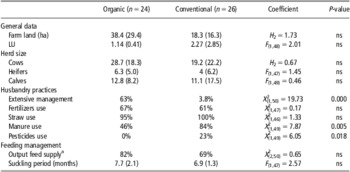
General information of the 24 organic and 26 conventional farms participating is summarised in Table 1. Livestock density unit per hectare (LU) was significantly fewer for organic farms; hence, the stock density on conventional farms was twice that of organic farms. The main differences between organic and conventional farms were related to husbandry practices. For the organic farms, the most common type of housing was an extensive system often with housing in covered yards followed by a semi-extensive system with cubicles using straw bedding or other litter materials. In contrast, extensive systems were very uncommon on conventional farms, which mostly had semi-extensive (54%) systems. In relation to other husbandry practices, organic farms significantly differ from conventional farms in the use of fertilisers and pesticides. The feeding management was similar on organic and conventional farms for cows and calves. However, concentrate in organic farms was exclusively offered to suckling and finishing calves.
Descriptive general information on some characteristics in the studied 24 organic and 26 conventional farms participating, obtained from the completion of questionnaires to farmers

LU = livestock density per hectare.
Figures are presented as mean (s.d.) or percentage.
aOutput feed supply: purchased grown feeds and concentrates.
Farm buildings, at the stage of farm inspection on organic farms, offer to animals optimum conditions (natural ventilation and light, homogeneous stock density on pens). Livestock have free access to water and feed. Finally, poor animal welfare practices, such as tail cutting, castration and tethering, were not carried out in our organic farms, although some farms (33%) still (but not routinely) practised dehorning.
In relation to reproductive performance, the average percentage (s.d.) of calving was significantly higher (P < 0.05) on conventional (77% (21.5)) than on organic farms (63% (21.8)); with calculations based on the model proposed by Caldow et al. (Reference Caldow, Riddell, Stuart and Lowman2007). The percentage of fattened calves or designated breeding stock replacement animals did not differ between farming types (data not shown).
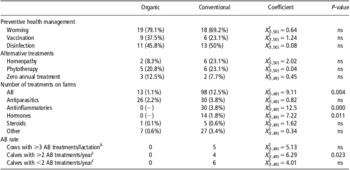
Main results related to animal health management and routines of chemotherapeutical treatments are presented in Table 2. Conventional farms did not differ from organic farms in any of the preventive actions. In terms of treatments, the use of homoeopathy and phytotherapy did not differ between farm systems. The use of chemotherapy (antibiotics, anti-inflammatories and hormones) was significantly higher in conventional than in organic farms.
Summary of total number of health management and chemotherapeutical treatments over the 24 organic and 26 conventional Spanish beef farms that participated in our study. Number of treatments on farms, treatment incidenceFootnote a (in brackets) and AB rate according to farm type are also presented

AB = antibiotics.
a Treatment incidence calculation: number of new events/total number of animals at risk. The number of animals at risk were 1086 in organic farms and 786 in conventional farms.
b Calculation: number of treatments with antibiotics /total number of cows per lactation present in the farm in 2007.
c Calculation: number of treatments with antibiotics /total number of calves present in the farm in 2007.
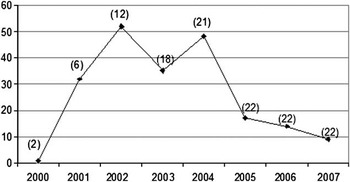
The number of veterinary interventions as an indicator of disease appearance is presented in Figure 1. The longer the organic farms had been established, the fewer interventions happened, even though the number of organic farms increased during the period 2000 to 2007.
Number of total veterinary interventions per year across all the organic farms of our study (n = 22). Health card information was not available from the initiation of organic status for two farms. The number of farms with organic status in each year is presented in brackets.

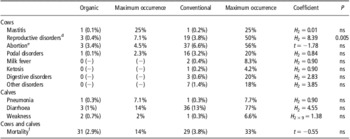
A summary of the different disease events and incidences at the farm level are presented in Table 3. Overall, the most affected farm of each disorder presented higher occurrences in conventional than in organic farms. Compared with conventional farms, only reproductive disorders were significantly lower in organic farms.
Aggregate number of all veterinary treatmentsFootnote a in the studied 24 organic and 26 conventional farms in 2007. Information of disease incidenceFootnote b (in brackets) according to farm type, and the maximum occurrencec in a farm are also presented

The number of animals at risk were 780 cows and 306 calves (organic farms) and 498 cows and 288 calves (conventional farms).
a Veterinary treated cases of each disease. A re-treatment within a certain qualification period was not counted as a new case.
b Disease incidence calculation: number of new events of a disease/total number of animals at risk in 2007.
c Maximum occurrence is the highest occurrence observed in a farm.
d Reproductive disorders: retained placenta, dystocia, caesareans and infections after birth per cows at risk in 2007.
e Abortion calculation: number of abortions/number of females that calved in 2007 (Reference Caldow, Riddell, Stuart and LowmanCaldow et al., 2007).
f Mortality calculation: number of death animals in 2007/herd size.
Slaughtering phase analysis
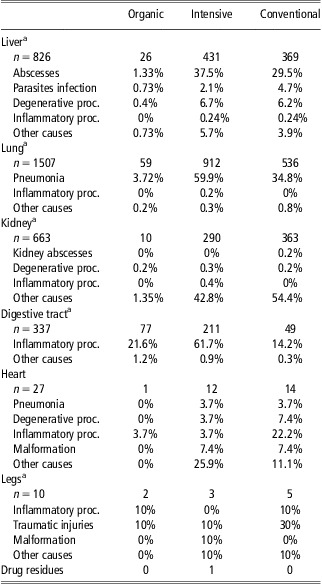
Data distribution of observations according to the post-mortem inspection from organic, conventional and intensive calves retrieved from the slaughterhouse in 2007 is presented in Table 4. In all, 26% of all animals had at least one pathological code recorded. The highest proportion of condemnations was because of pathologies observed in the lung, liver, kidney and digestive tract.
Summary of post-mortem condemnations from the carcass of 244 organic, 2596 intensive and 3021 conventional beef calves from the 2007 yearbook of a slaughterhouse

Degenerative proc. = degenerative processes; Inflammatory proc. = inflammatory processes.
Condemnations are presented as number of total cases per viscera (n) and as a percentage of each viscera with a corresponding pathological lesion.
aSignificant differences in the number of total cases in the viscera between farm systems.
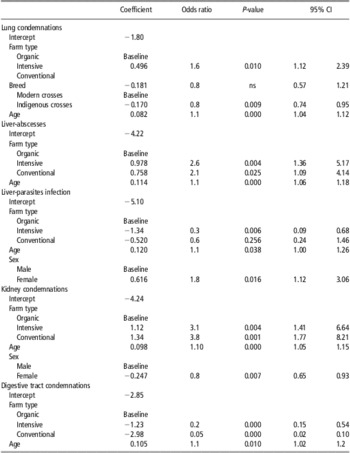
Results from the logistic regression models of the appearance of the most common condemnations in organic, intensive and conventional calves are presented in Table 5. Farm type was a significant predictor in all the models. Higher risk of lung condemnations was significantly associated with intensive calves compared with the organic systems. Higher risk for infections caused by liver parasites and digestive tract lesions were significantly observed in organic calves differing from intensive and also from conventional calves (the last only for digestive lesions). In contrast, higher risks for liver abscesses for intensive and conventional calves were observed compared with organic calves. Apart from farm type, another significant predictor in all the models was the age. Elder calves presented more cases of condemnations. Sex and breed were significant in some of the models. Females were associated with a higher appearance of hepatic abscesses and lower risk for renal lesions. Breed was only found as a significant predictor in the model of lung condemnations with the rustic breeds being at lower risk.
Results of the final mixed logistic regression models on the effects of farm type on the appearance of predominant condemnations in the carcass of organic, intensive and conventional Spanish beef calves (n = 5861)

CI = confidence interval.
Carcass hygiene records were obtained from the 2007 yearbook of a slaughterhouse.
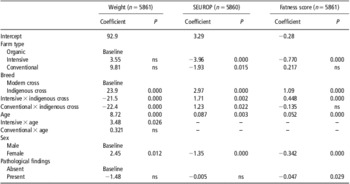
Results of carcass weight, SEUROP classification and fatness score models for the analyses of the effect of farm type on carcass quality with data from organic, intensive and conventional calves are presented in Table 6.
Fixed effect coefficients and P-values for carcass weight, SEUROP system classification and fatness score from three linear regression models using the data of organic, intensive and conventional Spanish beef calves

In the model for carcass weight, two interactions were found. The first interaction in the model between farm type and breed showed that intensive calves of rustic breeds had significantly lower carcass weight than those of rustic breeds from organic farms. The second interaction of farm type and age showed that elder intensive calves presented higher carcass weights. Despite the fact that intensive system was the group that mostly interacted, the carcass weight of calves from intensive farms was less variable than those of calves from conventional and especially from organic farms (coefficients of variation: 17.2, 24.4 and 28.2, respectively). From the other predictors investigated, females presented higher carcass weight. A third interaction was evaluated for age and sex, and was found to approach significance (P = 0.055). From the classification of carcasses under the SEUROP system, the interaction term between farm type and breed showed that conventional and intensive farms calves were associated with lower scores of SEUROP classification than those from organic farms in the case of rustic breed calves. The other predictors that were also significant in the model explained that males reached better scores in the SEUROP system and calves had slightly worse classification with increasing age. Calves with records of pathological findings were not associated with the scoring of the SEUROP system. In the fatness model, the interaction term explained that calves from intensive farms and rustic breeds, obtained fattier carcasses than those from organic farms. Females and the presence of condemnations were significantly related to leaner carcass and elder calves with fattier carcass.
Discussion
Most of the organic beef cattle farms in Galicia may have been more extensively outdoor conventional beef cattle farms that were able to convert to organic status most easily. This is supported by the significantly higher farmland area but lower LU of organic farms. Difficulties to deal with it seem in part to be related to the non-use of alternative treatments. However, this low use was common on both farms types and may be explained by their lack of scientific proof (Van der Meulen et al., Reference Van der Meulen, Van der werf and Kijlstra2006).
Although higher treatment incidence and wide range of diseases were observed on conventional farms, in general they did not differ significantly. The higher use of chemotherapeuticals we found on conventional farms is not conclusive of a better or worse health status in organic farms based on farm data. They also give no indication of whether such incidences of disease occur ‘because of’, or ‘in spite of’ adherence to the European Union Regulation. Interpretations of our findings do not exclusively involve the disease itself. It may have more to do with the effect of a less-intensive observation of animals in the organic systems. A different reason could be the restrictions in terms of chemotherapeutical treatments with the organic rules as a starting point. Organic rules restrain the administration of antibiotics, which may lead to think that organic farmers are more unwilling to consult veterinarians for diseased animals, but such indications could not be confirmed in our study as long as poor health (and welfare) status was not observed in organic farms. In contrast, it should be considered that preconditions of better health in organic farms were observed in our study – for example, contributing factors such as the limitation of intensification management (Sundrum et al., Reference Sundrum, Schneider and Richter2005), as well as gained knowledge and experience of organic farmers on practices over time, which, over the long term, would be expected to result in improved farm health (Lund and Algers, Reference Lund and Algers2003). These preconditions could explain the lower frequency of chemotherapeutical treatments, although the number of organic farms is indeed constantly growing, agreeing with the findings of Hamilton et al. (Reference Hamilton, Hansson, Ekman, Emanuelson and Forslund2002) who found a lower mean incidence for all veterinary treated cases in Swedish organically managed cows compared with conventionally managed cows. However, our results contrasted with the findings of Vaarst and Hovi (Reference Vaarst and Hovi2004) who found that the use of antibiotics on organic and conventional farms were similar.
In our study, differences in farm size and reproductive performance may contribute to the slight differences in health (mainly reproductive) problems observed between organic and conventional farms. The lower incidence of reproductive disorders in organic farms could be interpreted as the lower number of births and a lower replacement index of the farms, thus accentuating differences with conventional farms. This lower reproduction performance on organic farms was described before (Reksen et al., Reference Reksen, Tverdal and Ropstad1999) and was attributed to a deficit of nutritional energy during the winter season. However, in our study, the relatively poor fertility of organic farms was most likely related to the ‘natural’ physiology of rustic breeds (more used in our sampled organic farms), seasonal calving and an extensive management that is adapted to the optimum periods of grass growth.
The pathological records of the animal at slaughter manifested the impact of husbandry and feeding practices on the health of animals. The high incidence of lung condemnations (mostly pneumonia) in intensive than in organic calves, similarly observed in pigs (Hansson et al., Reference Hansson, Hamilton, Ekman and Forslund2000; Baumgartner et al., Reference Baumgartner, Leeb, Gruber and Tiefenbacher2003), may be explained by the permanent indoor conditions, which may have been overcrowded and/or poorly ventilated (Grandin, Reference Grandin1997). Conversely, the higher frequency of liver abscesses in intensive compared with organic calves may be related to feeding regimes. Unlike all intensive farms, organic farms provide only a low fraction of concentrate in the feed ration and this can prevent rumen acidosis and liver disorders (Owens et al., Reference Owens, Secrist, Hill and Gill1998). Furthermore, calves that competed for feed in crowded penning (as might be most likely to occur on intensive farms) had twice as many instances of abscessed livers (Welfare Quality, 2008). For instance, the highest percentage of parasitic infections in the liver of organic calves may be related to the grazing management on organic farms similar to that reported earlier (Hansson et al., Reference Hansson, Hamilton, Ekman and Forslund2000), in contrast to permanent indoor conditions and standardised parasite prophylaxis on intensive farms. Pathological findings in the kidney share the same significant predictors of previous models. Since the majority of renal condemnations were coded as “other causes” they could not be explained. Finally, the highest incidence of digestive tract condemnations for organically reared calves in our study probably reflected a predominantly sub-clinical pattern (because it was not observed in the farm phase analysis) and may be associated with diarrhoea or mucosal lesions that are related to feeding behaviour and supply in extensive systems (Vaarst and Hovi, Reference Vaarst and Hovi2004).
Our study has demonstrated that the generally promoted view that organic farming concentrates more on product quality than on quantity (Hermansen and Zervas, Reference Hermansen and Zervas2004) may not be completely true and agree with Sundrum (Reference Sundrum2001) who reported that there was little evidence of any impact of organic production on product quality. Although the percentage of condemnations in organically reared calves was generally lower than those from intensive and conventional systems (better hygienic quality), other aspects of product quality (beef performance) that we analysed were of poor quality in organic farms.
The highest mean and also most homogenous carcass weights of intensive calves may be partly related to the higher age at slaughter of animals from intensive farms and the lower breed diversity (mostly modern crosses), although the indigenous crosses seem to reach a better adaptability (and performance) in the organic than the intensive and conventional systems as manifested the interaction term in the three models. We assumed that other underlying mechanisms related to our main predictor, farm type, such as standardised husbandry and management of indoor practices, a low dependence on local feed and little influence of seasonal and environmental conditions and a high proportion of concentrate that leads to higher fat deposition and energy retention (Galyean and Rivera, Reference Galyean and Rivera2003) may also contribute to the figures observed in intensive farms. In contrast, all these factors are likely to exert a maximal (and potentially adverse) effect on beef performance in organically reared calves that present a heterogeneous group of rustic breeds with slower biorhythms and fed higher proportion of roughage needing more time to fatten (Nielsen and Thamsborg, Reference Nielsen and Thamsborg2005).
Conclusions
By focussing on different levels of assessment, we can conclude that organic and conventional beef cattle farms did not substantially differ on animal health, but the lack of official farm data remains one of the most difficult aspect for a comprehensive picture of disease status on extensive beef production systems. However, the evaluation of condemnations at slaughter evidenced that organic calves presented fewer condemnations compared with intensive and to a lesser extent with conventional calves. The examination of the slaughter data is needed for an improvement of health assessment because it emanates the distribution of pathological events, is a good control measure of sub-clinical disorders and shows associations with a specific farm type and corresponding husbandry practices. Carcass performance also reflected differences between farm type and breed and was not necessarily better in organic farms.
Acknowledgements
This study was supported by the Xunta de Galicia (Spain; PGIDT02RA6261001PR) and I.B.P. received a research fellowship (AP2003-3835) from the Ministry of Science of Spain. We thank farmers, veterinarian clinics, veterinarian inspectors and employees of the slaughterhouse Cocarga (A Estrada, Galicia) for the facilities to develop this study and Dr Marie Mörk for statistical assistance.