





Introduction
European health systems should strive to become more people centred (Nolte et al., Reference Nolte, Merkur and Anell2020) by positioning primary health care (PHC) as ‘the centrepiece’ (World Health Organization [WHO] Regional Office for Europe, 2021:18) of service delivery. The PHC approach fosters access to and supports the quality of services by providing a link between health systems and communities and by fostering community participation (CP) in decision-making processes in health matters (Rouleau et al., Reference Rouleau, Rajan, Winkelmann, Kringos, Melitta, Faraz, Lessof, Porignon and Schmets2024). In this regard, empowered people and communities are seen as fundamental to the PHC approach (WHO and United Nations Children’s Fund, 2018). CP and community empowerment (CE) have common features; for example, they both focus on the active involvement and enablement of communities to influence life-affecting decisions (Popay, Reference Popay, Morgan, Davies and Ziglio2010). However, whereas CP fosters involvement to varying degrees, from supporting CE and helping communities gain power and control over decisions to engaging in processes where power dynamics are not addressed at all, CE has an explicit mandate to challenge power relations and bring about social and political change to address social justice (Popay, Reference Popay, Morgan, Davies and Ziglio2010; Popay et al., Reference Popay, Whitehead, Ponsford, Egan and Mead2021).
The promotion of CP and CE has been linked to improved health outcomes (O’Mara-Eves et al., Reference O’Mara-Eves, Brunton, McDaid, Oliver, Kavanagh, Jamal, Matosevic, Harden and Thomas2013), greater health equity and social justice (WHO, 1978; Rajan et al., Reference Rajan, Rouleau, Winkelmann, Kringos, Jakab and Khalid2024).
Furthermore, CP and CE can add service value by improving partnerships between health services and the community, leading to a better understanding of community needs and, ultimately, the development of favourable living environments (Pedersen et al., Reference Pedersen, Overgaard, Egilstrød and Petersen2022a). However, unintended negative outcomes have also been reported, such as the need for community members to invest resources that disadvantaged subgroups may lack. Thus, unequal participation, weak or uncertain influence of citizens’ voices, and power imbalances between community groups and service providers can emerge (Pedersen et al., Reference Pedersen, Overgaard, Egilstrød and Petersen2022a). Moreover, groups in difficult life situations, e.g., people with chronic health conditions, can be overwhelmed by CP approaches (Labonte, Reference Labonte1993; Heumann et al., Reference Heumann, Röhnsch and Hämel2022). Therefore, CP strategies tailored to target groups are needed, considering the multifaceted nature of the conditions faced by group members (Heumann et al., Reference Heumann, Röhnsch and Hämel2022). Finally, the outcomes of CP are still difficult to measure, not least because of the complexity of the phenomenon and its various definitions (Rifkin, Reference Rifkin2014).
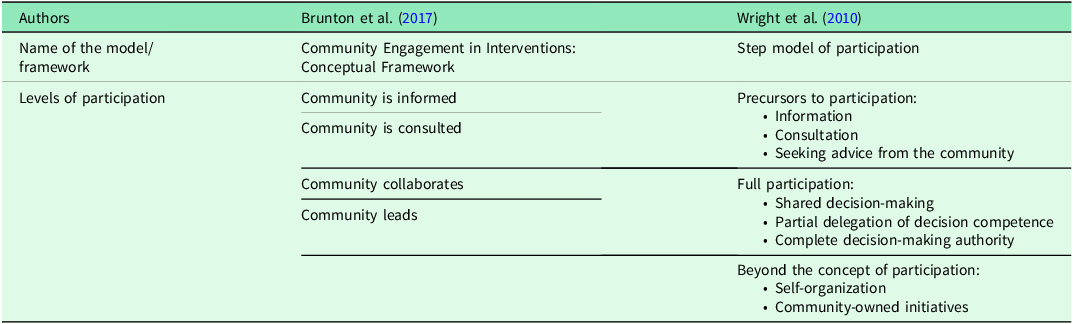
On the basis of Arnstein (Reference Arnstein1969), different levels of CP in decision-making processes, ranging from low to high, have been suggested for health. Table 1 compares the CP levels of Wright et al. (Reference Wright, Von Unger, Block and Wright2010) and Brunton et al. (Reference Brunton, Thomas, O’Mara-Eves, Jamal, Oliver and Kavanagh2017).
Comparison of the levels of community participation used for this study according to Wright et al. (Reference Wright, Von Unger, Block and Wright2010) and Brunton et al. (Reference Brunton, Thomas, O’Mara-Eves, Jamal, Oliver and Kavanagh2017)

Table 1. Long description
A table comparing levels of community participation models by Brunton et al. (2017) and Wright et al. (2010). The table has two columns and four rows. Column headers are Authors and Name of the model/framework. Row labels include Levels of participation, Community is informed, Community is consulted, Community collaborates, Community leads, Beyond the concept of participation. Row 1: Authors, Brunton et al. (2017), Wright et al. (2010). Row 2: Name of the model/framework, Community Engagement in Interventions: Conceptual Framework, Step model of participation. Row 3: Levels of participation, Community is informed, Community is consulted, Precursors to participation: Information, Consultation, Seeking advice from the community. Row 4: Community collaborates, Community leads, Full participation: Shared decision-making, Partial delegation of decision competence, Complete decision-making authority. Row 5: Beyond the concept of participation, Self-organization, Community-owned initiatives.
Elaboration and translation by the authors.
These participation models, if used as analysis instruments, can assist in critically questioning CP and CE practices and considering possible improvements (Wright, Reference Wright, Rosenbrock and Hartung2012).
Study setting: Case della Comunità in Emilia-Romagna
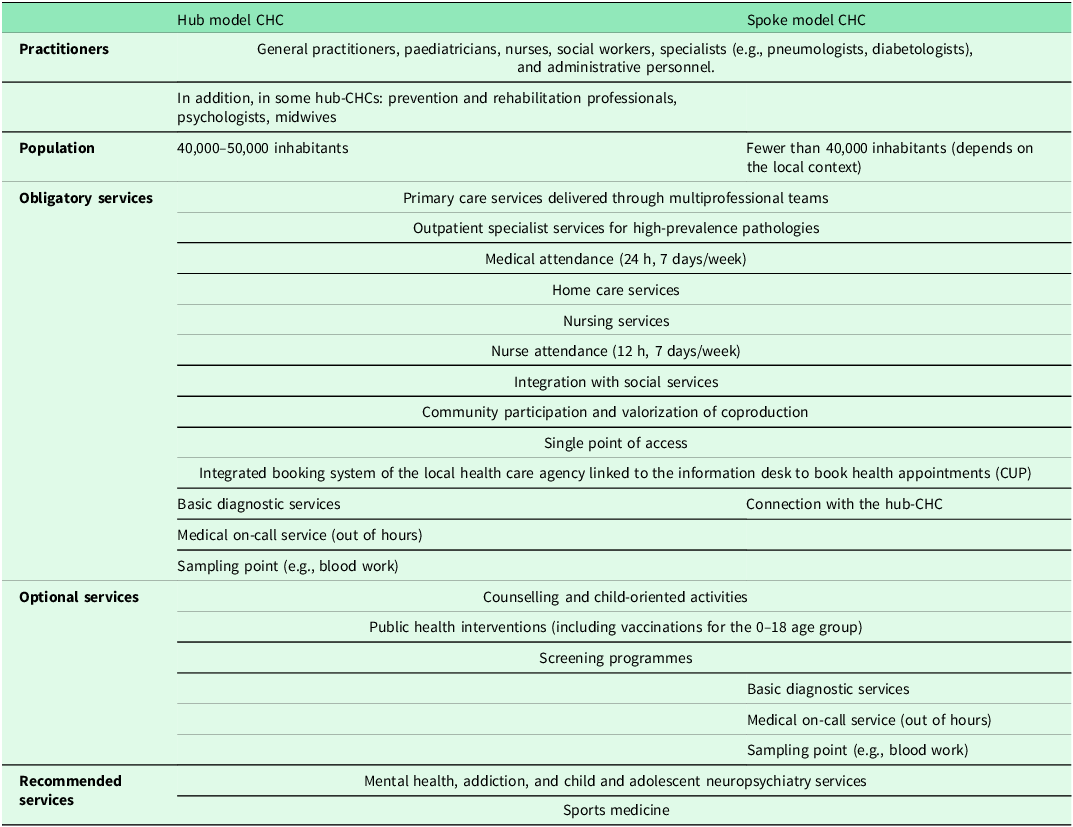
In Italy, PHC is provided mainly by general practitioners (GPs) and paediatricians who work in single practices (De Belvis et al., Reference De Belvis, Meregaglia, Morsella, Adduci, Perilli, Cascini, Solipaca, Fattore, Ricciardi, D’Agostino, Maresso and Scarpetti2024). In addition, self-employed GPs are increasingly expected to spend some practice hours in community health centres (CHCs) on the basis of national and regional collective agreements with the NHS (Conferenza delle regioni e delle province autonome, 2025; Struttura Interregionale Sanitari Convenzionati, 2025). CHCs aim to provide comprehensive, interprofessional and intersectoral community care; enforce prevention and health promotion; and cultivate a new vision of health (Ministero della Salute [MdS], 2007). They take two forms, the hub model and the spoke model, and are run by Local Health Care Authorities (LHCAs), that also employ the other health professionals practising in CHCs (e.g., nurses, midwives and administrative personnel) (Ministero della Salute, 2022) (see Table 2).
Community health centres’ characteristics and services

Table 2. Long description
A table comparing the characteristics and services of hub and spoke model community health centres. The table has four rows and three columns. Column headers are Hub model CHC, and Spoke model CHC. Row labels include Practitioners, Population, Obligatory services, Optional services, and Recommended services. Row 1: Practitioners, Hub model CHC: General practitioners, paediatricians, nurses, social workers, specialists (e.g., pneumologists, diabetologists), and administrative personnel. In addition, in some hub-CHCs: prevention and rehabilitation professionals, psychologists, midwives. Spoke model CHC: General practitioners, paediatricians, nurses, social workers, specialists (e.g., pneumologists, diabetologists), and administrative personnel. Row 2: Population, Hub model CHC: 40,000–50,000 inhabitants. Spoke model CHC: Fewer than 40,000 inhabitants (depends on the local context). Row 3: Obligatory services, Hub model CHC: Primary care services delivered through multiprofessional teams. Outpatient specialist services for high-prevalence pathologies. Medical attendance (24 h, 7 days/week). Home care services. Nursing services. Nurse attendance (12 h, 7 days/week). Integration with social services. Community participation and valorization of coproduction. Single point of access. Integrated booking system of the local health care agency linked to the information desk to book health appointments (CUP). Basic diagnostic services. Medical on-call service (out of hours). Sampling point (e.g., blood work). Spoke model CHC: Primary care services delivered through multiprofessional teams. Outpatient specialist services for high-prevalence pathologies. Medical attendance (24 h, 7 days/week). Home care services. Nursing services. Nurse attendance (12 h, 7 days/week). Integration with social services. Community participation and valorization of coproduction. Single point of access. Integrated booking system of the local health care agency linked to the information desk to book health appointments (CUP). Connection with the hub-CHC. Basic diagnostic services. Medical on-call service (out of hours). Sampling point (e.g., blood work). Row 4: Optional services, Hub model CHC: Counselling and child-oriented activities. Public health interventions (including vaccinations for the 0–18 age group). Screening programmes. Spoke model CHC: Basic diagnostic services. Medical on-call service (out of hours). Sampling point (e.g., blood work). Row 5: Recommended services, Hub model CHC: Mental health, addiction, and child and adolescent neuropsychiatry services. Sports medicine. Spoke model CHC: Mental health, addiction, and child and adolescent neuropsychiatry services. Sports medicine.
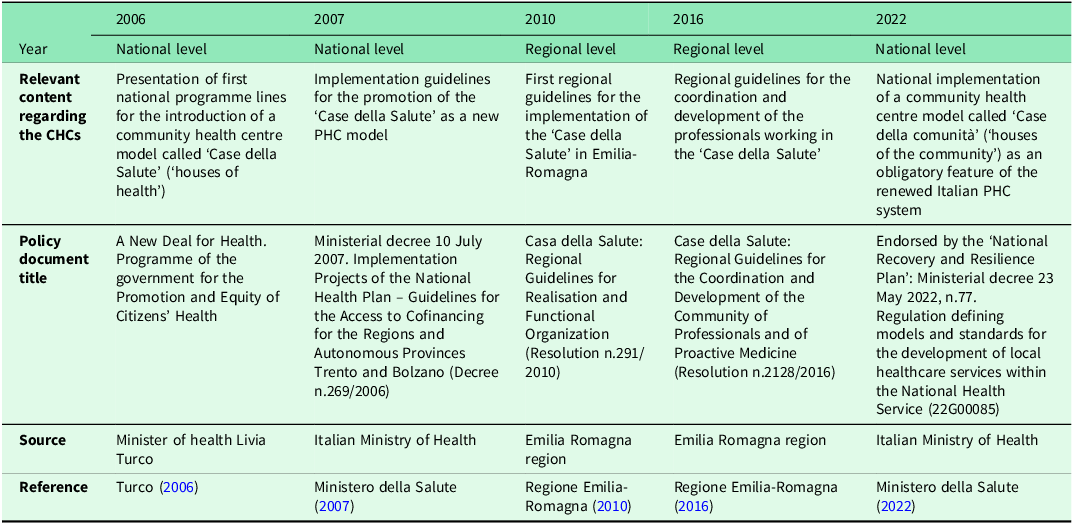
In 2010, Emilia-Romagna, as one of the first regions, adopted the CHC model called ‘Casa della Salute’ and reported great advancements in their implementation as well as in the development of CP in the following years (Luisi and Hämel, Reference Luisi and Hämel2021; Ministero della Salute, 2022). While a few other Italian regions followed this example, it was not until 2022 that a nationwide implementation took place. This was accompanied by a conceptual revision of the CHC model, now referred to as the ‘Casa della Comunità’. This updated terminology underscores the desired paradigmatic shift towards a stronger collaboration with the community (Ingrosso, Reference Ingrosso2022; Ministero della Salute, 2022). Table 3 provides an overview of the development of CHCs in Italy.
Development of the implementation of community health centres (CHCs) in Italy and in the Emilia-Romagna region from the ‘Casa della Salute’ (‘house of health’) to the ‘Casa della Comunità’ (‘house of the community’) according to the most relevant policy documents from 2006 to 2022

Table 3. Long description
A table comparing the development of community health centers (CHCs) in Italy from 2006 to 2022. The table has five columns labeled Year, Relevant content regarding the CHCs, Policy document title, Source, and Reference. It has five rows with the following data: Row 1: Year: 2006, National level, Presentation of first national programme lines for the introduction of a community health centre model called ‘Case della Salute’ (’houses of health’), A New Deal for Health. Programme of the government for the Promotion and Equity of Citizens’ Health, Minister of health Livia Turco, Turco (2006). Row 2: Year: 2007, National level, Implementation guidelines for the promotion of the ‘Case della Salute’ as a new PHC model, Ministerial decree 10 July 2007. Implementation Projects of the National Health Plan – Guidelines for the Access to Cofinancing for the Regions and Autonomous Provinces Trent and Bolzano (Decree n.269/2006), Italian Ministry of Health, Ministero della Salute (2007). Row 3: Year: 2010, Regional level, First regional guidelines for the implementation of the ‘Case della Salute’ in Emilia-Romagna, Casa della Salute: Regional Guidelines for Realization and Functional Organization (Resolution n.291/2010), Emilia Romagna region, Regione Emilia-Romagna (2010). Row 4: Year: 2016, Regional level, Regional guidelines for the coordination and development of the professionals working in the ‘Case della Salute’, Case della Salute: Regional Guidelines for the Coordination and Development of the Community of Professionals and of Proactive Medicine (Resolution n.2128/2016), Emilia Romagna region, Regione Emilia-Romagna (2016). Row 5: Year: 2022, National level, National implementation of a community health centre model called ‘Case della Comunità’ (’houses of the community’) as an obligatory feature of the renewed Italian PHC system, Endorsed by the ‘National Recovery and Resilience Plan’: Ministerial decree 23 May 2022, n.77. Regulation defining models and standards for the development of local healthcare services within the National Health Service (22G00085), Italian Ministry of Health, Ministero della Salute (2022).
Elaboration and translation by the authors (see also Luisi and Hämel, Reference Luisi and Hämel2021).
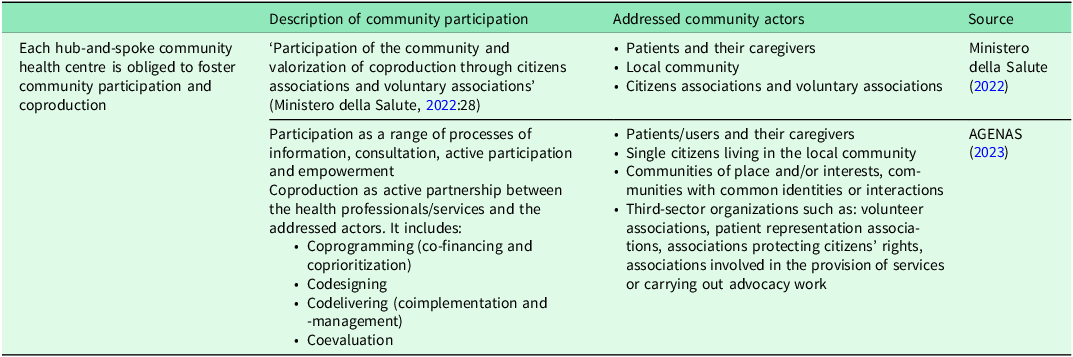
Considerable differences in the implementation of CHCs still exist across regions (Agenzia Nazionale per i Servizi Sanitari Regionali [AGENAS], 2025), not least because of a decentralized NHS with large regional disparities: Compared with the southern Italian regions, the northern and central regions have greater availability of health professionals, higher capacity of health care infrastructure and better access to and provision of services (De Belvis et al., Reference De Belvis, Meregaglia, Morsella, Adduci, Perilli, Cascini, Solipaca, Fattore, Ricciardi, D’Agostino, Maresso and Scarpetti2024). In 2025, across Italy, 660 CHCs were operating, 140 of which are located in the Emilia-Romagna region, and almost none in the southern regions (AGENAS, 2025). CP is a mandatory feature of each CHC; it is defined in terms of CP practices and addresses specific community actors (see Table 4) (Ministero della Salute, 2022; AGENAS, 2023).
Description of community participation and addressed community actors in the context of Italian community health centres

Table 4. Long description
A table with four rows and four columns. The columns are labeled ‘Description of community participation’, ‘Addressed community actors’, and ‘Source’. The rows describe, according to each source, how comunity participation is described and which actors are involved. Column 1: Each hub-and-spoke community health center is obliged to foster community participation and coproduction. Row 1, column 2 : Description of community participation according to the source Ministero della Salute (2022). It includes participation of the community and valorization of coproduction through citizens associations and voluntary associations. Addressed community actors are patients and their caregivers, local community, and citizens associations and voluntary associations. Source is Ministero della Salute (2022). Row 2, column 3: Description of community participation according to the source AGENAS (2023). Here, participation as a range of processes of information, consultation, active participation, and empowerment. Coproduction as active partnership between the health professionals/services and the addressed actors. Includes coprogramming, codesigning, codelivering, and coevaluation. Addressed community actors are patients/users and their caregivers, single citizens living in the local community, communities of place and/or interests, communities with common identities or interactions, and third-sector organizations. Source is AGENAS (2023).
However, the lack of CHCs in some regions might contribute to the unequal distribution of PHC participation opportunities. Moreover, it is unclear whether the conditions faced by the GPs who work hourly in CHCs with limited (time) resources (Giosa, Reference Giosa2024) have an influence on the GPs’ long-lasting support of CP and CE processes.
Despite the many current developments, systematic empirical knowledge of how CP and CE processes are shaped in highly professionalized European PHC systems, such as Italian PHC systems, is lacking (see Luisi and Hämel, Reference Luisi and Hämel2021, Reference Luisi and Hämel2024; Ingrosso, Reference Ingrosso2022). Drawing on the case of CHCs in Emilia-Romagna, we aim to address this gap by presenting and discussing good-practice examples.
Aim of the study
This study examines how CP and CE processes are promoted and shaped in CHC practice by analysing the methods used, target community groups, goals and reported potential benefits. Our analysis is guided by participation levels and an examination of the degree of CP and contributes to the ongoing discussion on how to strengthen meaningful CP and CE in PHC.
Methods
Study design
We adopted a qualitative exploratory design that allows us to describe in detail novel social phenomena and processes that have thus far received little research attention (Pope and Mays, Reference Pope and Mays1995). For this purpose, we conducted semistructured interviews with practitioners and stakeholders who were involved in the development of CP and CE processes in the context of CHCs in the Emilia-Romagna region. The practitioners had specific working expertise, and the stakeholders provided a comprehensive overview of such processes at the local and regional levels (Meuser and Nagel, Reference Meuser, Nagel, Bogner, Littig and Menz2002). Some of the stakeholders also had practical insights into CP and CE processes. This study is part of a larger study on the topic of CP and CE in CHCs in Emilia-Romagna. A detailed description of the methodological approach can be found elsewhere (Luisi and Hämel, Reference Luisi and Hämel2024).
Sampling and field access
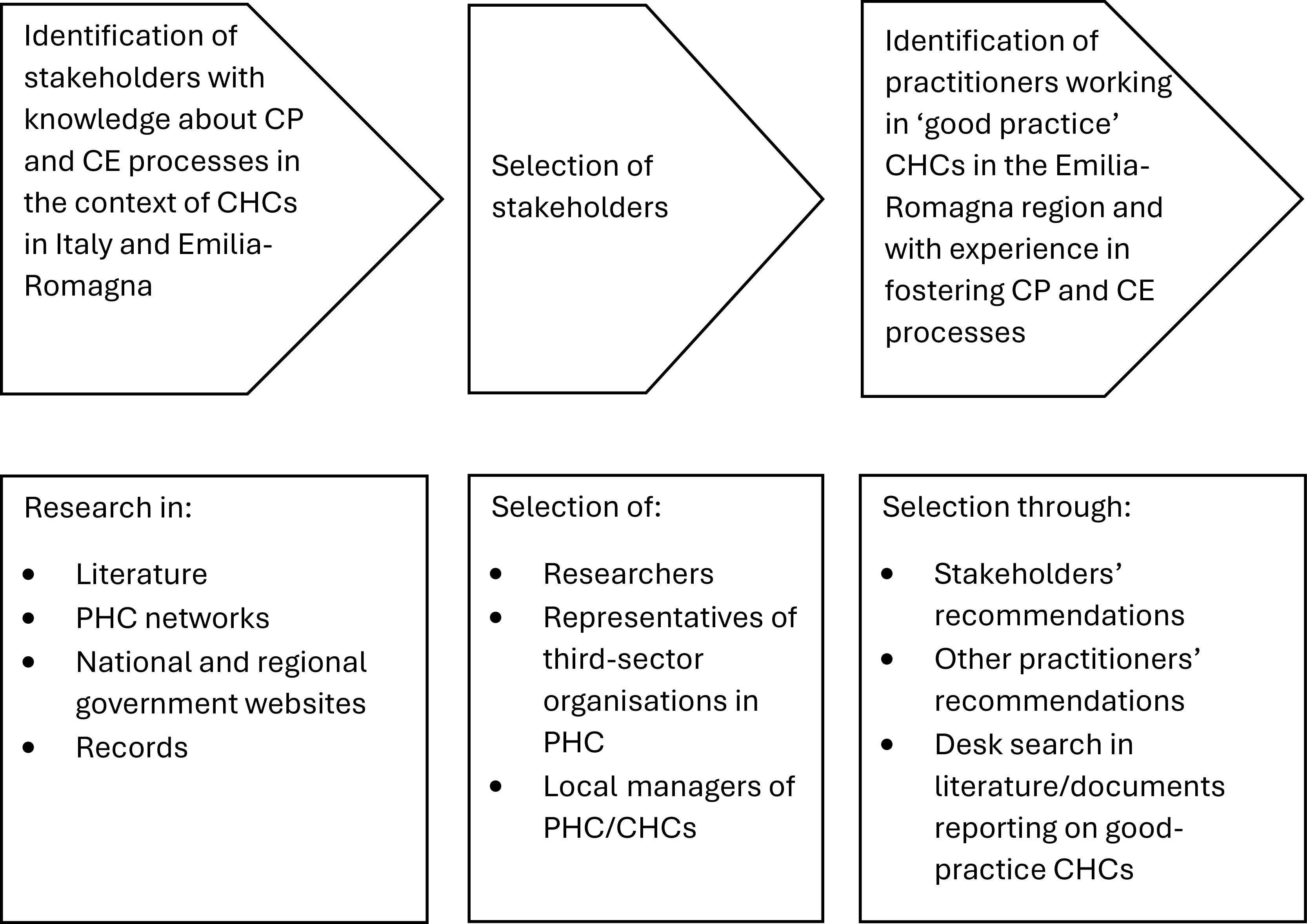
In line with Patton (Reference Patton1990), we chose a purposive and snowball sampling strategy (see Figure 1).
Sampling strategy. Process of identification of the sampling by first starting with desk search of eligible stakeholders at the national level and regional level, their purposive selection, and then the identification of practitioners working in health centres in the Emilia-Romagna region through desk search and recommendations from other interviewed stakeholders and practitioners.

To obtain comprehensive data on the topic, we selected cases from a range of good-practice CHCs from different settings (e.g., CHCs in distinct provinces under different LHCAs, hub and spoke CHCs in rural and urban areas).
The period of recruitment was the 2nd of October, 2020, through the 31st of May, 2021. Prior to the interviews, the participants received written information about the study. We stopped looking for interviewees when the information collected began to be repeated (data saturation), and the data allowed us to properly determine themes. Ultimately, we interviewed 19 people (six stakeholders and 13 practitioners). Their professional backgrounds included medicine (n = 8); nursing (n = 3); pedagogy (n = 2) and others (n = 6), such as health management, psychology and economics. The interviewees referred to practice examples from 14 different CHCs. A complete description of the sample can be found here: https://doi.org/10.1371/journal.pone.0310137.t001 (Luisi and Hämel, Reference Luisi and Hämel2024).
Data collection
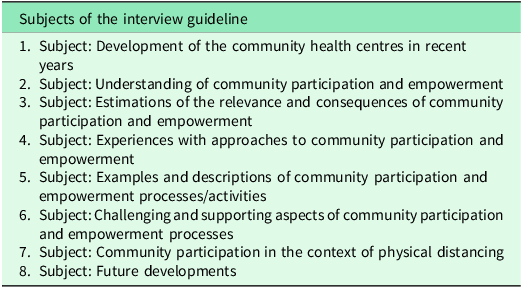
The interview guideline consisted of open-ended questions that covered eight subjects (see Table 5).
Subjects of the interview guideline on the topic of community participation and empowerment processes in the context of community health centres in the Emilia-Romagna region, Italy

Table 5. Long description
A table listing eight subjects of an interview guideline on community participation and empowerment in health centers. The table has one column labeled ‘Subjects of the interview guideline’ and eight rows detailing the subjects. Row 1: Subject: Development of the community health centres in recent years. Row 2: Subject: Understanding of community participation and empowerment. Row 3: Subject: Estimations of the relevance and consequences of community participation and empowerment. Row 4: Subject: Experiences with approaches to community participation and empowerment. Row 5: Subject: Examples and descriptions of community participation and empowerment processes/activities. Row 6: Subject: Challenging and supporting aspects of community participation and empowerment processes. Row 7: Subject: Community participation in the context of physical distancing. Row 8: Subject: Future developments.
The guideline is available at https://doi.org/10.1371/journal.pone.0310137.s002 (Luisi and Hämel, Reference Luisi and Hämel2024).
Owing to the COVID-19 pandemic, the first author conducted all the interviews, which lasted 1–3 hours each, online using the Zoom platform. The first author did not know any of the interviewees beforehand, has experience with conducting qualitative research, and has a background in occupational therapy and public health.
Data analysis
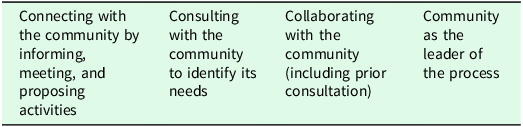
The computer programme ‘easytranscript’ was used to fully transcribe and anonymize the audio-recorded interviews. Transcript coding was performed with the use of Word documents and MAXQDA 12 software (VERBI GmbH). We used qualitative content analysis, drawing from the work of Kuckartz and Rädiker (Reference Kuckartz and Rädiker2023). Using the topics from the interview guideline related to the descriptions of CP and CE processes, the first author deductively created a coding system. The levels of participation identified by Brunton et al. (Reference Brunton, Thomas, O’Mara-Eves, Jamal, Oliver and Kavanagh2017) framework (see Table 1) served as a structure for coding the descriptions of the main themes (see Table 6). Each example of a CP and CE process was coded as one unit.
Main themes based on the levels of CP from Brunton et al. (Reference Brunton, Thomas, O’Mara-Eves, Jamal, Oliver and Kavanagh2017)

Table 6. Long description
A table with four columns and four rows describing main themes based on levels of community participation. The columns are labeled as follows: Connecting with the community by informing, meeting, and proposing activities; Consulting with the community to identify its needs; Collaborating with the community (including prior consultation); and Community as the leader of the process. Each row represents a distinct theme related to community participation.
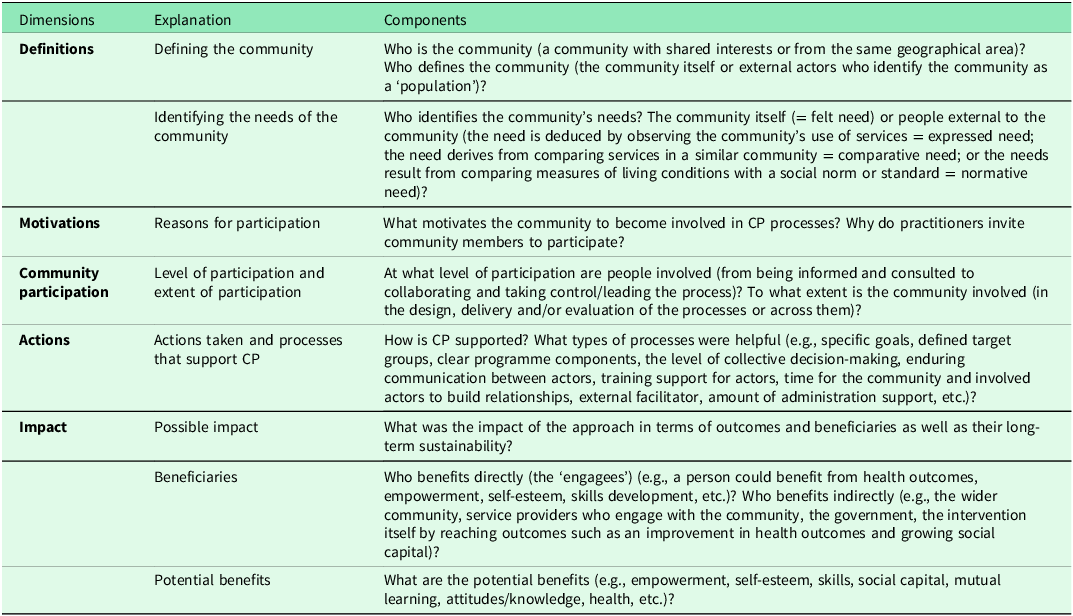
To conduct an in-depth analysis of each example, we used some of Brunton et al. (Reference Brunton, Thomas, O’Mara-Eves, Jamal, Oliver and Kavanagh2017) dimensions, which were the definitions of community, the motivations for its involvement, the level and extent of CP, the actions and the reported impacts of such processes (see Table 7).
Dimensions and components of Brunton et al.’s (Reference Brunton, Thomas, O’Mara-Eves, Jamal, Oliver and Kavanagh2017) framework

Table 7. Long description
A table with six rows and three columns. The columns are labeled Dimensions, Explanation, and Components. The rows are Definitions, Identifying the needs of the community, Motivations, Community participation, Actions, and Impact. Each row provides detailed explanations and components of a community participation framework.
Author’s elaboration, based on Brunton et al.’s (Reference Brunton, Thomas, O’Mara-Eves, Jamal, Oliver and Kavanagh2017) framework.
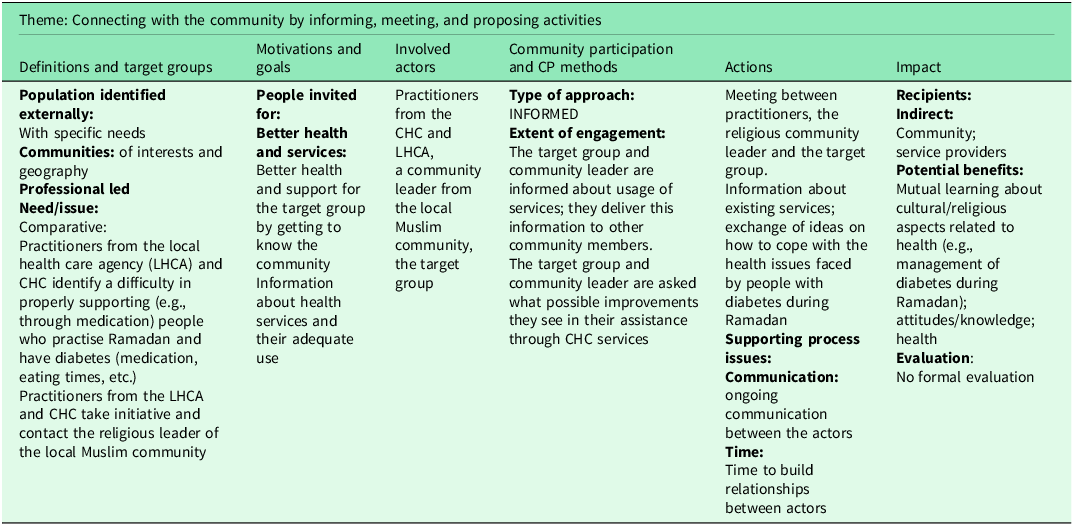
Starting with these dimensions, we then inductively coded the data with codes such as ‘involved actors’, ‘goals’ and ‘CP methods’. Table 8 illustrates how we organized the data obtained from the description and provides an example.
Example: structure of the identified project: meeting the local Muslim community and informing it about services

Table 8. Long description
A table with six columns and five rows detailing a project to meet and inform the local Muslim community about services. The columns are labeled Definitions and target groups, Motivations and goals, Involved actors, Community participation and CP methods, Actions, and Impact. The rows describe the population identified externally, motivations and goals for inviting people, involved actors, type of approach and extent of engagement, actions taken, and the impact on recipients and service providers. The table includes specific details about the target groups, the goals of better health and services, the involved actors from the CHC, LHCA, and the local Muslim community, the informed approach and engagement methods, the actions of meeting and information exchange, and the indirect benefits and mutual learning for the community and service providers.
All coding steps were performed by the first author in close consultation with the second author until an agreement was reached, ensuring consistent data coding and the confirmability of the results.
Results
The reported examples are based on the practitioners’ initial efforts to promote CP approaches. Typically, they had limited timeframes that varied from a few months up to one and a half years. With one exception, the processes were initiated and led by professionals (e.g., CHC staff and practitioners from local health and/or social authorities). One project was initiated and led directly by a community group. The professional-led approaches varied widely. Some followed a structured project format with predefined practitioner goals (e.g., improving health services), with CP at a later stage. Others began with a community needs assessment and were shaped in a more participatory manner. Here, the assessment formed the basis for shared decision-making on goals and actions to meet prioritized needs. Within the same CHC, the degree of CP varied greatly from project to project depending on the goals, the target group and the context of each process.
Connecting with the community by informing, meeting, and proposing activities
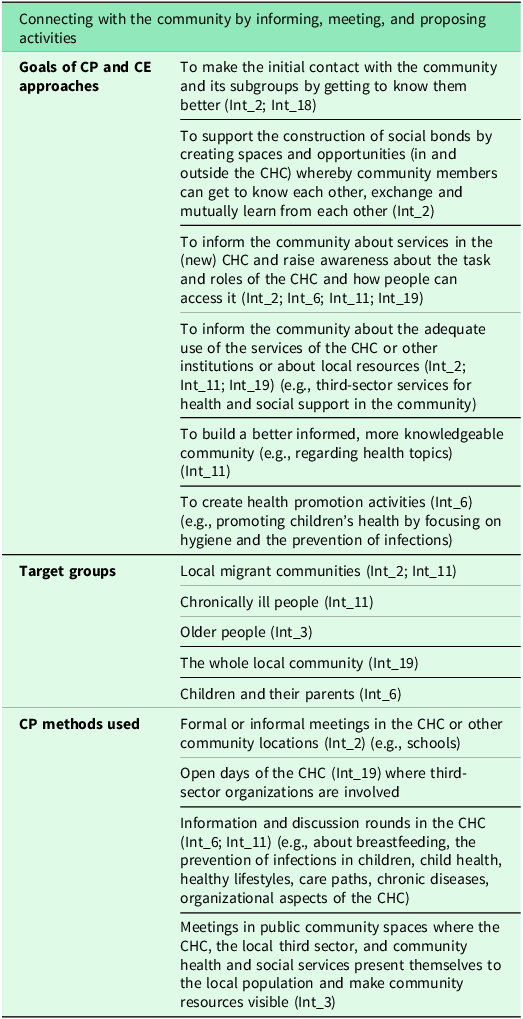
With respect to this theme, we grouped CP processes related to finding ways to connect with the community and its subgroups. The interviewees described these processes as getting in contact with the community by creating opportunities for exchanging information, organizing meetings and by proposing group activities. These moments of encounter and the creation of social networks not only between the practitioners and the community but also among the community members themselves were seen as prerequisites for future collaborations with the community. Table 9 illustrates the goals and methods described by the interviewees in their reports of these approaches.
Connecting with the community by informing, meeting, and proposing activities: reported goals, target groups, and methods aiming to promote CP and CE

Table 9. Long description
The table summarizes approaches for community participation and empowerment. It has three sections. Goals of CP and CE approaches lists six goals: establishing initial contact with the community and its subgroups; strengthening social bonds through opportunities for community members to meet and learn from one another; informing the community about CHC services, roles, and access; informing the community about appropriate use of the CHC, other institutions, and local resources; developing a better-informed community on health topics; and creating health-promotion activities, including children’s health, hygiene, and infection prevention. Target groups include local migrant communities, chronically ill people, older people, the whole local community, and children and their parents. CP methods used include formal and informal meetings at CHCs and other community locations, CHC open days involving third-sector organizations, information and discussion sessions on health and CHC-related topics, and meetings in public community spaces to make health and social services and local resources visible.
Example: meeting the local Muslim community and informing it about services
In this example (see also Table 8), practitioners from the LHCA and CHC were concerned about the health situation of people with diabetes living in the local community and practising Ramadan. The CHC staff noted a lack of knowledge about this community subgroup in terms of its health situation and cultural and religious practices. On the one hand, practitioners perceived an underusage of CHC services by this target group; on the other hand, they did not feel properly prepared to give specific assistance and therefore wanted ‘to improve the approach with this target audience’ (Health-manager-2_par.53). As a result, a team consisting of a GP, a nurse and the diabetologist of the CHC scheduled a meeting with the religious leader and the target group to exchange ideas on how to improve services for people with diabetes during Ramadan and to inform them of existing CHC services and their appropriate use. This meeting was seen as a first step towards building knowledge among CHC staff regarding culturally sensitive support and among members of the target group regarding adequate access to and usage of health services. In this context, the practitioners saw the potential ‘[…] in making [the target group] stronger, in creating an opportunity for empowerment for Muslim citizens with diabetes issues in that territory’ (Health-manager-2_ par.53). In conclusion, as shown in this example, connecting with the community, exchanging ideas and informing it were perceived as potentially helpful ways of improving health service delivery, especially through the creation of initial relationships, the increase in relevant knowledge, and mutual learning possibilities between practitioners and the community.
Consulting with the community to identify its needs
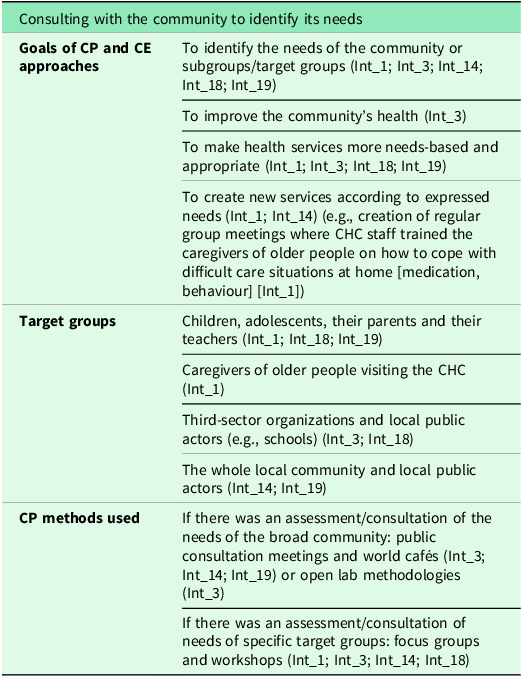
The approaches that were categorized under this theme focused strongly on consultation with the community or specific community subgroups to (better) understand their needs. The interviewees noted that they reached out to the community (subgroup), their representatives from local third-sector organizations, and additional stakeholders and practitioners who knew the community. Beginning with the identified demands, actions were then planned by the practitioners and delivered to the community. Table 10 provides an overview of the different reported goals and methods used to support consultation.
Consulting with the community to identify its needs: reported goals, target groups, and methods aiming to promote CP and CE

Table 10. Long description
The table has three sections: Goals of CP and CE approaches, target groups, and CP methods used. The goals are to identify the needs of the community and specific target groups, improve community health, make health services more needs-based and appropriate, and create new services based on expressed needs, such as regular group meetings where CHC staff train caregivers of older people to manage difficult situations at home. The target groups include children, adolescents, their parents and teachers; caregivers of older people visiting the CHC; third-sector organizations and local public actors such as schools; and the whole local community and local public actors. The methods include public consultation meetings, World Cafés, and open-lab methodologies for assessing the needs of the broader community, as well as focus groups and workshops for assessing the needs of specific target groups.
Example: understanding adolescents’ health needs
CHC staff identified a need to understand and address adolescents’ (unmet) health demands more effectively and to develop appropriate services. With the support of an external CP facilitator, they proposed consultation meetings with adolescents and their parents. Workshops at the communities’ schools provided insights into youth health needs and the reasons for (not) using CHC services. One central finding of these consultations was that students avoided visiting GPs in CHCs for ‘minor’ health concerns (e.g., a mole) because they feared that the GPs would share information with their parents. This reluctance to visit GPs was also confirmed by parents, who were consulted separately. As a result, the GPs collaborated with a clinical psychologist from the LHCA to find ways to create a setting where adolescents feel comfortable and safe to talk.
‘From there, it started a whole process that we [CP facilitator and CHC staff] did together with family doctors […]. Because […] a family doctor was also a bit scared, because he said, ‘I am not a psychologist, so how can I ask the right question and allow the boy to talk and also involve the parents?’’ (Health-manager-1_par.19).
This example suggests how consulting the community or its subgroups can help support the identification of (health) needs and can lead to changes in services aimed at making them more needs-based and adequate for the target group.
Collaborating with the community (including its prior consultation)
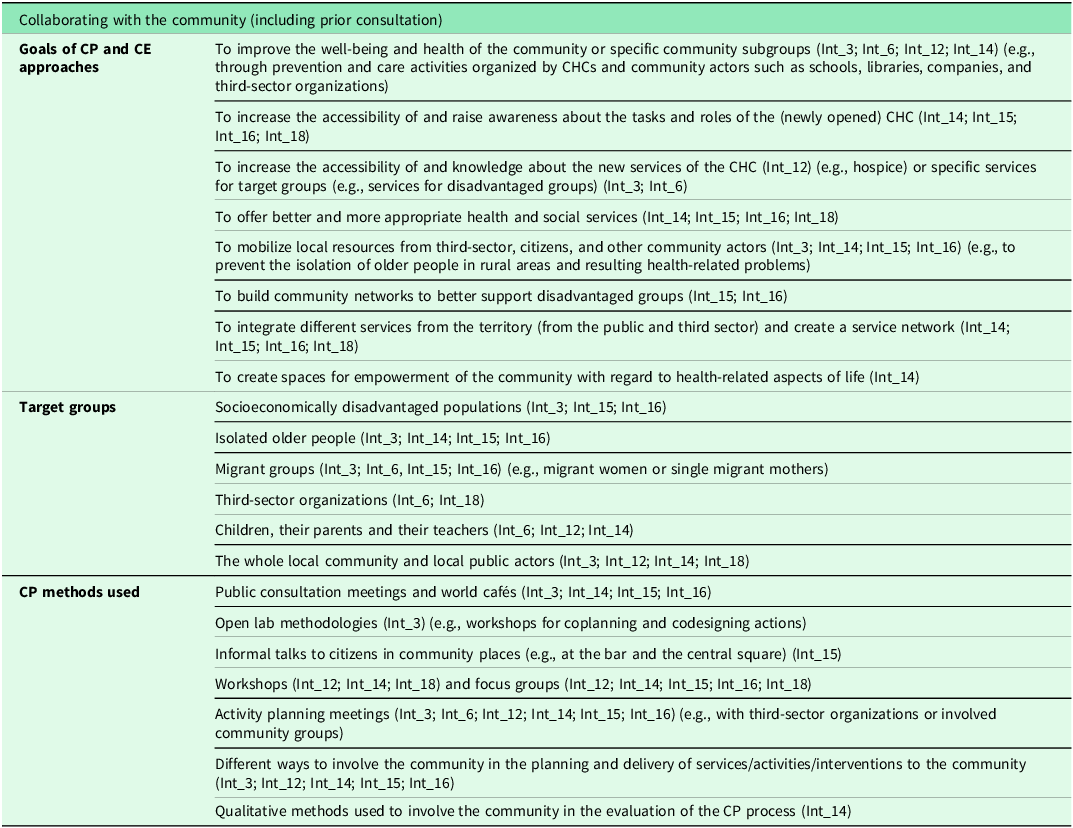
Processes that belonged to this theme concentrated on collaboration with the community. This approach involved shared decision-making processes regarding the planning, implementation, and/or evaluation of a collaborative project. CP was supported in different stages of the processes and to different extents. Table 11 presents the related goals and methods.
Collaborating with the community (including prior consultation): reported goals, target groups, and methods aiming to promote CP and CE

Table 11. Long description
The table details community participation (CP) and community empowerment (CE) strategies categorized into three main sections: Goals of CP and CE approaches, target groups, and CP methods used, with associated interview codes (e.g., Int_3, Int_14). The primary goals focus on improving community health and well-being through prevention, raising awareness of Community Health Center (CHC) roles and new services (such as hospice), offering tailored social and health services, mobilizing local third-sector and citizen resources to, for example, reduce rural elder isolation, creating support networks for disadvantaged populations, integrating public and territory services, and empowering citizens regarding health. Target groups include socioeconomically disadvantaged populations, isolated older adults, migrant groups (e.g., single migrant mothers), third-sector organizations, children along with their parents and teachers, and the broader community alongside local public actors. To achieve these goals, CP methods range from public consultations, world cafés, and open-lab co-design workshops to informal talks in public spaces like bars or squares, dedicated focus groups, activity planning meetings with community groups, diverse involvement channels for service planning and delivery, and qualitative evaluation methods to assess the CP process.
Example: community intermediaries as a bridge between the community and services
With the opening of a newly established CHC, the municipality’s social services and CHC staff decided to propose to the local community an open lab methodology that included public consultation meetings and open workshops with the aim of codesigning community needs assessment and jointly planning actions and CHC services accordingly. With the help of external CP facilitators, these actors hosted meetings and workshops with community members and third-sector organizations, who identified unmet health needs in several disadvantaged populations (e.g., people living in poverty after the financial crisis and specific migrant groups) that rarely access local health and social services. The participants jointly formulated goals, such as obtaining an improved understanding of the needs of disadvantaged local populations, improving their health and social situation by offering adequate services, facilitating access to services through low-threshold approaches, and mobilizing community resources for mutual support. Consequently, the participants collaboratively decided to conduct a project that involved personnel from local shops often frequented by the community (e.g., pharmacies, bakeries, grocery shops, and hair salons) and employers (here, from the food and agricultural sector). These people acted as intermediaries between the community and health and social services. They could decide to take different roles within this project. They could either ‘create within their store a small information space’ (Pedagogue-3_par.31) so that people could choose to take information material on health and social service support, or they could take a role as a ‘sentinel’ by reporting and discussing with the practitioners the difficulties they saw in the community so that they could provide different types of information or services. Moreover, if they decided to take an active role by directly addressing perceived difficulties with their clients, they would be sensitized by the practitioners in advance on how to observe and recognize possible problems of poverty or health among their clients. In this case, they would provide information about and encourage their clients to use existing community services.
‘[…] That is, precisely, already maybe taking advantage of the confidence, of a chat with their clients, who say ‘look, I’m really tired, I’m left alone, I don’t know what to do anymore’. Use this and say, ‘but look, I know that there is the social counter. It seems to me that they help people who may have your needs. If you want, I’ll give you the phone number’. Or if the citizen was a little bit in trouble, ‘if you want, I can, if you think, I can give your phone number to the operator. If you want, I can have the operator call you’’ (Pedagogue-3_par.33).
Important process aspects that were conducive to the implementation of this project included ongoing communication and regular contact between practitioners, shop personnel and employers, as well as regular feedback and exchanges about the project’s challenges and successes. This example of collaboration with the community shows how CP processes and shared decision-making power can potentially sustain the creation of networks and mutual support between community members while helping increase the accessibility of services for disadvantaged community groups.
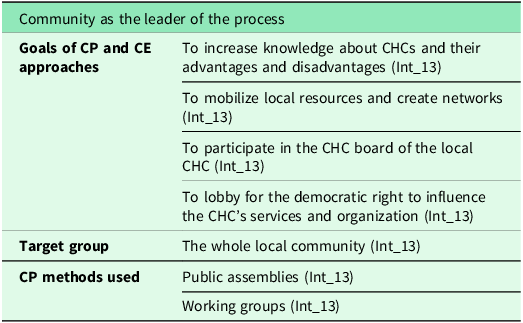
Community as the leader of the process
This theme is characterized by a CP and CE approach that is community-led – an action that was initiated, organized and implemented by the community itself. Only one example from the interviews could be categorized under this theme (see Table 12).
Community as the leader of the process: reported goals, target groups, and methods aiming to promote CP and CE

Table 12. Long description
The table details community participation (CP) and community empowerment (CE) approaches structured across three core categories: Goals of CP and CE approaches, target group, and CP methods used, with all items citing interview identifier Int_13. The primary goals of this leadership approach focus on four key objectives: increasing public knowledge regarding Community Health Centers (CHCs) along with their advantages and disadvantages, mobilizing local resources and building collaborative networks, participating directly on the board of the local CHC, and lobbying for the democratic right to actively influence the CHC’s services and overall organization. The designated target group for this approach encompasses the whole local community. To operationalize community leadership, the framework identifies two specific CP methods used to facilitate participation and decision-making: public assemblies and structured working groups.
Example: lobbying for the right to participate in the CHC board
The starting point for this case consisted of community groups from an urban neighbourhood that critically questioned the implementation of a new CHC that replaced a popular health facility. These community groups were concerned with a worsening of health care supply, a reduction in services and the inappropriateness of the CHC in fulfilling the community’s needs. A group of community residents, practitioners from the former health facility, and local third-sector organizations expressed their concerns to local politicians and decision makers and demanded clear information about this unknown CHC concept. Consequently, they ‘started a bit to mobilize’ (GP-13_par.68) and to self-organize monthly public assemblies to build knowledge about the CHC and its features.
‘[…] it lasted for many months, these community assemblies, very … very much inhabited, very much attended by very different people, from the university professor to the senior citizen, to the young citizen, to the university student, […], to the parent, […] to the health workers who also did not understand, despite the fact that in theory they were supposed to be the primary promoters and connoisseurs of the [new service] structure […]’ (GP-13_par.11).
To increase the community’s knowledge about the CHC and its opportunities to take action, experts from the PHC field, CHC staff, local politicians and stakeholders (e.g., from the LHCA) were invited to the assemblies, and networks with local neighbourhood councils and other local actors were established. Through this process, community members learned about the opportunities presented by the CHC and expanded their view on ‘the topic of health equity for the city and, therefore, also for CP of the city’ (GP-13_par.84). They used the acquired knowledge to disseminate these ideas in other neighbourhoods with CHCs and to give their opinion on the organization of the new CHC. For example, they raised concerns about the inclusivity of the CHC, as the clinical information folders were available only in Italian, making it difficult for foreign citizens to access this information. Moreover, they became aware that Emilia-Romagna policies require that each CHC should be steered by a CHC board and that this is a way to take part in decisions regarding health services. As the community group’s ‘ultimate goal was [then] really the board, that is, to get on the [CHC] board’ (GP-13_par.84), it decided to create a separate working group composed of citizens and third-sector representatives who would take political action to lobby for the establishment of such a CHC board. The aim was to transform the CHC into a ‘real’ community health place and a ‘point of reference’ (GP-13_par.12) of the community where CP and CE are promoted. The example of this theme illustrates how the self-organized building of awareness and acquisition of knowledge on the CHC topic, as well as actively engaging in collaborative processes, offers the opportunity to address some aspects of decision-making control (e.g., through the CHC board) and contributes to changes in CHCs.
Discussion
Drawing on practice examples from CHCs in the Emilia-Romagna region, Italy, this study provides insights into a variety of CP processes, identifying focal goals, methods, and target groups and the varying extents to which communities are involved. We organized the findings according to the CP levels (Brunton et al., Reference Brunton, Thomas, O’Mara-Eves, Jamal, Oliver and Kavanagh2017): some processes prioritized information sharing, consultation and the creation of networks through meetings with the community, whereas others emphasized collaboration and shared decision-making or community-led action. The first and second themes, with their examples, goals and methods, can be seen as precursors of participation (Wright et al., Reference Wright, Von Unger, Block and Wright2010), offering the possibility to create preliminary contacts with the community, which can evolve during the process into more engaging and powerful approaches (Mossakowski et al., Reference Mossakowski, Süß and Trojan2009). However, this requires such processes to be pursued over longer periods and higher levels of participation to be reached if real decision-making power is to be achieved. Thus, the creation of spaces for CE where the community can gain collective capacity is fundamental for communities to take control over life-affecting and broader health equity issues (Labonte, Reference Labonte1993; Popay et al., Reference Popay, Whitehead, Ponsford, Egan and Mead2021).
Our results regarding CP methods reveal that, depending on the level of participation, such methods ranged from information and public consultation meetings at lower CP levels to more collaborative methods such as workshops, activity planning meetings and working groups at higher levels of CP. Though, some methods (e.g., focus groups, world cafés) were used throughout the different CP levels but with different aims (e.g., for needs consultation, discussion of priorities or the codesign of activities). These methods largely match those described in the literature (MacFarlane and Lionis, Reference MacFarlane, Lionis, Kumar and Diaz2019; Pedersen et al., Reference Pedersen, Egilstrød, Overgaard and Petersen2022b). However, the goals and the addressed aspects determined whether the methods were more or less participatory.
Accordingly, a variety of goals and desired outcomes (see Tables 9–12) targeted by project initiators emerged. Goals such as informing communities about how to appropriately use and gain access to CHC services, as well as creating more needs-based services might be reached through community information and consultation only. For example, our results show that with the opening of newly established and unknown CHCs, practitioners chose information and consultation approaches with the aim of making their roles as community-oriented PHC providers clear and visible to the community. However, when changes in (health) behaviour over time, broader community health outcomes or health equity are targeted, information and consultation alone are not enough (Popay, Reference Popay, Morgan, Davies and Ziglio2010; O’Mara-Eves et al., Reference O’Mara-Eves, Brunton, McDaid, Oliver, Kavanagh, Jamal, Matosevic, Harden and Thomas2013; Draper and Rifkin, Reference Draper, Rifkin, Nolte, Merkur and Anell2020; Popey et al., Reference Popay, Whitehead, Ponsford, Egan and Mead2021). Such changes require higher levels of participation (e.g., collaboration and coproduction) and more community control to address the power dynamics among communities, institutions, and the government that influence these outcomes (Popay, Reference Popay, Morgan, Davies and Ziglio2010). According to Popay (Reference Popay, Morgan, Davies and Ziglio2010), only when sufficient power has been relinquished to the community can these goals be realized. While our study provides some examples of strongly collaborative processes where the community and other actors shared control over decisions and actions to achieve common ends (e.g., the third example addressing disadvantaged groups through joint action) and, as in the latter example, contested power structures to achieve political change and democracy in health, most of the processes focused less on power dynamics and CE. The interviewees described processes such as informing the community (e.g., the first example) as ways in which they sought to empower people; this approach to CE should be carefully reflected by practitioners, as collective empowerment constitutes an emancipatory act whereby groups actively seize power and, in doing so, change life conditions (Labonte, Reference Labonte1993) and structural determinants of health (Popey et al., Reference Popay, Whitehead, Ponsford, Egan and Mead2021). Beyond sharing knowledge and cultivating relationships, creating favourable conditions for community members’ development of capabilities to cooperate, codecide and to exercise power over actions is a promising approach (Popey et al, Reference Popay, Whitehead, Ponsford, Egan and Mead2021). In this regard, in a previous study, we reported that in CHCs, there is a lack of a shared understanding of the meaning and implications of CE (Luisi and Hämel, Reference Luisi and Hämel2024). Moreover, CE is limited mainly to individual health empowerment in the national guidelines (AGENAS, 2023); therefore, this concept must be thoughtfully revised at the policy and practice levels.
The goals reported by the interviewees are closely linked to the perceived potential benefits offered by CP and CE processes, such as increased awareness, capacity and knowledge in the community regarding relevant health and service topics; changes in health services; opportunities for mutual help among community members; and the creation of supportive networks. However, projects involving the first two themes with precursor levels of CP often had restricted time frames and limited goals (e.g., informing the community about services in the CHC and its appropriate use), which raises the question of the real meaning and overlooked potential of CP and CE processes. In their research on community-building health strategies in Italy, which included examples from CHCs, Longo and Barsanti (Reference Longo and Barsanti2021) emphasized the relevance of supporting, through CP and CE, the creation of communities where people help each other. Confirming some of our results, their study revealed that CP and CE processes have the potential to link public institutions and health services with the community and to foster collaboration on a wide range of goals and benefits, such as better health and well-being, prevention, mutual support and more appropriate services (Longo and Barsanti, Reference Longo and Barsanti2021). However, such benefits require CP and CE approaches that prioritize communities as beneficiaries of the process and where institutions and services invest in trusting relationships that lead to sustained partnership with the community and to the sharing of decision-making power (Labonte, Reference Labonte1993; Schiavo, Reference Schiavo2021).
In this regard it is also important to reflect on who should lead CP and CE processes and who the target groups are. Our data reveal that some processes addressed the whole local community; however, most focused on specific target groups, such as disadvantaged populations (e.g., socioeconomically disadvantaged groups, specific migrant groups, isolated older people, young people and children). They were either involved directly in the CP processes or indirectly (e.g., other community members who did not belong to this group or third-sector representatives who were involved to generate better support for the target groups). Nevertheless, from a social justice perspective, the direct involvement of disadvantaged groups remains fundamental and must be fostered (MacFarlane and Lionis, Reference MacFarlane, Lionis, Kumar and Diaz2019). In addition, our results demonstrate that most of the identified projects were initiated, proposed and led by practitioners. As noted by some scholars, CP and CE are often driven by a utilitarian or health service perspective, with practitioners leading and deciding on key aspects of the process (e.g., design of the action) (Brunton et al., Reference Brunton, Thomas, O’Mara-Eves, Jamal, Oliver and Kavanagh2017; Draper and Rifkin, Reference Draper, Rifkin, Nolte, Merkur and Anell2020). This runs the risk of proposing processes that are not relevant for the community (Labonte, Reference Labonte1993), that seek consent only regarding other actors’ interests (Mossakowski et al., Reference Mossakowski, Süß and Trojan2009) or that leave aside opportunities for capacity building and CE for active and sustained change (Schiavo, Reference Schiavo2021). Nevertheless, processes proposed by practitioners are not necessarily misguided (Mossakowski et al., Reference Mossakowski, Süß and Trojan2009). The examples presented in this study show that within professional-led processes – if a collaborative approach was used – communities were actively engaged in decisions (e.g., regarding the design and implementation of actions) and were able to influence aspects that were relevant to them.
Limitations
The selection of good-practice cases constitutes a limitation. These cases were identified through recommendations from the involved interviewees and through examples highlighted in national and regional documents and websites. In the future, with the help of the examples described here, clearly defining the criteria of good-practice cases will be important. Moreover, a mixed-methods design that makes it possible to compare data on a wide range of CHCs in the Emilia-Romagna region, in Italy and other comparable European countries would be valuable. Such a design could facilitate a better understanding of the specificities of the regions and wider institutional and organizational aspects influencing CP and CE processes. Finally, the fact that we did not interview community members who were involved in the CP and CE processes detailed here presents a limitation that should be considered in future research to promote a more comprehensive understanding of the topic.
Conclusions
To our knowledge, this study is the first to systematically describe and analyse CP and CE processes in CHCs in the Emilia-Romagna region. Our results provide examples that can stimulate reflection on such processes in practice and serve as a starting point for further practice experiments in PHC centres in Italy and in other European countries. Practitioners and managers should be aware that CP and CE processes need long-standing collaboration with the community and that power dynamics must be addressed if they are to develop their full potential.
Data availability statement
The data that support the findings of this study are available upon request from the corresponding author (kerstin.haemel@univie.ac.at). These data are not publicly available as a result of privacy or ethical restrictions.
Acknowledgements
Thank you to all the participants of the study who shared their valuable time to inform about their experiences and perspectives.
Author contributions
Conceptualization, D.R.L., K.H.; formal analysis, D.R.L.; investigation, D.R.L., K.H.; methodology, D.R.L., K.H.; project administration, D.R.L.; supervision, K.H.; writing – original draft preparation, D.R.L.; writing – review and editing, D.R.L., K.H.
Funding statement
This research received no specific grant from any funding agency, commercial or not-for-profit sectors.
Competing interests
None.
Ethical standards
The authors assert that all procedures contributing to this work comply with the ethical standards of the relevant national and institutional guidelines on human experimentation (German Association of Psychology – Deutsche Gesellschaft für Psychologie) and with the principles of the Declaration of Helsinki from 1975, as revised in 2008.
The study received ethical approval from Bielefeld University’s Ethics Committee on May 29, 2020, in accordance with the guidelines of the German Association of Psychology (Deutsche Gesellschaft für Psychologie), which are in line with the guidelines of the American Psychological Association (Application No. EUB-2020–091). After receiving participant information that included all pertinent details about the study, its goals, data protection, and privacy, each participant provided written consent.
AI use
When writing this article, the authors used DeepL and Microsoft Word to improve the linguistic formulation. The authors are responsible for the content.

 Open access

